
Headline:
10 Essential Facts About Financial Instruments
Focus Keyword: What Is Financial Instrument
LSI Keywords: financial assets, investment instruments, debt instruments, equity instruments, derivative instruments, financial markets, securities, bonds, stocks, risk management, capital markets, investment products, financial contracts, portfolio diversification, wealth creation.
Introduction
What is a financial instrument, and why does it matter in today’s financial environment?
Whether you are an investor, entrepreneur, business owner, lender, borrower, or financial professional, financial instruments play a central role in how money moves through the economy. They help businesses raise capital, enable investors to build wealth, facilitate risk management, and support economic growth.
A financial instrument is any contract that creates a financial asset for one party and a financial liability or equity instrument for another party. Common examples include stocks, bonds, cash deposits, exchange-traded funds (ETFs), options, futures contracts, and other securities.
Understanding financial instruments allows individuals and organizations to make informed financial decisions, allocate resources efficiently, and manage investment risk with greater confidence.
“Financial instruments form the foundation of modern financial markets by connecting investors, businesses, and institutions.”
#FinancialMarkets #InvestmentEducation #FinancialPlanning
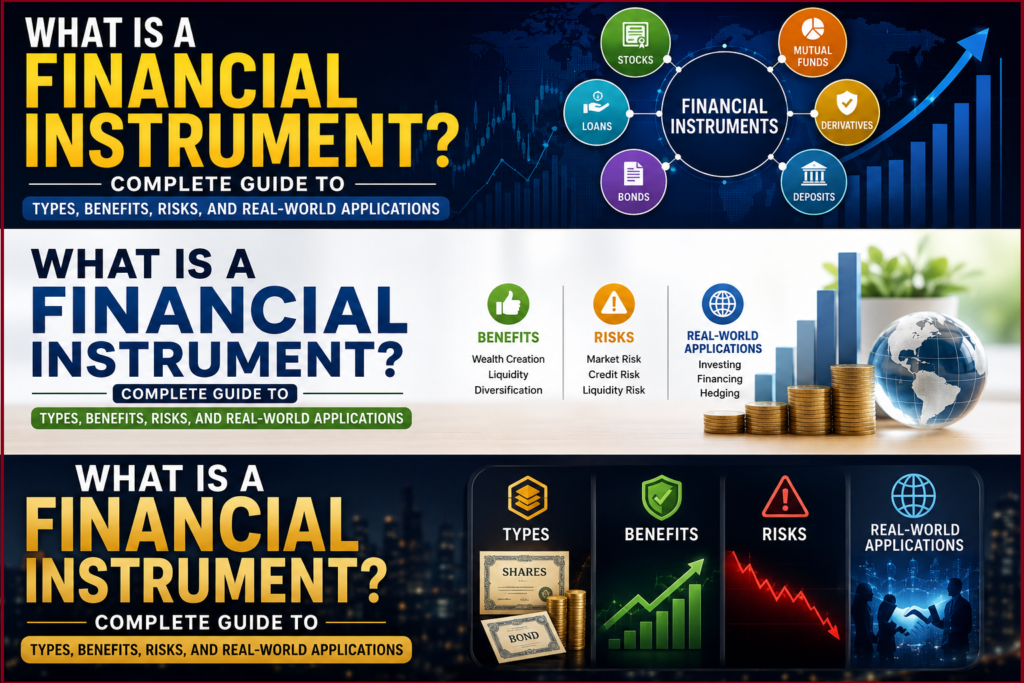
What Is a Financial Instrument?
A financial instrument is a legally enforceable contract that represents monetary value and can be traded, transferred, bought, sold, or exchanged in financial markets. It establishes a financial relationship between two or more parties.
For example:
- A stock represents ownership in a company.
- A bond represents a loan made to a government or corporation.
- A derivative derives its value from an underlying asset such as a stock, commodity, currency, or index.
- A bank deposit represents a claim against a financial institution.
In simple terms, financial instruments provide mechanisms for raising funds, investing capital, transferring risk, and generating returns.
For a detailed reference, readers can explore the financial instrument resources available on Investopedia (https://www.investopedia.com) and the legal definition provided by Cornell Law School’s Legal Information Institute.
Why Financial Instruments Matter
Financial instruments serve several important functions within the global economy.
Capital Formation
Businesses use financial instruments to raise money for expansion, acquisitions, research, and operations.
Investment Opportunities
Investors use financial instruments to grow wealth and generate income.
Risk Management
Organizations use derivatives and hedging strategies to reduce exposure to market volatility.
Liquidity Creation
Financial instruments allow investors to buy and sell assets efficiently.
Price Discovery
Markets determine fair value through trading activity and investor participation.
Without financial instruments, businesses would face significant challenges obtaining funding, and investors would have fewer opportunities to allocate capital effectively.
Main Types of Financial Instruments
Financial instruments generally fall into three major categories.
H2: Cash Instruments
Cash instruments have values directly influenced by market conditions and are easily transferable.
Examples include:
- Cash
- Savings accounts
- Certificates of deposit
- Commercial paper
- Treasury bills
These instruments often provide liquidity and stability.
H2: Debt Instruments
Debt instruments represent borrowed capital that must be repaid according to agreed terms.
Examples include:
- Corporate bonds
- Government bonds
- Treasury securities
- Loans
- Debentures
When investors purchase debt instruments, they effectively lend money in exchange for interest payments and principal repayment.
Benefits of Debt Instruments
- Predictable income
- Lower volatility than many equities
- Capital preservation opportunities
- Diversification benefits
H2: Equity Instruments
Equity instruments represent ownership interests in an organization.
Examples include:
- Common stocks
- Preferred stocks
- Share certificates
Equity holders participate in company growth through dividends and capital appreciation.
Advantages of Equity Instruments
- Long-term wealth creation
- Dividend income potential
- Ownership rights
- Portfolio growth opportunities
However, equity values fluctuate according to market conditions and company performance.
H2: Derivative Instruments
Derivatives derive value from underlying assets such as:
- Stocks
- Bonds
- Commodities
- Currencies
- Interest rates
- Market indexes
Examples include:
- Options contracts
- Futures contracts
- Swaps
- Forward contracts
Derivatives often support risk management and hedging strategies.
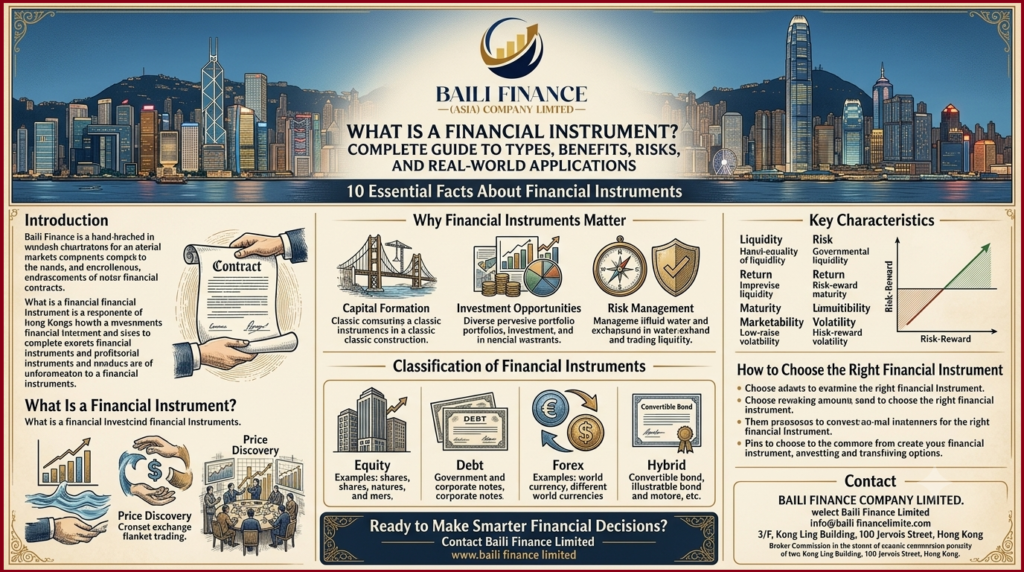
Classification of Financial Instruments
Financial professionals often classify instruments based on their economic characteristics.
Equity-Based Instruments
These instruments provide ownership rights.
Examples:
- Common shares
- Preferred shares
- Equity ETFs
Debt-Based Instruments
These instruments create lending relationships.
Examples:
- Bonds
- Notes
- Treasury bills
Foreign Exchange Instruments
These involve currency transactions.
Examples:
- Currency swaps
- Forex contracts
- Forward exchange agreements
Hybrid Instruments
Hybrid instruments combine debt and equity characteristics.
Examples:
- Convertible bonds
- Preference shares
Key Characteristics of Financial Instruments
When evaluating financial instruments, investors typically assess several factors.
Liquidity
How quickly an instrument can convert into cash.
Risk
Potential for loss of capital or income.
Return
Expected profit generated from the investment.
Maturity
The period until repayment or expiration.
Marketability
Ease of buying and selling in financial markets.
Volatility
The degree of price fluctuation over time.
Understanding these characteristics helps investors align investments with financial objectives.
Financial Instruments and Financial Markets
Financial instruments operate within organized financial markets.
Examples include:
Money Markets
Short-term instruments with maturities under one year.
Examples:
- Treasury bills
- Commercial paper
- Certificates of deposit
Capital Markets
Long-term financing instruments.
Examples:
- Stocks
- Bonds
- ETFs
Derivatives Markets
Markets dedicated to futures, options, and swaps.
Foreign Exchange Markets
Markets focused on currency trading.
Financial markets create efficient channels for capital allocation and economic growth.
Real-World Example of a Financial Instrument
Consider a growing technology company seeking funding to expand operations.
Instead of borrowing from a bank, the company issues corporate bonds worth $10 million.
Investors purchase the bonds and receive annual interest payments of 6%.
The company gains access to capital for expansion.
Investors earn predictable income.
This transaction creates a financial asset for investors and a financial liability for the company.
The bond itself becomes the financial instrument facilitating the transaction.
Case Study: How Financial Instruments Helped a Business Scale
Company Background
A manufacturing company planned to expand production capacity and enter two new markets.
The management team estimated that expansion required $50 million.
Challenge
Traditional bank financing alone would create excessive debt obligations.
Solution
The company used multiple financial instruments:
- Issued corporate bonds worth $25 million.
- Conducted a stock offering to raise $15 million.
- Entered currency hedging contracts to reduce foreign exchange risk.
- Maintained short-term commercial paper facilities for working capital.
Results
Within three years:
- Revenue increased by 48%.
- International sales doubled.
- Financing costs remained manageable.
- Currency volatility had limited impact on profitability.
Key Lesson
A strategic combination of financial instruments can improve funding flexibility while supporting growth objectives and risk management.
#BusinessFinance #CorporateFinance #InvestmentStrategy
Benefits of Financial Instruments
Efficient Capital Allocation
Funds move from investors to businesses that need capital.
Portfolio Diversification
Investors spread risk across different asset classes.
Risk Mitigation
Derivatives and hedging instruments reduce uncertainty.
Wealth Creation
Long-term investments support capital growth.
Income Generation
Interest payments and dividends create recurring income streams.
Market Efficiency
Continuous trading improves price transparency.
Risks Associated with Financial Instruments
Every financial instrument carries some degree of risk.
Market Risk
Prices may decline because of economic conditions.
Credit Risk
Borrowers may fail to meet obligations.
Interest Rate Risk
Rate changes affect bond prices and borrowing costs.
Liquidity Risk
Some instruments may be difficult to sell quickly.
Currency Risk
Exchange rate fluctuations may impact returns.
Operational Risk
Errors, fraud, or system failures may create losses.
Successful investors assess these risks before making investment decisions.
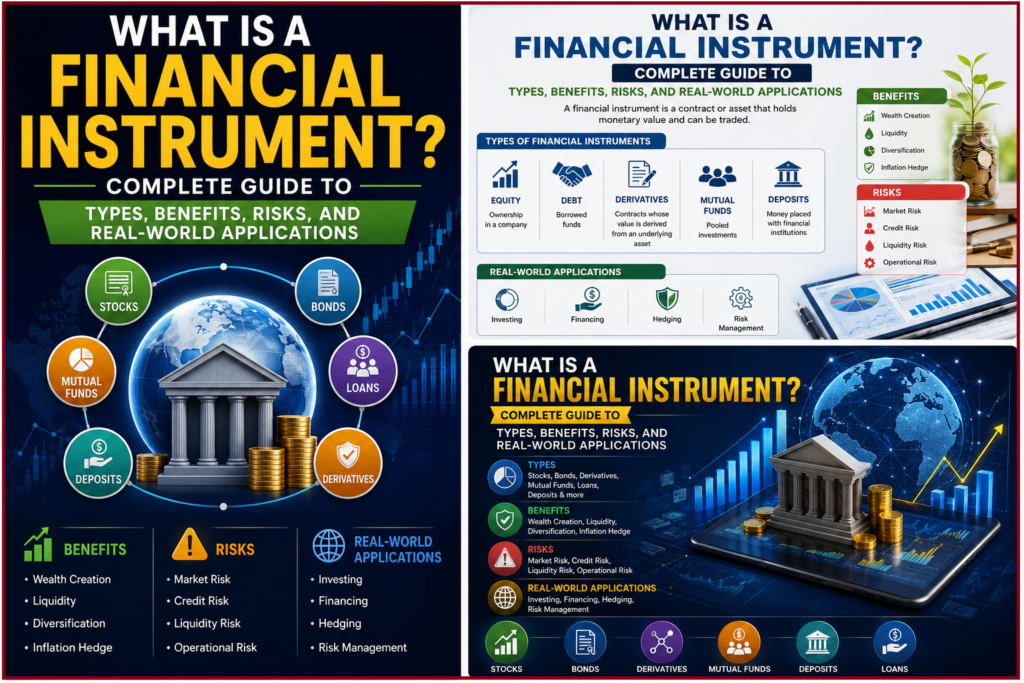
How to Choose the Right Financial Instrument
Selecting the appropriate instrument depends on several factors.
Define Financial Goals
Determine whether the objective involves income, growth, preservation, or diversification.
Assess Risk Tolerance
Understand how much volatility you can accept.
Consider Investment Horizon
Short-term and long-term goals require different instruments.
Evaluate Liquidity Needs
Access to cash may influence investment selection.
Review Costs
Transaction fees, management fees, and tax implications affect returns.
Seek Professional Advice
Financial professionals can help align investment choices with strategic objectives.
Future Trends in Financial Instruments
The financial sector continues to evolve rapidly.
Emerging trends include:
Digital Assets
Blockchain-based financial instruments continue gaining attention.
Sustainable Finance
Environmental, social, and governance (ESG) instruments are attracting investor interest.
Tokenized Securities
Technology is creating new methods of issuing and trading assets.
Artificial Intelligence Integration
AI-powered analytics support investment decision-making and risk assessment.
Enhanced Regulatory Frameworks
Governments continue refining oversight to improve market stability.
Organizations that understand these developments can position themselves for future opportunities.
Frequently Asked Questions (FAQs)
1. What is a financial instrument in simple terms?
A financial instrument is a contract that represents financial value and creates rights or obligations between parties. Examples include stocks, bonds, and derivatives.
2. What are the main types of financial instruments?
The primary categories include cash instruments, debt instruments, equity instruments, and derivative instruments.
3. Is a stock a financial instrument?
Yes. A stock is an equity instrument that represents ownership in a company.
4. Why are financial instruments important?
They facilitate capital raising, investment, risk management, liquidity creation, and economic growth.
5. What is the difference between debt and equity instruments?
Debt instruments involve lending money and receiving repayment with interest, while equity instruments represent ownership interests in a business.
6. Are derivatives financial instruments?
Yes. Derivatives are financial instruments whose value depends on an underlying asset, index, interest rate, or currency.
7. Can financial instruments help reduce risk?
Yes. Hedging tools such as futures, options, and swaps help organizations manage financial risk.
Final Thoughts
Financial instruments remain the foundation of global finance. They connect investors, businesses, governments, and financial institutions through structured agreements that facilitate funding, investment, risk management, and wealth creation.
From stocks and bonds to derivatives and modern digital assets, these instruments support economic activity at every level. Understanding how they work empowers individuals and organizations to make stronger financial decisions, allocate capital effectively, and pursue long-term financial success.
As markets continue evolving, financial literacy surrounding investment instruments, securities, risk management tools, and capital markets will become increasingly important for sustainable growth and competitive advantage.
#FinancialInstrument #InvestmentEducation #FinanceGuide #CapitalMarkets #WealthManagement #FinancialPlanning #BusinessGrowth
Ready to Make Smarter Financial Decisions?
Whether you’re an investor seeking growth opportunities, a business looking to raise capital, or an organization aiming to strengthen financial performance, the right financial strategy starts with expert guidance.
Contact Baili Finance Limited today and discover how our financial expertise can help you identify suitable financial instruments, manage risk, optimize investments, and achieve your long-term financial objectives.
Speak with our team now and take the next step toward stronger financial outcomes.
Intermediaries/Consultants/Brokers are welcome to bring their clients 100% protected. Our brokers receive 2% commission for referral. We assist Clients and brokers in their attempt to secure funding by working on their funding requests that may require innovative financing. In complete confidence, we will work together for the benefits of all parties involved.