Headline: BG VS SBLC: 10 KEY DIFFERENCES
A Bank Guarantee (BG) vs Standby Letter of Credit (SBLC) comparison matters whenever a company needs to manage payment, performance, contractual, or commercial risk. Although both instruments provide a bank-backed undertaking, they aren’t interchangeable in every transaction.
A bank guarantee generally supports an applicant’s obligation to a beneficiary, while an SBLC provides an independent undertaking under which the issuing bank agrees to honor a complying presentation if the stated conditions are met. The legal framework, drafting conventions, presentation requirements, market practice, and preferred jurisdictions can therefore influence which instrument fits a transaction.
For businesses involved in international trade finance, construction contracts, infrastructure projects, procurement, commodity transactions, project finance, cross-border transactions, and corporate finance, understanding the difference between a bank guarantee and an SBLC can prevent costly contractual errors.
The distinction becomes even more important when the instrument is subject to internationally recognized rules such as URDG 758 for demand guarantees or ISP98 for standby letters of credit. The International Chamber of Commerce (ICC) provides the established rule frameworks used by practitioners in these areas.
If you’re evaluating a BG or SBLC for a commercial transaction, the correct question isn’t simply which instrument is stronger. Instead, you should ask which instrument matches the underlying obligation, beneficiary requirements, applicable law, governing rules, bank requirements, and presentation conditions.
Keywords: bank guarantee vs SBLC, bank guarantee vs standby letter of credit, BG vs SBLC, bank guarantee and SBLC difference, difference between BG and SBLC, SBLC vs bank guarantee, bank guarantee or SBLC, standby letter of credit vs bank guarantee, trade finance, demand guarantee, standby letter of credit, financial guarantee, performance guarantee, payment guarantee, advance payment guarantee, performance SBLC, financial SBLC, credit enhancement
What Is a Bank Guarantee?
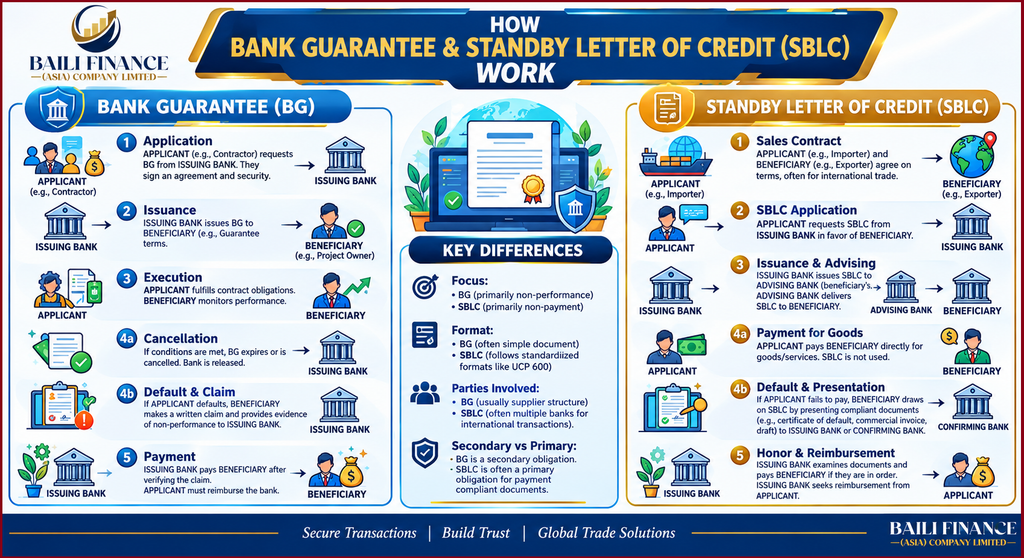
A Bank Guarantee (BG) is an undertaking issued by a bank for the benefit of a beneficiary. The bank agrees to make payment if the applicant fails to meet the obligations specified in the guarantee and the beneficiary makes a complying demand.
In practical terms, three principal parties normally participate:
- Applicant: the company or individual whose obligation the bank supports.
- Guarantor: the bank issuing the guarantee.
- Beneficiary: the party receiving the protection.
The guarantee remains separate from the underlying commercial relationship. Under URDG 758, a demand guarantee is an undertaking providing for payment when the beneficiary makes a complying demand. The rules also establish requirements concerning the demand, supporting statement, expiry, documents, and examination.
A bank guarantee can support several types of obligations, including:
- Performance obligations
- Payment obligations
- Advance payment obligations
- Tender or bid obligations
- Retention obligations
- Warranty obligations
- Customs obligations
- Contractual obligations
The ICC’s model URDG 758 forms specifically recognize categories such as tender guarantees, advance payment guarantees, performance guarantees, payment guarantees, retention money guarantees, and warranty guarantees.
How a Bank Guarantee Works
Suppose a contractor wins a $10 million infrastructure contract.
The project owner wants protection if the contractor fails to perform according to the contract. The contractor therefore asks its bank to issue a performance bank guarantee in favor of the project owner.
The bank assesses the contractor’s creditworthiness, financial capacity, collateral or security arrangements, and transaction structure.
If the bank approves the request, it issues the guarantee.
If the contractor subsequently defaults and the beneficiary makes a complying demand under the guarantee, the bank may have an obligation to pay according to the guarantee’s terms.
The applicant then remains responsible to the bank under the reimbursement or indemnity arrangements between them.
What Is a Standby Letter of Credit?
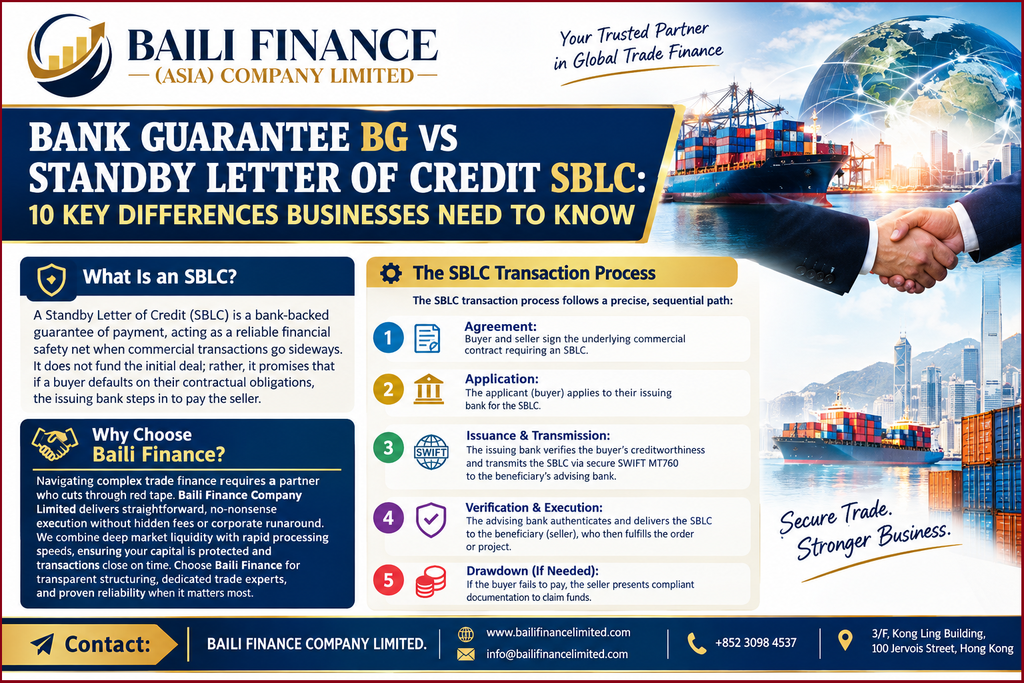
A Standby Letter of Credit (SBLC) is an independent undertaking issued by a bank in favor of a beneficiary.
Unlike a conventional commercial documentary letter of credit, an SBLC generally functions as a backup payment or performance mechanism. The beneficiary normally expects the applicant to perform the underlying obligation. The standby becomes relevant when the applicant fails to perform and the beneficiary makes the required presentation.
Under ISP98, a standby is an irrevocable, independent, documentary and binding undertaking. The issuer’s obligation depends on the presentation of documents that appear to comply with the standby’s requirements.
The ICC also describes an SBLC as an independent assurance of payment from the issuer and identifies its use as a credit-enhancement mechanism where the issuer provides stronger credit support.
Typical SBLC applications include:
- Payment security
- Performance security
- Lease obligations
- Loan repayment obligations
- Trade finance
- Project finance
- Commercial contracts
- Credit enhancement
- International transactions
- Direct-pay arrangements
The governing rules matter considerably. ISP98 was designed specifically for standby letters of credit and provides detailed provisions covering obligations, presentation, examination, notice, cancellation, reimbursement, timing, and syndication.
Bank Guarantee vs SBLC: The Core Difference
The simplest distinction is this:
A bank guarantee traditionally operates within guarantee practice, while an SBLC operates within standby letter of credit practice.
However, that statement doesn’t mean every BG and every SBLC operates differently.
Modern financial practice creates substantial overlap.
The ICC itself notes that standby letters of credit can fall within the scope of demand guarantee rules, while issuers may prefer UCP 600 or ISP98 when the transaction uses mechanisms more closely associated with documentary credits.
Consequently, the wording of the instrument can matter as much as its label.
Calling a document an “SBLC” doesn’t automatically determine its legal effect. Likewise, calling an undertaking a “bank guarantee” doesn’t, by itself, establish every obligation that the issuing bank has.
The actual instrument, incorporated rules, governing law, jurisdiction, presentation requirements, and contractual language require careful review.
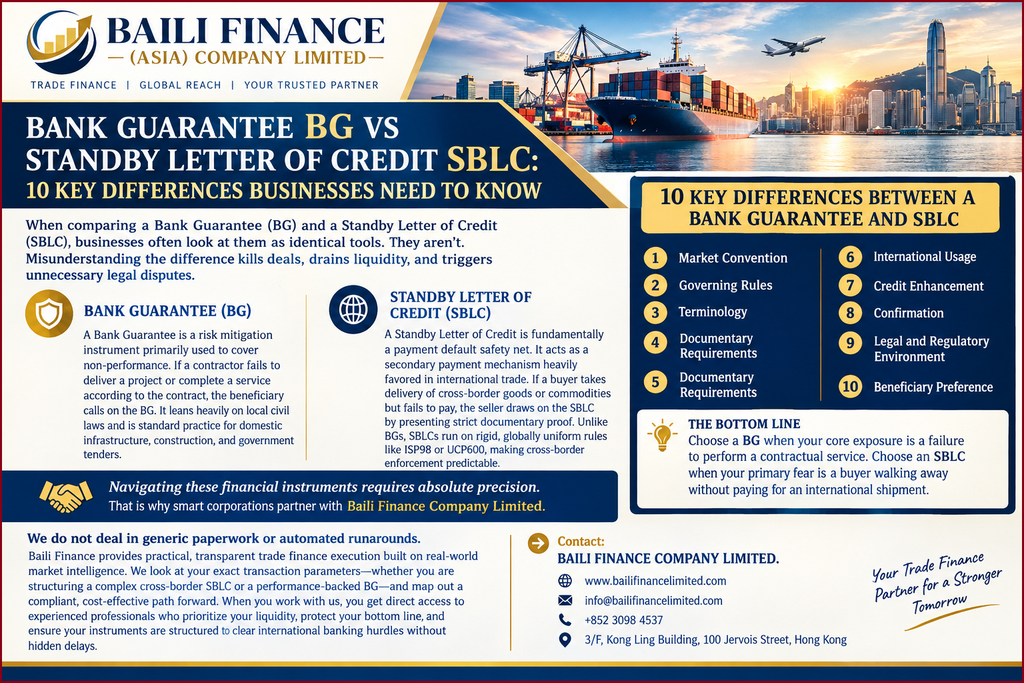
10 Key Differences Between a Bank Guarantee and SBLC
1. Market Convention
Bank guarantees have extensive use in construction, infrastructure, procurement, government contracts, and commercial agreements.
SBLCs have particularly strong usage in international finance, corporate finance, trade finance, credit support, and transactions influenced by U.S. banking practice.
The distinction isn’t absolute.
A company should therefore follow the beneficiary’s requirements and the transaction’s established banking practice rather than relying solely on the name of the instrument.
2. Governing Rules
A demand guarantee may be issued subject to URDG 758.
An SBLC may be issued subject to ISP98 or, depending on its structure, UCP 600.
URDG 758 expressly applies when a demand guarantee or counter-guarantee indicates that it is subject to those rules.
ISP98 similarly applies when the standby expressly incorporates those rules.
This difference matters because the rules establish different procedures for presentation, examination, notices, amendments, and other operational matters.
3. Terminology
The terminology differs.
A BG generally refers to:
- Applicant
- Beneficiary
- Guarantor
- Guarantee
- Demand
An SBLC generally refers to:
- Applicant
- Beneficiary
- Issuer
- Standby
- Presentation
The terminology can influence how banks, lawyers, counterparties, and compliance teams interpret transaction documents.
4. Documentary Requirements
Both instruments operate through documentary compliance.
Under URDG 758, a demand normally requires a beneficiary statement indicating how the applicant has breached its obligations, unless the guarantee’s structure provides otherwise within the applicable rules.
Under ISP98, the issuer examines the presentation against the standby’s terms and applicable rules.
This means a beneficiary shouldn’t assume that a genuine commercial dispute automatically produces payment.
The presentation must satisfy the instrument’s requirements.
5. Default and Presentation
Both instruments can respond to an applicant’s failure to perform.
However, the precise mechanism depends on the wording.
A BG may require a demand accompanied by a statement of breach or other specified documents.
An SBLC may require a demand, certificate, statement, or other documentary presentation specified by the standby.
The practical lesson is straightforward:
The beneficiary should draft the instrument around the exact circumstances under which it may need to draw.
6. International Usage
Both instruments support international commerce.
However, SBLCs have strong roots in the U.S. market, while demand guarantees have extensive usage across European, Middle Eastern, African and Asian commercial markets.
The ICC notes that standby letters of credit originated in the United States and that they are often used in circumstances where European markets would use demand guarantees.
7. Credit Enhancement
An SBLC can serve as a credit enhancement instrument.
For example, a corporate borrower may provide an SBLC from a financially strong bank to support an obligation to another institution.
The beneficiary therefore evaluates not only the applicant but also the credit standing of the issuing bank.
A similar principle applies to bank guarantees.
8. Confirmation
SBLC structures can involve a confirming bank.
Confirmation can provide an additional undertaking from another bank, which can become important where the beneficiary has concerns about the issuing bank, jurisdiction, transfer restrictions, or country risk.
Guarantees can also involve indirect structures and counter-guarantees.
URDG 758 expressly accommodates direct and indirect guarantees and counter-guarantee structures.
9. Legal and Regulatory Environment
The instrument doesn’t exist in isolation.
Applicable law can determine issues that banking rules don’t resolve.
ISP98 itself states that its rules supplement applicable law and that certain matters, including authority to issue and defenses relating to fraud or abuse, remain matters for applicable law.
Therefore, businesses should assess:
- Governing law
- Jurisdiction
- Banking regulations
- Sanctions requirements
- Foreign exchange controls
- Applicable tax considerations
- Enforcement risks
- Fraud provisions
- Local guarantee requirements
10. Beneficiary Preference
In many transactions, the beneficiary determines the acceptable instrument.
If a tender document specifically requires a bank guarantee subject to URDG 758, providing an SBLC subject to ISP98 may not satisfy the contractual requirement.
Conversely, if a financing agreement specifically requires an SBLC from an acceptable bank, a conventional demand guarantee may not meet the requirement.
The beneficiary’s exact wording therefore deserves attention before the applicant approaches a bank.
Bank Guarantee vs SBLC Comparison Table
| Feature | Bank Guarantee | SBLC |
|---|---|---|
| Primary terminology | Guarantee | Standby |
| Issuing institution | Bank or approved guarantor | Usually a bank |
| Common rules | URDG 758 | ISP98 or UCP 600 |
| Typical role | Performance/payment security | Backup payment/performance security |
| Common markets | Global, with strong guarantee practice outside the U.S. | Strong U.S. and international usage |
| Parties | Applicant, guarantor, beneficiary | Applicant, issuer, beneficiary |
| Payment trigger | Complying demand under guarantee | Complying presentation |
| Documentary nature | Yes | Yes |
| Credit enhancement | Yes | Yes |
| Counter-guarantee | Common | Possible through related structures |
| Confirmation | Possible | Commonly available |
| Legal independence | Generally independent | Independent |
| Best application | Contractual and performance obligations | Financial, commercial and credit-support obligations |
The table shows why the two instruments shouldn’t be treated as identical. They overlap significantly, but their market conventions and rule frameworks can differ.
Bank Guarantee vs SBLC: Which Is Better?
There isn’t one universally better instrument.
The better choice depends on the transaction.
A bank guarantee may be preferable when:
- The beneficiary specifically requests a guarantee.
- The contract operates under URDG 758.
- The transaction involves construction or infrastructure.
- A tender, performance, advance payment, or warranty guarantee is required.
- Local banking practice favors demand guarantees.
An SBLC may be preferable when:
- The beneficiary requests an SBLC.
- The transaction involves credit enhancement.
- The parties prefer ISP98.
- The transaction has strong U.S. banking characteristics.
- The obligation involves corporate finance or payment support.
- The beneficiary wants a standby structure with defined documentary presentation requirements.
Neither instrument should be selected solely because one sounds more secure.
The wording and governing rules determine the practical protection.
Real-World Example: International Construction Contract
Consider a hypothetical $25 million infrastructure contract.
A construction company based in Ghana wins a contract to construct a processing facility for an international buyer.
The buyer requires a 10% performance security.
That means the contractor must arrange security of $2.5 million.
The buyer specifies that the security must be a demand guarantee issued by an acceptable bank and subject to URDG 758.
The contractor approaches its relationship bank.
The bank conducts its credit assessment and requests corporate information, financial statements, details of the underlying contract, collateral or cash-margin arrangements, ownership information, and other compliance documents.
After approval, the bank issues the performance guarantee.
The contractor completes the project according to the contract.
The guarantee expires without a claim.
No payment occurs under the guarantee.
Now consider a different scenario.
The contractor materially fails to perform. The contract gives the buyer the right to make a complying demand under the guarantee.
The beneficiary submits the required demand and supporting statement within the required period.
The bank examines the presentation under the applicable rules.
If the presentation complies with the guarantee, the bank may be required to honor it.
The contractor’s underlying contractual dispute with the buyer doesn’t automatically prevent the bank from dealing with the demand according to the guarantee’s independent terms.
That independence is one reason these instruments are valuable in international transactions.
Case Study: Choosing Between a BG and SBLC
The Situation
A multinational trading company needs $15 million in credit support for a cross-border supply agreement.
The supplier doesn’t want to rely solely on the buyer’s corporate credit.
The buyer proposes an SBLC from an internationally recognized bank.
The supplier reviews the proposal and identifies four critical requirements:
- The issuer must meet an agreed credit standard.
- The SBLC must be irrevocable.
- The SBLC must specify clear documentary requirements.
- The undertaking must remain valid throughout the contractual exposure.
The parties agree to an SBLC subject to ISP98.
Why the Structure Works
The supplier receives an independent bank undertaking.
The buyer obtains the commercial relationship it needs without paying the entire contractual amount upfront.
The bank receives fees for providing the credit support.
The supplier receives additional assurance based on the issuing bank’s undertaking.
The transaction therefore aligns three interests:
Buyer: preserves liquidity.
Supplier: receives credit protection.
Bank: earns fees while managing the applicant’s credit exposure.
The Critical Lesson
The success of the transaction doesn’t come from using the acronym “SBLC.”
It comes from drafting the undertaking correctly.
The parties must define:
- Amount
- Currency
- Expiry date
- Presentation location
- Required documents
- Drawing conditions
- Governing rules
- Governing law
- Jurisdiction
- Issuer requirements
- Amendment procedures
- Transfer provisions
- Confirmation requirements
A poorly drafted $15 million SBLC can create more risk than a properly drafted $5 million undertaking.
What Businesses Should Check Before Requesting a BG or SBLC
Before approaching a bank or financial institution, prepare the transaction information.
1. Underlying Contract
The bank will need to understand the underlying transaction.
Provide the relevant agreement, purchase order, tender documents, loan agreement, lease, or commercial contract.
2. Required Instrument
Determine whether the beneficiary requires:
- BG
- Performance guarantee
- Payment guarantee
- Advance payment guarantee
- Tender guarantee
- SBLC
- Financial SBLC
- Performance SBLC
- Direct-pay SBLC
3. Amount
State the exact amount and currency.
Avoid vague language.
4. Expiry
The instrument should establish when the undertaking expires.
URDG 758 contains specific provisions addressing expiry, while ISP98 also requires a standby to contain an expiry date or a permitted termination mechanism.
5. Governing Rules
Identify whether the instrument should use:
- URDG 758
- ISP98
- UCP 600
- Applicable local law
6. Issuing Bank Requirements
The beneficiary may require a bank with:
- A specific credit rating
- International banking capability
- A particular jurisdiction
- SWIFT capability
- Acceptable correspondent banking relationships
- Acceptable regulatory status
7. Security Requirements
The issuing bank may require:
- Cash margin
- Collateral
- Fixed deposits
- Corporate guarantees
- Property security
- Credit facilities
- Other risk mitigants
Requirements vary according to the applicant, transaction, jurisdiction, bank, amount, tenor, and risk assessment.
Why Wording Matters More Than the Acronym
One of the most common mistakes in BG and SBLC transactions is focusing on the label rather than the actual undertaking.
A document called an “SBLC” doesn’t automatically provide the protection a beneficiary expects.
Likewise, a document called a “bank guarantee” doesn’t automatically create a simple payment mechanism.
The operative clauses matter.
For example, compare:
“The bank shall pay upon default.”
with:
“The bank shall honor a complying presentation made in accordance with the terms of this standby.”
The second formulation introduces a documentary compliance framework.
That distinction can become important when the beneficiary eventually attempts to draw.
The ICC’s URDG 758 framework similarly emphasizes clear and precise instructions covering the applicant, beneficiary, guarantor, amount, currency, expiry, demand requirements, presentation method, language and charges.
Common Mistakes in Bank Guarantee and SBLC Transactions
Using the Wrong Instrument
A beneficiary may require a demand guarantee while the applicant offers an SBLC.
That substitution may not satisfy the contract.
Leaving the Rules Unspecified
An undertaking that doesn’t clearly identify its governing rules can create uncertainty.
The applicable rules should be established during drafting rather than after a dispute arises.
Setting Vague Drawing Conditions
A beneficiary needs to know exactly what it must present.
An applicant needs to understand exactly when the bank can be required to pay.
Ignoring Expiry
An expired undertaking normally cannot provide the intended protection.
Dates and expiry events therefore deserve careful review.
Using Unclear Language
Ambiguous wording creates interpretation risk.
Financial instruments should use precise, operational language.
Assuming the Bank Will Investigate the Underlying Dispute
Independent undertakings operate on documentary principles.
The bank generally examines the presentation against the undertaking rather than conducting a full investigation of the underlying commercial dispute.
Failing to Review the Beneficiary’s Requirements
The applicant shouldn’t arrange an instrument before understanding what the beneficiary actually requires.
How Much Does a BG or SBLC Cost?
There isn’t a universal price.
Bank fees can depend on:
- Amount
- Tenor
- Applicant credit quality
- Issuing bank
- Country risk
- Industry
- Transaction structure
- Collateral
- Cash margin
- Confirmation
- Correspondent banking requirements
- Compliance requirements
- Currency
- Governing rules
A higher-risk applicant may face more stringent security requirements.
A stronger applicant with an established banking relationship may receive different terms.
For that reason, businesses should request a transaction-specific quotation rather than relying on generic online fee percentages.
BG vs SBLC for International Trade Finance
International trade often requires a mechanism that reduces counterparty risk without requiring full upfront payment.
A BG or SBLC can support that objective.
For example, an importer may need a supplier to ship goods before receiving full payment.
The supplier may request bank-backed security.
Alternatively, a buyer may need performance protection before making an advance payment.
The appropriate instrument depends on the commercial structure.
In international transactions, businesses should also consider:
- Country risk
- Currency restrictions
- Sanctions screening
- Bank acceptability
- Correspondent banking
- Applicable law
- Local guarantee requirements
- Confirmation
- Document presentation
- Expiry and extension mechanisms
The ICC’s guarantee framework applies across multiple sectors, including construction, banking, project finance and trade finance.
BG vs SBLC for Construction and Infrastructure
Construction projects frequently require performance security.
A project owner needs protection if the contractor fails to meet its contractual obligations.
The contractor, however, may not want to deposit the full guarantee amount in cash.
A bank guarantee can solve that requirement by transferring defined credit support from the bank to the beneficiary.
Common construction guarantees include:
- Bid bond or tender guarantee
- Performance guarantee
- Advance payment guarantee
- Retention money guarantee
- Warranty guarantee
URDG 758 specifically provides a framework for these types of demand guarantees.
For a project involving multiple jurisdictions, the parties should determine whether a direct guarantee, indirect guarantee, counter-guarantee, or confirmed undertaking is most appropriate.
BG vs SBLC for Corporate Finance
The analysis changes when the primary objective is financial support rather than construction performance.
An SBLC may support:
- Debt obligations
- Lease obligations
- Payment obligations
- Credit facilities
- Trade finance
- Corporate transactions
- Structured finance
Because an SBLC represents an independent undertaking, the beneficiary can receive additional comfort based on the issuing bank’s credit standing.
However, the bank still evaluates the applicant.
The applicant doesn’t obtain risk-free financing simply by requesting an SBLC.
The Role of URDG 758 and ISP98
Businesses should understand the two frameworks rather than treating them as interchangeable.
URDG 758
Uniform Rules for Demand Guarantees 758 provides a structured framework for demand guarantees and counter-guarantees.
The ICC states that URDG 758 became effective on 1 July 2010 and replaced URDG 458.
URDG 758 addresses areas such as:
- Definitions
- Issuance
- Amendments
- Presentation
- Examination
- Demand requirements
- Payment
- Expiry
- Counter-guarantees
- Transfers
- Applicable documentary procedures
ISP98
International Standby Practices 1998 provides rules specifically designed for standby letters of credit.
ISP98 covers:
- General provisions
- Issuer obligations
- Presentation
- Examination
- Notice
- Document disposition
- Transfer and assignment
- Cancellation
- Reimbursement
- Timing
- Syndication and participation
For businesses dealing with these instruments regularly, understanding the relevant rulebook can materially improve transaction preparation.
A Practical Decision Framework
Ask these seven questions before choosing a BG or SBLC:
Question 1: What Does the Contract Require?
Start with the beneficiary’s exact wording.
Question 2: What Is the Underlying Obligation?
Is it performance, payment, advance payment, debt repayment, lease payment, tender participation or another obligation?
Question 3: Which Rules Apply?
Determine whether the instrument should be subject to URDG 758, ISP98, UCP 600 or another framework.
Question 4: Which Bank Is Acceptable?
Check whether the beneficiary requires a specific jurisdiction, rating, bank or confirmation.
Question 5: What Documents Are Required?
Review every presentation requirement.
Question 6: When Does the Instrument Expire?
Confirm the date, extension provisions and any expiry event.
Question 7: What Happens If the Beneficiary Draws?
Understand the bank’s payment obligations and the applicant’s reimbursement obligations.
If these questions have clear answers, the transaction has a stronger foundation.
Frequently Asked Questions About Bank Guarantee vs SBLC
1. Is an SBLC the same as a bank guarantee?
No. They can perform similar commercial functions, but they arise from different banking practices and may use different governing rules. A bank guarantee commonly operates under guarantee practice such as URDG 758, while an SBLC may operate under ISP98 or UCP 600.
2. Which is better, BG or SBLC?
Neither is universally better. The correct choice depends on the beneficiary’s requirements, transaction structure, applicable law, governing rules, bank requirements, and intended use.
3. Can a bank guarantee be converted into an SBLC?
A bank generally cannot simply rename one instrument and assume that the legal and operational framework has changed. The parties and issuing bank need to establish the appropriate undertaking and governing rules.
4. Is an SBLC a form of collateral?
An SBLC can provide credit support and may function as a credit-enhancement mechanism. However, whether it qualifies as collateral for a particular financing arrangement depends on the lender, documentation, applicable law and transaction structure.
5. What is URDG 758?
URDG 758 stands for Uniform Rules for Demand Guarantees 758. It is an ICC framework governing demand guarantees and counter-guarantees when incorporated into the relevant undertaking.
6. What is ISP98?
ISP98 stands for International Standby Practices 1998. It provides rules specifically designed for standby letters of credit and addresses areas such as presentation, examination, issuer obligations and timing.
7. Can an SBLC be used for performance security?
Yes. ISP98 expressly covers performance, financial and direct-pay standby letters of credit.
8. Can a bank guarantee support an international transaction?
Yes. Demand guarantees are widely used in international transactions, including construction, procurement, project finance and trade finance. URDG 758 was developed for international demand guarantee practice and is used across sectors.
9. Does an SBLC guarantee that the applicant will perform?
Not exactly. The SBLC provides an independent undertaking by the issuing bank. It doesn’t necessarily guarantee that the applicant will perform. Instead, it can provide the beneficiary with a defined mechanism for seeking payment when the conditions for a complying presentation are satisfied.
10. What should I check before accepting a BG or SBLC?
Review the amount, currency, issuer, beneficiary, expiry date, governing law, governing rules, presentation requirements, required documents, drawing conditions, confirmation, amendment provisions and jurisdiction.
External source:
For SBLC-specific material, the ICC also provides its International Standby Practices (ISP98).
Final Summary: BG vs SBLC
The Bank Guarantee vs Standby Letter of Credit distinction deserves more attention than simply comparing two banking acronyms.
Both instruments can provide independent bank-backed protection. Both can reduce counterparty risk. Both can support international commerce. Both can serve payment and performance-related purposes.
Yet their market conventions, governing rules, documentary requirements, terminology, legal environment and transaction structures can differ.
A bank guarantee often fits contractual and performance obligations, particularly where the beneficiary expects a demand guarantee subject to URDG 758.
An SBLC can provide strong support for payment, performance and credit-enhancement arrangements, particularly where the parties prefer ISP98 or another standby framework.
The most important point is simple:
Don’t choose a BG or SBLC because the name sounds appropriate. Choose the instrument that matches the contract, beneficiary requirement, governing rules, issuing bank, applicable law and intended risk allocation.
For businesses entering international transactions, construction contracts, procurement arrangements, project finance, trade finance or structured commercial transactions, getting the instrument right before issuance can prevent delays, rejected presentations and unnecessary disputes.
Ready to Structure Your BG or SBLC Transaction?
A financial instrument is only useful when its structure matches the transaction.
If your company is considering a Bank Guarantee, Performance Guarantee, Payment Guarantee, Advance Payment Guarantee, Standby Letter of Credit, Financial SBLC or other bank-backed instrument, don’t leave the wording, issuing-bank requirements or transaction structure to the final stage.
Start the conversation before the transaction reaches the bank.
Contact Baili Finance Limited to discuss your requirements, transaction structure and appropriate financial instrument.
Your next transaction shouldn’t depend on assumptions. Get the structure reviewed, understand the requirements, and move forward with a clearly defined financial solution.
Visit: Baili Finance Limited
Intermediaries/Consultants/Brokers are welcome to bring their clients 100% protected. Our brokers receive 2% commission for referral. We assist Clients and brokers in their attempt to secure funding by working on their funding requests that may require innovative financing. In complete confidence, we will work together for the benefits of all parties involved.
#BankGuarantee #BG #SBLC #StandbyLetterOfCredit #TradeFinance #BankGuaranteeVsSBLC #InternationalTrade #ProjectFinance #FinancialGuarantee #CreditEnhancement #BailiFinanceLimited #TradeFinance #CorporateFinance #InternationalBusiness