Headline: Stop Confusing SBLCs With Commercial LCs
A Standby Letter of Credit (SBLC) and a Letter of Credit (LC) are both bank-backed instruments used to reduce payment and performance risk in commercial transactions. However, they serve different primary purposes. Understanding the difference between an SBLC vs LC matters when structuring international trade, securing contractual obligations, protecting suppliers, arranging project finance, or managing cross-border business risk.
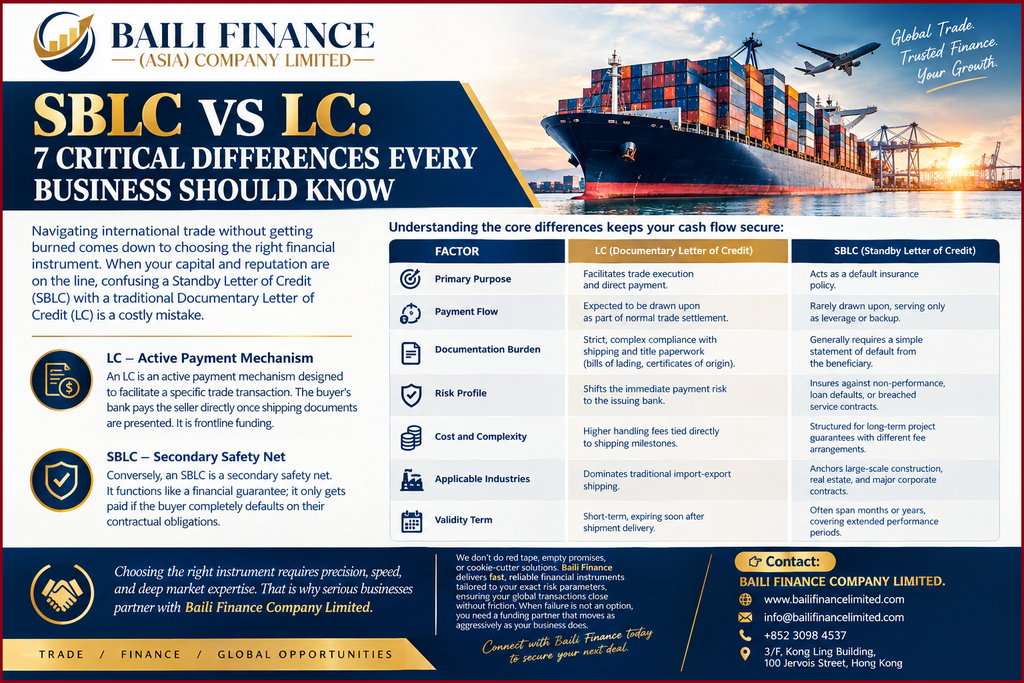
A commercial Letter of Credit (LC) normally functions as a payment mechanism for a transaction, particularly where a buyer and seller exchange goods across borders. A Standby Letter of Credit (SBLC) generally serves as a secondary payment or performance undertaking. The beneficiary normally expects the underlying transaction to proceed without drawing on the SBLC. If the applicant fails to meet the agreed obligation, the beneficiary may make a complying demand under the standby.
The distinction becomes important when businesses compare standby letter of credit vs letter of credit, SBLC vs commercial LC, LC vs SBLC for international trade, or when to use an SBLC instead of an LC. The right instrument depends on the transaction, the underlying obligation, the required documents, the applicable rules, the issuing bank, and the risk allocation between the parties.
Keywords: Standby Letter of Credit SBLC vs Letter of Credit LC, SBLC vs LC, standby letter of credit vs letter of credit, SBLC vs commercial LC, difference between SBLC and LC, standby letter of credit and commercial letter of credit, SBLC for international trade, commercial letter of credit explained, how standby letters of credit work, when to use an SBLC, when to use a commercial LC, SBLC vs LC for trade finance, documentary credit, trade finance, issuing bank, beneficiary, applicant, confirming bank, advising bank, UCP 600, ISP98, financial SBLC, performance SBLC
What Is a Letter of Credit?
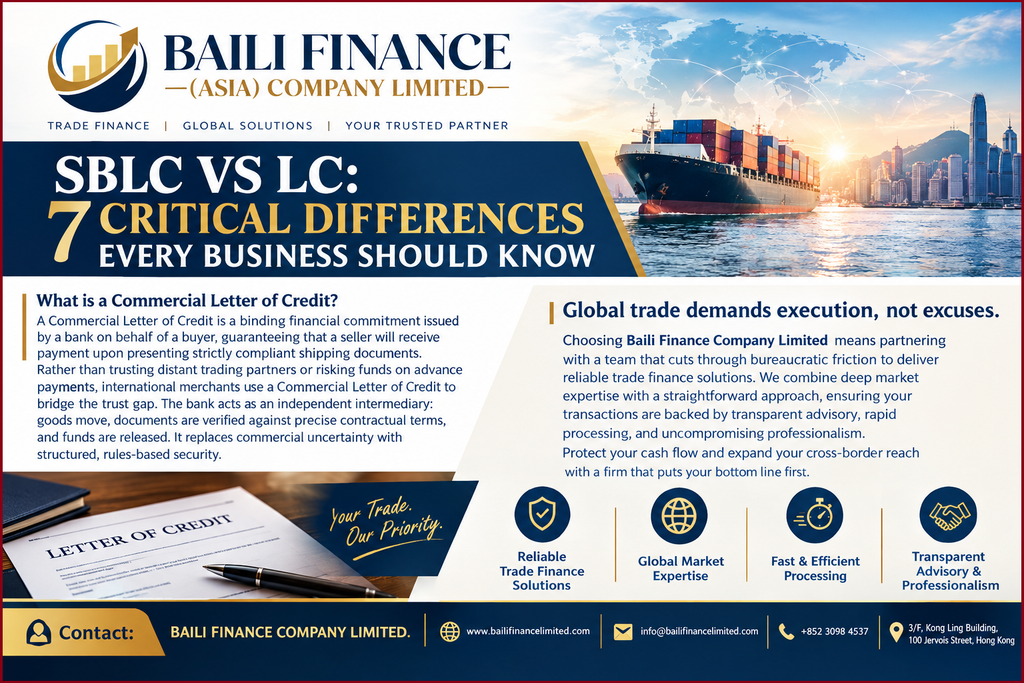
A Letter of Credit, commonly called an LC or commercial documentary credit, is a bank undertaking issued at the request of an applicant, usually the buyer, in favour of a beneficiary, usually the seller.
Under a typical commercial LC, the issuing bank undertakes to pay the beneficiary when the beneficiary presents documents that comply with the terms and conditions of the credit.
This structure gives the seller a degree of payment protection while also giving the buyer control over the documents required before payment occurs.
For example, an importer may purchase machinery from an overseas exporter. Instead of asking the exporter to rely solely on the importer’s promise to pay, the importer arranges a documentary LC with its bank. The LC can require documents such as a commercial invoice, transport document, packing list, certificate of origin, insurance document, or other transaction-specific documentation.
When the seller ships the goods and presents the required compliant documents, the bank processes the presentation according to the terms of the LC.
The ICC’s framework for documentary credits is the Uniform Customs and Practice for Documentary Credits, UCP 600. ICC materials explain that documentary credits commonly support international sales and can function as the payment vehicle for the transaction.
Therefore, a commercial LC is generally designed around a transaction that parties expect to perform normally.
Key characteristics of a commercial LC
A commercial LC commonly has these characteristics:
- It supports the purchase and sale of goods or services.
- It normally provides a structured payment mechanism.
- The seller presents specified documents to obtain payment.
- The bank examines documents rather than simply investigating the underlying commercial dispute.
- The credit normally identifies an expiry date and presentation requirements.
- UCP 600 commonly governs the transaction when expressly incorporated.
- The LC can be confirmed where additional bank protection is required.
- The bank’s undertaking remains independent from the underlying sales contract.
The precise terms matter. A poorly drafted LC can create unnecessary documentary risk even when the underlying commercial transaction is sound.
What Is a Standby Letter of Credit?
A Standby Letter of Credit (SBLC) is an independent bank undertaking that generally supports an applicant’s obligation if the applicant fails to perform or pay as required.
Unlike a typical commercial LC, the SBLC isn’t normally intended to serve as the primary payment mechanism for the underlying transaction.
Instead, it provides a secondary source of payment or contractual protection.
The OCC describes a standby letter of credit as a bank instrument that can ensure payment to a beneficiary if the bank’s customer fails to perform as contractually agreed. The OCC also distinguishes standbys from commercial letters of credit because standbys aren’t normally used to finance the purchase or shipment of goods.
ICC’s International Standby Practices (ISP98) specifically address standby letters of credit. ISP98 describes a standby as an irrevocable, independent, documentary and binding undertaking. The issuer’s obligation depends on the documents required by the standby and their compliance with its terms.
An SBLC can support several types of obligations, including:
- Payment obligations
- Performance obligations
- Lease obligations
- Construction contracts
- Project contracts
- Supply agreements
- Loan repayment obligations
- Advance payment obligations
- Financial obligations
- Certain contractual guarantees
- Cross-border commercial commitments
The precise purpose should appear clearly in the SBLC wording.
SBLC vs LC: The Core Difference
The simplest distinction is this:
A commercial LC is normally designed to facilitate payment during a transaction, while an SBLC is normally designed to provide protection if an applicant fails to pay or perform.
That distinction affects almost every other feature of the instruments.
| Feature | Commercial LC | SBLC |
|---|---|---|
| Primary purpose | Transaction payment | Payment or performance protection |
| Typical use | International sale of goods | Default, performance or financial support |
| Expected drawing | Usually expected | Normally not expected |
| Trigger | Compliant transaction documents | Compliant demand/documents following the standby terms |
| Underlying transaction | Usually sale of goods/services | Contractual or financial obligation |
| Common rules | UCP 600 | ISP98 or, where appropriate, UCP 600 |
| Typical timing | During normal transaction performance | Usually when something goes wrong |
| Trade finance role | Direct | Contingent/secondary |
| Documentary focus | Shipment and commercial documents | Demand and specified supporting documents |
| Risk function | Payment assurance | Default or performance assurance |
The table provides a general comparison. The actual legal and operational effect depends on the instrument’s wording, governing rules, applicable law, and transaction structure.
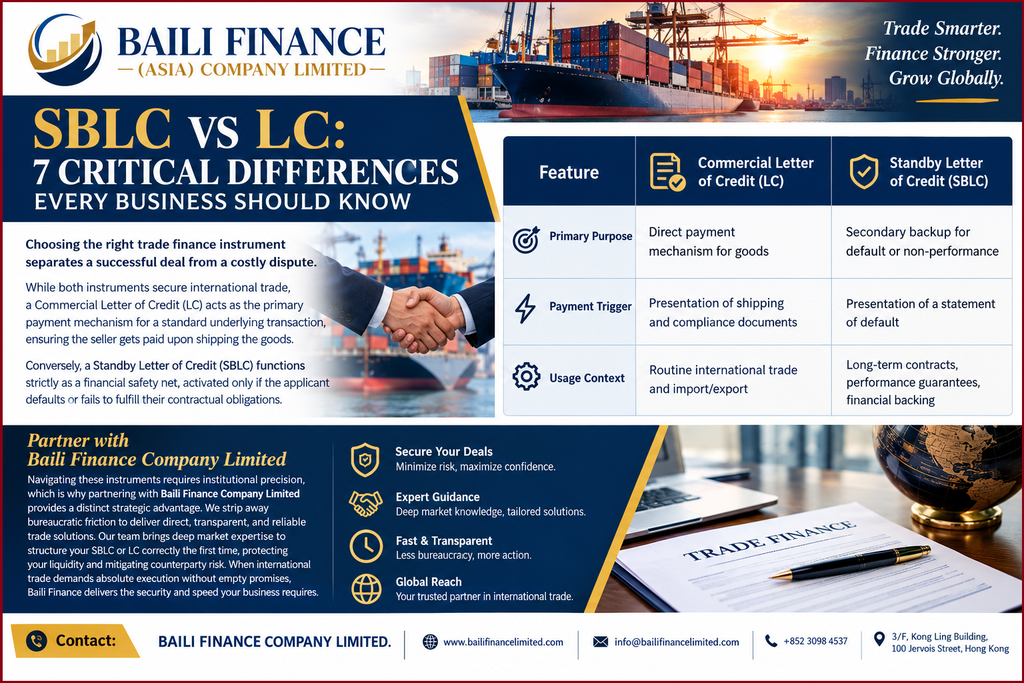
7 Major Differences Between SBLC and LC
1. Primary purpose
The first difference is purpose.
A commercial LC supports a transaction in which the seller expects to receive payment after meeting the documentary conditions.
An SBLC normally protects the beneficiary against a defined failure by the applicant.
For instance, an exporter may use a commercial LC to receive payment for machinery. A contractor may instead provide an SBLC to assure a project owner that the contractor’s contractual obligations have financial backing.
The distinction can therefore be expressed as:
LC = transaction payment mechanism.
SBLC = contingent payment or performance protection.
The distinction isn’t absolute because an SBLC can support financial obligations, and an LC can be structured for different commercial purposes. The instrument’s actual terms remain decisive.
2. When the beneficiary expects payment
With a commercial LC, payment is normally part of the expected transaction cycle.
The seller ships the goods, prepares the required documents, presents them, and seeks payment according to the LC.
With an SBLC, the beneficiary normally doesn’t expect to draw.
The underlying contract should operate without the SBLC being called.
If the applicant defaults, the beneficiary can make a complying presentation under the SBLC.
ICC materials similarly distinguish commercial credits, which parties generally intend to be paid, from standby credits, which typically become relevant when the underlying transaction encounters a failure.
3. Trigger for payment
A commercial LC commonly requires documents that evidence the commercial transaction.
For example:
- Commercial invoice
- Bill of lading
- Air waybill
- Packing list
- Certificate of origin
- Insurance document
- Inspection certificate
An SBLC may instead require a demand, statement of default, certificate, or other specified document.
The issuer examines the documents required by the instrument.
This point is critical. A bank generally doesn’t decide whether the underlying commercial dispute is morally or commercially justified. It examines the presentation against the applicable documentary requirements.
ISP98 expressly emphasizes the documentary nature of standby obligations.
4. Applicable rules
Commercial LCs commonly operate under UCP 600 when the credit expressly incorporates those rules.
SBLCs can also be subject to UCP 600, but ISP98 was specifically developed for standby practice.
ICC explains that UCP 600 can apply to standbys where expressly incorporated, while ISP98 was formulated specifically for standby transactions.
Therefore, asking whether an SBLC is “under UCP” or “under ISP98” isn’t a minor technical question. It can affect how documentary requirements, presentation, examination and other operational matters are handled.
For a new standby transaction, the parties should establish the applicable rules before issuance rather than attempting to resolve the issue after a dispute occurs.
5. Nature of the underlying obligation
A commercial LC usually connects closely with a sale of goods or services.
An SBLC can support a broader range of obligations.
For example, an SBLC may support:
Financial obligation:
A borrower provides an SBLC to support repayment obligations.
Performance obligation:
A contractor provides an SBLC to protect an employer if the contractor fails to meet specified contractual requirements.
Lease obligation:
A tenant may provide an SBLC as financial security for rent or other obligations.
Advance payment:
A beneficiary may require security for an advance payment made under a contract.
The broader application of an SBLC makes it useful beyond conventional import and export transactions.
6. Commercial documents versus default documents
The documentary package often represents one of the clearest practical differences.
A commercial LC can require evidence that goods were shipped according to specified conditions.
An SBLC may require a beneficiary’s signed statement declaring that the applicant has failed to meet a specified obligation.
The drafting must be precise.
A vague requirement can create uncertainty at presentation. A requirement that cannot be demonstrated through the specified documentary evidence can also create operational problems.
ISP98 addresses documentary requirements and explains that non-documentary conditions can create specific issues under standby practice.
7. Risk profile
Both instruments transfer or reduce certain commercial risks, but they don’t eliminate risk.
An LC primarily addresses the seller’s payment risk within a transaction.
An SBLC generally addresses the beneficiary’s risk that the applicant will fail to pay or perform.
For banks, however, an SBLC can create a significant contingent exposure. The OCC notes that standby letters of credit can present different risk characteristics from commercial LCs because the bank may make payment after the applicant has already defaulted and may not be immediately able to reimburse the bank.
That means the issuing bank’s credit assessment, collateral requirements, facility structure, fees, and internal approval process remain important.
When Should a Business Use an LC?
A commercial LC can be appropriate when the transaction requires a formal bank-backed payment mechanism.
Consider an international importer purchasing equipment from an overseas supplier.
The supplier may not want to ship the equipment based solely on the importer’s promise to pay. The importer may also resist paying the full purchase price before shipment.
An LC can address that commercial tension.
The bank undertakes to pay against compliant documents, while the seller gains a defined documentary payment process.
A commercial LC may therefore be suitable when:
- The buyer and seller don’t have an established credit relationship.
- The transaction involves international trade.
- The seller requires bank-backed payment assurance.
- The buyer doesn’t want to make unrestricted advance payment.
- Shipment documents form an important part of the transaction.
- Trade-finance facilities are available.
- The parties want standardized documentary procedures.
When Should a Business Use an SBLC?
An SBLC can be more appropriate when the underlying contract requires security against default rather than a routine payment mechanism.
For example, a project owner may award a contract to a construction company. The owner doesn’t necessarily expect the contractor to default. However, the owner may require financial protection if the contractor fails to perform.
An SBLC can provide that additional protection.
An SBLC may therefore be appropriate where a party needs:
- Performance security
- Payment security
- Financial security
- Contractual default protection
- Lease security
- Credit enhancement
- Support for project obligations
- Security for advance payments
- Cross-border contractual protection
The exact structure should be negotiated with the relevant bank and legal advisers.
Real-World Example: Importing Industrial Equipment
Consider a manufacturing company in Ghana purchasing industrial equipment from a supplier in Germany.
The equipment costs US$2 million.
The German supplier doesn’t want to rely solely on the Ghanaian buyer’s creditworthiness. At the same time, the Ghanaian buyer doesn’t want to send US$2 million before receiving evidence that the supplier has shipped the equipment.
The parties agree to use a commercial LC.
The buyer’s bank issues the LC in favour of the German supplier.
The LC specifies the documents the supplier must present, such as:
- Commercial invoice
- Transport document
- Packing list
- Certificate of origin
- Inspection certificate, where required
- Other documents agreed by the parties
The supplier ships the equipment and presents compliant documents.
The bank examines the presentation according to the applicable rules and LC terms.
If the presentation complies, the bank honours the credit according to its terms.
This is a conventional commercial LC structure because the instrument supports the normal payment process for the sale.
Now change the scenario.
Suppose the Ghanaian company enters into a three-year engineering contract with the same supplier. The supplier wants assurance that the buyer will meet specific payment obligations throughout the contract.
The parties could consider an SBLC instead.
The buyer’s bank issues an SBLC for an agreed amount. The beneficiary normally expects the buyer to meet its contractual obligations and does not expect to draw the SBLC.
If a defined default occurs and the beneficiary presents the documents required under the SBLC, the bank considers that presentation according to the standby’s terms and applicable rules.
The two instruments therefore address different stages and risks.
Case Study: Choosing the Wrong Instrument
Background
A construction company, Company A, wins a major infrastructure contract worth US$25 million.
The project owner, Company B, requires financial protection against non-performance.
Company A approaches a bank and requests what it calls an “LC.”
The bank asks for details about the underlying contract.
The problem becomes clear: Company B isn’t purchasing goods from Company A. Instead, Company A must complete defined construction milestones over 24 months.
The commercial requirement isn’t a conventional documentary payment mechanism.
It’s performance security.
The structure
The parties determine that a standby or another appropriate independent undertaking may better match the commercial requirement.
The proposed SBLC specifies:
- Beneficiary
- Applicant
- Issuing bank
- Maximum amount
- Expiry date
- Governing rules
- Presentation location
- Required demand
- Required statement or certificate
- Conditions for drawing
- Reduction or release mechanism
- Applicable law
- Amendment procedure
The bank also assesses Company A’s credit position and determines the facility, collateral and pricing requirements.
The result
Company B receives a defined bank-backed undertaking without expecting to draw it during normal project performance.
Company A continues performing under the construction contract.
If Company A performs properly, the SBLC can expire or be released according to its terms without a drawing.
If Company A fails and Company B makes a compliant presentation, the bank deals with the presentation under the SBLC.
The lesson
The key lesson isn’t that an SBLC is always better than an LC.
The lesson is that the instrument must match the underlying commercial objective.
An inappropriate instrument can create documentary, legal, operational and financial problems even when all parties entered the transaction with good intentions.
SBLC vs LC: Which Is Better?
There isn’t a universal winner.
The better instrument depends on the transaction.
Choose a commercial LC when the primary requirement is a bank-backed payment mechanism for a sale of goods or services.
Consider an SBLC when the primary requirement is protection against payment default, performance failure or another defined contractual event.
A business should evaluate:
- Purpose of the transaction
- Nature of the underlying contract
- Payment structure
- Performance obligations
- Beneficiary requirements
- Applicant’s financial capacity
- Issuing bank requirements
- Required documents
- Governing law
- Applicable ICC rules
- Confirmation requirements
- Expiry and presentation periods
- Collateral
- Bank fees
- Country risk
- Currency risk
- Sanctions and compliance requirements
The wording should then reflect the actual commercial objective.
UCP 600 vs ISP98 for SBLC Transactions
One of the most important technical questions in an SBLC transaction is which rules govern the undertaking.
UCP 600 is the ICC’s widely used framework for documentary credits.
ISP98 is specifically designed for standby letters of credit.
ICC materials explain that an SBLC can be made subject to UCP 600, but ISP98 addresses the specific characteristics of standby transactions and can therefore be more suitable for many standby structures.
This distinction matters because different rules can approach documentary examination and standby-specific issues differently.
Businesses shouldn’t simply copy a commercial LC template and label it an SBLC.
The drafting should reflect the instrument’s actual purpose.
For authoritative information about standby rules, the International Chamber of Commerce’s ISP98 resources provide a strong external reference for readers researching standby letters of credit. ICC International Standby Practices (ISP98)
How an SBLC Transaction Works
A simplified SBLC transaction normally involves these parties:
Applicant: The company requesting the SBLC.
Issuing bank: The bank issuing the undertaking.
Beneficiary: The party receiving the protection.
Advising bank: A bank that may authenticate and advise the instrument to the beneficiary.
Confirming bank: Where confirmation is added, the confirming bank undertakes its own obligation subject to the relevant terms.
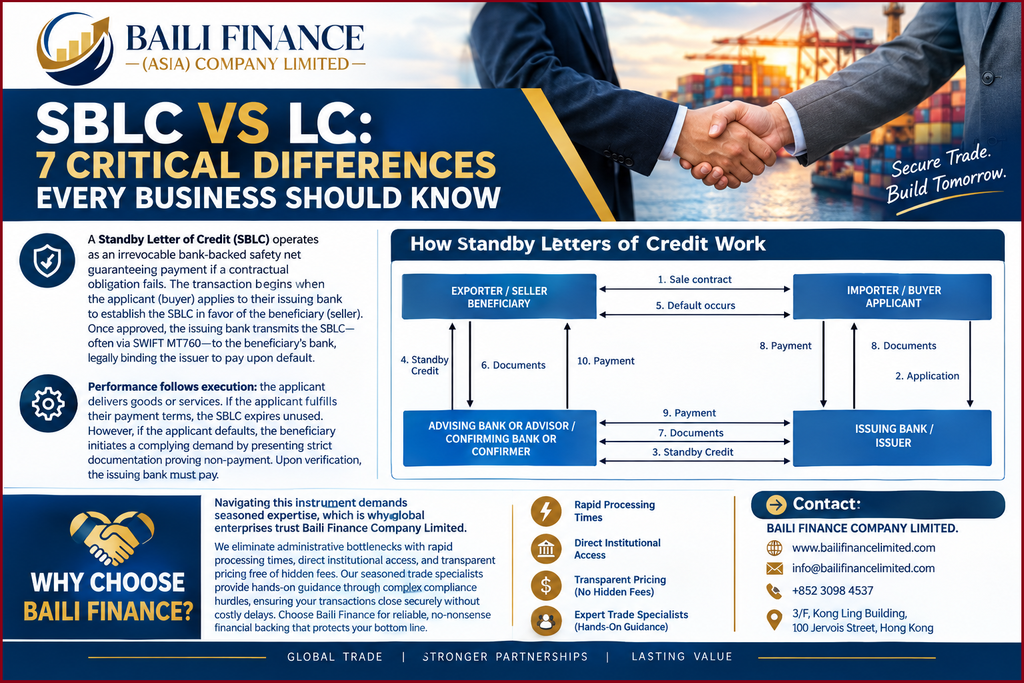
The process can look like this:
- Applicant and beneficiary agree on the commercial contract.
- Beneficiary requires an SBLC.
- Applicant approaches an acceptable issuing bank.
- Bank conducts credit, compliance and transaction assessment.
- Parties agree the SBLC wording.
- Bank issues the SBLC.
- Beneficiary receives the authenticated instrument.
- Applicant performs the underlying contract.
- If the applicant performs, no drawing normally occurs.
- If default occurs, the beneficiary may present the documents required by the SBLC.
- The bank examines the presentation.
- If the presentation complies, the bank honours according to the undertaking.
The exact procedure varies according to the instrument, bank, jurisdiction and applicable rules.
Common SBLC Types
The term SBLC covers several structures.
Financial SBLC
A financial standby supports a payment or financial obligation.
For example, a beneficiary may require an SBLC to support repayment under a financing or commercial agreement.
Performance SBLC
A performance standby supports performance under a contract.
Construction, engineering, infrastructure and service contracts can use this type of structure.
Direct-Pay SBLC
A direct-pay standby supports a payment obligation and can operate differently from a standby that only becomes relevant following a specified default.
The precise drafting determines how the undertaking operates.
Advance Payment SBLC
This structure can protect a party that makes an advance payment under a contract.
For example, a buyer may make a significant advance payment to a supplier and require security against the supplier’s failure to meet specified obligations.
Common LC Types
Commercial LCs can also take different forms.
Irrevocable LC
An irrevocable LC cannot generally be cancelled or amended by the issuing bank without the required consent under the applicable rules and terms.
Confirmed LC
A confirming bank adds its own undertaking to honour a complying presentation, subject to the terms of the confirmation.
This can be relevant where the beneficiary wants additional bank or country-risk protection.
Sight LC
A sight LC provides for payment upon a complying presentation, subject to its terms.
Deferred Payment LC
A deferred payment LC provides for payment at a specified future date following a complying presentation.
Transferable LC
A transferable credit may allow a beneficiary to transfer drawing rights to another beneficiary where the credit expressly provides for transferability and applicable requirements are met.
The suitability of each structure depends on the transaction.
Common Mistakes Businesses Make
Treating an SBLC as free money
An SBLC isn’t a cash asset simply because a bank issues it.
The applicant remains responsible for the underlying obligation and for reimbursement to the issuing bank following a valid drawing.
Assuming every bank issues SBLCs
Banks have different products, credit policies, jurisdictions, risk appetites and compliance requirements.
An applicant should identify an appropriate bank before making commercial commitments based on an assumed issuance.
Ignoring the wording
The wording is central.
A small drafting issue can affect presentation, expiry, documentary compliance and payment rights.
Using unclear trigger language
A standby should identify the circumstances and documents required for drawing with sufficient precision.
Confusing MT760 with the underlying instrument
A SWIFT message can be used to transmit certain bank-to-bank communications, including issuance of guarantees and standby instruments.
However, the SWIFT message itself shouldn’t be treated as a substitute for understanding the underlying legal undertaking and its governing terms.
Assuming an SBLC is automatically legitimate
Businesses should conduct proper due diligence on the issuing bank, transaction parties, intermediary, documents and contractual structure.
A genuine SBLC transaction involves regulated financial institutions and formal documentation. Claims involving “leased SBLCs,” “monetization,” guaranteed returns, upfront fees or unusually easy bank instruments require particularly careful due diligence.
SBLC Fees and LC Costs
Pricing depends on several factors.
These can include:
- Instrument amount
- Tenor
- Applicant creditworthiness
- Issuing bank
- Country risk
- Currency
- Collateral
- Confirmation
- Transaction complexity
- Compliance requirements
- Bank facility availability
- Amendment requirements
- Advising charges
- Correspondent bank charges
An SBLC isn’t priced solely according to its face value.
The bank considers the contingent exposure and the likelihood of a drawing.
Similarly, commercial LC pricing depends on the bank’s assessment of the transaction and applicant.
Businesses should request a complete fee schedule rather than evaluating only the headline issuance fee.
How to Evaluate an SBLC Provider
Before proceeding with an SBLC transaction, a business should verify:
1. The issuing institution
Confirm that the institution is a legitimate regulated bank or otherwise acceptable issuer for the transaction.
2. The beneficiary’s requirements
Don’t arrange an instrument that the beneficiary’s bank won’t accept.
3. The governing rules
Confirm whether the instrument is subject to ISP98, UCP 600 or another applicable framework.
4. The SWIFT requirements
Where SWIFT messaging is involved, confirm the required message type and bank-to-bank process with the relevant financial institutions.
5. The wording
The beneficiary and its advisers should review the proposed wording before issuance.
6. The fees
Obtain a written schedule of issuance, advising, confirmation, amendment and other applicable charges.
7. The collateral
Understand whether the bank requires cash collateral, a credit facility, security or other support.
8. The exit mechanism
Know exactly how and when the instrument expires, is cancelled, is reduced or is released.
These checks can reduce the risk of expensive misunderstandings.
SBLC vs LC: Quick Decision Guide
Use this simple framework:
You are buying goods internationally and need structured payment → consider a commercial LC.
You need security if a contractor fails to perform → consider an SBLC or another appropriate performance undertaking.
You need protection against a financial default → consider a financial SBLC or another suitable guarantee structure.
You need additional bank protection on a commercial LC → consider confirmation where commercially and bank-wise appropriate.
You need a standby → carefully evaluate ISP98 versus UCP 600 and the governing law.
The correct choice should follow the commercial requirement, not the name of the instrument.
Frequently Asked Questions
1. What is the main difference between an SBLC and an LC?
The main difference concerns their primary purpose. A commercial LC normally facilitates payment for a transaction, while an SBLC normally provides payment or performance protection if the applicant fails to meet an obligation.
2. Is an SBLC the same as a Letter of Credit?
No. An SBLC is a type of letter-of-credit undertaking, but it serves a different commercial function from a typical commercial LC. A commercial LC normally supports the expected payment cycle, while an SBLC normally provides contingent protection.
3. Which is better, an SBLC or LC?
Neither is universally better. A commercial LC can be more suitable for an international sale requiring documentary payment. An SBLC can be more suitable where a beneficiary requires protection against default or non-performance.
4. Can an SBLC be used for international trade?
Yes. SBLCs can support international commercial, financial and performance obligations. Their suitability depends on the transaction, issuing bank, beneficiary requirements, applicable law and governing rules.
5. Is an SBLC governed by UCP 600?
It can be, if the SBLC expressly incorporates UCP 600 and the relevant provisions apply. However, ISP98 was specifically designed for standby letters of credit and is commonly considered when structuring an SBLC.
6. What is ISP98?
ISP98 means the International Standby Practices. It is a set of rules specifically designed for standby letters of credit and similar standby undertakings.
7. What is UCP 600?
UCP 600 is the ICC’s Uniform Customs and Practice for Documentary Credits. It provides internationally recognized rules for documentary credits and can apply to standby credits where the credit expressly incorporates the rules.
8. Does an SBLC guarantee payment automatically?
No. An SBLC is a documentary undertaking with specific terms. The beneficiary generally must make a complying presentation according to the SBLC before the issuing bank becomes obligated to honour the drawing.
9. Can an SBLC be monetized?
The word “monetization” is used in the market in different ways and can refer to arrangements that carry substantial commercial, legal and regulatory risks. An SBLC shouldn’t be treated as automatically convertible into unrestricted cash or investment capital. Any proposed monetization structure requires careful due diligence, bank confirmation and independent professional advice.
10. How long does an SBLC last?
The tenor depends on the underlying transaction. An SBLC can have a defined expiry date or, where properly drafted, provisions dealing with automatic extension. The exact expiry and presentation provisions must be reviewed carefully.
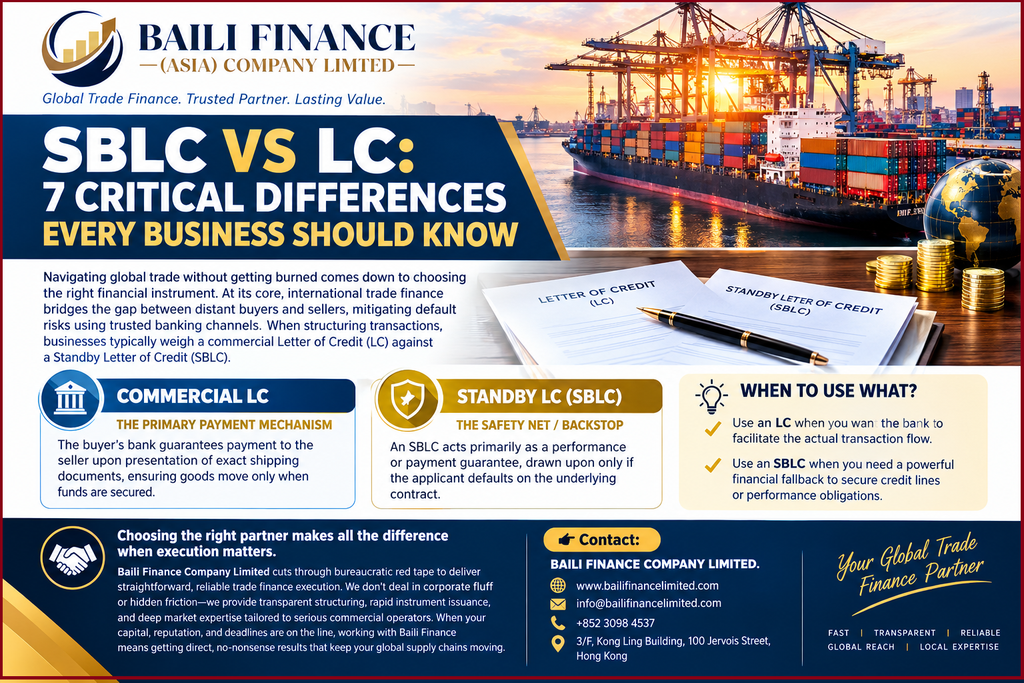
Final Summary: SBLC or LC?
The difference between an SBLC vs LC isn’t simply a matter of terminology.
A commercial Letter of Credit generally supports the normal payment process in a commercial transaction. An SBLC generally provides contingent protection when an applicant fails to meet a payment or performance obligation.
The commercial LC is closely associated with documentary trade transactions. The SBLC can support a broader range of financial and contractual obligations.
The applicable rules also matter. UCP 600 remains central to documentary credits, while ISP98 specifically addresses standby practice. ICC guidance makes clear that standbys can be subject to UCP 600, but the distinctive nature of standby transactions makes the choice of rules an important drafting consideration.
Ultimately, businesses shouldn’t choose between an SBLC and LC based only on the instrument’s name.
They should start with the commercial objective:
What obligation needs protection?
When should the bank be required to pay?
What documents should trigger payment?
Which bank will issue the instrument?
Which rules will govern it?
What does the beneficiary’s bank require?
What happens if the applicant defaults?
Those questions determine whether a commercial LC, SBLC, demand guarantee or another financial instrument is appropriate.
If your business is considering an SBLC, commercial LC, trade finance facility, performance undertaking, financial guarantee or cross-border payment structure, the most important step is to clarify the transaction before committing to an instrument.
Ready to Structure the Right Instrument?
Don’t proceed with an SBLC or LC simply because a counterparty has recommended one.
Contact Baili Finance Limited to discuss your transaction, understand the appropriate structure, assess the documentation requirements and determine the next practical steps for your business.
Whether you’re comparing SBLC vs LC, arranging international trade finance, evaluating payment security, or reviewing a proposed bank instrument, start with the underlying transaction and build the financial structure around it.
Make the right instrument part of the deal from the beginning. Contact Baili Finance Limited today and discuss your requirements with a professional team.
Intermediaries/Consultants/Brokers are welcome to bring their clients 100% protected. Our brokers receive 2% commission for referral. We assist Clients and brokers in their attempt to secure funding by working on their funding requests that may require innovative financing. In complete confidence, we will work together for the benefits of all parties involved.
#SBLC #LetterOfCredit #LC #TradeFinance #StandbyLetterOfCredit #InternationalTrade #BankGuarantee #DocumentaryCredit #ISP98 #UCP600 #TradeFinanceSolutions