Headline: SBLC Monetization for Business: Complete Guide
Businesses operating across international markets often need financing that supports large transactions, contract execution and working capital requirements. However, conventional lending doesn’t always accommodate the size, structure or timing of these transactions. This is where SBLC monetization for business can become a financing consideration.
A Standby Letter of Credit (SBLC) can support a financial transaction by providing a bank-backed undertaking, subject to its terms and conditions. In certain circumstances, an eligible SBLC may also serve as collateral in a financing arrangement. Nevertheless, businesses need to understand the difference between an SBLC, an SBLC-backed loan and the actual monetization of an instrument.
This guide explains how SBLC monetization works, how businesses can assess potential financing arrangements, what documentation they may need and which risks they should address before entering into a transaction. It also explores practical examples, a hypothetical case study and frequently asked questions for companies considering this financing route.
Keywords: SBLC monetization for business, SBLC monetization, SBLC financing, Standby Letter of Credit, SBLC-backed loan, business financing, trade finance, working capital financing, international business financing, standby letter of credit financing, How does SBLC monetization work for businesses?, How to monetize a standby letter of credit, SBLC monetization requirements for companies, SBLC-backed financing for international trade, How to obtain financing using an SBLC, SBLC monetization costs and fees, SBLC financing eligibility for businesses, Risks of SBLC monetization, SBLC monetization process and documentation, Can a company use an SBLC as collateral?
What Is SBLC Monetization for Business?
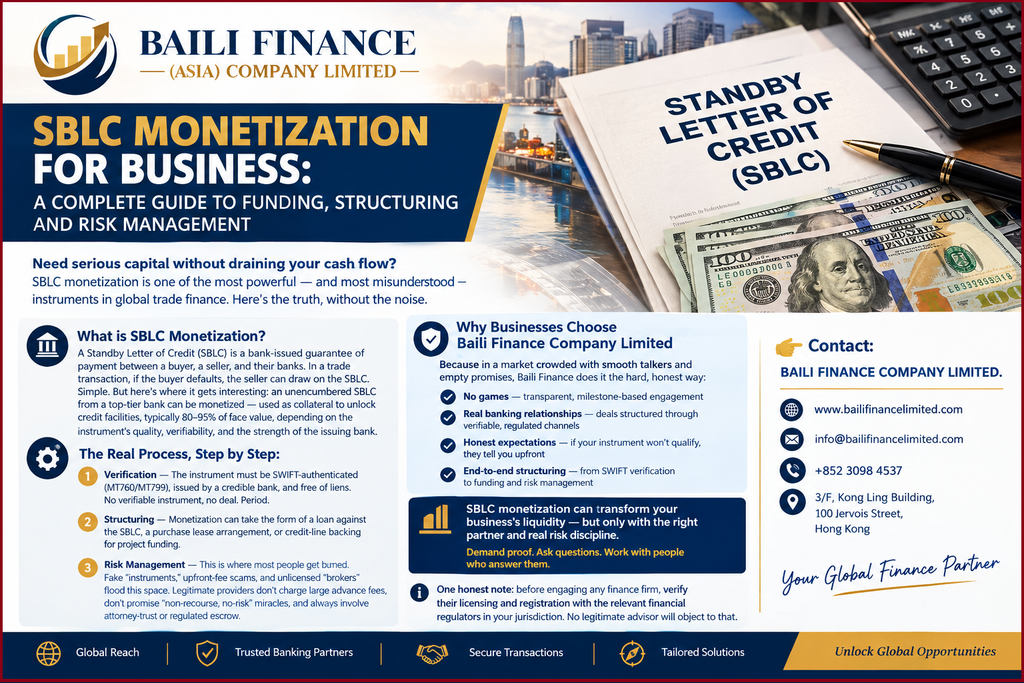
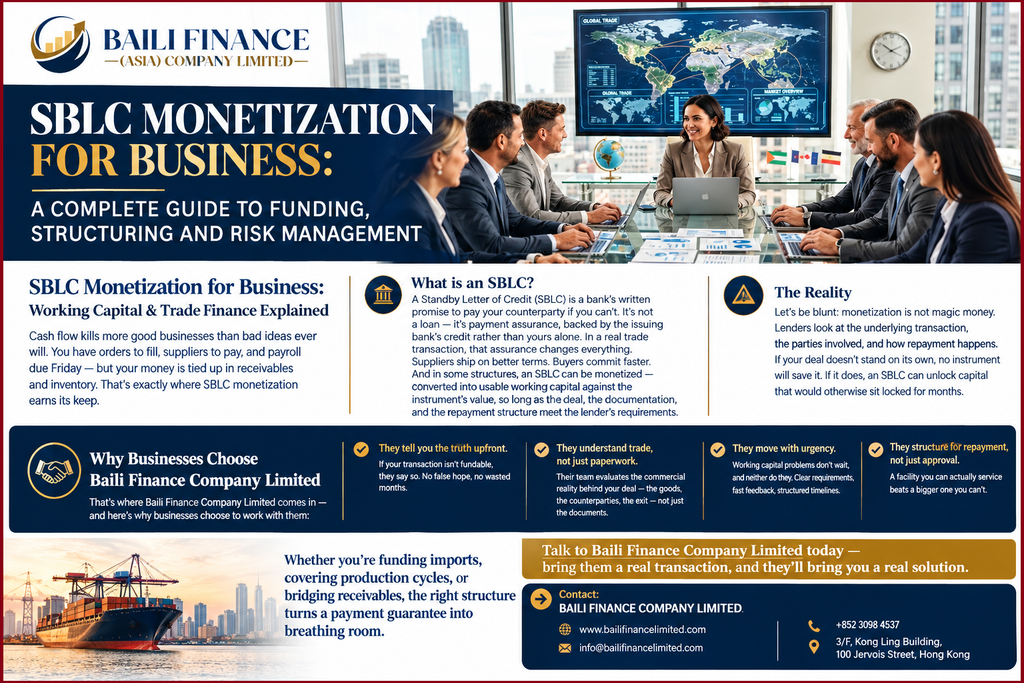
SBLC monetization refers to a financing arrangement in which a business seeks to use an eligible standby letter of credit to obtain funding or credit from a financial institution or another acceptable financing counterparty. The structure, however, depends on the instrument’s terms, the issuing bank’s credit standing, the proposed lender’s requirements and the borrower’s financial position.
An SBLC doesn’t automatically represent available cash. Instead, it provides a conditional undertaking from the issuing bank to pay a beneficiary when that beneficiary makes a complying demand under the instrument. A financing institution may consider that undertaking as part of its collateral assessment, subject to legal, credit and compliance reviews.
The ICC Academy’s comprehensive guide to standby letters of credit explains how these instruments support commercial obligations and may provide credit enhancement.
For businesses, three separate concepts matter:
- SBLC issuance: A bank issues a standby undertaking on behalf of its customer, usually to support a payment or performance obligation.
- SBLC-backed financing: A lender considers the instrument as collateral or credit support when evaluating a financing request.
- SBLC monetization: A financing structure aims to convert the economic value of an eligible instrument into usable financing, subject to the lender’s approval and the applicable terms.
These concepts shouldn’t be treated as interchangeable. In particular, a company shouldn’t assume that an instrument’s face value determines how much funding it can receive.
How Does SBLC Monetization Work?
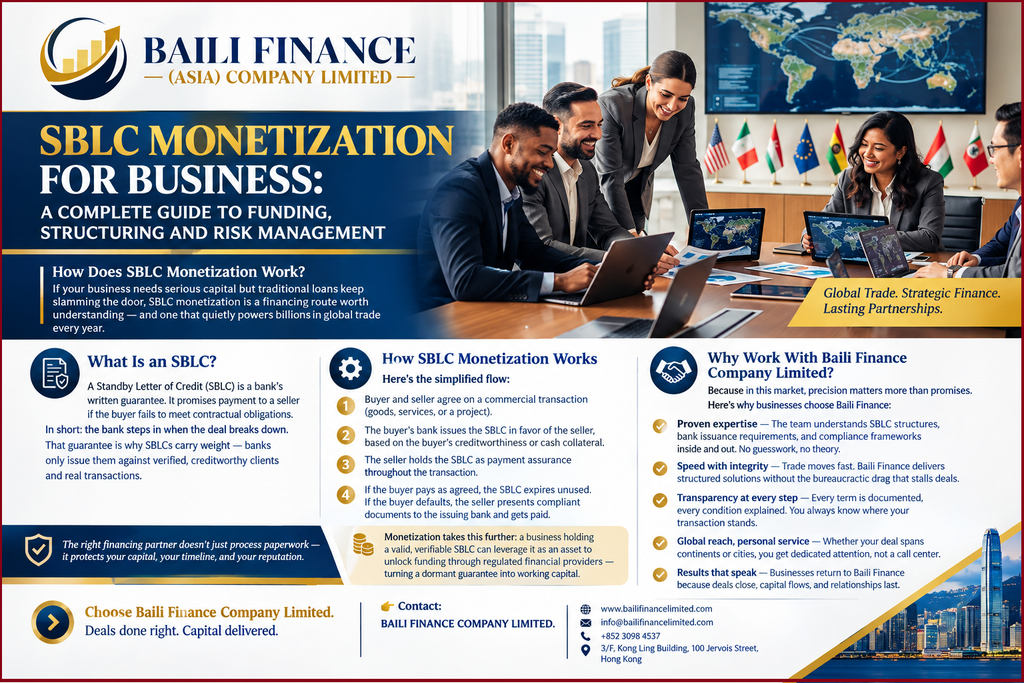
A typical proposed SBLC financing transaction involves the applicant, the issuing bank, the beneficiary and the prospective financing institution. Depending on the transaction, an advising bank, confirming bank, legal adviser or other intermediary may also participate.
The parties first establish whether the SBLC supports a legitimate commercial purpose and whether its terms permit the intended transaction. The financing institution then reviews the instrument and the applicant’s financial circumstances before deciding whether to proceed.
The SBLC Financing Process
- Business identifies its funding requirements The company defines its financing objective, required amount, intended use of funds and repayment capacity.
- The parties assess the SBLC The proposed lender reviews the issuer, instrument wording, governing rules, expiry date, beneficiary and any transfer or assignment provisions.
- Banks and counterparties verify the instrument The relevant institutions conduct independent verification, compliance screening and any necessary authentication.
- The financing institution conducts due diligence The lender assesses the company’s financial records, creditworthiness, collateral, transaction purpose and legal risks.
- The parties negotiate the financing agreement If the lender approves the proposal, the parties document the financing amount, conditions, fees, repayment terms, security arrangements and responsibilities.
- The transaction completes, subject to conditions Funds become available only after the required legal, banking, compliance and contractual conditions have been satisfied.
The process may differ substantially between transactions. A lender may reject an instrument even when the applicant holds an authentic SBLC, particularly when the instrument’s wording, issuer or legal structure doesn’t meet the lender’s requirements.
Step 1: Establish the Commercial Purpose
A financing request should begin with a defined business need. For example, a company may require capital to purchase equipment, fulfil a supply contract, acquire inventory or support a qualifying infrastructure project.
The applicant should prepare a financing proposal that explains:
- The company’s legal structure and ownership.
- The amount of financing required.
- The proposed use of the funds.
- The expected commercial benefits.
- The proposed repayment source and schedule.
- The available financial statements and supporting documentation.
- The origin, purpose and terms of the SBLC.
A well-prepared proposal allows the financing institution to evaluate the transaction on its actual commercial merits rather than relying on general claims about the instrument.
Step 2: Verify the SBLC and Issuing Bank
Instrument verification represents a critical stage of the process. The financing institution needs to establish that the SBLC exists, that the issuing bank issued it and that its terms support the proposed financing arrangement.
Verification should take place through appropriate, independently confirmed banking channels. The applicant shouldn’t rely solely on screenshots, emailed copies, broker assurances or documents supplied by an unverified intermediary.
The parties should also confirm the issuer’s ability and willingness to meet its obligations under the instrument. An authentic SBLC may still prove unsuitable for a particular financing transaction.
Step 3: Assess the Proposed Financing Structure
Once the parties establish that the instrument is authentic, the prospective lender evaluates whether it can accept the SBLC as collateral or credit support.
This assessment may involve:
- Issuer credit risk.
- Jurisdiction and applicable law.
- Instrument wording and documentary requirements.
- Expiry, renewal and cancellation provisions.
- Beneficiary rights and permitted transfers.
- Enforcement and recovery considerations.
- The applicant’s financial condition.
- Regulatory and anti-money-laundering requirements.
The lender also considers whether the proposed transaction complies with its own policies and the laws of the relevant jurisdictions.
Step 4: Agree on the Commercial Terms
Before the company commits to a transaction, the parties should agree on the financing structure in writing.
The agreement should identify the amount and currency of the financing, applicable interest or other financing charges, any arrangement fees, the security requirements and the expected disbursement conditions.
It should also explain what happens if the lender rejects the SBLC, the issuing bank doesn’t complete a required procedure or the transaction fails to satisfy a contractual condition.
Key Benefits of SBLC Monetization for Businesses
An SBLC-backed financing structure may offer advantages in suitable circumstances. However, businesses should evaluate these potential benefits against the cost, complexity and risk of the proposed transaction.
1. Access to Alternative Financing Structures
A company with a suitable SBLC may explore financing options beyond conventional unsecured borrowing. This may be relevant when the lender considers the instrument acceptable and the applicant meets the other credit requirements.
Nevertheless, the availability of financing depends on the institution’s actual approval, not simply on the presence of an SBLC.
2. Support for International Trade
International businesses frequently operate across multiple jurisdictions, currencies and banking systems. A standby letter of credit can support payment or performance obligations in transactions where counterparties require additional assurance.
For example, an exporter may request an SBLC to support a buyer’s payment obligations under an open-account arrangement. An importer may also encounter an SBLC requirement when negotiating a supply contract.
An SBLC used for this purpose provides a contractual payment undertaking. It doesn’t automatically provide the applicant with working capital.
3. Potential Support for Project Financing
Project owners may explore an SBLC-backed structure when arranging financing for eligible business activities. A prospective lender may assess the instrument alongside the project’s contracts, expected cash flows, sponsor support and other available security.
For large infrastructure projects, however, a financing institution will typically need to examine construction risks, regulatory approvals, project economics and the project’s repayment capacity.
4. Potential Improvement in Credit Support
An acceptable SBLC may enhance a lender’s assessment of a transaction by introducing an additional source of contractual credit support.
However, credit enhancement doesn’t eliminate the applicant’s repayment obligations. If the lender draws on the SBLC after a qualifying default, the applicant may remain liable to reimburse the issuing bank under its separate banking agreement.
Who Can Consider SBLC Monetization?
The suitability of SBLC-backed financing depends on the company’s financial circumstances, the instrument’s characteristics and the lender’s acceptance criteria.
Businesses that may investigate this structure include:
- Importers and exporters: Companies seeking financial support for qualifying international trade transactions.
- Construction companies: Contractors requiring financing for equipment, materials or eligible project expenses.
- Infrastructure developers: Project sponsors exploring acceptable credit support within a wider funding structure.
- Manufacturers: Businesses seeking capital for qualifying production or procurement requirements.
- Commodity traders: Eligible companies requiring finance for genuine, documented trading activity.
- Established corporations: Businesses assessing alternative financing arrangements alongside their existing banking facilities.
An SBLC alone doesn’t establish eligibility. Each applicant must demonstrate a legitimate funding requirement and satisfy the prospective lender’s underwriting, documentation and compliance requirements.
Essential Requirements for SBLC Monetization
Before submitting an SBLC for financing consideration, businesses should prepare the documentation needed to establish their identity, financial standing, transaction purpose and rights under the instrument.
The exact requirements vary by lender and jurisdiction. However, the following provides a useful starting point:
- Company registration documents.
- Ownership and identification documents.
- Audited or management financial statements.
- Bank statements where required.
- Business plan or transaction proposal.
- Evidence of the underlying commercial transaction.
- Purchase orders or contracts.
- Details of the issuing bank.
- SBLC documentation.
- Intended use of financing.
- Cash-flow projections.
- Proposed repayment strategy.
- Corporate and legal documentation.
- Relevant compliance documentation.
The financing institution may request additional information after its initial assessment.
Understanding the Role of ISP98 and UCP 600
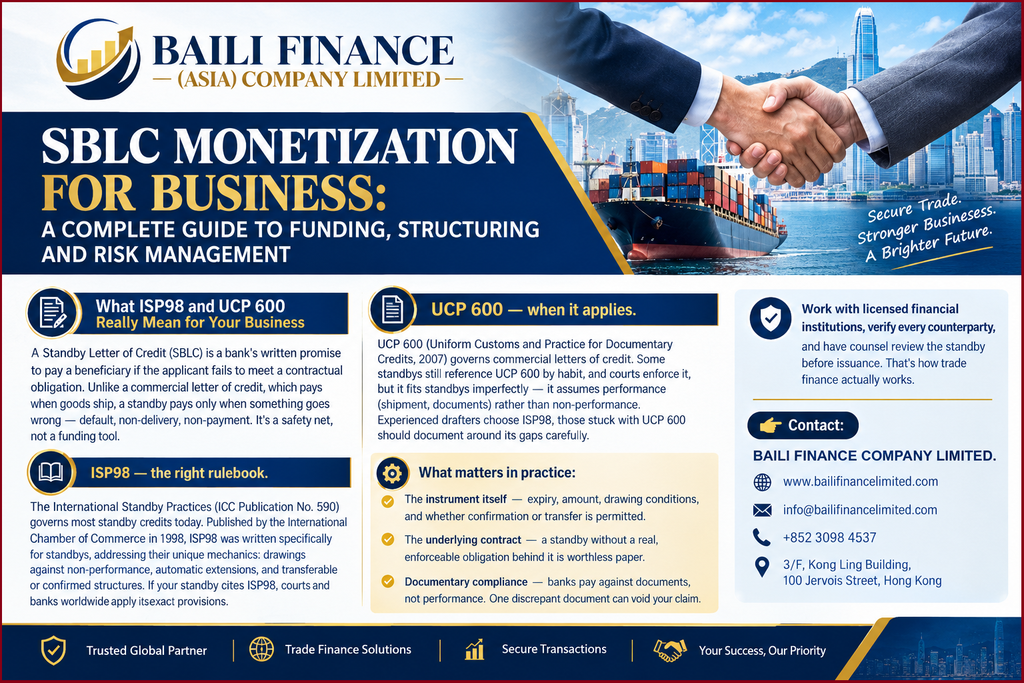
The legal and operational framework governing an SBLC is central to the transaction. Two important sets of rules are the International Standby Practices 1998 (ISP98) and the Uniform Customs and Practice for Documentary Credits (UCP 600).
The parties may choose to subject an SBLC to one of these frameworks, depending on the instrument and the intended transaction. ISP98 specifically addresses standby letters of credit, while UCP 600 primarily addresses documentary credits, although parties can also apply it to certain standbys.
The applicable rules don’t replace relevant national law or the instrument’s actual wording. Companies should have qualified trade finance counsel review the instrument and proposed financing documentation.
For additional information, businesses can consult the International Chamber of Commerce’s ISP98 publication.
Understanding SBLC Monetization Costs and Financing Terms
The cost of an SBLC financing transaction can vary significantly. Businesses should obtain a detailed, written breakdown of all applicable charges before signing an agreement or making a payment.
Depending on the arrangement, costs may include:
| Cost Category | What the Business Should Examine |
|---|---|
| Issuance charges | Bank fees for establishing the original SBLC |
| Advising or confirmation fees | Charges associated with additional banking services, where applicable |
| Financing interest | Interest or other agreed financing charges on the amount borrowed |
| Arrangement fees | Fees payable for documented financing arrangement services |
| Legal expenses | Costs for reviewing, negotiating and executing agreements |
| Verification and compliance | Legitimate, disclosed charges for required checks or services |
| Other contractual costs | Agreed security, administrative or transaction expenses |
A company should distinguish between the SBLC’s face value, the amount a lender may accept as collateral and the actual financing proceeds. These amounts can differ.
For example, an SBLC with a face value of $5 million doesn’t establish that a lender will advance $5 million. The lender may decline the instrument entirely, approve a smaller financing amount or require additional security.
Similarly, an advertised loan-to-value percentage doesn’t constitute a financing commitment. Only the signed agreement and the institution’s actual approval establish the terms of an agreed transaction.
Risks and Challenges of SBLC Monetization
SBLC-backed financing involves legal, credit, operational and fraud risks. Businesses should address these risks before committing capital, transferring documents or entering into a binding arrangement.
1. Fraudulent SBLC Offers
Fraudsters sometimes advertise SBLC monetization services while falsely claiming access to established banks, international investors or guaranteed funding.
The FBI’s Internet Crime Complaint Center has warned about fictitious standby letters of credit, fabricated banking communications and advance-fee schemes. Its warning identifies misleading offers involving supposed non-recourse loans and promises of financing through unverifiable counterparties.
Businesses should therefore:
- Independently verify every financial institution involved.
- Confirm all proposed banking procedures directly with the relevant banks.
- Investigate the legal identity and regulatory status of intermediaries.
- Avoid relying on purported bank relationships that the named banks haven’t independently confirmed.
- Obtain qualified legal advice before paying fees or signing agreements.
2. Counterparty and Issuing Bank Risk
The issuer’s identity and creditworthiness can affect whether a prospective lender accepts an SBLC.
A bank’s existence alone doesn’t establish that a particular instrument meets the lender’s requirements.
The company should confirm the issuing bank’s role, the instrument’s authenticity and the applicable banking arrangements.
3. Legal and Jurisdictional Risks
An SBLC may involve several jurisdictions, particularly when the applicant, issuing bank, beneficiary and financing institution operate in different countries.
Differences in local law, enforcement procedures, sanctions requirements and insolvency rules can affect the transaction.
Businesses should identify the governing law, dispute resolution mechanism and applicable documentary rules before proceeding.
4. Liquidity and Repayment Risk
Financing against an SBLC creates obligations that the company must meet under its financing agreement.
The company should identify a realistic repayment source and assess the consequences of delayed receivables, cost overruns or changes in market conditions.
An SBLC doesn’t guarantee that the business can repay its borrowing or that its underlying commercial project will succeed.
5. Unrealistic Funding Promises
Businesses should approach claims of guaranteed approval, immediate disbursement or financing without meaningful due diligence with caution.
The financing institution must evaluate the instrument and the transaction before it can make an informed lending decision.
No broker’s promise substitutes for a bank’s formal commitment.
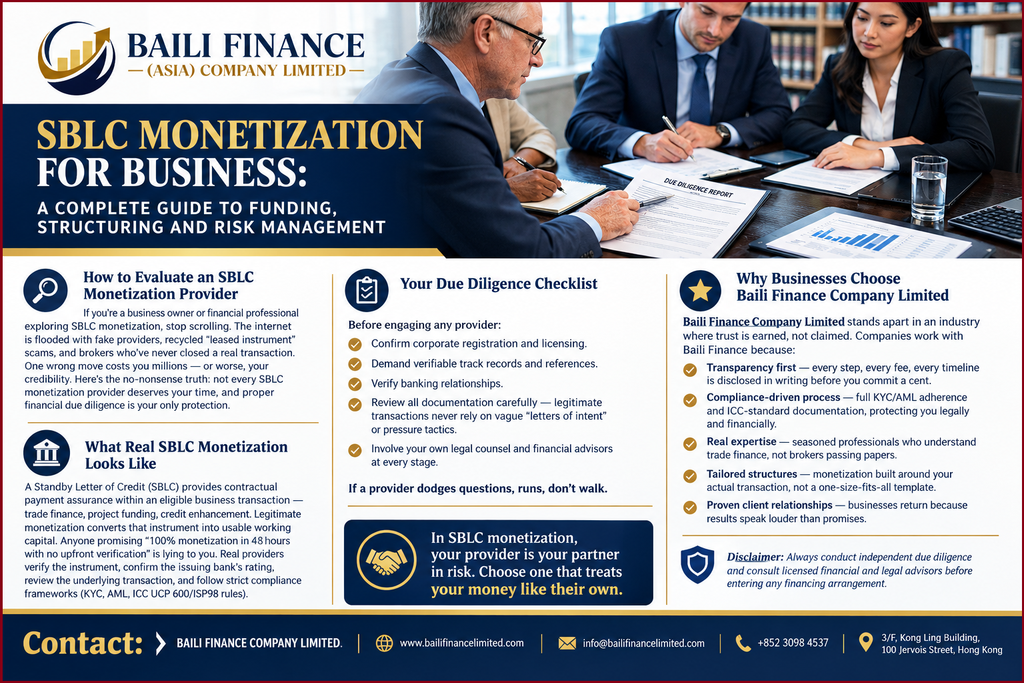
How to Evaluate an SBLC Monetization Provider
Choosing a financing counterparty requires more than comparing advertised funding percentages. Businesses should examine the provider’s legal identity, actual financing capacity, contractual responsibilities and track record.
Before proceeding, ask the following questions:
- What legal entity will provide the financing?
- Is the provider a bank, licensed financial institution, broker or independent arranger?
- Which bank will receive and verify the SBLC?
- What evidence supports the proposed financing capacity?
- What are the precise conditions for approval and disbursement?
- Which fees are payable, when are they due and what services do they cover?
- What happens if the transaction doesn’t proceed?
- Which party assumes each legal, financial and operational responsibility?
A broker’s involvement doesn’t establish that a lender has approved the transaction. Similarly, an arrangement with a bank doesn’t establish that the bank endorses every claim made by an intermediary.
For Hong Kong businesses, the Hong Kong Monetary Authority (HKMA) provides information about Hong Kong’s banking and financial sector. Businesses should also consult the appropriate regulator in each relevant jurisdiction to verify the status of financial institutions and applicable regulatory requirements. The HKMA Register of Authorized Institutions and Local Representative Offices can be used to check regulated banking institutions in Hong Kong.
The Hong Kong Police Force Anti-Deception Coordination Centre (ADCC) provides information about identifying and avoiding scams and fraudulent payment requests. The HKMA’s fraud and security guidance also warns the public about fraudulent websites.
Real-World Example: How an SBLC Can Support a Commercial Transaction
Consider an international equipment supplier that has agreed to deliver industrial machinery to a buyer in another country.
The buyer’s supplier requires payment assurance because it intends to manufacture and deliver the machinery before receiving the full contract amount. The buyer approaches its bank to arrange a standby letter of credit in favour of the supplier.
The SBLC supports the buyer’s payment obligations if the buyer fails to pay according to the instrument’s terms and the supplier makes a complying demand.
The supplier reviews the instrument and confirms that its terms meet the contractual requirements. Both companies then proceed with the supply agreement.
This example illustrates the established commercial function of an SBLC: providing an additional source of payment assurance.
If the buyer separately wants to use the SBLC to obtain working capital, it must negotiate a distinct financing arrangement. The supplier’s acceptance of the instrument doesn’t automatically mean that a third-party lender will accept it as collateral.
Case Study: A Hypothetical SBLC-Backed Working Capital Transaction
The following case study uses illustrative figures and a hypothetical company. It doesn’t describe a verified transaction completed by Baili Finance Limited or establish an actual funding offer.
A Manufacturing Company’s Financing Assessment
A manufacturing business has secured a supply contract that requires additional working capital to purchase raw materials, pay suppliers and meet production expenses.
The Company’s Initial Position
| Item | Illustrative Amount |
|---|---|
| Existing supply contract | $3,000,000 |
| Additional working capital required | $800,000 |
| Proposed SBLC face value | $1,000,000 |
| Estimated contract completion period | 6 months |
All amounts and timings are hypothetical.
The Proposed Financing Process
1. Commercial assessment
The company prepares its contract, supplier quotations, cash-flow forecast and repayment projections. It explains why the additional working capital is necessary to fulfil the order.
2. Instrument verification
The company provides the SBLC documentation through the required banking channels. The prospective lender conducts its independent verification and reviews the instrument’s expiry date, issuing bank, governing rules and payment conditions.
3. Credit and risk assessment
The lender examines the company’s financial position, the expected cash flows from the supply contract, the instrument’s acceptability and the proposed repayment arrangements.
4. Financing decision
After completing its assessment, the lender may approve the proposed financing, request further information, propose revised terms or decline the application.
Illustrative Financing Outcome
Assume the lender accepts the proposed structure and approves an $800,000 loan, subject to contractual conditions and agreed fees.
| Item | Illustrative Amount |
|---|---|
| Approved financing | $800,000 |
| Financing requirement | $800,000 |
| Remaining funding gap | $0 |
| Loan repayment source | Contract proceeds |
This is a hypothetical approval, not an indication that any lender will approve a comparable application.
What Does the Case Study Demonstrate?
The company doesn’t obtain funding merely because it has an SBLC. It must establish that the instrument is acceptable to the lender and demonstrate that the proposed borrowing makes commercial and financial sense.
Moreover, the company needs to consider whether the expected contract proceeds will arrive in time to meet its repayment obligations.
If the buyer delays payment, the company may still have to repay the lender. Therefore, the financing decision should account for the contract’s payment terms, working capital cycle and potential delays.
The example also illustrates why businesses should avoid focusing exclusively on the face value of an SBLC. The transaction’s actual financing outcome depends on underwriting, documentation and the lender’s final approval.
SBLC Monetization and Business Financing: Frequently Asked Questions
1. What is SBLC monetization for business?
SBLC monetization is a term used for financing arrangements in which an eligible standby letter of credit supports a proposed loan or other funding structure.
A prospective lender evaluates the instrument’s authenticity, terms and credit characteristics alongside the applicant’s financial position and the transaction’s commercial purpose.
An SBLC doesn’t automatically become cash. Funding depends on a lender’s approval and the satisfaction of the agreed conditions.
2. Can a business obtain 100% financing against an SBLC?
Not automatically.
A lender determines the financing amount based on its underwriting policies, the instrument’s terms, the issuing bank’s credit standing and the borrower’s financial circumstances.
A claim that every eligible SBLC receives financing equal to its face value shouldn’t be treated as a reliable financing commitment.
Businesses should request a written offer that specifies the approved amount and all applicable conditions.
3. How long does SBLC monetization take?
There isn’t one standard completion period for every transaction.
The time required depends on the complexity of the financing structure, the banks involved, the quality of the documentation, the due diligence required and any legal or regulatory approvals.
An applicant should obtain a realistic transaction schedule from the actual financing institution. Advertised turnaround times aren’t guarantees of approval or disbursement.
4. Which banks can issue a standby letter of credit?
Banks that provide standby letter of credit services may issue an SBLC for eligible customers, subject to their credit policies, compliance requirements and the applicable jurisdiction.
The issuing bank’s willingness to provide the instrument doesn’t mean that a separate financing institution will accept it as collateral.
Applicants should confirm both the issuance requirements and the prospective lender’s acceptance criteria before incurring substantial costs.
5. Is SBLC monetization legal?
An SBLC is a recognised banking instrument. Its issuance and use are subject to the relevant laws, regulatory requirements, banking procedures and contractual terms.
A proposed financing structure must also comply with applicable rules concerning lending, financial services, anti-money laundering, sanctions and other relevant regulatory requirements.
Businesses should seek independent legal advice to assess their specific transaction.
6. Can a newly established company apply for SBLC-backed financing?
A newly established business may explore the possibility, but its eligibility depends on the lender’s criteria and the structure of the proposed transaction.
The lender may require evidence of the company’s ownership, business plan, commercial contracts, source of repayment, financial backing and other supporting documents.
The existence of an SBLC doesn’t remove these requirements.
7. Does an SBLC need to be transferable for financing?
Not necessarily.
Transferability and the right to assign proceeds are separate contractual issues, and neither automatically establishes that a lender will accept the instrument.
A financing institution may require particular rights or arrangements, depending on the proposed structure.
The parties should review the actual SBLC wording and obtain legal advice before relying on a proposed transfer or assignment.
8. What is the difference between SBLC monetization and an SBLC-backed loan?
An SBLC-backed loan is a borrowing arrangement in which a lender accepts an eligible standby undertaking as collateral or credit support, subject to its underwriting requirements.
SBLC monetization is a broader commercial term that may refer to such a loan or another financing structure intended to make funds available against the instrument.
The parties should define the precise legal and financial arrangement rather than relying on the word “monetization” alone.
9. Can a company monetize an SBLC without collateral?
A lender may consider an SBLC as one form of credit support, but the instrument doesn’t guarantee that additional collateral won’t be required.
The lender may assess other assets, guarantees, cash flow, borrower creditworthiness or transaction-specific security.
The exact requirements should be documented in the proposed financing agreement.
10. What are the warning signs of an SBLC monetization scam?
Warning signs may include guaranteed financing without underwriting, unverifiable bank relationships, pressure to make urgent advance payments, unrealistic funding promises and demands to rely on documents that can’t be independently authenticated.
The FBI has specifically warned about fictitious SBLC schemes that use fabricated banking connections and purported SWIFT messages to create an appearance of legitimacy.
Businesses should verify the relevant institutions and proposed banking procedures independently before transferring funds or sensitive information.
Conclusion: Make an Informed SBLC Financing Decision
SBLC monetization for business can be a financing consideration for companies with legitimate commercial requirements and an eligible standby letter of credit. However, the instrument itself doesn’t guarantee liquidity, approval or a particular financing percentage.
A successful financing assessment requires a clear commercial purpose, independent instrument verification, appropriate documentation, a credible repayment strategy and a financing institution willing to accept the proposed structure.
Businesses should evaluate every proposed transaction against its legal requirements, actual costs and repayment risks. They should also verify the identities and responsibilities of all counterparties before signing agreements or making payments.
For companies considering this route, preparation and due diligence should come before any commitment. A properly documented financing proposal provides the basis for a meaningful assessment and helps businesses distinguish a genuine funding opportunity from an unverified offer.
Discuss Your SBLC Financing Requirements
Are you considering SBLC monetization to support a business transaction, working capital requirement or qualifying project?
Don’t leave your financing structure to assumptions. Start with the facts that matter: your business objective, funding requirement, SBLC details, transaction documentation and proposed repayment strategy.
If your business is exploring SBLC-backed financing, contact Baili Finance Limited to discuss your requirements and determine whether your proposed transaction falls within the company’s scope.
Visit: https://www.
Whether you’re seeking working capital, trade finance support or financing for a qualifying commercial project, provide the relevant transaction details and begin the discussion with a clear understanding of the structure involved.
Your SBLC may be an important part of a financing structure. The next step is determining whether the proposed structure works for your actual business.
Intermediaries/Consultants/Brokers are welcome to bring their clients 100% protected. Our brokers receive 2% commission for referral. We assist Clients and brokers in their attempt to secure funding by working on their funding requests that may require innovative financing. In complete confidence, we will work together for the benefits of all parties involved.
#SBLCMonetization #BusinessFinance #TradeFinance #StandbyLetterOfCredit #BusinessFunding #WorkingCapital #InternationalTrade #ProjectFinance #CorporateFinance #FinancialDueDiligence