Headline: Stop Choosing Bank Guarantees Without Verification
Businesses involved in international trade, construction, infrastructure, energy, commodity transactions and project finance often need more than contractual assurances. They need credible financial instruments that beneficiaries, lenders and commercial counterparties can review and accept. This is where bank guarantee providers with AAA-rated banks, performance guarantees, financial guarantees and standby letters of credit can become important.
However, choosing a provider requires more than searching for a company that advertises access to “AAA banks”. A serious transaction requires verification of the actual issuing bank, credit rating, guarantee wording, applicable rules, SWIFT transmission process, beneficiary requirements, compliance procedures and legal enforceability.
A bank guarantee is a financial undertaking that can protect a beneficiary when an applicant fails to meet defined contractual obligations. Under the international demand-guarantee framework, the guarantee operates according to its own terms and documentary requirements.
For companies seeking AAA-rated bank guarantee providers, bank guarantee services for international trade, BG issuance, performance guarantees, financial guarantees, project finance guarantees or structured trade finance, the quality of the issuing institution matters.
So does the structure behind the transaction.
Keywords: bank guarantee providers with AAA-rated banks, AAA bank guarantee providers, bank guarantee provider, AAA-rated banks, international bank guarantee, performance bank guarantee, financial guarantee, advance payment guarantee, bank guarantee services, trade finance, project finance, SBLC provider, bank guarantee issuance
What Is a Bank Guarantee?
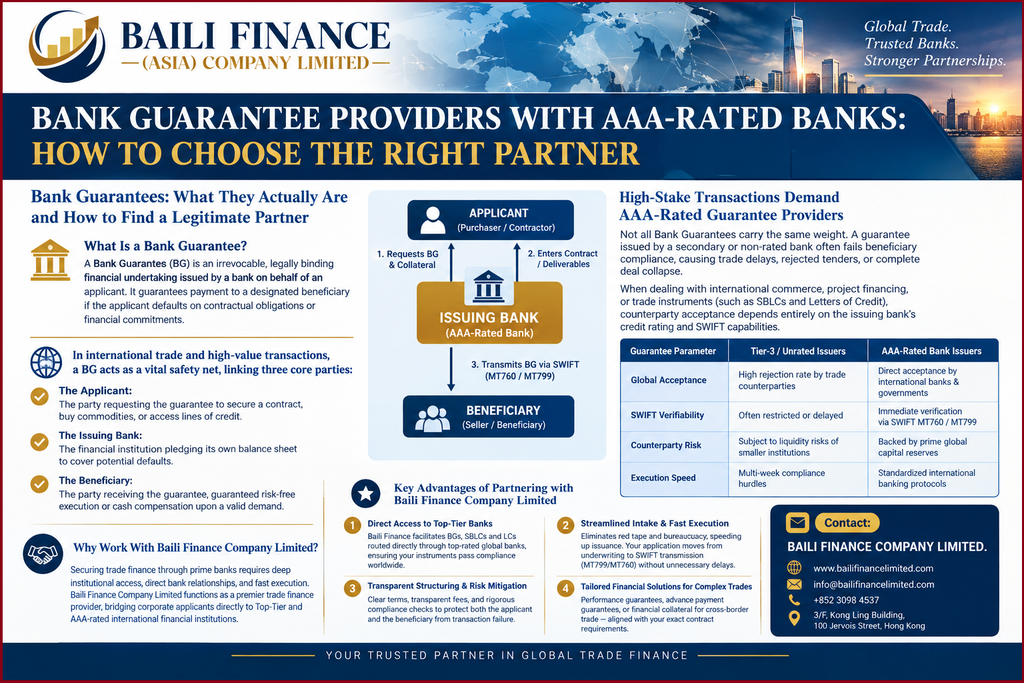
A bank guarantee is an undertaking through which a bank or other qualifying financial institution agrees to pay a beneficiary when the conditions specified in the guarantee are satisfied.
The underlying transaction can involve construction, procurement, financing, infrastructure development, international supply contracts or other commercial obligations.
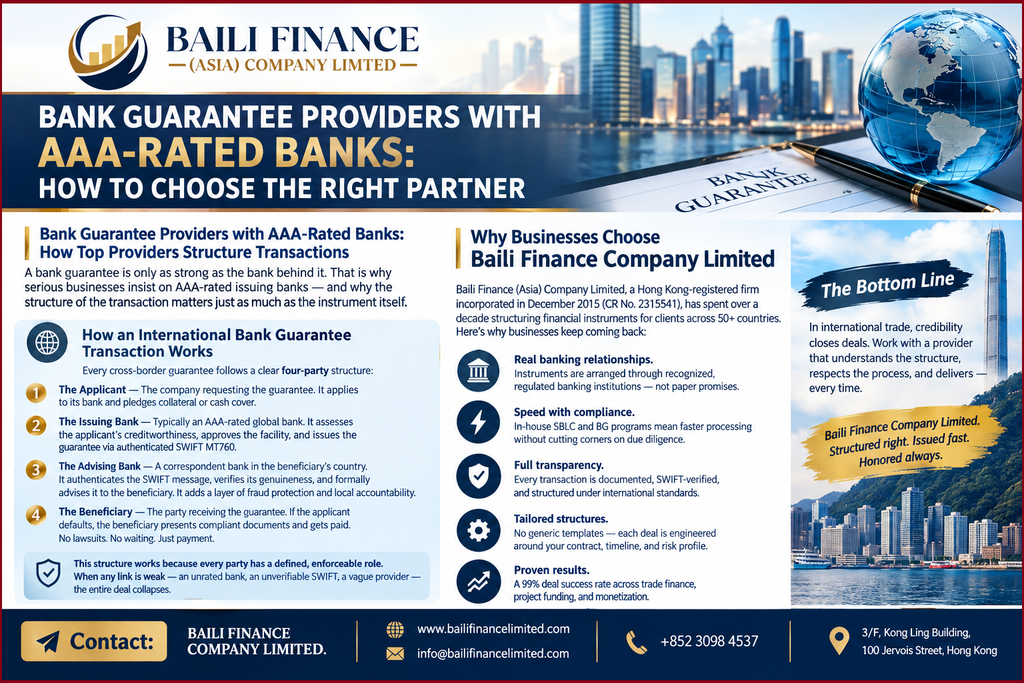
The principal parties usually include:
- Applicant: The company or party requesting the guarantee.
- Beneficiary: The party receiving the protection.
- Issuing bank or guarantor: The financial institution undertaking the payment obligation.
- Advising bank: A bank that authenticates and advises the guarantee to the beneficiary.
- Counter-guarantor: A financial institution that may support the issuing bank through a counter-guarantee.
The distinction between these parties matters because a financial intermediary that arranges a guarantee isn’t necessarily the institution that ultimately assumes the guarantee obligation.
That point deserves attention.
When a company advertises itself as a bank guarantee provider, the buyer should identify who actually issues the instrument and who carries the payment obligation.
The International Chamber of Commerce’s URDG 758 framework provides internationally recognised rules for demand guarantees and counter-guarantees. The ICC explains that demand guarantees generally involve an irrevocable undertaking by a guarantor to pay upon a complying demand.
Why Businesses Look for AAA-Rated Bank Guarantee Providers
A beneficiary evaluating a guarantee is effectively assessing counterparty risk.
The stronger the issuing institution’s recognised credit profile, subject to the relevant rating methodology and transaction structure, the more information the beneficiary may have when assessing the financial standing behind the instrument.
That doesn’t mean a higher rating automatically makes every transaction acceptable.
Instead, it provides one component of the overall credit assessment.
Businesses commonly seek highly rated bank guarantee providers for:
- International trade contracts
- Construction contracts
- Government and institutional tenders
- Infrastructure projects
- Energy projects
- Advance payment protection
- Performance obligations
- Payment obligations
- Import and export transactions
- Equipment procurement
- Commodity transactions
- Project finance
- Working capital structures
- Contractual security requirements
- Credit enhancement
A guarantee can therefore support a transaction without replacing the underlying commercial contract.
What Does “AAA-Rated Bank” Actually Mean?
This is one of the most important issues buyers should understand.
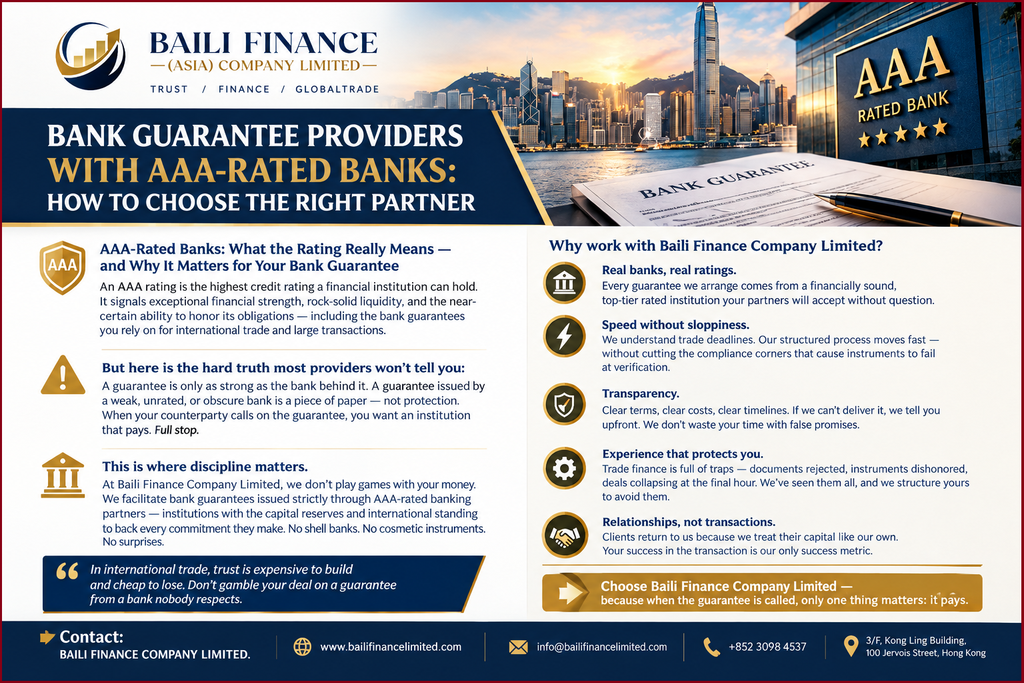
AAA isn’t a universal certification issued to banks by one global authority.
Credit ratings come from rating agencies, and agencies apply their own methodologies and rating scales. A bank can also have different ratings for different legal entities, debt instruments, currencies or rating categories.
In addition, national-scale ratings require careful interpretation.
S&P Global Ratings’ 2025 review of African credit ratings, published with ratings as of February 17, 2026, separately identifies global-scale ratings and national-scale ratings. For example, the table includes institutions carrying national-scale ratings such as “zaAAA”, while their global-scale ratings can be different or unavailable.
Therefore, a responsible AAA bank guarantee provider should be able to identify:
- The exact issuing bank.
- The exact legal entity issuing the instrument.
- The rating agency.
- The current rating.
- The rating scale.
- The date of the rating.
- The jurisdiction of the issuing entity.
- The applicable guarantee rules.
- The beneficiary’s acceptance requirements.
This verification process is more meaningful than simply placing “AAA bank” in a marketing headline.
AAA Rating Is Not the Same as Guarantee Acceptance
A highly rated bank guarantee can still fail a beneficiary’s requirements.
Why?
Because beneficiaries don’t assess credit rating alone.
They may also review:
- Issuing-bank jurisdiction
- Correspondent banking arrangements
- Sanctions exposure
- AML and KYC requirements
- Guarantee wording
- Governing law
- Applicable rules
- Expiry date
- Claim procedure
- Currency
- Guarantee amount
- Beneficiary identity
- SWIFT authentication
- Counter-guarantee structure
- Local regulatory requirements
- Internal bank policy
For example, a contractor may need a performance guarantee from a bank that the project owner has specifically approved.
The contractor therefore shouldn’t assume that any institution described as “AAA-rated” will automatically satisfy the tender conditions.
How AAA Bank Guarantee Providers Structure Transactions
A bank guarantee transaction can involve several layers.
The applicant first defines the underlying commercial obligation.
The beneficiary then specifies the required guarantee.
The provider or financial adviser may review the transaction and supporting documentation.
After that, the issuing bank performs its own credit, compliance and transaction assessment.
Where required, another bank may act as an advising bank or provide a counter-guarantee.
The guarantee can then be transmitted through established banking channels.
SWIFT’s documentation identifies MT 760 as the message used for the issue of a demand guarantee or standby letter of credit.
This is why buyers should distinguish between a marketing promise and an actual bank-issued instrument.
The critical question isn’t simply:
“Can you provide an AAA bank guarantee?”
The better question is:
“Which bank will issue the guarantee, under which legal entity, under which rules, for which beneficiary, and subject to what conditions?”
That question changes the quality of the due diligence.
Types of Bank Guarantees Businesses Commonly Use
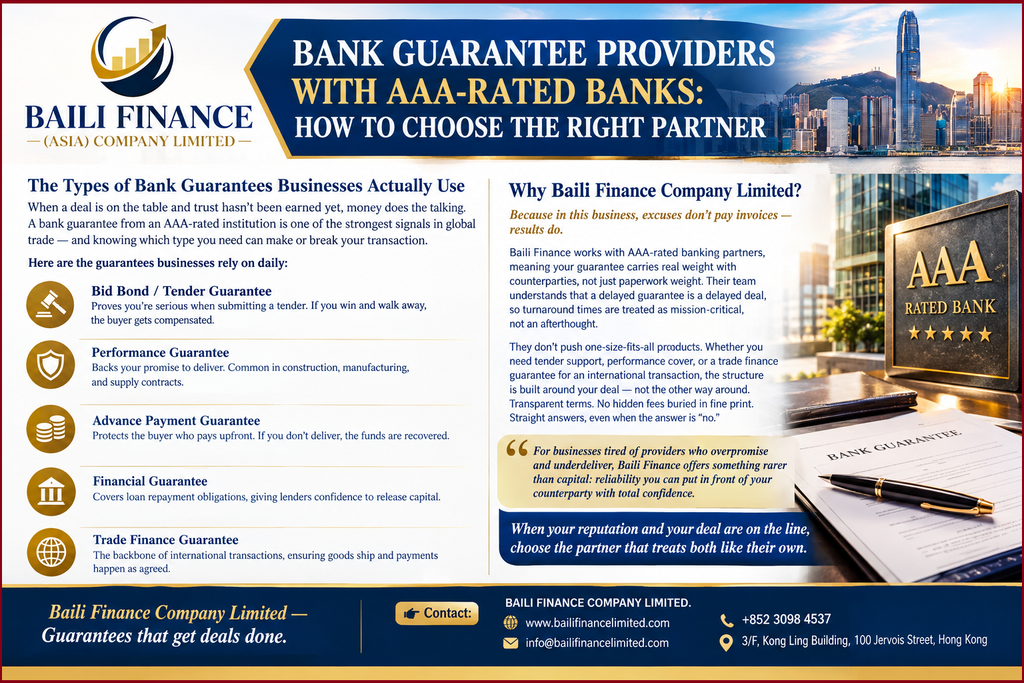
Performance Bank Guarantee
A performance guarantee provides financial protection connected with contractual performance.
It frequently appears in construction, engineering, infrastructure, procurement and service contracts.
The beneficiary wants assurance that it has a defined remedy if the applicant fails to perform according to the contractual requirements.
Advance Payment Guarantee
An advance payment guarantee can protect a buyer that makes an advance payment to a supplier or contractor.
For example, a buyer may agree to pay 20% of a contract value before production begins.
The buyer may request an advance payment guarantee covering the relevant amount.
Financial Guarantee
A financial guarantee supports a defined payment obligation.
It can be relevant where a beneficiary requires additional assurance that a contractual financial obligation will be met.
Tender Guarantee or Bid Guarantee
A tender guarantee can support a bid where the tendering authority requires financial security from participating bidders.
The exact requirements depend on the tender documentation and applicable procurement rules.
Retention Money Guarantee
A retention guarantee may allow a contractor to receive amounts that would otherwise remain withheld as retention.
The precise structure depends on the underlying contract.
Standby Letter of Credit
An SBLC can serve a similar risk-mitigation purpose but operates within a different documentary and legal framework.
The precise instrument required should always follow the beneficiary’s specifications rather than the provider’s preferred product.
Why Guarantee Wording Matters
A bank guarantee isn’t valuable merely because it carries a recognised bank’s name.
Its wording determines what the bank has actually undertaken to do.
The guarantee should clearly address:
- Amount
- Currency
- Beneficiary
- Applicant
- Issuing institution
- Expiry
- Claim mechanism
- Required documents
- Governing rules
- Applicable law
- Presentation requirements
- Reduction or cancellation provisions
- Amendment procedures
The ICC’s URDG 758 framework is particularly relevant to demand guarantees. The ICC explains that the framework covers matters including guarantees, counter-guarantees, amendments, presentations and examination of demands.
A vague guarantee can create unnecessary disputes.
A precisely drafted guarantee can reduce ambiguity.
What to Check Before Choosing a Bank Guarantee Provider
1. Verify the Issuing Bank
Ask for the exact legal name of the issuing bank.
Don’t accept only a bank logo or a list of famous financial institutions.
The bank named in the final instrument should be independently verifiable.
2. Verify the Credit Rating
Ask:
- Which rating agency issued the rating?
- What is the current rating?
- Is it global-scale or national-scale?
- Which legal entity holds the rating?
- What is the rating date?
- Has the rating changed recently?
This distinction is essential.
3. Confirm Beneficiary Acceptance
Before paying fees or committing to a structure, determine whether the beneficiary will accept the proposed issuing institution.
This can prevent an otherwise avoidable transaction failure.
4. Review the Guarantee Rules
The parties should understand whether the instrument uses URDG 758, ISP98, UCP 600 or another contractual framework, where appropriate.
The applicable rules shouldn’t be treated as a minor administrative detail.
5. Examine the SWIFT Process
If the transaction involves SWIFT messaging, the parties should understand the relevant message type and authentication process.
SWIFT’s standards specifically identify MT 760 for issuing a demand guarantee or standby letter of credit.
6. Review Fees
Ask for a complete transaction cost schedule.
This can include:
- Arrangement fees
- Bank charges
- Advising fees
- Correspondent charges
- Legal fees
- Compliance costs
- SWIFT charges
- Amendment charges
- Extension charges
- Brokerage fees, where applicable
Avoid evaluating a provider only on an advertised headline percentage.
7. Complete Due Diligence
A professional provider should expect KYC, AML and transaction documentation.
Requests for corporate documents, beneficial ownership information, financial statements, contracts and identification documents can form part of legitimate banking due diligence.
A provider that avoids meaningful compliance checks shouldn’t automatically be treated as more efficient.
Red Flags When Searching for AAA Bank Guarantee Providers
Search results contain many businesses advertising bank guarantees, SBLCs and financial instruments.
That makes verification important.
Watch for claims such as:
- Guaranteed financing regardless of credit profile
- Guaranteed monetisation
- Guaranteed returns
- Guaranteed approval
- No due diligence required
- No bank verification required
- Extremely large instruments with minimal documentation
- Immediate issuance without bank assessment
- Unclear issuing-bank identity
- Pressure to make unexplained upfront payments
- Claims that an instrument is automatically cash
- Claims that an SBLC automatically guarantees a loan
An SBLC or bank guarantee does not automatically create financing.
The lender or monetisation institution can still assess the borrower, transaction, instrument, issuing bank, repayment source, legal structure and compliance profile.
This distinction is important for businesses searching for bank guarantee providers for project finance or AAA bank guarantee providers for business funding.
Real-World Example: A Bank Guarantee Supporting an International Contract
Consider a renewable-energy company purchasing specialised equipment from an overseas manufacturer.
The supplier doesn’t want to manufacture and ship the equipment without additional payment security.
The buyer doesn’t want to pay the entire contract value before receiving the equipment.
A bank guarantee can address part of that commercial concern.
The buyer’s bank issues a suitable guarantee in favour of the supplier.
The guarantee defines the amount, expiry date and conditions for a compliant demand.
The supplier receives financial assurance without requiring the buyer to make the entire contractual payment immediately.
The buyer preserves working capital while satisfying the supplier’s security requirement.
The supplier gains a defined bank-backed contractual protection.
This example is illustrative, but it demonstrates why performance guarantees, payment guarantees and advance payment guarantees remain relevant to international commerce.

Case Study: ICC DOCDEX Decision and URDG 758
A useful documented example comes from an International Chamber of Commerce DOCDEX decision concerning a demand guarantee subject to URDG 758.
In the case, the beneficiary submitted a demand under a guarantee. The issuing bank subsequently sought additional proof and explanations concerning performance of the underlying contract.
The ICC decision examined the documentary requirements under URDG 758.
The decision noted that the guarantor examines the presentation against the guarantee’s requirements rather than investigating the underlying goods, services or contractual performance in the same way as the parties to the underlying contract.
It also addressed the five-business-day examination period under the applicable URDG provisions and the consequences of failing to reject a demand within the required timeframe.
The case illustrates a central principle of demand guarantees:
The guarantee must be drafted and administered as a distinct documentary undertaking.
That makes wording, presentation requirements and procedural deadlines commercially important.
For businesses entering international guarantee transactions, the ICC’s URDG 758 framework and related guidance provide a useful authoritative reference.
How Baili Finance Limited Can Support Bank Guarantee Transactions
Baili Finance Limited focuses on financial solutions for businesses involved in international commercial transactions, structured finance and trade-related requirements.
For clients evaluating a bank guarantee, performance guarantee, financial guarantee, advance payment guarantee or SBLC, the transaction should begin with the commercial requirement rather than the instrument alone.
The process should establish:
- What the guarantee must secure.
- Who the beneficiary is.
- The required guarantee amount.
- The required currency.
- The required tenor.
- The beneficiary’s approved-bank criteria.
- The applicable rules.
- The transaction jurisdiction.
- The required documentation.
- The intended banking structure.
- The compliance requirements.
This transaction-first approach helps reduce unnecessary revisions.
It also gives the client a clearer understanding of what the proposed instrument is designed to accomplish.
Bank Guarantee Provider vs. Issuing Bank
These terms shouldn’t be used interchangeably.
A bank guarantee provider may act as an intermediary, arranger, financial adviser or specialist service provider.
The issuing bank is the institution that actually undertakes the payment obligation under the guarantee.
That distinction becomes especially important when a client searches for:
“AAA bank guarantee provider near me”
or
“bank guarantee providers with AAA-rated banks.”
The search should lead to a verification process.
The provider’s role should be established.
The issuing institution should be identified.
The rating should be checked independently.
The beneficiary’s acceptance should be confirmed.
Only then should the client assess the commercial terms.
Why Professional Structuring Matters
A bank guarantee transaction can involve several jurisdictions and multiple financial institutions.
As a result, small inconsistencies can create significant delays.
A beneficiary might require specific wording.
A bank might require additional documentation.
A correspondent bank might impose its own compliance requirements.
A tender authority might restrict acceptable issuing banks.
A transaction might require a counter-guarantee because the beneficiary prefers or requires a local bank.
The ICC explains that counter-guarantees can support structures where a counter-guarantor provides an undertaking to a financial institution, enabling that institution to issue a local guarantee.
Professional coordination therefore matters.
External Sources:
ICC — Uniform Rules for Demand Guarantees (URDG 758)
SWIFT — MT 760 Demand Guarantee / Standby Letter of Credit
Frequently Asked Questions
What is a bank guarantee?
A bank guarantee is a financial undertaking under which a bank or other guarantor agrees to pay a beneficiary when the conditions specified in the guarantee are satisfied.
What does AAA-rated bank mean?
AAA generally refers to the highest long-term credit rating category used by major rating agencies. However, businesses should verify the rating agency, legal entity, rating scale and date because a national-scale AAA isn’t necessarily equivalent to a global-scale AAA.
How do I verify an AAA-rated bank guarantee provider?
Ask for the exact issuing bank, legal entity, current credit rating, rating agency, guarantee wording, applicable rules and transmission arrangements. Then independently verify the information before committing to the transaction.
Are bank guarantees and SBLCs the same?
No. They can serve similar risk-management functions, but their legal frameworks, documentation, market practices and applicable rules can differ. The beneficiary’s requirements should determine which instrument is appropriate.
Can a bank guarantee secure project financing?
A bank guarantee can form part of a financing structure where the lender accepts it as credit support. However, the guarantee doesn’t automatically create financing. The lender can still evaluate the borrower, transaction, issuing bank, repayment source, documentation and compliance requirements.
What is SWIFT MT760?
MT760 is a SWIFT message type used for the issue of a demand guarantee or standby letter of credit. The actual transaction still depends on the underlying instrument, participating banks, authentication procedures and contractual terms.
What information should I provide when requesting a bank guarantee?
A provider will generally need information about the applicant, beneficiary, transaction value, currency, required tenor, purpose, jurisdiction, guarantee wording and supporting commercial documents. Additional KYC and compliance information may also be required.
Can an AAA-rated bank guarantee be rejected?
Yes.
A beneficiary can reject a proposed guarantee because the issuing bank, wording, jurisdiction, rules, amount, expiry, claim procedure or other condition doesn’t meet its requirements.
Why does guarantee wording matter?
Because the wording defines the bank’s undertaking and the conditions under which the beneficiary can make a demand. Ambiguous or unsuitable wording can create disputes and delays.
Final Summary
Choosing among bank guarantee providers with AAA-rated banks requires more than finding a provider that uses “AAA” in its marketing.
The transaction should be evaluated from the issuing bank outward.
First, identify the actual issuing institution.
Then verify its legal entity and current credit rating.
Next, confirm whether the rating is global-scale or national-scale and identify the rating agency.
After that, review the guarantee wording, applicable rules, beneficiary requirements, jurisdiction, SWIFT process and complete cost structure.
Most importantly, don’t assume that an AAA rating guarantees acceptance, financing or commercial success.
A bank guarantee is only as useful as its structure, enforceability, wording, issuing institution and acceptance by the relevant beneficiary.
For companies involved in international trade, construction, infrastructure, energy, procurement, commodity transactions and project finance, professional transaction structuring can make the difference between an instrument that satisfies the requirement and one that requires costly revision.
If your business is evaluating a performance bank guarantee, financial guarantee, advance payment guarantee, tender guarantee, SBLC or other structured trade finance requirement, start with the transaction.
Define the beneficiary’s requirements.
Define the financial objective.
Then identify the banking structure capable of meeting those requirements.
Ready to Discuss Your Bank Guarantee Requirement?
If you’re searching for a bank guarantee provider with access to reputable, highly rated banking institutions, don’t make the decision from a search result or an advertised percentage alone.
Bring the actual transaction to the table.
Share the contract requirements, beneficiary details, required amount, currency, tenor and purpose of the guarantee.
Baili Finance Limited can review the transaction requirements and discuss the appropriate financial structure with you.
Whether you’re preparing for an international supply contract, infrastructure project, construction agreement, tender, equipment purchase or structured financing transaction, the next step is straightforward:
Contact Baili Finance Limited today, explain what your transaction requires, and request a professional assessment of the available bank guarantee structure.
Visit: www.bailifinancelimited.com
Don’t wait until your beneficiary rejects an unsuitable instrument.
Start the verification and structuring process before the transaction deadline.
Intermediaries/Consultants/Brokers are welcome to bring their clients 100% protected. Our brokers receive 2% commission for referral. We assist Clients and brokers in their attempt to secure funding by working on their funding requests that may require innovative financing. In complete confidence, we will work together for the benefits of all parties involved.
#BankGuarantee #AAABank #TradeFinance #ProjectFinance #BankGuaranteeProvider #FinancialGuarantee #PerformanceGuarantee #SBLC #InternationalTrade #StructuredFinance