
Headline: Project Finance for Oil and Gas: Complete Guide
Project finance for oil and gas projects requires more than securing a large loan. It requires a financeable project structure, credible reserves, reliable project cash flow, enforceable contracts, appropriate risk allocation, and sufficient protection for lenders and investors. Whether the transaction involves upstream oil exploration, offshore field development, midstream pipelines, gas processing, LNG infrastructure, storage terminals, or downstream petroleum facilities, the financing structure must connect technical feasibility with commercial viability.
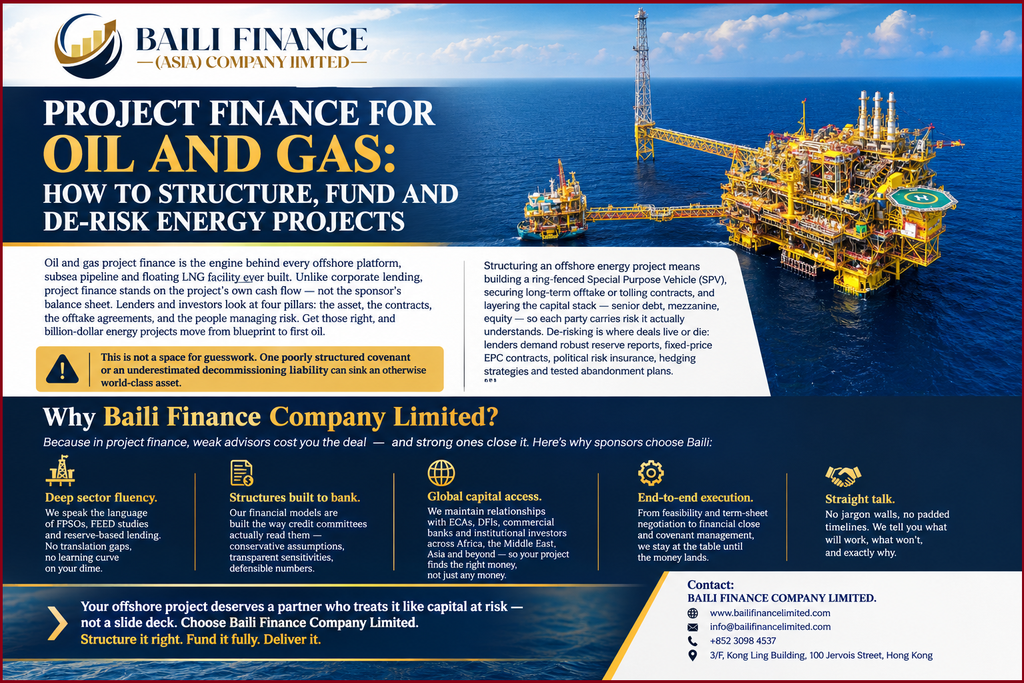
For project sponsors, understanding oil and gas project financing, energy project finance, limited-recourse financing, reserve-based lending, debt structuring, equity requirements, offtake agreements, and lender due diligence can make the difference between an attractive project and a financeable project.
The fundamental principle remains straightforward: lenders need a credible path to repayment.
In conventional project finance, lenders primarily assess the project’s expected cash flow, assets, contracts, and risk allocation rather than relying solely on the sponsor’s corporate balance sheet. A project company, often structured as a special purpose vehicle (SPV), usually owns the project assets and enters into the key project contracts.
For oil and gas transactions, however, that structure becomes more demanding because lenders must also consider reserves, production profiles, commodity prices, operating performance, transportation capacity, regulatory conditions, political risk, environmental obligations, and the ability of the project to generate hard-currency revenues where applicable.
Keywords: Project finance for oil and gas, Oil and gas project financing, oil and gas finance, energy project finance, oil and gas infrastructure financing, petroleum project finance, LNG project finance, pipeline project finance, oil field development financing, project finance structure, limited-recourse financing, financial modelling, debt financing, project bankability. oil and gas debt financing, limited recourse oil and gas financing, oil and gas financial modelling, oil and gas project funding, financing oil and gas projects in emerging markets
What Is Project Finance for Oil and Gas?
Project finance for oil and gas is a financing structure in which lenders base much of their credit assessment on the expected cash flows and assets of a specific energy project.
Unlike ordinary corporate lending, the financing doesn’t depend entirely on the sponsor’s existing balance sheet.
Instead, the transaction typically places the project inside an SPV. The SPV raises debt and equity, owns or controls the relevant project assets, signs commercial agreements, receives project revenues, pays operating expenses and debt service, and distributes surplus cash according to an agreed financing structure.
The World Bank describes project financing as a structure where repayment primarily relies on project-generated cash flow rather than the sponsors’ balance sheets. Lenders typically receive security over project assets and future revenue streams.
This approach can support large capital-intensive developments where the sponsor doesn’t want to fund the entire project from its own balance sheet.
However, project finance doesn’t eliminate risk.
It allocates risk.
That distinction matters.
A lender doesn’t simply ask whether an oil field contains hydrocarbons. The lender asks whether the reserves can support commercial production, whether the infrastructure can transport the production, whether buyers will purchase the output, whether the project can withstand downside scenarios, and whether the resulting cash flow can service debt under the agreed financing terms.
Why Oil and Gas Project Finance Requires Specialist Structuring
Oil and gas projects combine several risks that can interact.
A development may have technically recoverable reserves but still struggle to obtain financing if the project lacks transportation infrastructure. Similarly, a pipeline may have strong engineering specifications but weak bankability if it doesn’t have sufficient contracted throughput.
Commodity exposure creates another challenge.
Oil prices and natural gas prices can move significantly because supply disruptions, geopolitical events, weather, economic conditions and changes in demand can affect markets. The U.S. Energy Information Administration notes that geopolitical events and supply disruptions can increase uncertainty and price volatility in crude oil markets.
Consequently, lenders don’t usually base debt capacity on an optimistic commodity-price forecast.
They test downside cases.
They may examine:
- Lower oil or gas prices
- Reduced production volumes
- Delayed production
- Higher operating costs
- Construction cost overruns
- Interest-rate increases
- Foreign-exchange movements
- Reserve underperformance
- Pipeline capacity constraints
- Offtaker default
- Political or regulatory disruption
- Force majeure
- Tax and royalty changes
- Refinancing risk
By stress-testing these variables, lenders can determine whether the project can continue servicing debt when assumptions deteriorate.
The Core Structure of an Oil and Gas Project Finance Transaction
A typical transaction may involve several participants.
Project Sponsor
The sponsor originates and develops the project.
It may contribute equity, arrange development capital, negotiate commercial agreements and provide technical expertise. Sponsors can include international oil companies, national oil companies, independent exploration and production companies, infrastructure investors, private equity firms and strategic investors.
Special Purpose Vehicle
The SPV provides the legal and financial structure for the project.
Its activities normally focus on the project rather than unrelated businesses. This structure helps lenders identify the assets, contracts, revenues and obligations supporting their financing.
Lenders
Commercial banks, development finance institutions, export credit agencies, institutional investors and other financing institutions can participate depending on the transaction.
A large project may use a syndicated loan in which several lenders participate under coordinated financing documentation.
Equity Investors
Equity provides risk capital.
Because equity ranks behind senior debt in the repayment structure, investors normally require returns that reflect the higher risk they assume.
Contractors
Engineering, procurement and construction contractors can have a major role in construction-stage risk allocation.
A well-structured EPC contract can provide defined scope, pricing, schedule obligations, testing requirements, warranties and remedies for certain failures.
Offtakers
Offtakers purchase the project’s output.
Depending on the project, the output may include crude oil, natural gas, LNG, refined petroleum products or transportation capacity.
A credible offtake arrangement can strengthen revenue visibility and therefore improve debt bankability.
Government and Regulators
Government entities may provide licences, concessions, petroleum rights, permits, fiscal arrangements or other approvals.
In some jurisdictions, government support mechanisms may also address specific political or contractual risks.
Key Sources of Oil and Gas Project Finance
There isn’t one universal financing structure.
The appropriate structure depends on the project’s development stage, reserves, revenue model, jurisdiction, sponsor strength, contracts and risk profile.
Senior Debt
Senior project debt usually receives priority over subordinated debt and equity.
Lenders focus heavily on debt-service capacity, security, cash-flow stability and financial covenants.
Subordinated Debt
Subordinated debt ranks behind senior debt but ahead of equity.
It can increase total project funding while reducing the immediate amount of sponsor equity required, although it normally carries greater pricing or structural risk than senior debt.
Sponsor Equity
Sponsors provide equity to absorb project risk.
Equity contributions can occur during development, construction or later stages depending on the agreed financing structure.
Development Finance
Development finance institutions can provide loans, guarantees, risk-sharing instruments or mobilization support.
For emerging-market oil and gas projects, development institutions may also address specific political, environmental, social or financing risks.
For example, IFC provides loans, guarantees and structured finance solutions and can mobilize additional capital through its financing platform.
Export Credit Agency Financing
Export credit agencies can support qualifying transactions involving equipment, contractors or exports from their respective countries.
This can become relevant for large capital expenditures involving international engineering and equipment suppliers.
Mezzanine and Hybrid Capital
Mezzanine financing can sit between senior debt and equity.
It can provide additional funding where conventional senior debt cannot cover the entire capital requirement.
The trade-off usually involves higher financing costs or more complex repayment and security arrangements.
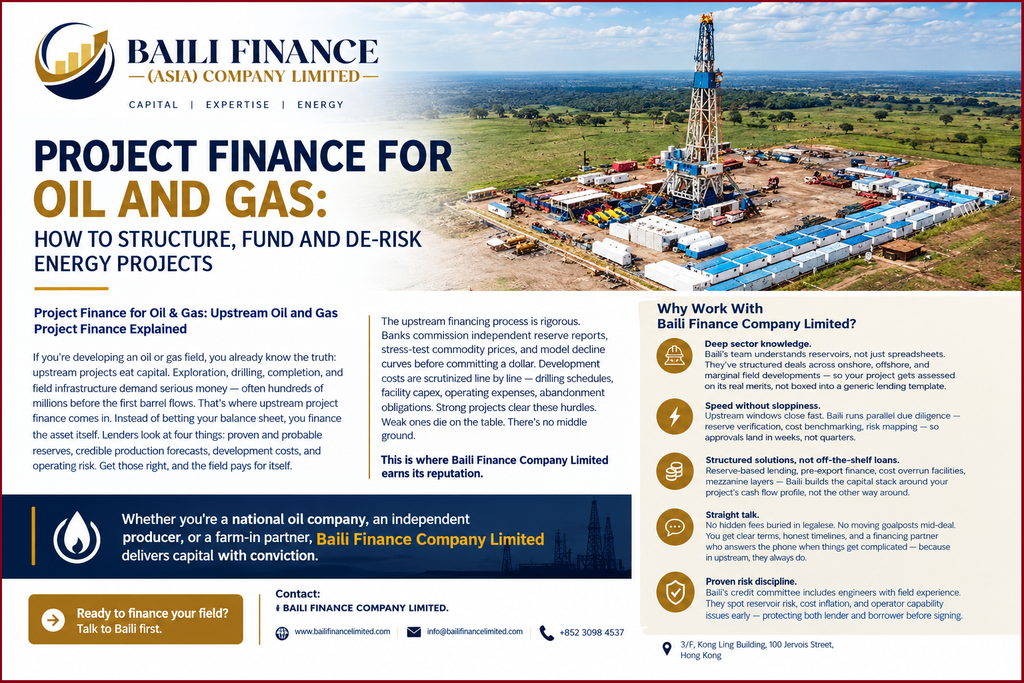
Upstream Oil and Gas Project Finance
Upstream projects involve exploration, appraisal, field development and production.
The financing analysis begins with the petroleum asset.
Lenders and investors need evidence supporting:
- Reserves and resources
- Production forecasts
- Reservoir performance
- Development plans
- Well economics
- Drilling schedules
- Field operating costs
- Capital expenditure
- Recovery assumptions
- Infrastructure requirements
- Petroleum rights
- Fiscal terms
- Environmental and social obligations
Reserve and production analysis becomes particularly important because future project revenue depends directly on the ability to produce and sell hydrocarbons.
The lender’s technical adviser may therefore review reservoir models, production forecasts, drilling programmes, field development plans and operating assumptions.
A project can have substantial resources and still face financing constraints if the lender cannot establish sufficient confidence in commercial production.
Midstream Oil and Gas Project Finance
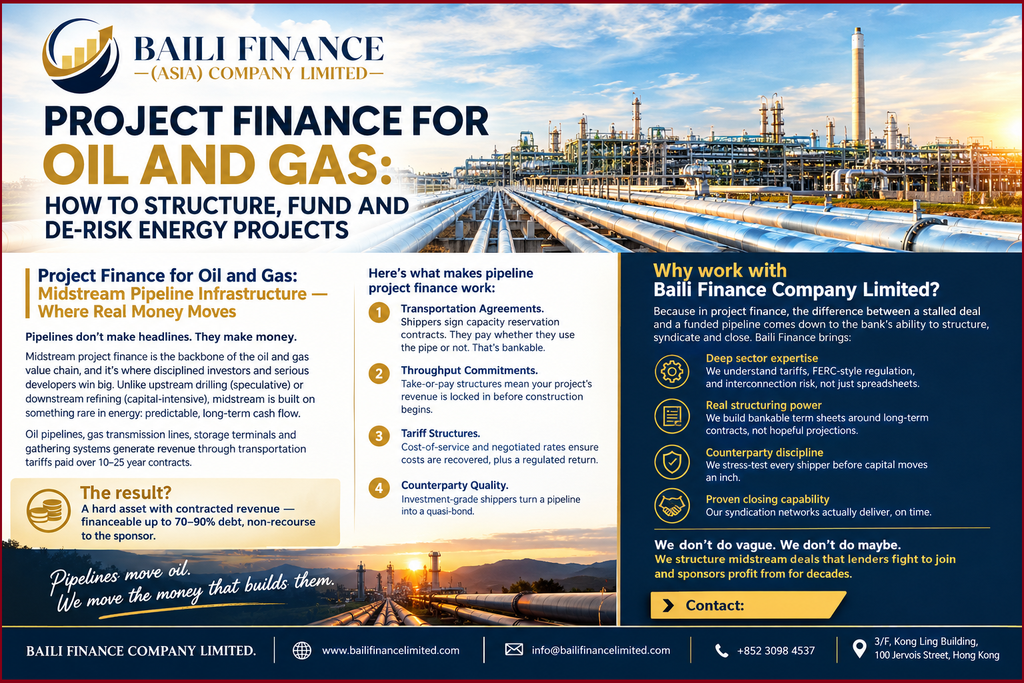
Midstream projects include pipelines, gas processing plants, storage facilities, gathering systems, terminals and transportation infrastructure.
The financing model often depends on contracted revenue.
For a pipeline, for example, lenders may examine:
- Throughput commitments
- Transportation tariffs
- Shipper credit quality
- Take-or-pay arrangements
- Pipeline capacity
- Expansion requirements
- Interconnection agreements
- Regulatory approvals
- Construction costs
- Operating expenses
This makes commercial contracts central to the financing structure.
A pipeline with strong contracted capacity may offer lenders greater revenue visibility than an infrastructure asset that depends entirely on future volumes.
LNG and Gas Project Finance
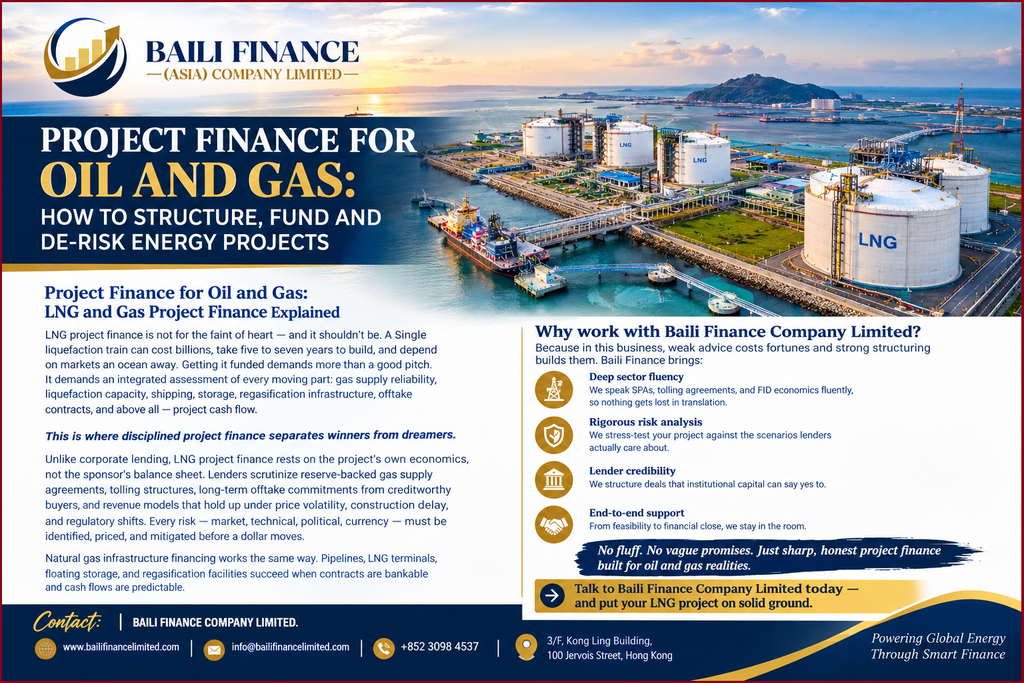
LNG projects require substantial capital and complex infrastructure.
A typical LNG development may involve upstream gas production, gathering infrastructure, processing, liquefaction, storage, marine facilities and shipping arrangements.
Consequently, lenders examine the entire value chain.
They need to understand whether sufficient gas will reach the LNG facility, whether the plant can achieve expected production levels, and whether buyers have sufficient contractual commitments.
Natural gas markets also respond to changes in production, storage, imports, exports and demand.
Therefore, the financing model should incorporate realistic assumptions for gas supply, LNG production, contracted sales and operating performance.
Downstream Petroleum Project Finance
Downstream projects may include:
- Refineries
- Fuel storage terminals
- LPG facilities
- Petroleum product pipelines
- Marine terminals
- Distribution infrastructure
- Petrochemical plants
The lender’s analysis changes because the project depends more heavily on feedstock supply, refining margins, product demand, logistics and operating efficiency.
A refinery, for example, faces different risks from an upstream oil field.
The key question isn’t simply whether crude exists.
The question becomes whether the facility can reliably process the required feedstock and sell its products at prices that support operating costs, taxes, financing costs and investor returns.
How Lenders Assess Oil and Gas Project Bankability
Bankability means that a project can satisfy the technical, legal, commercial and financial requirements necessary to obtain financing.
Several areas receive particular attention.
1. Technical Feasibility
Independent technical advisers typically assess the project’s engineering assumptions.
They may examine design, construction methodology, production forecasts, equipment specifications, maintenance requirements and operating assumptions.
2. Commercial Viability
Lenders need a credible revenue model.
They review offtake contracts, pricing mechanisms, transportation agreements, customer concentration and market demand.
3. Legal Structure
The lender needs enforceable rights.
That includes the SPV structure, petroleum licences, concessions, land rights, contracts, security documents and lender step-in rights where applicable.
4. Financial Model
The financial model connects the technical and commercial assumptions.
It normally projects:
- Revenue
- Operating expenditure
- Capital expenditure
- Taxes
- Royalties
- Working capital
- Debt service
- Interest
- Principal repayment
- Cash reserves
- Distributions
- Equity returns
5. Debt-Service Capacity
One of the central metrics is the Debt Service Coverage Ratio (DSCR).
A simplified formula is:
DSCR = Cash Flow Available for Debt Service ÷ Debt Service
A DSCR above 1.00x means that projected cash available for debt service exceeds scheduled debt service.
However, lenders normally establish minimum covenant levels and test them under downside scenarios.
The World Bank notes that lenders use financial ratios and sensitivities to assess project resilience, including scenarios involving higher construction costs or lower revenues.
6. Security Package
A project-finance security package can cover project assets, project agreements, receivables, bank accounts, insurance proceeds and other relevant rights.
The precise security package depends on local law and the transaction structure.
Oil and Gas Project Finance Risk Allocation
Successful project finance doesn’t make risks disappear.
It assigns them to the party best positioned to manage them.
For example:
| Risk | Typical Risk Allocation |
|---|---|
| Construction delay | EPC contractor / sponsors |
| Cost overrun | Sponsors / contractors |
| Reservoir performance | Sponsors / project company |
| Commodity price | Project company / hedging counterparties |
| Offtake risk | Offtaker / project company |
| Political risk | Government / insurers / DFIs |
| Currency risk | Project company / hedging counterparties |
| Operating risk | Operator |
| Environmental risk | Project company / operator |
| Force majeure | Contractually allocated |
| Interest-rate risk | Project company / lenders / hedge counterparties |
The allocation depends on the contracts.
For lenders, the objective is not to eliminate every risk. It is to ensure that material risks have identifiable owners, contractual protections and practical mitigation measures.
Contracts That Support Bankability
Project finance transactions rely on an interconnected contract structure.
Common agreements include:
- Petroleum licence or concession
- Production Sharing Agreement
- Joint Operating Agreement
- EPC contract
- Operations and Maintenance Agreement
- Offtake Agreement
- Transportation Agreement
- Gas Sales Agreement
- LNG Sales Agreement
- Feedstock Supply Agreement
- Port or terminal agreement
- Insurance policies
- Hedging agreements
- Financing agreements
- Direct agreements
- Government support agreements
The strength of the financing often depends on how these agreements interact.
A delay under an EPC contract, for example, can affect production commencement. That delay can reduce revenue, which can affect debt service.
The financing documents therefore need to connect contractual remedies with the lender’s rights.
Environmental, Social and Governance Due Diligence
Environmental and social considerations now form a central part of many large project-finance transactions.
Oil and gas projects can involve land acquisition, biodiversity impacts, emissions, worker safety, community health, resettlement, pollution risks and emergency-response requirements.
IFC’s Performance Standards provide a framework for identifying and managing environmental and social risks, including stakeholder engagement and disclosure requirements.
IFC also categorizes investments according to the scale and nature of their environmental and social risks.
For sponsors seeking oil and gas project financing, addressing these matters early can reduce delays during lender due diligence.
A strong financing process therefore shouldn’t treat ESG as a final compliance exercise.
It should integrate environmental and social risk management into project development.
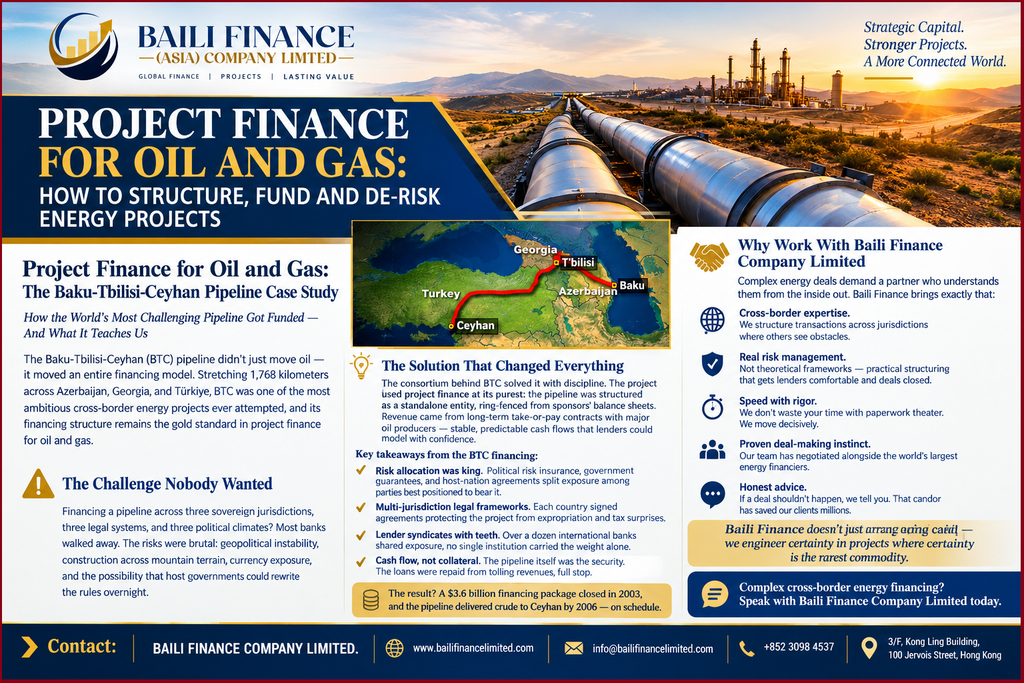
Real-World Example: The Baku-Tbilisi-Ceyhan Pipeline
The Baku-Tbilisi-Ceyhan (BTC) pipeline provides a useful example of how oil production, transportation infrastructure, contractual arrangements and project financing can operate together.
The pipeline connects oil production in Azerbaijan to the Mediterranean through Georgia and Turkey.
IFC documentation states that the BTC pipeline extends approximately 1,760 kilometres and was designed to transport crude oil from the Azeri-Chirag-Gunashli fields toward the Mediterranean.
The project involved several jurisdictions and significant infrastructure requirements.
That structure created several financing considerations:
- Cross-border political risk
- Construction risk
- Transportation risk
- Production risk
- Environmental and social risk
- Contractual risk
- Government participation
- Long-term revenue visibility
IFC reported that its role included providing long-term financing and mobilizing commercial bank funding while helping address political, environmental and social risks.
The example demonstrates an important principle: large oil and gas infrastructure projects rarely depend on one financing instrument.
They require coordinated capital, contractual protection, technical assessment and risk allocation.
For readers seeking a detailed foundational reference on how project finance works, the World Bank’s Project Finance – Key Concepts provides a useful external resource for understanding SPVs, limited recourse, project cash flow and contractual structures. World Bank: Project Finance – Key Concepts
Case Study: Financing the Ghana Jubilee Development
Ghana provides another relevant example for African energy markets.
The Jubilee field became an important offshore oil development, requiring substantial technical, environmental, commercial and financial coordination.
IFC’s disclosed documentation concerning Tullow Oil states that IFC financing supported activities connected with the Jubilee Field Phase 1 Development and that the financing process considered environmental and social requirements alongside the commercial transaction.
IFC also reported that its participation could help mobilize commercial-bank financing and provide greater comfort to lenders operating in an emerging and developing African oil market.
The case illustrates several practical lessons for oil and gas financing in Africa.
First, lenders need more than geological potential.
They need a structured development plan.
Second, international financing can involve environmental and social standards that sit alongside domestic regulatory requirements.
Third, development-finance participation can help mobilize additional private capital where lenders perceive elevated market or project risks.
Fourth, sponsors need to prepare for lender scrutiny before approaching the financing market.
Common Mistakes That Delay Oil and Gas Financing
Sponsors can lose time when they approach lenders before establishing the project’s financeability.
Common problems include:
Incomplete Financial Models
A model that doesn’t integrate production, pricing, operating expenditure, taxes, royalties and debt service won’t provide lenders with a reliable basis for analysis.
Unrealistic Commodity Assumptions
Using aggressive oil or gas price assumptions can materially inflate projected cash flow.
Lenders will normally test downside cases.
Weak Offtake Arrangements
Revenue visibility matters.
Where buyers haven’t committed sufficient volumes or contractual protections remain incomplete, lenders may treat revenue assumptions conservatively.
Poor Risk Allocation
Sponsors sometimes transfer contractual risks without confirming whether the counterparty can actually absorb them.
A risk allocation is only useful when the responsible party has the financial and operational capacity to manage the risk.
Late Environmental and Social Due Diligence
Environmental and social matters can affect permits, construction schedules, stakeholder relationships and financing conditions.
Addressing them late can delay financial close.
Insufficient Sponsor Equity
High leverage can increase debt-service pressure.
The World Bank notes that project finance involves higher transaction complexity and can carry higher debt costs than some conventional financing alternatives.
The financing structure should therefore balance leverage with project resilience.
A Practical Oil and Gas Project Finance Process
A disciplined process can improve financing readiness.
Step 1: Define the Project
Establish the project’s scope, ownership, development stage, capital requirement and revenue model.
Step 2: Establish the Legal Structure
Determine the SPV, ownership percentages, petroleum rights, licences and contractual relationships.
Step 3: Develop the Technical Case
Prepare reserve studies, engineering designs, development plans, production forecasts and capital expenditure estimates.
Step 4: Build the Financial Model
Integrate technical assumptions with revenue, expenditure, tax, debt and equity assumptions.
Step 5: Identify Financing Requirements
Determine the required debt, equity, subordinated capital, guarantees and other financing instruments.
Step 6: Complete Due Diligence
Coordinate technical, legal, financial, tax, insurance, environmental and social due diligence.
Step 7: Structure Risk Mitigation
Assess hedging, guarantees, insurance, reserve accounts, sponsor support, contractual protections and other mechanisms.
Step 8: Approach Potential Financiers
Present a clear investment memorandum, financial model, data room and financing proposal.
Step 9: Negotiate Term Sheets
Agree key commercial terms before progressing toward detailed documentation.
Step 10: Reach Financial Close
Once conditions precedent have been satisfied, financing documents can become effective and lenders can begin funding according to the agreed drawdown conditions.
What Investors Should Prepare Before Seeking Oil and Gas Financing
A financing request becomes easier to evaluate when the sponsor presents the information in a structured manner.
A professional financing package should generally cover:
Project overview: location, ownership, development stage and project objectives.
Technical information: reserves, resources, production forecast, engineering studies and development plan.
Commercial information: customers, offtake arrangements, pricing, transportation and market analysis.
Financial information: capital expenditure, operating expenditure, financial model, funding requirement and projected returns.
Legal information: licences, concessions, petroleum agreements, land rights and material contracts.
Risk analysis: technical, commercial, political, environmental, social, currency and commodity risks.
Management information: sponsor experience, operator capability and project governance.
Financing proposal: requested amount, tenor, proposed security, repayment source and expected financial close.
When preparing these materials early, sponsors can reduce avoidable information gaps during lender due diligence.
Frequently Asked Questions About Project Finance for Oil and Gas
1. What is project finance for oil and gas?
Project finance for oil and gas is a financing approach that bases repayment primarily on the expected cash flow and assets of a specific project. The structure commonly uses an SPV and may limit lender recourse to project assets and agreed sponsor support.
2. How does oil and gas project finance work?
The sponsor establishes the project structure, develops the technical and commercial case, secures required contracts and raises debt and equity. Lenders then assess the project’s expected cash flow, risks, contracts, assets, security and repayment capacity before financial close.
3. What documents do lenders require for oil and gas project financing?
Requirements vary, but lenders commonly request technical studies, reserve reports, financial models, licences, petroleum agreements, project contracts, environmental and social studies, insurance information, corporate documents and detailed financing assumptions.
4. What risks do lenders consider in oil and gas project finance?
Lenders can assess reserve risk, production risk, construction risk, commodity-price risk, operating risk, political risk, currency risk, regulatory risk, environmental and social risk, offtake risk and refinancing risk.
5. What is the difference between corporate finance and project finance?
Corporate finance generally relies on the borrower’s overall balance sheet and credit strength. Project finance focuses more directly on the cash flow, assets, contracts and risk allocation of a particular project.
6. Can oil and gas projects receive limited-recourse financing?
Yes. Limited-recourse project finance can restrict lender recourse to project assets, cash flows and specifically negotiated sponsor support. The exact structure depends on the transaction, jurisdiction, project risks and lender requirements.
7. How important is the financial model in oil and gas project finance?
It’s critical. The financial model connects production, commodity prices, operating costs, capital expenditure, taxes, royalties, debt service and investor returns. Lenders can use it to test downside scenarios and debt-service capacity.
8. Can development finance institutions participate in oil and gas financing?
Depending on their mandates and applicable policies, development finance institutions can provide loans, guarantees, risk-sharing products or mobilization support. Their participation can also influence environmental, social and governance requirements.
9. What makes an oil and gas project bankable?
Bankability usually depends on a combination of technical feasibility, credible reserves or feedstock, reliable production assumptions, contractual revenue, appropriate risk allocation, strong sponsors, enforceable legal rights, adequate equity and sufficient projected cash flow to service debt.
10. How long does oil and gas project financing take?
There isn’t a standard timeline. A transaction can take significantly longer when the project requires complex technical studies, government approvals, cross-border agreements, environmental and social assessments, multiple lenders or extensive contractual negotiations.
Why Professional Project Finance Advisory Matters
Oil and gas financing involves multiple disciplines.
Financial modelling alone doesn’t establish bankability.
A technically viable project may still fail to reach financial close because the revenue structure remains weak. Conversely, a commercially attractive project may require additional technical work before lenders can quantify production risk.
Professional advisory support can help sponsors connect these areas.
That may include:
- Financial modelling
- Capital-structure design
- Debt and equity strategy
- Lender engagement
- Investor presentations
- Transaction structuring
- Financial due diligence
- Project feasibility analysis
- Risk assessment
- Financing documentation support
- Financial-close preparation
The objective should be practical: create a transaction that lenders can understand, investors can evaluate and the project can support.
The Strategic Importance of Financial Modelling
For an oil and gas project, the financial model should do more than calculate an expected return.
It should answer difficult questions.
What happens if production starts six months late?
What happens if capital expenditure increases by 15%?
What happens if oil prices decline?
What happens if production reaches only 80% of the base case?
What happens if operating costs increase?
What happens if the exchange rate moves materially?
What happens if the offtaker pays late?
A robust model makes these scenarios visible.
It also allows sponsors to assess debt capacity before entering lender negotiations.
That can improve the quality of the financing discussion and reduce the risk of building a capital structure around assumptions that lenders won’t accept.
Final Summary
Project finance for oil and gas is fundamentally a process of converting a technically and commercially viable energy project into a financeable investment.
The strongest transactions connect the project’s reserves, production profile, infrastructure, contracts and revenue model with a disciplined capital structure.
For sponsors, the key priorities include establishing credible technical assumptions, developing a robust financial model, securing bankable commercial agreements, allocating risks appropriately, maintaining adequate equity, addressing environmental and social requirements early, and preparing a complete lender due-diligence package.
For lenders, the focus remains repayment capacity, security, contractual protections and downside resilience.
For investors, the central questions concern risk-adjusted returns, capital requirements, project execution and long-term cash generation.
Oil and gas projects can involve substantial capital requirements and complex risks. Therefore, financing should begin with bankability rather than simply the amount of money required.
If you’re developing an upstream field, pipeline, gas-processing facility, LNG project, storage terminal, refinery or other energy infrastructure project, the next step should be a structured assessment of the project’s capital requirement, financing capacity, risk allocation, projected cash flow and lender requirements.
Ready to Turn Your Energy Project Into a Financeable Transaction?
Don’t wait until lenders identify the weaknesses in your project.
Bring the financing question forward.
Baili Finance Limited can help you examine the commercial and financial structure of your project, assess funding requirements, strengthen the financing case and prepare the transaction for serious discussions with potential capital providers.
If your project has the assets, contracts, market opportunity and management capability, the next question is whether the financial structure can support it.
Contact Baili Finance Limited today to discuss your oil and gas project financing requirements and start building a financeable funding strategy.
Visit: www.bailifinancelimited.com
Intermediaries/Consultants/Brokers are welcome to bring their clients 100% protected. Our brokers receive 2% commission for referral. We assist Clients and brokers in their attempt to secure funding by working on their funding requests that may require innovative financing. In complete confidence, we will work together for the benefits of all parties involved.
#ProjectFinance #OilAndGas #EnergyFinance #OilAndGasFinance #ProjectFinancing #EnergyInvestment #InfrastructureFinance #FinancialModelling #OilAndGasInvestment