Headline: 10 Smart Ways to Fund Business Expansion Without Cash-Flow Pressure
Business expansion can create significant opportunities, but growth also requires capital. A business loan for expansion can help a company increase inventory, purchase equipment, open another location, enter a new market, hire staff, fulfil larger contracts, or strengthen working capital before additional revenue arrives.

However, borrowing shouldn’t start with the question, “How much can we get?”
It should start with a more important question:
How much financing does the business actually need to execute a specific growth plan while maintaining healthy cash flow?
That distinction matters.
A company can generate strong sales and still experience a funding shortage. Customers may pay after 30, 60, or 90 days, while suppliers, employees, landlords and service providers expect payment earlier. Expansion can therefore increase revenue while simultaneously increasing the amount of working capital the business requires.
For companies considering business expansion financing, business growth loans, working capital loans, equipment finance or structured funding, the objective should be clear: secure appropriate capital, deploy it productively and maintain a repayment structure that the business can realistically support.
Current research from the Bank of England reinforces an important point for growing companies: access to finance matters, but the type of finance needs to match the company’s stage, cash flow, assets and growth requirements. Its 2026 research also highlights the growing role of banks, specialist lenders and non-bank finance in supporting businesses.
For businesses planning their next stage of growth, that principle is essential.
Keywords: business loan for expansion, business expansion loan, business expansion financing, business growth loan, expansion funding, business loan for growth financing to expand a business, working capital loan, commercial business loan, SME business finance, business funding, equipment financing, business loan for new branch, business expansion funding, corporate financing, international business expansion financing
What Is a Business Loan for Expansion?
A business loan for expansion is commercial financing obtained specifically to fund activities that increase a company’s capacity, revenue potential, geographic reach, production capability or market presence.
Depending on the lender and transaction, expansion financing can support:
- Opening a new branch or facility
- Purchasing commercial property
- Expanding an existing facility
- Buying machinery and equipment
- Increasing inventory
- Hiring additional employees
- Entering a new geographic market
- Expanding distribution
- Developing new products
- Upgrading technology
- Fulfilling larger contracts
- Supporting international trade
- Funding acquisition opportunities
- Strengthening working capital
- Financing construction or infrastructure
- Supporting project development
The exact structure matters because a short-term working capital requirement shouldn’t automatically receive the same financing structure as a five-year equipment investment.
For example, a company purchasing machinery expected to generate additional revenue over several years may require medium- or long-term financing. A distributor waiting 60 days for customer payment may need a shorter working capital facility.
The financing should match the commercial purpose.
Businesses can explore financing and structured funding solutions through Baili Finance Limited, particularly where an expansion requirement involves business growth, working capital, trade finance or a more complex commercial transaction.
10 Smart Ways to Fund Business Expansion Without Cash-Flow Pressure
Business expansion creates opportunities—but growth can become dangerous when it puts too much pressure on working capital.
The goal is not simply to find money. The goal is to choose the right funding structure for the right business need, while protecting the cash required for payroll, inventory, suppliers, operations, and unexpected expenses.
From revenue-based financing and equipment leasing to invoice financing, strategic investors, and staged funding, here are 10 smart ways businesses can finance expansion without unnecessarily squeezing cash flow.
1. Match Financing to the Asset’s Lifespan
One of the most important principles of business financing is simple:
Long-term assets should generally be financed with long-term funding, while short-term working-capital needs should be matched with short-term facilities.
For example, financing a warehouse with a six-month facility can create unnecessary refinancing pressure. Conversely, financing short-term inventory with a ten-year loan can leave a business paying interest long after the inventory has been sold.
A properly structured financing plan aligns the repayment period with the economic life of the asset or the cash flow it generates.
This helps businesses avoid unnecessary cash-flow mismatches and gives management greater visibility over future obligations.
2. Consider Revenue-Based Financing
Revenue-based financing can provide an alternative to traditional fixed-payment borrowing.
Under this structure, the business repays the financing through an agreed percentage of revenue until a predetermined repayment amount or cap is reached. When revenue is lower, the payment may also be lower, depending on the terms of the agreement.
This can be particularly relevant to businesses with recurring or relatively predictable revenue, including certain SaaS, subscription, e-commerce, and service businesses.
However, companies should carefully compare the total repayment cost, revenue percentage, repayment cap, contractual restrictions, and effective cost of capital before choosing this option.
Flexible payments do not necessarily mean inexpensive financing.
3. Lease Equipment Instead of Buying It Outright
Expansion often requires machinery, vehicles, technology, production equipment, or other capital assets.
Instead of paying the entire purchase price upfront, a business may be able to lease the equipment and spread payments over several years.
The major advantage is working-capital preservation. The business can deploy more of its available cash toward inventory, hiring, marketing, and other growth requirements while the equipment is being used to generate revenue.
Depending on the jurisdiction and lease structure, there may also be accounting or tax considerations worth evaluating with professional advisers.
For asset-intensive businesses, equipment leasing can therefore be an effective part of a broader expansion strategy.
4. Use Prepaid Revenue to Help Finance Growth
Sometimes the best source of expansion capital is already sitting inside the customer base.
Businesses with strong customer relationships may be able to generate upfront cash through:
- Annual prepaid contracts
- Subscription prepayments
- Customer deposits
- Pre-orders
- Discounted multi-year agreements
- Founding-member or early-access programs
For example, a software company could offer customers a preferential rate in exchange for paying twelve months upfront.
This effectively converts future contracted revenue into cash today.
The important consideration is ensuring the business can actually deliver the products or services promised. Prepaid revenue creates liquidity, but it also creates a performance obligation.
5. Negotiate Better Payment Terms with Suppliers
Supplier terms can have a significant impact on working capital.
Moving from Net-30 to Net-60 or Net-90 terms, where commercially appropriate, gives the business additional time to sell inventory or collect customer payments before paying suppliers.
Combine extended supplier terms with faster customer collections, deposits, or prompt-payment incentives, and the business can create a more efficient working-capital cycle.
However, extended terms should be negotiated transparently rather than simply treating suppliers as an unlimited source of financing.
Strong supplier relationships, purchasing volumes, payment history, and creditworthiness can all improve negotiating power.
6. Explore Government and Industry Funding Programs
Depending on the country, industry, and purpose of the expansion, businesses may have access to grants, subsidized financing, export-support programs, technology incentives, green-transition programs, or employment initiatives.
These programs can be particularly attractive because grants generally do not require equity dilution, while subsidized financing may carry more favorable terms than conventional borrowing.
But businesses should avoid treating every grant or government program as “free money.”
Eligibility requirements, reporting obligations, matching-fund requirements, application deadlines, and permitted uses of funds can be significant.
The right program is one that genuinely fits the expansion project—not one pursued simply because the funding appears inexpensive.
7. Bring in Strategic Investors, Not Just Capital
An investor can contribute much more than money.
A strategic investor may also provide:
- Industry expertise
- Customer relationships
- Distribution channels
- Technology
- Supplier access
- Market credibility
- International connections
- Operational expertise
For example, a major customer investing in a supplier’s production expansion may help both companies secure additional capacity.
This type of investment can reduce the amount of external capital the business needs while strengthening the commercial relationship.
However, strategic investment also means giving up some ownership, control, or economic participation. The strategic value must therefore justify the dilution and governance implications.
8. Monetize Receivables Through Invoice Financing
A growing business can become profitable on paper while still experiencing cash-flow pressure because customers may take 30, 60, 90, or more days to pay.
Invoice financing can help bridge that timing gap.
Depending on the structure, a financier may advance a percentage of eligible invoices and provide the remaining amount—less fees and applicable charges—after the customer pays.
This can be particularly useful for businesses selling to financially strong corporate or institutional customers with predictable payment cycles.
Unlike a conventional term loan, the financing is directly connected to receivables generated by the business.
But companies should examine advance rates, fees, recourse provisions, customer notification requirements, concentration limits, and the actual annualized cost before proceeding.
9. Consider Asset-Based Lending
Businesses with substantial assets may be able to borrow against eligible receivables, inventory, equipment, or other qualifying assets.
Asset-based lending can provide a revolving source of working capital while allowing the business to leverage its existing balance sheet.
This can be particularly relevant to:
- Manufacturers
- Distributors
- Importers and exporters
- Inventory-heavy businesses
- Asset-intensive companies
The facility may grow as the borrowing base grows, subject to the lender’s eligibility and advance-rate requirements.
However, businesses must understand the consequences of pledging assets as collateral. A lower-cost secured facility can still create significant risk if the company cannot maintain the required financial and collateral conditions.
10. Stage Expansion Through Milestone-Based Funding
One of the most effective ways to reduce financing pressure is to avoid funding the entire expansion at once.
Instead, divide the project into measurable stages.
For example:
Phase 1: Enter the new market
Phase 2: Reach a defined revenue target
Phase 3: Expand inventory or production capacity
Phase 4: Open additional locations or facilities
Phase 5: Scale internationally
Funding can then be released according to predefined milestones.
This approach can work with internal capital, investor commitments, construction drawdowns, project financing, or lender facilities.
The advantage is straightforward: the business commits capital progressively as evidence of performance develops.
That can reduce unnecessary borrowing, limit dilution, and prevent the company from carrying financing costs for capital it does not yet need.
The Bottom Line
Cash-flow pressure is not necessarily caused by expansion itself.
It is often caused by financing growth with the wrong structure, at the wrong time, or in an amount that exceeds the business’s ability to service it.
A smarter approach is to build a financing strategy around the company’s actual cash-flow cycle.
A business might use customer deposits and supplier terms during the early stage, invoice financing as receivables grow, equipment leasing for new assets, and staged funding as expansion milestones are achieved.
The right combination depends on the business, its balance sheet, contractual commitments, assets, revenue profile, creditworthiness, and expansion objectives.
Before committing to any financing structure, model the expected cash flow month by month under conservative assumptions.
Stress-test:
- Revenue falling below projections
- Customer payment delays
- Higher operating costs
- Interest-rate increases
- Foreign-exchange movements
- Delayed project completion
- Unexpected capital expenditure
If the expansion only works when everything goes perfectly, it is not a robust financing plan.
It is a hope.
Smart expansion financing is about preserving flexibility while putting capital to work. The objective is not simply to raise more money—it is to build a structure that allows the business to grow while keeping its operating cash flow resilient.
Why Businesses Use Expansion Loans
Expansion rarely happens without upfront expenditure.
Before the additional revenue appears, the business may need to spend money on people, premises, equipment, stock, technology, marketing and logistics.
That creates a timing issue.
1. Increase Working Capital
Working capital supports the daily operating cycle of a business.
When sales increase, expenses often increase before customers pay.
A growing wholesaler may need to purchase more stock. A manufacturer may need additional raw materials. A contractor may need to pay workers and suppliers before receiving payment from the client.
A working capital business loan can help bridge that gap.
The financing may support:
- Supplier payments
- Inventory purchases
- Payroll
- Transportation
- Rent
- Production costs
- Receivables gaps
- Contract execution
- Operating expenses
The important point is that the borrowing should have a defined commercial purpose and a credible repayment source.
Borrowing repeatedly to cover operating losses doesn’t solve a structural business problem. It delays it.
2. Purchase Equipment and Machinery
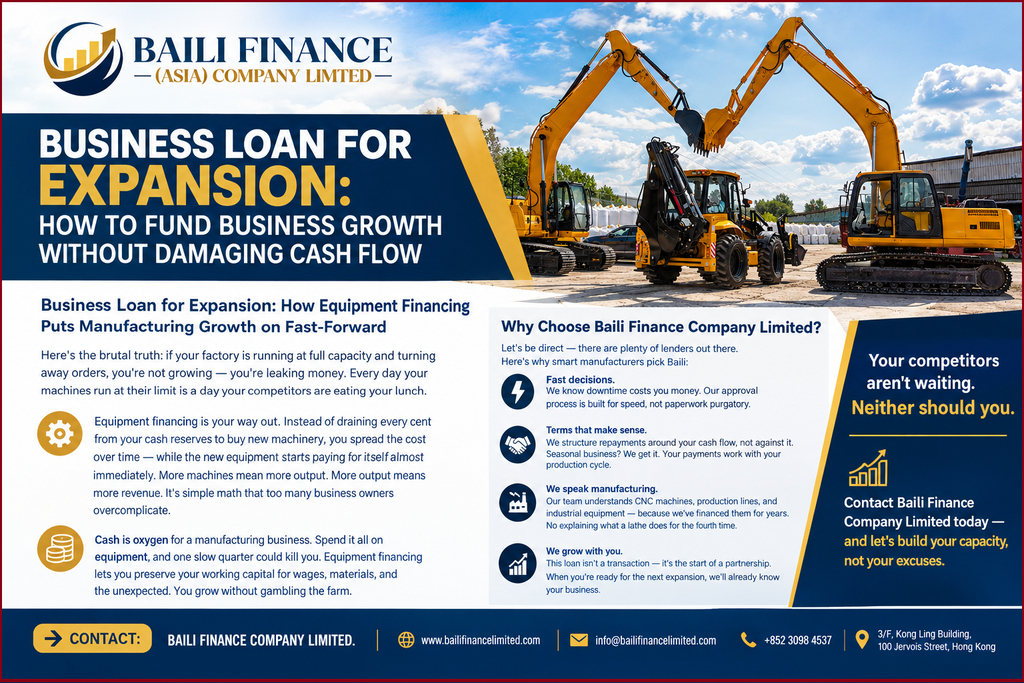
Expansion often requires greater production capacity.
A manufacturing business may receive more orders than its existing machinery can handle. A logistics company may need additional vehicles. A construction company may require new equipment to execute larger projects.
Equipment financing can help businesses acquire productive assets without paying the entire cost from existing cash reserves.
The decision should be based on incremental cash flow.
Before borrowing, calculate:
Additional revenue − additional operating costs − financing costs = expected incremental cash flow
If the new equipment doesn’t create sufficient economic value, the financing may increase financial pressure rather than improve the business.
3. Open a New Branch
A new location can increase market access, but it can also create significant upfront costs.
These may include:
- Lease or property costs
- Renovation
- Furniture
- Equipment
- Inventory
- Staff recruitment
- Licensing
- Technology
- Security
- Marketing
- Utilities
- Transportation
A business loan for expansion can provide some or all of the capital required, depending on the lender, borrower profile and financing structure.
However, management should establish the expected break-even period before taking on debt.
A branch that requires 18 months to reach break-even needs financing that doesn’t create an unsustainable repayment burden during the first few months.
4. Enter a New Market
Market expansion can require investment before revenue becomes predictable.
A company entering another region may need distribution infrastructure, inventory, local employees, marketing and customer support.
International expansion can add further requirements:
- Import financing
- Export finance
- Foreign exchange management
- Shipping
- Customs
- Insurance
- Letters of credit
- Bank guarantees
- Local regulatory compliance
Therefore, international expansion often requires more than a standard business loan.
A structured financing solution may provide a better fit where the transaction involves contracts, purchase orders, receivables, trade instruments or project-based cash flows.

5. Accept Larger Contracts
Sometimes a company already has demand.
What it lacks is the capital to fulfil that demand.
Consider a supplier that receives a confirmed $3 million purchase order but needs $1.8 million to acquire the goods and fulfil the contract.
The contract creates an opportunity, but the company still needs liquidity.
Appropriate contract financing or working capital financing could potentially bridge the funding gap, subject to lender requirements and due diligence.
This is one reason business owners should distinguish between lack of demand and lack of working capital.
The two problems require different solutions.
The U.S. Small Business Administration’s current 7(a) program, for example, identifies working capital, machinery, equipment, real estate and other business requirements among permitted financing purposes for eligible U.S. businesses. Its Working Capital Pilot also addresses financing needs associated with growing businesses and larger contracts.
The specific programs available to a company will depend on its jurisdiction, eligibility and financing provider.
How Much Should You Borrow for Business Expansion?
The answer shouldn’t be based on the maximum amount a lender offers.
It should be based on the actual capital requirement.
Start with a detailed expansion budget.
For example:
| Expansion Requirement | Estimated Cost |
|---|---|
| Equipment | $450,000 |
| Inventory | $300,000 |
| Staff recruitment | $100,000 |
| Facility improvements | $250,000 |
| Technology | $75,000 |
| Marketing | $50,000 |
| Working capital reserve | $175,000 |
| Total | $1,400,000 |
The business should then determine how much it can contribute from internal resources.
If the company can responsibly contribute $400,000, the potential financing requirement becomes $1 million.
That figure still requires further testing.
Management should model different scenarios.
Base Case
Expected sales occur and customers pay on schedule.
Downside Case
Sales fall by 20%, costs increase and some customers pay later than expected.
Severe Downside Case
Sales decline significantly while operating expenses and financing obligations remain.
If the business can’t service the loan under a reasonable downside scenario, management should reconsider the amount, timing or financing structure.
Business Loan for Expansion: What Lenders Assess
Lenders don’t simply assess the business idea.
They assess repayment capacity and risk.
Although requirements differ, lenders commonly review areas such as:
Business History
An established trading history can provide useful evidence of revenue, profitability, cash flow and management performance.
Revenue
Revenue demonstrates commercial activity, but high revenue alone doesn’t prove that a company can repay debt.
A company generating $10 million in annual revenue with very low margins may have less debt capacity than a company generating $5 million with stronger margins and cash generation.
Profitability
Lenders may review gross profit, operating profit and net profit.
The trend matters too.
A company with declining profitability may face greater scrutiny than a company with stable or improving margins.
Cash Flow
Cash flow often provides the clearest indication of repayment capacity.
A business may report accounting profits while struggling to collect receivables.
Therefore, projected cash flow should receive serious attention.
Existing Debt
Existing loans, overdrafts, leases and other obligations reduce available debt capacity.
Taking another facility without considering existing repayment commitments can create excessive leverage.
Collateral
Some financing structures require collateral.
Depending on the transaction, security may include property, equipment, receivables, guarantees or other acceptable assets.
Not every business loan requires the same security package.
Management Quality
Financial statements tell only part of the story.
Lenders may also evaluate the experience of the management team, business model, ownership structure, customers, suppliers and commercial relationships.
Purpose of Financing
A clearly documented purpose generally creates a stronger financing proposal than a vague request for “business growth.”
Explain exactly:
- How much funding is required.
- What the funds will finance.
- When the funds will be deployed.
- What additional revenue the investment is expected to generate.
- What costs will increase.
- Where repayment will come from.
Documents to Prepare Before Applying
Preparation can make the financing process more efficient.
Depending on the lender and transaction, a business may be asked for:
- Certificate of incorporation or registration
- Identification documents
- Company profile
- Business plan
- Management accounts
- Audited financial statements
- Bank statements
- Tax records
- Existing loan statements
- Major customer contracts
- Supplier agreements
- Purchase orders
- Invoices
- Asset documentation
- Cash-flow forecasts
- Expansion budget
- Details of shareholders and directors
The more complex the transaction, the more important documentation becomes.
For a major expansion project, a lender needs to understand not only the amount requested but also the commercial transaction behind it.
Business Expansion Loan vs Working Capital Loan
These terms overlap, but they don’t always describe the same financing need.
A business expansion loan generally supports growth initiatives such as new facilities, equipment, market entry, acquisitions or increased capacity.
A working capital loan generally addresses the short-term operating cycle.
For example:
Expansion financing:
Purchase a new production line costing $800,000.
Working capital financing:
Purchase additional raw materials because customer orders have increased.
A company may need both.
In fact, combining long-term financing for productive assets with appropriate short-term working capital support can create a more balanced capital structure.
Business Loan for Expansion: Interest Rates and Total Cost
The interest rate isn’t the only number that matters.
Businesses should examine the total cost of borrowing.
This can include:
- Interest
- Arrangement fees
- Processing fees
- Legal fees
- Valuation costs
- Insurance
- Commitment fees
- Early repayment charges
- Foreign exchange costs
- Other transaction expenses
Current business-finance guidance also emphasizes comparing loan structures, repayment capacity, fees and total borrowing costs rather than focusing only on the headline interest rate.
Therefore, don’t compare financing based solely on an advertised interest rate.
Compare the complete cost.
For additional educational information, Investopedia’s guide to how business loans work explains how business loans can support operations, purchases and expansion while outlining differences in loan structures, collateral and repayment terms.
Real-World Example: Financing a Larger Contract
Consider a distribution company with established customers and a consistent operating history.
The company receives a confirmed supply contract worth $3 million.
However, it needs approximately $1.8 million to purchase inventory and cover logistics before the customer makes payment.
The company has:
- $600,000 in available cash
- Established supplier relationships
- Three years of financial records
- Existing customer contracts
- A documented purchase order
- A projected gross margin of 18%
The financing requirement isn’t simply “$1.8 million for expansion.”
Management can present a much stronger commercial case:
Contract value: $3 million
Required fulfilment cost: $1.8 million
Internal contribution: $600,000
Potential funding gap: $1.2 million
Primary repayment source: Customer payment under the contract
That structure gives the lender a clearer view of the transaction.
The example is illustrative rather than a representation of a specific customer’s financing.
Case Study: Expanding a Manufacturing Business
The Situation
A manufacturing company has reached the practical limit of its existing production capacity.
Orders have increased, but the company can’t fulfil all potential demand with its current machinery.
Management identifies an expansion opportunity requiring:
- $900,000 for machinery
- $300,000 for installation
- $250,000 for additional inventory
- $150,000 for workforce expansion
- $100,000 for implementation and contingency requirements
Total requirement: $1.7 million
The company has $500,000 available internally.
It therefore considers external financing of approximately $1.2 million.
The Analysis
Management develops a five-year financial forecast.
The expansion is expected to increase production capacity by 45%.
However, management doesn’t assume that all additional capacity will immediately translate into sales.
Instead, the forecast considers three scenarios.
Base case:
Production increases, customer demand remains stable and the company achieves projected margins.
Downside case:
Sales growth reaches only 60% of the expected level.
Stress case:
Sales growth is delayed while operating expenses increase.
The business then compares projected free cash flow against proposed debt repayments.
The Financing Decision
The company proceeds only after confirming that the expected cash generation provides an appropriate repayment margin under reasonable downside assumptions.
This is the critical lesson.
The financing isn’t justified because the business wants a larger factory.
It’s justified because the expansion has a measurable commercial purpose, a defined capital requirement, identifiable revenue drivers and a credible repayment plan.
7 Mistakes to Avoid When Taking an Expansion Loan
1. Borrowing More Than Necessary
More capital isn’t automatically better.
Excess borrowing increases interest expense and repayment obligations.
2. Using Short-Term Debt for Long-Term Assets
Financing a long-life asset with very short-term debt can create cash-flow pressure.
The repayment structure should generally reflect the economic life and cash-generation profile of the investment.
3. Ignoring Working Capital
Expansion can consume cash faster than expected.
Businesses should budget for the operating capital required after the expansion becomes operational.
4. Focusing Only on Interest Rate
A lower headline rate doesn’t necessarily mean lower total financing cost.
Review all fees and conditions.
5. Assuming Revenue Equals Cash
A sale isn’t the same as cash received.
If customers pay after 60 or 90 days, the company needs enough liquidity to operate during that period.
6. Failing to Prepare a Downside Scenario
A growth plan should survive more than one forecast.
Stress-test the numbers.
7. Taking Financing Without a Clear Repayment Source
Before signing a loan agreement, identify exactly how the business expects to repay it.
That could be operating cash flow, customer receipts, asset-generated income, contract proceeds or another documented source.
How to Improve Your Business Loan Application
A strong application tells a coherent financial story.
Instead of submitting:
“We need $2 million to expand our business.”
Present:
“We require $2 million to acquire production equipment, increase inventory and expand capacity. The investment is expected to increase annual production capacity by X%, based on existing customer demand and documented purchase orders. The proposed repayment will come from operating cash flow generated by the expanded business.”
The second approach provides context.
A professional application should answer five questions:
- Why is the money required?
- How much is required?
- How will the money be used?
- What financial benefit should the investment produce?
- How will the financing be repaid?
If those questions aren’t answered clearly, the proposal isn’t ready.

When a Business Loan May Not Be the Best Option
Debt isn’t appropriate for every expansion.
A business may need equity investment, supplier credit, asset finance, trade finance, invoice financing, a joint venture or another capital structure.
For example, if an expansion project won’t generate cash for several years, conventional short-term borrowing may create unnecessary pressure.
Likewise, if the business has highly seasonal revenue, a flexible working capital facility may be more suitable than fixed monthly repayments.
The correct question isn’t:
“Can I get a business loan?”
It is:
“What financing structure best matches this business opportunity?”
That shift can materially improve financial decision-making.
Why Structured Financing Can Matter for Larger Expansion Projects
Larger transactions can involve multiple funding requirements.
A company expanding internationally may need working capital, trade finance, guarantees, equipment finance and project funding at the same time.
A single conventional loan may not address all of those requirements efficiently.
Structured finance can allow funding to align more closely with the underlying transaction, assets, contracts and projected cash flows.
This becomes particularly relevant for:
- Infrastructure
- Manufacturing
- International trade
- Construction
- Energy
- Logistics
- Commercial real estate
- Large procurement contracts
- Acquisitions
- Cross-border expansion
Current research from the Bank of England also points to the increasing diversity of business-finance providers, including banks, challenger banks, international banks and specialist non-bank lenders. The appropriate funding channel depends on the business and its financing requirements.
BAILI FINANCE presents structured financial solutions for strategic expansion, acquisitions, operational growth and capital restructuring, alongside business loans and trade finance solutions. Financing remains subject to due diligence, transaction suitability, documentation, approval and applicable terms.
A Practical Expansion Financing Checklist
Before approaching a lender, review the following checklist.
Commercial Readiness
- Is the expansion based on demonstrated demand?
- Do you have confirmed contracts or strong sales evidence?
- Have you researched the target market?
- Have you calculated expected margins?
- Have you identified major operational risks?
Financial Readiness
- Are financial statements current?
- Are bank statements available?
- Have you prepared a cash-flow forecast?
- Have you calculated existing debt obligations?
- Have you tested downside scenarios?
Funding Readiness
- Do you know the exact amount required?
- Have you prepared an expansion budget?
- Do you know how much equity you can contribute?
- Have you identified potential collateral?
- Do you understand the expected financing costs?
Repayment Readiness
- What is the primary repayment source?
- When will cash begin returning to the business?
- Can the company service repayments if revenue is lower than forecast?
- What happens if customers pay late?
- Is there sufficient liquidity for unexpected costs?
This process can turn a general financing request into a structured commercial proposal.
Frequently Asked Questions About Business Loans for Expansion
1. What is the best business loan for expansion?
The best business loan depends on the purpose of the expansion, amount required, cash-flow cycle, repayment capacity, collateral position and lender requirements. Term loans may suit long-term investments, while working capital facilities, equipment finance, trade finance or revolving facilities may suit other requirements.
2. Can I get a business loan to expand an existing business?
Yes, established businesses can seek financing for activities such as equipment purchases, additional inventory, new locations, market expansion, working capital and larger contracts. Approval depends on the lender’s assessment, documentation, financial performance and repayment capacity.
3. How much can I borrow to expand my business?
There isn’t one universal amount. The financing limit depends on the lender, business financial position, transaction size, repayment capacity, collateral, existing obligations and intended use of funds. The amount requested should be based on a documented funding requirement rather than the maximum available facility.
4. Can a business loan be used to open a new branch?
Potentially, yes. Depending on the financing agreement, expansion funding can support premises, renovation, equipment, inventory, technology, staffing and other approved costs associated with establishing a new location.
5. What documents are needed for a business expansion loan?
Requirements vary, but lenders may request business registration documents, identification, financial statements, bank statements, tax records, business plans, cash-flow forecasts, contracts, invoices, supplier quotations, details of existing debt and information about collateral.
6. Is collateral required for a business expansion loan?
Some facilities require collateral, while others may rely on business cash flow, guarantees, receivables or other forms of credit support. The requirements depend on the lender, transaction structure and risk assessment.
7. Should I borrow money to expand my business?
Borrowing can make sense when the expansion has a clear commercial rationale, the expected cash generation supports repayment and the financing cost is justified by the expected economic benefit. If the business can’t demonstrate a credible repayment source, borrowing may increase financial risk.
8. Can business financing support international expansion?
Yes. Depending on the transaction, international expansion may require business loans, trade finance, import financing, export finance, guarantees, letters of credit, structured finance or other facilities. The appropriate structure depends on the underlying commercial transaction.
9. What is the difference between a business loan and expansion financing?
A business loan is a broad financing category. Expansion financing describes funding used specifically to increase business capacity, market reach, assets, operations or revenue potential. An expansion facility can therefore take the form of a conventional loan, asset finance, working capital facility, trade finance or structured financing.
10. How do I apply for business expansion financing?
Start by defining the commercial requirement and exact amount needed. Prepare financial statements, bank records, an expansion plan, cash-flow forecasts, supporting contracts and a clear repayment strategy. Then approach an appropriate financing provider for assessment and structuring.
Final Summary: Fund Expansion With a Plan, Not a Guess
A business loan for expansion can provide the capital a company needs to move from its current operating capacity to its next stage of growth.
It can finance equipment.
It can increase inventory.
It can support working capital.
It can help fulfil larger contracts.
It can fund a new branch.
It can support market entry.
It can provide capital for international expansion.
But borrowing alone doesn’t create sustainable growth.
The quality of the expansion plan matters.
The financing structure matters.
The repayment capacity matters.
The cost of capital matters.
Most importantly, the business must have a clear commercial reason for borrowing.
Before applying, calculate the actual funding requirement. Build realistic financial projections. Identify the repayment source. Stress-test the numbers. Compare the total cost of financing. Then choose a financing structure that matches the business’s cash-flow cycle.
For larger or more complex transactions, consider whether a conventional loan is sufficient or whether structured finance, trade finance, equipment financing, contract financing or another solution would better match the underlying opportunity.
Ready to Discuss Your Expansion Funding Requirement?
If you’re planning to expand your business, acquire equipment, increase working capital, execute a major contract, enter a new market or finance a larger commercial project, Baili Finance Limited can discuss your funding requirement and the financing structure that may fit the transaction.
Don’t start with an arbitrary loan amount.
Start with the opportunity.
Explain what you’re financing, how much capital you need, what the funds will accomplish and how the business expects to generate the cash required for repayment.
Then let the financing structure follow the commercial requirement.
Visit Baili Finance Limited today and submit your financing enquiry.
Your next stage of business growth shouldn’t remain an unfunded plan when a structured financing conversation could help determine what is commercially possible.
Intermediaries/Consultants/Brokers are welcome to bring their clients 100% protected. Our brokers receive 2% commission for referral. We assist Clients and brokers in their attempt to secure funding by working on their funding requests that may require innovative financing. In complete confidence, we will work together for the benefits of all parties involved.
#BusinessLoan #BusinessExpansion #BusinessFinance #BusinessGrowth #WorkingCapital #SMEFinance #ExpansionFinance #CorporateFinance #TradeFinance #BusinessFunding