
Headline: Agribusiness Loans: Financing for Agricultural Businesses
Agribusiness loans play an important role in helping agricultural businesses secure the capital they need to expand operations, improve productivity, purchase equipment, strengthen supply chains and enter new markets. From commercial farming and livestock production to food processing, agricultural exports and distribution, access to appropriate financing can determine whether an agricultural enterprise maintains its operations or achieves sustainable commercial growth.

As global demand for food, agricultural commodities and processed products continues to create business opportunities, access to agribusiness financing, agricultural business loans and farm expansion funding remains an important consideration for entrepreneurs and established companies.
However, agricultural businesses face financing requirements that differ from those of many other commercial enterprises. Production cycles depend on planting and harvesting seasons, weather conditions, input costs, commodity prices and market demand. Consequently, selecting the right agricultural loan requires more than identifying an available lender. It requires an understanding of cash flow, repayment capacity, operational risks and the commercial purpose of the funding.
Whether you operate a commercial farm, manage an agricultural processing company, distribute agricultural products or plan to invest in agricultural infrastructure, understanding how agribusiness loans work can help you make informed financing decisions.
At BAILI FINANCE (ASIA) COMPANY LIMITED, we recognize the importance of appropriate business financing in supporting commercial operations and expansion. Through our business financing and structured finance services, we welcome enquiries from qualified businesses seeking to discuss their capital requirements.
Keywords: Agribusiness loans, Agricultural business loans, Agricultural financing, Agricultural business loans, Agribusiness financing, Farm business loans, Agricultural investment loans, Agricultural working capital, Farm expansion loans, Agricultural equipment financing, How to qualify for agribusiness loans, Best financing options for agricultural businesses, How to get funding for an agricultural business, Agricultural loans for commercial farming, Financing options for food processing companies, Business loans for agricultural equipment, International financing for agribusiness companies, Working capital loans for agricultural businesses, Financing for agricultural processing facilities, How to finance agricultural business expansion.
1. What Are Agribusiness Loans?
Agribusiness loans are financing facilities designed to provide capital to businesses operating within the agricultural sector. They support activities across the agricultural value chain, including farming, livestock production, agricultural processing, storage, transportation, distribution, equipment acquisition and international agricultural trade.
Unlike general-purpose personal loans, agricultural business financing focuses on the commercial requirements of agricultural enterprises. Depending on the lender and financing structure, borrowers may obtain funding for short-term operational expenses, seasonal production requirements, equipment purchases or long-term business expansion.
For example, a commercial farming company may require capital to purchase seeds, fertilizers, irrigation equipment and agricultural machinery before its next production cycle. A food processing company may need financing to acquire industrial equipment, increase production capacity or purchase agricultural commodities from suppliers.
Both businesses operate within the agricultural industry, but their financing requirements differ considerably.
Agribusiness loans can support:
- Commercial crop production and farm development.
- Livestock, poultry and dairy operations.
- Agricultural machinery and equipment purchases.
- Irrigation systems and water management infrastructure.
- Fertilizer, seeds and other agricultural inputs.
- Food processing and packaging facilities.
- Agricultural warehousing and cold storage.
- Commodity trading and agricultural exports.
- Transportation, logistics and distribution.
- Agricultural technology and production improvements.
The purpose of agricultural financing is to provide suitable capital for commercially viable activities while establishing a repayment structure that reflects the borrower’s financial capacity.
2. Why Agribusinesses Need Access to Financing
Agricultural businesses require capital at different stages of production and commercial development. Unfortunately, many enterprises cannot finance every operational requirement through retained earnings alone.
An established agricultural company may have confirmed purchase orders but lack the working capital required to purchase raw materials. Similarly, a commercial farm may have sufficient land and market demand but lack the equipment necessary to increase production.
In these situations, appropriate business financing can help address the funding gap.
Here are seven important reasons agribusinesses seek external financing.
2.1 Expanding Agricultural Production
Increasing production capacity often requires substantial initial investment. Businesses may need additional farmland, improved irrigation systems, machinery, storage facilities and agricultural inputs.
Agribusiness expansion loans can help finance these requirements where the project demonstrates commercial viability and an acceptable repayment capacity.
For example, a company operating a commercial maize farm may seek financing to increase its cultivated acreage, acquire additional tractors and install modern irrigation equipment.
With adequate planning, the investment may improve production efficiency and increase the company’s ability to meet existing and prospective customer demand.
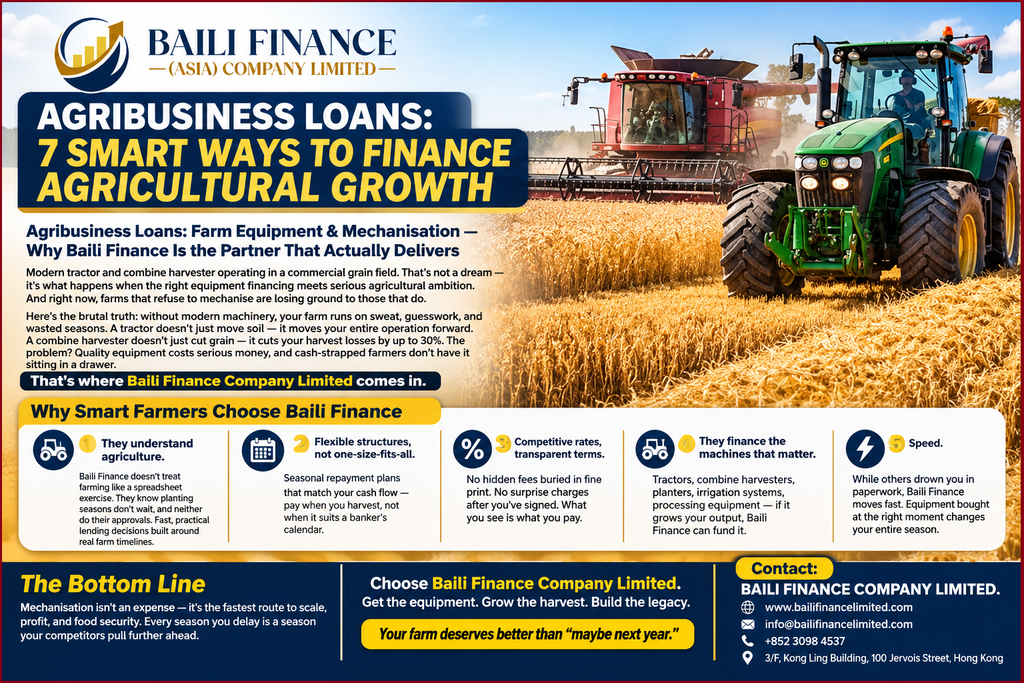
2.2 Purchasing Agricultural Equipment
Agricultural machinery represents a significant investment for commercial farming operations.
Depending on the scale of production, businesses may require tractors, harvesters, seed drills, irrigation pumps, processing machinery, refrigeration equipment and transportation vehicles.
Agricultural equipment financing allows qualifying businesses to explore funding structures for these productive assets without necessarily funding the entire acquisition from existing operating cash.
However, borrowers should compare the financing cost, asset valuation, repayment period and expected productivity benefits before committing to an equipment purchase.
2.3 Managing Seasonal Working Capital
Agricultural enterprises frequently incur expenses before generating revenue from harvested or processed products.
These expenses may include:
- Purchasing seeds and fertilizers.
- Paying farm workers and contractors.
- Maintaining agricultural equipment.
- Paying transportation and storage costs.
- Purchasing livestock feed and veterinary supplies.
- Meeting packaging and processing expenses.
Seasonal agricultural loans can help businesses manage these expenditure requirements.
The repayment structure should reflect the business’s production and sales cycle. A repayment schedule that requires substantial payments before the expected harvest or sales period may create unnecessary financial pressure.
2.4 Improving Storage and Distribution
Post-harvest losses, inadequate storage and inefficient distribution can reduce agricultural profitability.
Businesses may therefore require financing to establish warehouses, cold storage facilities, processing centres and transportation networks.
These investments can improve inventory management, preserve product quality and support access to markets that require consistent product availability.
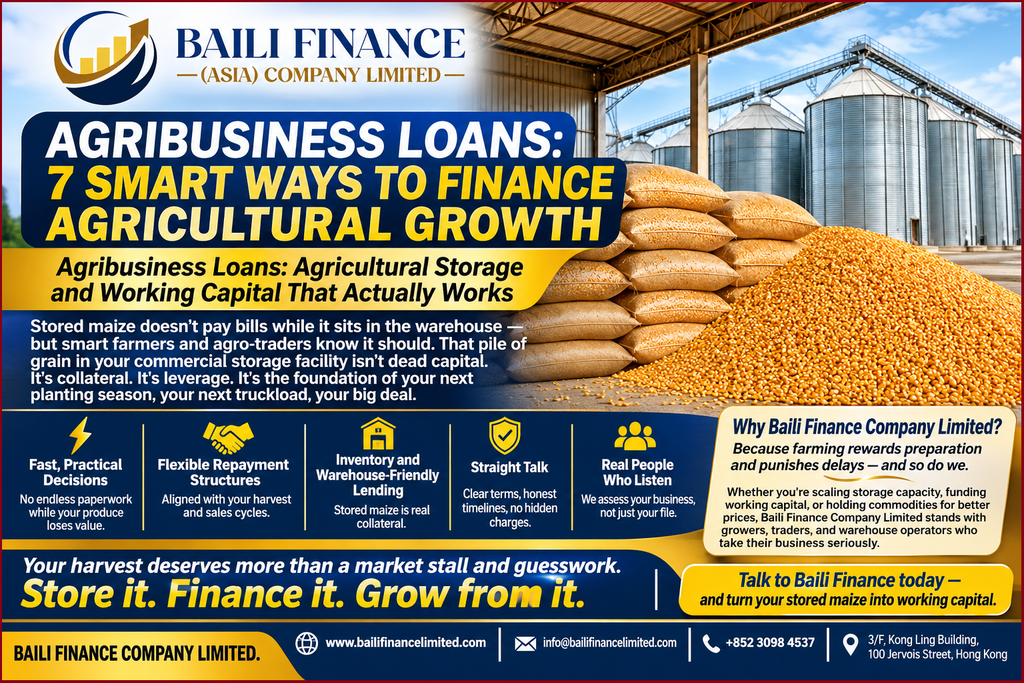
Warehouse financing also offers an important example of how agricultural commodities can support access to working capital.
The International Finance Corporation (IFC) explains how warehouse receipt financing enables eligible agricultural producers and traders to obtain loans against commodities deposited in approved warehouses. This arrangement can give borrowers greater flexibility over when they sell their produce.
2.5 Strengthening Agricultural Supply Chains
Agribusinesses rarely operate independently of other commercial participants.
Farmers depend on input suppliers, processors, transport operators, wholesalers, exporters and retailers. Financial constraints affecting one participant can disrupt the activities of others.
Agricultural value chain financing can help address these funding requirements by connecting financing to identifiable commercial transactions.
For example, a food processing company may require additional working capital to purchase agricultural produce from farmers under established supply arrangements.
Likewise, an agricultural exporter may need financing to purchase, grade, package and transport commodities before receiving payment from international buyers.
2.6 Adopting Agricultural Technology
Technology increasingly influences agricultural production, monitoring, processing and distribution.
Businesses may invest in precision agriculture, automated irrigation, digital inventory systems, greenhouse technology, renewable energy installations and modern processing equipment.
These investments can improve operational control and support more efficient resource allocation.
However, businesses should evaluate the expected commercial benefits against acquisition costs, maintenance expenses, implementation requirements and financing obligations.
2.7 Supporting International Agricultural Trade
Agricultural exporters and commodity traders may encounter substantial financing requirements when purchasing products, arranging inspections, handling documentation and transporting goods across borders.
Trade finance and structured business financing can help eligible enterprises manage these requirements.
Depending on the transaction, relevant financing arrangements may include working capital facilities, documentary letters of credit, guarantees, receivables financing and other trade-related instruments.
The appropriate structure depends on the commercial transaction, counterparties, documentation, banking requirements and applicable regulations.
3. Types of Agribusiness Loans Available
Agricultural financing is not a single financial product. Different loan structures address different business requirements, repayment periods and risk profiles.
Understanding these options can help borrowers identify financing arrangements that match their commercial objectives.
3.1 Agricultural Working Capital Loans
Working capital loans provide short-term financing for routine business expenditure.
Agricultural businesses may use these facilities to purchase inputs, pay suppliers, cover wages, finance inventory or meet transportation expenses.
They are particularly relevant when a business has predictable operating costs but receives customer payments after a production or delivery period.
Before applying, borrowers should prepare realistic cash flow projections showing when the funds will be required and how repayment will occur.
3.2 Farm Expansion Loans
Farm expansion loans provide capital for increasing agricultural production capacity.
Eligible investment requirements may include land development, irrigation infrastructure, farm buildings, additional livestock facilities and production equipment.
These facilities generally require a clear business plan, realistic financial projections and an explanation of how the proposed expansion will generate sufficient revenue to support repayment.
3.3 Agricultural Equipment Financing
Equipment financing supports the acquisition of machinery and productive assets.
Rather than treating equipment purchases as ordinary operating expenses, businesses can explore financing arrangements that distribute the acquisition cost over an agreed repayment period.
Depending on the financing structure, the equipment may serve as collateral or form part of the lender’s security arrangement.
3.4 Livestock and Poultry Financing
Livestock and poultry businesses require financing for animal purchases, housing, feed, veterinary services, breeding programmes, processing and distribution.
Their financial performance depends on factors such as production cycles, animal health, feed prices, mortality rates and market demand.
A suitable financing assessment should therefore consider the entire production cycle rather than focusing exclusively on the initial cost of acquiring livestock.
3.5 Agricultural Processing Loans
Agricultural processing businesses add commercial value by converting raw agricultural products into finished or semi-finished goods.
Examples include:
- Grain milling and flour production.
- Dairy processing and packaging.
- Fruit and vegetable processing.
- Edible oil production.
- Meat processing and cold storage.
- Food manufacturing and packaging.
Financing may support equipment acquisition, facility development, inventory purchases, operational expansion and distribution.

3.6 Agricultural Trade Finance
Agricultural trade finance supports the movement of commodities and related commercial transactions.
It may be particularly relevant to businesses involved in importing fertilizers, exporting agricultural commodities, purchasing inventory or supplying products under international contracts.
Depending on the transaction, financing may involve letters of credit, bank guarantees, receivables financing or structured working capital arrangements.
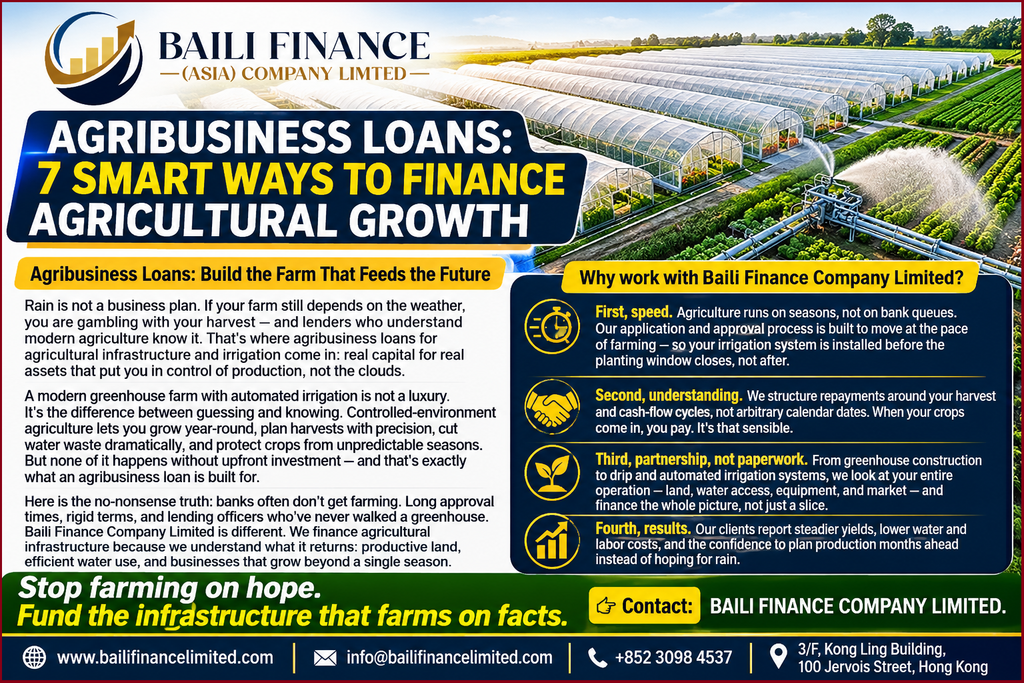
3.7 Agricultural Infrastructure Financing
Larger agricultural enterprises may require long-term funding for infrastructure projects.
These projects may include irrigation networks, agricultural warehouses, processing facilities, distribution centres and renewable energy systems supporting agricultural operations.
Project financing may be appropriate where the proposed investment has a defined scope, identifiable funding requirements, realistic implementation milestones and a credible revenue model.
4. How to Qualify for Agribusiness Loans
Qualifying for an agricultural business loan depends on the lender’s requirements, the borrower’s financial position and the commercial viability of the proposed financing.
Although requirements vary, lenders generally assess the following factors.
4.1 Business Registration and Legal Status
Businesses should maintain appropriate registration documents and demonstrate that they operate legally within their relevant jurisdictions.
Depending on the business structure and location, documentation may include:
- Certificate of incorporation or business registration.
- Tax identification documents.
- Relevant agricultural licences and permits.
- Ownership and management information.
- Business operating address.
- Identification documents for authorised representatives.
4.2 Financial Statements and Cash Flow
Financial records help lenders understand the business’s operating performance and repayment capacity.
Where available, applicants should prepare:
- Recent financial statements.
- Management accounts.
- Bank statements.
- Revenue and expenditure records.
- Existing loan schedules.
- Cash flow forecasts.
- Accounts receivable and payable reports.
For agricultural businesses, financial projections should account for production cycles, seasonal expenses, expected harvest volumes and anticipated sales receipts.
4.3 A Detailed Agricultural Business Plan
A credible business plan should explain how the company operates, what it intends to finance and how the investment will generate commercial returns.
It should cover:
- Business background and ownership.
- Agricultural products or services.
- Production capacity and operational requirements.
- Target markets and customer demand.
- Competitor analysis.
- Funding requirements and intended use.
- Revenue and expenditure forecasts.
- Identified operational and financial risks.
- Proposed repayment strategy.
A financing request becomes easier to assess when the applicant clearly explains the relationship between the requested capital and the expected business performance.
4.4 Collateral and Available Security
Some lenders require collateral to reduce their exposure to potential losses.
Depending on the financing arrangement and applicable law, acceptable security may include commercial property, machinery, inventory, receivables, warehouse receipts or other eligible assets.
However, collateral requirements vary. Some agricultural finance structures rely more heavily on transaction cash flows, buyer relationships, purchase agreements or other forms of risk mitigation.
Businesses should understand the security requirements before accepting a financing proposal.
4.5 Commercial Experience and Market Access
A lender may also consider management experience, supplier relationships, established buyers and the company’s position within the agricultural value chain.
A business with identifiable customers and reliable sales channels may present a different credit profile from an enterprise that has not yet established a route to market.
For this reason, applicants should provide relevant supply agreements, purchase orders, distribution contracts and other commercial evidence where available.
5. How to Apply for an Agribusiness Loan
A structured application process helps businesses present their financing requirements professionally and identify potential issues before entering a formal transaction.
The following steps provide a practical framework.
Step 1: Establish Your Funding Requirements
Determine exactly how much capital the business needs and what it will finance.
Separate operational expenses from capital expenditure.
For example, a company seeking USD 500,000 may require USD 150,000 for agricultural inputs, USD 200,000 for processing equipment and USD 150,000 for warehouse development.
These figures are illustrative. The actual financing request should reflect verified quotations, project costs and cash flow requirements.
Step 2: Identify the Appropriate Financing Structure
Consider whether the requirement involves working capital, equipment acquisition, project financing, agricultural trade finance or another commercial funding arrangement.
The repayment period should reflect the purpose of the financing and the expected cash generation of the business.
Step 3: Prepare Your Financial Documentation
Organise company registration records, financial statements, bank information, business plans, commercial contracts and relevant asset information.
Ensure that the information is accurate and consistent across all documents.
Step 4: Assess the Business’s Repayment Capacity
Calculate projected revenue, operating expenses, existing debt obligations and available cash flow.
Avoid relying on optimistic production or commodity price assumptions.
A responsible financing assessment should consider possible delays, changes in input prices, lower-than-expected yields and other circumstances that could affect repayment.
Step 5: Submit the Financing Enquiry
Approach suitable financial institutions or financing providers with a concise explanation of the requirement.
Include the proposed amount, currency, intended use, business location, operating history and anticipated repayment period.
Step 6: Review the Financing Terms
Before accepting any offer, carefully examine:
- Interest rates or applicable financing charges.
- Arrangement and administrative fees.
- Repayment frequency and maturity.
- Collateral requirements.
- Covenants and financial obligations.
- Default provisions.
- Applicable law and dispute resolution.
- Conditions precedent to disbursement.
Do not evaluate a financing proposal solely by the amount offered. The total cost and practical repayment obligations matter just as much.
Step 7: Complete Due Diligence and Execution
The financing provider may conduct legal, financial, commercial and compliance reviews before making a final decision.
Funding should proceed only after the relevant approvals, documentation and contractual requirements have been satisfied.
6. Understanding the Risks of Agricultural Business Financing
Agricultural lending requires careful risk assessment because production and revenue can depend on factors outside the borrower’s direct control.
Businesses should understand these risks before taking on additional debt.
Weather and Climate Risks
Droughts, floods, excessive rainfall and changing temperatures can affect production volumes and agricultural income.
Businesses should consider irrigation, crop diversification, appropriate insurance and other risk management measures where commercially practical.
Commodity Price Fluctuations
Agricultural commodity prices can change between production and sale.
A business that forecasts revenue using unusually high market prices may struggle to meet repayment obligations if prices decline.
Conservative financial projections can help reduce this exposure.
Production and Disease Risks
Pests, crop diseases, livestock illnesses and inadequate farm management can affect output and operating costs.
Preventive measures, veterinary support, agronomic advice and appropriate production monitoring can help manage these risks.
Market and Buyer Risks
A business may produce sufficient agricultural commodities but encounter delayed payments, cancelled purchase orders or reduced demand.
Diversifying buyers and maintaining reliable distribution relationships can improve commercial resilience.
Interest Rate and Currency Risks
Businesses borrowing in a foreign currency may face additional financial exposure if their operating revenue comes from a different currency.
Changes in exchange rates can increase the effective cost of repayment.
Borrowers should evaluate currency compatibility, interest rate arrangements and other financing conditions before signing an agreement.
7. Real-World Example: Warehouse Receipt Financing in Agriculture
One established example of agricultural financing involves warehouse receipt financing, which enables eligible agricultural producers and traders to obtain working capital against commodities stored in approved facilities.
The International Finance Corporation operates its Global Warehouse Finance Program to expand access to working capital for agricultural producers, traders and other participants in agricultural supply chains.
Under this financing approach, eligible commodities deposited in warehouses support a financing arrangement through warehouse receipts or equivalent security mechanisms.
Consider a commercial grain producer that harvests a substantial quantity of maize.
Immediately after harvesting, the producer may face pressure to sell the entire crop to generate cash for operating expenses. However, market prices may be lower during the harvest period.
Where the appropriate warehouse infrastructure, legal framework and financing arrangements exist, the producer may deposit the maize in an approved warehouse and use the warehouse receipt as security for a loan.
This arrangement can provide working capital while allowing the producer to consider selling the commodity at a more commercially favourable time.
The financing provider still evaluates commodity quality, storage conditions, ownership, marketability and other risks.
The IFC example demonstrates that agricultural finance does not always have to rely exclusively on conventional property-backed lending. Properly structured commodity-based financing can also support agricultural working capital requirements.
External reference: International Finance Corporation – Global Warehouse Finance Program.
8. Illustrative Case Study: Financing an Agricultural Processing Business
The following case study is hypothetical. It demonstrates how an agricultural enterprise might approach a commercial financing requirement. It does not represent an actual Baili Finance client, approved loan or completed transaction.
Business Background
A privately owned agricultural processing company operates a maize and grain processing facility. The company purchases agricultural produce from local suppliers, processes it into finished products and distributes the products to wholesalers and commercial retailers.
The business has established customer relationships and receives recurring orders. However, increasing demand has placed pressure on its existing production capacity.
Management identifies three primary requirements:
- Additional processing machinery.
- Increased raw material inventory.
- Improved warehouse and packaging capacity.
The Financing Challenge
The company estimates that it requires USD 750,000 to complete the proposed expansion.
Its retained earnings cannot cover the entire investment without reducing the working capital available for daily operations.
Management therefore considers external business financing.
Proposed Financing Allocation
| Funding requirement | Amount |
|---|---|
| Processing machinery | USD 300,000 |
| Raw material inventory | USD 200,000 |
| Warehouse improvements | USD 150,000 |
| Packaging and logistics | USD 100,000 |
| Total | USD 750,000 |
These figures are hypothetical and serve only to illustrate a possible funding structure.
Preparing the Application
Before approaching financing providers, the company prepares its corporate registration documents, financial statements, bank records, supplier agreements, customer contracts and business expansion plan.
It also develops cash flow forecasts showing how additional processing capacity could affect production volumes, operating costs and revenue.
Management includes a risk assessment covering commodity price fluctuations, supplier reliability, inventory management and customer payment periods.
Evaluating the Financing Structure
Rather than treating the entire USD 750,000 requirement as one undifferentiated expense, the company evaluates the financing requirements according to their purpose.
Machinery and warehouse improvements involve capital expenditure, while inventory and packaging represent working capital requirements.
Separating these components helps the business consider suitable repayment periods and financing arrangements.
The company also examines the total financing cost, security requirements and the effect of additional debt on existing cash flow.
Expected Commercial Benefits
If the investment proceeds successfully, the business may benefit from:
- Increased processing capacity.
- Improved inventory availability.
- More efficient packaging operations.
- Better fulfilment of customer orders.
- Reduced production bottlenecks.
- Improved distribution capabilities.
These outcomes remain dependent on execution, market demand, operating efficiency and the actual financing terms.
Key Lesson
The central lesson is that agricultural financing should support a defined commercial objective.
A business should not borrow simply because financing is available. It should establish how the capital will improve operations, generate revenue, support cash flow or strengthen its competitive position.
9. How to Choose the Right Agribusiness Financing Partner
Selecting a financing partner requires careful evaluation.
Not every lender has the same industry experience, financing capacity, risk appetite or transaction requirements.
Before proceeding, consider the following factors.
Industry understanding: Does the provider understand agricultural business models, seasonal cash flow and agricultural value chains?
Financing suitability: Does the proposed structure match the intended use of funds and the business’s repayment capacity?
Transparent terms: Are all charges, conditions, security requirements and repayment obligations clearly documented?
Due diligence: Does the provider follow appropriate legal, financial and compliance procedures?
Execution capability: Can the provider explain the financing process, approval requirements and expected transaction milestones?
Communication: Does the financing team provide clear information and respond to reasonable questions?
Businesses should independently verify the identity, legal status and relevant credentials of any financing provider. They should also obtain independent professional advice before entering significant financial commitments.
The World Bank’s Agricultural Lending: A How-To Guide provides further information about agricultural credit assessment, specialised lending processes, seasonal cash flow and risk management.
For additional context, the Food and Agriculture Organization (FAO) also examines access to rural finance and the importance of improving financial services for agricultural businesses and smallholder farming communities.
10. Agribusiness Financing Solutions with BAILI FINANCE
Agricultural businesses sometimes require financing arrangements that extend beyond conventional short-term borrowing.
A commercial enterprise may need capital to expand production, purchase processing equipment, improve storage infrastructure, strengthen distribution or support an international trading operation.
These requirements deserve an assessment that considers the company’s commercial objectives, financial position and proposed use of funds.
BAILI FINANCE (ASIA) COMPANY LIMITED is a Hong Kong-registered financial services company providing business financing, corporate financing, structured financial solutions, trade finance and related funding services to an international client base.
Our published financing services include:
Business Loans
Business financing solutions for qualifying enterprises seeking working capital, operational support and expansion funding.
Corporate Financing
Financing discussions for established businesses requiring capital to support growth, acquisitions, commercial operations or strategic development.
Equipment Financing
Financing support for businesses seeking to acquire productive machinery, industrial equipment and other operational assets.
Project Financing
Structured financing discussions for qualifying commercial projects with defined capital requirements and identifiable business objectives.
International Trade Finance
Financial solutions for businesses involved in international trade and cross-border commercial transactions.
Structured Financial Solutions
Tailored financing discussions for businesses with specialised funding requirements that may require more detailed transaction structuring.
For agricultural companies, the suitability of any financing arrangement depends on the specific transaction, business profile, jurisdiction, documentation and applicable approval requirements.
BAILI FINANCE does not represent every business financing facility as a dedicated agricultural loan. Prospective borrowers should contact the company to establish whether their particular agricultural financing requirement can be considered under its available services.
Learn more about our business and corporate financing solutions.
11. The Future of Agribusiness Financing
The agricultural finance sector continues to evolve as businesses adopt technology, improve supply chain management and respond to changing food production requirements.
Several developments are influencing how agricultural enterprises access capital.
Digital Agricultural Finance
Digital platforms can improve financial access by helping lenders assess agricultural businesses through transaction records, production information and digital payment histories.
Technology can also reduce some of the administrative costs associated with serving geographically dispersed agricultural borrowers.
Climate-Smart Agricultural Investment
Businesses increasingly need to consider water efficiency, renewable energy, soil management and climate resilience.
Financing arrangements that support commercially viable sustainability investments may help agricultural enterprises improve long-term operating performance.
Agricultural Value Chain Financing
Financing is increasingly being considered across the entire agricultural supply chain rather than focusing exclusively on individual farmers.
Processors, aggregators, input suppliers, transport operators and exporters may all require working capital to maintain commercial operations.
Asset-Based and Commodity Financing
Warehouse receipts, eligible inventory, equipment and receivables can support alternative financing structures where the necessary legal and commercial conditions exist.
Greater Focus on Financial Transparency
Lenders increasingly need reliable information to assess agricultural business performance.
Businesses that maintain accurate financial statements, operational records, customer information and production forecasts can improve the quality of their financing applications.
These developments reinforce the importance of preparing agricultural businesses for professional financial assessment.
12. Frequently Asked Questions About Agribusiness Loans
1. What are agribusiness loans used for?
Agribusiness loans provide financing for commercial agricultural activities, including crop production, livestock farming, agricultural machinery, irrigation, inventory purchases, food processing, warehousing, transportation and agricultural trade.
The appropriate financing structure depends on the borrower’s business activities, funding requirements and repayment capacity.
2. Can I get an agricultural business loan without owning farmland?
Yes, depending on the lender’s eligibility requirements and the type of financing requested.
Agricultural processors, commodity traders, distributors, equipment operators and other businesses within the agricultural value chain may qualify for certain business financing arrangements without owning farmland.
Lenders may assess business registration, financial performance, contracts, receivables, available security and repayment capacity.
3. How much can I borrow through an agribusiness loan?
There is no universal loan amount for agribusiness financing.
The available amount depends on the financing provider, business financial position, project requirements, collateral, repayment capacity and transaction structure.
Applicants should prepare a detailed funding proposal supported by realistic financial projections and relevant commercial documentation.
4. What documents are required to apply for an agricultural business loan?
Typical documents may include:
- Business registration documents.
- Valid identification for authorised representatives.
- Financial statements.
- Recent bank statements.
- Business plans and financial projections.
- Agricultural licences where applicable.
- Supplier and customer agreements.
- Asset and collateral information.
- Details of existing financial obligations.
Additional documentation may be required depending on the financing provider and jurisdiction.
5. Can a startup agricultural business qualify for financing?
A startup agricultural business may qualify for certain financing arrangements, but approval can be more challenging because the enterprise may lack an established operating history.
The applicant may need to demonstrate management experience, credible market demand, adequate initial capital, realistic projections and a viable business model.
Available collateral, investor support and commercial agreements may also influence the assessment.
6. Are agribusiness loans available for livestock and poultry farming?
Yes. Agricultural financing can support livestock and poultry operations, subject to the lender’s requirements.
Potential funding purposes include animal purchases, feed, farm buildings, veterinary services, processing equipment and distribution.
The financing assessment should consider production cycles, operating costs, animal health risks and expected sales revenue.
7. Can agricultural businesses obtain financing for machinery and equipment?
Yes. Agricultural equipment financing may support the acquisition of tractors, harvesters, irrigation systems, processing machinery, refrigeration equipment and other productive assets.
The lender may evaluate equipment specifications, purchase costs, expected useful life, business financial performance and available security.
8. What is the difference between an agricultural loan and an agribusiness loan?
An agricultural loan commonly refers to financing associated with farming and agricultural production.
An agribusiness loan has a broader commercial scope. It can support businesses across the entire agricultural value chain, including input supply, farming, processing, storage, transportation, distribution and agricultural trading.
The terms sometimes overlap, but agribusiness financing generally covers a wider range of commercial activities.
9. Can agricultural businesses obtain international financing?
Yes. Depending on the provider, jurisdiction and transaction requirements, qualifying agricultural businesses may explore international business financing, structured finance and trade finance arrangements.
However, cross-border financing requires appropriate legal, financial and compliance reviews. Currency exposure, repayment arrangements and applicable regulatory requirements must also be considered.
10. Does BAILI FINANCE provide agribusiness loans?
BAILI FINANCE (ASIA) COMPANY LIMITED publishes business loan, corporate financing, equipment financing, project financing and structured financing services.
Agricultural companies seeking capital for commercial expansion, equipment acquisition, processing operations or related business requirements may contact the company to discuss their financing needs.
Whether a particular agricultural transaction can be accommodated depends on the company’s assessment, available financing arrangements, documentation and applicable approval conditions.
Visit BAILI FINANCE to learn more about its published financing services.
11. How can I improve my chances of obtaining an agribusiness loan?
Prepare accurate financial records, develop a credible business plan, identify the exact funding requirement and demonstrate how the proposed investment will support revenue generation.
Provide evidence of market demand, reliable customers, supplier relationships and repayment capacity.
Avoid overstating projected income or underestimating operational expenses. A transparent application provides a stronger foundation for financial assessment.
12. What should I check before accepting an agribusiness loan?
Review the total financing cost, repayment schedule, interest rate, applicable fees, collateral requirements, default provisions, legal jurisdiction and conditions for disbursement.
Confirm that the repayment structure reflects the business’s expected cash flow.
Obtain independent financial and legal advice where necessary, particularly when dealing with large or cross-border financing transactions.
Conclusion: Secure the Right Financing for Your Agribusiness
Agribusiness loans remain an important financing consideration for agricultural enterprises seeking to expand production, acquire machinery, improve processing capacity, strengthen distribution and participate in international agricultural markets.
However, obtaining financing should never be the only objective. The real priority is identifying a funding structure that supports the business’s commercial requirements without creating unsustainable repayment obligations.
From agricultural working capital loans and farm expansion financing to equipment acquisition, commodity financing and international trade finance, businesses have several potential funding approaches to consider.
Success begins with preparation. Establish your capital requirements, understand your cash flow, organise your financial records and identify the commercial benefits of the proposed investment. Then compare financing providers and carefully evaluate their terms before making a commitment.
For agricultural entrepreneurs and established agribusiness companies, the right financing arrangement can support operational development and create opportunities for sustainable business growth.
READY TO EXPAND YOUR AGRIBUSINESS? LET’S DISCUSS YOUR FINANCING.
Your next stage of agricultural business growth shouldn’t be held back by a funding gap.
Whether you’re planning to expand commercial farming operations, acquire agricultural machinery, establish a processing facility, strengthen your supply chain or finance an international agricultural trade transaction, having access to the right financing structure can make a significant difference to your business objectives.
At BAILI FINANCE (ASIA) COMPANY LIMITED, we welcome enquiries from established businesses and qualified enterprises seeking business loans, corporate financing, equipment financing, project financing and structured financial solutions.
Tell us what your business needs to achieve. We’ll discuss your financing requirements and explore whether an appropriate funding solution is available.
Don’t wait until limited working capital restricts your production capacity, delays an expansion project or prevents you from pursuing a commercial opportunity.
Take the initiative today.
YOUR AGRIBUSINESS HAS GROWTH OBJECTIVES. LET’S DISCUSS HOW TO FINANCE THEM.
Contact BAILI FINANCE today and start a professional financing discussion.
BAILI FINANCE (ASIA) COMPANY LIMITED
- Website: https://www.bailifinancelimited.com/
- Email: info@bailifinancelimited.com
- Telephone: +852 3098 4537
- Office: 3/F, Kong Ling Building, 100 Jervois Street, Hong Kong.
EXPLORE OUR FINANCING SOLUTIONS
Your financing enquiry is the first step. Let us understand your business, assess your requirements and discuss the possibilities.
Visit our Financing Solutions page or contact our team to discuss your funding objectives.
BAILI FINANCE — Professional Financing Solutions for Global Business Growth.
Intermediaries/Consultants/Brokers are welcome to bring their clients 100% protected. Our brokers receive 2% commission for referral. We assist Clients and brokers in their attempt to secure funding by working on their funding requests that may require innovative financing. In complete confidence, we will work together for the benefits of all parties involved.
#AgribusinessLoans #AgriculturalFinance #AgribusinessFinancing #AgriculturalBusinessLoans #FarmFinancing #AgriculturalInvestment #FarmExpansion #AgriculturalEquipmentFinancing #BusinessLoans #WorkingCapitalFinancing #TradeFinance #CorporateFinancing #FoodProcessing #AgriculturalDevelopment #BAILIFINANCE