Headline: SME Loans: Types, Eligibility & Business Financing
Access to SME loans can determine how effectively a small or medium-sized enterprise manages its cash flow, finances expansion, acquires business assets and responds to commercial opportunities. For business owners, securing the right small and medium enterprise financing isn’t simply about obtaining capital. It’s about selecting a funding structure that supports business objectives without creating unnecessary financial pressure.
Across international markets, small and medium-sized enterprises (SMEs) contribute significantly to employment, economic activity and private-sector development. However, many viable businesses struggle to secure sufficient financing because of limited collateral, short operating histories, inconsistent cash flow or restrictive lending requirements.
The financing challenge affects businesses at different stages. A growing company may need additional working capital to fulfil a major order. An established enterprise may require a business expansion loan to enter a new market. Another company may need equipment financing, trade finance or structured corporate funding to complete a commercial project.
Understanding the available options helps business owners make informed decisions.
This guide explains how SME loans work, the different types of business financing available, eligibility considerations, application requirements, repayment structures and practical ways to improve financing prospects. It also examines a real-world business financing scenario and explains how BAILI FINANCE (ASIA) COMPANY LIMITED supports businesses seeking tailored financing solutions.
Keywords: SME loans, SME financing, Small business loans, Business loans, SME business funding, Small and medium enterprise financing, Corporate financing, Business expansion loans, Working capital loans, SME loans for small and medium-sized businesses, How to qualify for an SME business loan, Best financing options for SMEs, Business loans for international companies, SME working capital financing solutions, How to obtain financing for business expansion, SME loans without collateral, Business financing for growing companies, International SME trade finance solutions, Documents required for SME loan applications.
1. What Are SME Loans?
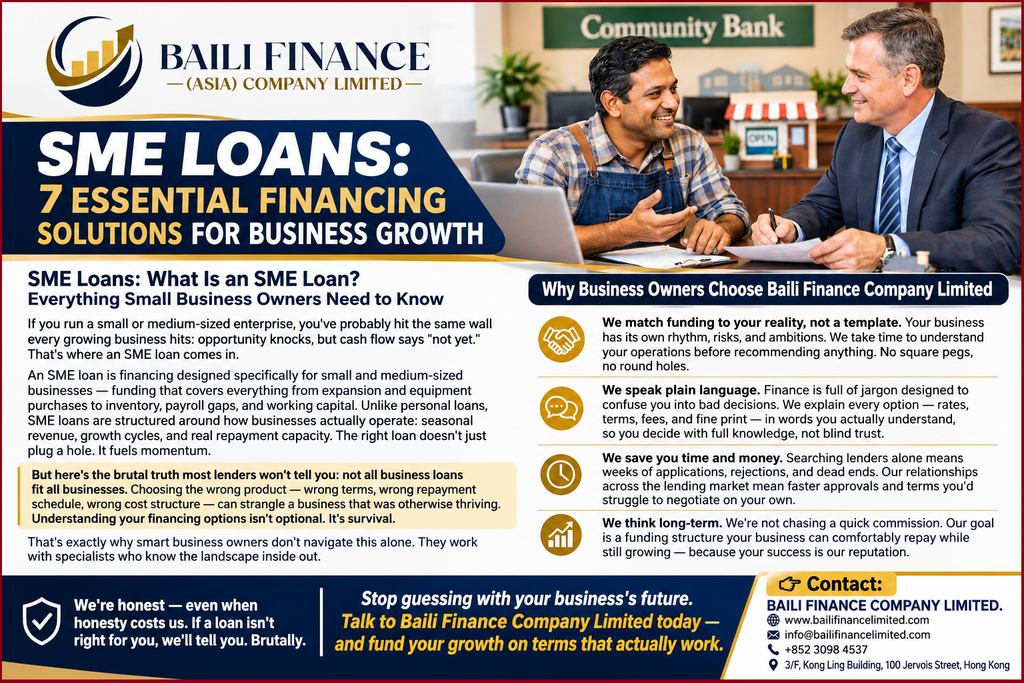
SME loans are financial facilities designed to provide small and medium-sized enterprises with capital for business operations, investment, expansion and other legitimate commercial purposes.
A lender provides an agreed amount of financing under specified conditions. The borrowing business then repays the principal, together with applicable interest and charges, according to the agreed repayment schedule.
Depending on the lender and financing arrangement, an SME loan may be secured or unsecured, short-term or long-term, fixed-rate or variable-rate.
Unlike personal loans, SME financing focuses primarily on business requirements and the enterprise’s financial position. Lenders commonly examine revenue, profitability, cash flow, outstanding liabilities, credit history, management experience and the proposed use of funds.
However, the precise assessment criteria vary between financial institutions, private lenders and alternative financing providers.
Why do SMEs need business loans?
Businesses frequently require additional capital for reasons that extend beyond immediate financial difficulties.
Common financing objectives include:
- Purchasing inventory and raw materials.
- Meeting payroll and operational expenses.
- Financing new contracts and customer orders.
- Acquiring machinery, vehicles and business equipment.
- Opening additional branches or operating facilities.
- Expanding into international markets.
- Financing imports, exports and commercial transactions.
- Improving working capital and liquidity.
- Refinancing existing business obligations where appropriate.
- Supporting mergers, acquisitions and strategic investments.
For a commercially viable enterprise, appropriate financing can provide the resources needed to execute a business plan while preserving sufficient operational liquidity.
2. Why SME Financing Matters to Business Growth
Access to business credit remains a significant issue across international markets.
According to the International Finance Corporation (IFC), micro, small and medium-sized enterprises represent more than 90% of businesses worldwide and account for approximately 70% of total employment and 50% of GDP on average.
The IFC also identifies a substantial financing gap among SMEs in emerging markets.
This matters because businesses cannot always fund expansion through retained earnings alone. External financing can support investment, improve production capacity and help companies fulfil commercial obligations.
Read the IFC’s MSME Finance and SME Lending research for further information about the global financing landscape.
The commercial importance of SME loans
Working capital management
Working capital supports daily business operations. It enables companies to purchase supplies, pay employees, meet supplier obligations and manage the timing differences between incoming and outgoing payments.
An SME working capital loan may help address a temporary liquidity requirement, particularly when customers operate on extended payment terms.
Business expansion
Expansion often requires substantial initial expenditure. Businesses may need to recruit employees, acquire additional equipment, establish distribution networks or secure commercial premises.
An appropriately structured business expansion loan can help finance these activities.
Improved production capacity
Manufacturing and industrial businesses may require machinery, technology and specialised equipment to increase production.
Equipment financing allows businesses to acquire productive assets without necessarily paying the entire purchase price immediately.
International trade
Importers and exporters frequently encounter financing requirements associated with purchasing inventory, transporting goods, managing receivables and fulfilling international contracts.
Trade finance and supply chain financing can address specific transaction-related funding requirements.
Financial flexibility
Access to suitable financing can help a company maintain sufficient liquidity while allocating internal funds to other business priorities.
However, borrowing should always reflect the company’s repayment capacity and commercial objectives.
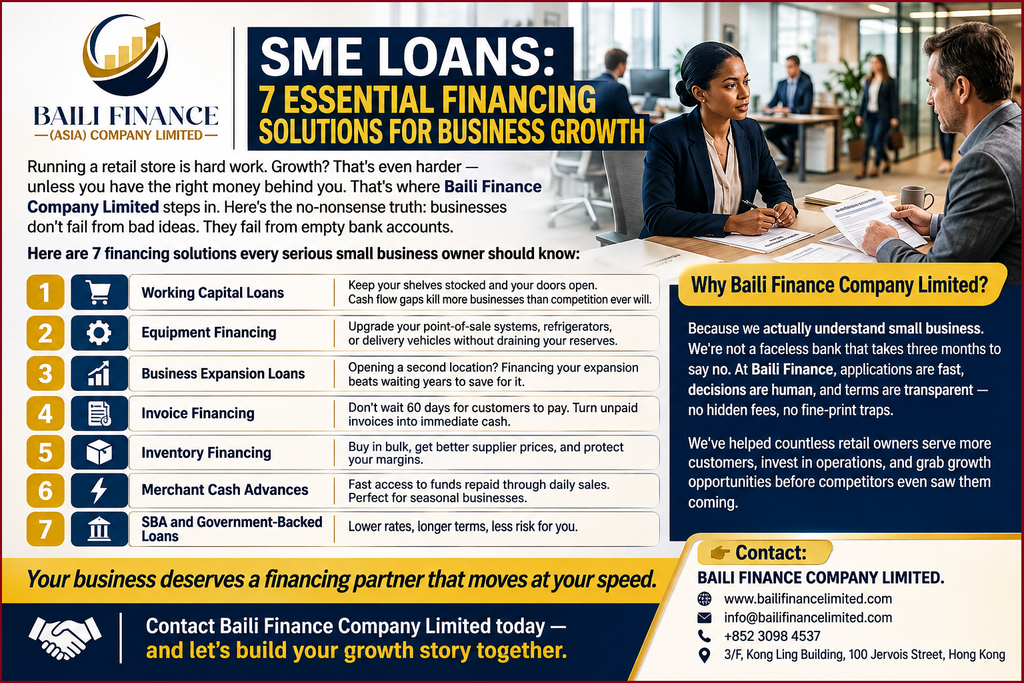
3. Seven Types of SME Loans and Business Financing
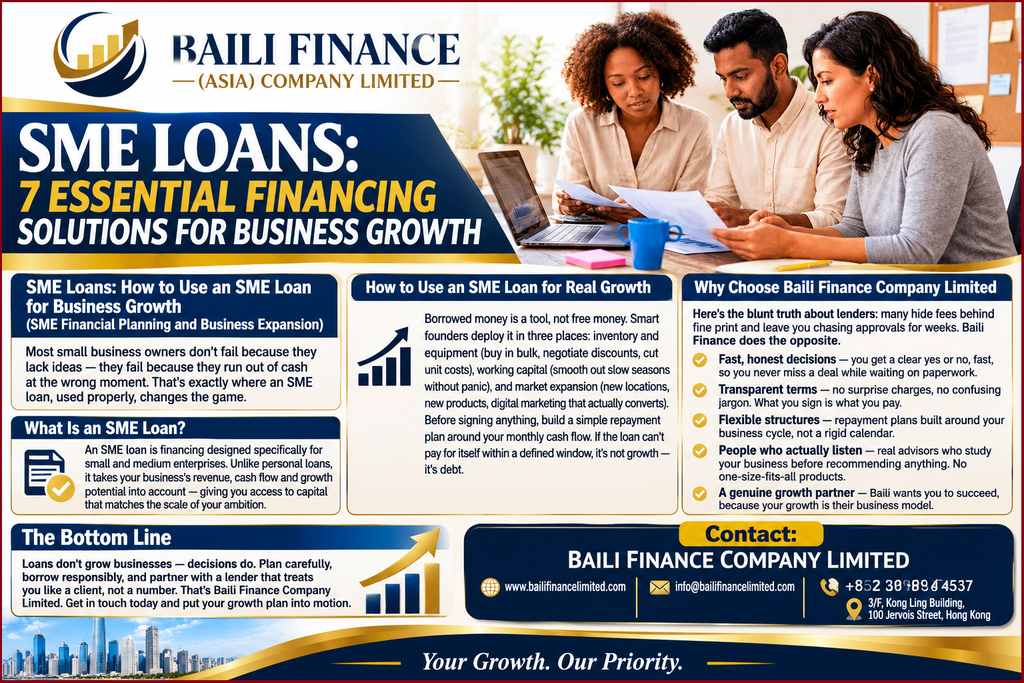
Not every financing facility serves the same purpose. Choosing an appropriate structure requires an understanding of the business’s funding requirements, repayment capacity and intended use of capital.
The following are seven important SME financing options.
1. Working Capital Loans
Working capital loans provide short-term or medium-term financing for routine business expenses.
Businesses commonly use these facilities to manage supplier payments, payroll, inventory purchases, rent, logistics and other operating costs.
For example, a wholesale distribution company may receive a substantial customer order but need additional funds to purchase inventory before receiving payment.
A working capital loan may bridge this timing gap.
Before applying, the business should prepare a cash flow forecast showing how it expects to generate sufficient funds to repay the facility.
2. Business Expansion Loans
Business expansion loans provide capital for companies planning to increase their commercial operations.
Possible uses include:
- Establishing additional business locations.
- Entering new domestic or international markets.
- Increasing production capacity.
- Recruiting additional personnel.
- Developing new products and services.
- Expanding distribution and logistics operations.
Lenders may request a business plan, financial projections, market research and evidence that the proposed expansion can generate sufficient revenue.
The most important consideration is whether the expected commercial benefits justify the borrowing cost.
3. Equipment and Machinery Financing
Equipment financing enables SMEs to acquire assets required for business operations.
Examples include industrial machinery, manufacturing equipment, commercial vehicles, agricultural machinery, medical equipment and information technology infrastructure.
Depending on the arrangement, the acquired asset may serve as security for the financing.
This structure can help businesses preserve cash reserves while investing in equipment that supports productivity and revenue generation.
4. Trade Finance and Import-Export Financing
Trade finance supports commercial transactions involving buyers, suppliers, importers and exporters.
International transactions frequently involve payment periods, transportation arrangements, documentation requirements and counterparty risks.
Depending on the transaction, available financing structures may include:
- Import financing.
- Export financing.
- Purchase order financing.
- Invoice financing.
- Supply chain financing.
- Letters of credit.
- Documentary trade facilities.
- Bank guarantees and other approved financial instruments.
These facilities can help businesses manage payment obligations and improve liquidity throughout the trade cycle.
For companies engaged in international commerce, selecting an appropriate trade finance structure requires careful assessment of the underlying contracts, counterparties, documentation and payment arrangements.
5. Commercial Real Estate Loans
Commercial real estate financing supports the acquisition, development, renovation or refinancing of property used for business purposes.
SMEs may require commercial property to establish offices, warehouses, factories, retail premises or distribution centres.
The lender may assess the property’s valuation, ownership documentation, location, existing liabilities and the borrower’s financial position.
Repayment terms and collateral requirements depend on the financing provider and transaction structure.
6. Invoice Financing and Receivables Financing
Invoice financing allows businesses to obtain liquidity against outstanding customer invoices.
This can be useful when a company supplies goods or services to customers who operate on 30-day, 60-day or 90-day payment terms.
Rather than waiting for customers to settle invoices, an eligible business may access a proportion of the receivable earlier.
The provider normally evaluates the invoices, customer creditworthiness, payment history and transaction documentation.
Businesses should compare the financing charges with the benefits of receiving funds earlier.
7. Structured Business and Corporate Loans
Structured financing involves arranging capital around the specific financial requirements, assets, contracts or commercial objectives of a business.
Unlike a standard business loan, a structured facility may involve multiple financing components, collateral arrangements, financial instruments or repayment sources.
These solutions may be relevant to established SMEs, corporate borrowers, project developers, international traders and businesses undertaking substantial commercial transactions.
The proposed structure should clearly identify the funding source, transaction parties, security arrangements, applicable charges and repayment obligations.
At BAILI FINANCE (ASIA) COMPANY LIMITED, businesses can discuss tailored business loans, working capital requirements, corporate financing and structured funding opportunities based on their individual circumstances.
4. How Do SME Loans Work?
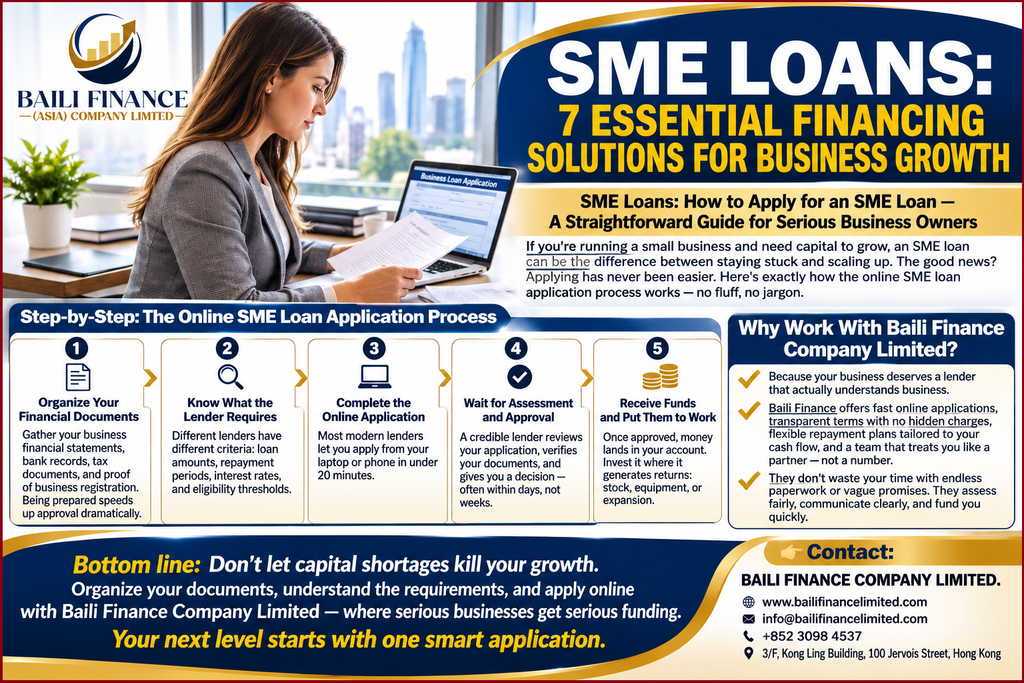
Although financing arrangements differ, most SME lending transactions follow a recognisable process.
Understanding each stage helps businesses prepare properly and avoid delays.
Step 1: Identify the financing requirement
Start by calculating the amount of capital required and establishing precisely how the business intends to use it.
Avoid requesting an arbitrary amount. Instead, prepare a funding breakdown supported by quotations, contracts, operating expenses or investment projections.
Step 2: Select an appropriate financing structure
Compare available financing options according to their purpose, duration, cost, collateral requirements and repayment arrangements.
For example, a short-term working capital requirement may not justify a long-term property-backed loan.
Likewise, purchasing industrial machinery may require a different financing structure from funding an international supply contract.
Step 3: Prepare the required documentation
Financial institutions and financing providers commonly request business registration documents, financial statements, bank statements, identification documents and information about the proposed transaction.
The documentation requirements depend on the lender and jurisdiction.
Step 4: Submit the application
The borrower provides the application and supporting documents for assessment.
The financing provider may request additional information to clarify the company’s ownership, financial position, funding requirements or repayment capacity.
Step 5: Undergo financial and commercial assessment
The lender evaluates the business and the proposed transaction.
This assessment may include credit checks, cash flow analysis, collateral valuation, background verification and due diligence.
Step 6: Review the financing offer
If the application progresses, the lender may provide indicative or formal financing terms.
Before accepting, review the interest rate, fees, repayment schedule, security requirements, default provisions, applicable law and any conditions attached to disbursement.
Step 7: Complete the transaction and repayment arrangements
Following approval, satisfaction of applicable conditions and execution of the relevant agreements, the financing provider arranges disbursement.
The borrower must then meet the agreed repayment obligations.
5. SME Loan Eligibility: What Do Lenders Consider?
Eligibility requirements vary considerably between lenders, countries and financing products.
There isn’t one universal eligibility standard for all SME loans.
Nevertheless, several factors commonly influence financing decisions.
Business registration and legal status
The applicant may need to demonstrate that the business operates through a legally recognised entity or qualifying business structure.
Relevant documents can include certificates of incorporation, business registration certificates, ownership records and corporate authorisations.
Business operating history
Some lenders prefer established companies with a documented trading history.
Others may consider younger businesses where the owners can demonstrate relevant experience, credible contracts, sufficient capital or a viable business model.
Revenue and profitability
Revenue helps demonstrate commercial activity, while profitability provides information about the company’s ability to generate earnings.
However, lenders shouldn’t evaluate revenue in isolation. A company with substantial sales may still experience cash flow problems.
Cash flow and repayment capacity
Cash flow is a central consideration in responsible business lending.
A business should demonstrate how it will generate the money needed to meet scheduled repayments.
The lender may review operating cash flow, outstanding receivables, supplier obligations, existing debt and projected income.
Credit history
Business credit records and, where relevant, the credit histories of owners or guarantors may influence the assessment.
Previous defaults, outstanding liabilities and repayment patterns can affect financing terms.
Collateral and guarantees
Some SME loans require collateral, while others may be unsecured or supported by guarantees.
Possible security arrangements include property, equipment, inventory, receivables or other acceptable assets.
The absence of conventional collateral doesn’t automatically mean that every financing option is unavailable. However, the borrower may face different pricing, eligibility conditions or risk requirements.
Business plan and funding purpose
A clear business plan helps explain why the company needs capital and how the proposed financing supports its objectives.
The stronger the supporting financial evidence, the easier it becomes for a lender to evaluate the commercial rationale.
6. Documents Required When Applying for an SME Loan
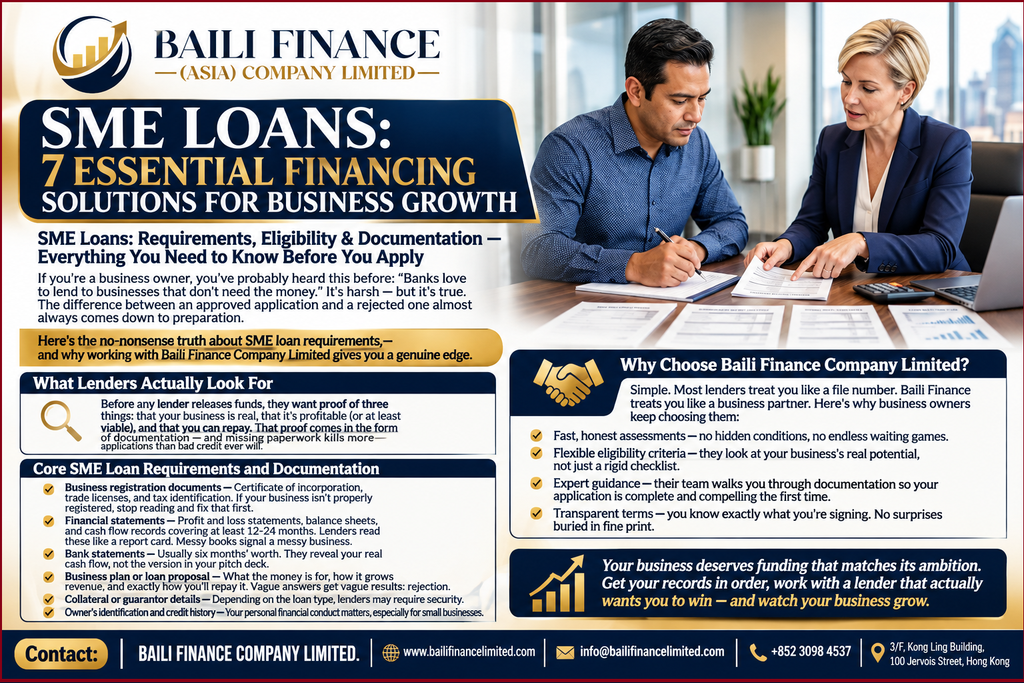
Preparing documentation before submitting an application can improve the efficiency of the assessment process.
Although requirements differ, businesses should generally prepare the following:
| Document | Purpose |
|---|---|
| Certificate of incorporation | Confirms the company’s legal registration |
| Business registration certificate | Establishes business registration details |
| Company ownership records | Identifies shareholders and beneficial owners |
| Director identification | Supports identity verification |
| Recent bank statements | Demonstrates account activity and cash flow |
| Financial statements | Provides information about revenue, expenses, assets and liabilities |
| Management accounts | Shows more recent financial performance |
| Business plan | Explains the commercial purpose of financing |
| Cash flow projections | Demonstrates expected repayment capacity |
| Existing loan statements | Identifies current financial obligations |
| Contracts and purchase orders | Supports the proposed use of funds |
| Asset documentation | Supports collateral assessment where applicable |
Depending on the financing structure, additional documentation may include tax records, audited accounts, property valuations, insurance certificates, supplier invoices and international trade documents.
Businesses should provide accurate and consistent information. Incomplete or contradictory documentation can delay due diligence.
7. How Much Can an SME Borrow?
There isn’t a universal maximum loan amount for SMEs.
The amount a business can obtain depends on the financing provider, the company’s financial position, the intended use of funds and the structure of the proposed transaction.
For example, a small enterprise seeking financing for inventory may require substantially less capital than an established manufacturer purchasing industrial equipment.
Lenders may consider:
- Annual turnover.
- Net operating income.
- Available cash flow.
- Existing debt obligations.
- Business assets.
- Collateral value.
- Credit history.
- Industry and commercial risks.
- The proposed repayment period.
A responsible borrowing decision should begin with the amount the business can reasonably repay, not simply the highest amount a lender might approve.
Illustrative SME loan calculation
Consider a business that borrows US$100,000 at an illustrative annual interest rate of 10%, using a three-year repayment period with monthly repayments.
Assuming a standard amortising loan, a fixed annual interest rate and no additional fees:
- Principal: US$100,000.
- Annual interest rate: 10%.
- Repayment period: 36 months.
- Approximate monthly repayment: US$3,227.
- Approximate total repayment: US$116,190.
- Approximate total interest: US$16,190.
These figures are illustrative, not a financing quotation. Actual repayments depend on the lender’s interest calculation, fees, payment frequency, disbursement date and contractual terms.
Before borrowing, businesses should compare the total cost of financing rather than focusing exclusively on the advertised interest rate.
8. Secured vs Unsecured SME Loans
One of the most important considerations when comparing SME financing options is whether the facility requires collateral.
Secured SME loans
A secured business loan requires the borrower to provide acceptable assets as security.
Depending on the arrangement, collateral may include commercial property, machinery, vehicles, receivables or other assets.
Potential advantages include:
- Access to financing amounts supported by asset values.
- Potentially more favourable interest rates.
- Longer repayment periods in certain arrangements.
- Financing opportunities for businesses with limited unsecured credit capacity.
However, the borrower risks losing pledged assets if it fails to meet contractual obligations and the lender lawfully enforces its security.
Unsecured SME loans
An unsecured business loan doesn’t require conventional asset collateral.
Instead, the lender may rely more heavily on business cash flow, financial performance, credit history and guarantees.
Potential advantages include:
- No specific business asset pledged as conventional collateral.
- Reduced asset-valuation requirements.
- Greater flexibility for qualifying businesses.
However, unsecured financing may carry higher interest rates, shorter repayment periods or stricter credit requirements.
An unsecured facility doesn’t eliminate repayment liability or prevent personal guarantees where the agreement requires them.
9. Common Reasons SME Loan Applications Get Rejected
A rejected application doesn’t necessarily mean that a business has no financing potential.
However, understanding the reasons behind a rejection can help management address weaknesses before approaching another lender.
Insufficient cash flow: The company cannot demonstrate adequate funds to meet the proposed repayments.
Poor credit history: Previous defaults or outstanding obligations raise concerns about repayment reliability.
Inadequate documentation: Missing financial records, inconsistent company information or incomplete applications prevent a proper assessment.
Unclear financing purpose: The lender cannot establish how the requested funds will support a legitimate commercial activity.
Excessive existing debt: Current financial commitments may leave insufficient capacity for additional borrowing.
Unrealistic financial projections: Revenue forecasts lack supporting evidence or rely on assumptions that don’t reflect market conditions.
Insufficient collateral: The assets offered don’t meet the lender’s security requirements.
How to improve your chances of approval
Before submitting another application:
- Review your company’s financial statements.
- Reconcile bank statements and accounting records.
- Prepare realistic cash flow forecasts.
- Reduce unnecessary existing liabilities where possible.
- Explain the intended use of financing clearly.
- Organise all company registration documents.
- Provide supporting contracts and commercial evidence.
- Select a financing product that matches your actual requirements.
The objective isn’t simply to obtain approval. It’s to secure financing under terms the business can manage.
10. Real-World Example: How SME Financing Supports Commercial Expansion
Consider a hypothetical wholesale distribution company operating in an international trading market.
The company supplies consumer goods to retailers and receives recurring purchase orders from established customers.
However, its suppliers require payment before dispatching inventory, while some customers settle invoices 60 days after delivery.
This creates a timing difference between outgoing supplier payments and incoming customer receipts.
The business has confirmed demand but insufficient immediately available working capital to finance the next order.
Management evaluates several funding options.
After reviewing its requirements, the company considers a US$150,000 working capital facility.
The proposed funds would cover:
- Inventory purchases: US$95,000.
- International transportation and logistics: US$20,000.
- Customs and related transaction expenses: US$10,000.
- Additional operating liquidity: US$25,000.
Before proceeding, management prepares a cash flow forecast, provides customer purchase orders and evaluates the expected collection dates.
The company also compares financing charges with the projected gross margin from the transaction.
The commercial lesson: The financing requirement arises from a working capital timing gap, not necessarily from a lack of customer demand or an unprofitable business model.
Appropriate SME financing may help the company fulfil the order, maintain supplier relationships and preserve operating continuity.
However, the company should proceed only if its projected cash flows can support repayment, including under less favourable collection scenarios.
11. Case Study: A Structured Financing Approach for an Expanding SME
The following case study is illustrative. It demonstrates how a financing assessment could work in practice. It isn’t a verified client transaction or a representation of a completed financing arrangement by BAILI FINANCE (ASIA) COMPANY LIMITED.
Business background
A medium-sized manufacturing company has operated for several years and supplies products to commercial buyers in multiple markets.
Following an increase in customer orders, the company identifies an opportunity to increase production capacity.
However, expansion requires additional capital for machinery, raw materials, staffing and operational expenses.
The company estimates that it needs US$750,000 to implement the expansion.
The financing challenge
Management identifies three principal requirements:
- Acquire additional manufacturing equipment.
- Purchase raw materials to support increased production.
- Maintain sufficient working capital during the expansion period.
A conventional short-term loan may not adequately match the investment’s expected cash generation period.
Therefore, management evaluates a financing structure that separates equipment investment from operational funding.
Financing assessment
The company prepares its financial statements, management accounts, bank statements, existing debt schedule, equipment quotations and customer contracts.
It also develops a financial forecast covering projected production capacity, expected sales, operating costs and debt repayment obligations.
The financing provider evaluates:
- The company’s trading history.
- Existing customer relationships.
- Equipment requirements.
- Projected operating cash flow.
- Existing liabilities.
- Available collateral.
- The proposed financing period.
Proposed financing structure
For illustration, management considers the following funding allocation:
| Financing requirement | Illustrative amount |
|---|---|
| Manufacturing equipment | US$400,000 |
| Raw materials | US$200,000 |
| Working capital reserve | US$150,000 |
| Total financing requirement | US$750,000 |
The company evaluates whether an equipment-backed facility and a separate working capital arrangement would better match its investment and operational requirements.
Expected commercial outcomes
If the financing receives approval, the company can implement the expansion according to the agreed funding conditions.
The business may then increase production capacity, improve its ability to fulfil customer orders and generate additional operating revenue.
However, these outcomes aren’t automatic. Actual performance depends on market demand, production efficiency, customer payments, operating costs and the company’s ability to service its debt.
Key lesson
A financing application should explain more than how much money a company wants to borrow.
It should establish why the capital is required, how the business intends to deploy it, what commercial results it expects and where the repayment funds will come from.
This is particularly important when seeking medium-term business loans, corporate financing or structured funding for larger commercial projects.
12. How to Choose the Right SME Loan Provider
Selecting a financing provider requires more than comparing interest rates.
A suitable provider should understand the proposed transaction and communicate its financing conditions clearly.
Before entering into an agreement, consider the following:
1. Financing experience
Establish whether the provider has experience with the type of business financing you require.
A provider handling equipment financing may approach a transaction differently from one specialising in international trade finance.
2. Transparent pricing
Request a complete breakdown of interest, arrangement fees, legal costs, valuation expenses, intermediary commissions and other applicable charges.
3. Clear eligibility requirements
Understand the documentation, financial thresholds, security arrangements and conditions that apply.
4. Repayment flexibility
Check whether the repayment schedule reflects the company’s revenue cycle.
Businesses with seasonal income may require a different structure from companies receiving predictable monthly revenue.
5. Regulatory and legal considerations
Verify the provider’s legal identity, relevant licensing or authorisation, financing source and applicable regulatory requirements.
For cross-border financing, understand the governing law, jurisdiction, dispute-resolution provisions and currency risks.
6. Independent verification
Verify financial institutions, issuing banks, guarantees and financial instruments directly through appropriate official channels.
Never rely exclusively on marketing claims, intermediary assurances or unverified transaction documents.
7. Professional communication
A reliable financing process should involve clear explanations, documented requirements and transparent communication about approval conditions.
13. SME Loans and the Role of BAILI FINANCE (ASIA) COMPANY LIMITED
Businesses seeking financing often require solutions that reflect their commercial circumstances rather than a standard lending structure.
BAILI FINANCE (ASIA) COMPANY LIMITED is a Hong Kong-based financial services company that publishes information about business loans, corporate financing, working capital, trade finance and structured funding solutions.
The company serves an international client base and provides information about financing options for businesses with different capital requirements.
Its published financing services include:
Business loans
Financing discussions for small, medium-sized and established enterprises seeking operational capital, business expansion funding or other commercial financing.
Corporate financing
Financing solutions designed around corporate funding requirements, business development and strategic investment objectives.
Working capital financing
Funding discussions for companies requiring additional liquidity to manage operational expenses, supplier payments and business activities.
International trade finance
Financing-related solutions for businesses involved in importation, exportation and international commercial transactions.
Structured financing
Tailored financing arrangements for qualifying transactions that require a more specialised funding approach.
Equipment and project financing
Financing discussions for companies undertaking equipment acquisitions, infrastructure development and other capital-intensive commercial activities.
The appropriate solution depends on the borrower’s financial profile, transaction requirements, available documentation and the financing terms that can be agreed.
Businesses can review the company’s financing solutions to understand the services it publishes.
14. Why Businesses Should Consider Baili Finance for SME Financing Discussions
BAILI FINANCE (ASIA) COMPANY LIMITED approaches financing requirements through an assessment of the business’s objectives and proposed transaction.
For companies seeking commercial financing, the initial discussion should establish the amount required, the intended use of funds, the business’s financial position and the preferred funding timeline.
The company provides a point of contact for businesses considering business loans, corporate funding and structured financial solutions.
Its Hong Kong contact details are:
Company: BAILI FINANCE (ASIA) COMPANY LIMITED
Office: 3/F, Kong Ling Building, 100 Jervois Street, Hong Kong.
Telephone: +852 3098 4537.
Email: info@bailifinancelimited.com.
Website: https://www.
Prospective borrowers should request the applicable eligibility criteria, financing terms, fees, security requirements and transaction documentation before making a commitment.
Any financing proposal remains subject to the relevant assessment, due diligence, contractual conditions and availability of an appropriate facility.
15. Frequently Asked Questions About SME Loans
1. What is an SME loan?
An SME loan is a financing facility designed for small and medium-sized enterprises. Businesses use these loans for working capital, inventory purchases, equipment acquisition, expansion, trade transactions and other commercial requirements. The borrower repays the principal and applicable financing charges under agreed terms.
2. Can a small business qualify for an SME loan?
Yes. Small businesses may qualify for SME financing if they meet the relevant lender’s eligibility requirements. Assessment criteria may include business registration, trading history, revenue, cash flow, credit history, existing liabilities and the intended use of funds. Some providers also consider businesses with shorter operating histories.
3. How much can an SME borrow?
There is no universal borrowing limit for SME loans. The approved amount depends on the lender, financing product, business performance, repayment capacity, collateral and transaction requirements. Businesses should calculate their actual funding needs and demonstrate how they intend to repay the facility.
4. Can I obtain an SME loan without collateral?
Some financing providers offer unsecured SME loans. However, approval may depend on revenue, cash flow, creditworthiness, operating history and other risk factors. Unsecured facilities may also carry higher interest rates, shorter repayment periods or personal guarantee requirements.
5. What documents do I need to apply for an SME loan?
Common requirements include company registration documents, identification documents, bank statements, financial statements, management accounts, a business plan and cash flow projections. Depending on the transaction, lenders may also request tax records, purchase orders, customer contracts, collateral documents and details of existing debt.
6. How long does SME loan approval take?
Approval timelines vary between financing providers and loan structures. Straightforward applications may progress faster than complex corporate or cross-border financing transactions. Documentation completeness, credit assessment, due diligence, collateral valuation and legal requirements can all affect processing time. Applicants should request an estimated timeline directly from the provider.
7. Can an SME loan be used for working capital?
Yes. Working capital is one of the common purposes of SME financing. Businesses may use eligible facilities to purchase inventory, pay suppliers, manage payroll, cover operating expenses and address temporary cash flow gaps. The loan agreement should expressly permit the intended use of funds.
8. What is the difference between an SME loan and a business loan?
The terms often overlap. An SME loan generally refers to financing intended for small and medium-sized enterprises, while a business loan is a broader term that can include financing for businesses of different sizes. Both may support working capital, equipment purchases, expansion and other commercial activities.
9. Are SME loans available for international businesses?
Yes. Certain lenders and financial services providers consider applications from companies operating across international markets. However, eligibility depends on the provider’s geographical coverage, borrower jurisdiction, regulatory requirements, currency, transaction structure and available documentation.
10. Can an SME obtain financing for an international trade transaction?
Yes. Depending on the transaction, businesses may consider import financing, export financing, invoice financing, supply chain financing, letters of credit and other trade finance structures. The financing provider may review purchase orders, commercial invoices, shipping documents, counterparties and payment arrangements.
11. How can I improve my chances of getting an SME loan?
Maintain accurate financial records, monitor cash flow, manage existing debt, prepare realistic projections and clearly explain the intended use of financing. Providing complete supporting documents and selecting a suitable financing product can also improve the quality of an application.
12. Where can I apply for SME loans?
Businesses can approach commercial banks, licensed financial institutions, specialist business lenders and alternative financing providers. Companies considering tailored business and corporate financing can also contact BAILI FINANCE (ASIA) COMPANY LIMITED through its official website to discuss their requirements.
Conclusion: Choose SME Financing That Supports Sustainable Growth
SME loans provide an important financing option for businesses seeking to manage working capital, purchase equipment, expand operations, finance commercial contracts and enter new markets.
However, obtaining financing should never be the only objective.
Business owners must understand the cost of borrowing, evaluate repayment capacity, compare financing structures and ensure that the proposed facility supports a commercially justified purpose.
From working capital loans and equipment financing to trade finance and structured corporate funding, the right solution depends on the company’s requirements, financial position and growth strategy.
Preparation also matters. Accurate financial statements, realistic projections, supporting contracts and a clearly defined funding purpose can help businesses present stronger financing applications.
For companies seeking a professional discussion about SME loans, business financing or structured corporate funding, BAILI FINANCE (ASIA) COMPANY LIMITED provides an opportunity to explore available financing solutions based on individual requirements.
Your next business opportunity may require additional capital. Make your financing decision with a clear understanding of the requirements, costs and repayment obligations.
Ready to Discuss Your SME Financing Requirements?
Don’t allow uncertainty about financing to delay an important business decision.
Whether your company requires working capital, expansion funding, equipment financing, international trade finance or a tailored corporate financing structure, start with a clear discussion of your requirements.
Contact BAILI FINANCE (ASIA) COMPANY LIMITED to outline your financing objectives and request information about the applicable funding process.
REQUEST A FINANCING DISCUSSION TODAY.
- Website: https://www.bailifinancelimited.com/
- Email: info@bailifinancelimited.com
- Telephone: +852 3098 4537
- Location: Hong Kong
Prepare your company profile, required funding amount, intended use of funds and available financial documents before making your enquiry.
Take the next step towards securing the financing your business needs.
Intermediaries/Consultants/Brokers are welcome to bring their clients 100% protected. Our brokers receive 2% commission for referral. We assist Clients and brokers in their attempt to secure funding by working on their funding requests that may require innovative financing. In complete confidence, we will work together for the benefits of all parties involved.
#SMELoans #BusinessLoans #SMEFinancing #BusinessFunding #WorkingCapital #CorporateFinance #TradeFinance #BusinessExpansion #BusinessGrowth #BAILIFINANCE
Disclaimer: This article provides general business financing information and doesn’t constitute financial, legal, investment or tax advice, an offer of credit, or a guarantee of loan approval. Financing availability, eligibility, interest rates, fees, security requirements and repayment terms depend on the relevant provider, transaction and applicable jurisdiction. The case study and numerical illustrations are hypothetical.