Stop Costly SBLC Fraud Fast
Keywords: SBLC scam warning, fake SBLC providers, standby letter of credit fraud, SBLC scams, SBLC fraud prevention, MT760 fraud, SBLC monetization scam, fake bank guarantee, trade finance fraud, genuine SBLC provider
In today’s global finance environment, a Standby Letter of Credit (SBLC) remains one of the most powerful instruments used in trade finance, project funding, credit enhancement, and international business transactions. However, as demand for SBLCs continues to grow, fraudulent operators have become increasingly sophisticated.
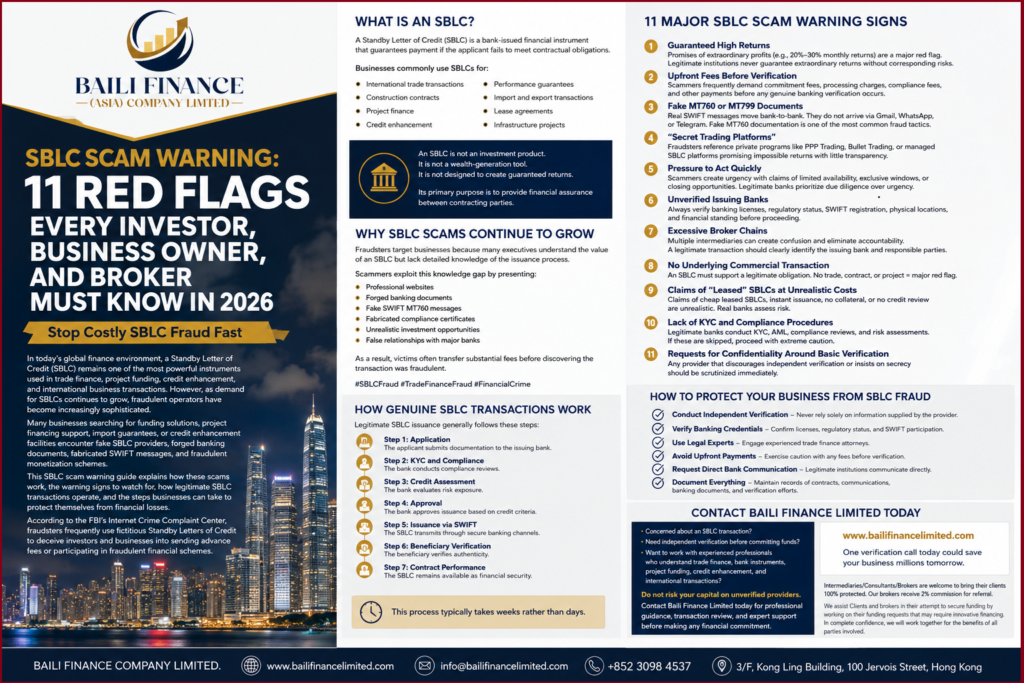
Many businesses searching for funding solutions, project financing support, import guarantees, or credit enhancement facilities encounter fake SBLC providers, forged banking documents, fabricated SWIFT messages, and fraudulent monetization schemes.
This SBLC scam warning guide explains how these scams work, the warning signs to watch for, how legitimate SBLC transactions operate, and the steps businesses can take to protect themselves from financial losses.
According to the FBI’s Internet Crime Complaint Center, fraudsters frequently use fictitious Standby Letters of Credit to deceive investors and businesses into sending advance fees or participating in fraudulent financial schemes.
What Is an SBLC?
A Standby Letter of Credit (SBLC) is a bank-issued financial instrument that guarantees payment if the applicant fails to meet contractual obligations.
Businesses commonly use SBLCs for:
- International trade transactions
- Construction contracts
- Project finance
- Credit enhancement
- Performance guarantees
- Import and export transactions
- Lease agreements
- Infrastructure projects
An SBLC is not an investment product. It is not a wealth-generation tool. It is not designed to create guaranteed returns.
Its primary purpose is to provide financial assurance between contracting parties.
Why SBLC Scams Continue to Grow
Fraudsters target businesses because many executives understand the value of an SBLC but lack detailed knowledge of the issuance process.
Scammers exploit this knowledge gap by presenting:
- Professional websites
- Forged banking documents
- Fake SWIFT MT760 messages
- Fabricated compliance certificates
- Unrealistic investment opportunities
- False relationships with major banks
As a result, victims often transfer substantial fees before discovering the transaction was fraudulent.
#SBLCFraud #TradeFinanceFraud #FinancialCrime
11 Major SBLC Scam Warning Signs
1. Guaranteed High Returns
One of the most common fraud indicators involves promises of extraordinary profits.
Fraudsters often claim:
- 20% monthly returns
- 30% monthly profits
- Risk-free investments
- Guaranteed platform trading income
Legitimate financial institutions never guarantee extraordinary returns without corresponding risks.
2. Upfront Fees Before Verification
Scammers frequently demand:
- Commitment fees
- Registration fees
- Processing charges
- Compliance fees
- Due diligence fees
before any genuine banking verification occurs.
A legitimate SBLC transaction follows a documented banking process rather than an advance-fee structure.
3. Fake MT760 or MT799 Documents
Many victims receive PDF files claiming to be SWIFT messages.
However:
- Real SWIFT messages move bank-to-bank.
- They do not arrive through Gmail.
- They do not arrive through WhatsApp.
- They do not arrive through Telegram.
Fake MT760 documentation remains one of the most common trade finance fraud tactics.
4. “Secret Trading Platforms”
Fraudsters often reference:
- Private Placement Programs
- PPP Trading
- Bullet Trading Programs
- Managed SBLC Trading Platforms
- Prime Bank Instruments
These programs typically promise impossible returns while providing little transparency regarding operations. Financial regulators have repeatedly warned investors about such schemes.
5. Pressure to Act Quickly
Scammers create urgency by claiming:
- Limited availability
- Exclusive bank windows
- Closing opportunities
- Restricted investor participation
Legitimate banking institutions prioritize due diligence over urgency.
6. Unverified Issuing Banks
A genuine SBLC originates from a licensed financial institution with regulatory oversight.
Before proceeding, verify:
- Banking licenses
- Regulatory status
- SWIFT registration
- Physical office locations
- Financial standing
Failure to verify the issuing bank creates substantial risk.
7. Excessive Broker Chains
Many fraudulent transactions involve:
- Brokers
- Sub-brokers
- Mandates
- Consultants
- Introducers
When multiple intermediaries participate, accountability often disappears.
A legitimate transaction should clearly identify the issuing bank and responsible parties.
8. No Underlying Commercial Transaction
An SBLC should support a legitimate commercial obligation.
Red flags appear when:
- No trade exists
- No contract exists
- No project exists
- No identifiable obligation exists
A genuine SBLC serves a business purpose. It does not exist independently.
9. Claims of “Leased” SBLCs at Unrealistic Costs
Fraudsters often advertise:
- Cheap leased SBLCs
- Instant SBLC issuance
- No collateral required
- No credit review required
Real banks evaluate creditworthiness and risk before issuing financial instruments.
10. Lack of KYC and Compliance Procedures
Legitimate banks conduct:
- Know Your Customer (KYC)
- Anti-Money Laundering (AML)
- Compliance reviews
- Risk assessments
If a provider skips these procedures, businesses should proceed with caution.
11. Requests for Confidentiality Around Basic Verification
Some fraudsters discourage independent verification.
They may insist on:
- Secrecy agreements
- Restricted communication
- Limited due diligence
Any provider that discourages verification deserves immediate scrutiny.
Real-World Example: The $500,000 Advance Fee Disaster
A commercial real estate developer sought funding support for a large project.
An intermediary introduced a supposedly exclusive SBLC provider who requested a $500,000 upfront commitment fee to initiate issuance.
The provider supplied professional documentation, banking references, and legal agreements.
Several warning signs emerged:
- No direct bank communication
- Excessive intermediary involvement
- Pressure to transfer funds quickly
- Limited verification options
The developer eventually discovered the transaction lacked legitimate banking support.
The proposed SBLC never existed.
The advance fee was lost. Similar situations continue to appear throughout the finance sector.

Case Study: How Proper Due Diligence Prevented a Multi-Million-Dollar Loss
Background
A manufacturing company required a $50 million SBLC for an international supply agreement.
A broker introduced a provider claiming access to major global banks.
Warning Signs Identified
The company’s compliance team noticed:
- Unrealistic pricing
- Forged-looking SWIFT screenshots
- Unverified banking contacts
- Guaranteed monetization claims
Due Diligence Actions
The company:
- Verified the issuing bank.
- Confirmed SWIFT capabilities.
- Requested direct bank-to-bank communication.
- Conducted legal review.
- Reviewed compliance documentation.
Outcome
The issuing institution denied any involvement.
The documents proved fraudulent.
The company avoided a potential multi-million-dollar loss and successfully secured financing through a legitimate provider.
Key Lesson
Verification should always occur before committing funds.
How Genuine SBLC Transactions Work
Legitimate SBLC issuance generally follows these steps:
Step 1: Application
The applicant submits documentation to the issuing bank.
Step 2: KYC and Compliance
The bank conducts compliance reviews.
Step 3: Credit Assessment
The bank evaluates risk exposure.
Step 4: Approval
The bank approves issuance based on credit criteria.
Step 5: Issuance via SWIFT
The SBLC transmits through secure banking channels.
Step 6: Beneficiary Verification
The beneficiary verifies authenticity.
Step 7: Contract Performance
The SBLC remains available as financial security.
This process typically takes weeks rather than days.
How to Protect Your Business from SBLC Fraud
Conduct Independent Verification
Never rely solely on information supplied by the provider.
Verify Banking Credentials
Confirm:
- Banking licenses
- Regulatory registrations
- SWIFT participation
Use Legal Experts
Engage experienced trade finance attorneys.
Avoid Upfront Payments
Exercise caution whenever substantial fees appear before verification.
Request Direct Bank Communication
Legitimate institutions can communicate directly with counterparties.
Document Everything
Maintain records of:
- Contracts
- Communications
- Banking documents
- Verification efforts
Recommended External Resource
For readers seeking an independent explanation of Standby Letters of Credit, review the comprehensive educational resource available at:
Investopedia – Standby Letter of Credit (SBLC):
https://www.investopedia.com/terms/s/standbyletterofcredit.asp
This resource explains how SBLCs function within legitimate commercial transactions.
Frequently Asked Questions (FAQ)
What is the biggest SBLC scam warning sign?
Guaranteed returns and advance fee requests remain among the most common indicators of fraud.
Are all SBLC monetization programs scams?
Not all monetization structures are fraudulent. However, businesses should carefully verify providers, issuing banks, legal documentation, and transaction structures before proceeding.
Can a genuine SBLC be verified?
Yes. Legitimate SBLCs can be verified through appropriate banking channels and direct institutional communication.
How long does a real SBLC issuance process take?
Most legitimate transactions require several weeks due to compliance reviews, credit assessments, documentation requirements, and bank approvals.
Can an SBLC arrive through email?
No. Genuine SWIFT messages move through secure banking networks. PDF files sent by email do not constitute proof of issuance.
What should I do if I suspect an SBLC scam?
Stop all payments immediately, conduct independent verification, consult legal professionals, and report suspicious activity to relevant authorities.
Why do scammers use major bank names?
They use trusted brands to create credibility and reduce skepticism among potential victims.
Final Thoughts: Protect Your Capital Before It Is Too Late
SBLC fraud continues to evolve. Fraudsters now combine sophisticated documentation, professional websites, forged banking instruments, and persuasive sales tactics to target businesses worldwide.
The most effective defense remains rigorous due diligence.
Before transferring funds, signing agreements, or engaging any SBLC provider, verify every detail independently.
A genuine Standby Letter of Credit supports a legitimate commercial obligation. It does not generate guaranteed profits. It does not bypass banking regulations. It does not eliminate risk.
Businesses that understand these fundamentals place themselves in a stronger position to avoid financial loss and build successful trade finance relationships.
#SBLCScamWarning #StandbyLetterOfCredit #TradeFinance #FinancialFraud #SBLCFraud #BankGuarantee #ProjectFinance #CreditEnhancement #BusinessFunding #RiskManagement
CONTACT BAILI FINANCE LIMITED TODAY
Concerned about an SBLC transaction?
Need independent verification before committing funds?
Want to work with experienced professionals who understand trade finance, bank instruments, project funding, credit enhancement, and international transactions?
Do not risk your capital on unverified providers.
Contact Baili Finance Limited today for professional guidance, transaction review, and expert support before making any financial commitment.
🌐www.bailifinancelimited.com
One verification call today could save your business millions tomorrow.
Intermediaries/Consultants/Brokers are welcome to bring their clients 100% protected. Our brokers receive 2% commission for referral. We assist Clients and brokers in their attempt to secure funding by working on their funding requests that may require innovative financing. In complete confidence, we will work together for the benefits of all parties involved.