Financial instruments, financial markets, investment products, capital structures, derivatives, bonds, structured products, liquidity solutions, and asset allocation frameworks define how modern economies operate. The term World Best Financial Instrument Provider refers to institutions or platforms that design, issue, distribute, and manage financial instruments across global markets with efficiency, compliance, and scalability.
keywords: financial instruments, structured finance, investment products, capital markets, liquidity solutions, risk management, derivatives, bonds, and asset management. These terms shape relevance across search engines and help define topical authority.
Modern financial ecosystems depend on providers that design instruments aligned with investor demand, regulatory frameworks, and global market conditions. Institutions operating in this space focus on transparency, capital efficiency, and structured financial engineering to support both retail and institutional investors.
This article evaluates what defines a top-tier provider, how financial instruments operate, real-world applications, and a case study illustrating institutional execution in global markets.
Understanding Financial Instruments in Global Markets
Financial instruments represent contractual assets that hold monetary value. These instruments facilitate capital movement between investors, governments, and corporations.
Common categories include:
- Equity instruments such as stocks and shares
- Debt instruments such as bonds and treasury notes
- Derivatives including options, futures, and swaps
- Hybrid instruments combining debt and equity characteristics
- Structured products tailored for specific risk-return profiles
According to Investopedia, financial instruments are critical for liquidity, risk transfer, and investment diversification.
Financial Instruments Definition (Investopedia)
A world-class provider structures these instruments to support capital formation while maintaining compliance with regulatory frameworks such as Basel III, IFRS standards, and SEC regulations.
Core Characteristics of a Leading Financial Instrument Provider
A provider operating at global standards typically demonstrates the following capabilities:
1. Capital Market Integration
A leading provider operates across multiple financial markets, including forex, equities, fixed income, and derivatives. Integration ensures liquidity and cross-border execution efficiency.
2. Risk Management Architecture
Robust risk frameworks govern exposure, credit risk, market volatility, and counterparty risk. Advanced modeling systems support real-time risk monitoring.
3. Product Engineering Capability
Financial product structuring requires quantitative analysis, scenario modeling, and pricing algorithms that align with investor risk profiles.
4. Regulatory Compliance Framework
Global providers maintain adherence to jurisdictional requirements, anti-money laundering protocols, and investor protection standards.
5. Technology-Driven Infrastructure
Cloud-based trading systems, blockchain settlement layers, and AI-driven analytics improve execution speed and accuracy.
Financial Instruments and Market Functionality
Financial instruments serve as the backbone of capital markets. Their functionality extends across several layers:
- Capital formation for corporations
- Government debt financing
- Hedging of financial exposure
- Portfolio diversification for institutional investors
- Liquidity creation in secondary markets
Long tail keywords relevant here include:
- structured financial instruments provider
- global investment product issuer
- capital market solutions provider
- risk-adjusted investment instruments
- institutional asset structuring services
Each of these reflects how providers position themselves within competitive financial ecosystems.
Types of Financial Instruments Offered by Global Providers
Equity-Based Instruments
Equity instruments represent ownership in corporations. Providers facilitate issuance, trading, and portfolio structuring.
Fixed Income Instruments
Bonds, notes, and treasury securities allow governments and corporations to raise debt capital under structured repayment frameworks.
Derivative Instruments
Options, futures, and swaps allow market participants to hedge risk or speculate on price movements.
Structured Investment Products
These combine multiple asset classes into tailored financial solutions designed for specific investor objectives.
Alternative Financial Instruments
Includes private equity structures, hedge fund allocations, and securitized assets.
Real-World Example: Institutional Capital Structuring
A multinational corporation seeking to expand operations across three continents requires $2.5 billion in capital.
A leading financial instrument provider structures the funding as follows:
- $1.2 billion in corporate bonds with staggered maturity
- $800 million in equity issuance across institutional investors
- $300 million in derivative hedging instruments to manage currency exposure
- $200 million in structured notes linked to commodity performance
This structured approach allows:
- Risk diversification across funding channels
- Stable liquidity management
- Currency and interest rate hedging
- Balanced investor participation
The outcome demonstrates how financial instruments integrate into real-world corporate expansion strategies.
Case Study: Global Structured Finance Deployment
Background
A financial institution in Europe required cross-border capital restructuring to support expansion into Asia and North America.
Challenge
- Currency volatility exposure
- Regulatory differences across jurisdictions
- Investor risk segmentation
- Liquidity constraints in emerging markets
Solution Provided
A global financial instrument provider implemented:
- Multi-currency bond issuance program
- Interest rate swaps to stabilize borrowing costs
- Asset-backed securities tied to receivables
- Structured notes linked to diversified indices
Outcome
- Reduced financing cost by 18%
- Improved liquidity coverage ratio
- Enhanced investor participation across three regions
- Stabilized long-term capital exposure
This case demonstrates structured finance efficiency in global capital markets.
Importance of Technology in Financial Instrument Provision
Modern financial systems depend heavily on technology integration:
- Algorithmic pricing engines
- AI-based credit risk scoring
- Blockchain-based settlement systems
- Real-time market analytics
- Automated compliance reporting systems
These systems reduce operational inefficiencies and improve transparency across financial transactions.
Global Market Trends in Financial Instruments
Several trends shape the future of financial instrument provision:
- Increasing demand for ESG-linked instruments
- Expansion of tokenized assets
- Growth of decentralized finance structures
- Rising demand for customized structured products
- Increased regulatory scrutiny on cross-border capital flows
These trends reflect evolving investor expectations and macroeconomic shifts.
Risk Considerations in Financial Instruments
All financial instruments carry inherent risks:
- Market volatility risk
- Credit default risk
- Liquidity risk
- Interest rate fluctuations
- Currency exchange exposure
A world-class provider integrates risk mitigation strategies into product design rather than treating risk as an external factor.
Institutional Role in Financial Stability
Financial instrument providers contribute to global economic stability by:
- Supporting government borrowing programs
- Enabling corporate expansion
- Providing liquidity to financial markets
- Facilitating cross-border investment flows
- Enhancing market efficiency
Without structured financial instruments, global capital movement would slow significantly.
Frequently Asked Questions (FAQ)
1. What is a financial instrument provider?
A financial instrument provider designs, issues, and manages investment products such as bonds, derivatives, and structured instruments for global markets.
2. What makes a provider globally competitive?
Technology infrastructure, regulatory compliance, product diversity, risk management systems, and liquidity access determine competitiveness.
3. Are financial instruments risky?
Yes. All financial instruments carry risk depending on market exposure, credit quality, and structural complexity.
4. What are structured financial instruments?
These are customized investment products combining multiple financial assets to achieve specific risk-return objectives.
5. How do financial instruments support businesses?
They provide access to capital, manage financial risks, and support expansion strategies across global markets.
6. What is the role of derivatives in financial markets?
Derivatives are used for hedging risk, price speculation, and portfolio diversification.
Summary and Final Insights
Financial instruments remain central to global economic systems. Providers operating at a world-class level integrate capital markets, risk management frameworks, and structured product engineering to support institutional and corporate financial needs.
A strong financial instrument provider does not only distribute investment products; it builds financial architecture that supports liquidity, stability, and global capital flow efficiency. As markets evolve, technology and regulatory frameworks will continue shaping how these instruments are designed and deployed.
Call to Action (CTA)
If your organization requires structured financial solutions, capital market instruments, or tailored investment products, then engaging with a specialized financial instrument provider becomes essential.
Take the next step toward structured financial efficiency. Explore solutions designed to support capital growth, risk control, and global investment execution.
🌐www.bailifinancelimited.com
Contact Baili Finance Limited today to discuss tailored financial instrument strategies aligned with your operational goals.
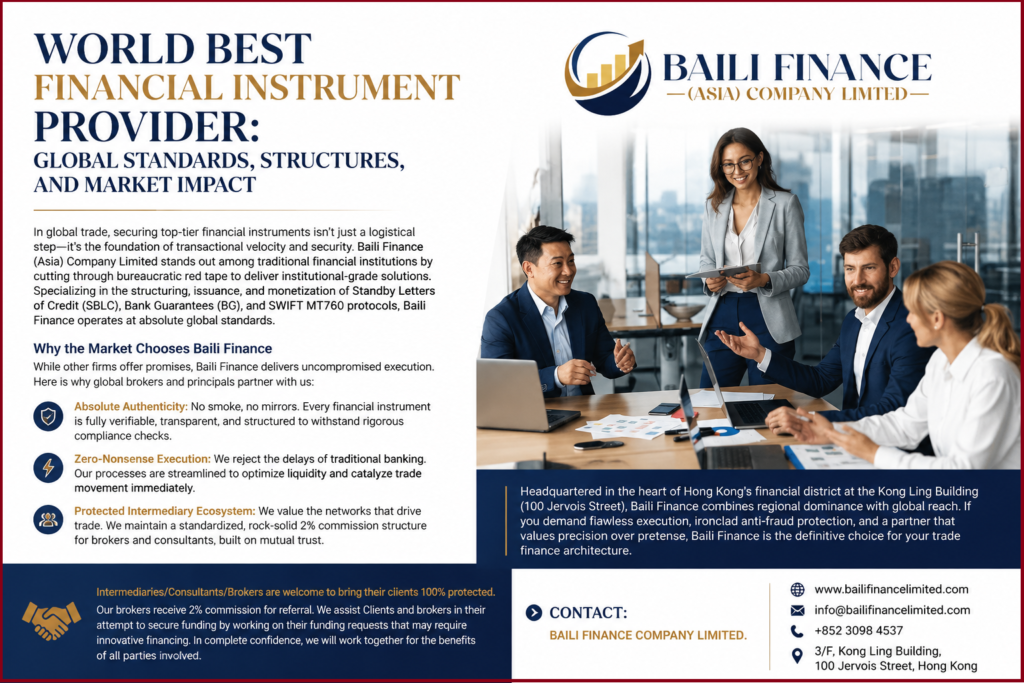
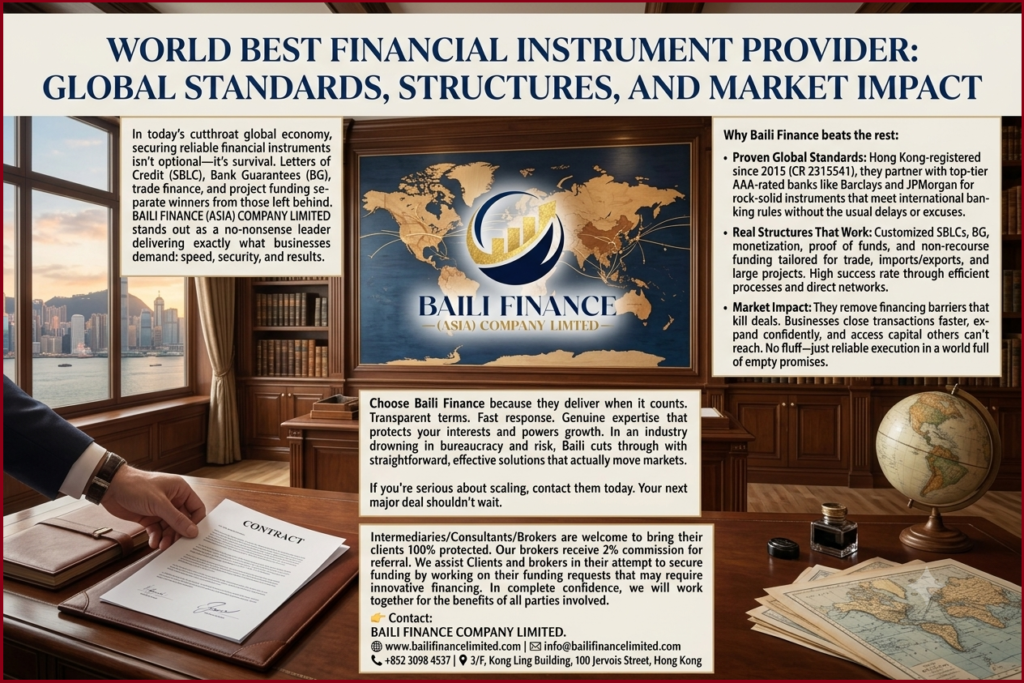
Intermediaries/Consultants/Brokers are welcome to bring their clients 100% protected. Our brokers receive 2% commission for referral. We assist Clients and brokers in their attempt to secure funding by working on their funding requests that may require innovative financing. In complete confidence, we will work together for the benefits of all parties involved.
#FinancialInstruments #StructuredFinance #CapitalMarkets #InvestmentProducts #GlobalFinance #AssetManagement #RiskManagement #DerivativesTrading #BondMarkets #WealthManagement #FinancialServices #InvestmentBanking #FinTech #MarketAnalysis #CorporateFinance #LiquidityManagement #FinancialEngineering #StructuredProducts #PortfolioManagement #GlobalInvesting #FinanceIndustry #EconomicGrowth #CapitalSolutions #InstitutionalInvesting #BailiFinanceLimited