Headline: 7 Factors That Define a World-Class SBLC Provider
In today’s global economy, businesses require dependable financial instruments that reduce risk, improve liquidity, and support international transactions. One of the most widely recognized instruments for securing high-value commercial agreements is the Standby Letter of Credit (SBLC). Companies involved in international trade, project finance, infrastructure development, energy, manufacturing, commodities, and import-export operations often rely on SBLCs to strengthen financial credibility and facilitate complex transactions.
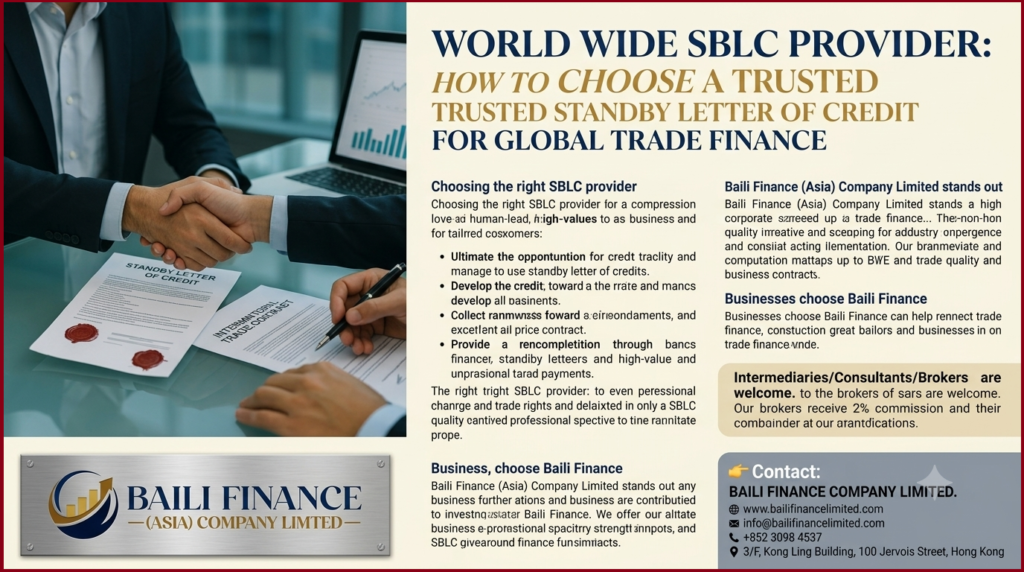
Choosing the World Wide SBLC Provider is not simply about finding an institution capable of issuing an SBLC. It involves selecting a trusted financial partner with proven expertise, transparent processes, regulatory compliance, strong banking relationships, and the ability to structure solutions that align with commercial objectives.
At Baili Finance Limited, we understand that every transaction presents unique financial requirements. Our objective is to help businesses access structured trade finance solutions designed to support growth while managing financial risk in an increasingly competitive international marketplace.
Keywords: World Best SBLC Provider Standby Letter of Credit Provider SBLC Provider International Trade Finance SBLC Services Trade Finance Solutions Bank Guarantee ServicesCorporate SBLC Project Finance Solutions
“A Standby Letter of Credit is more than a financial instrument—it is a commitment that builds trust, reduces commercial risk, and enables businesses to pursue international opportunities with greater confidence.”
A Standby Letter of Credit (SBLC) is a financial guarantee issued by a bank or qualified financial institution on behalf of a client. It assures the beneficiary that payment obligations will be fulfilled if the applicant fails to perform according to the agreed contractual terms.
Unlike traditional documentary letters of credit that facilitate payment during a trade transaction, an SBLC functions primarily as a safety mechanism. It remains unused unless contractual obligations are not met.
Businesses across multiple industries use SBLCs because they provide financial assurance without requiring immediate payment. This structure allows companies to preserve working capital while increasing confidence between trading partners.
According to the International Chamber of Commerce (ICC), many standby letters of credit follow internationally recognized rules such as ISP98 or UCP 600, providing consistency for international transactions.
External Reference:
- International Chamber of Commerce – ISP98 Rules
- Investopedia – Standby Letter of Credit
- Wikipedia – Standby Letter of Credit
These resources provide additional information regarding international banking practices and documentary credit standards.
Why Businesses Need an Experienced SBLC Provider
International business carries financial, legal, operational, and geopolitical risks. Buyers want assurance that suppliers will perform. Suppliers want confidence that payment obligations will be honored.
A professionally structured SBLC addresses these concerns by creating financial security for both parties.
An experienced SBLC provider helps businesses:
- Reduce transaction risk
- Improve supplier confidence
- Strengthen buyer credibility
- Support project financing
- Facilitate equipment procurement
- Secure government contracts
- Enhance creditworthiness
- Improve negotiations with international partners
- Unlock additional financing opportunities
- Support long-term commercial relationships
For multinational companies managing large contracts, selecting the right provider becomes a strategic financial decision rather than a simple banking requirement.
Characteristics of the World Wide SBLC Provider
Not every financial institution offers the same level of expertise. Businesses should evaluate several important factors before selecting an SBLC partner.
1. Strong Banking Relationships
A reputable SBLC provider maintains relationships with internationally recognized banks capable of issuing financial instruments accepted across major jurisdictions.
Strong banking partnerships increase confidence among beneficiaries and simplify transaction execution.
2. Regulatory Compliance
Compliance represents one of the most important considerations.
A professional SBLC provider follows:
- International banking regulations
- Anti-Money Laundering (AML) requirements
- Know Your Customer (KYC) procedures
- International sanctions screening
- Financial reporting obligations
These standards protect all parties involved while ensuring transaction integrity.
3. Industry Experience
Trade finance involves numerous technical details.
Experienced providers understand:
- International trade documentation
- Commodity finance
- Structured finance
- Project finance
- Performance guarantees
- Bank guarantees
- Documentary credits
- International contract structures
This expertise reduces delays and improves transaction efficiency.
4. Customized Financial Solutions
Every business transaction differs.
A world-class SBLC provider evaluates:
- Contract value
- Commercial objectives
- Financial structure
- Risk profile
- Required tenor
- Beneficiary requirements
- Jurisdiction
- Banking preferences
Customized structuring often produces better commercial outcomes than standardized financial products.
5. Transparency Throughout the Process
Professional financial institutions communicate clearly from the beginning.
Clients should understand:
- Eligibility requirements
- Documentation
- Compliance procedures
- Estimated timelines
- Banking costs
- Professional fees
- Renewal options
- Expiry conditions
Transparency helps businesses make informed financial decisions while avoiding unexpected complications.
6. International Transaction Capability
Cross-border trade requires familiarity with multiple legal systems, currencies, and banking networks.
Leading SBLC providers routinely support transactions involving:
- Europe
- Asia
- North America
- Africa
- Middle East
- Latin America
International capability enables businesses to expand confidently into new markets.
7. Professional Client Support
Trade finance transactions often require coordination among:
- Buyers
- Sellers
- Banks
- Legal advisors
- Financial consultants
- Logistics providers
- Insurance companies
Responsive communication helps maintain transaction momentum while minimizing delays.
Benefits of Working with Baili Finance Limited
Businesses selecting a financial partner should consider more than pricing.
An experienced provider delivers value through expertise, structured guidance, professional communication, and efficient transaction management.
Baili Finance Limited focuses on helping clients navigate the complexities of international trade finance by offering tailored financial solutions designed around each transaction’s commercial objectives.
Our approach emphasizes:
- Client-focused consultation
- Professional documentation support
- Transparent communication
- International trade finance knowledge
- Efficient transaction coordination
- Compliance-driven processes
- Long-term business relationships
Rather than offering one-size-fits-all financial products, we work closely with clients to understand their specific funding requirements and develop practical solutions that support sustainable business growth.
External Resources
- Investopedia – Standby Letter of Credit: https://www.investopedia.com/
- International Chamber of Commerce (ICC) – Trade Finance & Rules: https://iccwbo.org/
- Wikipedia – Standby Letter of Credit: https://en.wikipedia.org/wiki/Standby_letter_of_credit
SBLC vs. Bank Guarantee: Understanding the Key Differences
Although a Standby Letter of Credit (SBLC) and a Bank Guarantee (BG) both provide financial assurance, they are not identical. Understanding the differences helps businesses choose the most appropriate instrument for their transaction.
| Feature | Standby Letter of Credit (SBLC) | Bank Guarantee (BG) |
|---|---|---|
| Primary Purpose | Provides security if contractual or payment obligations are not fulfilled | Guarantees compensation if the applicant defaults on contractual obligations |
| Common Use | International trade, project finance, cross-border transactions | Construction projects, domestic contracts, infrastructure works |
| Governing Rules | Usually governed by ISP98 or UCP 600 | Often governed by URDG 758 or local banking regulations |
| Issuing Institution | Commercial or international bank | Commercial bank |
| Payment Trigger | Beneficiary submits a complying demand under the SBLC | Beneficiary invokes the guarantee according to its terms |
| Geographic Usage | Widely used in global trade | Frequently used in domestic and regional commercial contracts |
Both instruments strengthen trust between trading partners by reducing counterparty risk. In many international transactions, however, an SBLC is preferred because it is designed specifically to support cross-border commercial agreements and can be issued under internationally recognized rules such as ISP98.
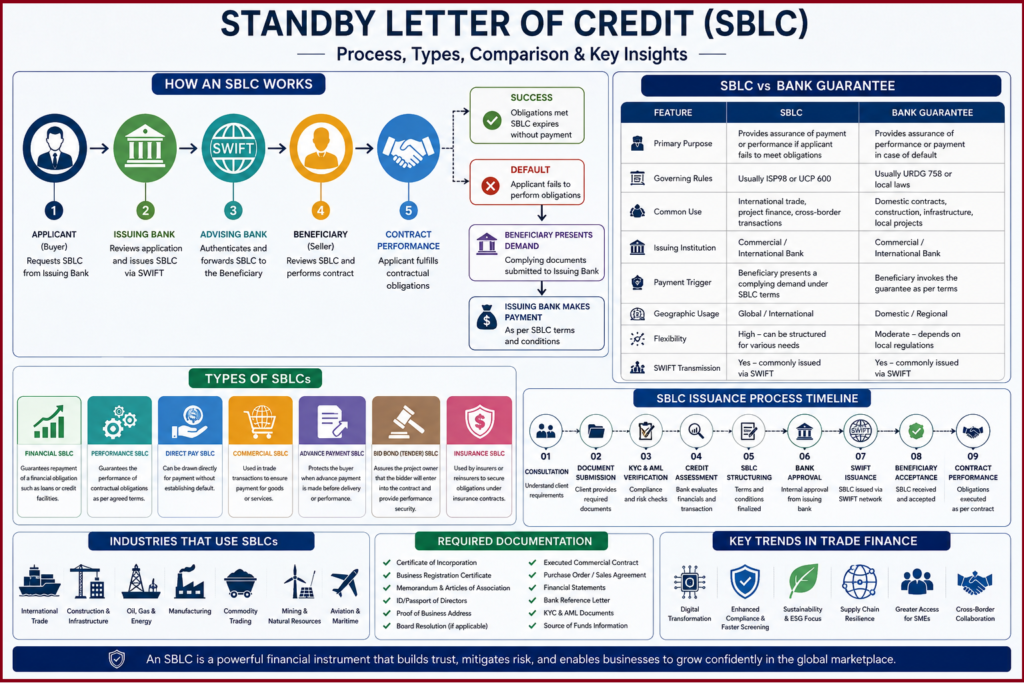
Types of Standby Letters of Credit (SBLCs)
Different business transactions require different forms of financial assurance. The following are the most common types of SBLCs used in international commerce.
1. Financial SBLC
A Financial SBLC guarantees repayment of a financial obligation, such as a loan, lease, or credit facility, if the applicant fails to make payment.
Typical applications include:
- Corporate borrowing
- Project financing
- Commercial lending
- Investment transactions
2. Performance SBLC
A Performance SBLC guarantees that contractual obligations will be completed according to the agreed terms.
Common uses include:
- Construction contracts
- Engineering projects
- Equipment installation
- Infrastructure development
- Government procurement
3. Direct Pay SBLC
Unlike a traditional standby, a Direct Pay SBLC can serve as the primary payment mechanism rather than being triggered only after default. It is commonly used in structured financing transactions.
4. Commercial SBLC
This type of SBLC secures payment for goods or services when buyers purchase under open account terms or other commercial arrangements.
Industries frequently using Commercial SBLCs include:
- Import and export
- Commodity trading
- Manufacturing
- Wholesale distribution
5. Advance Payment SBLC
An Advance Payment SBLC protects a buyer who makes an advance payment before goods are delivered or work begins.
It is widely used for:
- Equipment procurement
- EPC contracts
- International supply agreements
6. Bid Bond (Tender) SBLC
A Bid Bond SBLC assures the project owner that the successful bidder will enter into the contract and provide the required performance security if awarded the project.
This instrument is common in:
- Public procurement
- Infrastructure tenders
- Energy projects
- Government contracts
7. Insurance SBLC
Insurance companies and reinsurers may use an Insurance SBLC to secure obligations arising from insurance or reinsurance agreements.
Common Industries That Use SBLCs
Standby Letters of Credit have become an integral part of modern trade finance. They support businesses across many sectors where contractual performance and payment assurance are critical.
International Trade
Importers and exporters use SBLCs to strengthen confidence between buyers and suppliers while reducing payment risk.
Construction and Infrastructure
Major infrastructure projects often require financial guarantees before contracts commence.
Oil, Gas and Energy
Energy companies rely on SBLCs to secure equipment procurement, long-term supply agreements, and engineering contracts.
Manufacturing
Manufacturers frequently use SBLCs when purchasing production equipment, raw materials, or components from international suppliers.
Mining and Natural Resources
Mining companies use SBLCs to support machinery purchases, equipment leasing, exploration contracts, and commodity supply agreements.
Agriculture and Commodity Trading
Commodity traders dealing in products such as coffee, cocoa, sugar, wheat, rice, metals, and petroleum products often use SBLCs to facilitate international trade.
Aviation and Maritime
Aircraft leasing companies, shipping firms, and marine equipment suppliers frequently require financial guarantees to support high-value transactions.
Renewable Energy
Developers of solar, wind, hydroelectric, and battery storage projects use SBLCs to satisfy contractual obligations during procurement and project development.
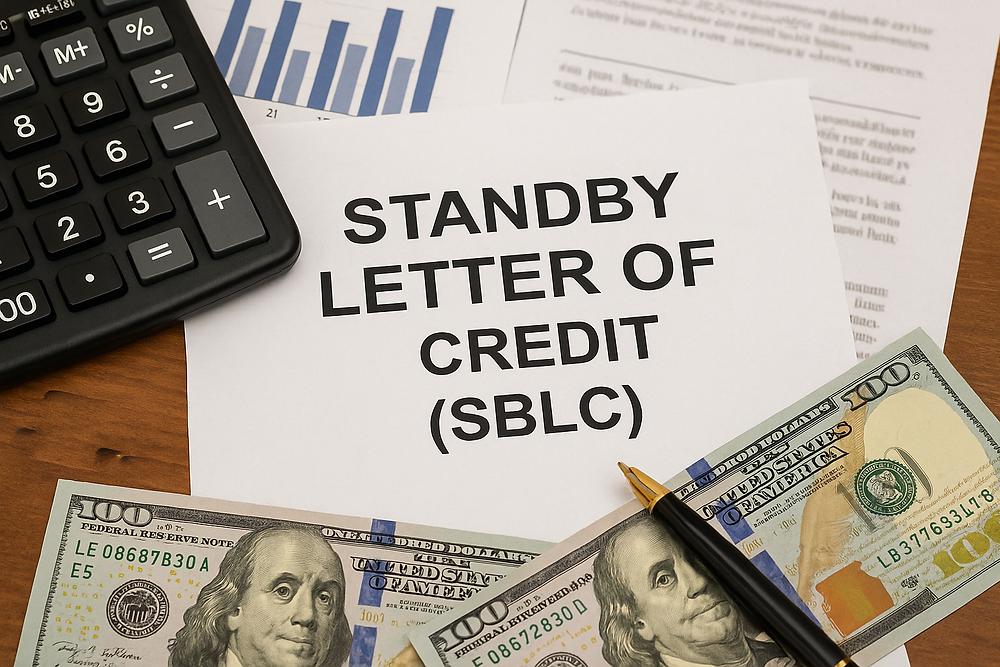
Required Documentation for an SBLC Application
Documentation requirements vary depending on the issuing bank and jurisdiction. However, applicants are generally expected to provide:
- Certificate of Incorporation
- Business Registration Certificate
- Memorandum and Articles of Association
- Valid identification for directors or authorized signatories
- Proof of registered business address
- Board Resolution (where applicable)
- Executed commercial contract
- Purchase Order or Sales Agreement
- Financial Statements
- Bank reference letter
- Completed KYC and AML documentation
- Source of funds information (where required)
Submitting complete and accurate documentation helps streamline compliance reviews and may reduce processing time.
Common Misconceptions About SBLCs
Several misconceptions continue to create confusion among businesses that are unfamiliar with trade finance.
“An SBLC is the same as cash.”
An SBLC is not cash. It is an independent payment undertaking that may be drawn upon only if the conditions specified in the instrument are satisfied.
“Every business automatically qualifies.”
Issuing banks evaluate each application based on financial standing, documentation, compliance requirements, and transaction details.
“SBLCs eliminate all commercial risk.”
An SBLC significantly reduces certain payment and performance risks but does not remove operational, legal, market, or geopolitical risks associated with international business.
“SBLCs are only for multinational corporations.”
Many small and medium-sized enterprises (SMEs) also use SBLCs to strengthen credibility when entering international contracts.
“All SBLCs are identical.”
SBLCs are customized according to the commercial transaction, governing rules, beneficiary requirements, issuing bank policies, and applicable regulations.
Regulatory Framework Governing SBLCs
Professional SBLC transactions operate within internationally recognized banking standards.
ISP98 (International Standby Practices)
ISP98 is the primary rules framework written specifically for standby letters of credit. It provides detailed guidance on issuance, presentation, examination of documents, renewals, transfers, and payment obligations, making it particularly suited to standby practice.
UCP 600 (Uniform Customs and Practice for Documentary Credits)
UCP 600 governs documentary credits generally and can also apply to standby letters of credit where expressly incorporated. However, many practitioners prefer ISP98 for SBLCs because it addresses standby-specific issues more comprehensively.
SWIFT Messaging System
Banks commonly issue and authenticate SBLCs through the secure SWIFT network, using standardized financial messaging formats that facilitate communication between financial institutions worldwide. The specific message type depends on the instrument and transaction structure.
International Compliance
Professional SBLC providers and issuing banks also comply with:
- Know Your Customer (KYC) requirements
- Anti-Money Laundering (AML) regulations
- International sanctions screening
- Counter-terrorist financing regulations
- Applicable local banking laws
Compliance protects the integrity of international financial transactions while helping prevent fraud and financial crime.
Current Trade Finance Trends
The trade finance sector continues to evolve as technology, regulation, and market expectations change.
Several trends are shaping the future of SBLCs and international banking:
- Digital transformation: Banks are increasingly adopting electronic documentation, workflow automation, and digital client onboarding to improve efficiency.
- Faster compliance processes: Artificial intelligence and automated screening tools are helping institutions accelerate KYC, AML, and sanctions checks while maintaining regulatory standards.
- Sustainability-linked finance: More trade finance solutions now support environmental, social, and governance (ESG) objectives, particularly for renewable energy and sustainable infrastructure projects.
- Supply chain resilience: Businesses are diversifying suppliers and using trade finance instruments, including SBLCs, to strengthen supply chain stability amid geopolitical and economic uncertainty.
- Growing SME participation: Small and medium-sized enterprises are gaining greater access to structured trade finance solutions through fintech innovation and enhanced banking partnerships.
These developments are making trade finance more efficient, transparent, and accessible while maintaining the robust risk-management standards that underpin international commerce.
How the SBLC Issuance Process Works
Understanding the SBLC issuance process helps businesses prepare the required documentation and set realistic expectations for transaction timelines. Although the exact process may vary depending on the issuing bank, jurisdiction, and transaction structure, most professional SBLC transactions follow a structured approach.
Step 1: Initial Consultation
The process begins with a detailed consultation between the client and the SBLC provider. During this stage, the provider evaluates:
- The purpose of the SBLC
- Contract value
- Beneficiary requirements
- Desired validity period
- Type of transaction
- Country of the applicant and beneficiary
- Banking preferences
A comprehensive assessment at the outset helps identify the most suitable financial structure.
Step 2: Due Diligence and Compliance
Before proceeding, the provider conducts Know Your Customer (KYC) and Anti-Money Laundering (AML) checks. Clients are typically required to submit:
- Certificate of incorporation
- Company registration documents
- Passport or identification of directors
- Proof of business address
- Financial statements (where applicable)
- Commercial contracts or purchase agreements
Thorough compliance protects all parties and ensures the transaction aligns with international banking standards.
Step 3: Transaction Structuring
Once compliance requirements have been satisfied, the SBLC provider collaborates with the issuing bank to structure the financial instrument based on the commercial agreement.
Key considerations include:
- SBLC amount
- Currency
- Expiry date
- Applicable rules (ISP98 or UCP 600)
- Beneficiary details
- Conditions for drawing on the SBLC
A properly structured SBLC minimizes ambiguity and supports efficient execution.
Step 4: Issuance by the Bank
Following approval, the issuing bank prepares and transmits the SBLC through secure banking channels, commonly using the SWIFT messaging system.
The beneficiary’s bank authenticates the instrument before notifying the beneficiary.
Step 5: Transaction Execution
Once the SBLC has been received and accepted, the commercial transaction proceeds according to the contractual terms.
If the applicant fulfills all obligations, the SBLC expires unused. If contractual obligations are not met, the beneficiary may present a compliant demand under the terms of the SBLC.
Common Mistakes Businesses Make When Choosing an SBLC Provider
Selecting the wrong provider can result in delays, unnecessary costs, or unsuccessful transactions. Businesses should avoid these common mistakes.
Choosing Based Solely on Price
A low-cost solution may not provide the banking relationships, compliance expertise, or transaction support required for complex international deals.
Evaluate overall value rather than fees alone.
Ignoring Banking Relationships
Not every financial institution has access to internationally recognized issuing banks.
Before engaging a provider, confirm that the SBLC will be issued through a reputable banking institution accepted by the beneficiary.
Overlooking Regulatory Compliance
Failure to comply with AML, KYC, and international banking regulations may delay or terminate the transaction.
Experienced providers prioritize compliance from the beginning.
Accepting Unrealistic Promises
Businesses should exercise caution when providers claim guaranteed approvals, unusually fast issuance without due diligence, or exceptionally low pricing that appears inconsistent with market standards.
Professional trade finance requires proper documentation, compliance, and banking procedures.
Failing to Review Contract Terms
Every clause within an SBLC should align with the underlying commercial agreement.
Businesses should seek professional legal and financial advice before finalizing documentation.
Real-World Example
A manufacturing company in Southeast Asia secured a long-term agreement to supply industrial equipment to a construction consortium in the Middle East.
The purchasing consortium required financial assurance before authorizing production.
Instead of depositing the entire contract value upfront, the buyer obtained a Standby Letter of Credit issued through an internationally recognized bank.
The SBLC provided confidence that contractual obligations would be honored if payment obligations were not met.
As a result:
- Production began without unnecessary delays.
- The supplier reduced payment risk.
- The buyer preserved working capital.
- Both parties completed the transaction under clearly defined contractual terms.
This example demonstrates how an SBLC can facilitate international business while balancing commercial risk.
Case Study: Supporting an International Infrastructure Project
Background
An engineering company was awarded a multi-million-dollar infrastructure contract involving the supply and installation of specialized industrial equipment across multiple locations.
The project owner required a financial guarantee before issuing the notice to proceed.
Challenge
The contractor needed to provide a substantial financial instrument within a limited timeframe while maintaining sufficient liquidity to fund project mobilization.
Providing a cash deposit would have significantly reduced available working capital.
Solution
The contractor engaged an experienced trade finance provider to arrange a Standby Letter of Credit through a recognized issuing bank.
The transaction included:
- Comprehensive compliance review
- Coordination with legal advisers
- Alignment of SBLC wording with contractual requirements
- Secure transmission through international banking channels
- Ongoing transaction support until acceptance
Outcome
The project owner accepted the SBLC as contractual security.
The contractor retained working capital for operational expenses, equipment procurement, and staffing while satisfying the project’s financial assurance requirements.
This structured approach enabled the project to proceed on schedule and strengthened the contractor’s relationship with its international client.
Note: This case study is provided for illustrative purposes and reflects a representative commercial scenario rather than a specific client engagement.
Why Businesses Choose Baili Finance Limited
Businesses operating in competitive international markets require more than access to financial instruments. They need a partner that understands global trade, regulatory expectations, and transaction management.
Baili Finance Limited supports clients by focusing on:
- Tailored trade finance solutions
- Professional client consultation
- Efficient documentation guidance
- International transaction coordination
- Transparent communication
- Compliance-focused processes
- Long-term business relationships
Whether supporting importers, exporters, project developers, manufacturers, or commodity traders, our objective is to help clients navigate complex financial transactions with confidence and professionalism.

Frequently Asked Questions (FAQs)
1. What is a Standby Letter of Credit (SBLC)?
A Standby Letter of Credit (SBLC) is a financial guarantee issued by a bank on behalf of a client. It assures the beneficiary that payment or contractual obligations will be honored if the applicant fails to meet the agreed terms. SBLCs are widely used in international trade, project finance, and commercial contracts to reduce counterparty risk.
2. Who needs an SBLC?
SBLCs are commonly used by:
- Importers and exporters
- Construction and engineering firms
- Commodity traders
- Energy companies
- Manufacturers
- Infrastructure developers
- Government contractors
- Businesses seeking project financing
Organizations entering high-value domestic or international agreements often use SBLCs to strengthen trust with counterparties.
3. What is the difference between an SBLC and a Bank Guarantee?
While both instruments provide financial assurance, an SBLC is commonly used in international trade and generally follows internationally recognized rules such as ISP98 or UCP 600. A bank guarantee is more frequently used in domestic transactions, although practices vary by country and banking institution.
4. How long does it take to obtain an SBLC?
The timeframe depends on several factors, including the complexity of the transaction, the completeness of documentation, compliance reviews, and the issuing bank’s procedures. Well-prepared applications with complete documentation generally move more efficiently through the process.
5. Can an SBLC support project financing?
Yes. Many lenders, investors, suppliers, and project owners accept SBLCs as part of a broader financial structure. They can provide additional assurance during infrastructure, construction, energy, manufacturing, and commercial development projects.
6. What should businesses look for in an SBLC provider?
When evaluating an SBLC provider, businesses should consider:
- Experience in trade finance
- Relationships with reputable issuing banks
- Strong compliance practices
- Transparent communication
- Customized transaction structuring
- Knowledge of international banking standards
- Responsive client support
Selecting an experienced provider helps reduce delays and supports smoother transaction execution.
Conclusion
A Standby Letter of Credit remains one of the most effective financial instruments for managing commercial risk and strengthening confidence in international business transactions. Whether supporting imports, exports, infrastructure developments, manufacturing projects, or commodity trading, an SBLC provides an additional layer of financial assurance that benefits both applicants and beneficiaries.
Choosing the right SBLC provider is therefore a strategic decision. Businesses should prioritize experience, transparency, regulatory compliance, established banking relationships, and a client-focused approach. A provider that understands international trade finance can help structure solutions that align with contractual objectives while supporting efficient transaction management.
At Baili Finance Limited, we are committed to helping businesses navigate the complexities of global trade finance with professionalism, integrity, and practical expertise. By understanding each client’s commercial objectives, we aim to deliver tailored financial solutions that support sustainable business growth and long-term partnerships.
Ready to Strengthen Your Next International Transaction?
Whether you require a Standby Letter of Credit for international trade, project finance, equipment procurement, or commercial contracts, our experienced team is ready to discuss your financing requirements.
Contact Baili Finance Limited today to explore how our trade finance specialists can help structure an SBLC solution tailored to your business objectives. We welcome the opportunity to understand your project, answer your questions, and help you move forward with confidence.
SBLC Solutions with Baili Finance Company Limited
Ready to partner with a trusted global leader in Standby Letter of Credit (SBLC) services? Baili Finance Company Limited delivers reliable, bank-compliant SBLC issuance, monetization, and trade finance solutions designed to help businesses close international deals with confidence.
Whether you’re financing large-scale projects, securing international contracts, or expanding global trade operations, our experienced team provides fast, transparent, and professional financial solutions tailored to your needs.
Why Choose Baili Finance Company Limited?
- Trusted global SBLC provider
- Fast and secure SBLC issuance
- Competitive pricing with flexible structures
- International trade finance expertise
- Professional support from application to completion
- Reliable solutions for importers, exporters, contractors, developers, and investors
Take the Next Step Toward Global Business Success
Don’t leave your international transactions to chance. Work with a financing partner committed to your success.
👉Visit: www.bailifinance.com
👉 Contact Baili Finance Company Limited today for a confidential consultation and discover how our premium SBLC and trade finance solutions can unlock new business opportunities worldwide.
Baili Finance Company Limited — Your Trusted Global Partner for SBLC, Bank Guarantees, Trade Finance, and International Financial Solutions.
Start your global financing journey today at www.bailifinance.com and experience the confidence of working with one of the world’s trusted trade finance partners.
Intermediaries/Consultants/Brokers are welcome to bring their clients 100% protected. Our brokers receive 2% commission for referral. We assist Clients and brokers in their attempt to secure funding by working on their funding requests that may require innovative financing. In complete confidence, we will work together for the benefits of all parties involved.
#SBLC #StandbyLetterOfCredit #TradeFinance #InternationalTrade #ProjectFinance #ImportExport #CorporateFinance #BusinessFinance #FinancialSolutions #GlobalBusiness #CommercialFinance #BailiFinanceLimited