Headline: 7 Proven Facts About SBLC Monetization
SBLC Monetization
In today’s global financial environment, businesses often require immediate access to capital to execute large-scale projects, finance international trade, expand operations, or improve liquidity without diluting ownership. While conventional lending remains a common funding option, many organizations seek structured financial solutions that preserve cash flow and strengthen their balance sheets. One of the most effective instruments for achieving this objective is SBLC Monetization.

SBLC Monetization refers to the process of converting the financial value of a Standby Letter of Credit (SBLC) into usable working capital through a structured monetization facility. Rather than allowing an SBLC to remain an unused banking instrument, businesses can leverage its value to secure funding for commercial activities, project financing, import and export transactions, infrastructure development, acquisitions, and corporate expansion.
As international commerce continues to evolve, financial institutions and specialized providers have developed monetization structures that enable qualified organizations to transform bank-issued guarantees into immediate liquidity while maintaining financial flexibility. This financing strategy has become increasingly relevant for corporations seeking alternative capital solutions without relying exclusively on traditional loans or equity financing.
Whether you are an investor, project developer, importer, exporter, contractor, or corporate executive, understanding how SBLC monetization works can help you identify financing opportunities that align with your business objectives and risk management strategy.
This comprehensive guide explains every critical aspect of SBLC monetization, including its structure, benefits, process, practical applications, eligibility requirements, and best practices for selecting a reliable monetization partner.
Focus Keyword: SBLC Monetization Standby Letter of Credit, SBLC Funding, SBLC Financing, Trade Finance Solutions, Structured Finance, Business Liquidity, Corporate Finance
What Is SBLC Monetization?
SBLC Monetization is a structured financial transaction in which the beneficiary or owner of a bank-issued Standby Letter of Credit (SBLC) uses that financial instrument to obtain funding from a monetizer or financial institution. Instead of drawing directly on the SBLC, the holder leverages its financial strength to access working capital for legitimate business purposes.
Unlike conventional lending, monetization focuses on the financial credibility of the issuing bank and the terms of the SBLC. Once the instrument satisfies due diligence requirements, the monetizer structures financing based on its value, validity period, issuing bank, and transaction purpose.
This approach enables businesses to unlock liquidity without selling ownership interests or disrupting operational cash flow.
Organizations frequently use monetized funds for:
- International trade finance
- Project finance
- Construction projects
- Infrastructure development
- Renewable energy investments
- Oil and gas transactions
- Manufacturing expansion
- Equipment acquisition
- Import financing
- Export financing
- Working capital requirements
- Corporate growth initiatives
As global financing becomes more sophisticated, SBLC monetization continues to provide businesses with greater flexibility when pursuing commercial opportunities.
Understanding Standby Letters of Credit
Before exploring the monetization process, it is important to understand the purpose of a Standby Letter of Credit.
A Standby Letter of Credit is a banking instrument issued by a financial institution on behalf of its customer. It serves as a payment guarantee, assuring the beneficiary that the issuing bank will meet specified financial obligations if the applicant fails to perform according to contractual terms.
Unlike traditional documentary letters of credit, which facilitate payments during trade transactions, an SBLC functions primarily as a financial guarantee.
Businesses commonly use SBLCs in:
International Trade
Importers and exporters rely on SBLCs to reduce payment risk while strengthening commercial relationships between trading partners operating across different jurisdictions.
Project Finance
Developers often provide SBLCs to demonstrate financial capability before commencing large infrastructure or commercial developments.
Construction Contracts
Government agencies and private organizations frequently require contractors to submit SBLCs as performance guarantees before awarding contracts.
Equipment Procurement
Manufacturers purchasing high-value industrial equipment may provide SBLCs to reassure suppliers regarding future payment obligations.
Corporate Transactions
Mergers, acquisitions, strategic partnerships, and investment agreements often include SBLCs to enhance financial security during negotiations.
Because these instruments originate from recognized financial institutions, they carry significant financial credibility, making them suitable for monetization under the right conditions.

How SBLC Monetization Works
Understanding the monetization process helps businesses evaluate whether this financing solution aligns with their strategic objectives.
Although transaction structures vary among providers, the process generally follows several key stages.
Step 1: Issuance of the SBLC
A reputable bank issues the Standby Letter of Credit in accordance with internationally recognized banking practices and the agreed contractual terms.
Step 2: Initial Review
The monetization provider conducts a preliminary assessment to determine whether the instrument satisfies its eligibility criteria. Key evaluation factors include:
- Issuing bank reputation
- Instrument authenticity
- Face value
- Validity period
- Transferability, where applicable
- Compliance documentation
- Intended commercial purpose
Step 3: Due Diligence
Comprehensive verification confirms the legitimacy of the instrument, participating parties, and underlying commercial transaction. This phase helps protect every stakeholder while ensuring regulatory compliance.
Step 4: Structuring the Monetization Facility
Once verification concludes successfully, the monetizer develops a customized financing structure based on the agreed commercial objectives.
Depending on the transaction, businesses may receive funding through structured investment programs, credit facilities, or other approved financial arrangements.
Step 5: Access to Capital
Following completion of contractual requirements, the business receives access to capital that can support approved commercial activities while preserving operational flexibility.
Properly structured SBLC monetization enables organizations to pursue business opportunities that might otherwise remain inaccessible because of capital constraints.
External Sources:
International Chamber of Commerce (ICC) — UCP 600 Rules for Documentary Credits. ICC UCP 600 Uniform Rules for Documentary Credits
Investopedia — Letters of Credit and Bank Guarantees. Investopedia: Bank Guarantees and Letters of Credit Explained
7 Proven Facts About SBLC Monetization
1. SBLC Monetization Converts a Financial Instrument Into Business Liquidity
A Standby Letter of Credit (SBLC) is a bank-issued financial instrument designed to provide payment assurance between parties. Through SBLC monetization, an eligible SBLC can be leveraged to access structured financing for approved commercial purposes.
Instead of allowing an SBLC to remain unused, qualified businesses may use its financial strength to support liquidity needs, including:
- Working capital requirements
- International trade transactions
- Project financing
- Infrastructure development
- Business expansion
- Equipment acquisition
However, monetization does not mean the SBLC is simply converted into cash automatically. The process requires verification, due diligence, compliance checks, and agreement between qualified parties.
2. The Issuing Bank’s Reputation Plays a Major Role in SBLC Monetization
Not every SBLC receives the same level of acceptance in financial markets. One of the most important factors considered during monetization is the credibility and standing of the issuing bank.
Financial providers typically review:
- The bank’s international recognition
- Credit strength
- Regulatory standing
- Authenticity of the instrument
- Compliance history
- Terms and conditions of the SBLC
A Standby Letter of Credit issued by a reputable financial institution generally provides stronger confidence during the evaluation process.
3. SBLC Monetization Is Commonly Used in Capital-Intensive Industries
Businesses operating in industries that require significant upfront investment often explore structured financing solutions.
Common sectors include:
- International trade
- Construction
- Infrastructure
- Renewable energy
- Manufacturing
- Mining
- Oil and gas
- Real estate development
For example, a construction company developing a large commercial project may use an eligible SBLC-based financing structure to support procurement, contractor payments, and project execution.
4. SBLC Monetization Requires Professional Due Diligence and Compliance
A legitimate SBLC monetization process involves careful evaluation before any financing arrangement is established.
Important checks may include:
- Know Your Customer (KYC) verification
- Anti-Money Laundering (AML) compliance
- Document authentication
- Contract review
- Banking verification
- Transaction purpose assessment
Businesses should avoid providers that promise guaranteed returns, instant approvals, or unrealistic funding outcomes without proper verification.
A professional approach focuses on transparency, regulatory compliance, and clearly defined contractual obligations.
5. SBLC Monetization Does Not Work Like a Traditional Business Loan
Although both solutions provide access to capital, SBLC monetization and traditional lending operate differently.
A traditional business loan usually depends on:
- Company revenue
- Credit history
- Debt capacity
- Collateral
- Repayment ability
SBLC monetization focuses more on:
- The value and validity of the SBLC
- The issuing bank
- The transaction structure
- Compliance requirements
- Commercial objectives
Understanding this difference helps businesses choose the financing approach that best matches their needs.
6. SBLC Monetization Can Support Global Trade and Cross-Border Transactions
International businesses often face challenges involving supplier confidence, payment security, and liquidity management.
SBLC-based financing structures may support:
- Import and export activities
- Supplier payment arrangements
- International procurement
- Trade expansion
- Cross-border commercial agreements
By strengthening financial credibility, an SBLC can help businesses participate in larger transactions and develop stronger relationships with international partners.
7. Successful SBLC Monetization Depends on Choosing the Right Financial Partner
The success of an SBLC monetization transaction depends heavily on selecting experienced professionals who understand structured finance, banking procedures, and international compliance requirements.
A reliable partner should demonstrate:
- Clear transaction processes
- Professional documentation
- Transparent communication
- Industry experience
- Compliance-focused operations
Businesses should conduct proper research before engaging any monetization provider and seek independent legal and financial advice when necessary.
SBLC Monetization can provide businesses with a structured approach to accessing liquidity by leveraging the value of an eligible Standby Letter of Credit. When properly executed, it can support trade finance, project development, and corporate expansion.
The key factors behind successful SBLC monetization are credible banking instruments, qualified financial partners, proper due diligence, and a clearly defined business purpose.
Types of SBLC Monetization
Different financing objectives require different monetization structures. Experienced providers evaluate each transaction individually before recommending the most appropriate solution.
Non-Recourse Monetization
In a non-recourse arrangement, repayment obligations remain limited according to the agreed contractual structure. This option may provide greater financial flexibility for qualifying commercial transactions.
Recourse Monetization
Recourse monetization includes defined repayment obligations between participating parties and is commonly used for structured commercial financing arrangements.
Project-Based Monetization
Large infrastructure developments, energy projects, mining operations, logistics facilities, and manufacturing investments frequently utilize project-specific monetization structures tailored to project cash flows and financing milestones.
“Liquidity is not only about available cash. It is about converting financial strength into business opportunity through structured financing solutions.”
Key Participants in the SBLC Monetization Process
Every successful SBLC monetization transaction involves multiple stakeholders, each performing a specific role to ensure the transaction proceeds efficiently, transparently, and in compliance with applicable banking regulations.
The Applicant
The applicant is the individual or business that requests the issuance of the Standby Letter of Credit from its bank. The applicant agrees to the bank’s terms and remains responsible for meeting the obligations outlined in the underlying commercial agreement.
The Issuing Bank
The issuing bank creates and guarantees the SBLC. Its financial strength, international reputation, credit rating, and compliance standards significantly influence whether the instrument qualifies for monetization.
In most transactions, monetization providers prefer SBLCs issued by established financial institutions with strong international recognition.
The Beneficiary
The beneficiary is the party in whose favor the SBLC is issued. Depending on the transaction structure, the beneficiary may be the entity seeking monetization or another party involved in the commercial agreement.
The Monetization Provider
The monetization provider evaluates the SBLC, conducts due diligence, structures the financing arrangement, and facilitates access to capital after all commercial and compliance requirements have been satisfied.
An experienced provider will also assess project feasibility, risk exposure, regulatory obligations, and funding objectives before recommending a financing structure.
Legal and Compliance Professionals
International financial transactions require legal oversight. Attorneys and compliance specialists review documentation, verify contractual obligations, and ensure the transaction complies with applicable laws, banking regulations, and anti-money laundering (AML) requirements.
Financial Advisors
Corporate finance professionals often assist businesses in determining whether SBLC monetization is the most suitable funding option when compared with syndicated loans, private investment, bridge financing, or other structured finance solutions.
Business Benefits of SBLC Monetization
SBLC monetization continues to gain acceptance because it offers businesses a practical method of improving liquidity while supporting long-term growth objectives.
Improved Cash Flow
Many organizations possess valuable banking instruments but lack immediate access to operating capital. Monetization converts that financial strength into usable funds that can support business operations, supplier payments, payroll, and strategic investments.
Access to Large-Scale Funding
Businesses undertaking infrastructure developments, energy projects, manufacturing expansion, or international trade often require significant funding. SBLC monetization can provide access to capital that supports these complex commercial activities.
Preservation of Ownership
Unlike equity financing, monetization enables businesses to raise capital without issuing additional shares or reducing ownership interests.
For founders, investors, and privately owned companies, maintaining control over business operations is often a strategic priority.
Faster Execution of Commercial Opportunities
Many commercial opportunities have strict deadlines. Delays in financing may result in lost contracts or reduced competitiveness.
A properly structured monetization facility can help businesses secure funding within agreed timelines, allowing projects to proceed without unnecessary interruption.
Enhanced Financial Flexibility
Businesses frequently use monetized funds to diversify investments, strengthen working capital, purchase inventory, acquire equipment, or expand into new markets.
This flexibility allows management to allocate capital where it delivers the greatest commercial value.
Support for International Trade
International transactions often involve extended payment terms, foreign suppliers, and cross-border regulatory requirements.
SBLC monetization provides businesses with additional liquidity to manage imports, exports, logistics, and supply chain operations while maintaining financial stability.
Strengthened Corporate Growth Strategy
Organizations with reliable access to structured finance are generally better positioned to pursue acquisitions, geographic expansion, technology upgrades, and strategic partnerships.
SBLC Monetization vs. Traditional Business Loans.
| Feature | SBLC Monetization | Traditional Business Loans |
|---|---|---|
| Primary Purpose | Converts the value of an eligible Standby Letter of Credit into working capital or structured financing. | Provides borrowed funds based on the borrower’s creditworthiness and financial profile. |
| Funding Basis | Value and quality of the SBLC, issuing bank, and transaction structure. | Credit history, financial statements, collateral, and repayment capacity. |
| Source of Financing | Specialized monetization providers or structured finance institutions. | Commercial banks, development banks, credit unions, and other lending institutions. |
| Collateral Requirement | The SBLC serves as the primary financial instrument supporting the transaction. | Often requires business assets, property, inventory, or personal guarantees as collateral. |
| Approval Process | Focuses on verification of the SBLC, issuing bank, compliance, and commercial purpose. | Focuses on credit analysis, cash flow, debt ratios, and business performance. |
| Funding Speed | Can be efficient once due diligence and instrument verification are complete. | Approval timelines vary and may take several weeks or months, depending on the lender. |
| Working Capital Access | Enables businesses to unlock liquidity without selling equity. | Provides direct financing through a loan agreement with scheduled repayments. |
| Ownership Dilution | No dilution of ownership or shareholder equity. | No ownership dilution, although loan covenants may restrict certain business activities. |
| Repayment Structure | Depends on the monetization agreement and transaction structure. | Fixed or variable repayment schedule with principal and interest payments. |
| Suitable For | International trade, project finance, infrastructure, manufacturing, energy, and other capital-intensive commercial activities. | General business expansion, equipment purchases, operating expenses, acquisitions, and working capital needs. |
| Risk Assessment | Emphasizes the credibility of the issuing bank, the SBLC, and regulatory compliance. | Emphasizes borrower creditworthiness, financial stability, and collateral value. |
| Regulatory Requirements | Requires strict compliance with KYC, AML, sanctions screening, and international banking standards. | Subject to banking regulations, lending policies, and borrower due diligence requirements. |
| Financial Flexibility | Provides access to structured funding while preserving existing cash flow. | May reduce borrowing capacity as additional debt appears on the balance sheet. |
| Best Use Cases | Large commercial projects, cross-border trade, structured finance, and corporate expansion initiatives. | Day-to-day business financing, expansion projects, refinancing, and capital investments. |
Key Takeaways
- SBLC Monetization is most appropriate for businesses that already possess an eligible Standby Letter of Credit and want to unlock its value to finance strategic commercial activities.
- Traditional Business Loans remain a practical solution for businesses seeking direct financing based on their financial performance, credit profile, and repayment capacity.
- The right financing option depends on your organization’s objectives, available financial instruments, funding timeline, and long-term growth strategy.
- Before selecting either option, consult experienced financial, legal, and banking professionals to ensure the chosen structure aligns with your commercial and regulatory requirements.
Expert Insight: Businesses engaged in international trade, infrastructure development, manufacturing, and project finance often view SBLC monetization as a complementary financing strategy rather than a replacement for traditional business loans. A well-planned capital structure may combine both solutions to optimize liquidity, manage risk, and support sustainable growth.
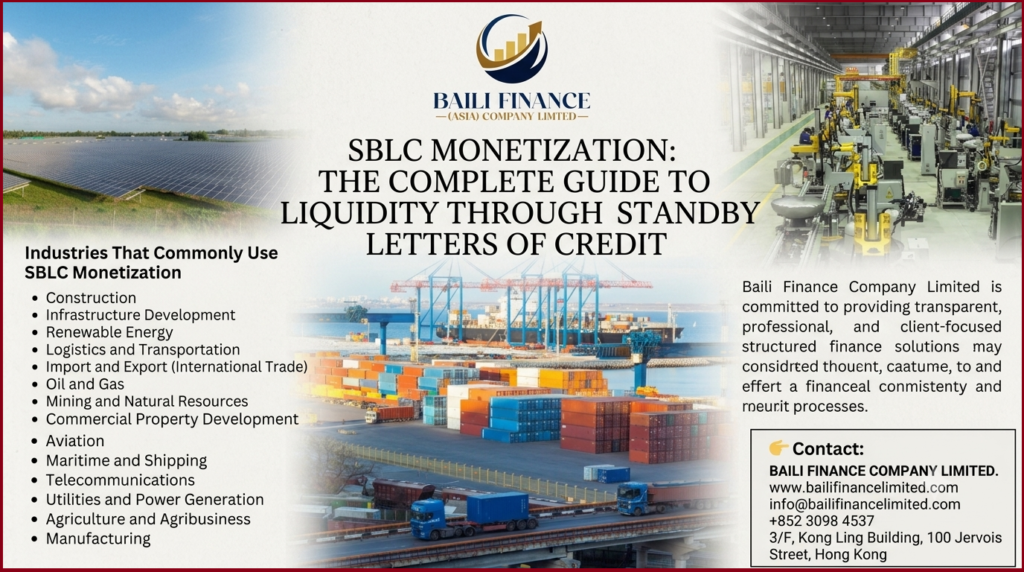
Industries That Commonly Use SBLC Monetization
Although SBLC monetization serves a wide range of businesses, several industries rely on this financing solution more frequently because of their capital-intensive operations.
Construction and Infrastructure
Large infrastructure projects require continuous funding throughout planning, procurement, construction, and commissioning.
SBLC monetization helps contractors and developers maintain project momentum while meeting contractual obligations.
Energy and Renewable Energy
Power generation facilities, solar farms, wind energy projects, hydroelectric developments, and battery storage investments require substantial capital before generating revenue.
Structured financing supports project execution while reducing funding delays.
Oil and Gas
The oil and gas industry often relies on substantial financial guarantees for exploration, production, transportation, and equipment procurement.
SBLC monetization provides additional liquidity throughout these investment cycles.
International Import and Export
Importers and exporters regularly manage supplier payments, shipping costs, customs obligations, and inventory financing.
Monetization strengthens working capital while supporting international trade growth.
Manufacturing
Manufacturers frequently require financing for machinery purchases, production expansion, warehouse facilities, and raw material procurement.
Using an SBLC to unlock liquidity can improve operational efficiency without interrupting production schedules.
Mining and Natural Resources
Mining operations involve considerable upfront investment in exploration, equipment, logistics, environmental compliance, and workforce development.
Structured financing enables companies to advance projects while maintaining financial discipline.
Commercial Real Estate
Developers use monetized capital to finance land acquisition, mixed-use developments, commercial buildings, hospitality projects, and industrial facilities.
Important Risks and Considerations
Although SBLC monetization offers significant advantages, businesses should evaluate every transaction carefully before entering into an agreement.
Verify the Credibility of Every Party
Organizations should work only with reputable financial institutions and experienced monetization providers that maintain transparent processes and comply with international banking standards.
A thorough review of the provider’s credentials, transaction history, and legal documentation helps reduce unnecessary risk.
Understand the Transaction Structure
Every monetization agreement differs.
Businesses should clearly understand:
- Funding timelines
- Commercial terms
- Applicable fees
- Compliance requirements
- Exit provisions
- Reporting obligations
- Legal responsibilities
Professional legal and financial advice remains essential before signing any agreement.
Regulatory Compliance
Cross-border financial transactions are subject to various regulatory frameworks, including Know Your Customer (KYC), Anti-Money Laundering (AML), and sanctions screening requirements.
Businesses should ensure complete and accurate documentation throughout the transaction.
Evaluate the Issuing Bank
Not every SBLC qualifies for monetization.
Providers assess factors such as:
- Bank reputation
- Credit quality
- International acceptance
- Instrument wording
- Validity period
- Applicable banking rules
SBLCs issued by well-established financial institutions generally receive broader market acceptance.
Work With Experienced Advisors
Complex financial transactions require collaboration among experienced bankers, lawyers, accountants, and structured finance professionals.
Professional guidance reduces risk while improving transaction efficiency and regulatory compliance.
Best Practices for a Successful SBLC Monetization Transaction
Organizations seeking to maximize the value of their SBLC should adopt several practical best practices.
Prepare Complete Documentation
Incomplete documentation remains one of the primary causes of transaction delays.
Prepare all relevant financial statements, corporate documents, banking records, contracts, and identification documents before initiating discussions with a monetization provider.
Define Clear Business Objectives
Clearly identify how the monetized funds will support business growth.
Whether financing imports, expanding manufacturing capacity, or funding infrastructure development, clearly defined objectives improve financing discussions.
Select an Experienced Financial Partner
Choose a monetization provider with demonstrated expertise in structured finance, international banking, and complex commercial transactions.
An experienced partner understands regulatory expectations and can help structure financing that aligns with your organization’s goals.
Maintain Open Communication
Transparent communication between all stakeholders helps resolve issues quickly and improves transaction efficiency.
Regular updates, timely documentation, and collaborative decision-making contribute to successful outcomes.
“Successful monetization begins with a credible banking instrument, comprehensive due diligence, and a financing strategy aligned with long-term business objectives.”
Latest Trends Influencing SBLC Monetization in Global Finance
The demand for SBLC monetization continues to grow as businesses seek flexible financing solutions that support international expansion, infrastructure development, and strategic investment. Several market trends are shaping how companies approach structured finance.
Businesses are increasingly combining Standby Letters of Credit, trade finance solutions, and alternative funding strategies to improve liquidity without depending exclusively on traditional lending models.
Key trends influencing the market include:
- Growing demand for cross-border trade financing
- Increased use of structured finance solutions
- Expansion of renewable energy and infrastructure projects
- Greater focus on corporate liquidity management
- Adoption of digital tools for financial analysis and transaction monitoring
Organizations that understand these trends can make better financing decisions and identify opportunities where SBLC monetization supports long-term business objectives.
Real-World Example: How SBLC Monetization Supports International Business Growth
Consider a renewable energy company that secures a contract to build a 100 MW solar power facility. The project requires immediate funding for engineering, procurement, equipment purchases, and contractor mobilization before the first milestone payment is received.
To strengthen the financing structure, the company obtains a Standby Letter of Credit from a reputable international bank. Instead of leaving the SBLC unused, the company works with a qualified monetization provider to convert the instrument into working capital.
The monetized funds allow the business to:
- Purchase solar panels and electrical components.
- Secure engineering and construction services.
- Pay suppliers on time.
- Recruit project personnel.
- Maintain project schedules.
- Meet contractual obligations without disrupting existing cash flow.
As construction progresses, milestone payments from the project owner improve liquidity, enabling the company to complete the project while preserving financial flexibility. Rather than relying solely on conventional borrowing, the organization uses the strength of its banking instrument to support sustainable business growth.
This example demonstrates why SBLC monetization has become an important financing solution for businesses executing capital-intensive projects across international markets.
Case Study: Structured SBLC Monetization for Manufacturing Expansion
Background
A manufacturing company planned to expand production capacity to meet increasing demand from international customers. The expansion included purchasing new machinery, upgrading warehouse facilities, and increasing inventory.
Although the company maintained strong customer relationships and profitable operations, traditional financing required lengthy approval processes that could delay implementation.
Challenge
Management needed immediate access to capital while maintaining ownership of the business and preserving existing banking facilities.
Solution
The company obtained a bank-issued Standby Letter of Credit and engaged a specialist structured finance provider to evaluate the instrument for monetization.
After completing due diligence, reviewing the issuing bank, and confirming the commercial purpose of the transaction, the provider structured a monetization facility aligned with the company’s expansion strategy.
Results
The monetized funds enabled the company to:
- Increase manufacturing capacity.
- Purchase modern production equipment.
- Expand warehouse operations.
- Improve inventory management.
- Meet customer delivery schedules.
- Strengthen long-term revenue growth.
The expansion was completed on schedule, allowing the company to enter additional export markets while maintaining a healthy financial position.
Key Takeaway
A well-structured SBLC monetization transaction can provide businesses with the liquidity needed to execute strategic initiatives without depending exclusively on conventional lending or equity financing.
Frequently Asked Questions
1. What is SBLC monetization?
SBLC monetization is the process of using the value of a bank-issued Standby Letter of Credit to obtain financing or working capital through a structured financial arrangement. The funding supports legitimate commercial activities such as international trade, project finance, expansion, and corporate investment.
2. Who can benefit from SBLC monetization?
Businesses involved in construction, infrastructure, international trade, manufacturing, energy, oil and gas, mining, logistics, real estate, and large commercial projects often use SBLC monetization to improve liquidity and finance growth.
3. Is every Standby Letter of Credit eligible for monetization?
No. Eligibility depends on several factors, including the issuing bank, the wording of the instrument, its validity period, compliance with applicable banking standards, and the commercial purpose of the transaction.
4. How long does the monetization process take?
The timeline varies depending on the complexity of the transaction, the quality of documentation, compliance reviews, and the due diligence process. Well-prepared applications generally progress more efficiently.
5. Is SBLC monetization the same as a business loan?
No. While both provide access to capital, SBLC monetization relies on the financial strength of a qualifying banking instrument rather than following the structure of a conventional commercial loan.
6. What documents are commonly required?
Requirements differ between providers but typically include corporate registration documents, financial statements, identification records, banking information, the SBLC documentation, and details of the underlying commercial transaction.
7. Can monetized funds be used for international trade?
Yes. Many organizations use monetized funds to finance imports, exports, supplier payments, inventory purchases, logistics, and supply chain operations.
Conclusion
SBLC monetization has become an established structured finance solution for businesses seeking efficient access to capital while preserving financial flexibility. When supported by a credible issuing bank, comprehensive due diligence, and an experienced monetization provider, a Standby Letter of Credit can become more than a financial guarantee—it can become a strategic funding tool that supports expansion, improves liquidity, and enables organizations to execute complex commercial opportunities.
Businesses considering SBLC monetization should approach every transaction with careful planning, transparent documentation, and professional legal and financial advice. Choosing experienced partners and maintaining compliance with international banking standards are essential to achieving successful outcomes.
As global commerce continues to evolve, organizations that understand and use structured finance solutions effectively will be better positioned to compete, invest, and grow in increasingly demanding markets.
Ready to Unlock the Value of Your SBLC?
Whether you are financing an international trade transaction, expanding your business, funding infrastructure development, or seeking additional working capital, Baili Finance Limited is committed to helping businesses identify structured finance solutions tailored to their commercial objectives.
Our team works closely with clients to evaluate eligible banking instruments, provide professional guidance, and structure financing solutions that support sustainable business growth.
🌐www.bailifinancelimited.com
Contact Baili Finance Limited today to discuss your SBLC monetization requirements and discover how structured finance can help your business move forward with confidence. Your next growth opportunity may already be within reach.
Intermediaries/Consultants/Brokers are welcome to bring their clients 100% protected. Our brokers receive 2% commission for referral. We assist Clients and brokers in their attempt to secure funding by working on their funding requests that may require innovative financing. In complete confidence, we will work together for the benefits of all parties involved.
#SBLCMonetization #StructuredFinance #TradeFinance #BusinessFunding #ProjectFinance #WorkingCapital #StandbyLetterOfCredit #InternationalTrade #CorporateFinance #BailiFinanceLimited