Headline: 9 Critical Steps for SBLC Funding Without Delays
The SBLC funding process involves more than obtaining a Standby Letter of Credit and asking a financier to release cash. A professional transaction requires a valid Standby Letter of Credit (SBLC), an acceptable issuing bank, clear instrument wording, banking verification, compliance checks, a credible funding purpose, and a financing structure that an eligible institution can approve.
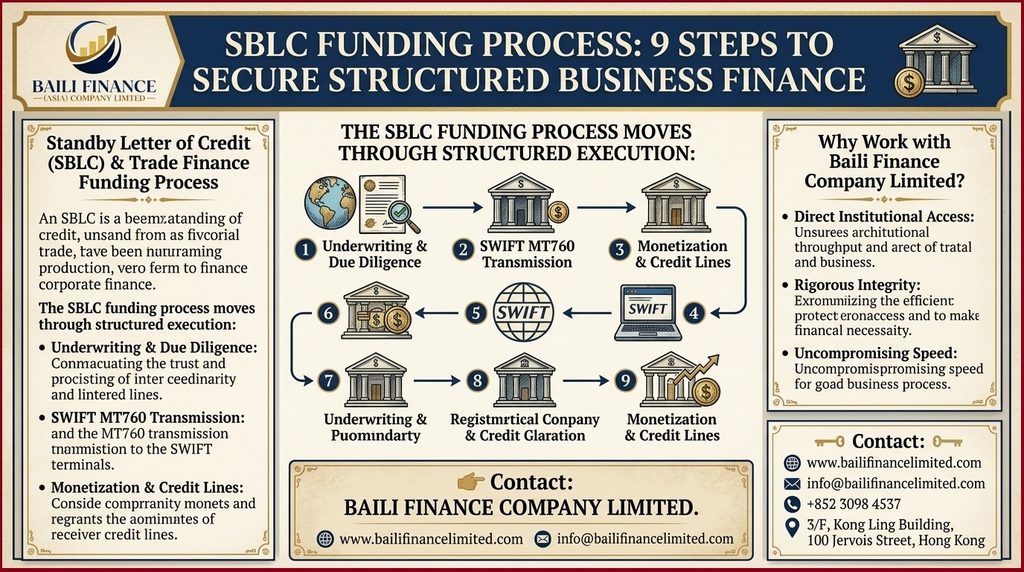
For businesses seeking SBLC funding, SBLC financing, SBLC monetization, trade finance, project funding, working capital, or structured finance, understanding each stage can prevent costly delays and unrealistic expectations.
An SBLC is an independent bank undertaking that can provide payment assurance or credit enhancement. The International Chamber of Commerce explains that an SBLC can support an applicant’s credit quality when issued by a sufficiently strong bank. It also distinguishes the SBLC from the underlying commercial contract.
That distinction matters.
An SBLC isn’t cash. It can support a financing arrangement when a lender or financing institution accepts the instrument and agrees to structure funding against it.
This guide explains the SBLC funding process from initial assessment through due diligence, bank verification, financing approval, documentation, collateral arrangements, and funding.
keywords: SBLC funding process, SBLC funding, SBLC financing, SBLC monetization, SBLC-backed financing, standby letter of credit funding, standby letter of credit financing, SBLC funding process step by step, how SBLC funding works, SBLC financing process, SBLC monetization process, SBLC project funding, SBLC trade finance, bank instrument financing, standby letter of credit funding requirements.
What Is the SBLC Funding Process?
The SBLC funding process is the structured procedure through which a valid bank-issued Standby Letter of Credit may support a financing facility.
Depending on the transaction, the SBLC can function as:
- Credit enhancement
- Payment assurance
- Performance security
- Collateral support
- Trade finance security
- Financing support
- A component of an SBLC monetization structure
The precise structure depends on the issuing bank, beneficiary, applicant, instrument wording, applicable rules, jurisdiction, transaction purpose, tenor, and financing provider.
The ICC notes that standby letters of credit are commonly governed by ISP98 or UCP 600, depending on the wording of the instrument. ISP98 provides a framework specifically developed for standby transactions, while UCP 600 applies to documentary credits, including SBLCs when the credit expressly incorporates the rules to the extent applicable.
Therefore, businesses shouldn’t treat every SBLC as identical.
The instrument must be examined on its own terms.

SBLC Funding vs. SBLC Issuance
One of the most important points to understand is the difference between SBLC issuance and SBLC funding.
SBLC issuance means a bank issues the standby instrument for an applicant in favour of a beneficiary.
SBLC funding means a separate financing arrangement is structured using an eligible SBLC as part of the credit support.
These are different transactions.
A company may obtain an SBLC but still fail to obtain funding if the proposed lender doesn’t accept the issuing bank, the instrument contains unsuitable conditions, the transaction lacks a credible repayment source, or compliance requirements aren’t satisfied.
The ICC’s trade finance principles describe a typical SBLC structure in which the applicant instructs an issuing bank, the bank issues the instrument in favour of the beneficiary, and an advising bank may transmit or advise it. If a compliant claim is presented under the applicable terms, the issuing bank may be required to honour it.
Consequently, SBLC funding isn’t an automatic conversion of face value into cash.
That distinction should remain clear throughout the transaction.
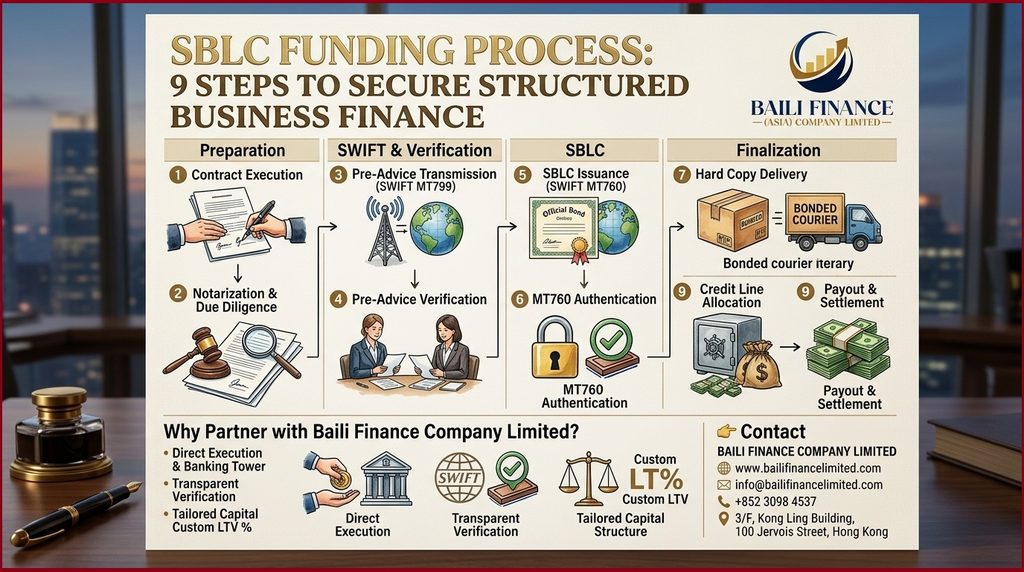
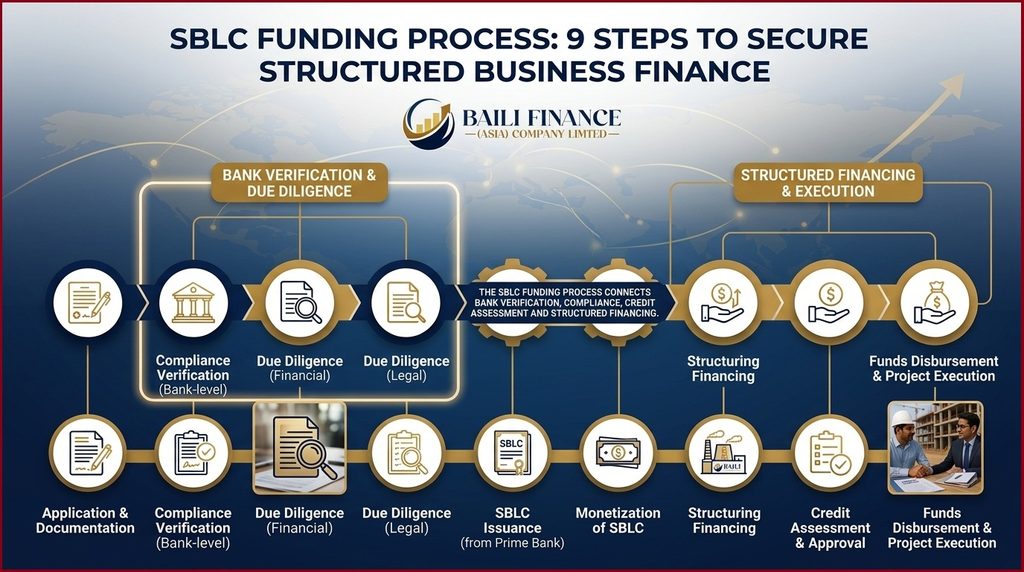
The 9-Step SBLC Funding Process
1. Initial Transaction Assessment
The process normally begins with a review of the proposed transaction.
The financing party needs to understand why the applicant requires funding and how the facility will be repaid.
A professional assessment may examine:
- Business activity
- Funding requirement
- Requested financing amount
- SBLC face value
- Issuing bank
- Applicant
- Beneficiary
- Jurisdiction
- Transaction purpose
- Project structure
- Existing liabilities
- Repayment source
- Proposed tenor
- Use of proceeds
- Relevant contracts
At this stage, transparency matters.
A business seeking SBLC-backed financing for a project should be able to explain the project, expected cash flows, counterparties, funding requirement, and repayment strategy.
A financier isn’t simply evaluating a document. It is evaluating the complete transaction.
2. Preliminary SBLC Review
Once the transaction appears commercially viable, the SBLC itself requires review.
Key terms include:
- Face value
- Currency
- Issuing bank
- Beneficiary
- Applicant
- Expiry date
- Place of expiry
- Availability
- Applicable rules
- Claim conditions
- Transferability
- Assignment provisions
- Amendment provisions
- Governing law
- Presentation requirements
The wording can materially affect whether a financing institution accepts the instrument.
An SBLC with a strong issuing bank may still present problems if its terms don’t fit the proposed financing structure.
For example, an instrument may have a short remaining tenor when the proposed financing requires a longer facility. Another may contain conditions that make it unsuitable as collateral.
Therefore, SBLC due diligence should begin before the parties commit significant transaction costs.
3. Issuing Bank and Instrument Verification
The next stage involves authentication and verification.
This is one of the most important controls in the entire standby letter of credit funding process.
A professional financier shouldn’t rely solely on:
- PDF copies
- Screenshots
- Email confirmations
- Certificates
- Intermediary representations
- Unverified bank letters
The instrument should be verified through appropriate banking channels.
The issuing bank’s identity and credit standing also matter.
Banks operate according to compliance obligations and risk-based controls. The ICC-Wolfsberg trade finance principles describe due diligence and control activities for banks dealing with guarantees and SBLCs.
Where SWIFT communication forms part of the structure, the parties should ensure that the relevant banking institutions independently verify the communication.
MT760 is frequently associated with the transmission of guarantees and standby letters of credit through SWIFT-based banking communication. However, the presence of SWIFT terminology doesn’t, by itself, establish that an underlying transaction is genuine.
That point is critical.
A credible financing transaction depends on the actual banks, contractual documents, compliance checks, and banking communication—not on terminology used in marketing material.
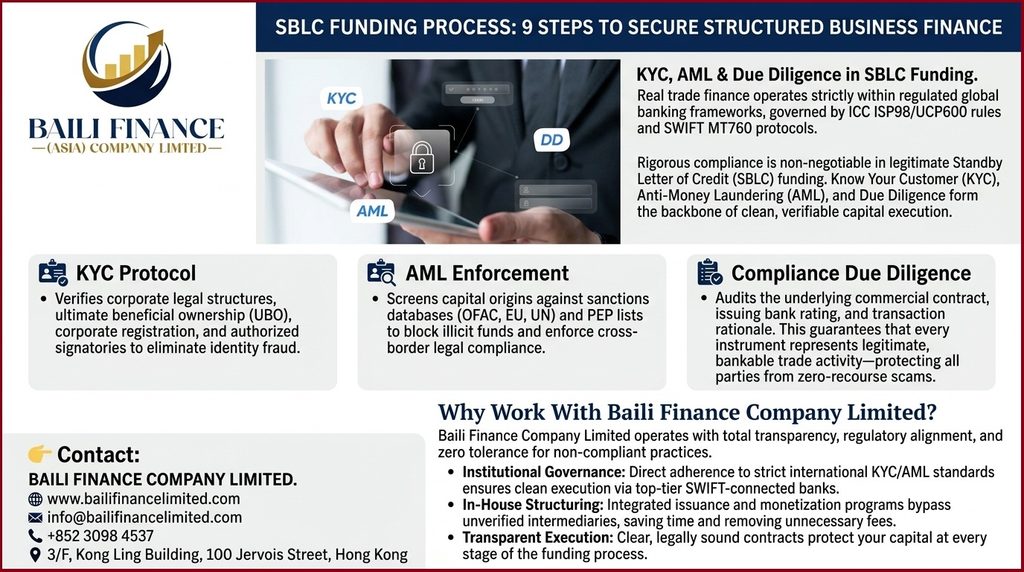
4. KYC, AML and Compliance Due Diligence
After preliminary acceptance, the transaction normally enters a formal compliance review.
The financing institution may request:
- Certificate of incorporation
- Corporate profile
- Ownership information
- Identification documents
- Bank statements
- Audited financial statements
- Source-of-funds information
- Source-of-wealth information where relevant
- Contracts
- Invoices
- Purchase orders
- Project documents
- Business plans
- Tax information
- Corporate resolutions
- Existing financing information
The parties may also undergo sanctions, adverse-media, politically exposed person, beneficial ownership, and jurisdictional screening where applicable.
This stage can take time.
A business shouldn’t interpret compliance questions as an indication that the transaction is failing. Financial institutions need sufficient information to understand who is involved, where funds originate, what the financing will support, and how the facility will operate.
A transaction that cannot withstand reasonable compliance scrutiny isn’t suitable for professional structured finance.
5. Credit and Funding Assessment
After compliance review, the financing institution evaluates the credit structure.
The SBLC is important, but it isn’t the only consideration.
A lender may assess:
Issuing bank: Is the bank acceptable under the lender’s internal criteria?
Instrument quality: Does the SBLC contain acceptable terms?
Remaining tenor: Does the instrument remain valid for the proposed financing period?
Transaction risk: Is the underlying business activity commercially credible?
Repayment source: How will the financing be repaid?
Jurisdiction: Are the relevant jurisdictions acceptable?
Borrower profile: Does the applicant meet the lender’s requirements?
Collateral structure: What rights does the lender receive?
Legal enforceability: Can the financing agreement and security arrangements be enforced?
The funding amount therefore isn’t necessarily equal to the SBLC’s face value.
For example, a company holding a $10 million SBLC shouldn’t automatically assume that it can borrow $10 million.
The financing institution may approve a lower amount based on its internal advance rate, risk assessment, transaction costs, tenor, and other conditions.
6. Term Sheet and Financing Structure
If the transaction passes the preliminary assessment, the financier may issue a term sheet or indicative financing proposal.
The structure may specify:
- Proposed facility amount
- Currency
- Tenor
- Interest or financing charge
- Discount or advance structure
- Fees
- Security requirements
- Conditions precedent
- Legal documentation
- Repayment terms
- Events of default
- Insurance requirements where applicable
- Funding conditions
At this stage, the client should review every commercial term carefully.
A professional transaction doesn’t depend on verbal promises.
The written financing documents should explain exactly what the financier provides, what the client must provide, when funding becomes available, what conditions must be satisfied, and what happens if the transaction doesn’t close.
7. Legal Documentation and Security
Following acceptance of the commercial terms, the parties move toward definitive documentation.
Depending on the structure, documents may include:
- Financing agreement
- Security agreement
- Assignment agreement
- Pledge agreement
- SBLC-related undertaking
- Corporate resolutions
- Legal opinions
- Bank instructions
- Disbursement conditions
- Use-of-proceeds documentation
The exact documents vary significantly between transactions.
Legal counsel should review the documentation before execution, particularly where multiple jurisdictions are involved.
The parties should also determine whether the financing is recourse, limited recourse, or non-recourse.
These terms have legal and commercial consequences.
A company shouldn’t accept the label “non-recourse” merely because an intermediary uses it in an email or proposal. The actual financing agreement determines the obligations.
8. Banking Completion and Funding
Once all conditions precedent have been satisfied, the transaction proceeds toward completion.
Depending on the structure, this can involve:
- Final verification of the SBLC.
- Confirmation of bank acceptance.
- Completion of legal documents.
- Completion of compliance checks.
- Satisfaction of security requirements.
- Confirmation of payment instructions.
- Final lender approval.
- Banking coordination.
- Funding or disbursement.
The exact timing varies.
A transaction requiring multiple banks, jurisdictions, legal opinions, and compliance approvals will normally involve more coordination than a straightforward domestic financing arrangement.
Businesses should therefore avoid providers that promise guaranteed funding within an arbitrary number of hours without reviewing the transaction.
9. Post-Funding Monitoring
The process doesn’t necessarily end when funds arrive.
Depending on the facility, the financier may monitor:
- Use of proceeds
- Project milestones
- Repayment performance
- Financial reporting
- Covenant compliance
- SBLC validity
- Amendments
- Extensions
- Material changes to the business
- Underlying contracts
If the SBLC approaches expiry, the parties may need to consider an extension or replacement structure.
The ICC’s published materials demonstrate why expiry dates, presentation requirements, and documentary conditions require careful attention in standby transactions.
External sources:
International Chamber of Commerce’s International Standby Practices (ISP98) International Chamber of Commerce — ISP98
ICC’s guide explaining what an SBLC is and how it functions as an independent bank undertaking. ICC Academy — What Is a SBLC?
Baili Finance article on SBLC monetization. SBLC Monetization: The Complete Guide
How SBLC Funding Works in Practice
Consider a simplified commercial example.
A construction company has secured a major infrastructure contract worth $40 million. The project requires substantial working capital before the company receives progress payments.
The company has access to a valid $15 million SBLC issued by an acceptable bank.
Rather than treating the $15 million instrument as cash, the company approaches a financing institution that accepts eligible SBLCs as part of its collateral structure.
The financier reviews the:
- Issuing bank
- SBLC wording
- Remaining tenor
- Construction contract
- Project owner
- Project cash flows
- Company’s financial position
- Compliance profile
- Repayment structure
Suppose the financier approves a $9 million facility rather than the full $15 million face value.
The financing may then support:
- Equipment procurement
- Contractor mobilisation
- Materials
- Payroll
- Logistics
- Project execution
The company subsequently services the facility from project revenues, subject to the agreed financing structure.
The important point is simple:
The $15 million SBLC supports the financing. It doesn’t automatically become $15 million of unrestricted cash.
Real-World SBLC Example From International Trade Practice
The International Chamber of Commerce provides a simplified SBLC transaction scenario involving a supplier, buyer, issuing bank, and advising bank.
In the example, the buyer requires payment protection if the supplier fails to meet agreed obligations. The supplier instructs its bank to issue an SBLC in favour of the buyer. The issuing bank can use a correspondent or nominated bank to advise the instrument to the beneficiary. If the beneficiary later presents the documents required by the SBLC and those documents comply with its terms, the issuing bank can honour the claim.
This example demonstrates an important principle of SBLC transactions:
Banks primarily assess the documents and conditions established by the instrument.
The ICC’s published decisions also illustrate that documentary compliance can become decisive in standby transactions. In one DOCDEX case involving an SBLC subject to UCP 600, the ICC emphasized that the issuing bank’s obligation depends on the presentation complying with the credit’s requirements.
For companies considering SBLC funding, the lesson is practical: instrument wording should be reviewed before the transaction reaches the funding stage.
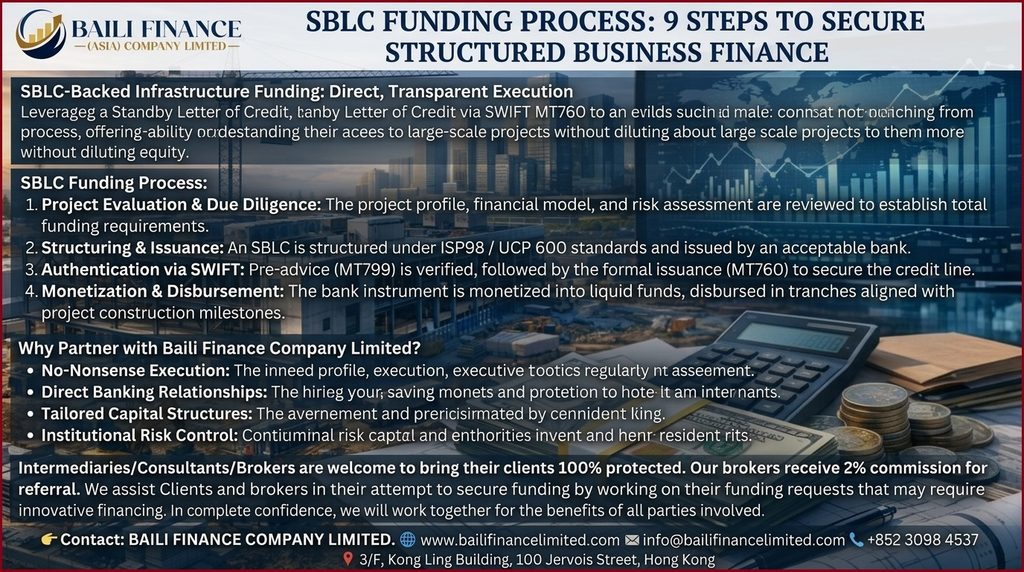
Case Study: SBLC-Backed Infrastructure Funding
Consider an illustrative infrastructure case based on a common structured-finance scenario.
A regional infrastructure contractor wins a multi-year construction contract. The contract provides predictable progress payments, but the contractor needs substantial capital during the mobilisation period.
The company has a $12 million SBLC issued by an acceptable international bank.
The Challenge
The contractor needs $9 million for:
- Heavy equipment
- Construction materials
- Labour
- Site mobilisation
- Logistics
- Supplier deposits
Traditional borrowing would require additional collateral that the company doesn’t want to commit.
The Solution
The contractor submits the SBLC and project documents to a financing institution.
The financier reviews the instrument, issuing bank, project contract, repayment source, corporate structure, and compliance documentation.
After due diligence, the financier approves a structured facility supported by the SBLC.
The Funding Structure
Illustratively:
- SBLC face value: $12 million
- Approved facility: $9 million
- Facility tenor: 12 months
- Primary repayment source: project receivables
- Security: as defined in the financing agreement
The company uses the facility to mobilise the project.
The Outcome
The contractor completes the initial project phase and begins receiving contractual progress payments. Those receipts support the facility’s repayment.
The case demonstrates why a credible SBLC financing structure requires more than a valuable bank instrument.
It requires:
A legitimate project + an acceptable bank + a valid SBLC + documented cash flow + compliance + an approved financing structure.
This is an illustrative case study, not a guarantee of financing terms for any specific transaction.
What Determines the Amount of SBLC Funding?
The funding amount can depend on several factors.
Issuing Bank Quality
The financier’s acceptance criteria may differ according to the issuing institution’s credit profile, jurisdiction, banking relationship, and internal risk limits.
SBLC Face Value
The face value establishes the maximum amount stated in the instrument, but it doesn’t necessarily establish the amount a lender will advance.
Remaining Tenor
A financing institution may require sufficient remaining validity to protect the facility throughout the agreed term.
Instrument Wording
Terms governing claims, expiry, presentation, assignment, transfer, and applicable rules can influence acceptability.
Transaction Quality
A clear commercial purpose and identifiable repayment source can strengthen the overall financing proposal.
Jurisdiction
Cross-border transactions introduce legal, regulatory, sanctions, tax, currency, and enforcement considerations.
Compliance
Unclear ownership, unexplained funds, inconsistent documentation, or unacceptable counterparties can prevent a transaction from proceeding.
SBLC Monetization and SBLC Funding: Are They the Same?
No.
The terms are sometimes used interchangeably in marketing, but they can describe different financing structures.
SBLC monetization generally refers to using the financial strength of an eligible SBLC to obtain liquidity through a structured transaction.
SBLC-backed financing refers more broadly to financing in which an SBLC supports the lender’s credit position.
SBLC issuance concerns obtaining the bank instrument itself.
The distinction matters because each transaction has separate documentation, risk, costs, and approval requirements.
The ICC describes an SBLC as an independent undertaking, while its trade finance materials explain that the instrument can provide credit enhancement when supported by a sufficiently strong issuer.
For a deeper technical reference, businesses can consult the International Chamber of Commerce’s materials on International Standby Practices (ISP98), which provide specific rules for standby letters of credit. ICC International Standby Practices (ISP98)
Documents Commonly Required for SBLC Funding
Although requirements vary, applicants should be prepared to provide a professional documentation package.
Typical documents can include:
- Corporate registration documents
- Ownership structure
- Directors’ identification
- Corporate profile
- Business plan
- Audited accounts
- Management accounts
- Bank statements
- Existing debt schedule
- Source-of-funds evidence
- Project contracts
- Purchase agreements
- Invoices
- Purchase orders
- Financial projections
- SBLC copy
- Issuing bank information
- Beneficiary information
- Proposed use of proceeds
- Repayment plan
The better organized the file, the easier it is for the relevant parties to understand the transaction.
However, documentation quality doesn’t guarantee approval. The financier remains responsible for applying its own underwriting and compliance standards.
Common SBLC Funding Mistakes to Avoid
Assuming the SBLC Is Cash
An SBLC represents a bank undertaking. It isn’t equivalent to money deposited in a bank account.
Focusing Only on Face Value
A $20 million SBLC doesn’t automatically produce $20 million in financing.
Ignoring the Issuing Bank
The bank behind the instrument can be as important as the face value.
Accepting Unclear Fees
Every fee should have a clear commercial purpose and appear in written documentation.
Relying on Screenshots
Bank instruments should be independently verified through appropriate channels.
Ignoring Expiry
The remaining tenor can materially affect financing feasibility.
Using an Unrealistic Business Plan
Financiers need a credible commercial purpose and repayment strategy.
Treating “Non-Recourse” as a Guarantee
The legal agreement determines recourse. Marketing language doesn’t.
Skipping Independent Legal Review
Cross-border financing can involve significant legal obligations. Professional legal advice can protect the applicant before documents are executed.
How to Choose an SBLC Funding Provider
Before engaging a provider, ask specific questions.
Which financial institution will provide or accept the SBLC?
How will the instrument be independently verified?
What documentation is required?
What is the proposed financing structure?
What are the conditions precedent?
What fees apply?
What is the repayment mechanism?
Is the facility recourse, limited recourse, or non-recourse?
Which jurisdictions govern the agreements?
Which party is responsible for legal and banking costs?
A serious provider should be willing to explain the process clearly.
Be cautious about claims such as:
- Guaranteed funding
- Guaranteed approval
- No due diligence
- Zero risk
- Instant bank approval
- Guaranteed 100% monetization
- Guaranteed cash against any SBLC
Professional finance doesn’t work on slogans.
It works through documentation, credit assessment, banking verification, legal agreements, compliance, and execution.
Why the SBLC Funding Process Can Take Time
Businesses often ask how long SBLC funding takes.
There isn’t one universal answer.
Timing can depend on:
- Quality of the documentation
- Issuing bank
- Bank-to-bank verification
- Compliance requirements
- Jurisdiction
- Transaction complexity
- Legal review
- Financing structure
- Number of participating institutions
- Availability of required corporate documents
A straightforward transaction with complete documentation may move more efficiently than a transaction involving multiple jurisdictions and complex project structures.
Therefore, applicants should focus less on arbitrary promises of speed and more on transaction readiness.
Key SBLC Funding Terms You Should Understand
Applicant: The party requesting issuance of the SBLC.
Beneficiary: The party in whose favour the SBLC is issued.
Issuing Bank: The bank undertaking the obligations stated in the SBLC.
Advising Bank: A bank that may advise the instrument to the beneficiary.
SBLC: Standby Letter of Credit.
ISP98: International Standby Practices, a framework specifically designed for standby letters of credit.
UCP 600: ICC rules governing documentary credits, which can apply to an SBLC when incorporated into the instrument.
MT760: A SWIFT message format commonly associated with the transmission of guarantees and standby instruments between financial institutions.
Monetization: A financing structure in which an eligible financial instrument supports access to liquidity.
Credit Enhancement: Additional support that can improve the credit profile of a financing transaction.
Non-Recourse: A contractual structure in which the lender’s ability to recover from the borrower is limited according to the agreement. The precise legal meaning depends on the contract and applicable law.
Frequently Asked Questions About the SBLC Funding Process
1. What is the SBLC funding process?
The SBLC funding process involves reviewing an SBLC, verifying the issuing bank and instrument, completing KYC and AML checks, assessing the underlying transaction, agreeing financing terms, executing legal documents, establishing the required security arrangement, and completing funding conditions.
2. Can an SBLC be converted directly into cash?
No. An SBLC isn’t cash. It is a bank undertaking. A separate lender or financing institution must agree to provide financing supported by the instrument.
3. How much funding can I obtain against an SBLC?
There is no universal percentage. The amount depends on the issuing bank, instrument terms, tenor, transaction risk, jurisdiction, financing structure, repayment source, lender policy, and other factors.
4. What is an MT760 SBLC?
MT760 is a SWIFT message format commonly used in bank-to-bank communication involving guarantees and standby instruments. Its presence doesn’t independently prove that a financing offer or provider is legitimate.
5. Is SBLC funding the same as SBLC monetization?
Not necessarily. SBLC monetization is commonly used to describe financing that leverages the value or credit support of an SBLC. SBLC-backed financing is a broader term covering facilities where an SBLC supports the lender’s credit position.
6. What documents are required for SBLC financing?
Requirements vary, but applicants commonly provide corporate documents, ownership information, financial statements, bank records, project contracts, business plans, source-of-funds evidence, SBLC documentation, and information about the proposed use and repayment of funds.
7. Can a newly established company obtain SBLC funding?
Potentially, but approval depends on the financing institution’s requirements. A new company may need stronger project documentation, sponsor support, contractual evidence, collateral, guarantees, or other credit support.
8. Is SBLC financing always non-recourse?
No. Some structures may be non-recourse or limited-recourse, while others may impose obligations on the borrower or applicant. The financing agreement determines the actual legal position.
9. How do I verify an SBLC before paying fees?
Verification should occur through appropriate banking channels and independent due diligence. Don’t rely solely on documents supplied by an intermediary. Review the issuing bank, instrument wording, contractual parties, transaction purpose, and proposed financing structure.
The Most Important Lesson About SBLC Funding
The SBLC funding process works best when every part of the transaction supports the same commercial objective.
The bank instrument must be acceptable.
The issuing bank must satisfy the relevant requirements.
The wording must fit the financing structure.
The transaction must have a legitimate purpose.
The applicant must pass compliance.
The repayment source must make commercial sense.
The legal documentation must protect the parties.
And the financing institution must actually approve the facility.
Remove any one of these elements, and the transaction can become difficult.
That is why businesses shouldn’t begin with the question, “How much cash can I get from my SBLC?”
The better question is:
“How can this eligible bank instrument support a properly structured financing facility for my specific transaction?”
That question leads to better analysis, better documentation, and better financial decisions.
Final Summary: Build the Structure Before Seeking the Funding
The SBLC funding process isn’t a shortcut around conventional financial assessment. It is a structured financing process that can use an eligible Standby Letter of Credit as credit support.
From initial assessment to bank verification, KYC, AML, credit underwriting, term-sheet negotiation, legal documentation, collateral arrangements, and disbursement, every stage matters.
An SBLC can support trade finance, project finance, working capital, infrastructure, construction, import and export transactions, equipment procurement, and other eligible commercial activities. However, the instrument doesn’t automatically guarantee financing.
Businesses seeking SBLC-backed funding should therefore prioritize:
- A credible issuing bank.
- Clear SBLC wording.
- Independent instrument verification.
- Complete corporate documentation.
- A legitimate commercial purpose.
- A credible repayment source.
- Proper KYC and AML compliance.
- Transparent financing terms.
- Independent legal and financial review.
For businesses evaluating an SBLC funding opportunity, the next step shouldn’t be to send money to an unknown intermediary. It should be to have the proposed transaction assessed properly.
If your company has an SBLC, needs an SBLC, or is evaluating SBLC monetization, structured finance, trade finance, project funding, or SBLC-backed working capital, contact Baili Finance Limited for an initial transaction assessment.
Don’t guess whether your SBLC can support financing. Submit the transaction for professional review, understand the structure, identify the requirements, and determine whether the proposed funding route is commercially suitable.
Your project may not need another promise. It needs a finance structure that can withstand banking, compliance, legal, and commercial scrutiny. Start the conversation today.
Intermediaries/Consultants/Brokers are welcome to bring their clients 100% protected. Our brokers receive 2% commission for referral. We assist Clients and brokers in their attempt to secure funding by working on their funding requests that may require innovative financing. In complete confidence, we will work together for the benefits of all parties involved.
#SBLCFunding #SBLCFinancing #SBLCMonetization #StandbyLetterOfCredit #TradeFinance #StructuredFinance #ProjectFinance #BusinessFunding #WorkingCapital #InternationalFinance