Headline: Mastering Large-Scale Project Funding: 9 Proven Steps to Success
Large-scale project funding determines whether major infrastructure, energy, construction, real estate, manufacturing, technology and international development projects move from concept to execution. For sponsors, developers and investors, securing capital isn’t simply about finding a lender. It requires a financeable project, credible sponsors, reliable cash-flow projections, appropriate risk allocation, strong documentation and a funding structure that matches the project’s commercial reality.
A major project can require millions or billions of dollars before it generates its first dollar of revenue. Therefore, project finance, infrastructure financing, structured finance, non-recourse funding, debt financing, equity investment and other capital sources must work together within a carefully designed financial structure.
For project owners seeking large-scale project funding, preparation matters. Lenders and investors want to understand how the project will generate revenue, how capital will be protected, how risks will be managed and how financing will be repaid.
That’s where professional financial structuring becomes important.
Keywords: large-scale project financing, project finance funding, infrastructure project funding, international project funding, structured project finance, large project financing solutions, project finance solutions, non-recourse project funding, infrastructure financing, commercial project funding
What Is Large-Scale Project Funding?
Large-scale project funding refers to the process of raising substantial capital for projects that require significant investment and usually involve long development, construction and operating periods.
These projects can include:
- Power plants and renewable energy projects
- Roads, bridges and transport infrastructure
- Ports, airports and logistics facilities
- Oil and gas infrastructure
- Mining and natural resource projects
- Commercial and residential developments
- Industrial manufacturing facilities
- Telecommunications infrastructure
- Water and sanitation projects
- Technology and data infrastructure
- Healthcare facilities
- Public-private partnership projects
- International trade and industrial expansion projects
Unlike ordinary business financing, large project funding usually depends on a combination of the project’s financial strength, contractual structure, sponsor capability and expected future cash flow.
In conventional corporate lending, the lender often assesses the borrower’s existing balance sheet and repayment history. In project finance, the lender may instead focus heavily on the project’s future cash flows, contracts, assets and risk allocation.
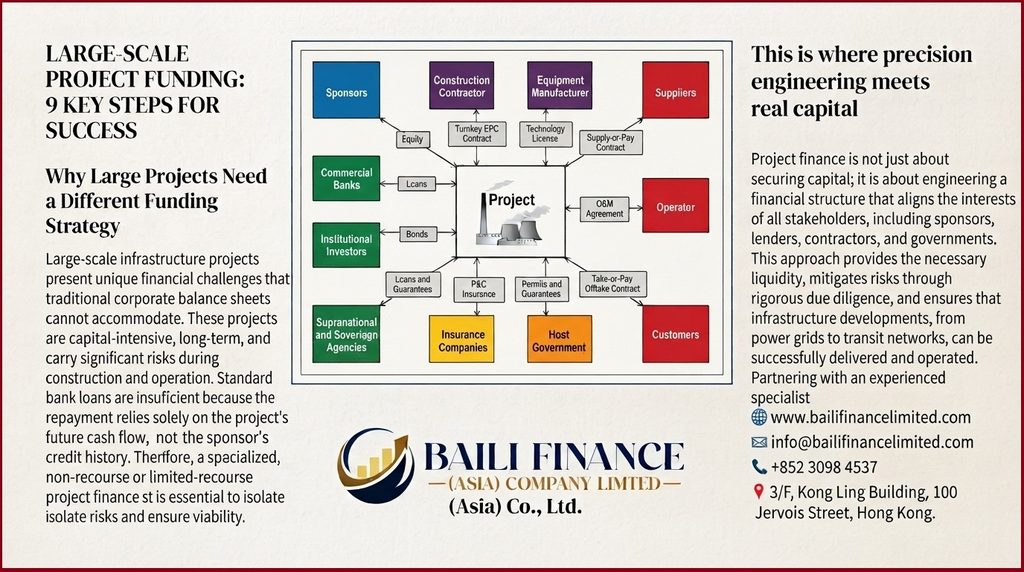
The World Bank explains that project finance structures commonly use a special purpose vehicle, or SPV, whose primary purpose is to develop and operate the project. The project can then have its own contractual and financial structure separate from the sponsors.
That distinction matters because the financing strategy must reflect the project’s actual economics.
Why Large Projects Need a Different Funding Strategy
Large projects create financing challenges that smaller businesses usually don’t face.
First, capital requirements can become substantial before revenue begins. Second, construction delays can increase costs while creating no additional revenue. Third, projects can face regulatory, currency, interest-rate, political, environmental, market and operational risks.
Therefore, funding must be structured around the entire project lifecycle.
A typical project passes through several stages:
- Concept development
- Feasibility assessment
- Financial modelling
- Due diligence
- Capital structuring
- Negotiation with funders
- Financial close
- Construction
- Commissioning
- Operations
- Debt repayment
- Refinancing or exit
Each stage creates different financing requirements.
For example, development capital may be needed before senior debt becomes available. Construction financing may then fund capital expenditure. Once the project becomes operational, stable revenues may support long-term debt repayment or refinancing.
This is why large-scale project financing solutions shouldn’t be selected solely because they offer the lowest nominal interest rate.
The correct structure must also consider tenor, repayment profile, security, currency, guarantees, equity requirements, cash-flow timing and project risk.
The Main Sources of Large-Scale Project Funding
There isn’t one universal source of capital for major projects. Strong financing structures often combine several sources.
1. Senior Debt
Senior debt remains one of the most common sources of project capital.
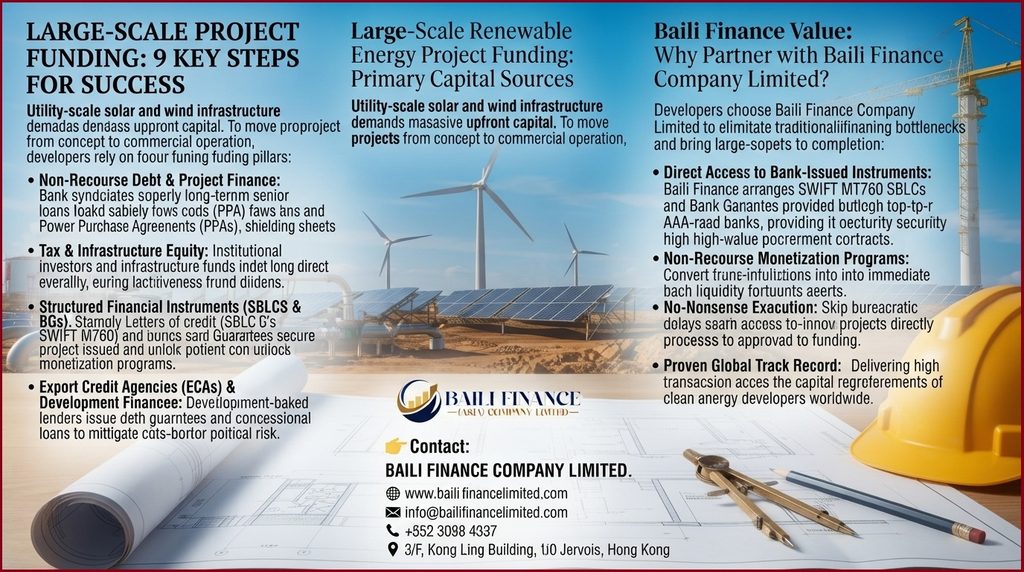
Commercial banks, development finance institutions, export credit agencies and institutional lenders can provide senior loans when the project satisfies their credit, commercial and risk requirements.
Senior debt normally receives priority in repayment over subordinated debt and equity.
For a project to support significant senior debt, lenders generally need evidence that the project’s projected cash flows can service the debt under reasonable operating assumptions.
2. Equity Financing
Equity represents capital contributed by sponsors, strategic investors, infrastructure funds, private equity investors or other shareholders.
Equity carries greater risk than senior debt because shareholders normally receive distributions after contractual debt obligations have been satisfied.
However, equity provides an important foundation for project financing.
A lender may be more comfortable financing a project when the sponsors have meaningful capital at risk and demonstrate the financial capacity to support the project.
3. Mezzanine Financing
Mezzanine financing sits between senior debt and equity in the capital structure.
It can become useful when senior lenders won’t provide the entire amount required and sponsors don’t want to increase equity contributions substantially.
Because mezzanine capital carries higher risk, it normally comes with a higher expected return.
The financing structure must therefore demonstrate that the project can support the additional cost.
4. Development Finance
Development finance institutions can support infrastructure, energy, industrialisation and other projects with economic-development objectives.
Their involvement can also improve financing credibility and attract additional commercial capital, depending on the project and institution.
Development finance may include loans, guarantees, equity, technical assistance or blended-finance structures.
5. Export Credit and Supplier Financing
Projects involving substantial imported equipment may qualify for export-related financing.
For example, an energy project purchasing turbines, generators or other major equipment from international suppliers may explore financing structures linked to the equipment purchase.
This can help align procurement and financing requirements.
6. Public-Private Partnerships
A public-private partnership, commonly called a PPP, can combine government participation with private-sector capital and expertise.
PPP structures appear frequently in transport, energy, healthcare, water, sanitation and other public infrastructure.
Risk allocation becomes particularly important.
The World Bank notes that project risks should generally sit with the party best able to control or manage those risks rather than automatically transferring the maximum amount of risk to the private sector.
That principle can directly influence the project’s bankability.
7. Structured Finance
Structured finance allows multiple financial instruments and contractual arrangements to work together.
Depending on the transaction, a structure may involve debt, equity, guarantees, letters of credit, receivables, contractual revenues, collateral or other financial instruments.
The objective isn’t complexity for its own sake.
The objective is to create a financing structure that addresses the project’s specific capital requirements and risk profile.
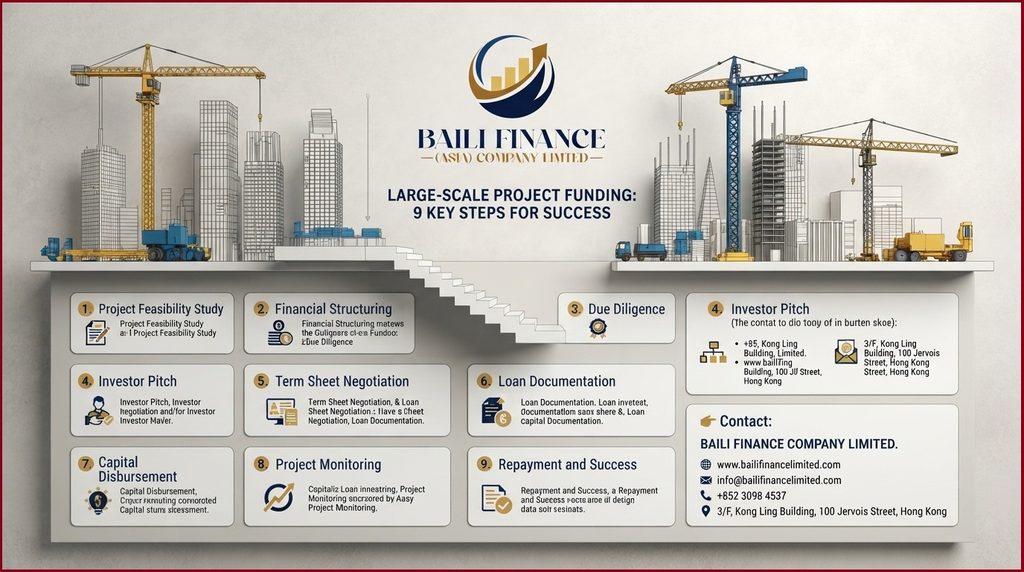
The 9 Key Steps to Secure Large-Scale Project Funding
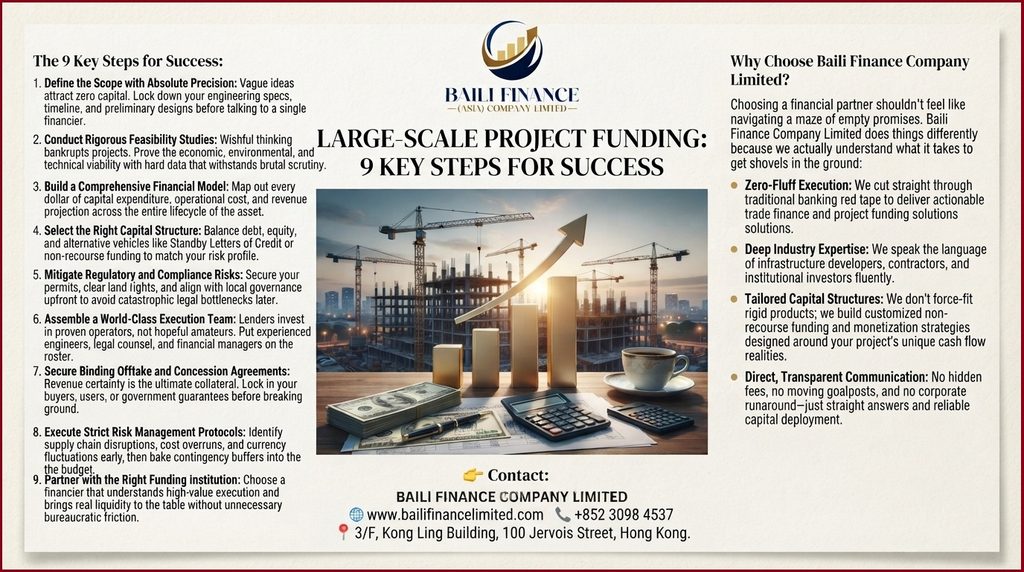
1. Establish the Project’s Commercial Viability
Before approaching funders, the sponsor should demonstrate that the project makes commercial sense.
A lender doesn’t fund an idea simply because the market appears attractive.
The project needs a credible economic rationale.
That means answering questions such as:
- Who will buy the project’s output?
- What price will customers pay?
- How long will contracts remain valid?
- What are the projected operating costs?
- What capital expenditure is required?
- When will revenue begin?
- What happens if construction costs increase?
- What happens if revenue falls below expectations?
- What regulatory approvals are required?
- What risks could prevent completion?
A well-developed feasibility study should address these issues before serious funding discussions begin.
2. Build a Bankable Financial Model
A financial model translates the business plan into numbers.
For large-scale projects, the model should typically include:
- Capital expenditure
- Operating expenditure
- Revenue assumptions
- Tax
- Debt structure
- Interest expense
- Depreciation
- Working capital
- Construction schedule
- Drawdown schedule
- Debt repayment
- Cash-flow projections
- Sensitivity analysis
- Scenario analysis
- Foreign exchange assumptions
- Inflation assumptions
- Exit or refinancing assumptions
The model should also test downside scenarios.
What happens if construction costs rise by 15%?
What happens if revenue starts six months late?
What happens if the local currency depreciates?
What happens if interest rates increase?
These questions matter because lenders evaluate repayment capacity under more than one scenario.
3. Define the Capital Structure
The next step involves determining how much debt, equity and other financing the project can reasonably support.
For example, a project may require $200 million in total capital.
The structure could potentially include:
- $50 million sponsor equity
- $100 million senior debt
- $30 million mezzanine financing
- $20 million subordinated or strategic capital
The exact structure depends on the project’s risk, cash flows, contracts and investor requirements.
There is no universal debt-to-equity ratio that makes every project bankable.
The correct structure is the one that supports the project’s cash-flow profile without creating excessive financial pressure.
4. Establish the Project Company
Many large projects use a special purpose vehicle.
The SPV owns or controls the project and enters into the principal project agreements.
This can separate project-related obligations from the broader activities of the sponsor, subject to the specific financing and legal structure.
The World Bank identifies the SPV as a core component of a typical project-finance structure.
The SPV may enter into:
- Construction agreements
- Operations and maintenance agreements
- Offtake agreements
- Supply contracts
- Concession agreements
- Land agreements
- Insurance contracts
- Financing agreements
- Government support agreements
The contractual structure therefore becomes an important part of the credit assessment.
5. Secure Revenue Visibility
Revenue visibility is one of the most important considerations in project funding.
A project with predictable contractual revenue can present a different risk profile from a project that depends entirely on uncertain market demand.
Depending on the sector, revenue support may come from:
- Long-term purchase agreements
- Offtake contracts
- Government availability payments
- User charges
- Lease agreements
- Capacity payments
- Supply agreements
- Regulated tariffs
- Concession arrangements
Where revenue depends on market conditions, the sponsor should provide realistic assumptions and appropriate downside scenarios.
6. Allocate Risks Properly
Risk allocation directly affects financing costs and bankability.
Major risks can include:
- Construction risk
- Completion risk
- Cost-overrun risk
- Demand risk
- Operational risk
- Political risk
- Regulatory risk
- Currency risk
- Interest-rate risk
- Commodity-price risk
- Environmental risk
- Social risk
- Refinancing risk
The World Bank identifies construction, demand, political, regulatory, currency, interest-rate and social risks among the factors that lenders need to assess in project-financed transactions.
A practical risk allocation principle is simple: allocate each risk to the party that can manage it most effectively.
For example, a qualified engineering contractor may be better positioned to manage construction execution risk than a passive financial investor.
Likewise, a government may be better positioned to manage certain regulatory or sovereign risks.
This approach can reduce unnecessary financing costs.
7. Prepare a Professional Funding Package
A serious funding request needs more than a short proposal.
A professional project funding package may include:
- Executive summary
- Corporate profile
- Sponsor information
- Project feasibility study
- Business plan
- Detailed financial model
- Project budget
- Funding requirement
- Proposed capital structure
- Project timeline
- Market study
- Technical study
- Environmental assessment
- Legal documentation
- Revenue contracts
- Offtake agreements
- Permits and licences
- Collateral information
- Risk matrix
- Management profiles
- Historical financial statements
- Corporate documentation
- Know-your-customer documentation
The stronger the documentation, the easier it becomes for financiers to understand the opportunity and identify the issues requiring further due diligence.
8. Approach the Right Funding Partners
Not every lender is appropriate for every project.
A commercial bank may suit a mature project with predictable cash flow.
A development finance institution may suit an infrastructure project with substantial economic or social benefits.
An institutional investor may prefer a different risk-return profile.
A strategic investor may contribute industry expertise as well as capital.
Therefore, finding large-scale project funding requires lender matching rather than sending the same proposal to every financial institution.
The funding partner should understand the sector, geography, project size and risk profile.
9. Prepare for Due Diligence and Financial Close
Once a potential funder shows interest, due diligence begins.
This stage can involve financial, technical, legal, environmental, tax, commercial and regulatory reviews.
The funder may test:
- Financial projections
- Sponsor capacity
- Project contracts
- Construction assumptions
- Revenue assumptions
- Security arrangements
- Insurance
- Licences
- Ownership
- Corporate structure
- Counterparty strength
- Regulatory compliance
Negotiations then focus on financing terms, conditions precedent, covenants, security, guarantees and disbursement requirements.
The transaction reaches financial close only after the required agreements and conditions have been completed.
What Makes a Project Bankable?
“Bankable” doesn’t mean that financing is guaranteed.
It means that the project has characteristics that can make it acceptable to a prospective lender or investor after appropriate due diligence.
Several factors influence bankability.
Predictable Cash Flow
The project should have a credible path to generating enough cash to meet operating costs and financing obligations.
Strong Sponsors
Funders assess the sponsor’s experience, financial capacity, governance and ability to execute.
Reliable Contracts
Long-term contracts with credible counterparties can strengthen revenue visibility and reduce uncertainty.
Appropriate Risk Allocation
Risks should sit with parties that can control or mitigate them effectively.
Strong Legal Structure
The project must operate within a clear legal and regulatory framework.
Realistic Financial Assumptions
Aggressive projections can damage credibility.
Professional financial models should show realistic base cases and transparent downside scenarios.
Adequate Equity
Sponsors need sufficient equity to demonstrate commitment and absorb part of the project’s development and execution risk.
Experienced Management
Execution capability matters, particularly when projects involve multiple contractors, jurisdictions and stakeholders.
The Role of Guarantees and Financial Instruments
Large-scale transactions may require financial instruments that support contractual obligations or strengthen the financing structure.
Depending on the transaction, these can include:
- Bank guarantees
- Standby letters of credit
- Performance guarantees
- Advance payment guarantees
- Bid bonds
- Letters of credit
- Proof of funds
- Credit enhancement instruments
However, financial instruments should have a clear commercial purpose.
A bank guarantee doesn’t automatically make a weak project financeable. Likewise, an SBLC shouldn’t replace proper financial analysis, due diligence or a credible repayment structure.
The instrument must fit the transaction.
For example, a contractor may require a performance guarantee under a major construction contract, while an importer may need a letter of credit to support an international purchase.
This distinction is important when structuring international project funding.
Real-World Example: Ghana’s Bui Dam
Ghana’s Bui Dam provides a useful example of how financing arrangements can influence the economics of a national-scale infrastructure project.
The 400 MW Bui Dam began construction in 2009 and commenced hydropower generation in 2013. A peer-reviewed study published in Energy Economics assessed the project’s construction, financing and operating phases and estimated total financial costs at approximately US$622 million.
The study reports that financing included government spending, a 20-year concessional loan of US$270 million at 2% interest and a 12-year commercial loan of US$292 million priced at 1.03% over the applicable Commercial Interest Reference Rate. The financing arrangement also incorporated annual cocoa exports over a 20-year period.
The case demonstrates an important point.
Large infrastructure financing doesn’t exist in isolation from the wider economy.
The financing terms, export arrangements, government participation, construction expenditure and eventual electricity production can interact with employment, household income, government revenue and economic activity.
The study found that incorporating financing conditions and associated economic effects materially changed the estimated economic impact of the project.
Case Study: What Bui Dam Teaches Project Sponsors
The Bui Dam case provides several lessons for sponsors considering large-scale infrastructure project funding.
First, financing structure matters.
The cost and conditions of capital can influence the overall economic outcome of a project.
Second, financing should reflect the project’s broader economics.
Infrastructure projects can affect sectors beyond the project company itself.
Third, collateral and contractual arrangements require careful assessment.
The study specifically examined the role of the cocoa export arrangement connected with the financing.
Fourth, construction and financing must be evaluated together.
A project may appear financially attractive after completion while facing substantial capital requirements and risks during construction.
Finally, economic development and financial viability should be assessed separately but together.
A project can produce significant public benefits while still requiring a carefully structured financing package to remain commercially sustainable.
External source:
World Bank guidance on project finance concepts
World Bank guidance on project finance concepts
Common Mistakes That Can Delay Project Funding
Many funding applications fail before a lender reaches the final credit decision.
Submitting an Incomplete Proposal
A short concept note rarely answers the questions required for institutional due diligence.
Inflating Revenue Projections
Unrealistic revenue assumptions can undermine the credibility of the entire financial model.
Ignoring Currency Risk
Where project revenue and debt use different currencies, exchange-rate movements can materially affect debt-service capacity.
Underestimating Construction Costs
Cost overruns can create funding gaps and delay completion.
Failing to Identify Permits
A project without the required regulatory approvals may not be financeable.
Choosing the Wrong Capital Source
A project can struggle when its financing structure doesn’t match its risk profile.
Treating Guarantees as a Substitute for Viability
A financial instrument cannot compensate for weak economics, poor governance or inadequate documentation.
Approaching Funders Too Early
Sponsors should develop the project sufficiently before entering serious financing discussions.
Large-Scale Project Funding and Emerging Markets
Emerging markets can present significant opportunities for infrastructure, energy, manufacturing, logistics, agriculture and technology projects.
At the same time, they can create additional financing considerations.
These may include:
- Foreign exchange exposure
- Political risk
- Regulatory uncertainty
- Local interest rates
- Limited domestic long-term capital
- Infrastructure constraints
- Import dependency
- Sovereign risk
- Counterparty risk
The African Development Bank has highlighted the importance of developing domestic long-term finance markets in countries such as Ghana while noting that foreign capital will continue to play an important role in investment financing.
For project sponsors, this creates a strong reason to consider multiple sources of capital rather than relying on one financing channel.
A blended approach may combine local and international financing, development capital, sponsor equity, commercial debt and appropriate credit-enhancement mechanisms.
How Sponsors Can Improve Their Funding Readiness
Before contacting a potential funding partner, project sponsors should be able to answer five questions clearly:
How much funding is required?
State the exact amount and distinguish between development, construction, working capital and contingency requirements.
What will the money finance?
Provide a detailed use-of-funds schedule.
How will the project generate revenue?
Explain customers, contracts, pricing and expected cash flow.
How will the financing be repaid?
Show the projected repayment source and debt-service capacity.
What happens if the project underperforms?
Provide realistic downside scenarios and risk-mitigation measures.
A sponsor that can answer these questions clearly is usually better prepared for professional funding discussions.
Choosing a Financial Partner for a Major Project
The right financial partner should bring more than access to capital.
Sponsors should consider:
- Transaction experience
- International network
- Sector knowledge
- Financial structuring capability
- Due diligence standards
- Regulatory awareness
- Cross-border transaction experience
- Speed of communication
- Transparency around fees
- Documentation standards
- Ability to coordinate multiple stakeholders
For international projects, these factors can become particularly important.
A transaction may involve sponsors in one country, contractors in another, lenders in another jurisdiction and revenue denominated in a fourth currency.
Coordination becomes a financing issue in its own right.
Why Professional Structuring Matters
A project can have a strong commercial idea and still struggle to obtain funding.
The problem may not be the project itself.
The problem may be how the opportunity has been presented.
Professional financial structuring connects the commercial plan with the requirements of prospective funders.
That process can include reviewing the capital requirement, assessing project risks, developing the funding strategy, preparing financial information and identifying appropriate financial instruments.
For businesses exploring large-scale project funding, project finance solutions, infrastructure finance, structured project funding, non-recourse financing or international project finance, preparation should begin before the funding request reaches a lender.
The objective is straightforward: make the transaction understandable, commercially credible and appropriately structured.
Frequently Asked Questions About Large-Scale Project Funding
1. What is large-scale project funding?
Large-scale project funding is the process of arranging substantial capital for projects that require significant investment, such as infrastructure, energy, manufacturing, transport, mining, real estate and technology projects. Funding can involve debt, equity, development finance, guarantees, structured finance and other capital sources.
2. How do I qualify for large-scale project funding?
Qualification depends on the project, sponsor and proposed financing structure. Funders typically assess commercial viability, projected cash flow, sponsor experience, equity contribution, contracts, collateral, regulatory approvals, project risks and repayment capacity.
3. Can a new project obtain project finance?
Yes, a new project can potentially obtain project finance. However, the sponsor must compensate for the absence of an operating track record with credible feasibility studies, experienced management, strong contracts, realistic financial projections and appropriate risk allocation.
4. What documents are required for project funding?
Requirements vary by funder and transaction. Common documents include a business plan, feasibility study, financial model, corporate documents, project budget, funding proposal, financial statements, contracts, permits, technical studies, ownership information and due diligence documents.
5. What industries can qualify for large-scale project financing?
Potential sectors include renewable energy, power generation, infrastructure, construction, transportation, manufacturing, mining, telecommunications, logistics, real estate, healthcare, water and sanitation and other commercially viable sectors.
6. What is non-recourse project finance?
Non-recourse project finance generally limits lender recourse to the project’s assets and cash flows rather than the broader balance sheet of the project sponsors, subject to the terms of the financing agreements. The structure can allow sponsors to isolate project risks within a dedicated project company.
7. Can bank guarantees or SBLCs support project funding?
They can potentially support specific contractual or financing requirements, depending on the transaction and the requirements of the relevant financial institution. However, they don’t replace project viability, due diligence or a credible repayment structure.
8. How long does large-scale project funding take?
There is no standard timeline. Simple transactions may progress faster, while major infrastructure and cross-border projects can require extensive technical, legal, financial, environmental and commercial due diligence before financial close.
9. What is the biggest mistake project sponsors make?
One of the most common problems is approaching funders before the project is adequately prepared. A credible funding request should clearly explain the project, capital requirement, revenue model, risks, repayment strategy and supporting documentation.
Final Summary: Fund the Project, Not Just the Idea
Large-scale project funding requires disciplined preparation.
A successful financing strategy starts with a commercially viable project and continues through financial modelling, capital structuring, risk allocation, documentation, lender selection, due diligence and financial close.
The strongest funding proposals don’t simply ask for capital.
They explain why the project deserves capital, how the money will be deployed, how revenue will be generated, how risks will be controlled and how the financing will be repaid.
That distinction matters.
Whether you’re developing an infrastructure project, expanding a manufacturing facility, financing renewable energy capacity, developing real estate, building transport infrastructure or executing an international commercial project, the funding structure should match the project’s economics.
Stop approaching major funders with incomplete project information. Start with a financing structure that can withstand professional scrutiny.
If your project requires large-scale project funding, structured finance, project finance, non-recourse funding, bank guarantees, SBLC solutions or other international financing support, the next step is to present the project professionally and identify the financing structure that fits its requirements.
Contact Baili Finance and discuss your project requirements, funding objective and proposed transaction structure.
Prepare the project. Structure the capital. Approach the right funding partners.
Intermediaries/Consultants/Brokers are welcome to bring their clients 100% protected. Our brokers receive 2% commission for referral. We assist Clients and brokers in their attempt to secure funding by working on their funding requests that may require innovative financing. In complete confidence, we will work together for the benefits of all parties involved.
#LargeScaleProjectFunding #ProjectFinance #InfrastructureFinance #StructuredFinance #ProjectFunding #BusinessFunding #InternationalFinance #TradeFinance #Investment #InfrastructureDevelopment