
Headline: Project Funding for Infrastructure: A Complete Guide
Infrastructure projects require more than a sound concept and a construction plan. They need a credible funding structure, reliable revenue assumptions, appropriate risk allocation, and financial partners who understand the project’s long-term requirements. Project funding for infrastructure provides the capital needed to develop roads, bridges, power plants, renewable energy facilities, water treatment systems, transport networks, telecommunications infrastructure, and other essential assets.
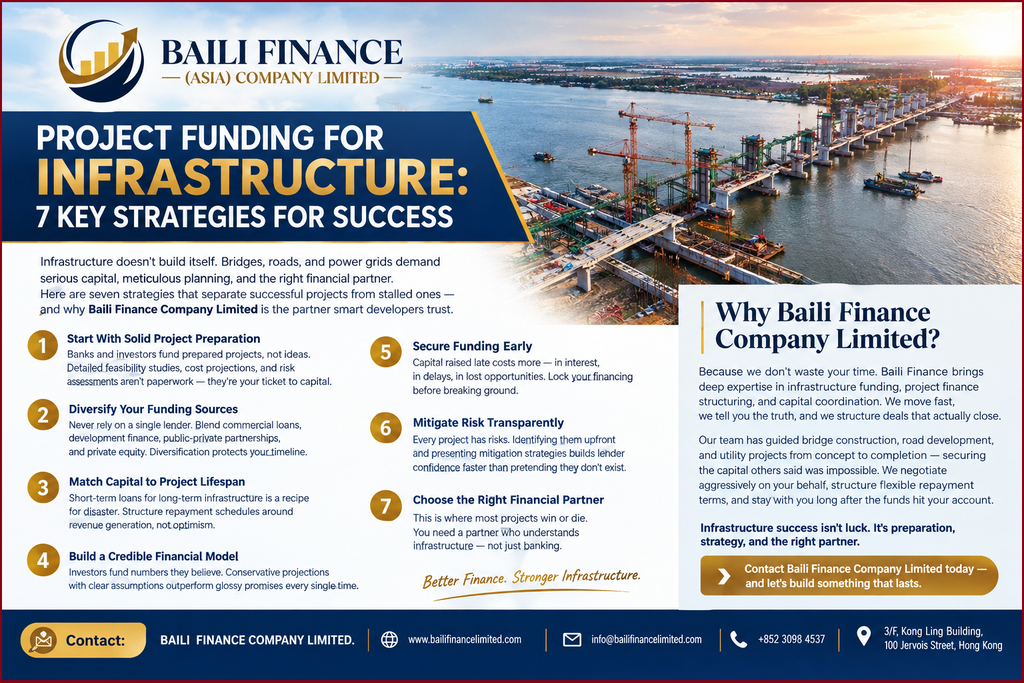
For project sponsors, developers, contractors, and public authorities, securing infrastructure project financing can be one of the most demanding stages of project development. A project may offer clear economic benefits and address a significant public need, yet struggle to attract investment if its financial model, contractual arrangements, or repayment structure lacks credibility.
The solution begins with understanding how infrastructure finance works, which funding options are available, and what lenders and investors expect before committing capital.
At Baili Finance Limited, we recognise the importance of approaching financing discussions with a clear understanding of project requirements, capital needs, commercial objectives, and funding conditions. This guide explains the principal infrastructure financing options, the preparation required to attract capital, the risks that affect funding decisions, and the practical steps that can improve a project’s financing prospects.
Keywords: project funding for infrastructure, infrastructure project financing, infrastructure funding solutions, how to secure funding for infrastructure projects, infrastructure development finance, infrastructure project finance requirements, financing roads, bridges and energy projects, public-private partnership infrastructure funding, renewable energy project financing, infrastructure funding application process
What Is Project Funding for Infrastructure?
Project funding for infrastructure refers to the financing arrangements used to develop, acquire, expand, rehabilitate, or operate infrastructure assets. These arrangements may combine private investment, commercial loans, government contributions, development finance, institutional capital, and other funding sources.
Unlike short-term business borrowing, infrastructure financing often supports assets that require substantial initial expenditure and generate benefits or revenue over many years.
Examples include:
- Transport infrastructure, including highways, bridges, airports, railways, and seaports.
- Energy infrastructure, including solar farms, wind power facilities, electricity transmission networks, and power plants.
- Water infrastructure, including reservoirs, dams, pipelines, desalination plants, and wastewater treatment facilities.
- Digital infrastructure, including fibre-optic networks, data centres, and telecommunications systems.
- Social infrastructure, including hospitals, educational facilities, and public service buildings.
- Industrial infrastructure, including logistics centres, industrial parks, and utility networks.
The financing structure depends on the asset, project sponsor, jurisdiction, expected cash flow, construction period, and intended ownership model.
For example, a toll road may generate revenue from road users, while a public water treatment facility may receive payments under a long-term supply agreement. A hospital developed through a public-private partnership may receive contractual payments from a government authority.
These differences matter because infrastructure financing must reflect how a project will generate income, meet its obligations, and sustain operations after construction.
Why Infrastructure Projects Need Structured Financing
Infrastructure projects frequently require substantial capital before they produce revenue. Construction can take several years, while repayment obligations may continue for decades.
This timing creates a financing challenge. Project sponsors must secure sufficient capital to complete construction, manage unexpected costs, satisfy contractual commitments, and maintain operations without placing excessive pressure on available cash flow.
A properly structured financing arrangement can help address these requirements.
1. Manage High Initial Capital Expenditure
Infrastructure development involves land acquisition, engineering, construction, equipment, professional services, permits, and environmental assessments.
These costs can exceed the resources available to a single sponsor. Structured financing allows eligible projects to combine several funding sources and align capital availability with the construction schedule.
2. Match Repayments to Project Cash Flow
Infrastructure assets often generate income gradually. A financing structure that requires substantial repayments before operations begin may create unnecessary financial pressure.
Lenders and sponsors should therefore assess construction milestones, commissioning dates, operating costs, revenue assumptions, and debt repayment schedules together.
Where appropriate, the structure may include a construction period, an agreed repayment commencement date, and repayment terms that reflect the asset’s expected operating life.
3. Distribute Financial Risk
A project may involve developers, contractors, lenders, equipment suppliers, insurers, government agencies, and operating companies.
Each party has different responsibilities and risk exposures. Clear contractual arrangements help establish who bears construction risk, operating risk, demand risk, foreign exchange risk, and other material obligations.
4. Support Economic Development
Reliable infrastructure improves access to essential services, supports business activity, reduces logistical constraints, and can encourage further investment.
The World Bank Group’s Private Participation in Infrastructure database documents infrastructure projects involving private participation across sectors such as energy, transport, water, and digital infrastructure. Its reporting provides a useful reference for understanding how public and private capital can contribute to infrastructure development.
Seven Key Strategies for Securing Infrastructure Project Funding
Securing infrastructure finance requires more than identifying a potential lender. Project sponsors must demonstrate that the project has a credible commercial, technical, legal, and operational foundation.
1. Develop a Bankable Project Proposal
A bankable project proposal gives potential financiers sufficient information to evaluate the project’s viability, risks, and funding requirements.
The proposal should explain what the project will deliver, why the investment is necessary, how implementation will proceed, and how the project will meet its financial obligations.
A comprehensive infrastructure funding proposal typically includes:
- An executive summary and project objectives.
- The sponsor’s background and relevant experience.
- Technical designs and engineering assessments.
- A detailed capital expenditure budget.
- A construction schedule and implementation plan.
- Revenue forecasts and operating expenditure estimates.
- A financial model with sensitivity analysis.
- Environmental and social impact assessments.
- Required permits, licences, land rights, and approvals.
- Proposed funding structure and repayment strategy.
- Risk assessments and mitigation measures.
Financial projections should use reasonable assumptions supported by available evidence. Where demand, pricing, construction costs, or completion dates remain uncertain, the proposal should disclose those uncertainties rather than present optimistic estimates as established facts.
2. Choose the Appropriate Financing Structure
Infrastructure projects can use several financing structures. The most suitable option depends on the project’s ownership, cash flow, risk profile, and contractual arrangements.
Debt financing: Commercial banks, development finance institutions, and other lenders provide capital that the borrower repays under agreed terms. The borrower must demonstrate its capacity to service the debt.
Equity financing: Sponsors or investors contribute capital in exchange for ownership interests and potential financial returns. Equity investors generally accept greater downside risk than senior lenders.
Project finance: Lenders primarily assess the project’s anticipated cash flow, contractual arrangements, and available security. A dedicated project company may borrow funds, with repayment depending substantially on project revenues. The precise recourse arrangements depend on the financing documents.
Public-private partnerships (PPPs): A public authority contracts with a private party to deliver specified infrastructure or services under an agreed allocation of responsibilities and risks. PPPs can incorporate private financing, but they do not automatically reduce the overall cost of infrastructure.
Blended finance: Public or development capital supports the mobilisation of additional commercial investment where appropriate. Depending on the structure, support may include concessional funding, guarantees, technical assistance, or other risk-sharing arrangements.
Export credit and equipment financing: These facilities may support eligible infrastructure projects that require imported machinery, specialised technology, or equipment from international suppliers.
A project may combine several of these approaches. However, a complex structure should have a clear commercial purpose. Adding more financing instruments does not necessarily improve affordability or reduce risk.
3. Establish a Credible Revenue Model
A project’s ability to repay debt and provide investor returns depends on its financial performance.
Potential revenue sources include user charges, tolls, electricity sales, water supply agreements, lease payments, availability payments, service contracts, and other legally enforceable income arrangements.
Before approaching financiers, sponsors should assess:
- Expected demand and customer affordability.
- Pricing rules and regulatory restrictions.
- Contract duration and payment obligations.
- Customer concentration and counterparty creditworthiness.
- Operating expenditure and maintenance requirements.
- Taxes, insurance, and financing costs.
- Currency exposure and inflation.
- Potential delays in receiving payments.
The financial model should test how the project performs when conditions deteriorate.
For example, what happens if construction costs increase by 15%, commissioning takes six months longer than planned, or customer demand falls below the forecast?
These are illustrative stress scenarios, not universal industry benchmarks. The appropriate tests depend on the project and its jurisdiction.
A credible downside analysis helps sponsors identify funding gaps before they become expensive problems.
4. Secure Experienced Financing Partners
Infrastructure financing may involve several institutions, each with different eligibility requirements and investment objectives.
Commercial banks may provide construction loans, term loans, or working capital. Development finance institutions may support projects that meet specific economic development and sustainability criteria. Institutional investors may consider long-term infrastructure assets with suitable risk and return characteristics.
Private equity investors may participate where the ownership structure and anticipated returns fit their investment mandate.
Sponsors should assess prospective financing partners against the following criteria:
- Sector experience and transaction history.
- Minimum and maximum funding requirements.
- Geographic and regulatory eligibility.
- Available financing instruments.
- Risk appetite and security requirements.
- Expected due diligence and approval timelines.
- Currency, pricing, tenor, and repayment conditions.
- Relevant environmental and governance standards.
A lender’s advertised capabilities do not establish that it will finance a particular project. Actual funding depends on underwriting, eligibility, documentation, approvals, and satisfactory completion of applicable conditions.
5. Allocate Construction and Operating Risks Properly
Construction delays, cost overruns, equipment failures, regulatory changes, and inadequate demand can undermine infrastructure project performance.
Financiers therefore examine how the project allocates these risks.
A fixed-price construction contract may help control certain construction costs, subject to its exclusions and enforceability. Performance guarantees may address specified equipment or operational requirements. Insurance may cover eligible risks, while contingency reserves can provide additional protection against defined cost pressures.
However, contractual protections have limits. A guarantee is only as useful as its terms, enforceability, and the guarantor’s ability to meet its obligations.
Sponsors should also examine political risk, changes in law, land acquisition, environmental obligations, climate exposure, and foreign exchange movements.
The objective is not to eliminate every risk. It is to identify material exposures, assign them to parties capable of managing them, and ensure that the financial structure remains viable under reasonable adverse conditions.
6. Prepare for Due Diligence and Financial Close
Financiers conduct due diligence to establish whether a project can proceed under acceptable conditions.
The review may cover technical feasibility, market demand, ownership, corporate structure, financial projections, contracts, tax treatment, regulatory compliance, environmental performance, and legal enforceability.
Sponsors should maintain an organised data room containing current documents, clear ownership records, consistent financial figures, and evidence supporting key assumptions.
They should also identify unresolved matters before submitting the project for formal review.
Financial close generally occurs when the required financing commitments and documentation are in place and the relevant conditions have been satisfied in accordance with the transaction structure. The precise definition varies by transaction.
Importantly, preliminary discussions, expressions of interest, indicative terms, and non-binding proposals do not necessarily constitute committed funding.
7. Demonstrate Long-Term Financial and Operational Sustainability
Infrastructure assets must continue to perform after construction. A financing proposal should therefore address maintenance, replacement of major equipment, operational staffing, insurance, service quality, and future capital expenditure.
Sponsors should prepare realistic lifecycle cost estimates rather than focus exclusively on construction costs.
They should also demonstrate how the project will respond to changes in demand, technology, environmental requirements, and operating expenses.
Where relevant, climate resilience, energy efficiency, water conservation, and emissions reduction can form part of the project’s technical and investment assessment.
A sustainable operating plan helps financiers evaluate whether the asset can deliver its intended service while meeting financial obligations over time.
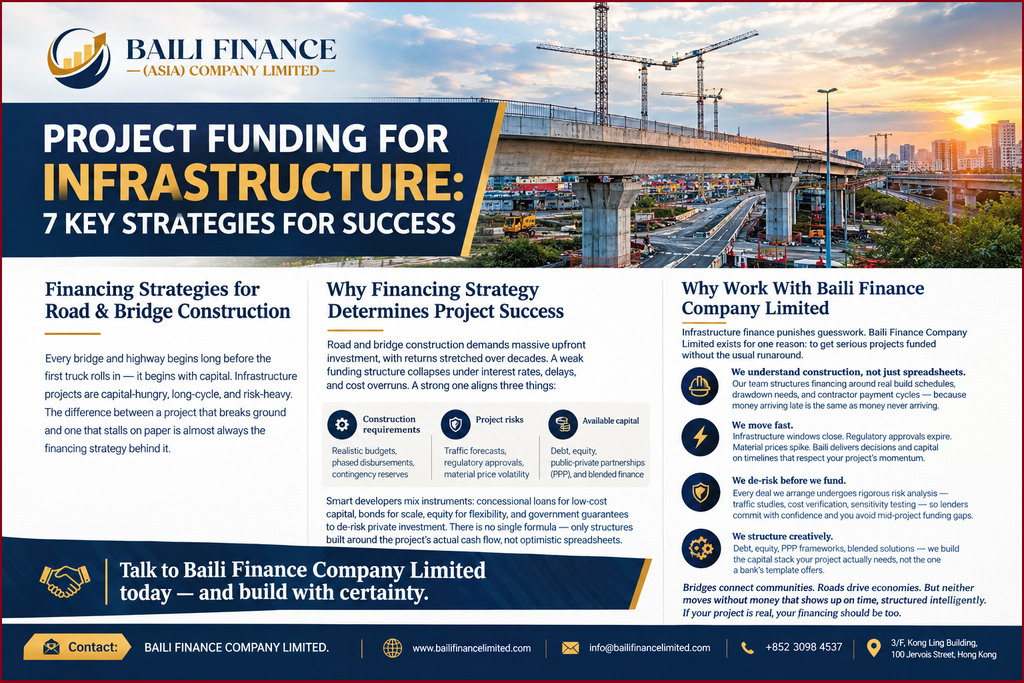
Infrastructure Financing Options Compared
The following table summarises common financing options and their principal considerations.
| Financing option | Typical application | Main consideration |
|---|---|---|
| Commercial bank loans | Construction and operating assets | Repayment capacity, security, and credit risk |
| Equity investment | Projects with ownership-based returns | Investor control, dilution, and return expectations |
| Project finance | Assets with identifiable cash flows | Contract strength and project bankability |
| Public-private partnerships | Public infrastructure and services | Value for money and risk allocation |
| Development finance | Eligible development-oriented projects | Institutional mandate and eligibility |
| Blended finance | Projects requiring targeted risk-sharing support | Additionality, governance, and subsidy justification |
| Export credit finance | Eligible imported equipment and services | Export eligibility and supplier requirements |
| Institutional investment | Suitable long-term infrastructure assets | Predictable cash flows and investment mandate |
These options are not interchangeable. The right choice depends on the project’s development stage, revenue model, ownership, jurisdiction, and funding objectives.
What Do Lenders Look for in an Infrastructure Project?
Lenders generally seek evidence that a project can meet its obligations and manage material risks.
Although requirements differ, five areas receive particular attention.
Technical feasibility: Engineering studies, design specifications, construction plans, equipment requirements, and independent technical assessments.
Financial viability: A credible financial model, realistic cost estimates, sustainable cash flow, and a repayment structure appropriate to the project.
Legal and regulatory readiness: Land rights, licences, permits, concession agreements, supply contracts, and enforceable financing documentation.
Sponsor capability: Relevant experience, governance, financial resources, management capacity, and the ability to fulfil contractual commitments.
Risk management: Appropriate insurance, contingency planning, construction arrangements, counterparty assessment, and protection against material financial exposures.
The project sponsor should be able to explain not only why the project deserves funding, but also how it will be delivered, operated, and financed under less favourable conditions.
Real-World Example: The Metolong Dam and Water Supply Programme
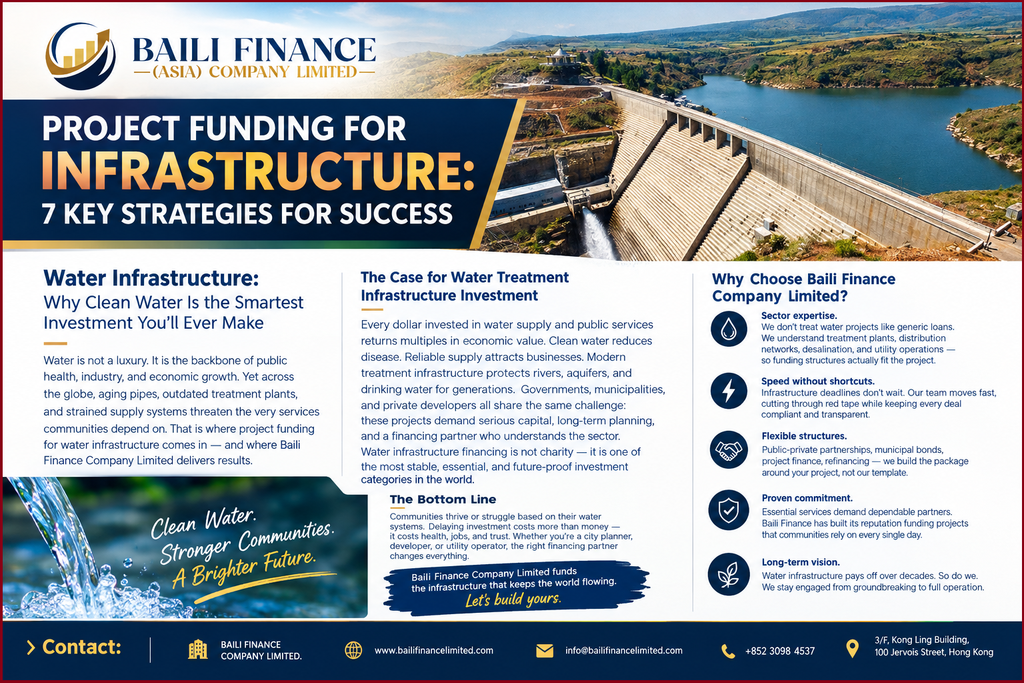
The Metolong Dam and Water Supply Programme in Lesotho provides a documented example of infrastructure investment supported by multiple funding partners.
According to the World Bank’s project results report, the programme addressed water shortages affecting households and businesses in Lesotho’s lowlands. Reliable water supply was particularly important for industrial activity, including the textile sector.
The programme combined infrastructure development with institutional strengthening, environmental and social measures, and community support.
The World Bank reported that its International Development Association (IDA) provided US$49.5 million for the project. Other funding partners included the European Investment Bank, the OPEC Fund, the Kuwait Fund, the Saudi Development Fund, the Abu Dhabi Fund for Development, the African Renaissance and International Cooperation Fund, the Arab Bank for Economic Development in Africa, and the Millennium Challenge Corporation. The Government of Lesotho contributed a further US$6.8 million.
By the end of 2018, reported results included a 24-kilometre pipeline connecting Metolong Dam and Teyateyaneng, improved water access for more than 30,000 residents in Teyateyaneng, and the construction or rehabilitation of more than 400 community water points.
The programme also supported the electrification of 80 villages in the project area.
What infrastructure developers can learn
The programme illustrates several principles relevant to infrastructure project funding.
First, large projects may require multiple financing partners because their capital requirements exceed the capacity or mandate of a single institution.
Second, project preparation matters. Engineering, institutional capacity, environmental safeguards, and implementation arrangements contribute to delivery readiness.
Third, infrastructure benefits extend beyond the asset itself. Reliable water supply can support public health, industrial activity, employment, and investment.
Finally, funding structures should reflect the project’s wider economic purpose as well as its immediate financial requirements.
The Metolong programme was a publicly supported, multi-partner initiative. It should not be treated as evidence that a private commercial project will qualify for the same institutions or terms. Each funding decision remains subject to its own eligibility requirements and assessment.
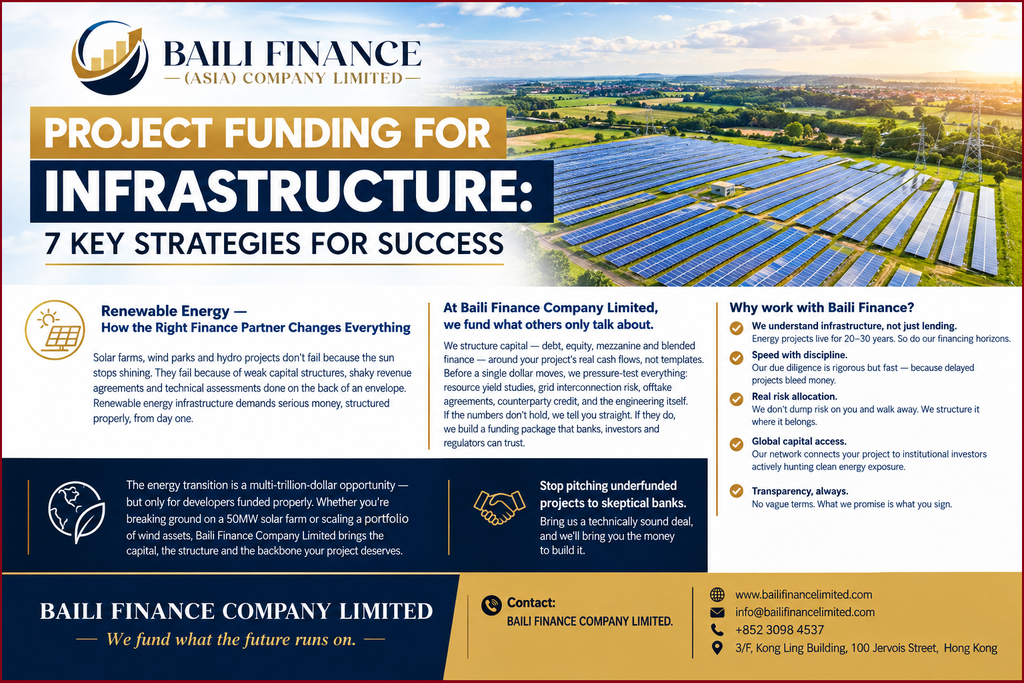
Illustrative Case Study: Financing a US$100 Million Renewable Energy Project
The following example is hypothetical. It demonstrates how a sponsor might structure a renewable energy infrastructure project and prepare for financing discussions.
The project
A project developer proposes a solar power facility with an estimated total development cost of US$100 million. The project will supply electricity under a proposed long-term power purchase agreement.
The sponsor seeks a financing structure that limits its initial equity contribution while providing sufficient capital for construction, commissioning, and associated development costs.
Proposed capital structure
For illustration, assume the sponsor proposes the following funding mix:
| Funding source | Illustrative amount | Share |
|---|---|---|
| Sponsor and investor equity | US$30 million | 30% |
| Senior project debt | US$60 million | 60% |
| Other eligible subordinated or development capital | US$10 million | 10% |
| Total project funding | US$100 million | 100% |
This is an example of a proposed capital structure, not a financing offer or an indication of typical market terms. The availability of each funding source depends on the project, jurisdiction, sponsors, contracts, and financier requirements.
The financing challenge
During initial assessment, the financing team identifies three issues.
First, the proposed power purchase agreement has not yet secured all required approvals. Second, the construction budget contains limited contingency provisions. Third, the financial model assumes electricity generation levels that require independent technical validation.
These issues could affect revenue certainty, project costs, and the willingness of lenders to commit capital.
The preparation process
The sponsor addresses these matters through a structured work programme.
- Contract development: The sponsor works to finalise the power purchase agreement and assess the buyer’s creditworthiness.
- Technical review: Independent advisers assess energy yield, equipment specifications, grid connection, construction requirements, and operating assumptions.
- Financial modelling: The sponsor tests lower electricity output, higher operating costs, construction delays, and changes in interest rates or exchange rates.
- Risk allocation: Construction, equipment performance, insurance, and operating responsibilities receive appropriate contractual treatment.
- Funding coordination: The sponsor seeks to align the equity contribution, debt terms, and any eligible development capital with the project schedule.
The outcome sought
The objective is to present a project that financiers can evaluate using consistent technical, commercial, and financial information.
Whether the proposed US$100 million structure can achieve financial close will depend on the final contracts, funding commitments, due diligence, regulatory approvals, and satisfaction of applicable conditions.
Lessons from the case study
The example demonstrates why infrastructure funding should begin with project readiness rather than an unsupported request for capital.
A detailed budget, realistic revenue model, credible counterparties, appropriate risk allocation, and complete documentation can improve the quality of financing discussions.
They do not guarantee approval, but they give prospective financiers a clearer basis for assessing the project.
Common Reasons Infrastructure Funding Applications Fail
Even projects with clear economic benefits may struggle to obtain finance.
Common reasons include:
- Incomplete project documentation: Missing technical studies, permits, contracts, or ownership records can delay assessment.
- Unrealistic financial projections: Unsupported revenue forecasts can weaken confidence in the business case.
- Unclear repayment sources: Lenders need to understand how the project will service its obligations.
- Insufficient sponsor commitment: A funding proposal may lack credible evidence of the sponsor’s financial contribution or delivery capability.
- Poor risk allocation: Unresolved construction, demand, regulatory, or counterparty risks can make a project difficult to finance.
- Inadequate contingency planning: Projects may become financially unviable when costs rise or completion takes longer than expected.
- Misunderstood funding terms: Sponsors may confuse preliminary interest with a binding financing commitment.
- Failure to meet eligibility criteria: A project may fall outside a financier’s geographic, sectoral, credit, or investment mandate.
To address these issues, sponsors should assess their funding readiness before approaching prospective financiers.
How to Prepare an Infrastructure Funding Application
A structured application process can help sponsors identify gaps and use their time efficiently.
Step 1: Define the funding requirement
Establish the total project cost, the amount already secured, the remaining funding gap, the required financing currency, and the proposed use of funds.
Separate construction expenditure from working capital, contingency reserves, financing costs, and operating requirements.
Step 2: Confirm the project’s development stage
Determine whether the project remains at concept stage, has completed feasibility studies, has obtained key approvals, has entered procurement, or is ready for construction.
Different financiers support different development stages. A project seeking early-stage development capital requires a different financing approach from one seeking a construction loan.
Step 3: Prepare the supporting documents
Compile the business plan, financial model, technical studies, corporate records, relevant contracts, permits, project schedule, and risk assessment.
Ensure that figures and assumptions remain consistent across all documents.
Step 4: Identify suitable financing partners
Match the project with institutions whose mandates and eligibility requirements align with its sector, geography, size, and development stage.
Avoid relying solely on generic funding advertisements or unverified claims about available capital.
Step 5: Review financing terms carefully
Evaluate interest rates, fees, repayment periods, security requirements, covenants, conditions precedent, guarantees, and potential currency exposure.
A financing arrangement should be assessed on its total cost and risk allocation, not solely on the headline interest rate.
Step 6: Manage due diligence and closing conditions
Respond promptly to reasonable information requests, resolve outstanding legal or technical issues, and maintain clear communication with advisers and prospective financiers.
Financing timelines vary. Sponsors should not commit to construction dates based solely on preliminary funding discussions.
The Role of Public-Private Partnerships in Infrastructure Finance
Public-private partnerships can provide a framework for developing infrastructure when a government authority and private-sector participants have complementary capabilities.
Depending on the arrangement, a private party may design, build, finance, operate, or maintain an asset. The public authority may retain ownership, make contractual payments, collect user charges, or share specified responsibilities.
However, a PPP is not simply a method of transferring costs to private investors. The public authority must assess affordability, value for money, competition, fiscal exposure, service standards, and long-term contractual obligations.
Private financing still requires repayment. If project revenues depend on government payments, the public authority must evaluate whether those payments remain affordable throughout the contract.
For a detailed technical reference, consult the World Bank Group’s Public-Private Partnerships Reference Guide.
The guide addresses PPP structures, institutional frameworks, project preparation, procurement, contract management, and environmental and social considerations.
Frequently Asked Questions About Project Funding for Infrastructure
1. What is project funding for infrastructure?
Project funding for infrastructure is the capital used to develop, construct, acquire, expand, or rehabilitate assets such as roads, bridges, power plants, water systems, hospitals, and telecommunications networks. Funding may come from commercial loans, equity investment, public budgets, development finance, institutional investors, or combinations of these sources.
2. How can I secure funding for an infrastructure project?
Start by defining the project’s funding requirement and development stage. Prepare a credible business plan, technical feasibility studies, a financial model, relevant approvals, revenue assumptions, and a risk management plan. Then identify financiers whose mandates match the project. Funding remains subject to due diligence, eligibility, approvals, and agreed conditions.
3. What documents do lenders require for infrastructure project financing?
Requirements vary, but lenders commonly request a project proposal, feasibility studies, financial projections, construction budget, corporate and ownership documents, relevant permits, land rights, contracts, environmental and social assessments, and evidence of sponsor equity. They may also require independent technical reviews, insurance arrangements, and detailed security documentation.
4. Can infrastructure projects receive 100% financing?
Some structures may cover most or, in specific circumstances, all eligible project costs through debt, equity, public contributions, grants, guarantees, or other instruments. However, 100% debt financing is not a standard outcome and may be difficult to obtain. The capital structure depends on project cash flow, security, sponsor strength, contractual arrangements, risk allocation, and the financier’s requirements.
5. What is the difference between project finance and corporate finance?
Project finance relies substantially on the project’s anticipated cash flow, contractual structure, and available project security to support repayment. Corporate finance assesses a company’s broader financial position, cash flow, assets, and creditworthiness. Some project finance arrangements are non-recourse or limited-recourse, while others include sponsor support or guarantees.
6. How long does it take to obtain infrastructure project funding?
There is no universal timeline. Smaller or more advanced transactions may progress more quickly than complex projects involving land acquisition, regulatory approvals, multiple financiers, environmental assessments, or extensive construction planning. Sponsors should allow time for project preparation, due diligence, negotiation, documentation, and satisfaction of financing conditions.
7. What makes an infrastructure project bankable?
A bankable project generally demonstrates technical feasibility, credible revenue or payment arrangements, a sustainable financial model, capable sponsors, appropriate risk allocation, legal and regulatory compliance, and a realistic implementation plan. Bankability depends on the perspective of the proposed financier and does not guarantee financing approval.
8. Can renewable energy projects qualify for infrastructure financing?
Solar, wind, hydropower, transmission, and other eligible energy projects may qualify for infrastructure financing. Financiers commonly assess resource availability, technology, construction costs, grid access, power purchase agreements, buyer creditworthiness, regulatory requirements, environmental considerations, and projected cash flow.
9. What is blended finance in infrastructure development?
Blended finance combines development-oriented capital with commercial funding to support projects that may face barriers to attracting investment on purely commercial terms. Depending on the structure, it can include concessional loans, grants, guarantees, or technical assistance. Its suitability depends on the project’s development objectives, additionality, risks, and eligibility for participating institutions.
10. How can Baili Finance Limited help with infrastructure funding enquiries?
Baili Finance Limited can be contacted to discuss your project’s financing requirements and determine whether its services and potential financing pathways align with your objectives. Prepare a concise project summary, the required funding amount, the development stage, the intended use of funds, and the supporting documents available. Any potential financing arrangement remains subject to the company’s actual service scope, eligibility requirements, due diligence, and applicable approvals.
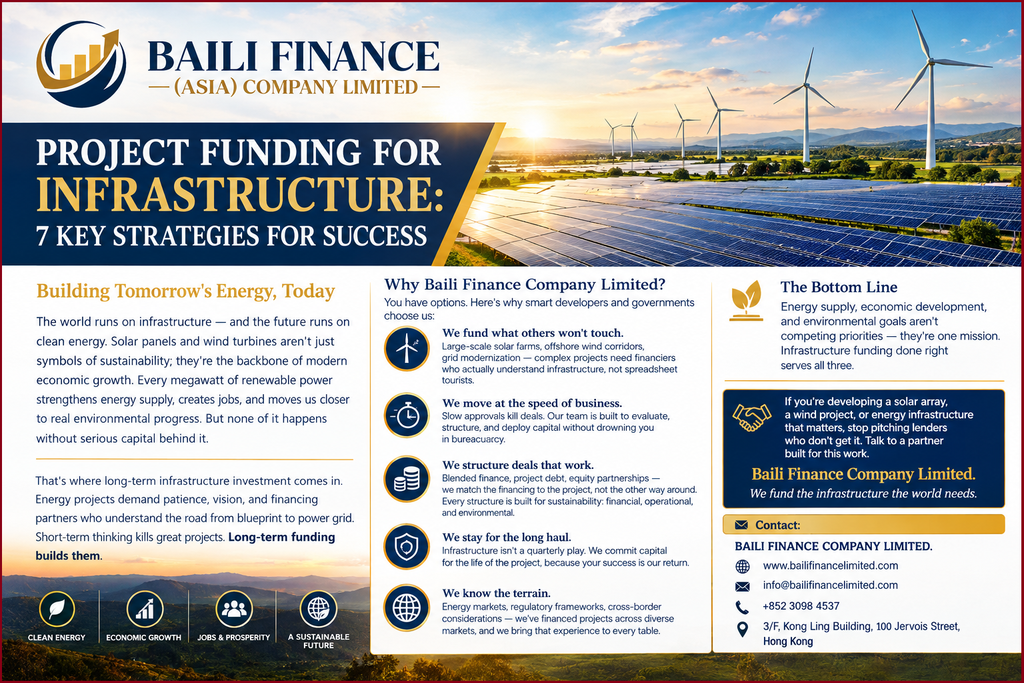
Conclusion: Secure the Right Funding Structure for Your Infrastructure Project
Project funding for infrastructure requires a disciplined approach to capital planning, financial modelling, risk management, and stakeholder coordination. A project’s strategic importance alone does not establish its bankability. Financiers need evidence that the asset can be delivered, operated, and financed under credible commercial and contractual arrangements.
The most effective approach starts with a clear funding requirement, a realistic development plan, and a financial model that reflects both expected performance and potential adverse conditions.
Sponsors should then select suitable financing structures, establish appropriate risk allocation, organise their documentation, and approach relevant financing partners with a well-supported proposal.
Public funding, commercial lending, equity investment, development finance, project finance, and public-private partnerships can each contribute to infrastructure development. Their effectiveness depends on the project’s requirements and the terms under which the capital becomes available.
For developers, contractors, project sponsors, and infrastructure investors, preparation is essential. Addressing funding gaps early can improve decision-making, reduce avoidable delays, and help establish a credible route towards financial close.
Are You Planning an Infrastructure Project That Requires Funding?
Your next financing discussion should begin with a clear project assessment, not a generic funding request.
If you’re developing a road, energy facility, water supply system, transport asset, industrial facility, or another infrastructure project, contact Baili Finance Limited to discuss your funding requirements and potential financing options.
Visit www.bailifinancelimited.com and submit your enquiry with the following information:
- Project overview: What infrastructure are you developing, and where?
- Funding requirement: How much capital do you need, and what will it finance?
- Development stage: Are you conducting feasibility studies, seeking approvals, preparing for construction, or expanding an existing asset?
- Project readiness: Which financial, technical, legal, and commercial documents are available?
The more clearly you define your requirements, the easier it becomes to assess whether a financing pathway may be appropriate.
Contact Baili Finance Limited today to start a focused discussion about your infrastructure funding requirements. Bring your project details, explain your objectives, and take the next step towards identifying a suitable financing structure.
All financing enquiries are subject to eligibility, due diligence, available services, applicable law, and any required approvals. Contacting the company does not guarantee funding or financing approval.
Intermediaries/Consultants/Brokers are welcome to bring their clients 100% protected. Our brokers receive 2% commission for referral. We assist Clients and brokers in their attempt to secure funding by working on their funding requests that may require innovative financing. In complete confidence, we will work together for the benefits of all parties involved.
#InfrastructureFinance #ProjectFunding #ProjectFinance #InfrastructureDevelopment #RenewableEnergyFinance #StructuredFinance #PublicPrivatePartnerships