
Headline: Corporate Financing: 7 Business Funding Options
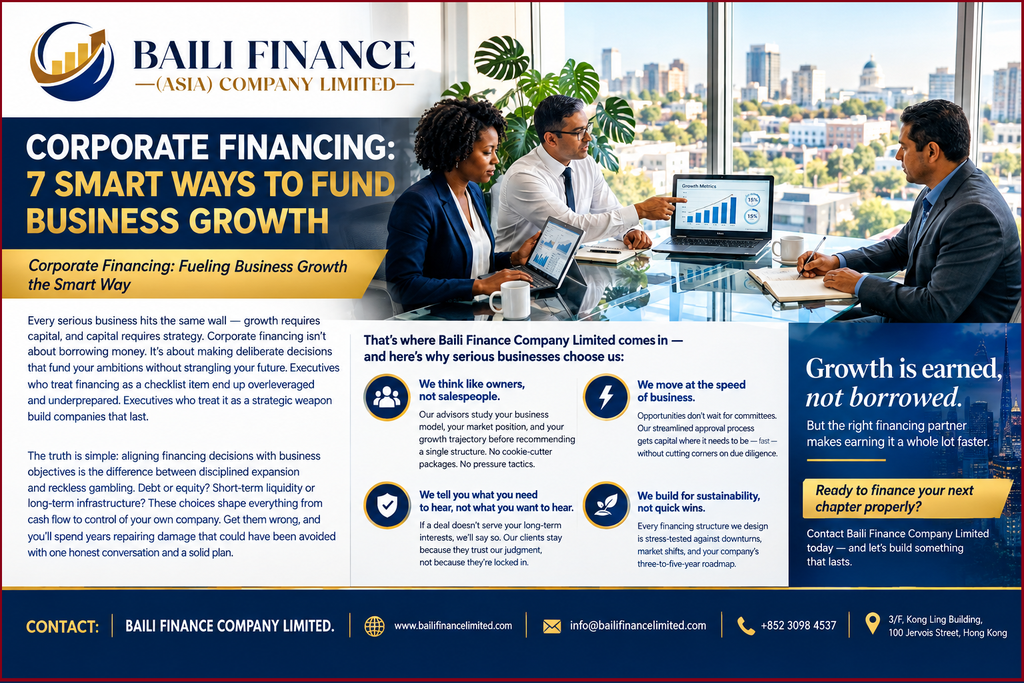
Corporate financing plays a central role in business expansion, cash flow management, investment planning, and long-term financial stability. Whether a company wants to enter a new market, acquire equipment, increase production, or strengthen its working capital, choosing the right financing structure can determine how effectively it achieves its objectives.
For business owners, executives, and financial decision-makers, understanding corporate financing options is essential to making informed investment decisions. The right funding strategy helps a company access the capital it needs while managing borrowing costs, ownership dilution, repayment obligations, and financial risk.
However, securing business funding involves more than obtaining a corporate loan. Companies must evaluate their financial position, understand the cost of capital, compare financing providers, and align their funding arrangements with their commercial objectives.
At Baili Finance Limited, we recognize the importance of understanding business funding before committing to a financial arrangement. This guide explains how corporate financing works, explores the principal funding options, examines a real-world financing initiative, and provides practical guidance for businesses seeking capital to support sustainable growth.
Keywords: corporate financing, business financing, business funding, corporate loans, cash flow management, capital structure, debt financing, equity financing, invoice financing, asset financing, trade finance, cost of capital, debt service coverage ratio
What Is Corporate Financing?
Corporate financing refers to the methods businesses use to obtain, allocate, and manage capital for their operations, investments, and strategic objectives. It includes raising money through debt, equity, retained earnings, and structured financing arrangements.
Companies use corporate finance to fund daily operations, purchase assets, develop products, acquire other businesses, refinance existing obligations, and enter new markets.
The financing structure depends on several factors, including the company’s size, creditworthiness, cash flow, growth plans, existing liabilities, and the purpose of the funding.
For example, a manufacturing company purchasing production equipment may require long-term asset financing. A distributor waiting for customers to settle invoices may need short-term working capital. A company planning an international acquisition may consider equity investment, syndicated loans, or a combination of financing instruments.
Each situation requires a different approach.
Corporate financing also involves financial planning. Businesses must determine how much capital they need, when they need it, how they intend to use it, and how they will meet the associated financial obligations.
The objective isn’t simply to secure funding. It’s to obtain suitable capital on terms that support the company’s financial position and commercial priorities.
Why Corporate Financing Matters to Businesses
Access to appropriate business funding enables companies to pursue opportunities without relying exclusively on existing cash reserves.
Nevertheless, financing decisions affect more than immediate liquidity. They influence profitability, ownership, financial flexibility, and the company’s capacity to respond to changing market conditions.
1. Supporting Business Expansion
Business expansion often requires significant upfront investment. Companies may need additional premises, equipment, employees, inventory, technology, or distribution capacity before generating revenue from their investment.
Corporate financing can provide the capital needed to meet these costs.
For example, a company entering a new geographical market may use a business loan to establish operations while preserving some of its existing cash for ordinary expenses. Alternatively, a company with a scalable business model may seek equity investment to fund expansion without taking on scheduled loan repayments.
Before committing to either option, management should prepare financial forecasts that estimate the expected investment, operating costs, revenue, and time required to generate an acceptable return.
2. Improving Working Capital and Cash Flow
Profitable companies can still experience cash shortages. This often happens when customers pay invoices slowly while suppliers, employees, landlords, and tax authorities require payment on schedule.
Working capital financing helps businesses manage these timing differences.
Depending on eligibility and the financing arrangement, available options may include revolving credit facilities, invoice financing, overdrafts, and supply chain finance.
These arrangements can help a company meet short-term obligations while waiting for incoming payments.
However, financing should address a defined cash flow requirement rather than conceal persistent operating losses. Businesses need to identify the underlying cause of a liquidity problem before increasing their borrowing.
3. Funding Equipment and Capital Expenditure
Companies often need to invest in machinery, vehicles, production facilities, information technology, and other assets.
Asset financing and equipment loans can spread the cost of eligible purchases over an agreed period. This may help preserve cash for other business requirements.
The repayment period should generally reflect the asset’s useful economic life and the cash flow it is expected to generate.
Financing an asset over a period that exceeds its useful life can leave the company paying for equipment that no longer generates sufficient value. Conversely, an unnecessarily short repayment period may create avoidable pressure on monthly cash flow.
4. Strengthening Financial Resilience
Appropriate financing can help businesses preserve liquidity, manage seasonal demand, and respond to unexpected operating requirements.
Nevertheless, resilience requires more than access to credit. Management must maintain suitable cash reserves, monitor debt obligations, and avoid excessive dependence on short-term borrowing.
A well-designed financing strategy gives decision-makers greater visibility into future funding requirements and helps them prepare for changing business conditions.
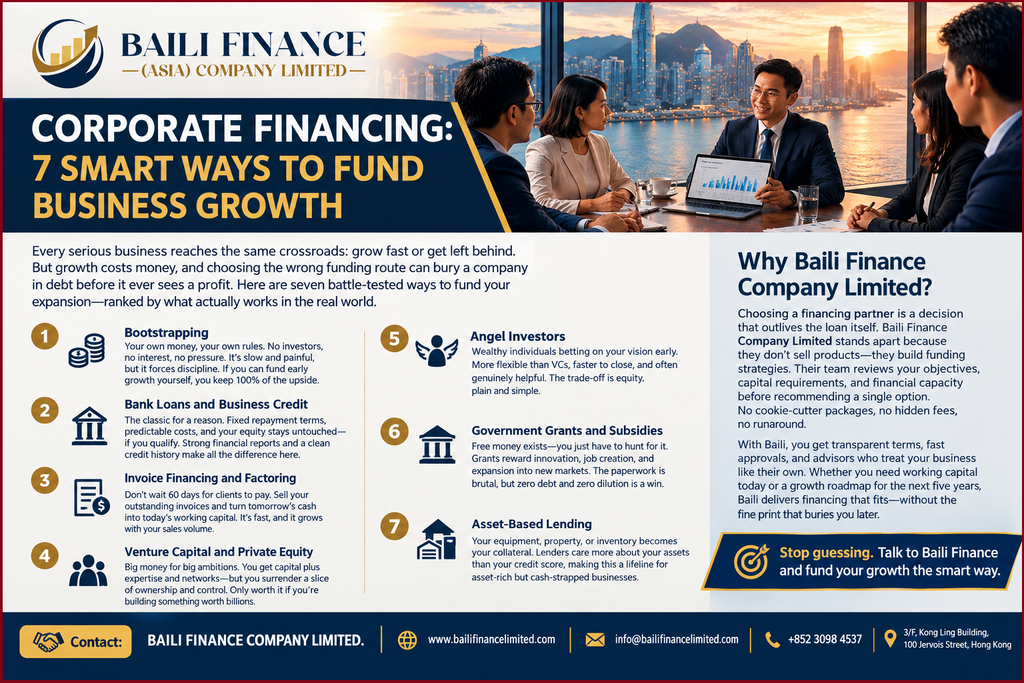
7 Corporate Financing Options Businesses Should Understand
Businesses can access capital through several financing methods. Each option has different eligibility requirements, costs, repayment terms, and implications for ownership.
1. Corporate Loans and Business Term Loans
A corporate loan provides funding that a company repays according to agreed terms. Depending on the facility, the lender may require collateral, guarantees, financial covenants, or other credit protections.
Businesses commonly use term loans to finance expansion, equipment purchases, acquisitions, and other defined investments.
Before accepting an offer, companies should examine the interest rate, arrangement fees, repayment schedule, security requirements, early repayment conditions, and consequences of default.
They should also distinguish between fixed and variable interest rates. A fixed rate can provide greater payment certainty during the agreed period, while a variable rate may change with the relevant benchmark or contractual pricing mechanism.
A loan is appropriate when the company can reasonably demonstrate its ability to service the debt under realistic financial assumptions.
2. Equity Financing
Equity financing allows a company to raise capital by issuing ownership interests to investors.
Potential investors include founders, angel investors, venture capital firms, private equity firms, and other strategic investors.
Unlike conventional debt, equity financing doesn’t usually require scheduled principal repayments. However, existing shareholders may experience ownership dilution, and investors may obtain voting rights or influence over important business decisions.
Equity can suit businesses that need substantial growth capital but lack predictable cash flow to support additional debt.
However, founders should carefully evaluate valuation, shareholder rights, governance arrangements, exit provisions, and the long-term implications of bringing new investors into the business.
The absence of scheduled loan repayments doesn’t mean equity is cost-free. Investors expect compensation for the capital and risk they assume.
3. Working Capital Financing
Working capital financing addresses short-term operating requirements, including inventory purchases, payroll, supplier payments, and temporary gaps between receivables and payables.
Common arrangements include revolving credit facilities, overdrafts, and short-term business loans.
A revolving facility allows a company to draw funds up to an agreed limit, repay amounts used, and draw again under the facility’s terms.
This flexibility can help companies manage seasonal fluctuations. However, fees and interest may apply, and the lender may review or change the facility according to the agreement.
Businesses should match the facility to their operating cycle and avoid using short-term credit indefinitely to finance investments that require long-term funding.
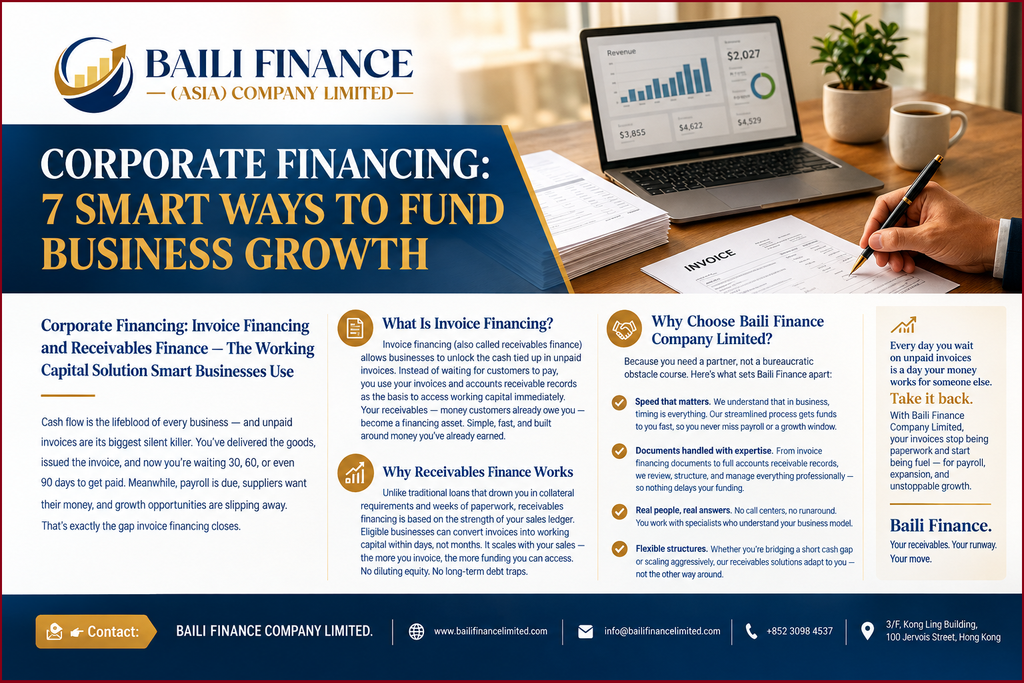
4. Invoice Financing and Receivables Finance
Invoice financing enables businesses to access funds against eligible unpaid customer invoices.
Depending on the product, a provider may advance a proportion of the invoice value before the customer pays. The provider then collects the invoice or receives repayment under the agreed arrangement.
This option can benefit companies that sell to creditworthy customers but experience long payment cycles.
For example, a business supplying products to a large corporate buyer may need to pay its suppliers several weeks before receiving payment from that buyer. Receivables financing can help bridge the gap.
Before proceeding, businesses should review advance rates, service fees, recourse provisions, customer notification requirements, and the treatment of disputed invoices.
Invoice financing doesn’t eliminate customer credit risk in every arrangement. The business must understand who bears the loss if a customer fails to pay.
5. Asset and Equipment Financing
Asset financing supports the purchase or use of qualifying business assets. Depending on the structure, it may take the form of an equipment loan, finance lease, or another asset-backed arrangement.
This approach can align funding with the asset being acquired rather than requiring the business to fund the entire purchase from existing cash.
Companies should assess the deposit, total repayment amount, ownership arrangements, maintenance obligations, insurance requirements, and end-of-term conditions.
They should also consider whether the asset will generate sufficient revenue or cost savings to justify the financing expense.
6. Trade Finance and Supply Chain Finance
Trade finance helps businesses manage payment and performance risks associated with domestic or international trade. Instruments may include letters of credit, documentary collections, trade loans, and bank guarantees.
Supply chain finance can help eligible suppliers improve liquidity by accessing funding linked to invoices or transactions with participating buyers.
These arrangements can be particularly relevant to businesses importing raw materials, exporting finished goods, or supplying large corporate customers.
The appropriate instrument depends on the transaction, counterparties, jurisdiction, payment terms, and risk allocation.
Businesses should examine currency exposure, documentary requirements, transaction fees, counterparty risk, and applicable regulations before entering a cross-border financing arrangement.
7. Private Equity, Venture Capital, and Strategic Investment
Private equity and venture capital provide investment capital in exchange for an ownership interest and, in some cases, additional contractual rights.
Venture capital typically focuses on businesses with significant growth potential, while private equity can support a wider range of investment strategies, including expansion, acquisitions, and business transformation.
Strategic investors may also contribute industry expertise, distribution networks, technology, or commercial relationships.
These benefits can extend beyond the initial investment. However, companies must evaluate investor expectations, governance requirements, valuation, future fundraising needs, and potential exit timelines.
The right investor should align with the company’s objectives and operating model, not merely offer the largest investment amount.

How to Choose the Right Corporate Financing Structure
Selecting a financing option requires a clear understanding of the business’s financial position and funding objectives.
A company shouldn’t choose a facility solely because a provider offers an attractive headline rate. The total cost, repayment conditions, security requirements, and potential impact on future borrowing capacity also matter.
Step 1: Define the Funding Purpose
Start by identifying exactly what the company intends to finance.
Is the requirement related to working capital, equipment, market expansion, an acquisition, debt refinancing, or a temporary liquidity shortfall?
A defined purpose makes it easier to determine the appropriate financing period and assess whether the expected benefits justify the cost.
Step 2: Calculate the Capital Requirement
Estimate the amount needed to complete the intended project or meet the operating requirement.
Include direct expenses, implementation costs, taxes where applicable, contingency allowances, and the cash needed to maintain ordinary operations.
Avoid borrowing significantly more than necessary without a clear business justification. Equally, underestimating the funding requirement can force the company to seek additional capital on less favourable terms later.
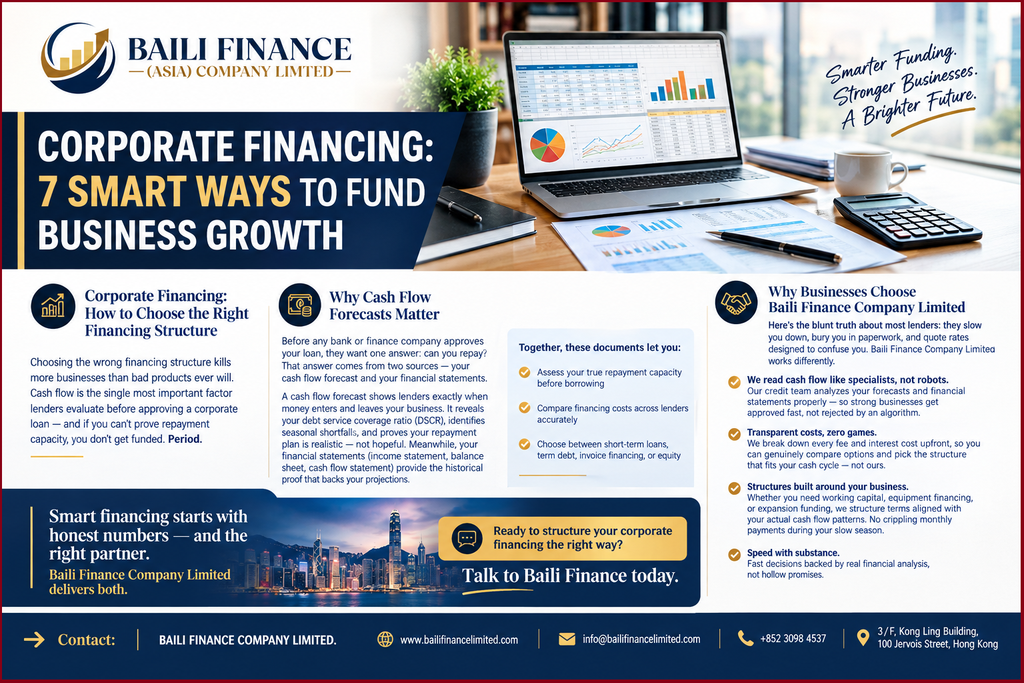
Step 3: Review Cash Flow and Repayment Capacity
Prepare realistic cash flow forecasts that cover the proposed financing period.
Consider revenue fluctuations, customer payment delays, operating expenses, existing debt, and potential changes in interest rates or currency values.
For debt financing, assess the company’s capacity to meet principal and interest payments under both expected and adverse conditions.
One useful measure is the debt service coverage ratio (DSCR):
DSCR = Cash Flow Available for Debt Service ÷ Total Debt Service
For example, if a company generates $300,000 in annual cash flow available for debt service and its annual principal and interest obligations total $200,000, its DSCR is 1.50.
This means the company generates $1.50 in available cash flow for every $1.00 of scheduled debt service.
The calculation is illustrative. Lenders may use different definitions of cash flow and debt service, and their minimum DSCR requirements vary.
Step 4: Compare the Total Cost of Financing
Compare financing offers using their effective overall cost rather than the headline interest rate alone.
Review interest, arrangement fees, legal costs, commitment fees, valuation expenses, insurance requirements, and any other applicable charges.
For equity financing, consider dilution and the value of the ownership interest surrendered. For asset financing, examine the total cost over the full contractual term.
Where possible, compare offers on a consistent basis, using the same financing amount, repayment period, and assumptions.
Step 5: Assess Security and Contractual Obligations
Some financing arrangements require collateral, personal guarantees, financial covenants, restrictions on additional borrowing, or minimum financial performance.
These conditions can affect a company’s future flexibility.
Management should understand the consequences of breaching a covenant, missing a payment, or failing to meet another contractual requirement.
Professional legal and financial advice can help the company assess complex or high-value agreements before signing.
Step 6: Match the Financing Term to the Business Need
Short-term cash flow requirements generally call for a different structure from long-term capital investments.
For example, a temporary inventory requirement may suit a revolving working capital facility. A production line expected to operate for several years may justify longer-term asset financing.
Matching the funding period to the expected benefit helps reduce refinancing risk and repayment pressure.
What Lenders Typically Evaluate Before Approving Corporate Financing
Financing providers use different underwriting policies, but many assess a company’s ability to repay, financial condition, management quality, and the purpose of the proposed facility.
Preparing the relevant information in advance can improve the quality of the application and reduce avoidable delays.
Common requirements include:
- Financial statements: Historical income statements, balance sheets, and cash flow statements.
- Management accounts: Recent financial information that shows current trading performance.
- Bank statements: Evidence of account activity and cash flow patterns.
- Business plan: A clear explanation of the company’s activities, objectives, and funding requirements.
- Cash flow forecasts: Projected income, expenses, working capital, and debt service.
- Corporate documents: Registration records, ownership information, and relevant authorisations.
- Existing debt information: Outstanding facilities, repayment schedules, guarantees, and other financial commitments.
- Collateral information: Details of available assets where the financing arrangement requires security.
- Use-of-funds explanation: A breakdown of how the requested capital will support the proposed business activity.
Requirements vary by provider, country, financing product, and transaction size. A complete application doesn’t guarantee approval, and a lender may request additional information during due diligence.
Common Corporate Financing Mistakes to Avoid
Even businesses with sound commercial prospects can create financial pressure by selecting unsuitable funding structures.
Understanding the common mistakes can help management make more disciplined decisions.
Borrowing Without a Clear Repayment Plan
A business should identify how it will repay debt before accepting the facility.
Projected revenue alone isn’t enough. Management must account for operating costs, taxes, working capital requirements, existing obligations, and potential delays in receiving customer payments.
Choosing Financing Based Only on the Interest Rate
A low headline rate can conceal arrangement fees, restrictive covenants, mandatory security, or unfavourable repayment conditions.
Compare the full contractual cost and consider how the facility affects the company’s financial flexibility.
Using Short-Term Debt for Long-Term Investments
Relying on short-term facilities to fund assets with long payback periods can create repeated refinancing requirements.
If a lender declines to renew the facility, the company may face a liquidity shortfall even when its underlying investment remains commercially viable.
Overlooking Currency Risk
Companies that borrow in one currency but generate most of their revenue in another may face repayment pressure when exchange rates move against them.
Where relevant, assess the relationship between financing currency, operating revenue, supplier costs, and contractual payment dates.
Failing to Maintain Financial Records
Incomplete or inconsistent financial records can make it harder for a provider to assess the company’s performance and repayment capacity.
Maintaining accurate accounts, reconciling transactions, and monitoring key financial indicators helps management make better decisions and prepare for financing discussions.
Real-World Example: IFC and Access Bank’s SME Financing Initiative
A relevant real-world example comes from the International Finance Corporation (IFC), a member of the World Bank Group, and its September 12, 2024 announcement of a partnership with Access Bank to expand financing for small and medium-sized businesses.
According to the IFC announcement on its partnership with Access Bank, IFC planned to invest up to $10 million in local-currency equivalent through an unfunded risk-sharing facility.
The facility was designed to support eligible SME lending of up to $20 million in local-currency equivalent. It included a 50% guarantee on eligible loans within the agreed portfolio structure.
The initiative aimed to improve access to financing for businesses in sectors including agriculture, healthcare, education, and green industries.
This example demonstrates how corporate and SME financing can involve more than a direct loan between a company and a bank. Risk-sharing arrangements can help participating financial institutions expand lending while allocating part of the credit risk to another institution under agreed terms.
The initiative also illustrates the importance of understanding the structure behind a financing facility. A guarantee doesn’t mean every applicant automatically qualifies, and the arrangement doesn’t remove all lending risks.
For business owners, the practical lesson is to investigate the financing products and eligibility criteria available through relevant institutions rather than assuming that conventional term loans represent the only route to capital.
Case Study: How a Growing Distributor Could Structure Its Funding
The following is an illustrative case study based on a hypothetical company. The figures are examples, not reported results from a real client.
Consider a distributor of industrial components that supplies established corporate customers. The company has secured additional purchase orders, but its customers pay invoices 60 days after delivery while suppliers require payment within 30 days.
The business wants to purchase more inventory to fulfil the new orders. However, using its cash reserves would leave insufficient liquidity for payroll, transportation, and other operating expenses.
The Funding Challenge
The company estimates that it needs $250,000 to finance additional inventory and bridge the gap between supplier payments and customer collections.
Management identifies three possible approaches:
- Use existing cash reserves.
- Obtain a short-term business loan.
- Explore invoice financing against eligible customer receivables.
Using all available cash could weaken the company’s ability to meet ordinary expenses. A term loan could provide the required capital, but the company would need to compare repayment dates with its expected collections.
Invoice financing may provide access to funds against eligible invoices, subject to the provider’s advance rate, fees, customer credit assessment, and contractual terms.
The Financing Assessment
Before choosing a facility, the company prepares a 13-week cash flow forecast, reviews its outstanding invoices, and checks the payment history of its major customers.
Management also estimates the gross margin on the additional orders and calculates the costs associated with fulfilling them.
The company then requests comparable financing proposals and evaluates the total cost, availability of funds, repayment obligations, and potential impact on future working capital.
Suppose the additional orders generate $400,000 in revenue and carry $300,000 in direct costs. The resulting gross profit is $100,000 before financing costs and other operating expenses.
That $100,000 isn’t automatically the amount available to repay financing. The company must still account for overhead, taxes, potential returns, bad debts, and other cash requirements.
The Decision and Expected Outcome
After reviewing the alternatives, management selects the facility that best matches the timing of its receivables and inventory requirements, provided the final terms remain commercially acceptable.
The company establishes a collection monitoring process and reserves sufficient cash for its operating commitments.
This approach doesn’t guarantee a profit or eliminate credit risk. Instead, it demonstrates how a company can use financial analysis to select funding that addresses a defined operating requirement.
The key lesson: the right corporate financing decision starts with the company’s cash flow, transaction economics, and repayment capacity—not simply the amount a lender is willing to provide.
How to Prepare Your Business for Corporate Financing
Businesses can improve their readiness for financing by organising financial information and identifying their funding priorities before approaching providers.
First, maintain up-to-date financial statements and management accounts. Lenders and investors need reliable information to assess trading performance, liabilities, and liquidity.
Second, document the proposed use of funds. Explain what the business intends to finance, why the investment matters, and how management will measure the outcome.
Third, prepare realistic forecasts. Include assumptions about sales, operating costs, customer collections, supplier payments, and financing expenses. Test the projections against less favourable conditions.
Fourth, review existing financial commitments. Identify upcoming repayments, guarantees, security arrangements, and contractual restrictions that could affect the proposed facility.
Finally, compare suitable financing providers and seek professional advice where needed. The most appropriate option depends on the company’s circumstances, the transaction structure, and the terms available.
For additional background on business finance and access to capital, the International Finance Corporation provides resources on SME finance and investment services.
Frequently Asked Questions About Corporate Financing
1. What is corporate financing in simple terms?
Corporate financing is how a business obtains and manages money to fund its operations, investments, and growth plans. It can include business loans, equity investment, working capital facilities, asset financing, and other funding arrangements.
2. What are the main types of corporate financing?
The main types include debt financing, equity financing, working capital financing, invoice financing, asset financing, trade finance, and private investment. The appropriate option depends on the company’s funding purpose, financial position, repayment capacity, and ownership preferences.
3. What is the difference between corporate financing and corporate finance?
Corporate finance is the broader discipline concerned with investment decisions, capital structure, financial planning, and the management of company resources. Corporate financing focuses more specifically on how a company obtains the capital it needs and structures its funding arrangements.
In practice, the terms often overlap because financing decisions form part of corporate financial management.
4. How can a company qualify for corporate financing?
Eligibility varies by lender and financing product. Providers commonly review financial statements, cash flow, existing debt, credit history, ownership structure, business performance, and the intended use of funds.
Some facilities require collateral or guarantees, while others may rely more heavily on receivables, transaction structures, or the company’s projected cash flow. Approval isn’t guaranteed.
5. Is debt financing better than equity financing?
Neither option is universally better. Debt allows existing shareholders to retain ownership but creates repayment obligations and may require security. Equity can reduce immediate repayment pressure but dilutes ownership and may give investors governance rights.
Businesses should compare the cost, risk, flexibility, and long-term implications of both options.
6. Can a company obtain financing without collateral?
Some financing products may not require traditional collateral. However, providers may still assess cash flow, receivables, creditworthiness, guarantees, or other forms of risk protection.
Availability depends on the lender, jurisdiction, product, and applicant’s circumstances. Unsecured financing may also carry higher pricing or stricter eligibility requirements.
7. How much corporate financing should a business seek?
A company should calculate the capital required for its defined purpose, include reasonable transaction and implementation costs, and maintain sufficient liquidity for normal operations.
It should then test whether the proposed funding remains affordable under realistic and adverse scenarios. The maximum amount available from a lender isn’t necessarily the amount the business should borrow.
8. How long does corporate financing take to obtain?
Timing varies considerably. A straightforward facility with complete documentation may progress more quickly than a complex transaction involving collateral valuations, multiple lenders, cross-border structures, regulatory approvals, or extensive due diligence.
Businesses should ask providers about the application process, required documents, approval stages, and expected disbursement conditions.
9. What documents are required for a corporate financing application?
Common documents include financial statements, recent management accounts, bank statements, business plans, cash flow forecasts, corporate registration documents, ownership details, and information about existing debt.
The provider may also request contracts, invoices, asset valuations, tax records, or other documents relevant to the proposed facility.
10. How can Baili Finance Limited help businesses exploring financing?
Businesses can contact Baili Finance Limited through its website to discuss their financing objectives and enquire about relevant services. Any potential solution will depend on the company’s circumstances, the nature of the transaction, applicable requirements, and the services actually available.
Companies should confirm the scope, eligibility criteria, fees, and contractual terms of any proposed arrangement before making a commitment.
Conclusion: Make Corporate Financing a Strategic Decision
Corporate financing can help businesses fund expansion, improve working capital, acquire assets, enter new markets, and manage financial obligations. However, the benefits depend on selecting an appropriate structure and managing the associated costs and risks.
Debt financing can preserve ownership but requires repayment. Equity financing can provide growth capital without conventional loan instalments but may dilute existing shareholders’ interests. Working capital, invoice, asset, and trade finance can address specific operating requirements when their terms match the underlying business need.
The most effective approach begins with a clear funding objective, accurate financial information, realistic cash flow forecasts, and a detailed comparison of available options.
Businesses should also assess the total cost of financing, contractual obligations, currency exposure, and their ability to withstand changes in revenue or market conditions.
For decision-makers, the priority should be to secure capital that supports the company’s objectives without placing unnecessary pressure on its financial position.
Is your business preparing to expand, manage a cash flow gap, acquire equipment, or explore new funding options?
Visit: www.bailifinancelimited.com to contact Baili Finance Limited and discuss your business financing objectives. Prepare a clear summary of your funding requirement, intended use of funds, and expected timeline so that your enquiry can begin with the information that matters.
Take the next step with a clear understanding of your financing needs, the alternatives available, and the commitments involved. The right funding decision starts with the right questions.
Intermediaries/Consultants/Brokers are welcome to bring their clients 100% protected. Our brokers receive 2% commission for referral. We assist Clients and brokers in their attempt to secure funding by working on their funding requests that may require innovative financing. In complete confidence, we will work together for the benefits of all parties involved.
#CorporateFinancing #CorporateFinance #BusinessFunding #BusinessFinance #WorkingCapital #SMEFinance #BusinessGrowth #FinancialPlanning