Headline: Direct Top Tier Bank BG SBLC Provider | Baili Finance
International businesses often need more than access to capital. They need financial instruments that meet contractual requirements, support cross-border transactions, and give counterparties confidence in their ability to fulfil financial obligations. Working with a Direct Top Tier Bank BG SBLC Provider can help businesses explore these requirements through bank guarantees (BGs), standby letters of credit (SBLCs), and structured trade finance solutions.

For importers, exporters, contractors, project developers, and corporate borrowers, choosing the right financial partner requires careful assessment. The issuing bank, instrument wording, transaction structure, beneficiary requirements, and compliance process all influence whether a proposed arrangement will serve its intended purpose.
BAILI FINANCE (ASIA) COMPANY LIMITED provides financial services involving bank guarantees, standby letters of credit, international trade finance, and structured funding solutions. The company operates from Hong Kong and supports enquiries from businesses seeking suitable financial arrangements for their commercial objectives.
This guide explains how to evaluate a top-tier bank BG SBLC provider, understand the available instruments, assess potential funding structures, and prepare a transaction for professional review.
Keywords: Direct Top Tier Bank BG SBLC Provider, Direct bank guarantee provider, Top tier bank SBLC provider, Bank guarantee and SBLC provider, International SBLC provider, Bank guarantee issuance services, Standby letter of credit provider, SBLC monetization company, SWIFT MT760 SBLC provider, International trade finance solutions, Bank guarantee for project financing, How to find a direct top tier bank BG SBLC provider, How to obtain a bank guarantee for international trade, What to check before choosing an SBLC provider, How to verify a bank-issued standby letter of credit, Bank guarantee versus SBLC for project financing, Requirements for SBLC monetization and business funding, How SWIFT MT760 works in bank guarantee transactions
What Is a Direct Top Tier Bank BG SBLC Provider?
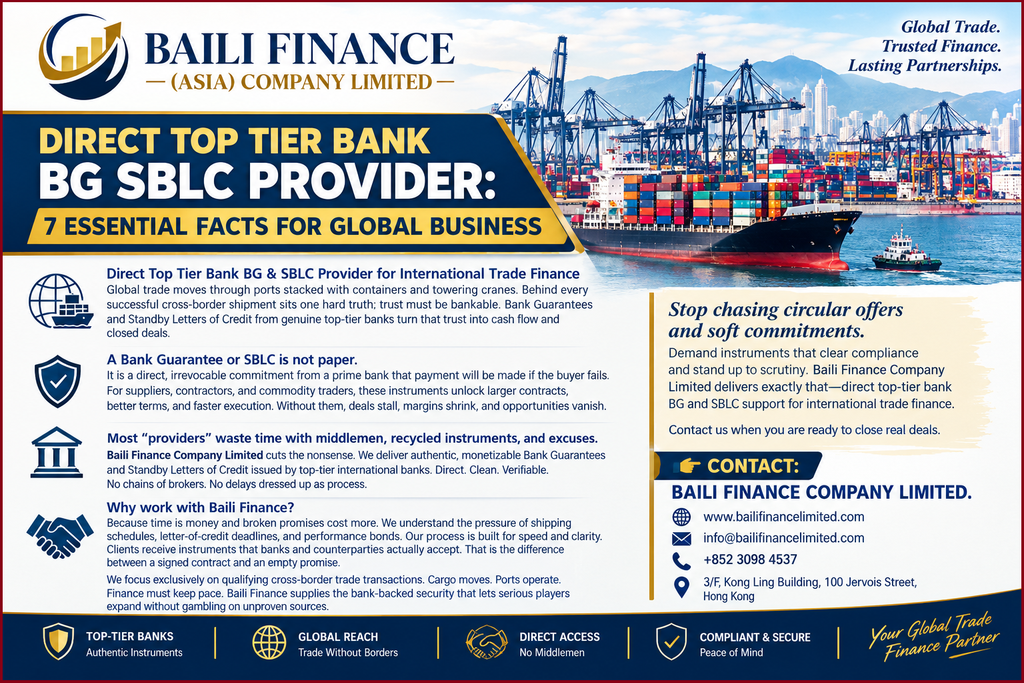
A direct top-tier bank BG SBLC provider is a commercial search term used by businesses seeking access to bank guarantees and standby letters of credit issued by reputable banking institutions, preferably through a clearly documented transaction structure with minimal unnecessary intermediaries.
The term covers several possible arrangements. A bank may issue an instrument directly to its customer. Alternatively, a specialist financial services company may arrange the transaction, coordinate documentation, or introduce the applicant to a suitable issuing institution.
These arrangements aren’t identical.
A bank guarantee is an undertaking under which a bank agrees to pay a beneficiary when the applicable claim conditions are satisfied. A standby letter of credit is an independent documentary undertaking that provides payment or other contractual assurance according to its terms.
The International Chamber of Commerce (ICC) publishes internationally recognised rules for these instruments, including the International Standby Practices (ISP98) and the Uniform Rules for Demand Guarantees (URDG 758).
These rules help define how the instruments operate when the relevant undertaking incorporates them. The applicable legal framework and instrument wording remain important.
What does “top-tier bank” mean?
The expression generally refers to a bank with an established institutional profile, credible financial standing, recognised international operations, and the ability to issue an instrument acceptable to the beneficiary.
However, there’s no single universal definition of a top-tier bank that guarantees acceptance in every transaction.
A bank’s credit rating, jurisdiction, reputation, correspondent banking relationships, and compliance standing may all influence a beneficiary’s assessment. More importantly, the beneficiary’s own bank may impose specific acceptance requirements.
Therefore, businesses should evaluate the actual issuing institution rather than relying solely on marketing terminology.
TOP-TIER BANKS ISSUING BANK GUARANTEES (BG) AND STANDBY LETTERS OF CREDIT (SBLC): HOW TO ACCESS LEGITIMATE FINANCING AND FUNDING
1. Understanding How BG and SBLC Financing Really Works
Bank Guarantees (BGs) and Standby Letters of Credit (SBLCs) are legitimate financial instruments used in international trade, corporate transactions, project financing, and contractual performance support. However, obtaining one—and using it to secure financing—requires the involvement of reputable, regulated financial institutions.
The most important point to understand is this: BG and SBLC financing is not something that can be obtained simply by contacting an online broker or paying an advertised provider. Genuine transactions require proper banking channels, financial assessments, compliance checks, and an underlying commercial purpose.
Major international banks issue BGs and SBLCs for eligible clients, subject to their internal credit policies, risk assessments, documentation requirements, and regulatory obligations.
2. Major Regulated Banks That Issue BGs and SBLCs
The following are established international banking institutions with corporate banking and trade-finance capabilities. Depending on the jurisdiction, product, transaction, and client eligibility, they may provide bank guarantees, standby letters of credit, or related credit facilities.
- JPMorgan Chase — Corporate banking and international trade finance.
- Bank of America — Commercial banking, trade services, and guarantee facilities.
- Citibank — Global transaction banking and cross-border trade finance.
- HSBC — International trade finance, guarantees, and corporate banking.
- Deutsche Bank — Corporate banking and international trade services.
- Wells Fargo — Commercial banking and eligible guarantee or standby facilities.
- Standard Chartered — Cross-border trade finance and international banking.
- BNP Paribas — Corporate trade finance, guarantees, and structured financing.
- Barclays — Corporate banking and eligible trade-finance solutions.
- MUFG Bank — International corporate banking, trade finance, and guarantees.
Other established institutions, including DBS Bank and OCBC, may also support suitable transactions in the markets they serve.
Important: This list identifies established banks with relevant banking capabilities; it is not a guarantee that every institution offers every BG or SBLC product in every country, accepts new applicants, or will approve a particular transaction.
3. How to Obtain a BG or SBLC Through the Proper Banking Channels
Access to these instruments normally begins with a legitimate banking relationship and a clearly defined commercial requirement. The process generally involves the following steps.
Step 1: Establish a relationship with a reputable financial institution.
Approach a regulated bank through its corporate banking, trade-finance, or relationship-management department. If you already maintain a business banking relationship, start with your relationship manager.
Step 2: Define the commercial purpose.
Explain why the BG or SBLC is required. The purpose may involve securing a contractual obligation, supporting an international trade transaction, meeting a tender requirement, or satisfying a beneficiary’s credit-support requirements.
Step 3: Prepare the required documentation.
Depending on the transaction, the bank may request company registration documents, beneficial ownership information, financial statements, bank records, contracts, invoices, project information, and details of the beneficiary.
Step 4: Complete credit and compliance assessments.
The bank assesses the applicant’s financial strength, repayment capacity, transaction legitimacy, source of funds, counterparty risk, and compliance with applicable Know Your Customer (KYC) and Anti-Money Laundering (AML) requirements.
Step 5: Obtain formal approval and agree on the terms.
If the transaction meets the bank’s requirements, the bank may approve issuance under an existing credit facility, an approved new facility, or an acceptable collateral arrangement. Fees, security requirements, wording, expiry dates, and other conditions must be agreed upon.
Step 6: Arrange the instrument through authenticated banking channels.
Where applicable, the bank issues and transmits the instrument through appropriate authenticated bank-to-bank channels, including SWIFT. The beneficiary or its bank should verify the instrument independently through official banking channels.
4. How BG and SBLC Instruments Can Support Financing and Funding
Obtaining a BG or SBLC does not automatically mean that funding will be released. The instrument may support a financing application, but a separate lender must determine whether it is acceptable as credit support.
For example, a company seeking working capital may have an eligible SBLC issued by an acceptable bank. A prospective lender will assess the issuing bank, the instrument’s wording, validity, enforceability, the underlying transaction, and the lender’s ability to rely on the instrument if the applicant defaults.
If the lender accepts the structure and approves the transaction, financing may be provided under agreed terms.
The essential distinction is:
- Issuance: A bank agrees to issue a BG or SBLC under approved conditions.
- Credit support: The instrument provides a specified form of protection to a beneficiary.
- Financing or funding: A lender separately approves and provides credit against an acceptable risk and transaction structure.
These are related but separate processes. Neither issuance nor financing is guaranteed.
5. Why Reputable Financial Institutions Matter
BGs and SBLCs create contingent obligations for the issuing bank. They are not ordinary cash deposits, and they do not automatically represent funds available for withdrawal.
For that reason, reputable institutions apply credit controls and compliance procedures before issuing these instruments. Applicants may need to demonstrate financial capacity, provide collateral, maintain an approved credit facility, or meet other requirements established by the bank.
Fees vary according to the issuing institution, applicant creditworthiness, instrument amount, tenor, collateral, jurisdiction, and transaction risk. There is no universal fee or approval rate that applies to every applicant.
Businesses should therefore evaluate the full transaction cost and conditions rather than rely on advertised percentages or promised returns.
6. Beware of Unverified BG and SBLC Providers
Businesses should exercise particular caution when encountering online advertisements promising guaranteed BG or SBLC issuance, immediate monetization, leased instruments, or funding without meaningful due diligence.
Some legitimate transactions involve intermediaries, arrangers, or specialist finance firms. Their involvement, however, does not make them issuing banks, and their claims should not be accepted without independent verification.
Before engaging any intermediary, establish:
- Whether the proposed issuing bank is genuine and willing to undertake the transaction.
- Whether the intermediary has a verifiable legal identity and clearly defined role.
- Whether the transaction has a legitimate commercial purpose and acceptable documentation.
- Whether the proposed lender has independently confirmed that it will consider the instrument.
- Whether all fees, collateral requirements, refund terms, and contractual obligations are documented.
- Whether the instrument can be authenticated directly through the relevant banks.
Never assume that a document, bank logo, SWIFT reference, or purported banking message proves that an instrument is genuine. Verify the transaction independently through the relevant financial institutions before committing funds.
7. The Bottom Line: Start With Banking Credibility, Not Online Promises
Genuine BG and SBLC transactions begin with a credible commercial need, appropriate financial documentation, and access to reputable regulated banking institutions. Financing requires an additional assessment by a lender willing to accept the proposed structure.
The practical route is straightforward: establish the commercial purpose, approach a qualified bank, meet its credit and compliance requirements, obtain formal approval, and confirm the financing arrangement with the intended lender.
No confusing language. No unrealistic promises. No shortcuts. Legitimate BG and SBLC issuance and financing depend on banking credibility, documented transactions, independent verification, and formal credit approval—not marketing claims.
7 Essential Factors When Choosing a BG SBLC Provider
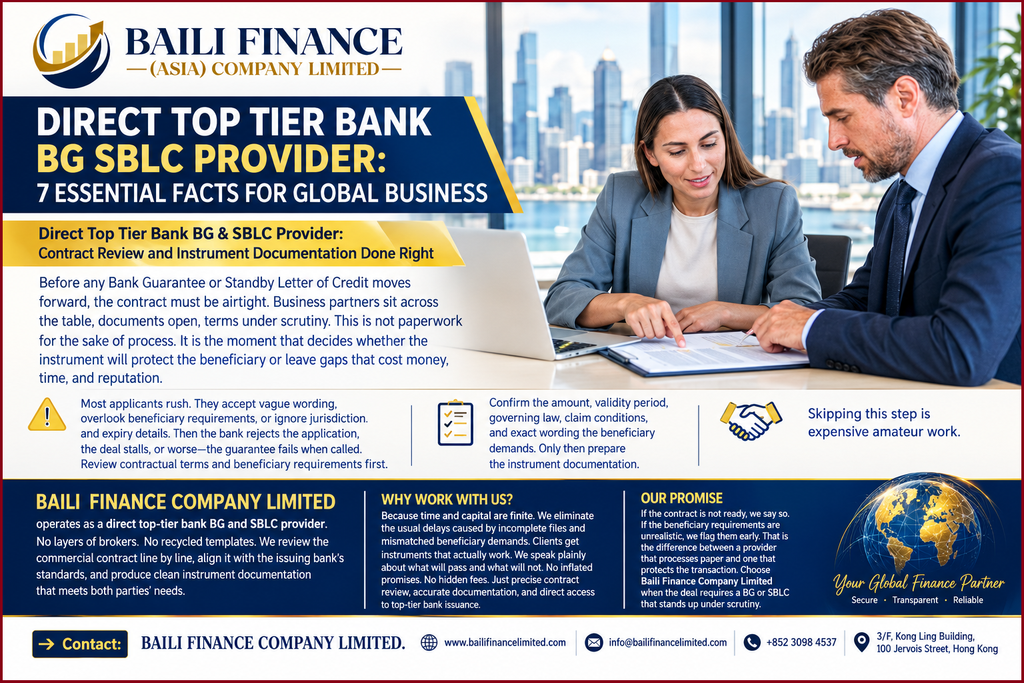
Selecting a provider involves more than comparing fees or asking how quickly an instrument can be issued. The objective is to establish whether the proposed transaction is commercially suitable, properly documented, and acceptable to the intended beneficiary.
1. Verify the issuing bank
Start by identifying the institution expected to issue the bank guarantee or standby letter of credit.
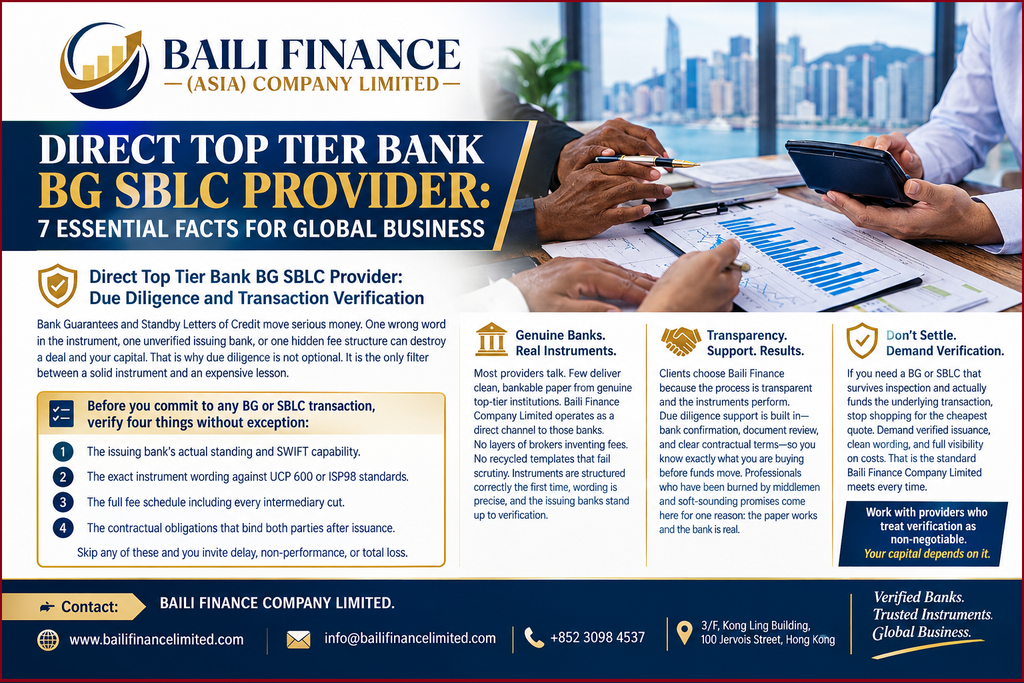
Request the proposed bank’s full legal name, issuing jurisdiction, and relevant transaction details. Where appropriate, assess its credit ratings through recognised rating agencies and consult official banking sources.
Don’t rely exclusively on screenshots, draft instruments, certificates, or documents supplied by an intermediary.
The beneficiary or its bank should independently authenticate the instrument through established banking channels before treating it as genuine.
2. Confirm the provider’s precise role
A financial intermediary may arrange a bank-issued instrument without being the bank that assumes the payment obligation.
Before proceeding, establish whether the company will:
- Issue the instrument as a regulated banking institution.
- Arrange issuance through a separate bank.
- Introduce the applicant to an issuing institution.
- Provide advisory, documentation, or transaction-coordination services.
- Arrange a separate funding or monetization facility.
This distinction matters because the legal obligation usually rests with the issuer identified in the instrument, subject to its terms and applicable law.
For businesses considering Baili Finance, the appropriate starting point is to clarify the proposed issuing institution and the company’s role in the specific transaction.
3. Review the instrument wording
A bank guarantee or SBLC must reflect the underlying commercial agreement and the beneficiary’s requirements.
Key provisions include:
- Applicant and beneficiary names.
- Maximum guaranteed amount and currency.
- Expiry date and place of presentation.
- Events that permit a demand.
- Required supporting statements or documents.
- Applicable rules and governing law.
- Presentation method and payment terms.
- Amendment, reduction, and extension provisions.
Even small drafting differences can create significant problems. A beneficiary may reject an instrument that doesn’t satisfy its contractual specifications.
For that reason, have the beneficiary and relevant banking teams review the proposed wording before issuance whenever the transaction permits.
4. Understand SWIFT MT760 transmission
SWIFT is a financial messaging network used by banks and other eligible institutions to exchange authenticated financial messages.
MT760 is a SWIFT message type historically used to issue a demand guarantee or standby letter of credit. Its use doesn’t, by itself, prove that a transaction is commercially sound or that every beneficiary will accept the instrument.
Businesses should establish how the issuing bank will transmit the instrument, which bank will receive or advise it, and how the beneficiary will authenticate it.
They should also confirm the relevant technical requirements with the banks involved, since messaging standards and bank procedures can change.
A provider’s claim that it can arrange an MT760 transmission shouldn’t replace independent verification by the receiving bank.
5. Evaluate costs and funding terms
The total cost of a BG or SBLC transaction may include several components.
Depending on the arrangement, these may include issuance charges, arrangement fees, collateral requirements, bank commissions, legal expenses, amendment fees, and extension charges.
For monetization or lending transactions, additional costs may apply to underwriting, facility arrangement, interest, and other financing services.
Request a written fee schedule and a clear explanation of when each charge becomes payable.
Be particularly cautious when a provider promises guaranteed monetization, unusually high loan-to-value ratios, or assured investment returns without explaining the underlying credit assessment and contractual conditions.
6. Assess compliance requirements
Banks and financial service providers must assess relevant risks before completing many cross-border transactions.
Depending on the transaction, they may request:
- Corporate registration documents.
- Identification and verification of beneficial owners.
- Directors’ identification and authorisation documents.
- Audited financial statements or management accounts.
- Evidence of the source of funds.
- Underlying contracts, invoices, or purchase orders.
- Details of counterparties and the transaction’s commercial purpose.
Providing complete and consistent information can reduce avoidable delays.
However, no legitimate provider should guarantee approval before the relevant institution completes its required checks.
7. Confirm the beneficiary’s acceptance criteria
An instrument that appears suitable to an applicant may not meet the beneficiary’s requirements.
For example, a government contractor may require a performance guarantee from a bank meeting specified rating thresholds. An international supplier may require a financial SBLC issued in a particular currency and delivered through an approved banking channel.
Before paying substantial fees, obtain the beneficiary’s requirements in writing.
This step can prevent businesses from spending time and money on an instrument that doesn’t meet the underlying contractual obligation.
Bank Guarantee vs SBLC: Which Instrument Do You Need?
Although bank guarantees and standby letters of credit can serve similar commercial purposes, they aren’t interchangeable in every transaction.
| Feature | Bank Guarantee (BG) | Standby Letter of Credit (SBLC) |
|---|---|---|
| Primary purpose | Supports payment or contractual performance obligations | Supports payment or other obligations defined in the standby |
| Common applications | Construction contracts, tenders, performance obligations | Trade payments, financial obligations, contractual assurance |
| Claim requirements | Depend on the guarantee wording and applicable rules | Depend on the standby wording and applicable rules |
| Relevant ICC rules | URDG 758 may apply | ISP98 may apply |
| Beneficiary acceptance | Depends on contract and bank requirements | Depends on contract and bank requirements |
The ICC’s official trade finance rules library provides further information about these frameworks. The rules must be incorporated appropriately; their existence doesn’t mean they automatically govern every instrument.
When should a business consider a bank guarantee?
A bank guarantee may suit a business that must provide contractual security to a customer, project owner, government agency, or supplier.
Common applications include:
Bid bonds and tender guarantees: These support specified obligations arising from participation in a tender.
Performance guarantees: These provide contractual protection if the applicant fails to meet defined performance obligations.
Advance payment guarantees: These support obligations relating to an advance paid to a contractor or supplier.
Payment guarantees: These support payment obligations under an agreed commercial arrangement.
The precise protection depends on the guarantee’s wording, claim conditions, and applicable legal framework.
When should a business consider an SBLC?
An SBLC may suit an importer, exporter, borrower, or corporate customer that needs a bank’s independent undertaking to support a financial or other specified obligation.
Common applications include:
- International supplier payment security.
- Financial obligations under commercial agreements.
- Contractual credit support.
- Certain project financing arrangements.
- Security for specified repayment obligations.
A standby doesn’t automatically provide cash to its applicant. It creates an undertaking in favour of its beneficiary, subject to the terms of the instrument.
Businesses that require working capital must assess whether an SBLC is merely contractual security or forms part of a separately approved financing arrangement.
How a Direct BG SBLC Transaction Works
A properly structured transaction should have a clear commercial purpose, defined responsibilities, and a documented process.
Step 1: Define the commercial requirement
Identify the underlying contract, the required instrument type, the amount, currency, beneficiary, expiry date, and purpose.
Step 2: Submit the application
Provide the relevant corporate documents, financial information, underlying agreements, and requested transaction details.
Step 3: Complete due diligence
The relevant parties assess the applicant, commercial purpose, source of funds, transaction risks, and proposed structure.
Step 4: Agree on the terms
Confirm the issuing bank, fees, collateral arrangements, instrument wording, applicable rules, and contractual responsibilities.
Step 5: Issue and authenticate the instrument
Following the necessary approvals, the issuing bank transmits the instrument through the agreed channel. The beneficiary’s bank verifies its authenticity and reviews its acceptability.
Step 6: Complete the underlying transaction
The parties proceed under their commercial agreement, while monitoring expiry dates, amendments, continuing obligations, and any applicable claim requirements.
Actual processing times vary. An applicant shouldn’t rely on a standard number of banking days unless the relevant institution has confirmed its timeline for that specific transaction.
Real-World Example: An Importer Securing a USD 5 Million Purchase
Consider a hypothetical importer that wants to purchase USD 5 million in industrial equipment from an overseas manufacturer.
The supplier is prepared to fulfil the order but wants additional protection against non-payment. The importer, meanwhile, wants to preserve working capital for shipping, installation, and other operating expenses.
The parties agree to consider an SBLC as part of the commercial arrangement.
How the transaction could work
1. The parties agree on the requirements. The supplier specifies the required issuing bank standards, the instrument amount, expiry date, claim conditions, and acceptable delivery method.
2. The importer approaches a suitable financial partner. The importer discusses the transaction with a provider that can explain its available arrangements and identify the proposed issuing institution.
3. The relevant bank assesses the application. The bank evaluates the applicant’s financial standing, credit exposure, collateral, and transaction documentation.
4. The parties approve the wording. The supplier and its bank review the draft against the purchase agreement.
5. The instrument is issued if approved. The issuing bank sends the SBLC through the agreed banking channel. The receiving bank authenticates it and confirms whether it meets the supplier’s requirements.
6. The parties proceed with the purchase. The supplier ships the equipment in accordance with the contract. If the importer later defaults, the supplier may make a demand only in accordance with the SBLC’s terms and applicable rules.
The transaction doesn’t eliminate every commercial risk. The supplier must still assess delivery, quality, logistics, and other contractual matters. The importer must also understand its obligations under the facility and underlying purchase agreement.
The key lesson is that a well-structured SBLC begins with a clearly defined commercial requirement, not merely a request for a financial instrument.
Illustrative Case Study: A Contractor Seeking a Performance Guarantee
The following case study is a hypothetical illustration, not a verified Baili Finance client transaction.
The challenge
An engineering contractor wins a contract to install industrial equipment for a project owner. Before work can begin, the project owner requires a performance guarantee equal to 10% of the contract value.
The contractor has sufficient operational capacity but must determine how to satisfy the guarantee requirement without committing more cash collateral than necessary.
The proposed solution
The contractor reviews the contract’s guarantee provisions and approaches a financial services provider to explore bank guarantee arrangements.
The transaction team establishes the following requirements:
- The guarantee must cover the correct contractual obligations.
- The issuing bank must meet the project owner’s acceptance criteria.
- The guarantee must use the required currency and amount.
- The expiry and claim provisions must align with the contract.
- The contractor must satisfy the bank’s credit and compliance requirements.
Assume the underlying contract is worth USD 8 million. A 10% performance guarantee would therefore have a face value of USD 800,000.
That figure represents the guarantee amount, not a cash payment to the contractor and not the amount the contractor necessarily has to deposit as collateral. The bank’s actual collateral requirements depend on its credit assessment and agreed terms.
The outcome
If the bank approves the application, the guarantee meets the beneficiary’s requirements, and the relevant parties complete their obligations, the contractor can proceed under the contract with the agreed financial security in place.
The contractor must still budget for bank fees, collateral, and other facility costs.
If the bank declines the application or the proposed instrument fails to meet the project owner’s requirements, the contractor may need to negotiate an alternative structure or seek another acceptable provider.
The business lesson: Evaluate the underlying contract, the issuing bank, the wording, and the funding requirements together. A guarantee only serves its intended purpose when it meets the commercial and legal conditions of the transaction.
SBLC Monetization and BG Funding: What Businesses Should Know
Businesses sometimes search for a direct top-tier bank BG SBLC provider because they want access to funding, not simply a guarantee.
In this context, SBLC monetization generally refers to an arrangement in which a qualifying financial instrument supports a separate loan or financing facility.
However, monetization isn’t automatic. A bank-issued SBLC doesn’t guarantee that another institution will lend against it.
A potential funder may consider:
- The identity and credit quality of the issuing bank.
- The instrument’s authenticity and enforceability.
- Whether the instrument is transferable or otherwise usable as proposed.
- The proposed lender’s internal credit policies.
- The applicant’s financial position and compliance status.
- The instrument’s maturity, claim conditions, and applicable law.
- The proposed loan-to-value ratio, fees, and repayment obligations.
Some transactions may require additional collateral or recourse to the borrower. Others may not qualify for funding at all.
What does non-recourse financing mean?
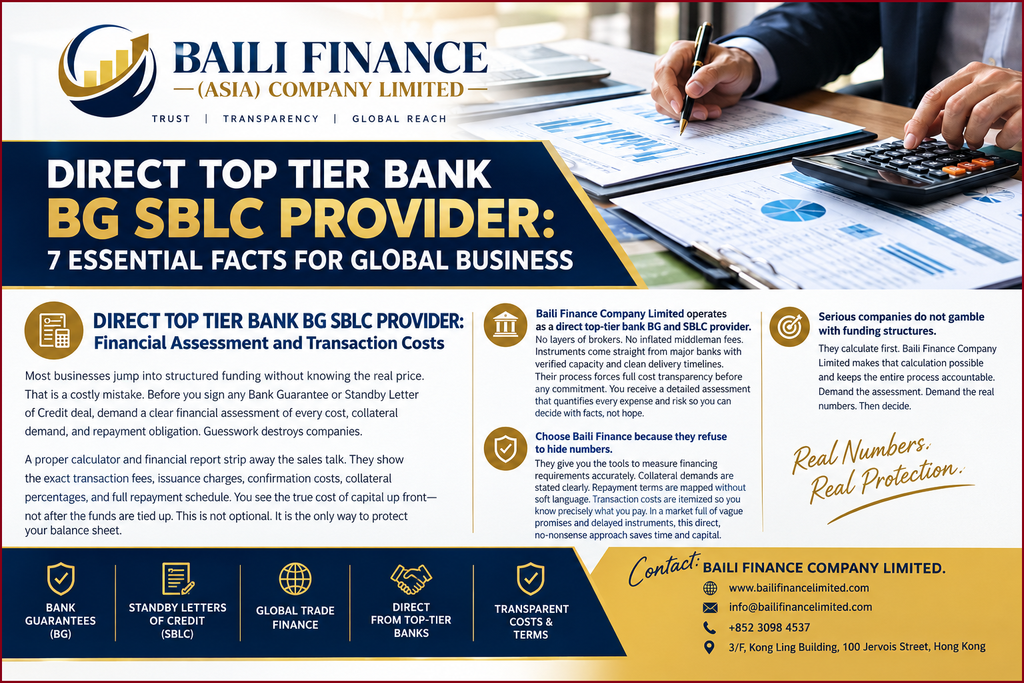
In a genuine non-recourse financing arrangement, the lender’s recovery rights are limited to the assets or collateral specified in the agreement, subject to applicable law and contractual exceptions.
The label alone isn’t sufficient. Applicants should review the full agreement to understand the lender’s remedies, representations, indemnities, fraud provisions, and any circumstances that create additional liability.
Before accepting a monetization proposal, obtain written confirmation of the funding conditions, net proceeds, payment schedule, and fees.
Avoid treating advertised returns, advance funding promises, or claimed bank relationships as substitutes for independent legal and financial due diligence.
Why Consider Baili Finance for BG and SBLC Arrangements?
BAILI FINANCE (ASIA) COMPANY LIMITED is a Hong Kong-registered financial services company that describes its services as including bank guarantees, standby letters of credit, international trade finance, and structured funding solutions. Its published company registration details include CR No. 2315541 and BRN 65543223. These details can be reviewed alongside the company’s other information on its official website.
For businesses evaluating a potential engagement, the relevant questions are practical:
- Can the company explain the proposed transaction structure clearly?
- Will it identify the proposed issuing institution before the client commits?
- Can the beneficiary’s requirements be reviewed before issuance?
- Are fees, collateral, and intermediary roles documented?
- Does the proposed structure meet the applicant’s commercial and compliance requirements?
- Can the issuing bank and instrument be independently authenticated?
Baili Finance’s published service information describes its involvement in SBLC issuance and monetization arrangements, bank guarantees, and trade finance. The precise role of the company, the issuing bank, and any other financial institution should be established for each proposed transaction.
A responsible assessment considers the specific opportunity rather than relying on broad claims of guaranteed acceptance, guaranteed funding, or universal bank access.
Services to explore
Depending on the transaction, businesses may wish to discuss:
Bank guarantee arrangements: For qualifying performance, tender, advance payment, and payment obligations.
SBLC arrangements: For suitable international trade and financial obligations.
Trade finance: For eligible import, export, and commercial transactions.
Structured funding: For businesses assessing financing options linked to defined commercial requirements.
SBLC monetization: For eligible instrument holders exploring a separate funding facility, subject to underwriting and contractual terms.
To assess suitability, provide the transaction purpose, required amount, currency, jurisdiction, beneficiary’s requirements, and proposed timeframe.
Common Mistakes to Avoid When Selecting an SBLC Provider
Even experienced businesses can encounter difficulties when they focus on price or speed without evaluating the transaction’s structure.
Choosing an instrument before understanding the contract
A guarantee designed for a performance obligation may not meet a beneficiary’s payment-security requirement.
Start with the contract and obtain confirmation of the required instrument type.
Assuming every bank guarantee is acceptable worldwide
Beneficiaries can impose specific requirements concerning issuing banks, ratings, governing law, wording, and delivery.
Confirm acceptance before proceeding.
Treating a SWIFT reference as proof of authenticity
A screenshot, purported message copy, or reference number doesn’t independently establish that an instrument exists or is valid.
Ask the relevant bank to authenticate the message through its established procedures.
Paying unexplained advance fees
Some legitimate arrangements involve advance costs. However, applicants should establish what each fee covers, when it becomes payable, and whether any refund provisions apply.
Verify the counterparty and contractual arrangements before transferring funds.
Assuming monetization is guaranteed
Funding depends on the proposed lender’s underwriting, the instrument, and the transaction terms.
A provider should explain the approval conditions rather than imply that face value automatically converts into cash.
Ignoring expiry and presentation conditions
A beneficiary can lose important protections if it fails to comply with applicable claim requirements or misses a relevant deadline.
Record expiry dates and review presentation requirements with qualified legal and banking professionals.
Frequently Asked Questions About Direct Top Tier Bank BG SBLC Providers
1. What is a direct top-tier bank BG SBLC provider?
It’s a search term for a provider or financial intermediary that helps businesses obtain bank guarantees and standby letters of credit involving reputable banking institutions. The provider may arrange issuance rather than issue the instrument itself. Applicants should confirm the legal identity of the issuing bank and the intermediary’s precise role.
2. Can I obtain a bank guarantee or SBLC without going through several brokers?
Potentially. Some providers may offer a more direct arrangement, depending on the applicant, issuing bank, jurisdiction, and transaction requirements. However, the number of intermediaries doesn’t establish the transaction’s legitimacy. Verify each party’s role and ensure the issuing bank can be independently authenticated.
3. What is the difference between an SBLC and a bank guarantee?
A bank guarantee supports specified payment or contractual obligations, while an SBLC provides an independent undertaking according to its terms. Their functions overlap, but their legal treatment, claim requirements, and governing rules can differ. The underlying contract and proposed instrument wording determine which option is appropriate.
4. What is SWIFT MT760 in an SBLC transaction?
MT760 is a SWIFT message type historically used for issuing guarantees and standby letters of credit. It supports bank-to-bank communication, but the message type alone doesn’t guarantee acceptance, funding, or commercial validity. The receiving bank should authenticate the message and assess the instrument.
5. How long does it take to issue an SBLC?
There isn’t a universal issuance timeline. Processing depends on the bank’s approval procedures, applicant documentation, credit assessment, compliance checks, and the complexity of the proposed instrument. Obtain a transaction-specific estimate rather than relying on a generic promise.
6. Can an SBLC be used to obtain business funding?
Potentially. A qualifying SBLC may support a separate financing facility, but approval depends on the lender’s underwriting criteria, the issuing bank, the instrument’s terms, and the applicant’s financial position. Funding is not automatic, and the proposed loan agreement should clearly state the costs and repayment obligations.
7. What documents are required to apply for a BG or SBLC?
Requirements vary, but applicants may need corporate registration records, beneficial ownership information, identification documents, financial statements, underlying contracts, transaction details, and evidence of the source of funds. The issuing institution will specify its actual requirements.
8. How can I verify a bank-issued SBLC?
Ask the relevant receiving or beneficiary bank to authenticate the instrument through established banking channels. Verify the issuing institution independently, review the final instrument, and confirm the beneficiary, amount, expiry, and claim requirements. Don’t rely solely on documents provided by an intermediary.
9. Does a top-tier bank guarantee mean the transaction is risk-free?
No. A reputable issuing bank may reduce certain counterparty risks, but the transaction still carries legal, operational, compliance, documentation, and commercial risks. Payment depends on the instrument’s terms and the relevant presentation requirements.
10. Does Baili Finance provide BG, SBLC, and trade finance services?
Baili Finance publishes information about bank guarantee arrangements, SBLC services, trade finance, and related funding solutions on its website. Businesses should contact the company to discuss their requirements and confirm the available structure, proposed issuing institution, eligibility criteria, fees, and contractual terms.
Conclusion: Choose Your BG SBLC Provider With Confidence
Finding a Direct Top Tier Bank BG SBLC Provider requires more than identifying a company that advertises international financial instruments. It requires a clear understanding of the underlying commercial need, the issuing bank’s role, the instrument’s wording, the beneficiary’s acceptance criteria, and the costs and obligations associated with the transaction.
For businesses involved in international trade, infrastructure, construction, procurement, and project development, bank guarantees and standby letters of credit can support commercial arrangements when the parties structure them appropriately.
The right process begins with due diligence. Confirm the proposed issuing institution. Review the instrument against the underlying contract. Understand the applicable rules. Authenticate the instrument through the relevant banking channels. If financing is the objective, assess the separate lending agreement rather than assuming that the instrument itself provides immediate liquidity.
BAILI FINANCE (ASIA) COMPANY LIMITED invites businesses, corporate borrowers, importers, exporters, project developers, and qualified intermediaries to discuss their BG, SBLC, and trade finance requirements.
READY TO SECURE YOUR NEXT BG OR SBLC TRANSACTION?
Your next business opportunity may depend on having the right financial instrument in place. Make your next move with a clear strategy, a defined transaction structure, and the right financial partner.
Whether you require a bank guarantee (BG), standby letter of credit (SBLC), SWIFT MT760 issuance, or a structured trade finance solution, Baili Finance is ready to discuss your requirements and assess the available options for your transaction.
At BAILI FINANCE (ASIA) COMPANY LIMITED, we understand that every transaction has its own commercial objectives, documentation requirements, and banking considerations. That’s why the first step is to understand what your business needs and identify a suitable way forward.
LET’S DISCUSS YOUR TRANSACTION
Contact our team today and provide the following details:
- Instrument required: BG, SBLC, or another trade finance solution.
- Transaction amount: Your required amount and currency.
- Purpose: The underlying contract, trade, project, or financing objective.
- Jurisdiction: The country of the applicant and beneficiary.
- Timeline: Your expected transaction deadline.
With this information, we can discuss the proposed structure, relevant requirements, and next steps, subject to eligibility, due diligence, and the availability of suitable banking arrangements.
Don’t leave a critical financial requirement until the final stage of your transaction. Start the conversation early, understand your options, and prepare your business to move forward with greater clarity.
Contact Baili Finance today:
🌐 Website: https://www.bailifinancelimited.com/
✉️ Email: info@bailifinancelimited.com
☎️ Telephone: +852 3098 4537
Your transaction starts with a conversation. Contact Baili Finance today to discuss your BG, SBLC, or trade finance requirements.
All transactions remain subject to the relevant institution’s approval, due diligence, contractual terms, and applicable regulatory requirements..
#BankGuarantee #SBLCProvider #TopTierBank #TradeFinance #SBLCMonetization #SWIFTMT760 #ProjectFinance #InternationalTrade