Headline: 12 Critical Checks Before Choosing an SBLC Provider
Introduction
Choosing the right Standby Letter of Credit (SBLC) provider represents an important decision for businesses involved in international trade, project financing, contractual obligations and structured financial transactions. An SBLC can support commercial agreements, strengthen payment security and help businesses satisfy financial commitments. However, these benefits depend heavily on the credibility of the issuing bank, the instrument’s wording and the reliability of the parties arranging the transaction.
Understanding what to check before choosing an SBLC provider can help businesses avoid unnecessary financial exposure, contractual complications and potentially fraudulent arrangements. Not every company advertising SBLC issuance has the authority to issue a bank instrument. Some companies operate as financial intermediaries, consultants, brokers or transaction facilitators, while the actual undertaking must come from an appropriately authorised financial institution
This distinction matters.
An SBLC is not simply a financial document that a company can create and distribute. It represents an independent undertaking by an issuer, usually a bank, to honour a complying demand under the instrument’s terms. Consequently, businesses must evaluate the institution responsible for the undertaking, the transaction structure, the applicable rules and the verification arrangements before committing funds.
Whether you need an SBLC for international trade, a construction contract, project financing, a financial obligation or another commercial purpose, selecting the right provider requires more than comparing fees and promised issuance timelines.
You need to establish who will issue the instrument, whether the receiving institution will accept it, how the bank will authenticate it and whether its terms adequately protect your commercial interests.
This guide examines 12 essential factors to consider before selecting an SBLC provider, with practical examples, due diligence recommendations and answers to frequently asked questions.
Keywords: What to check before choosing an SBLC provider, Best SBLC provider, How to choose an SBLC provider, Standby Letter of Credit provider, SBLC issuing bank, SBLC issuance process, SBLC bank guarantee, SBLC financial instrument, International trade finance, SBLC verification process, Legitimate SBLC providers, SBLC monetisation, Bank instrument due diligence, How to choose an SBLC provider, Best SBLC provider for international trade, SBLC issuing bank verification, Legitimate SBLC providers, SBLC issuance requirements, Standby Letter of Credit verification, SBLC transaction process, SBLC provider due diligence.
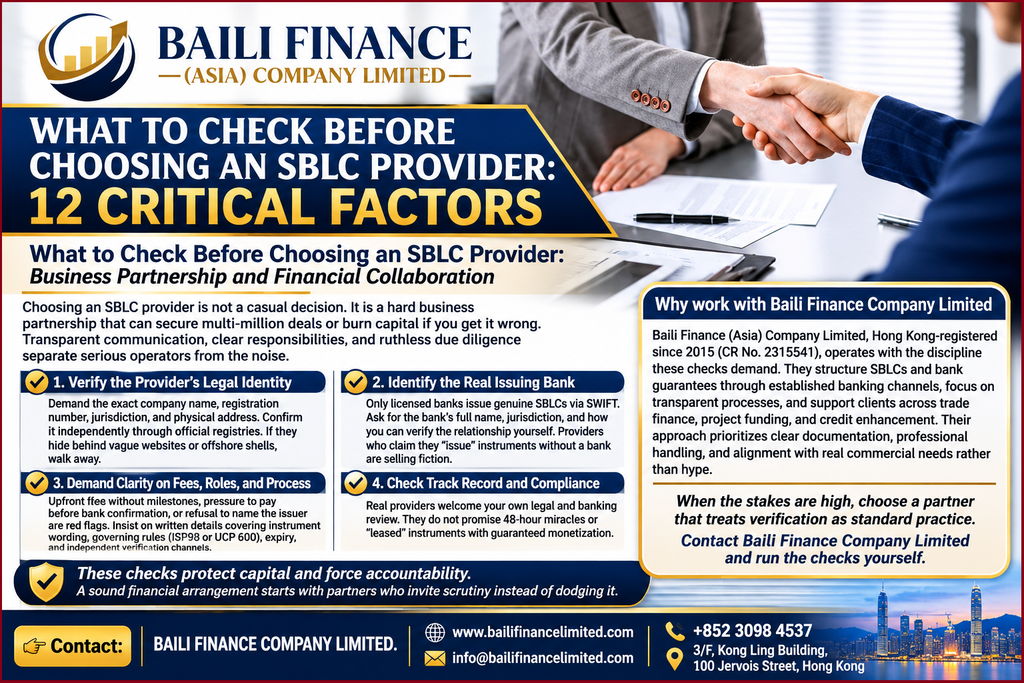
1. Verify the SBLC Provider’s Legal Identity and Business Registration
The first step involves establishing the legal identity of the company offering the SBLC service.
Before entering into an agreement, obtain the provider’s full registered business name, registration number, registered office address, jurisdiction of incorporation and relevant corporate documentation. Then independently verify these details through the appropriate government business registry.
This process helps establish whether the company legally exists and whether its stated business activities align with the services it offers.
However, business registration alone does not establish banking authority.
A registered financial consultancy, trade finance company or intermediary does not automatically possess the authority to issue a Standby Letter of Credit. Therefore, you must distinguish between the company arranging the transaction and the financial institution undertaking the payment obligation.
Ask the provider the following questions:
- What is the company’s full registered legal name?
- Where is the company incorporated?
- Does it act as an arranger, intermediary, consultant or direct banking institution?
- Which financial institution will issue the SBLC?
- Can the proposed issuing bank be independently contacted?
- What contractual responsibilities does the provider accept?
A credible provider should explain its precise role without creating confusion about who assumes the financial obligation.
Important: Never interpret a company’s registration certificate, business address or professional website as evidence that a bank has approved an SBLC transaction.

2. Confirm the Identity and Credibility of the Issuing Bank
The issuing bank represents one of the most important considerations when selecting an SBLC provider.
Although a financial intermediary may coordinate the transaction, the issuing institution ultimately undertakes the obligation stated in the instrument.
Therefore, you should investigate the proposed issuing bank before signing an agreement or paying substantial transaction fees.
Start by confirming:
- The bank’s full legal name.
- Its country of incorporation and operating jurisdiction.
- Its banking licence and regulatory status.
- Its official website and independently published contact details.
- Its ability to issue the proposed type of standby instrument.
- Its financial standing and relevant credit information.
- Whether the beneficiary’s bank accepts instruments from that institution.
Where possible, obtain confirmation through the bank’s official trade finance department rather than relying exclusively on information supplied by an intermediary.
You should also distinguish between a bank’s existence and its willingness to issue a particular instrument. A legitimate bank may operate internationally but still decline an application because of its internal credit policies, customer requirements, jurisdictional restrictions or risk appetite.
A provider should not represent a proposed issuing bank as a confirmed issuer until the bank has actually approved the relevant transaction.
What matters most: The financial institution named in the SBLC must be identifiable, appropriately authorised and acceptable to the intended beneficiary.
3. Understand the Difference Between an Issuer, Arranger and Intermediary
One of the most common sources of confusion in the SBLC market is the failure to distinguish between different participants in a transaction.
These parties may perform related functions, but their legal responsibilities differ.
| Participant | Primary responsibility |
|---|---|
| Issuing bank | Undertakes the payment obligation under the SBLC |
| Applicant | Requests the bank to issue the instrument |
| Arranger | Coordinates the proposed transaction |
| Financial intermediary | Introduces or facilitates commercial relationships |
| Advising bank | Advises the instrument and checks its apparent authenticity within its role |
| Beneficiary | Receives the benefit of the undertaking |
Understanding these distinctions helps prevent businesses from relying on representations that a particular intermediary cannot legally fulfil.
For example, a financial consultancy may have relationships with international banks and assist applicants with documentation, transaction coordination and communication. However, those relationships do not automatically make the consultancy the issuing institution.
Similarly, an advising bank does not necessarily assume the issuing bank’s payment obligation.
Under Article 10 of the International Chamber of Commerce’s Uniform Rules for Demand Guarantees, an advising party confirms that it has satisfied itself as to the apparent authenticity of the guarantee and that its advice accurately reflects the terms received. That role does not, by itself, create an additional payment undertaking.
Before proceeding, request a written explanation of each party’s role.
This is particularly important where a transaction involves several intermediaries, a counter-guarantee or an international banking arrangement.
4. Examine the SBLC’s Governing Rules and Legal Framework
An SBLC must operate within a clearly established contractual and legal framework.
Two important international frameworks deserve attention:
International Standby Practices (ISP98)
The International Standby Practices, commonly known as ISP98, provide internationally recognised rules specifically designed for standby letters of credit.
They address important matters such as:
- Issuance and effectiveness.
- Independence of the undertaking.
- Documentary presentations.
- Examination of demands.
- Notice of dishonour.
- Expiry and termination.
- Amendments and cancellation.
ISP98 is particularly relevant when structuring an international standby letter of credit.
You can review the official ICC rules here:
External reference: ICC International Standby Practices (ISP98) – Official Rules.
Uniform Rules for Demand Guarantees (URDG 758)
URDG 758 provides an internationally recognised framework for demand guarantees and counter-guarantees.
Although an SBLC and a demand guarantee are distinct legal instruments, they share several functional characteristics. Both can create independent documentary payment obligations when appropriately structured.
URDG 758 addresses the requirements for issuance, demands, examination, payment, expiry and other operational matters.
Review the official ICC publication:
External reference: ICC Uniform Rules for Demand Guarantees (URDG 758).
Why the governing rules matter
A provider should explain which rules apply to the proposed instrument and why those rules suit the transaction.
Do not assume that every SBLC automatically falls under ISP98 or that every demand guarantee automatically falls under URDG 758. The instrument must expressly incorporate the relevant rules, subject to applicable law and any agreed modifications.
You should also establish:
- The governing law.
- The jurisdiction responsible for resolving disputes.
- The place of presentation.
- The applicable documentary requirements.
- The expiry date and presentation deadline.
- The method of delivering demands.
Where the transaction involves substantial financial exposure, obtain independent legal advice before accepting the instrument’s wording.

5. Verify the SBLC Through an Appropriate Banking Channel
Authentication is one of the most important stages in evaluating an SBLC provider.
A professional-looking PDF, stamped document, bank logo or scanned signature does not establish that a bank has issued an operative instrument.
Fraudsters can reproduce institutional branding and create documents that appear convincing to an inexperienced recipient.
Consequently, the beneficiary should establish an appropriate bank-to-bank verification process.
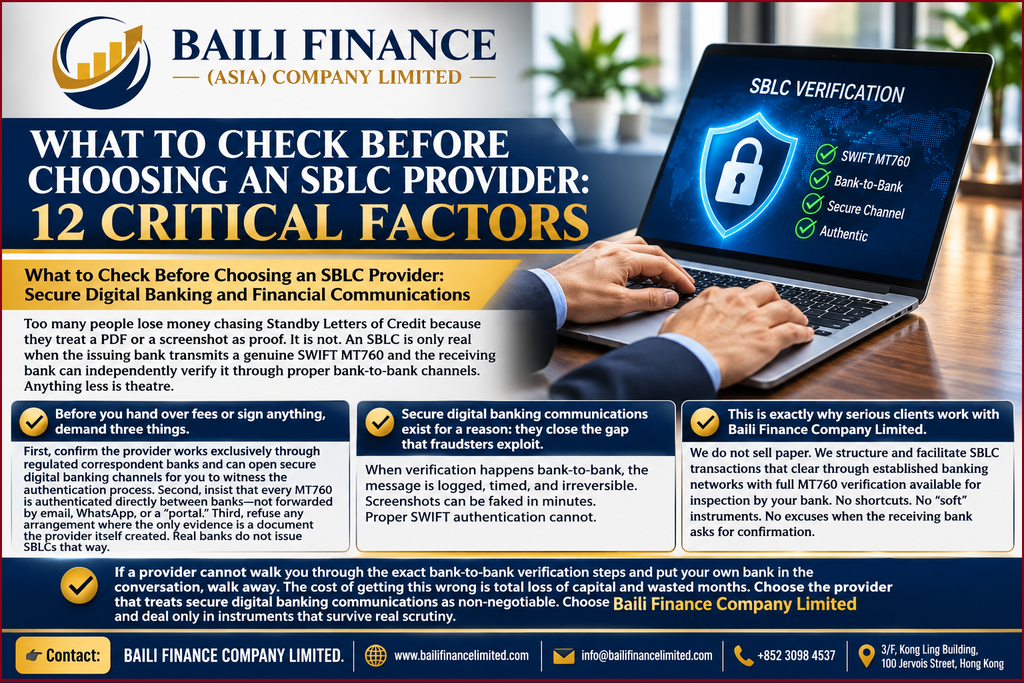
Understanding SWIFT MT760
SWIFT MT760 is a financial messaging format used for the issuance of a demand guarantee or standby letter of credit.
It allows the issuing or advising institution to communicate an undertaking through the SWIFT network in accordance with the applicable message standards.
However, businesses should understand an important distinction: referring to MT760 does not prove that an instrument exists.
A provider must arrange for the relevant bank to transmit the appropriate message through its authorised banking channel. The beneficiary’s bank should then verify the communication through its own established procedures.
Ask these questions:
- Will the issuing bank transmit the instrument through an authenticated banking channel?
- Can the beneficiary’s bank receive and authenticate the message?
- Has the beneficiary’s bank confirmed that it can process the proposed instrument?
- Does the message identify the issuer, beneficiary, amount, currency and expiry?
- Do the transmitted terms match the agreed instrument wording?
The official SWIFT reference explains the purpose and structure of the MT760 message:
SWIFT MT760 – Issue of a Demand Guarantee or Standby Letter of Credit.
Remember: An MT760 reference, screenshot, message copy or purported SWIFT confirmation supplied by an intermediary should never replace independent verification by the receiving bank.
6. Review the SBLC’s Terms, Conditions and Documentary Requirements
An SBLC’s commercial value depends on its actual terms, not simply its stated face value.
A USD 10 million SBLC with restrictive or unclear drawing conditions may provide less practical protection than a smaller instrument with clearly defined and workable presentation requirements.
Before accepting an SBLC provider’s proposed structure, request a draft instrument for review.
Pay particular attention to the following provisions.
Beneficiary details
The beneficiary’s legal name must match the intended recipient’s corporate identity and contractual requirements.
Incorrect names can create avoidable complications when presenting a demand.
Face value and currency
Confirm that the instrument specifies the agreed amount and currency.
For example, a USD-denominated undertaking should clearly identify the maximum amount payable in United States dollars.
Expiry date
Check the expiry date and the time and location at which presentation must occur.
An instrument that expires before the underlying commercial obligation ends may fail to provide the protection the beneficiary expects.
Drawing conditions
Examine exactly what the beneficiary must present to demand payment.
Some instruments require a written demand, while others require additional statements or supporting documents.
Under ISP98, an issuer’s obligation generally depends on the presentation of documents and their examination against the instrument’s terms.
Therefore, avoid unnecessary or ambiguous documentary requirements.
Partial and multiple drawings
Determine whether the beneficiary can make partial demands or multiple demands.
This distinction can matter when the underlying obligation involves several payment milestones or separate contractual breaches.
Transferability
If the transaction requires a transferable undertaking, establish whether the instrument expressly provides for transfer and whether the proposed arrangement meets the applicable requirements.
Transferability should never be assumed.
Applicable law and rules
Check the governing law, incorporated rules and dispute resolution arrangements.
A qualified trade finance lawyer should review the draft before the beneficiary accepts it.
7. Investigate the Provider’s Transaction Experience and Professional Competence
Experience matters in international trade finance because SBLC transactions often involve several institutions, multiple jurisdictions and detailed documentary requirements.
However, experience claims must be independently assessed.
A provider may advertise years of experience or claim to have facilitated substantial financial transactions. Those statements should not automatically influence your decision.
Instead, request information that demonstrates relevant operational competence.
Consider asking for:
- A description of previous SBLC transaction structures.
- Experience with the intended issuing bank or banking jurisdiction.
- Knowledge of ISP98 and relevant documentary practices.
- Experience coordinating with beneficiary banks.
- Evidence of appropriate professional relationships.
- A clear explanation of the issuance and verification process.
Where confidentiality restrictions prevent disclosure of client names or transaction documents, the provider should still be able to explain its processes and provide appropriate non-confidential evidence of its experience.
Also, determine whether the provider understands your particular commercial objective.
A standby intended to secure a construction contract may require different terms from one intended to support an international supply agreement.
Likewise, a financial institution may have different acceptance requirements for a performance SBLC and a financial SBLC.
An experienced transaction coordinator should understand these differences and identify issues before they become contractual problems.
8. Examine the Fee Structure and Payment Arrangements
Cost is another essential factor when choosing an SBLC provider.
However, the lowest quotation does not necessarily represent the most suitable transaction.
SBLC-related expenses may include:
- Bank issuance charges.
- Arrangement or advisory fees.
- Legal and documentation expenses.
- Advising or confirmation charges.
- SWIFT-related banking charges.
- Amendment fees.
- Renewal or extension charges.
- Other agreed transaction expenses.
Request a comprehensive written fee schedule before making any payment.
The agreement should identify the party receiving each payment, the service covered and the conditions under which the fee becomes payable.
Be cautious of advance-fee arrangements
An advance payment is not automatically evidence of fraud. Some legitimate professional services and banking processes involve upfront costs.
Nevertheless, you should understand precisely what the payment covers and whether the provider has the authority to collect it.
Pay particular attention to arrangements involving:
- Large non-refundable upfront fees without a clear contractual basis.
- Personal bank accounts instead of verified corporate accounts.
- Requests to transfer money to unrelated third parties.
- Unexplained changes in payment instructions.
- Guaranteed issuance before the bank completes its assessment.
- Additional fees introduced after the original agreement.
A professional provider should explain its payment structure transparently.
Never make a substantial payment solely because someone claims that an SBLC will be issued within a particular number of days.
9. Determine Whether the Provider Understands Your Specific Financial Objective
Before selecting an SBLC provider, establish whether the proposed instrument addresses your actual business requirement.
Businesses pursue standby letters of credit for different reasons.
These may include:
International trade: An SBLC can support payment obligations between buyers and suppliers, subject to the agreed instrument terms.
Contract performance: A performance-related standby can provide financial security for specified contractual obligations.
Project financing: A standby may form part of a broader financing or contractual security structure, subject to lender acceptance and applicable requirements.
Financial obligations: A financial SBLC may support an applicant’s payment obligations under an agreed transaction.
Lease and contractual arrangements: Certain commercial counterparties may accept an SBLC as security where the contract expressly provides for it.
However, an SBLC does not automatically create cash, provide a loan or guarantee that another financial institution will advance funds against it.
If your objective involves monetisation, discounting or collateralised financing, investigate the proposed monetising institution separately.
Ask whether that institution has reviewed the actual instrument wording, issuing bank, applicable rules, transaction purpose and relevant collateral requirements.
A provider should not promise monetisation merely because an SBLC has a particular face value.
The proposed financing institution makes its own credit, compliance and risk assessment.
10. Assess Compliance, AML and KYC Requirements
International financial transactions must satisfy relevant regulatory and institutional compliance requirements.
A provider that understands international trade finance should explain the documentation and compliance procedures applicable to the proposed transaction.
These may include:
- Know Your Customer (KYC) documentation.
- Anti-Money Laundering (AML) checks.
- Beneficial ownership information.
- Source-of-funds documentation.
- Corporate registration documents.
- Board resolutions and authorised signatory details.
- Sanctions screening.
- Transaction purpose and supporting contracts.
The precise requirements depend on the institutions, jurisdictions and nature of the transaction.
Do not regard compliance checks as unnecessary administrative delays.
Banks must assess applicants and transactions in accordance with their applicable legal and regulatory obligations.
Be cautious of providers who promise to bypass banking compliance, conceal beneficial ownership or arrange an instrument without appropriate applicant verification.
These assurances may expose your business to serious legal and financial risks.
A credible transaction process should identify compliance requirements early and explain which documents each institution needs.
11. Evaluate Communication, Transparency and Contractual Accountability
Communication can significantly influence the efficiency of an SBLC transaction.
A provider should be able to explain the transaction process, respond to reasonable questions and communicate material changes without creating confusion.
Before signing an agreement, evaluate the quality of the provider’s communication.
Consider the following:
- Does the provider explain the transaction structure clearly?
- Does it distinguish confirmed banking arrangements from proposals?
- Does it provide written responses to technical questions?
- Does it identify the expected stages of the transaction?
- Does it disclose relevant conditions and limitations?
- Does it provide a clear point of contact?
- Does it explain what happens if the issuing bank declines the application?
Most importantly, review the service agreement.
The agreement should define the parties’ responsibilities, fees, payment conditions, deliverables, confidentiality obligations, termination rights and dispute resolution arrangements.
It should also distinguish between the provider’s coordination obligations and the issuing bank’s independent obligations.
Avoid agreements that rely on vague promises without clearly defining what the provider must actually deliver.
12. Understand the Risks of SBLC Monetisation and Investment-Related Promises
Some businesses approach SBLC providers because they intend to use the instrument in a proposed monetisation or investment arrangement.
These transactions require additional scrutiny.
SBLC monetisation generally refers to a proposed arrangement in which a financial institution or another eligible counterparty evaluates an SBLC and may provide financing against it under separately agreed conditions.
It is not automatic.
A receiving institution may consider:
- The identity and credit standing of the issuer.
- The authenticity and operative status of the instrument.
- The amount and currency.
- The expiry date.
- The applicable rules.
- The beneficiary’s rights.
- The proposed use of proceeds.
- The institution’s internal credit and compliance policies.
No provider should imply that every SBLC can be monetised at a predetermined percentage.
Likewise, claims of guaranteed returns, guaranteed financing or risk-free investment programmes deserve particular scrutiny.
Before entering such an arrangement, obtain independent confirmation from the proposed financing institution and seek legal and financial advice.
Your due diligence should cover both the SBLC and the separate financing agreement.
An authentic SBLC does not automatically make every transaction associated with it legitimate.
A Practical SBLC Provider Due Diligence Checklist
Before appointing a provider, use the following checklist to assess whether the proposed transaction meets your requirements.
| Due diligence requirement | What you should establish |
|---|---|
| Legal registration | Verify the provider’s corporate identity |
| Provider’s role | Establish whether it is an arranger, intermediary or issuer |
| Issuing bank | Identify the actual issuing institution |
| Banking authority | Verify the bank’s regulatory status |
| Bank reputation | Examine relevant financial and institutional information |
| Beneficiary acceptance | Obtain feedback from the receiving bank |
| Governing rules | Confirm ISP98 or another appropriate framework |
| Instrument wording | Review all operative clauses |
| SWIFT authentication | Establish an appropriate bank-to-bank verification process |
| Fees | Obtain a complete written fee schedule |
| Compliance | Identify AML, KYC and sanctions requirements |
| Legal protection | Obtain an appropriate contractual and legal review |
| Monetisation | Obtain independent confirmation from the proposed financing institution |
Do not proceed simply because most items appear satisfactory. Any unresolved issue involving the identity of the issuer, authenticity of the instrument or beneficiary’s ability to make a complying demand deserves attention before payment or acceptance.
Real-World SBLC Example: Securing an International Supply Contract
Consider a company that imports industrial equipment from an overseas manufacturer.
The buyer wants to purchase USD 5 million worth of equipment. However, the supplier requires additional payment security before committing production capacity and arranging shipment.
The buyer proposes an SBLC to support its contractual payment obligations.
The transaction could proceed as follows:
- Commercial agreement: The buyer and supplier negotiate the equipment purchase agreement, including the payment schedule and security requirements.
- SBLC requirement: The supplier specifies the required issuing bank, amount, currency, expiry date and drawing conditions.
- Provider selection: The buyer engages a financial services provider to help coordinate the SBLC application.
- Bank assessment: The proposed issuing bank evaluates the applicant’s financial position, creditworthiness, compliance documentation and transaction details.
- Instrument drafting: The relevant parties review the proposed SBLC wording and ensure that it meets the supplier’s requirements.
- Issuance: Following approval, the issuing bank transmits the operative instrument through the agreed banking channel.
- Authentication: The supplier’s bank independently verifies the instrument.
- Commercial performance: The supplier proceeds with the contractual obligations, relying on the agreed payment security.
If the buyer subsequently defaults, the supplier may present a demand in accordance with the SBLC’s terms.
The issuing bank then examines the presentation against the instrument and applicable rules. If the demand complies, the bank must honour its undertaking, subject to applicable law and the instrument’s provisions.
The commercial lesson: The transaction’s effectiveness depends on the issuing bank, the wording of the SBLC, the beneficiary’s acceptance and the ability to present a complying demand. The intermediary’s promises alone do not provide payment security.
Case Study: How Poor SBLC Due Diligence Can Expose a Business to Financial Loss
Illustrative case study
The following case study is a hypothetical scenario based on common transaction risks. It does not describe a verified transaction involving a named company or bank.
Background
An international construction company secures a major infrastructure contract requiring a financial instrument to support a contractual obligation.
The company approaches an intermediary advertising access to international SBLC issuance.
The intermediary promises a USD 20 million SBLC within a short period and offers an attractive arrangement fee.
The construction company is interested because the proposed instrument could help it satisfy the project’s contractual security requirements.
However, the company makes several mistakes during its initial assessment.
What went wrong?
1. It failed to identify the actual issuing bank.
The intermediary discussed international banking relationships but did not provide independently verifiable details of the proposed issuer.
2. It relied on promotional documentation.
The company received sample instruments and transaction presentations. It treated these materials as evidence of actual issuance capability.
3. It did not consult the beneficiary’s bank.
The construction company never established whether the proposed issuing institution or instrument wording would satisfy the beneficiary’s requirements.
4. It paid before completing due diligence.
The company transferred an arrangement fee without receiving sufficient contractual protection or independently verifying the transaction structure.
5. It overlooked the instrument’s operative conditions.
The proposed wording contained documentary requirements that had not been reviewed by the company’s legal advisers.
The potential consequences
The company could face several problems:
- Loss of fees paid under an inadequately protected arrangement.
- Delays in satisfying contractual obligations.
- Additional legal and advisory expenses.
- Disruption to project financing.
- Damage to its commercial relationship with the project owner.
- Potential contractual penalties if the required security is not delivered on time.
How the company could have avoided the problem
A more disciplined approach would have involved five important steps.
- Independently verify the provider’s legal identity and role.
- Identify the proposed issuing bank and establish its regulatory status.
- Obtain preliminary acceptance of the proposed issuer and instrument requirements from the beneficiary’s bank.
- Have independent legal advisers review the SBLC wording and service agreement.
- Make payments only in accordance with a documented, verified contractual arrangement.
Key lesson from the case study
The principal mistake was not simply choosing an expensive or inexpensive provider. It was proceeding without verifying the parties responsible for the transaction.
An SBLC transaction requires proper coordination between the applicant, arranger, issuing bank and beneficiary.
Businesses should complete these checks before committing substantial funds or relying on an anticipated instrument to meet contractual deadlines.
Common Red Flags to Watch for When Choosing an SBLC Provider
Knowing what to check before choosing an SBLC provider also means recognising warning signs.
Even when a company presents an attractive proposal, certain practices should prompt additional investigation.
1. Guaranteed issuance without bank approval
No intermediary should represent a proposed bank issuance as guaranteed before the relevant bank completes its assessment and approves the transaction.
2. Unverifiable issuing bank details
A provider should identify the proposed issuing institution clearly enough for appropriate independent verification.
3. Unrealistic issuance timelines
Banks must complete internal assessments, compliance checks and documentation procedures. Be cautious of timelines that disregard these requirements.
4. Pressure to pay immediately
Artificial deadlines, aggressive payment demands and threats of losing an opportunity should not replace proper due diligence.
5. Claims that an MT760 screenshot proves issuance
A screenshot or document claiming to show a SWIFT message is not a substitute for authentication through the receiving bank.
6. Unclear contractual responsibilities
If the provider cannot explain what it is responsible for delivering, you should reconsider the arrangement.
7. Guaranteed monetisation or investment returns
An SBLC does not automatically create financing or guarantee investment returns. Any proposed financing must receive separate institutional assessment.
8. Requests to bypass compliance
Avoid arrangements that encourage you to conceal beneficial ownership, misrepresent the transaction purpose or bypass applicable banking procedures.
Recognising these warning signs early can help protect your organisation’s capital, commercial relationships and contractual position.
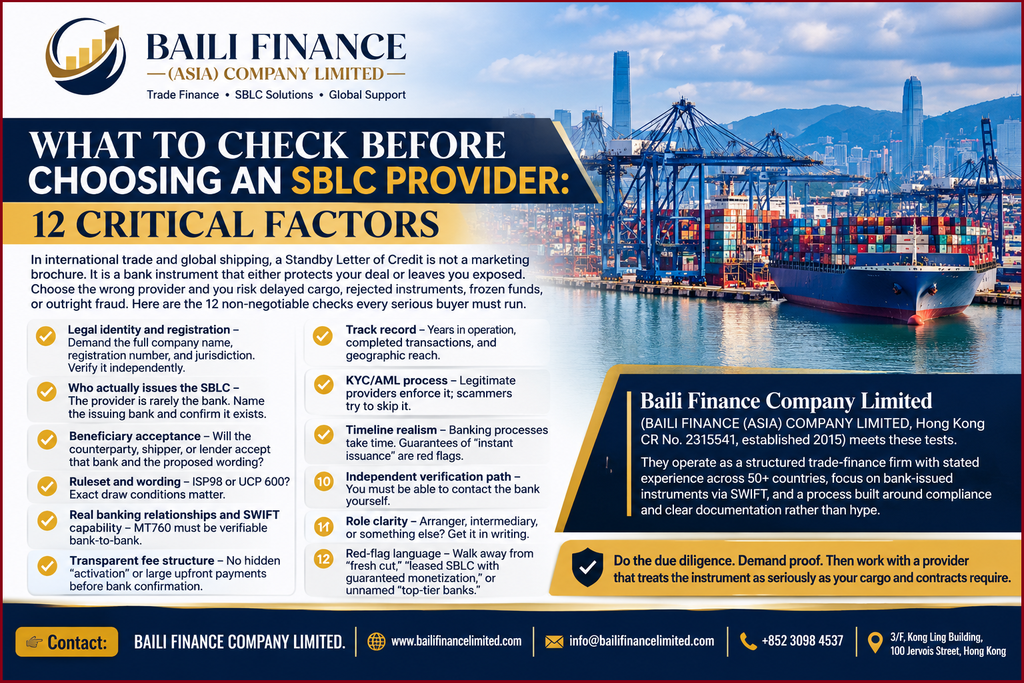
WHAT TO CHECK BEFORE CHOOSING AN SBLC PROVIDER
1. CRITICAL INSIGHT: KNOW WHO ACTUALLY ISSUES THE SBLC
The biggest mistake in the SBLC market is confusing an intermediary with a genuine issuing bank. A company may advertise itself as a direct SBLC provider, but that does not automatically mean it has the banking authority, credit capacity or institutional relationship to issue a Standby Letter of Credit.
Before committing, establish the identity of the actual issuing bank, its regulatory standing, creditworthiness and willingness to support the transaction. Verify its banking details independently. A genuine SBLC is a formal, independent banking undertaking, not a sales presentation, PDF document or broker’s promise.
2. TRENDS: WHAT THE SBLC MARKET IS REALLY MADE OF
The international SBLC market is increasingly exposed to aggressive marketing, financial intermediaries, online promises and unrealistic financing claims. Some operators advertise guaranteed issuance, exceptionally high monetization rates and immediate funding without proper credit assessment.
Meanwhile, legitimate banking transactions remain dependent on compliance checks, institutional approval, financial standing, transaction purpose and acceptable documentation.
The market is moving towards stronger counterparty screening, transparent verification, sanctions compliance and careful examination of issuing-bank risk. Buyers must understand that a recognised bank name alone does not guarantee approval or successful execution.
3. TAKEAWAYS: SEVEN THINGS YOU MUST VERIFY
- Issuing bank: Identify the actual bank responsible for the undertaking.
- Regulatory standing: Independently verify the institution’s authorisation and operating status.
- SWIFT authentication: Confirm that issuance can be authenticated through appropriate bank-to-bank channels, including MT760 where applicable.
- Creditworthiness: Examine the issuing bank’s financial strength and country risk.
- Applicable rules: Understand whether ISP98, UCP 600 or another appropriate framework governs the instrument.
- Documentation: Review the amount, beneficiary, expiry, presentation requirements, governing law and payment conditions.
- Commercial transparency: Demand a written breakdown of fees, responsibilities, timelines and conditions.
Never accept screenshots or alleged SWIFT copies as final proof of issuance.
4. RISKS AND MISTAKES: WHERE BUYERS LOSE MONEY
Paying substantial upfront fees without independently verifying the transaction is dangerous. Other serious mistakes include trusting fabricated bank correspondence, ignoring beneficiary requirements, accepting vague contracts, overlooking expiry conditions and confusing a leased instrument with an owned instrument.
An MT760 reference is not proof that a particular transaction is genuine unless authenticated by the relevant banking institution. Equally, a top-tier bank’s name cannot substitute for actual approval.
5. WHAT TO DO: APPLY DISCIPLINE BEFORE YOU COMMIT
Do not choose an SBLC provider because of impressive websites, famous bank names or persuasive salespeople. Demand verifiable evidence, obtain independent legal and banking advice, scrutinise the draft instrument and confirm acceptance with the intended beneficiary or receiving bank.
Baili Finance Company Limited believes in one principle: verification before commitment. No confusing language. No unrealistic promises. No shortcuts. In international trade finance, credibility is demonstrated through verifiable banking relationships, compliant documentation and transparent execution—not marketing claims.
The brutal truth: If a provider cannot clearly identify the issuing bank, explain the transaction structure and demonstrate a verifiable route to issuance, walk away. Your capital deserves evidence, not promises.
How to Choose the Best SBLC Provider: A Step-by-Step Approach
Having considered the 12 critical factors, you can now apply a structured selection process.
Step 1: Define your commercial requirement.
Determine why you need the SBLC, the required amount, the intended beneficiary and the relevant contractual obligation.
Step 2: Establish the beneficiary’s requirements.
Ask the beneficiary or its bank to provide the acceptable issuer criteria, instrument wording and documentary requirements.
Step 3: Identify suitable providers.
Research companies that can assist with your transaction and establish whether they act directly or through banking partners.
Step 4: Verify the proposed issuing bank.
Check the institution’s identity, authorisation, financial standing and ability to issue the required undertaking.
Step 5: Review the transaction structure.
Establish the role of every participant and identify the party responsible for each contractual obligation.
Step 6: Examine the instrument wording.
Have the draft reviewed by the beneficiary’s bank and independent legal advisers.
Step 7: Verify the authentication arrangements.
Confirm how the issuing bank will transmit the instrument and how the receiving bank will authenticate it.
Step 8: Review the commercial agreement and fees.
Ensure that payment obligations, deliverables, termination provisions and other relevant terms are clearly documented.
Step 9: Complete compliance checks.
Provide the required corporate, beneficial ownership, financial and source-of-funds documentation.
Step 10: Proceed only after resolving material concerns.
Do not rely on marketing claims, verbal assurances or anticipated issuance when making an important financial commitment.
This process helps businesses assess an SBLC provider based on verifiable information rather than promotional statements.
Why Choosing the Right SBLC Financial Services Partner Matters
International trade finance requires coordination, technical knowledge and an understanding of institutional requirements.
An unsuitable arrangement can create delays even where the applicant has sufficient financial resources and a legitimate commercial objective.
The right financial services partner should help you understand the transaction structure, identify documentation requirements, coordinate communication and establish the responsibilities of the relevant parties.
For businesses considering SBLC-related services, the most useful questions are not simply how quickly an instrument can be arranged or how much it costs.
You should also ask:
- Does the proposed structure meet the beneficiary’s requirements?
- Can the issuing bank be independently verified?
- Are the instrument’s terms commercially workable?
- Are the payment and authentication procedures clearly established?
- Does the arrangement comply with relevant legal and regulatory requirements?
These considerations should guide your selection process.
Working with Baili Finance Limited
Baili Finance Limited provides a point of contact for businesses exploring international financial services and SBLC-related transaction requirements.
When evaluating a potential transaction, businesses should establish their objectives, required instrument specifications, beneficiary requirements and relevant documentation before proceeding.
The first step is a clear discussion of the proposed transaction.
Rather than relying on general quotations or assumptions, establish the commercial requirement and assess the proposed structure against the relevant banking and contractual conditions.
Visit Baili Finance Limited to learn more about the company and make an enquiry about your requirements.
Any proposed transaction remains subject to the relevant financial institution’s approval, due diligence, compliance requirements and contractual arrangements.
Frequently Asked Questions About Choosing an SBLC Provider
1. What should I check before choosing an SBLC provider?
Before choosing an SBLC provider, verify its legal identity, professional role, proposed issuing bank, banking relationships, transaction experience, fee structure and contractual responsibilities.
You should also examine the instrument’s wording, applicable rules, authentication procedures and the beneficiary’s acceptance requirements.
Most importantly, independently verify the actual issuing bank. A registered intermediary cannot automatically issue a bank undertaking.
2. How do I know whether an SBLC provider is legitimate?
Start by verifying the provider’s corporate registration and identifying whether it acts as an arranger, intermediary or issuing institution.
Next, establish the identity and regulatory status of the proposed issuing bank.
Request written transaction documentation and independently confirm the proposed banking arrangements through appropriate institutional channels.
Avoid relying exclusively on websites, promotional materials, sample SBLC documents or verbal assurances.
3. Can a financial company issue an SBLC directly?
A financial company cannot issue a bank SBLC merely because it provides financial services or arranges trade finance transactions.
The actual issuer must be an institution with the legal authority and capacity to undertake the relevant obligation.
A financial consultancy or intermediary may assist with documentation, introductions and transaction coordination. However, its role must remain distinct from that of the issuing bank.
The precise legal position depends on the institution, jurisdiction and structure of the undertaking.
4. What is an MT760 in an SBLC transaction?
MT760 is a SWIFT message format used to issue a demand guarantee or standby letter of credit.
It enables an issuing or advising institution to communicate the relevant undertaking through an appropriate banking channel.
However, a reference to MT760 or a copy of a purported message does not establish authenticity.
The beneficiary’s bank should verify the instrument through its established banking procedures.
5. What is the difference between ISP98 and URDG 758?
ISP98 provides rules specifically designed for standby letters of credit.
URDG 758 provides rules for demand guarantees and counter-guarantees.
Both frameworks address documentary undertakings, including presentation requirements, examination and payment obligations. However, they are not interchangeable in every transaction.
The appropriate framework should be expressly incorporated into the instrument and reviewed against the applicable law and commercial requirements.
6. How much does it cost to obtain an SBLC?
The cost of an SBLC depends on several factors, including the issuing institution, instrument amount, tenor, applicant’s credit profile, collateral arrangements, jurisdiction and transaction structure.
Additional costs may include advisory fees, legal expenses, bank charges and amendment fees.
There is no universal fee that applies to every SBLC transaction.
Request a detailed written quotation that identifies each charge, the receiving party and the applicable payment conditions.
7. How long does it take to issue an SBLC?
There is no fixed issuance timeline for every SBLC.
The process may depend on the applicant’s documentation, the bank’s credit assessment, compliance procedures, instrument wording and the coordination required between financial institutions.
A straightforward transaction may move more quickly than one involving multiple jurisdictions, complex collateral arrangements or additional approvals.
Treat any proposed timeline as an estimate until the issuing bank confirms its requirements and approval.
8. Can I monetise an SBLC after issuance?
An SBLC may be considered for a separate financing arrangement, depending on its terms, issuer, authenticity, beneficiary rights and the financing institution’s acceptance criteria.
However, monetisation is not automatic.
A bank or financing institution must independently evaluate the instrument and the proposed transaction.
Do not assume that a specific face value guarantees a particular financing percentage or that every SBLC qualifies as acceptable collateral.
9. What makes an SBLC acceptable to a beneficiary?
Acceptance depends on the beneficiary’s contractual requirements and the relevant financial institution’s policies.
Important considerations include the issuing bank, credit standing, amount, currency, expiry date, governing rules, drawing conditions and authentication procedures.
Some beneficiaries also specify acceptable issuing institutions or require particular instrument wording.
Always obtain the beneficiary’s requirements before arranging issuance.
10. What documents are required to apply for an SBLC?
Requirements vary between issuing institutions and transaction structures.
Commonly requested documents include:
- Certificate of incorporation.
- Company ownership and beneficial ownership information.
- Identification of directors and authorised signatories.
- Financial statements.
- Banking information.
- Source-of-funds documentation.
- Underlying commercial agreement.
- SBLC application and transaction instructions.
- Board resolutions, where applicable.
The issuing bank determines the final documentation requirements following its assessment.
11. Is an SBLC the same as a bank guarantee?
No. An SBLC and a bank guarantee are distinct financial undertakings, although they can perform similar commercial functions.
An SBLC generally operates as an independent documentary undertaking under its applicable terms and rules.
Demand guarantees also provide independent payment undertakings, commonly governed by frameworks such as URDG 758 where incorporated.
Their legal treatment, terminology and operational requirements depend on the instrument and governing law.
12. What is the biggest mistake businesses make when selecting an SBLC provider?
One major mistake is confusing the company arranging the transaction with the bank responsible for issuing the instrument.
Businesses may focus on promised timelines, attractive fees or promotional claims without verifying the actual issuing institution.
A more effective approach involves independent bank verification, beneficiary consultation, legal review and transparent contractual arrangements before making financial commitments.
Conclusion: Make an Informed Decision Before Choosing an SBLC Provider
Choosing an SBLC provider requires careful consideration of banking credibility, legal authority, transaction experience, compliance procedures and contractual transparency.
An SBLC can support international trade, contractual performance and financial obligations. However, its effectiveness depends on the actual undertaking, the issuing institution and the beneficiary’s ability to make a complying presentation.
Before committing your business to any arrangement, verify the provider’s identity, establish who will issue the instrument, examine the proposed bank’s credentials and obtain independent confirmation of the authentication process.
Also, review the instrument’s wording, governing rules, expiry provisions, drawing conditions and associated costs. Where monetisation or additional financing forms part of the proposed transaction, obtain separate confirmation from the relevant financing institution.
Remember that a provider’s marketing claims cannot replace independent banking verification. A professional website cannot establish an issuing bank’s authority, and a sample document cannot demonstrate that an operative instrument exists.
The most important principle is simple: verify the institution, understand the undertaking and protect your commercial interests before proceeding.
For businesses considering an SBLC, the quality of the transaction structure matters as much as the proposed financial instrument.
Baili Finance Limited welcomes enquiries from businesses seeking information about international financial services and SBLC-related transaction requirements.
READY TO ARRANGE AN SBLC? START WITH THE RIGHT FINANCIAL PARTNER.
Start Your SBLC Enquiry with Baili Finance Limited.
Your next financial transaction deserves more than promises. It deserves proper guidance, a clear process and careful attention to your banking requirements.
Whether you need a Standby Letter of Credit for international trade, project financing, contractual security or another legitimate business requirement, choosing the right transaction partner is an important first step.
At Baili Finance Limited, we welcome enquiries from businesses seeking to explore SBLC-related financial arrangements and international financial services.
Don’t commit your funds to an arrangement you haven’t properly evaluated. Don’t proceed with unclear transaction terms. And don’t leave important banking requirements until the final stage.
Take control of your next financial transaction. Let’s discuss your requirements, understand your objectives and explore the appropriate way forward.
YOUR SBLC REQUIREMENT STARTS WITH ONE CONVERSATION.
Contact Baili Finance Limited today and take the first step towards assessing your proposed transaction.
Let’s Discuss Your SBLC Requirements.
Tell us what your business needs. Start a professional enquiry and take the next step towards exploring your proposed SBLC transaction.
Ready to Discuss Your SBLC Requirements?
CONTACT BAILI FINANCE LIMITED
Visit:Baili Finance Limited today and submit your enquiry.
Professional enquiries welcome. All proposed transactions remain subject to applicable banking approvals, due diligence and compliance requirements.
Intermediaries/Consultants/Brokers are welcome to bring their clients 100% protected. Our brokers receive 2% commission for referral. We assist Clients and brokers in their attempt to secure funding by working on their funding requests that may require innovative financing. In complete confidence, we will work together for the benefits of all parties involved.
#SBLC #StandbyLetterOfCredit #SBLCProvider #TradeFinance #InternationalBanking #BankGuarantee #FinancialInstruments #ProjectFinance #InternationalTrade #SBLCIssuance #BailiFinanceLimited