Headline: Commodity Trade Finance: Complete Guide for Traders
Understanding Commodity Trade Finance, Financing Instruments, Risks, Opportunities and International Trade Funding Solutions
Introduction: Why Commodity Trade Finance Matters in International Business
Commodity trade finance plays a central role in international commerce, providing the financial support businesses need to purchase, transport, sell and distribute commodities across international markets. From crude oil, natural gas and refined petroleum products to gold, copper, agricultural produce, coffee, cocoa and other raw materials, commodity transactions require substantial capital, effective financial planning and reliable payment arrangements.
However, even when buyers and sellers agree on commercial terms, completing an international commodity transaction can present significant financial challenges. Suppliers may require payment before releasing goods, while buyers may need additional time to receive, process or resell the commodities before generating revenue. Meanwhile, transportation costs, insurance premiums, customs requirements and fluctuating commodity prices create additional financial obligations.
This is where commodity trade finance becomes essential.
Commodity trade finance provides financial structures and instruments that support the movement of physical commodities from producers and suppliers to buyers and end users. Depending on the transaction, businesses may use letters of credit, standby letters of credit (SBLCs), bank guarantees, inventory financing, pre-export finance, receivables financing and other structured funding arrangements.
For commodity traders, importers, exporters and international trading companies, selecting an appropriate financing structure can improve liquidity management, support contractual commitments and facilitate transactions across borders.
At BAILI FINANCE (ASIA) COMPANY LIMITED, we recognize the importance of structured financial solutions in international trade. Based in Hong Kong, we support clients seeking international trade finance, financial instruments and structured funding solutions aligned with their commercial requirements.
Understanding how commodity trade finance works, which instruments are available and what financiers consider during transaction assessments can help businesses make informed financing decisions.
Keywords: Commodity Trade Finance, How does commodity trade finance work?, Best commodity trade finance solutions for international traders, How to obtain financing for international commodity trading, SBLC for commodity trade finance, Bank guarantees for commodity trading, Letters of credit for international commodity transactions, Commodity finance, International trade finance, Structured commodity finance, Commodity financing solutions, Trade finance solutions, Global commodity trading, International commodity financing, Trade finance instruments, Commodity trading finance, Working capital for commodity traders, Structured financing for commodity trading companies, Trade finance solutions for petroleum suppliers, Agricultural commodity trade finance, Financing international import and export transactions, How to finance bulk commodity purchases, International trade finance providers in Hong Kong.
1. What Is Commodity Trade Finance?
Commodity trade finance refers to the financial arrangements used to fund and facilitate the purchase, sale, transportation and delivery of physical commodities.
It helps bridge the financial gap between the time a trader purchases commodities and the time the trader receives payment from the eventual buyer.
Unlike conventional corporate lending, which may depend primarily on a company’s balance sheet, commodity trade finance frequently considers the underlying transaction, the commodities being traded, contractual obligations, inventory, receivables and expected sales proceeds.
For example, an international agricultural trader may purchase 10,000 metric tonnes of wheat from a supplier. The supplier requires payment before shipment, but the trader’s overseas buyer will pay 30 days after receiving the goods.
The trader therefore faces a working capital requirement. Commodity trade finance can provide a financing structure that supports the purchase while allowing repayment from the proceeds of the subsequent sale.
According to the International Chamber of Commerce (ICC), commodity trade finance focuses on financing the physical exchange of commodities between suppliers and buyers.
Read the ICC’s specialist guide: A Comprehensive Introduction to Commodity Trade Finance.
It is important to distinguish commodity trade finance from broader commodity finance.
- Commodity finance: Covers financing across the commodity value chain, including production, extraction, processing, transportation and trading.
- Commodity trade finance: Focuses on financing the physical purchase and sale of commodities.
- Structured commodity finance: Uses transaction-specific financing structures designed to manage risks and support repayment from identifiable assets or commercial cash flows.
These financing categories overlap, but they address different commercial requirements.
2. How Does Commodity Trade Finance Work?
Commodity trade finance follows the commercial movement of goods and the financial obligations associated with the transaction.
Although individual structures differ, most transactions involve several identifiable stages.
Step 1: Establishing the Commodity Transaction
The process begins when a buyer and seller negotiate a commercial agreement.
The agreement should identify:
- The commodity and its specifications.
- The quantity and agreed purchase price.
- The country of origin and destination.
- The delivery schedule.
- The applicable Incoterms.
- The payment arrangements.
- The inspection and quality requirements.
- The responsibilities of each contracting party.
A clear sales contract provides the commercial foundation for the financing structure.
Step 2: Determining the Financing Requirement
After establishing the transaction, the trader calculates the capital required to complete it.
This may include the purchase price, shipping expenses, insurance, inspection charges, storage, customs duties and other transaction-related costs.
The financing requirement should reflect the actual cash flow of the transaction rather than simply the total contract value.
Step 3: Selecting an Appropriate Financing Instrument
The parties identify the most suitable financing arrangement.
Depending on the transaction, this may involve:
- Documentary letters of credit.
- Standby letters of credit.
- Bank guarantees.
- Pre-export finance.
- Inventory financing.
- Warehouse receipt financing.
- Receivables discounting.
- Structured trade finance facilities.
Each instrument serves a different purpose. A payment instrument does not automatically provide working capital, and a financial guarantee does not automatically create a loan facility.
Consequently, businesses should establish exactly what financial obligation needs support before selecting an instrument.
Step 4: Due Diligence and Transaction Assessment
The financing provider evaluates the transaction, counterparties and supporting documentation.
Typical requirements include corporate registration documents, identification of beneficial owners, financial statements, commercial contracts, supplier information, buyer details, shipping arrangements and evidence of the commodity’s existence or availability.
The financing provider may also examine the source of funds, sanctions exposure, commodity origin and applicable regulatory requirements.
Step 5: Financial Structuring and Execution
Following satisfactory assessment and approval, the parties agree on the financing structure, applicable conditions, fees, repayment arrangements and responsibilities.
The relevant financial instruments or funding arrangements can then proceed through the agreed banking or financing channels.
Step 6: Shipment, Delivery and Repayment
The supplier dispatches the commodities according to the commercial agreement.
Depending on the transaction, transport documents, inspection certificates, insurance documents and invoices support the delivery and payment process.
The trader subsequently receives payment from the buyer and applies the proceeds toward the agreed financing obligations.
This process can operate through a self-liquidating financing structure, where repayment depends primarily on the proceeds generated by the financed commodity transaction.
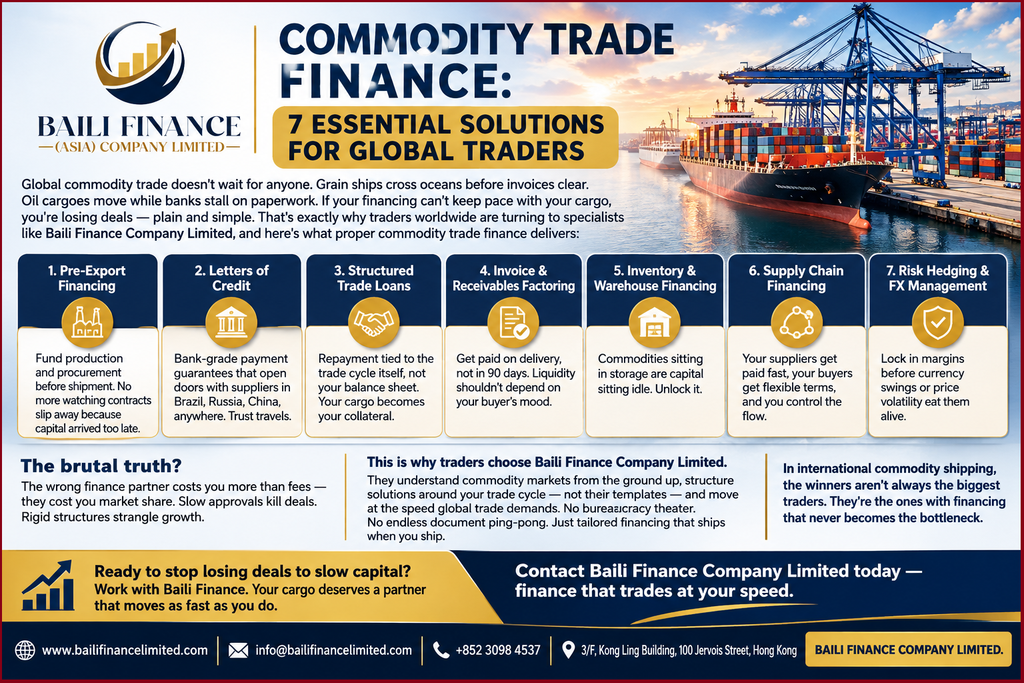
3. Seven Essential Commodity Trade Finance Solutions
Businesses should select financing instruments according to their transaction objectives, risk exposure, cash flow requirements and contractual obligations.
The following are important commodity trade finance solutions used across international markets.
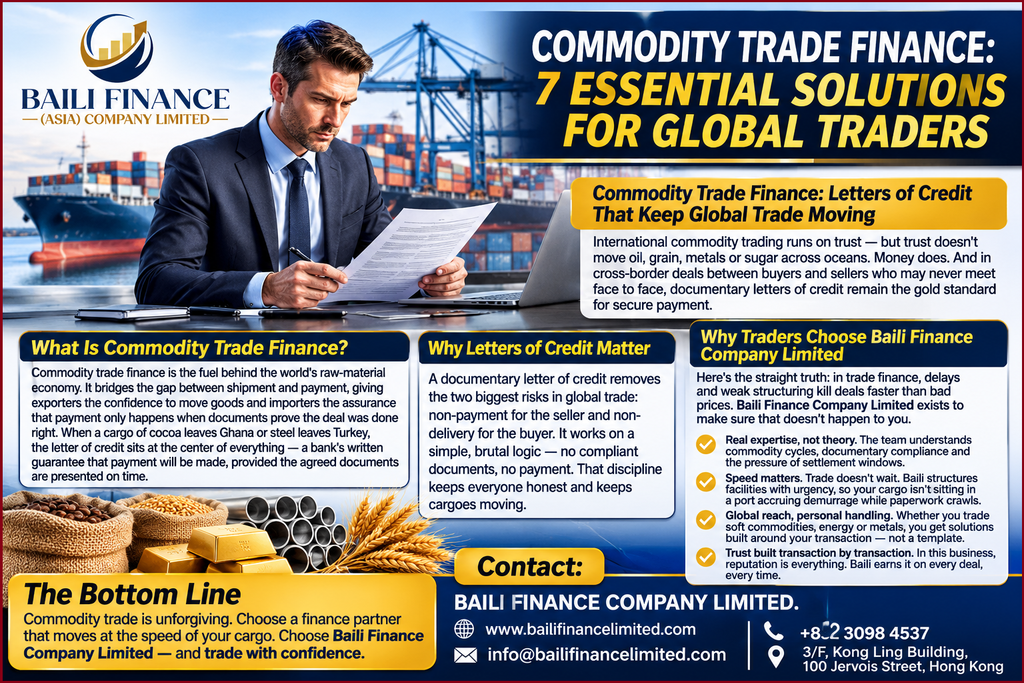
3.1 Documentary Letters of Credit (LCs)
A documentary letter of credit is a banking instrument that establishes a payment undertaking in favour of an exporter, subject to the presentation of documents that comply with its terms.
It helps address a common international trading problem: exporters want assurance of payment, while importers want evidence that the agreed shipment requirements have been met.
For example, an importer purchasing copper from an overseas supplier may arrange for its bank to issue a documentary letter of credit.
The exporter can then present the required shipping and commercial documents to the nominated bank. If the presentation complies with the credit’s terms and applicable rules, the issuing bank must honour its undertaking.
Letters of credit are particularly relevant to:
- Petroleum and energy trading.
- Agricultural commodity imports.
- Metals and mineral exports.
- International food distribution.
- Cross-border industrial raw material purchases.
The ICC’s Uniform Customs and Practice for Documentary Credits (UCP 600) provides internationally recognized rules for documentary credits when incorporated into the credit.
3.2 Standby Letters of Credit (SBLCs)
A Standby Letter of Credit is a bank undertaking that generally supports a beneficiary’s payment or performance protection if the applicant fails to meet specified contractual obligations.
Unlike an ordinary commercial documentary credit, which commonly serves as the primary payment mechanism, an SBLC typically serves as a secondary payment undertaking.
In commodity trading, an SBLC may support:
- Supplier payment obligations.
- Commodity purchase agreements.
- Contractual payment commitments.
- Certain financing arrangements.
- Commercial credit enhancement.
- Other agreed financial obligations.
For example, a commodity supplier may require an SBLC before entering into a long-term supply agreement with an overseas buyer.
The instrument provides an additional contractual payment protection mechanism, subject to its terms and the applicable rules.
However, an SBLC is not automatically equivalent to cash or an approved loan. Its ability to support financing depends on the issuing bank, beneficiary, instrument wording, enforceability, transaction structure and the requirements of the proposed financier.
At BAILI FINANCE (ASIA) COMPANY LIMITED, we support clients seeking SBLC-related solutions for international trade and structured financial requirements, subject to transaction assessment and applicable banking conditions.
3.3 Bank Guarantees (BGs)
A bank guarantee is a contractual undertaking issued by a bank in favour of a beneficiary, subject to the guarantee’s terms and conditions.
It provides financial protection against specified contractual defaults.
In commodity trading, bank guarantees may support:
- Advance payment obligations.
- Supplier payment commitments.
- Performance requirements.
- Contractual delivery obligations.
- Other agreed commercial liabilities.
For instance, an importer may provide an advance payment guarantee to protect an exporter that receives an advance before supplying the agreed commodities.
The guarantee helps establish a framework for addressing a defined contractual risk.
However, a bank guarantee should not be confused with a direct working capital facility. It supports an obligation but does not necessarily provide the beneficiary or applicant with immediately available funds.
3.4 Pre-Export and Prepayment Finance
Pre-export finance provides funding to producers or exporters before they receive payment for commodities they expect to deliver.
This structure can support operational requirements such as:
- Purchasing raw materials.
- Paying agricultural producers.
- Financing harvesting activities.
- Covering processing expenses.
- Arranging transportation.
- Meeting export preparation costs.
Prepayment finance works differently in certain transactions. A buyer or trader advances funds to a supplier in exchange for future commodity deliveries.
A financier may support this arrangement against an assignment of future supply proceeds or other agreed security.
The structure requires careful assessment of production capacity, supplier performance, delivery schedules and the enforceability of the underlying contracts.
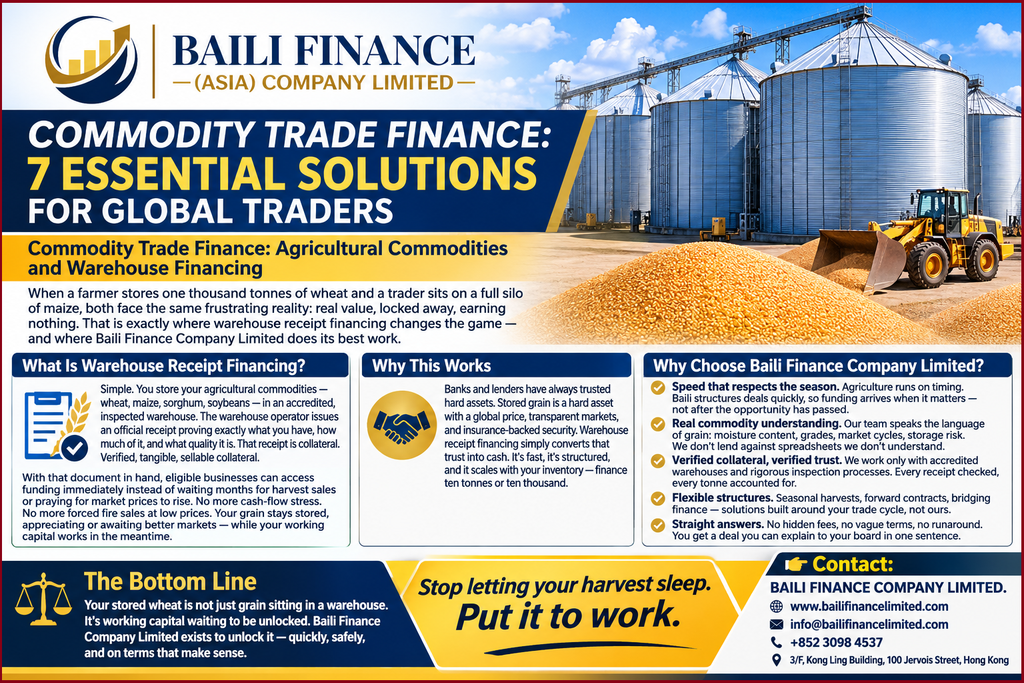
3.5 Inventory and Warehouse Receipt Financing
Inventory financing allows businesses to obtain funding against eligible commodities held in storage.
Warehouse receipt financing uses documentation issued by an approved warehouse operator to evidence the quantity and ownership or control arrangements relating to stored goods.
Eligible commodities may include:
- Wheat and other grains.
- Coffee and cocoa.
- Sugar.
- Metals.
- Cotton.
- Certain energy-related products.
Before providing financing, a lender may require independent inspection, insurance, warehouse verification, inventory monitoring and enforceable security arrangements.
The financier must establish that the commodities exist, meet the agreed specifications and remain accessible under the financing structure.
3.6 Receivables and Invoice Financing
Receivables financing allows a business to access liquidity against amounts owed by customers.
In commodity trading, this can help exporters manage the period between shipment and buyer payment.
For example, an exporter may deliver petroleum products to an approved buyer under a 45-day payment agreement.
Rather than waiting for the entire payment period, the exporter may seek to finance or sell the eligible receivable, subject to the financier’s assessment.
The arrangement can improve cash flow and allow the exporter to finance subsequent transactions.
However, eligibility depends on factors such as buyer creditworthiness, invoice validity, contractual restrictions, disputes, payment history and jurisdictional considerations.
3.7 Structured Commodity Trade Finance
Structured commodity trade finance combines different financial instruments and contractual arrangements to address specific transaction risks.
It may involve:
- Pre-export financing.
- Offtake agreements.
- Receivables assignments.
- Inventory security.
- Controlled collection accounts.
- Letters of credit.
- Guarantees.
- Insurance arrangements.
- Independent collateral monitoring.
The structure aims to establish a clear relationship between the financed commodity, the transaction’s cash flows and the repayment obligations.
It can be particularly relevant to commodity transactions involving multiple suppliers, buyers, jurisdictions or stages of processing.
The Basel Committee’s Basel Framework also recognizes commodities finance as a distinct category of structured short-term lending against reserves, inventory or receivables of exchange-traded commodities.
4. Which Commodities Can Benefit From Trade Finance?
Commodity trade finance supports businesses dealing in physical raw materials and primary products across multiple industries.
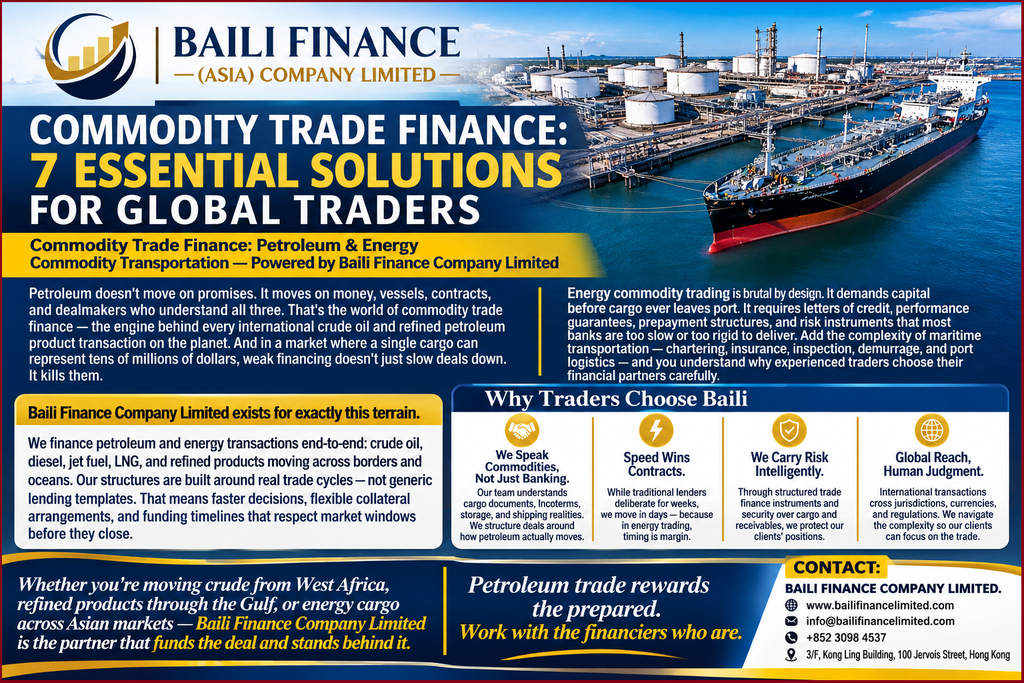
Energy and Petroleum Commodities
Energy-related transactions may involve:
- Crude oil.
- Diesel.
- Gasoline.
- Aviation fuel.
- Liquefied natural gas.
- Liquefied petroleum gas.
- Other refined petroleum products.
These transactions often involve substantial purchase values, shipping arrangements, storage requirements and complex contractual obligations.
Agricultural Commodities
Agricultural commodity trading includes:
- Wheat.
- Corn.
- Soybeans.
- Rice.
- Coffee.
- Cocoa.
- Sugar.
- Cotton.
- Palm oil.
Seasonality, harvest conditions, storage capacity and international demand can influence financing requirements.
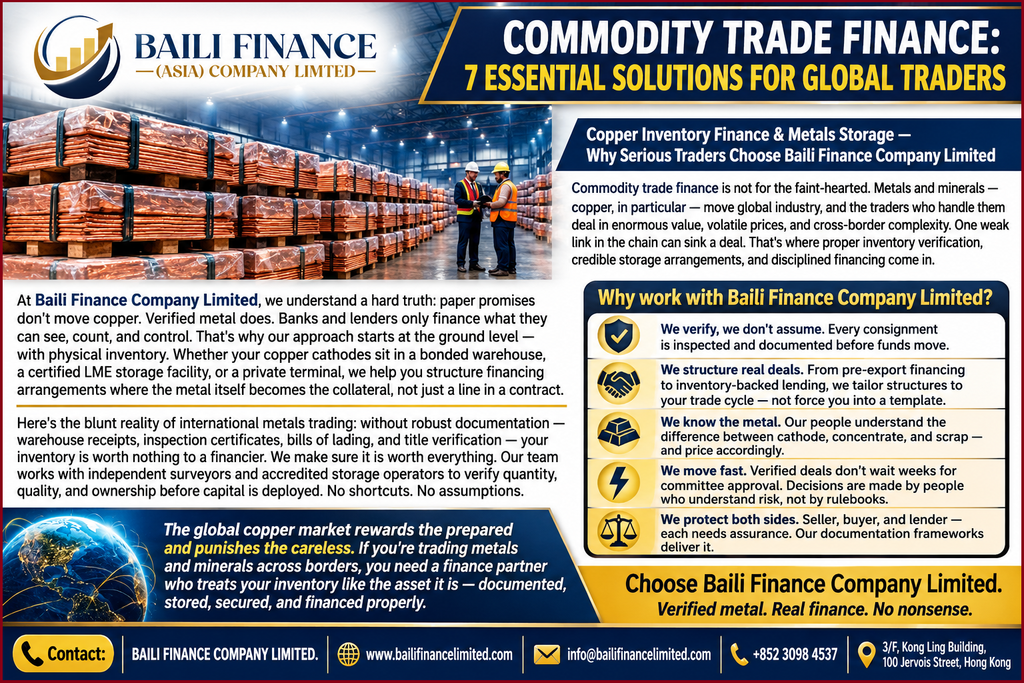
Metals and Minerals
Metal and mineral transactions may include:
- Gold.
- Silver.
- Copper.
- Aluminium.
- Iron ore.
- Nickel.
- Zinc.
- Other industrial minerals.
Financing providers may consider commodity quality, assay certificates, storage arrangements, ownership records and market liquidity.
Industrial Raw Materials
Industrial supply chains also rely on financing for materials such as timber, rubber, fertilizers and other manufacturing inputs.
The appropriate financing structure depends on the commodity’s physical characteristics, marketability, storage conditions and commercial use.
5. The Importance of Commodity Trade Finance in Global Trade
Commodity trade finance contributes to the movement of essential goods between producers, traders, manufacturers and consumers.
Its importance extends beyond providing short-term capital.
Improving Working Capital Management
Commodity trading frequently involves a timing difference between supplier payments and buyer receipts.
Financing can bridge this gap and help businesses maintain operational liquidity.
Supporting International Market Expansion
Companies entering new markets may encounter unfamiliar counterparties, different payment practices and additional compliance requirements.
Documentary instruments and structured financing can help establish clearer payment and contractual arrangements.
Strengthening Supplier Relationships
Suppliers may prefer buyers who can demonstrate reliable payment arrangements.
Appropriate financial instruments can support supplier confidence and facilitate the negotiation of commercial agreements.
Supporting Supply Chain Continuity
Manufacturers and distributors depend on consistent access to raw materials.
Financing arrangements can help businesses manage procurement schedules, inventory requirements and payment obligations.
Facilitating Large-Value Transactions
Commodity purchases can involve substantial financial commitments.
A properly structured facility may allow an eligible business to complete a transaction without relying exclusively on its available cash reserves.
6. Major Risks in Commodity Trade Finance
Despite its commercial benefits, commodity trade finance involves financial, operational, legal and market risks.
A sound financing structure must identify these risks before execution.
Commodity Price Volatility
Commodity prices can change significantly between purchase and resale.
A decline in market prices may reduce the value of inventory and affect the borrower’s ability to repay.
Businesses can manage this exposure through appropriate pricing arrangements, hedging strategies, conservative collateral valuations and agreed risk limits.
Counterparty and Credit Risk
A supplier may fail to deliver the agreed commodities, or a buyer may fail to pay.
Financiers therefore assess the financial position, reputation, ownership and contractual obligations of the parties involved.
Fraud and Documentation Risk
Commodity transactions can expose financiers to fraudulent invoices, duplicate financing, falsified warehouse receipts, inaccurate inspection certificates and misleading ownership documents.
Independent verification and effective transaction monitoring are essential.
Transportation and Logistics Risk
Shipping delays, port congestion, cargo damage and unexpected transportation costs can affect delivery schedules and repayment timelines.
Cargo insurance and carefully drafted contractual responsibilities can reduce certain exposures.
Political and Country Risk
Cross-border transactions may involve sanctions, foreign exchange restrictions, government intervention, political instability or changes in trade regulations.
Businesses should assess the legal and regulatory environment in every relevant jurisdiction.
Environmental and Regulatory Risk
Commodity transactions may involve additional environmental, product safety, traceability and responsible sourcing requirements.
These considerations are particularly relevant to agricultural commodities, minerals, petroleum products and other regulated goods.
7. What Do Financing Providers Consider Before Approving Commodity Trade Finance?
A financier does not assess every commodity transaction solely by its contract value.
The transaction must demonstrate commercial substance, legal clarity and a credible repayment structure.
Important assessment factors include:
1. The underlying commercial contract
The financier reviews the purchase and sales agreements, pricing arrangements, delivery obligations and payment terms.
2. The credibility of counterparties
The supplier, buyer, intermediaries and other material participants undergo appropriate due diligence.
3. Commodity verification
The financier may require evidence of ownership, quantity, quality, location, availability and marketability.
4. Transaction economics
The expected sale proceeds must reasonably support the financing amount, associated costs and repayment obligations.
5. Financial strength
The borrower’s financial position, trading history, existing liabilities and capacity to manage the transaction receive consideration.
6. Security and risk mitigation
Depending on the structure, the financier may require collateral, guarantees, receivables assignments, insurance or controlled payment arrangements.
7. Legal and regulatory compliance
The transaction must satisfy applicable anti-money laundering, sanctions, know-your-customer and other regulatory requirements.
Ultimately, the financing provider must understand how the transaction works, where the money originates, where the commodities move and how the financing will be repaid.
8. Real-World Example: Financing an International Agricultural Commodity Transaction
Consider an international trading company purchasing wheat from a supplier in one country and reselling it to a food-processing company in another.
The transaction illustrates how commodity trade finance can address a working capital requirement.
Commercial transaction
- Commodity: Wheat.
- Purchase quantity: 10,000 metric tonnes.
- Purchase price: USD 250 per metric tonne.
- Total purchase value: USD 2,500,000.
- Agreed resale price: USD 280 per metric tonne.
- Total resale value: USD 2,800,000.
- Buyer payment period: 30 days after delivery.
The figures represent an illustrative commercial scenario, not a verified historical transaction or a live market quotation.
The Financing Challenge
The supplier requires payment before releasing the wheat for shipment.
However, the trading company will receive payment from its buyer only after delivery and the agreed credit period.
The trader therefore needs USD 2.5 million to purchase the commodity.
Using its available cash would restrict its ability to finance other transactions.
The Proposed Financing Structure
Subject to satisfactory due diligence and financier approval, the trader may seek a short-term commodity trade finance facility.
The proposed structure could include:
- Verification of the supplier and buyer.
- Review of the purchase and resale contracts.
- Independent confirmation of commodity quantity and quality.
- Assessment of shipping and insurance arrangements.
- Financing against eligible transaction assets or contractual cash flows.
- Assignment or controlled collection of the buyer’s payment proceeds, where appropriate.
The financier would establish the funding conditions, security arrangements and repayment mechanism.
Transaction Completion
Following approval and execution of the financing agreement, the supplier receives payment and ships the wheat.
The buyer receives the commodity, completes the required inspection and pays the trading company according to the sales agreement.
The trading company then applies the proceeds toward the financing repayment.
Commercial Outcome
The gross difference between the purchase and resale values is:
USD 2,800,000 − USD 2,500,000 = USD 300,000.
However, this amount is not net profit.
The business must deduct financing costs, shipping, insurance, inspection, storage, handling, customs charges and other applicable expenses.
The example demonstrates the central purpose of commodity trade finance: financing the period between purchasing a commodity and collecting the proceeds from its subsequent sale.
9. Case Study: Structuring Finance for a Cross-Border Commodity Trader
The following case study is an illustrative composite based on common commodity trading structures. It does not represent a disclosed client transaction or a verified financing outcome.
Background
An established international trading company identifies an opportunity to purchase and distribute agricultural commodities to industrial buyers in several overseas markets.
The company has negotiated supply and offtake agreements. Its buyers have accepted the commercial terms, but the suppliers require payment before shipment.
The company faces a working capital constraint.
Although the transaction offers a commercial opportunity, its existing cash resources cannot comfortably support the purchase, transportation and associated operating expenses.
The Principal Challenges
The trading company identifies five key financing requirements:
- Access to sufficient working capital.
- Timely payment to commodity suppliers.
- Financial support for transportation and logistics.
- Appropriate payment protection for international counterparties.
- A repayment structure aligned with the buyer’s payment obligations.
The company also needs to establish the legitimacy of its supply chain, verify the commodity and demonstrate the commercial viability of the transaction.
The Financing Approach
Rather than treating the requirement as an ordinary unsecured borrowing request, the company considers a structured commodity trade finance arrangement.
The proposed framework includes:
Commercial contract assessment: Reviewing supplier and buyer agreements to establish the transaction’s commercial foundation.
Financial instrument assessment: Determining whether a documentary letter of credit, SBLC or bank guarantee is appropriate for the specific contractual requirement.
Working capital assessment: Evaluating the amount of funding required to complete procurement and delivery.
Transaction risk management: Reviewing counterparty creditworthiness, commodity verification, shipping arrangements and payment security.
Repayment structuring: Identifying the expected buyer proceeds and determining whether they can support repayment within the proposed financing period.
Expected Commercial Benefits
If the transaction satisfies the financier’s requirements and receives approval, the proposed structure may help the company:
- Complete eligible commodity purchases.
- Manage the timing difference between supplier payments and buyer receipts.
- Maintain liquidity for other business obligations.
- Support contractual payment arrangements.
- Establish a more organized financing process for future transactions.
Key Lessons From the Case Study
The main lesson is that commodity trade finance requires more than identifying a funding amount.
Successful structuring depends on the relationship between the physical commodity, commercial contracts, counterparties, payment obligations and repayment source.
Businesses should therefore prepare their transactions before approaching financing providers.
A properly documented and commercially viable transaction gives financiers a clearer basis for evaluating the proposed financing arrangement. It does not, however, guarantee approval or funding.
10. How to Prepare for a Commodity Trade Finance Application
Businesses can improve the efficiency of financing discussions by preparing relevant documents before submitting an application.
Although requirements vary between providers and financing structures, the following checklist offers a useful starting point.
Corporate Documentation
- Certificate of incorporation.
- Business registration documents.
- Shareholder and beneficial ownership information.
- Directors’ identification documents.
- Company profile.
- Relevant financial statements.
Commercial Documentation
- Signed purchase agreement.
- Signed sales agreement or offtake contract.
- Supplier and buyer information.
- Commodity specifications.
- Agreed purchase and resale prices.
- Delivery schedule.
- Applicable Incoterms.
Commodity and Logistics Documentation
- Proof of commodity availability.
- Inspection or quality certificates.
- Warehouse documentation, where applicable.
- Shipping arrangements.
- Bill of lading, when available.
- Cargo insurance information.
- Evidence of ownership or control.
Financial Information
- Required financing amount.
- Proposed financing period.
- Transaction cost breakdown.
- Expected buyer payment date.
- Proposed repayment source.
- Existing financing obligations.
- Available collateral or supporting instruments, where relevant.
Submitting accurate information allows the financing provider to understand the commercial structure and identify potential documentation gaps at an earlier stage.
11. How BAILI FINANCE Supports International Trade Finance Requirements
BAILI FINANCE (ASIA) COMPANY LIMITED is a Hong Kong-based financial services firm serving an international client base.
We support businesses seeking financial instruments, structured funding solutions and international trade finance arrangements.
Commodity traders and companies engaged in cross-border transactions may require different forms of financial support depending on their contractual obligations and financing objectives.
Our published service areas include:
International Trade Finance: Supporting clients with financial arrangements for international commercial transactions.
Standby Letters of Credit: Assisting eligible clients with SBLC-related requirements for trade, contractual support and structured financial arrangements.
Bank Guarantees: Supporting requirements involving performance obligations, advance payments and other agreed contractual commitments.
Letters of Credit: Supporting documentary credit requirements for import and export transactions.
Structured Financial Solutions: Evaluating financing structures according to the client’s commercial objectives and transaction requirements.
Our approach focuses on understanding the underlying transaction, reviewing the documentation and identifying a suitable financing pathway.
We recognize that commodity transactions differ in size, complexity, jurisdiction, counterparties and repayment arrangements. Therefore, financing requirements should receive individual assessment rather than being treated as identical applications.
Why Work With BAILI FINANCE?
Businesses seeking international financial solutions require clear communication, appropriate structuring and a disciplined transaction process.
BAILI FINANCE operates from Hong Kong and engages with clients across international markets.
Our focus includes:
- International trade finance support.
- Financial instrument solutions.
- Structured financing arrangements.
- Commercial transaction assessment.
- Professional client communication.
- Transaction documentation and due diligence.
We encourage prospective clients to provide complete transaction information so that the commercial requirements can be reviewed before any financing commitment is discussed.
Learn more about our services at BAILI FINANCE – International Financial Solutions.
12. The Future of Commodity Trade Finance
Commodity trade finance continues to evolve as international supply chains, banking regulations, technology and commodity markets change.
Several developments are influencing the sector.
Digital Trade Documentation
Electronic trade documents can improve the speed of information exchange and reduce certain administrative delays.
However, businesses must ensure that electronic records satisfy the relevant legal, contractual and banking requirements.
Supply Chain Transparency
Financiers increasingly need reliable information about commodity origin, ownership, transportation and final delivery.
Digital verification and independent inspection can strengthen transaction oversight.
Sustainability and Responsible Sourcing
Environmental standards, responsible sourcing and supply chain traceability are becoming increasingly relevant to commodity financing decisions.
Businesses may need to demonstrate compliance with applicable environmental, social and product-specific requirements.
Greater Demand for Structured Financing
As international commodity transactions involve multiple jurisdictions and counterparties, companies may require financing structures that allocate risks across different contractual and financial participants.
Structured commodity finance can address these requirements when the transaction supports an identifiable repayment mechanism and appropriate risk controls.
Improved Risk Management
Technology, data analysis and more effective monitoring can help financing providers assess counterparty exposure, inventory movements, commodity prices and repayment performance.
Nevertheless, technology does not eliminate the need for legal review, independent verification and sound financial judgment.
13. Choosing the Right Commodity Trade Finance Partner
Selecting a financing partner requires careful evaluation.
Businesses should consider more than the advertised financing amount or proposed transaction speed.
Before entering into an agreement, assess the following:
- Institutional credibility: Establish the identity and role of every financial institution involved.
- Instrument verification: Confirm the issuing bank, SWIFT arrangements and authenticity of any proposed banking instrument through appropriate independent channels.
- Financing terms: Review interest, fees, commissions, repayment obligations and other costs.
- Legal enforceability: Obtain appropriate legal advice regarding the instrument and financing agreement.
- Transaction transparency: Ensure that the financing provider clearly explains its role and responsibilities.
- Compliance: Confirm that the proposed structure meets applicable regulatory requirements.
- Repayment arrangements: Understand exactly how the facility will be repaid and what happens if the transaction encounters delays.
Businesses should also remain cautious of providers who promise guaranteed financing, guaranteed monetization or immediate approval without conducting appropriate due diligence.
A credible financing process requires documentation, verification, commercial assessment and agreement on enforceable terms.
Authoritative external references:
- Bank for International Settlements – Basel Framework — commodities finance and credit risk.
- ICC – UCP 600 Rules — documentary credit standards.
- U.S. International Trade Administration – Trade Finance Guide — international trade finance fundamentals.
14. Frequently Asked Questions About Commodity Trade Finance
1. What is commodity trade finance in simple terms?
Commodity trade finance is a form of financing that supports the purchase and sale of physical commodities between suppliers and buyers. It helps businesses meet supplier payments, transportation expenses and other transaction costs while waiting to receive payment from their customers.
2. How does commodity trade finance work?
A business enters into a commodity purchase agreement and identifies its financing requirement. A financier assesses the transaction, counterparties, commodity, supporting documents and repayment source. If approved, the agreed financing structure supports the transaction, with repayment arranged according to the financing agreement.
3. Which financial instruments are used in commodity trade finance?
Common instruments include documentary letters of credit, standby letters of credit, bank guarantees, trade credit facilities, inventory financing, pre-export finance and receivables financing. The appropriate instrument depends on the commercial obligation and financing objective.
4. Can an SBLC be used for commodity trade finance?
Yes. An SBLC may support specified payment obligations, contractual commitments or credit enhancement arrangements associated with commodity transactions. However, an SBLC does not automatically provide cash or guarantee access to a loan. Any financing application depends on the instrument’s terms, issuing bank, beneficiary and the proposed financier’s approval.
5. What commodities qualify for trade finance?
Depending on the financing provider and transaction structure, eligible commodities may include crude oil, refined petroleum products, natural gas, gold, silver, copper, iron ore, wheat, corn, soybeans, coffee, cocoa, sugar and other agricultural or industrial raw materials.
6. What documents are required for commodity trade finance?
Typical documents include company registration records, identification documents, purchase and sales contracts, supplier and buyer information, commodity specifications, proof of ownership or availability, inspection certificates, shipping documents, insurance information and financial statements.
The exact requirements depend on the financing arrangement.
7. Is commodity trade finance available to new trading companies?
Potentially. However, companies without an established trading history may face additional assessment requirements. Financiers may place greater emphasis on the experience of management, the credibility of counterparties, contractual arrangements, commodity verification, available security and the proposed repayment mechanism.
8. What is the difference between commodity finance and commodity trade finance?
Commodity finance covers a broader range of financing activities throughout the commodity value chain, including production, extraction, processing, storage and trading. Commodity trade finance specifically focuses on funding the physical purchase and sale of commodities.
9. What is structured commodity trade finance?
Structured commodity trade finance uses a combination of financing instruments, contractual arrangements and risk mitigation measures to support a specific commodity transaction. It may involve inventory security, receivables assignments, offtake agreements, prepayments, guarantees and controlled payment arrangements.
10. How much financing can a commodity trader obtain?
There is no universal financing limit. The amount depends on the commodity, transaction value, financial position of the applicant, counterparty quality, collateral, repayment capacity, jurisdiction and the financier’s risk appetite.
11. How long does commodity trade finance take?
Processing times vary according to the transaction’s complexity, documentation, due diligence requirements, banking arrangements and approval procedures. Complete documentation and verified counterparties can help reduce avoidable delays, but no universal processing period applies.
12. Can international commodity transactions be financed through Hong Kong?
Yes. Hong Kong is an established international financial centre with access to international banking and commercial networks. Businesses may explore financing arrangements through eligible financial institutions and financing providers, subject to applicable laws, regulatory requirements, transaction eligibility and approval.
13. Does commodity trade finance eliminate international trading risks?
No. It can help manage specific financial and payment risks, but it does not eliminate commodity price fluctuations, transportation problems, fraud, counterparty defaults, political risks or regulatory exposure. Appropriate due diligence, insurance, contractual protections and transaction monitoring remain necessary.
14. How can I apply for commodity trade finance through BAILI FINANCE?
Businesses can contact BAILI FINANCE (ASIA) COMPANY LIMITED through its official website or email. Prospective clients should provide their company details, commodity information, purchase and sales contracts, financing requirements and expected repayment arrangements.
The team can then review the initial information and discuss whether an appropriate financial solution may be available, subject to due diligence and applicable approval requirements.
Conclusion: Make Commodity Trade Finance Work for Your Business
Commodity trade finance is an important component of international commerce. It connects the financial requirements of commodity suppliers, producers, exporters, importers, trading companies and end users.
From documentary letters of credit and standby letters of credit to bank guarantees, inventory financing, pre-export finance and structured commodity financing, the available solutions help businesses address different stages of the commodity trading cycle.
However, obtaining suitable financing requires more than identifying a funding requirement. Businesses must establish commercially viable transactions, prepare accurate documentation, verify counterparties, understand their contractual obligations and identify credible repayment sources.
The right financing structure should reflect the commodity, transaction value, delivery arrangements, payment terms, jurisdiction and risk profile.
For businesses operating in international commodity markets, preparation and appropriate financial structuring can make a significant difference to transaction execution and liquidity management.
At BAILI FINANCE (ASIA) COMPANY LIMITED, we understand that every international trade transaction has its own financial requirements. We support clients seeking international trade finance, bank guarantees, standby letters of credit and structured financial solutions, subject to transaction assessment and applicable conditions.
Your next commodity transaction deserves a properly assessed financing strategy.
Ready to Discuss Your Commodity Trade Finance Requirements?
Are you an importer, exporter, commodity trader, petroleum supplier, agricultural trading company or international business seeking financing support for a commercial transaction?
Do not leave your financing requirements until the final stage of your negotiations.
Contact BAILI FINANCE and let our team understand your transaction requirements.
Whether you need to discuss an SBLC, bank guarantee, letter of credit, international trade finance or a structured funding arrangement, we welcome a detailed discussion about your commercial objectives.
Take the next step:
- Website: https://www.bailifinancelimited.com/
- Email: info@bailifinancelimited.com
- Telephone: +852 3098 4537
- Location: Hong Kong
Send us your commodity type, transaction value, countries involved, purchase and sales arrangements, required financing amount and expected repayment period.
The earlier you establish your financing requirements, the more effectively you can prepare your transaction for assessment.
BAILI FINANCE (ASIA) COMPANY LIMITED — Supporting International Trade Through Structured Financial Solutions.
Financing is subject to eligibility, due diligence, applicable laws, documentation, institutional requirements and approval. Submission of an enquiry does not constitute an offer, commitment or guarantee of financing.
#CommodityTradeFinance #TradeFinance #CommodityTrading #InternationalTrade #StructuredFinance #SBLC #BankGuarantee #LetterOfCredit #GlobalTrade #TradeFinancing #BailiFinance #InternationalBusiness