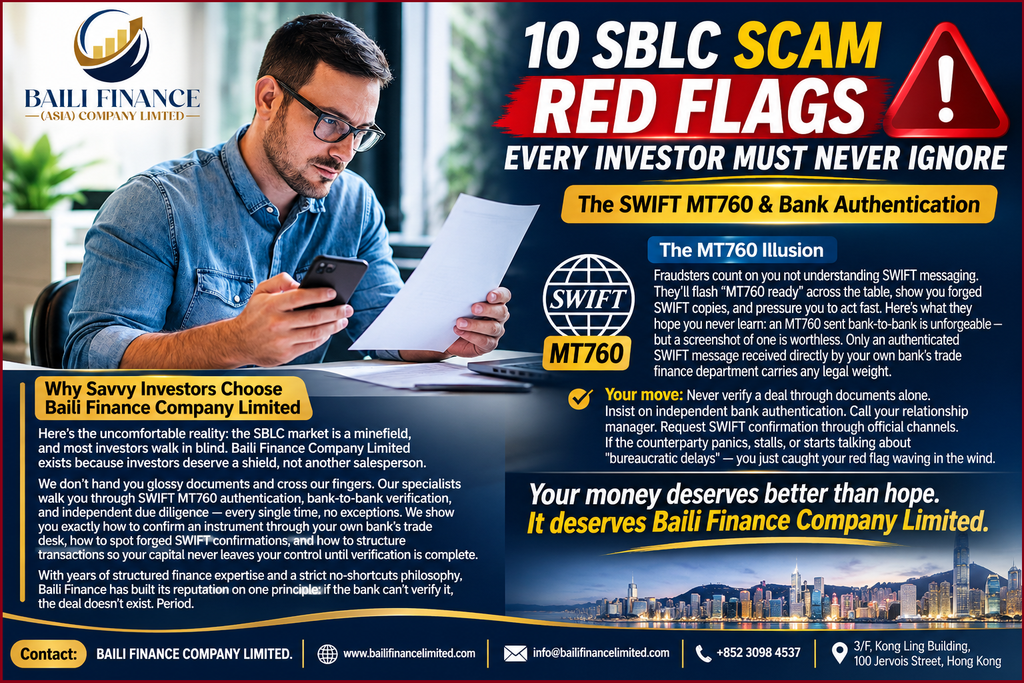
Headline: 10 SBLC Scam Red Flags Every Investor Must Know
The global demand for international financing has increased interest in Standby Letters of Credit (SBLCs), but it has also created opportunities for financial fraud. Investors and businesses must understand how to identify SBLC scam red flags before committing their capital. From fake SWIFT MT760 messages and fraudulent SBLC monetization offers to advance-fee demands and impersonated banks, deceptive operators use sophisticated tactics to exploit trust and limited banking knowledge. Whether you’re considering SBLC financing or evaluating an investment proposal, understanding these warning signs, verifying banking credentials, and conducting independent due diligence can help protect your funds from costly financial losses.

Understanding SBLC scam red flags has therefore become essential for anyone considering a standby letter of credit transaction, SBLC monetization arrangement, or structured finance opportunity.
An SBLC can provide financial security when a bank issues it in support of a client’s contractual or financial obligations. Nevertheless, an authentic-looking document does not automatically establish that a bank has issued a valid instrument. Fraudsters increasingly use fabricated banking documents, impersonated financial institutions, misleading investment proposals, and counterfeit SWIFT communications to deceive unsuspecting investors.
The risks extend beyond individuals. Businesses, project developers, international traders, contractors, and institutional investors can also suffer significant financial losses when they fail to verify the parties and banking arrangements behind a proposed transaction.
The Federal Bureau of Investigation (FBI) has specifically warned about fictitious standby letters of credit used to defraud investors. Its warning identifies advance-fee demands, unverifiable banking relationships, unrealistic returns, and fraudulent SWIFT messages among the recurring characteristics of these schemes.
This guide examines ten major SBLC fraud warning signs, explains how fraudulent transactions operate, presents a documented case study, and provides a practical due diligence framework for protecting your capital.
Keywords: SBLC Scam Red Flags, SBLC scam, SBLC fraud, SBLC scam red flags, standby letter of credit scams, fake SBLC, fraudulent MT760, fake SWIFT MT799, SBLC monetization scams, SBLC investment fraud, SBLC fraud warning signs, Standby letter of credit scams, Fake SBLC investment schemes, How to verify an SBLC, SBLC MT760 verification, Fake SWIFT MT760 messages, SBLC monetization fraud, International banking scams, Advance fee SBLC scams, Legitimate SBLC financing, international banking fraud, SBLC verification, advance fee fraud, trade finance scams, investor protection, standby letter of credit verification.
What Is an SBLC and Why Do Fraudsters Target Investors?
A Standby Letter of Credit is a bank-issued financial undertaking that supports an applicant’s obligation to a beneficiary. If the applicant fails to meet the obligation specified in the instrument, the beneficiary may present the documents required under its terms and request payment from the issuing bank.
Businesses commonly use SBLCs to support:
- International trade transactions.
- Commercial payment obligations.
- Project financing arrangements.
- Credit enhancement.
- Contractual performance obligations.
- Certain financing and collateral arrangements.
Unlike an ordinary investment product, an SBLC does not represent a security that investors can simply purchase and trade for speculative profit.
The distinction matters.
Fraudsters often promote SBLCs as financial instruments that investors can buy at a discount, monetize immediately, or use to access extraordinary returns without meaningful risk. These claims can create a false impression that the instrument itself generates investment income.
In reality, a legitimate transaction requires an identifiable commercial or financial purpose, appropriate banking involvement, verifiable counterparties, and properly documented obligations.
The FBI explicitly warns that SBLCs are not investment vehicles that investors can purchase and trade. It also identifies fictitious SBLC offerings as a source of significant financial losses.
10 SBLC Scam Red Flags Every Investor Must Know
1. Advance Fee Demands Before Independent Banking Verification
One of the most important warning signs in SBLC transactions is an advance payment request that has not been properly verified.
Let’s be clear: Financial institutions, banks, and legitimate service providers may require advance payments or upfront fees as part of genuine financial transactions. Such payments are not automatically evidence of fraud. Depending on the transaction structure, fees may cover application processing, due diligence, legal services, bank charges, instrument issuance, SWIFT transmission, amendments, or other agreed professional services.
However, investors and businesses must never assume that a payment request is legitimate simply because it comes from someone claiming to represent a bank, financial institution, SBLC provider, or investment company.
Fraudulent operators can exploit this expectation by demanding upfront payments for supposed issuance fees, activation charges, SWIFT processing, compliance certificates, registration, bank guarantees, or monetization arrangements. They may promise access to millions of dollars in financing while providing little or no independently verifiable evidence that the proposed transaction has genuine banking support.
For example, an intermediary may promise to arrange a $20 million SBLC but request an initial $50,000 payment before the applicant has independently verified the issuing bank, confirmed the transaction structure, or established the recipient’s authority to collect the funds. After receiving the initial payment, the intermediary may introduce additional charges under different descriptions, including authentication fees, amendment costs, tax clearance, or unexpected administrative expenses.
This is where investors and businesses must exercise extreme caution.
An advance fee is not automatically a scam, but an unverified payment demand is a serious risk. Before transferring any money, conduct thorough due diligence and establish exactly who is requesting payment, why it is required, and whether the request is supported by a genuine and documented transaction.
Before making any payment, verify the following:
- Payment Recipient: Who exactly receives the money? Is the recipient the issuing bank, an authorized financial institution, a licensed service provider, or an independent intermediary?
- Purpose of Payment: What specific service does the fee cover? Is it clearly explained and itemized?
- Authority to Collect: Does the recipient have a legitimate contractual or institutional role in the proposed transaction?
- Independent Banking Confirmation: Can the relevant bank independently confirm its involvement through verified official banking communication channels?
- Written Agreement: Are the fees, payment milestones, refund conditions, responsibilities, and consequences of non-performance clearly documented?
- Payment Instructions: Do the beneficiary’s account name and banking details match the verified contractual arrangements?
- Additional Charges: Are all expected fees disclosed in advance, or does the intermediary repeatedly introduce new payment demands?
- Refund and Accountability: What happens if the transaction is rejected, delayed, or never completed?
The Brutal Truth: Never release substantial funds based solely on promises, WhatsApp messages, emails, screenshots, draft instruments, certificates, or verbal assurances. Verify the institution, the transaction, the payment recipient, and the contractual obligations independently before committing your money.
In international finance, due diligence is not optional. It is your first line of protection against financial loss.

2. Unrealistic Returns and Guaranteed Investment Profits
Promises of extraordinary returns with little or no risk should immediately attract scrutiny.
Some fraudulent SBLC promoters advertise guaranteed returns of 30%, 50%, 100%, or even higher percentages within a short period.
Others claim that investors can generate substantial profits through secret bank trading programmes, private placement programmes, or exclusive financial platforms.
These proposals frequently rely on complicated terminology to make unsupported financial claims appear credible.
A genuine financing arrangement requires a commercially understandable explanation of where the money comes from, who assumes the financial obligation, how repayment works, and which parties bear the risks.
No legitimate financial instrument eliminates all commercial, counterparty, credit, legal, and operational risks.
Before accepting a projected return, request:
- A complete explanation of the investment or financing structure.
- Identification of the actual source of funds.
- Independent confirmation of participating financial institutions.
- Documented contractual obligations.
- A clear explanation of the risks and repayment arrangements.
- Evidence supporting the projected financial performance.
If the promoter cannot explain how the transaction generates its promised returns, do not proceed.
3. Fake SWIFT MT760 and MT799 Messages
SWIFT messaging plays an important role in international banking communications.
In SBLC transactions, MT760 commonly serves as the SWIFT message type used to issue a guarantee or standby letter of credit. MT799 is a free-format message type that banks may use for authenticated communications.
Unfortunately, fraudsters exploit the technical complexity of these messages.
They may circulate fabricated SWIFT documents, screenshots, transmission confirmations, or purported bank communications to convince investors that an SBLC exists.
Some even use genuine bank names, copied logos, fabricated reference numbers, and impersonated banking personnel.
An investor who receives an impressive-looking MT760 document should not assume that the instrument exists.
A screenshot is not independent banking authentication. A PDF is not proof of issuance. A SWIFT reference number alone does not establish that a valid SBLC exists.
The appropriate verification process should involve the relevant financial institutions through independently obtained, official communication channels.
Do not rely exclusively on telephone numbers, email addresses, or banking contacts supplied by the intermediary promoting the transaction.
For additional protection, ask the receiving or advising bank to explain its authentication procedures and confirm what it can independently establish.
4. Unverified Banks and Misrepresented Banking Relationships
A fraudulent SBLC proposal may claim that a major international bank has approved an instrument or committed to provide financing.
The promoter might mention well-known institutions to create confidence and discourage further investigation.
However, referencing a bank does not establish that the institution has approved, issued, advised, or confirmed anything.
Fraudsters can misuse the names of legitimate banks without their knowledge or authorization.
Before proceeding, establish:
- The exact legal name of the issuing bank.
- The identity of the applicant.
- The intended beneficiary.
- The bank’s actual role in the transaction.
- Whether an advising or confirming bank participates.
- Whether the bank independently recognizes the proposed arrangement.
Use official bank websites and independently sourced contact details to establish communication.
Where appropriate, ask the bank to confirm the authenticity of the instrument through its authorized trade finance department.
A broker’s relationship with a bank, even if genuine, does not automatically establish that the bank has approved a particular transaction.

5. Pressure to Sign Confidentiality Agreements Before Due Diligence
Confidentiality agreements serve legitimate purposes in international finance. They protect commercially sensitive information and restrict unauthorized disclosure.
However, fraudulent operators sometimes use excessive secrecy to prevent investors from conducting independent checks.
They may insist that investors cannot contact the issuing bank, consult independent lawyers, verify the transaction structure, or request documentary evidence.
Some claim that disclosure would violate international banking regulations or jeopardize a supposedly exclusive funding programme.
These statements deserve careful examination.
A confidentiality agreement should not prevent a party from obtaining independent legal advice or conducting reasonable verification through authorized channels.
Before signing, review the document carefully.
Pay particular attention to provisions concerning:
- Restrictions on contacting banks.
- Penalties for conducting independent verification.
- Unreasonable confidentiality obligations.
- Exclusivity arrangements.
- Unclear intermediary responsibilities.
- Disproportionate financial penalties.
A legitimate financial transaction should withstand appropriate professional scrutiny.

6. Unclear SBLC Monetization Arrangements
SBLC monetization refers broadly to financing arrangements in which an eligible standby letter of credit supports a lending or liquidity facility.
However, fraudsters frequently misrepresent monetization as an automatic process.
They may claim that any SBLC can generate immediate cash, regardless of the issuing bank, applicant, beneficiary, transaction purpose, collateral arrangements, or underlying financial obligations.
That is not a reliable description of institutional financing.
A financing institution must evaluate the instrument, its issuer, its terms, the proposed structure, and the relevant counterparty risks.
An SBLC does not automatically create an entitlement to funding.
Before accepting a monetization proposal, request written answers to the following questions:
- Which institution will provide the financing?
- What role does the SBLC play in the proposed facility?
- What amount will the lender consider?
- What financing conditions apply?
- What fees and deductions will apply?
- What happens if the lender rejects the instrument?
- What are the repayment and recourse provisions?
Pay particular attention to claims involving non-recourse funding.
Non-recourse financing has a specific contractual meaning. It does not mean that every borrower automatically receives money without repayment obligations, conditions, or exposure to legal consequences.
7. Brokers Who Cannot Establish Their Authority
International SBLC transactions can involve applicants, beneficiaries, issuing banks, advising banks, confirming banks, lenders, financial advisers, and intermediaries.
Not every broker has the same authority or responsibilities.
A fraudulent intermediary may claim to represent a bank, institutional investor, private lender, or international financial group without providing credible evidence.
Others may introduce several layers of brokers, each claiming exclusive access to the same funding source.
This creates uncertainty about who actually controls the transaction.
Before engaging an intermediary, establish:
- Their legal business identity.
- Their registered business address.
- Their contractual role.
- Their authority to represent the relevant party.
- Their compensation arrangements.
- Their beneficial ownership, where relevant.
- Their professional references and transaction history.
Verify these details independently.
Where an intermediary claims to represent a financial institution, contact that institution directly through its official channels.
A professional presentation and an extensive contact list do not replace evidence of authority.
8. Unusual Escrow Arrangements and Unexplained Payment Instructions
Escrow arrangements can provide a useful mechanism for managing certain commercial transactions.
Nevertheless, an escrow account does not automatically protect an investor.
Fraudsters may direct payments into accounts controlled by unrelated companies, private individuals, shell entities, or intermediaries.
They may also use the reputation of an attorney or escrow provider to create false confidence.
Before accepting an escrow arrangement, establish:
- The legal identity of the escrow agent.
- The jurisdiction governing the arrangement.
- The ownership and control of the account.
- The conditions governing release of funds.
- The circumstances permitting refunds.
- The dispute-resolution procedure.
- Whether the escrow agent has a genuine and documented role.
Do not assume that an account is safe merely because someone describes it as a lawyer’s escrow account.
Independently contact the escrow provider using verified contact information.
Also confirm that the payment beneficiary matches the contractual instructions.
An unexplained request to transfer funds to a third party should trigger additional scrutiny.
9. Missing Documentation and Inconsistent Transaction Details
Documentation provides the foundation for effective financial due diligence.
A legitimate SBLC proposal should have a coherent commercial purpose and documentation that identifies the parties, their responsibilities, and the proposed banking arrangements.
Fraudulent proposals frequently contain inconsistencies.
For example:
- Different company names appear across documents.
- The beneficiary changes without a clear explanation.
- Bank addresses do not match official records.
- Signatures appear inconsistent.
- The transaction amount changes between agreements.
- Expiry dates contradict other documents.
- The underlying commercial obligation remains unexplained.
- Documents contain suspicious alterations or fabricated references.
Investors should also examine whether the proposed SBLC terms match the underlying contract.
An independent legal and financial review can identify discrepancies before they become expensive problems.
For complex transactions, verify corporate registration, beneficial ownership, source of funds, sanctions exposure, and the commercial rationale.
The FFIEC’s trade finance guidance highlights the importance of customer due diligence, reliable documentation, and identifying unusual transaction structures.
10. Refusal to Allow Independent Professional Verification
Perhaps the most important warning sign is an intermediary who discourages independent verification.
A promoter may become aggressive when an investor requests legal review, direct bank authentication, or documentary evidence.
They might claim that the transaction will disappear if the investor does not pay immediately.
Others use artificial deadlines, exclusive opportunities, or threats of losing access to a funding programme.
Professional financial transactions require careful assessment.
No investor should allow urgency to replace due diligence.
Before committing capital, consult qualified banking professionals, independent legal advisers, and relevant compliance specialists.
If the promoter refuses reasonable verification, withdraw from the proposed arrangement until the concerns have been resolved.
Protecting capital should always take priority over meeting an intermediary’s deadline.
Real-World Example: How an SBLC Scam Can Target an Investor
Consider an illustrative international financing scenario.
A company seeks $15 million to finance a commercial infrastructure project. During its search for funding, the company meets an intermediary who claims to have access to a large international banking network.
The intermediary proposes an SBLC-backed financing arrangement.
He promises that a bank will issue a $25 million SBLC, which a private institutional lender will supposedly monetize.
The proposed financing sounds attractive because the intermediary promises a rapid process and claims that the borrower will not need to provide conventional collateral.
However, several problems emerge.
First, the intermediary requests $40,000 in advance for documentation and SWIFT processing.
Second, he provides a purported MT799 message and a draft MT760 document bearing the name of a recognized international bank.
Third, he refuses to allow the company’s legal adviser to contact the bank directly.
Fourth, he insists that the company transfer the advance fee to an offshore consulting company rather than an identified banking institution.
Finally, he warns that the financing opportunity will disappear unless payment arrives within 48 hours.
The company’s management decides to investigate.
Its legal adviser independently contacts the named bank and discovers that the institution cannot confirm the proposed arrangement.
The company also finds that the consulting company’s contractual role remains unclear.
Consequently, management suspends the transaction and refuses to transfer the money.
What This Example Teaches Investors
The proposed transaction contained several recognizable SBLC fraud warning signs:
- Advance-Fee Demand: An upfront payment was requested. Investors must understand that advance fees are commonly demanded in legitimate SBLC and banking transactions. Banks and financial institutions may require payment for processing, due diligence, issuance, SWIFT transmission, legal work, and other agreed services. Therefore, the mere request for an advance fee does not establish fraud. The critical issue is whether the payment request, recipient, purpose, and underlying banking arrangement can be independently verified.
- Unverified Banking Involvement: The claimed issuing bank’s participation had not been independently confirmed through official banking channels.
- Suspicious SWIFT Documentation: The documents provided did not establish that an authentic, bank-to-bank SWIFT transaction had taken place.
- Unclear Intermediary Authority: There was insufficient evidence that the intermediary had the authority to represent the bank or collect transaction fees.
- Unexplained Payment Instructions: The requested payment lacked adequate documentation establishing its purpose, beneficiary, and contractual basis.
- Pressure to Complete Immediately: The company was encouraged to make payment quickly without sufficient time for independent due diligence.
The Key Lesson: Advance payments are a normal feature of many legitimate financial transactions, including SBLC arrangements. However, investors and businesses must never confuse a legitimate fee requirement with proof that a transaction is genuine. Every payment demand must be scrutinized, documented, and independently verified before funds are released.
In this case, the company avoided a potential financial loss because it investigated the transaction, questioned the payment requirements, and verified the available banking information before transferring any money.
The central lesson is straightforward: authenticate the banking arrangement before committing capital.
Case Study: The FBI’s Warning About Fictitious SBLC Schemes
One of the most relevant documented warnings concerning SBLC fraud comes from the FBI’s Internet Crime Complaint Center (IC3).
On March 18, 2019, the FBI published a public service announcement titled FBI Warns of Fraud Actors Scamming Investors Through Fictitious Standby Letters of Credit.
The warning followed complaints involving fraudsters who fabricated financial industry relationships and claimed access to international commodities markets.
According to the FBI, these operators used purported connections to legitimate banks to persuade investors that they could access substantial financing.
The warning identified several recurring practices.
First, counterfeit banking communications.
Fraudsters used fabricated SWIFT messages and documents, including purported MT799 and MT760 communications, to make their proposals appear authentic.
Second, advance-fee demands.
Advance payments are commonly required in legitimate banking, SBLC, BG, financing, and investment transactions. Financial institutions and authorized service providers may demand upfront fees to cover application processing, due diligence, legal services, instrument issuance, SWIFT transmission, and other agreed transaction costs.
However, the fact that an advance fee is requested does not automatically make a transaction legitimate. In this case, victims were asked to make upfront payments before receiving the promised financing or investment benefits, without sufficient independent verification of the institutions involved, the payment recipients, or the underlying transaction.
The lesson is clear: Never assume an advance-fee demand is genuine simply because upfront payments are normal in financial transactions. Verify the institution, payment purpose, recipient, contractual obligations, and banking arrangements independently before releasing any funds.
Third, misleading investment promises.
Some promoters advertised disproportionate returns or loans with little or no repayment risk.
Fourth, secrecy and unverifiable relationships.
Fraudsters referenced legitimate financial institutions without their authorization and discouraged independent investigation.
Fifth, misleading monetization claims.
The FBI identified the term “monetize” among the language frequently associated with these schemes.
Most importantly, the FBI clarified that SBLCs are not investment vehicles that individuals can purchase and trade for speculative profits.
Lessons From the FBI Case Study
The warning establishes several important principles for investors.
- Never equate an SBLC document with proof of a genuine bank commitment.
- Verify every financial institution independently.
- Treat advance-fee demands with appropriate scrutiny.
- Investigate unrealistic funding and investment promises.
- Understand the actual purpose of the financial instrument.
- Do not allow secrecy or urgency to undermine professional due diligence.
Read the original announcement directly from the FBI:
External authority: FBI IC3 – Fraud Warning on Fictitious Standby Letters of Credit.
This is an important reference for anyone researching SBLC investment scams, fake SWIFT messages, and international banking fraud.
How to Verify an SBLC Before Entering a Transaction
Recognizing warning signs is important. However, investors also need a practical verification process.
The following steps can help reduce exposure to fraudulent financial proposals.
Step 1: Verify the Issuing Financial Institution
Identify the exact issuing institution and independently establish its involvement.
Use official communication channels rather than contact details supplied exclusively by an intermediary.
Step 2: Authenticate the Banking Communication
Ask the relevant bank to explain its procedures for confirming the authenticity of the instrument.
Do not rely on screenshots, emailed PDFs, or unverified SWIFT references.
Step 3: Establish the Commercial Purpose
Identify the underlying financial or contractual obligation that the SBLC supports.
A proposal without a clear commercial rationale requires further investigation.
Step 4: Conduct Corporate Due Diligence
Investigate every significant participant.
Review corporate registrations, directors, beneficial ownership, business activities, reputation, and relevant regulatory information.
Step 5: Review All Agreements
Have an independent lawyer examine the proposed instrument, financing agreement, intermediary agreement, escrow provisions, fees, expiry conditions, and dispute-resolution clauses.
Step 6: Confirm the Financing Structure
If the transaction involves SBLC monetization, identify the actual lender and obtain a clear explanation of the financing terms.
Confirm the proposed loan amount, fees, repayment obligations, recourse provisions, and conditions precedent.
Step 7: Verify Payment Instructions
Check the recipient’s legal identity and the contractual basis for every requested payment.
Do not transfer money to unrelated third parties without a documented and independently verified reason.
Step 8: Maintain a Complete Transaction Record
Keep copies of correspondence, agreements, invoices, banking confirmations, due diligence findings, and payment records.
Good documentation supports accountability and can assist investigators if a dispute or suspected fraud arises.
Why Professional SBLC Due Diligence Matters
International finance involves multiple parties, jurisdictions, banking relationships, contractual obligations, and compliance requirements.
A single document cannot establish the integrity of an entire transaction.
The Financial Action Task Force, banking regulators, and financial institutions emphasize the importance of customer identification, source-of-funds checks, beneficial ownership transparency, and transaction monitoring.
The Financial Action Task Force’s work on trade-based money laundering also provides useful background for understanding financial crime risks associated with international commerce.
For further technical guidance, investors and businesses can consult the FFIEC Bank Secrecy Act and Anti-Money Laundering Examination Manual – Trade Finance Activities.
This guidance explains how banks assess applicants, beneficiaries, transaction documents, and suspicious trade finance activity.
For investors, the practical message is clear: verify the parties, understand the structure, and establish the authenticity of the banking commitment before making financial decisions.
Frequently Asked Questions About SBLC Scams
1. What are the biggest warning signs of an SBLC scam?
The most significant warning signs include advance-fee demands, unrealistic financial returns, counterfeit SWIFT MT760 or MT799 messages, unverified issuing banks, unauthorized intermediaries, suspicious escrow arrangements, excessive secrecy, and pressure to transfer money immediately.
A single warning sign does not necessarily establish fraud. However, several unexplained inconsistencies should prompt investors to suspend the transaction and investigate.
2. Can someone purchase an SBLC as an investment?
An SBLC is not a conventional investment security that individuals can purchase and trade to generate speculative profits.
It is a bank-issued undertaking that supports specified financial or contractual obligations.
Some legitimate financing structures involve SBLCs as collateral or credit support. However, this does not make the SBLC itself a freely tradable investment product.
The FBI specifically warns investors against attempts to purchase or invest in SBLCs as standalone investment opportunities.
3. How can I verify whether an SBLC MT760 is genuine?
The appropriate approach involves independent authentication through the relevant financial institutions.
Contact the issuing or advising bank through independently verified official channels and ask it to explain the applicable authentication process.
Do not treat a PDF, screenshot, SWIFT reference number, or intermediary’s confirmation as conclusive proof.
The receiving bank’s ability to authenticate the communication and confirm its role is particularly important.
4. Is SBLC monetization legitimate?
SBLC-backed financing can form part of legitimate structured lending arrangements.
However, monetization is not automatic. A financing institution must assess the issuing bank, instrument terms, transaction structure, counterparty risk, and applicable lending conditions.
Claims that every SBLC can generate immediate cash or guaranteed profits should receive careful scrutiny.
5. Do legitimate SBLC transactions require advance fees?
Some legitimate transactions involve banking charges, professional fees, legal costs, and intermediary compensation.
However, investors should never assume that a requested advance payment is legitimate merely because the promoter describes it as a standard banking requirement.
Verify the recipient, contractual basis, service provided, refund conditions, and the relevant institution’s involvement before making payment.
6. Can a legitimate bank be associated with a fraudulent SBLC proposal?
Yes. Fraudsters can misuse the names, logos, addresses, and identities of genuine financial institutions.
A bank’s reputation does not validate a transaction merely because its name appears on a document.
Investors must independently establish whether the bank actually participates in the proposed arrangement.
7. What should I do if I suspect an SBLC scam?
Stop further payments and preserve all transaction records.
Save emails, messages, contracts, payment instructions, bank details, purported SWIFT documents, and communications with intermediaries.
Contact your bank immediately if you have transferred funds or disclosed sensitive financial information.
Seek independent legal advice and report suspected criminal activity to the appropriate financial crime or law enforcement authorities in the relevant jurisdiction.
Where appropriate, notify the relevant financial regulator.
8. Is an SBLC issued through SWIFT MT760 automatically genuine?
No.
MT760 is an established SWIFT message type used for issuing guarantees and standby letters of credit. However, a document claiming to represent an MT760 message does not establish that the issuing bank transmitted an authentic message.
Investors and beneficiaries should rely on appropriate independent banking authentication rather than the appearance of a document.
9. What documents should investors review before an SBLC transaction?
Depending on the transaction, relevant documents may include:
- The proposed SBLC wording.
- The underlying commercial agreement.
- Applicant and beneficiary identification.
- Corporate registration documents.
- The issuing bank’s identity and role.
- Financing and monetization agreements.
- Fee agreements.
- Escrow arrangements, where applicable.
- Compliance and source-of-funds documentation.
The precise requirements depend on the transaction, jurisdiction, banking procedures, and applicable legal framework.
10. How can I identify a credible SBLC financing partner?
Start by establishing the company’s legal identity, business history, contractual role, and authority to represent the relevant transaction participants.
Request a transparent explanation of the financing structure and its associated costs.
Verify all claimed banking relationships independently, review contractual documents with qualified professionals, and ensure that the company does not discourage legitimate due diligence.
A credible commercial relationship should permit reasonable questions and independent professional assessment.
Conclusion: Protect Your Capital Before Committing to an SBLC Transaction
SBLC financing can support international commerce, commercial obligations, project development, and structured lending. However, the complexity of international banking creates opportunities for fraudsters to exploit investors who rely on promises instead of verification.
The ten SBLC scam red flags discussed in this article provide a practical foundation for identifying suspicious proposals.
From advance-fee demands and counterfeit SWIFT messages to unverified banking relationships, unrealistic returns, and misleading monetization claims, each warning sign deserves careful attention.
Most importantly, remember that an SBLC is a financial undertaking, not a guaranteed investment opportunity. Its value and practical usefulness depend on its actual issuing institution, terms, beneficiary, underlying obligation, and the applicable banking arrangements.
Before committing capital, verify the parties, authenticate the banking communications, review the agreements, investigate the source of funds, and seek independent professional advice.
In international finance, informed decisions begin with independent verification.
Looking for a Professional Approach to SBLC Financing?
If your company requires information about standby letters of credit, bank guarantees, international trade finance, or structured financing arrangements, working with an experienced financial services partner can help you understand the transaction requirements before making a commitment.
BAILI FINANCE (ASIA) COMPANY LIMITED welcomes enquiries from qualified businesses, corporate clients, project developers, contractors, and international trading companies seeking to discuss their financing requirements.
Before proceeding with any proposed arrangement, our team encourages clients to understand the commercial purpose, documentation requirements, applicable banking procedures, and due diligence considerations.
Do not commit your capital based on unverified promises. Start with a professional discussion.
Contact Baili Finance Limited today:
- Website: https://www.bailifinancelimited.com/
- Email: info@bailifinancelimited.com
- Telephone: +852 3098 4537
- Office: Hong Kong
Request a confidential discussion about your SBLC or trade finance requirements.
Your next financial decision deserves proper scrutiny, transparent communication, and a clearly understood transaction structure.
Intermediaries/Consultants/Brokers are welcome to bring their clients 100% protected. Our brokers receive 2% commission for referral. We assist Clients and brokers in their attempt to secure funding by working on their funding requests that may require innovative financing. In complete confidence, we will work together for the benefits of all parties involved.
#SBLC #SBLCScam #SBLCFraud #StandbyLetterOfCredit #SBLCMonetization #TradeFinance #InternationalBanking #FinancialFraud #InvestorProtection #StructuredFinance