
Headline: SME Loans: MINING PROJECT FINANCE: 7 WAYS TO SECURE CAPITAL
An executive guide to mining development finance, structured funding, investment readiness, capital mobilisation and long-term project sustainability.
Mining project finance plays a central role in developing mineral resources, expanding mining operations and bringing commercially viable mineral deposits into production. From gold, copper and iron ore to lithium, cobalt, nickel and other strategic minerals, mining companies require substantial capital to finance exploration, mine construction, processing facilities, equipment procurement, infrastructure and operational expansion.
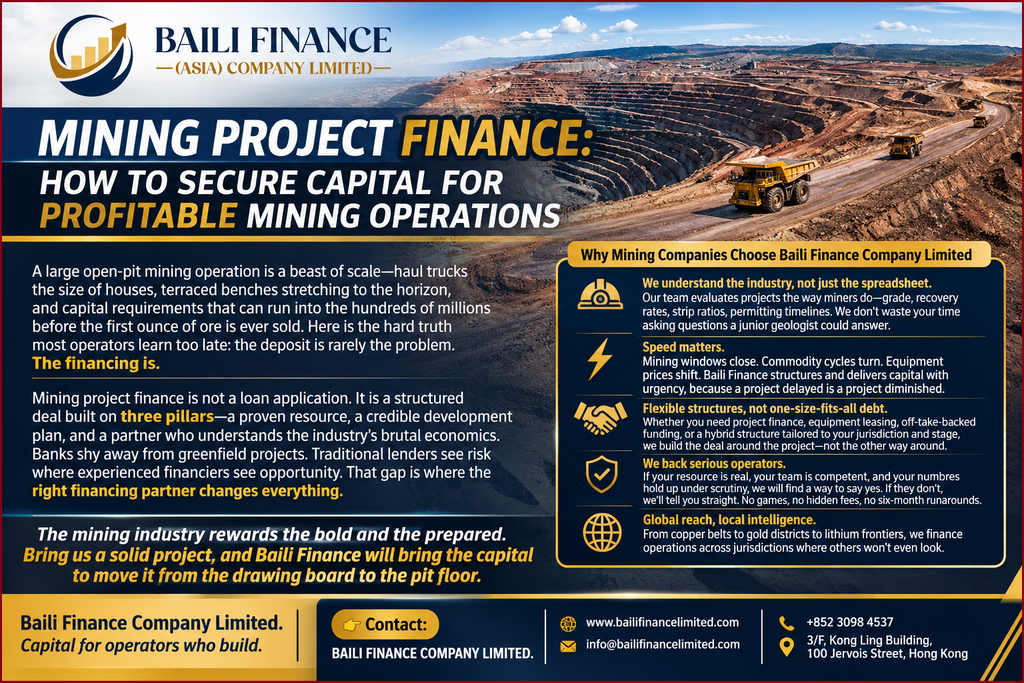
However, securing mining project funding involves more than identifying a lender or presenting an investment proposal. Investors and financial institutions assess geological confidence, mineral reserves, project economics, management experience, regulatory compliance, environmental obligations, commodity price exposure and the ability to generate sufficient cash flow to repay financing.
For mining companies, project developers and investors, understanding how mining project finance works, which funding structures are available and what lenders expect can make a significant difference to a project’s financing prospects.
Whether a company intends to develop a new gold mine, expand an existing copper operation, establish a lithium processing facility or acquire an advanced-stage mining asset, the financing strategy must reflect the project’s development stage, capital requirements and commercial objectives.
This guide examines the principal mining project finance structures, funding sources, lender requirements, financial risks and investment considerations. It also examines a documented international mining transaction and a separate illustrative case study to demonstrate how companies can approach the financing process.
Keywords: Mining Project Finance. Mining Finance, Mining Project Funding, Mining Investment, Mining Development Finance, Mining Financing Solutions, Mining Capital Raising, Mining Structured Finance, International Project Finance, How to secure mining project finance, International financing for mining projects, Financing solutions for gold mining projects, How mining companies raise development capital, Structured finance for mining companies, Mining project funding requirements, Financing for copper and lithium mining projects, Mining project loans and investment opportunities, How to finance a new mining development, Bank financing for mining infrastructure projects.
1. What Is Mining Project Finance?
Mining project finance refers to the funding of a mining development or operating asset through a combination of debt, equity, structured finance and other capital arrangements.
Unlike conventional corporate lending, project finance places significant emphasis on the financial performance and projected cash flows of the underlying mining project.
Depending on the transaction, lenders may rely primarily on the project’s assets, contractual revenues, reserves, offtake agreements and other project-related rights when assessing repayment capacity.
In a limited-recourse financing structure, lenders generally have recourse primarily to the project company and its assets, subject to negotiated exceptions, guarantees and completion support arrangements. In a non-recourse structure, lenders rely more heavily on project cash flows and security over project assets rather than the wider balance sheet of the sponsor.
Nevertheless, mining finance transactions rarely follow one universal structure. The appropriate arrangement depends on the sponsor’s financial position, project maturity, jurisdiction, risk allocation and lender requirements.
Mining project finance can support several activities, including:
- Greenfield mine development.
- Brownfield mine expansion.
- Mineral exploration and resource development.
- Underground and open-pit mine construction.
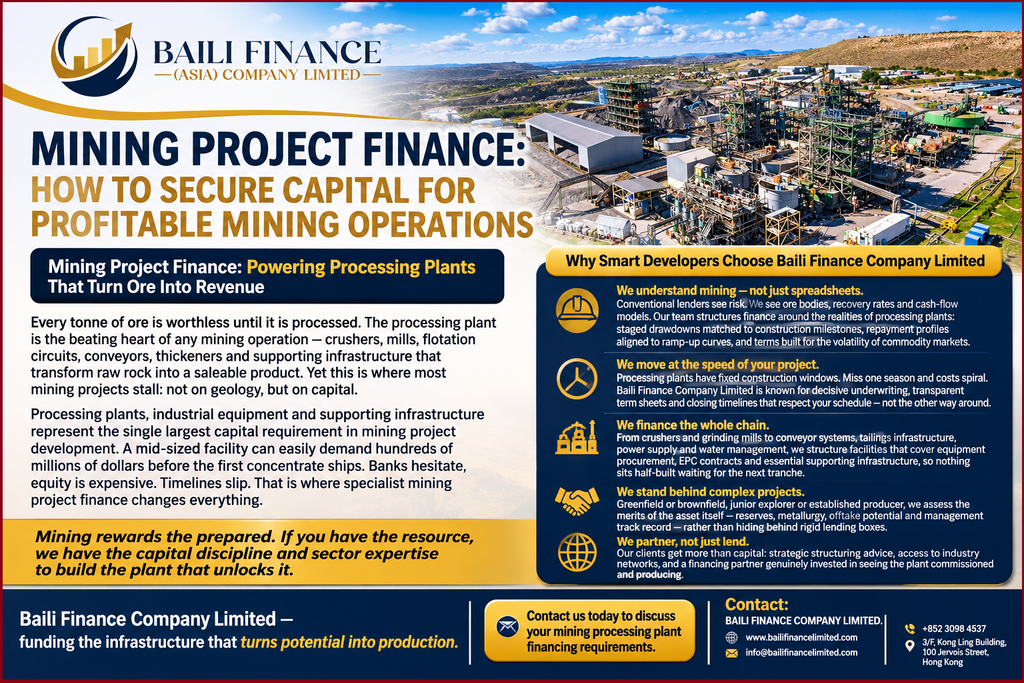
- Mineral processing and beneficiation facilities.
- Mining equipment and infrastructure acquisition.
- Refinancing of existing mining obligations.
- Working capital and production expansion.
- Acquisition of mining concessions and operating assets.
- Development of critical mineral and battery mineral projects.
The principal objective is to establish a sustainable funding structure that allows the project to reach commercial production while maintaining an acceptable financial risk profile.
2. Why Mining Projects Require Specialised Financing
Mining projects have financial characteristics that distinguish them from many other commercial developments.
First, they require substantial upfront capital. A mining company may need to invest in geological surveys, drilling, engineering studies, land access, roads, power infrastructure, processing plants, heavy machinery and environmental management before generating its first commercial revenue.
Second, the development period can extend over several years. During this period, the project may generate little or no operating income while continuing to incur construction, professional and financing expenses.
Third, mineral production carries geological and operational uncertainty. Even where a deposit contains commercially attractive mineralisation, actual production may differ from initial forecasts because of ore grades, recovery rates, mining conditions or processing performance.
Commodity price movements also influence revenue projections. A decline in copper, gold, lithium or iron ore prices can reduce operating margins and weaken debt repayment capacity.
Furthermore, governments may change royalty arrangements, tax policies, export requirements and mining regulations.
These factors explain why mining project lenders conduct extensive technical, financial, legal and environmental due diligence before committing capital.
A financially attractive mineral deposit does not automatically constitute a bankable mining project. The company must demonstrate that it can extract, process, transport and sell the mineral economically under realistic operating assumptions.
3. Major Sources of Mining Project Finance
Mining companies can access several financing channels. In many cases, combining different sources produces a more suitable capital structure than relying on a single funding instrument.
3.1 Senior Secured Project Finance
Senior secured project finance represents a major source of long-term funding for established mining developments.
Commercial banks, development finance institutions and other institutional lenders may provide facilities secured against eligible project assets, contractual rights, shares in the project company, receivables and other agreed collateral.
Lenders assess:
- The quality and classification of mineral resources and reserves.
- The project’s technical feasibility.
- Estimated construction and development costs.
- Projected production volumes.
- Commodity price assumptions.
- Operating expenditure.
- Expected debt service coverage.
- Environmental and regulatory approvals.
- The sponsor’s financial and operational capabilities.
Senior debt generally receives priority over subordinated debt and equity in the agreed payment waterfall.
However, lenders may impose financial covenants, restrictions on additional borrowing, dividend limitations, reserve requirements and conditions governing the use of loan proceeds.
3.2 Equity Financing
Equity financing involves raising capital from shareholders, institutional investors, private equity funds, strategic investors or other qualified investment participants.
Unlike debt, equity does not normally require scheduled principal repayments. However, investors receive ownership interests and may participate in future distributions and capital appreciation.
Mining equity investors typically examine:
- Mineral resource potential.
- Expected project returns.
- Management experience.
- Capital expenditure requirements.
- Jurisdictional and political risks.
- Expected production costs.
- Exit opportunities.
- Corporate governance.
Equity can be particularly important during exploration and early development, when geological and technical uncertainty may prevent the project from obtaining conventional project debt.
Nevertheless, equity financing can dilute existing shareholders. Project sponsors should therefore evaluate the cost of issuing additional ownership interests against the benefits of securing development capital.
3.3 Mezzanine Financing
Mezzanine financing occupies a position between senior debt and equity.
It may provide additional funding when senior lenders cannot finance the entire capital requirement. Depending on the transaction, mezzanine facilities may include subordinated loans, payment-in-kind interest, warrants or equity participation rights.
Mining companies may consider mezzanine capital when:
- Senior debt capacity has reached its practical limit.
- The project requires additional development funding.
- Sponsors wish to limit immediate equity dilution.
- A temporary funding gap exists before commercial production.
The cost of mezzanine capital is generally higher than senior secured debt because the lender accepts greater repayment risk.
Consequently, the company must evaluate whether projected cash flows can support the additional financing obligations.
3.4 Offtake Financing and Prepayment Agreements
An offtake agreement establishes contractual arrangements for the sale of future mineral production.
Under an offtake financing arrangement, a buyer may provide an advance payment or other financial support in exchange for agreed future deliveries of minerals or concentrates.
These structures can support mining developments by linking financing to the project’s future commercial output.
For example, a copper producer may negotiate a long-term concentrate sales agreement with a qualified commodity buyer. The agreement could include pricing mechanisms, delivery schedules, quality specifications and volume commitments.
An offtake arrangement can improve revenue visibility. However, developers must assess pricing discounts, delivery obligations, minimum production requirements and potential restrictions on selling production to alternative buyers.
3.5 Royalty and Streaming Finance
Royalty and streaming agreements provide another financing option for mining companies.
Under a royalty arrangement, an investor provides capital in exchange for a contractual entitlement to a percentage of future mineral revenue or production value.
Under a streaming agreement, a financing company advances capital in return for the right to purchase an agreed portion of future mineral production at a predetermined price or pricing formula.
These arrangements can provide development capital without requiring a conventional amortising bank loan.
However, they also transfer part of the project’s future economic value to the financing provider.
Mining companies should assess the long-term cost of these arrangements, particularly where the project has substantial production potential.
3.6 Export Credit Agency Financing
Export credit agencies (ECAs) support eligible international transactions involving the export of equipment, engineering services and other goods from their respective countries.
For mining developments, ECA-backed financing may support the acquisition of processing equipment, power systems, heavy machinery and other eligible infrastructure.
Depending on the relevant programme, an ECA may provide direct financing, insurance or guarantees that help commercial lenders participate in a transaction.
This can be particularly relevant to mining projects requiring equipment sourced from several international suppliers.
3.7 Development Finance Institutions
Development finance institutions (DFIs) can participate in mining transactions where the project meets their investment, development and risk requirements.
Institutions such as the International Finance Corporation (IFC) and the European Bank for Reconstruction and Development (EBRD) may support eligible private-sector projects through loans, equity investments, guarantees, advisory services and syndicated financing.
Their involvement can also help mobilise commercial capital.
However, DFI financing is subject to institutional mandates, eligibility requirements, due diligence and applicable environmental and social standards. It is not automatically available to every mining company.
4. Understanding the Mining Project Finance Process
A successful financing transaction requires preparation, coordination and a clear understanding of lender expectations.
Although the exact process varies, most mining project finance transactions follow several stages.
Stage 1: Project Identification and Preliminary Assessment
The company establishes the project’s commercial objectives and identifies its capital requirements.
At this stage, management should define:
- Mineral type and location.
- Ownership and concession rights.
- Exploration and development status.
- Estimated capital expenditure.
- Expected production capacity.
- Target construction and commissioning dates.
- Potential buyers and sales markets.
- Preliminary financing requirements.
The initial assessment helps determine whether the project warrants further technical and financial development.
Stage 2: Geological and Technical Due Diligence
Lenders and investors need credible evidence that the mineral deposit supports the proposed mining operation.
This requires appropriate geological studies, drilling results, mineral resource estimates, reserve assessments and technical reports.
The company should engage qualified professionals to prepare or review the relevant technical documentation.
Where applicable, recognised reporting frameworks such as the JORC Code or Canadian NI 43-101 requirements provide important standards for public reporting of mineral exploration results, resources and reserves.
The JORC Code, for example, establishes minimum standards for reporting mineral exploration results, mineral resources and ore reserves.
Technical confidence matters because lenders cannot assess repayment capacity using unverified mineral estimates.
Stage 3: Feasibility Study and Financial Modelling
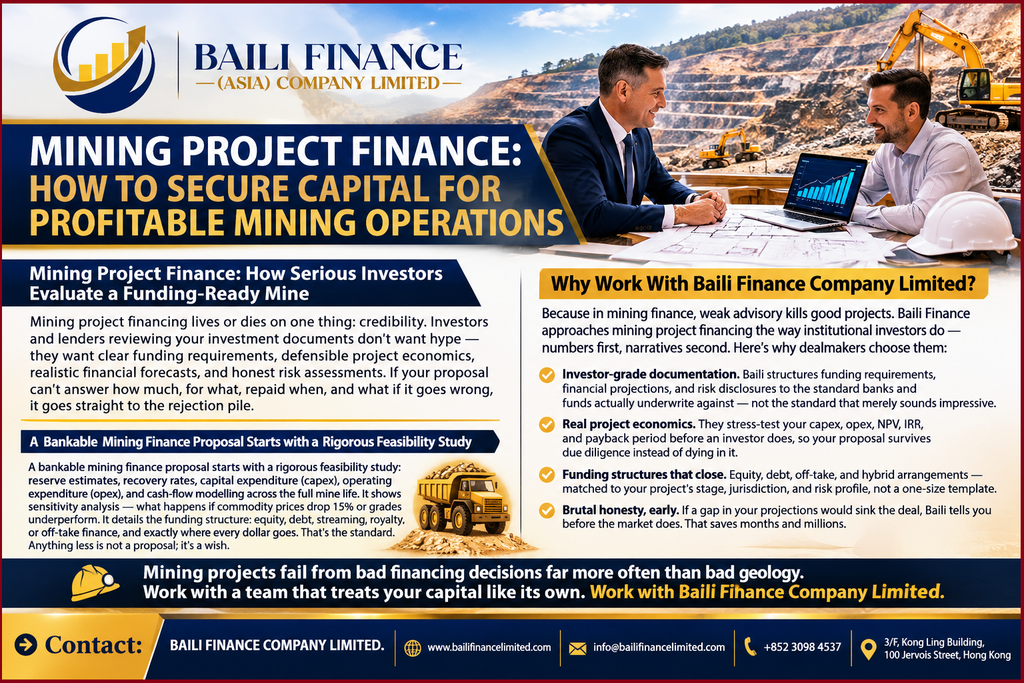
A bankable feasibility study provides a detailed assessment of whether the proposed mining operation can achieve commercial and technical objectives.
It typically examines:
- Mine design and production scheduling.
- Processing technology.
- Metallurgical recovery.
- Infrastructure requirements.
- Construction costs.
- Operating expenditure.
- Environmental obligations.
- Closure and rehabilitation costs.
- Commodity price assumptions.
- Project economics and financial returns.
The financial model should translate these assumptions into projected revenues, operating cash flows, taxes, royalties, capital expenditure and debt service requirements.
Common financial indicators include:
Net Present Value (NPV): The present value of expected project cash flows after applying an appropriate discount rate.
Internal Rate of Return (IRR): The discount rate at which the project’s NPV equals zero.
Debt Service Coverage Ratio (DSCR): The cash flow available for debt service divided by scheduled principal and interest payments.
Loan Life Coverage Ratio (LLCR): The present value of cash flow available for debt service over the remaining loan life divided by outstanding debt.
Payback Period: The time required for cumulative project cash flows to recover the initial investment.
These indicators help investors and lenders assess profitability, liquidity and repayment capacity.
Importantly, the financial model should include downside scenarios rather than relying exclusively on optimistic production and commodity price forecasts.
Stage 4: Legal, Regulatory and Environmental Due Diligence
Mining operations depend on legal rights and regulatory approvals.
A financing review may examine:
- Mining licences and concessions.
- Land ownership and access rights.
- Environmental permits.
- Water extraction and usage approvals.
- Tax and royalty obligations.
- Export licences.
- Community agreements.
- Government approvals.
- Material litigation.
- Existing security interests.
- Foreign ownership restrictions.
Environmental and social due diligence also plays a major role.
International lenders may assess projects against the applicable IFC Performance Standards, Equator Principles or other relevant institutional requirements.
The IFC framework addresses environmental and social risk management, labour conditions, pollution prevention, community health and safety, land acquisition, biodiversity, Indigenous Peoples and cultural heritage.
International Finance Corporation (IFC)+1
A company that identifies and manages these obligations early can reduce financing delays and improve its investment readiness.
Stage 5: Financing Structure and Capital Strategy
Once the project has sufficient technical and commercial documentation, management can evaluate suitable funding structures.
For example, a mining company may combine:
- Sponsor equity.
- Senior secured debt.
- Mezzanine financing.
- Offtake prepayments.
- Equipment financing.
- ECA-backed facilities.
- Strategic investment.
The objective is to create a structure that matches the project’s cash flow profile and development timeline.
A financing structure should not expose the company to debt repayments before the project can reasonably generate sufficient operating cash flow.
Stage 6: Lender Engagement and Investment Negotiations
The company prepares its financing presentation and approaches appropriate financial institutions, investors or funding partners.
The presentation should explain:
- The project’s ownership and corporate structure.
- The mineral resource and reserve position.
- The development plan.
- The total funding requirement.
- The proposed capital structure.
- The projected financial returns.
- The proposed repayment strategy.
- The project’s risk management arrangements.
- The status of permits and approvals.
- The proposed transaction timetable.
During negotiations, financing parties may discuss interest rates, maturity, repayment schedules, collateral, guarantees, covenants, conditions precedent and financial reporting obligations.
Stage 7: Documentation, Financial Close and Disbursement
Once the parties agree on the commercial terms and complete due diligence, legal advisers prepare the necessary financing documents.
Depending on the structure, these may include:
- Facility agreements.
- Security agreements.
- Share pledges.
- Account control agreements.
- Offtake agreements.
- Intercreditor agreements.
- Sponsor support agreements.
- Insurance arrangements.
- Direct agreements with major contractors.
Financial close occurs when the relevant contractual and approval requirements have been satisfied or appropriately documented.
Disbursement then follows the agreed conditions and drawdown procedures.
The company must maintain financial discipline throughout construction and operation to comply with the financing agreements.
5. What Makes a Mining Project Bankable?
Bankability refers to the extent to which a project meets the commercial, technical, financial and legal requirements of prospective financing providers.
A mining project may contain substantial mineral resources yet remain unsuitable for conventional project finance.
The following factors influence bankability.
Proven Project Economics
Investors require credible evidence that the project can generate sufficient revenue to cover operating expenses, taxes, royalties, capital requirements and financing costs.
The financial model must use realistic assumptions and account for possible market fluctuations.
Reliable Mineral Resource and Reserve Information
A project needs appropriately supported geological data and resource estimates.
The quality of the information influences mine planning, production forecasts and the credibility of the financial model.
Experienced Project Management
Investors consider the sponsor’s ability to manage engineering, procurement, construction, operations and regulatory obligations.
An experienced management team can strengthen confidence in the project’s execution capacity.
Secure Mineral Rights
The project company must demonstrate valid ownership, concession rights or legally enforceable rights to conduct the proposed mining activities.
Unresolved ownership disputes or uncertain licences can prevent financing from progressing.
Infrastructure and Logistics
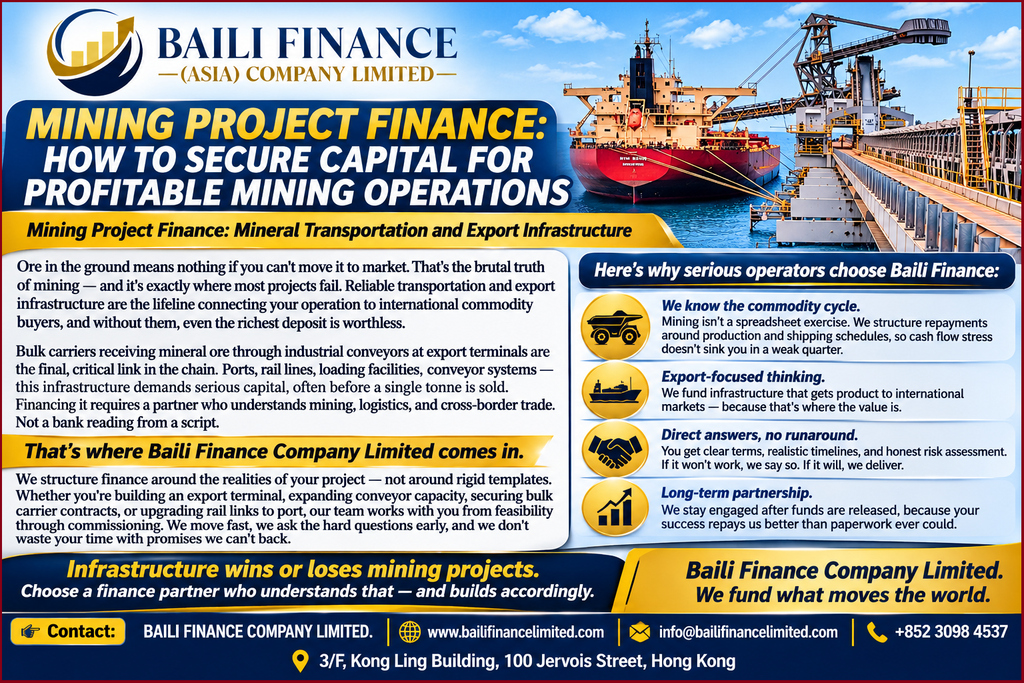
Mining operations depend on reliable access to roads, railways, ports, power, water and processing facilities.
Infrastructure limitations can increase capital expenditure and operating costs.
Offtake and Market Access
A credible sales strategy helps establish how the company will commercialise its production.
Where appropriate, long-term offtake agreements can improve revenue visibility and support lender confidence.
Environmental and Social Management
Investors increasingly examine how mining companies manage environmental impacts, local communities, labour practices, biodiversity and rehabilitation obligations.
These issues affect regulatory approvals, operating continuity and access to institutional capital.
6. Financial Risks in Mining Project Finance
Mining projects face several risks that require careful identification and mitigation.
| Risk category | Potential impact | Possible mitigation |
|---|---|---|
| Geological risk | Lower mineral grades or reserves | Independent technical studies and drilling |
| Construction risk | Delays and cost overruns | Fixed-price or appropriately structured EPC contracts |
| Commodity price risk | Reduced project revenue | Hedging and conservative price assumptions |
| Operational risk | Lower production and recovery rates | Experienced operators and maintenance programmes |
| Financing risk | Higher interest and refinancing costs | Appropriate debt structure and liquidity reserves |
| Political risk | Regulatory changes or expropriation | Political risk insurance and contractual protections |
| Environmental risk | Penalties, delays and remediation costs | Environmental management and monitoring |
| Currency risk | Exchange-rate losses | Currency matching and appropriate hedging |
| Market risk | Reduced demand or buyer concentration | Diversified sales arrangements where practical |
Commodity Price Volatility
Mining companies often sell products whose prices fluctuate in international markets.
A project that appears profitable under favourable price assumptions may become financially stressed during a prolonged market downturn.
Therefore, lenders generally expect sensitivity analysis covering different commodity prices, production levels, operating costs and exchange rates.
Construction Delays and Cost Overruns
Mining construction involves engineering complexity, procurement dependencies, contractor coordination and infrastructure development.
Delays can increase interest during construction and postpone revenue generation.
A realistic contingency allowance and effective project controls can help manage these exposures.
Political and Regulatory Risk
Mining licences, taxation, royalties, export restrictions and government policies influence long-term project economics.
Companies should assess the host country’s legal framework and obtain appropriate legal advice before committing significant capital.
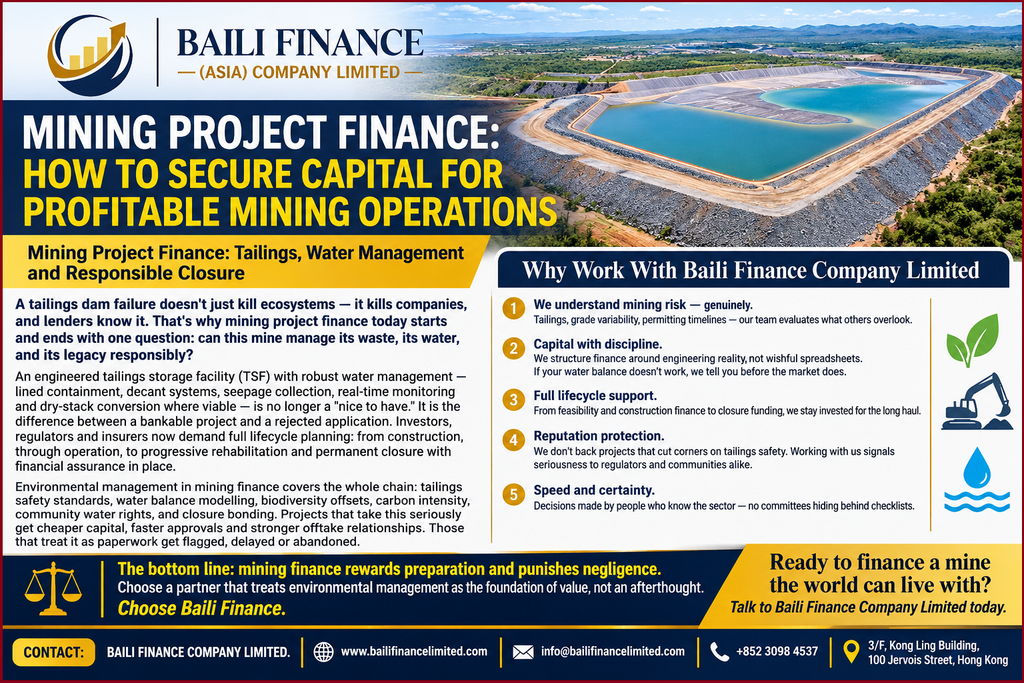
Environmental and Closure Liabilities
Mine closure is a financial obligation, not merely an operational consideration.
Companies should budget for rehabilitation, waste management, tailings facilities, water treatment and post-closure monitoring where applicable.
Ignoring these costs can distort projected returns and create future liabilities.
7. How to Prepare a Mining Project Finance Proposal
A professional financing proposal should provide enough information for a prospective lender or investor to understand the project and assess its funding requirements.
The proposal should be supported by verifiable documentation.
A standard mining project finance package may include:
1. Executive summary
A concise description of the mining operation, ownership, mineral type, development stage and funding requirement.
2. Corporate documentation
Company registration, shareholder information, beneficial ownership details, organisational structure and relevant corporate authorisations.
3. Mining rights and licences
Evidence of the company’s rights to explore, develop or operate the mining asset.
4. Geological and technical reports
Independent resource estimates, reserve reports, drilling results, mine plans and relevant feasibility studies.
5. Financial model
Projected revenue, capital expenditure, operating costs, taxes, royalties, cash flow, NPV, IRR and debt repayment analysis.
6. Environmental and social documentation
Environmental impact assessments, permits, management plans, stakeholder engagement records and rehabilitation provisions.
7. Commercial agreements
Offtake contracts, supply agreements, construction contracts and relevant infrastructure arrangements.
8. Financing proposal
The required amount, intended use of funds, proposed financing structure, repayment source, security package and expected financing period.
9. Risk management strategy
An explanation of the project’s main commercial, financial, technical, environmental and regulatory risks.
10. Supporting evidence
Relevant bank statements, sponsor financial information, insurance documentation and other materials requested during due diligence.
A well-organised data room can make document review more efficient and help prospective financing partners identify outstanding requirements.
8. Real-World Example: Oyu Tolgoi Mining Project Financing
One of the documented examples of large-scale mining project finance is the Oyu Tolgoi copper-gold mine in Mongolia.
The project demonstrates how international financial institutions, export credit agencies and commercial banks can participate in financing a major mining development.
On 15 December 2015, Oyu Tolgoi signed a US$4.4 billion project financing agreement to support the development of its underground mine.
According to Rio Tinto’s announcement, the financing involved international financial institutions, export credit agencies representing the United States, Canada and Australia, and 15 commercial banks.
The participating institutions included:
- European Bank for Reconstruction and Development (EBRD).
- International Finance Corporation (IFC).
- Export Development Canada (EDC).
- Export-Import Bank of the United States.
- Australia’s Export Finance and Insurance Corporation.
- BNP Paribas.
- Standard Chartered Bank.
- HSBC.
- ING.
- Société Générale.
- Other international commercial lenders.
The transaction also involved political risk insurance through the Multilateral Investment Guarantee Agency (MIGA).
Importantly, the project had already established an operating open-pit mine. Its underground development therefore involved an existing mining operation with production and revenue, alongside the additional development requirements.
Rio Tinto reported that the underground financing package included US$4.4 billion in initial senior loans, with a debt capacity of up to US$6 billion.
The structure also included completion support arrangements and funding from existing operations.
Global+2
The transaction illustrates several important principles:
- Large mining developments can attract capital from multiple international financing institutions.
- Existing operations and projected cash flows can contribute to the financing structure.
- Export credit agencies can participate alongside commercial banks and development finance institutions.
- Political risk insurance can support lender participation.
- Completion support and contractual arrangements can address construction-period financing risks.
For mining developers, Oyu Tolgoi demonstrates the importance of combining technical preparation, sponsor support, institutional participation and a clearly defined funding strategy.
Primary external case study: Rio Tinto – Oyu Tolgoi signs US$4.4 billion Project Finance Agreement.
9. Illustrative Case Study: Financing a Gold Mining Development
The following example is hypothetical. It demonstrates how a mining company could structure its funding requirements. It does not represent an actual transaction completed by Baili Finance Limited or a financing commitment from any named institution.
Project background
Assume a mining company owns the development rights to a gold deposit and intends to construct an open-pit mine with an associated processing facility.
The company has completed its feasibility study, obtained the principal development approvals and secured an independent technical assessment of its mineral resources and reserves.
However, the sponsor does not have sufficient internal capital to finance the entire development.
The estimated funding requirement is US$120 million.
Proposed capital structure
ILLUSTRATIVE FINANCING STRUCTURE
| Funding source | Amount | Share |
|---|---|---|
| Sponsor equity | US$30 million | 25% |
| Senior secured debt | US$60 million | 50% |
| Equipment financing | US$15 million | 12.5% |
| Offtake prepayment | US$15 million | 12.5% |
| Total | US$120 million | 100% |
Allocation of funds
The company allocates the capital as follows:
| Development requirement | Amount |
|---|---|
| Mine construction and civil works | US$35 million |
| Processing plant | US$30 million |
| Mining equipment | US$20 million |
| Roads, power and water infrastructure | US$12 million |
| Environmental and safety systems | US$5 million |
| Engineering and professional services | US$6 million |
| Working capital and contingency | US$12 million |
| Total | US$120 million |
Financing strategy
The sponsor contributes US$30 million in equity, demonstrating its financial commitment to the development.
A senior lender considers a US$60 million secured facility, subject to satisfactory technical, legal and financial due diligence.
An equipment financier provides US$15 million for eligible machinery purchases.
Meanwhile, a qualified commodity buyer considers a US$15 million prepayment arrangement in exchange for agreed future gold deliveries.
Each component has separate contractual terms, conditions and repayment or delivery obligations.
Expected financing benefits
The proposed structure distributes the funding requirement across several sources.
It also links specific financing components to identifiable project requirements.
The equipment facility supports machinery procurement, while the offtake arrangement connects part of the funding to future production.
The senior debt provides the largest portion of the construction capital, while sponsor equity demonstrates financial commitment.
However, the company must still demonstrate that projected operating cash flows can meet debt service requirements and fulfil its contractual obligations.
Lessons from the case study
This example highlights several important considerations for mining developers:
- Funding should match the project’s development requirements.
- Sponsor equity can strengthen financing credibility.
- Debt repayments should reflect the production and revenue timeline.
- Offtake obligations must remain commercially sustainable.
- Equipment financing should correspond to eligible assets.
- Contingency allowances should reflect realistic construction risks.
- The financial model must account for commodity price volatility.
A financing structure should support the project’s commercial objectives rather than introduce obligations that undermine its future cash flow.
10. The Role of Structured Finance in Mining Projects
Traditional bank loans are not always sufficient to meet the capital requirements of mining developments.
Some projects require a combination of financial instruments, credit enhancement, guarantees, liquidity arrangements and structured funding solutions.
Structured finance allows companies to consider financing arrangements that reflect the project’s particular commercial requirements.
Depending on the transaction, these arrangements may involve:
- Bank-issued financial instruments.
- Standby Letters of Credit (SBLCs).
- Bank Guarantees (BGs).
- Credit enhancement arrangements.
- Asset-backed financing.
- Structured lending.
- Trade finance.
- Receivables financing.
- Offtake-linked funding.
Standby Letters of Credit in Mining Finance
A Standby Letter of Credit (SBLC) is an independent bank undertaking that provides a beneficiary with payment protection if the applicant fails to meet specified obligations, subject to the instrument’s terms and presentation requirements.
In mining transactions, an SBLC may support eligible contractual obligations, provide credit support or help meet specified counterparty requirements.
For example, a mining company entering into an international equipment supply agreement may be required to provide a financial instrument acceptable to the supplier.
An SBLC may serve that purpose where the beneficiary, issuing bank and transaction structure accept the proposed instrument.
However, an SBLC does not automatically constitute a mining project loan. Nor does its issuance guarantee that another financial institution will provide credit or monetise the instrument.
Any proposed financing or monetisation arrangement requires independent assessment of the issuing bank, instrument wording, beneficiary, transaction documentation, applicable rules and counterparty acceptance.
Bank Guarantees in Mining Transactions
A Bank Guarantee provides a contractual undertaking by a bank to pay a beneficiary if the conditions specified in the guarantee are satisfied.
Depending on its terms, a bank guarantee may support:
- Advance payment obligations.
- Performance obligations.
- Contractual commitments.
- Certain payment obligations.
- Eligible infrastructure and construction arrangements.
For mining companies working with international contractors, suppliers and commercial counterparties, appropriately structured bank guarantees can support contractual performance and risk allocation.
The company must ensure that the instrument matches the underlying transaction and the beneficiary’s requirements.
11. How Baili Finance Limited Supports International Financing Requirements
Mining developers often require more than a conventional loan. Depending on their project structure, they may need access to international financial instruments, structured financing arrangements and credit support solutions.
Baili Finance Limited provides international financial services focused on structured finance, bank-issued financial instruments and funding solutions for eligible corporate clients.
Its stated service offerings include:
- Standby Letter of Credit (SBLC) services.
- Bank Guarantee (BG) services.
- Structured financing solutions.
- Financial instruments for eligible project funding requirements.
- Trade finance support.
- International financing arrangements.
For mining companies, the relevance of these services depends on the specific financing requirement and the acceptability of the proposed structure to the relevant financial institutions and counterparties.
For example, a mining contractor may require an appropriate bank guarantee to meet a contractual obligation. A mining developer may need an SBLC to support an eligible commercial arrangement. Another company may require assistance evaluating a structured financing proposal involving multiple counterparties.
These transactions require careful assessment of the company’s financial position, project documentation, instrument requirements and proposed use of funds.
Baili Finance Limited’s approach focuses on evaluating the financing requirement and identifying an appropriate financial structure rather than assuming that one instrument will solve every funding challenge.
Why Mining Companies Should Assess Their Financing Options Early
Financing discussions become more productive when project sponsors understand their capital requirements before approaching prospective financial partners.
Early preparation helps companies:
- Identify the appropriate financing instruments.
- Establish the project’s funding requirements.
- Assess potential collateral and credit support.
- Review the suitability of proposed bank instruments.
- Understand counterparty requirements.
- Prepare the documentation required for financial assessment.
- Identify potential financing limitations before negotiations progress.
Mining developers should also distinguish between a financial intermediary, an instrument provider, a commercial lender and an investment institution. Each performs a different function, and the parties’ respective obligations must remain clear.
For more information about Baili Finance Limited’s services, visit Baili Finance Limited – International Financial Services.
12. How to Improve Your Chances of Securing Mining Project Funding
Securing mining project finance requires a combination of technical credibility, financial preparation and effective transaction management.
The following recommendations can help project sponsors strengthen their funding proposals.
1. Establish Clear Ownership
Ensure that the mining company can demonstrate legitimate ownership, concession rights or legally enforceable interests in the mining asset.
Resolve ownership disputes before approaching financing institutions.
2. Commission Independent Technical Reports
Engage appropriately qualified geological, engineering and mining professionals to assess the deposit and proposed development.
Ensure that resource and reserve estimates follow applicable reporting standards.
3. Prepare a Credible Financial Model
Develop a financial model that reflects realistic production, commodity prices, operating expenses, capital expenditure, taxes and royalties.
Include downside scenarios and sensitivity analysis.
4. Secure Regulatory Approvals
Identify the licences, permits and authorisations required to construct and operate the mine.
Maintain a clear record of approvals already obtained and outstanding conditions.
5. Develop a Commercial Sales Strategy
Identify potential buyers, processing requirements, transportation arrangements and export markets.
Where appropriate, negotiate offtake agreements that support the proposed financing structure.
6. Demonstrate Sponsor Commitment
Investors and lenders generally want to understand the sponsor’s financial contribution and ability to support the project.
Document available equity, existing investments and relevant financial commitments.
7. Identify the Appropriate Financing Partners
Different financing institutions focus on different project sizes, minerals, jurisdictions and development stages.
A suitable funding strategy should reflect these differences.
8. Maintain a Professional Data Room
Organise corporate records, licences, feasibility studies, financial models, contracts and due diligence documents in a secure and accessible data room.
This helps reduce delays during financing reviews.
9. Address Environmental and Social Obligations
Develop practical environmental, health, safety and community engagement plans.
The company should demonstrate how it will manage these obligations throughout construction, production and closure.
10. Avoid Unrealistic Financing Expectations
No lender or financial institution should be expected to approve a transaction solely because a company possesses mining rights or has prepared a financing proposal.
Financing remains subject to credit approval, due diligence, transaction documentation, risk assessment and the institution’s internal requirements.
13. The Future of Mining Project Finance
The mining finance market continues to evolve as global industries require reliable supplies of minerals for infrastructure, manufacturing, technology and energy systems.
Copper, lithium, nickel, cobalt, graphite and rare earth elements have attracted attention because of their importance in electrical networks, batteries, electronics and industrial applications.
However, increased demand does not eliminate the commercial risks associated with mining investments.
Developers must still demonstrate that their projects can produce minerals at competitive costs, comply with applicable regulations and generate sustainable financial returns.
Several developments are likely to influence future mining finance transactions.
Critical Minerals Financing
Governments, industrial buyers and investors are paying greater attention to the security of critical mineral supply chains.
This creates opportunities for qualifying projects with credible development plans, suitable infrastructure and reliable access to markets.
Sustainability-Linked Capital
Environmental and social performance increasingly influences institutional investment decisions.
Projects that can demonstrate effective environmental management, responsible water use, emissions controls, community engagement and rehabilitation planning may be better positioned to meet the requirements of certain financing providers.
Digital Financial and Operational Reporting
Mining companies increasingly use digital systems to monitor production, equipment performance, costs, inventory and financial results.
Reliable reporting can improve management oversight and support lender monitoring requirements.
Infrastructure and Integrated Mining Development
Some mining developments require associated roads, railways, electricity generation, water infrastructure and mineral processing facilities.
Financing these components may involve multiple lenders, government participation, infrastructure investors and commercial partners.
Consequently, integrated project planning becomes important when determining the appropriate capital structure.
Greater Attention to Supply Chain Security
Industrial buyers may seek long-term supply arrangements with mining companies to reduce procurement uncertainty.
These commercial relationships can influence offtake financing, strategic investment and long-term purchasing agreements.
Ultimately, the strongest mining finance proposals will combine sound project economics, technical evidence, transparent governance and a financing structure that reflects the project’s actual risk profile.
14. Frequently Asked Questions About Mining Project Finance
The following questions address common concerns raised by mining companies, investors, project developers and commercial financing professionals.
1. What is mining project finance?
Mining project finance is the process of raising capital to develop, construct, expand or operate a mining asset. It may involve senior secured loans, equity investments, mezzanine financing, equipment finance, offtake prepayments, royalties and structured financing arrangements.
The appropriate funding structure depends on the project’s development stage, financial performance, mineral resources, ownership, jurisdiction and risk profile.
2. How do mining companies secure project finance?
Mining companies typically begin by preparing geological reports, feasibility studies, financial models, corporate documentation and regulatory approvals.
They then identify suitable financing providers and present a structured funding proposal.
Prospective lenders and investors assess the project’s technical feasibility, projected cash flows, management capabilities, collateral, environmental obligations and repayment capacity before making a financing decision.
3. Can a mining project obtain financing without an operating mine?
Yes. Some mining developments obtain financing before commercial production.
However, financing an undeveloped mine can be more challenging because the project has not yet established operating cash flows.
Early-stage projects may rely more heavily on sponsor equity, strategic investors, exploration capital, development finance and other eligible funding arrangements.
Advanced projects with completed feasibility studies, established mineral reserves and relevant permits may be better positioned to pursue construction financing.
4. What documents are required for mining project finance?
Requirements vary by lender and transaction structure. Common documents include:
- Company incorporation documents.
- Shareholder and beneficial ownership records.
- Mining licences and concessions.
- Geological and mineral reserve reports.
- Feasibility studies.
- Environmental impact assessments.
- Financial projections and business plans.
- Construction and procurement budgets.
- Offtake agreements, where available.
- Existing loan and security documents.
- Sponsor financial statements.
- Details of the proposed financing structure.
Additional documents may be required during legal, financial, technical and environmental due diligence.
5. What is the difference between corporate finance and mining project finance?
Corporate finance generally evaluates a company’s overall financial position, balance sheet, cash flows and creditworthiness.
Mining project finance focuses more directly on the economics, assets, contractual arrangements and expected cash flows of a particular mining development.
However, the two approaches can overlap. Mining companies may combine corporate borrowing with project-level debt, equity and structured financing.
6. Can an SBLC be used for mining project finance?
An SBLC may support an eligible mining-related financing or commercial transaction, depending on the requirements of the beneficiary and participating financial institutions.
It can provide payment protection or credit support under specified conditions.
However, an SBLC is not automatically a loan, and its existence does not guarantee project funding or monetisation. The issuing bank, instrument terms, beneficiary requirements and proposed transaction must all be independently assessed.
7. What are the main risks associated with mining project finance?
The main risks include geological uncertainty, construction delays, cost overruns, commodity price fluctuations, operational problems, political instability, regulatory changes, environmental liabilities and foreign exchange exposure.
Lenders and investors seek to understand how these risks could affect production, revenue, project completion and debt repayment.
Effective risk allocation, technical due diligence, insurance, contractual protections and financial contingency planning can help manage these exposures.
8. How much equity does a mining project need before securing financing?
There is no universal equity requirement.
The amount depends on the project’s size, development stage, technical risks, sponsor financial strength, jurisdiction and lender requirements.
Some transactions require substantial sponsor equity, while others may accommodate strategic investments, equipment finance, offtake arrangements and additional funding sources.
The appropriate equity contribution must be assessed as part of the overall capital structure.
9. Can international investors finance mining projects in emerging markets?
Yes. International commercial banks, institutional investors, private equity funds, development finance institutions and strategic investors may consider qualifying mining projects in emerging markets.
However, they assess country risk, political stability, foreign investment regulations, currency exposure, infrastructure, environmental compliance and the enforceability of contractual rights.
Political risk insurance and participation by development finance institutions may support certain transactions.
10. How long does it take to secure mining project finance?
The timeframe varies considerably.
A relatively advanced project with completed feasibility studies, clear ownership, regulatory approvals and an established financing structure may progress more quickly than an early-stage development.
Complex mining transactions may require extensive technical reviews, legal negotiations, environmental assessments, credit approvals and coordination among multiple financing institutions.
Companies should therefore incorporate a realistic financing timetable into their overall development plan.
11. What makes a mining project attractive to international investors?
International investors generally look for credible mineral resources, commercially viable production costs, realistic revenue projections, experienced management, secure mining rights, reliable infrastructure and an appropriate risk management strategy.
They also consider market demand, potential exit opportunities, governance and environmental and social performance.
Ultimately, investment attractiveness depends on whether the expected financial returns adequately compensate investors for the risks they accept.
12. Can Baili Finance Limited assist with mining-related financing requirements?
Baili Finance Limited provides international financial services that include structured financing and bank-issued financial instrument solutions, including SBLCs and Bank Guarantees.
These services may be relevant to certain mining-related commercial and financing requirements, subject to the proposed transaction, eligibility, documentation, issuing-bank requirements and counterparty acceptance.
Mining companies should submit their specific financing requirements for an initial assessment rather than assume that a particular instrument or financing arrangement will automatically be suitable.
15. Conclusion: Building a Financeable Mining Project
Mining project finance is a critical component of successful mineral development. From exploration and feasibility studies to construction, production and expansion, every stage requires a financing strategy that reflects the project’s technical, commercial and financial requirements.
Although mining companies may have access to several funding sources, securing capital requires more than identifying prospective lenders. Project sponsors must demonstrate mineral resource confidence, commercially viable operations, secure mining rights, credible financial projections, effective management and compliance with applicable regulatory and environmental requirements.
Senior secured debt, equity investments, mezzanine financing, equipment finance, offtake arrangements, royalty financing and structured financial instruments each serve different purposes. Selecting the appropriate combination can help companies manage development costs, allocate financial risks and maintain sufficient liquidity throughout the project lifecycle.
The experience of major mining developments such as Oyu Tolgoi demonstrates the importance of international financial partnerships, structured lending, institutional participation and appropriate risk allocation.
For mining companies seeking international funding, preparation remains essential. A professionally documented project, supported by reliable technical studies and a realistic financial model, provides a stronger foundation for financing discussions.
Baili Finance Limited provides international financial services, including structured financing solutions, Standby Letters of Credit and Bank Guarantee services for eligible corporate transactions.
If you are developing a mining project, expanding an existing operation or evaluating international financing arrangements, the next step is to establish which funding structure best addresses your requirements.
Do not allow an unstructured financing proposal to delay your development plans.
READY TO MOVE YOUR MINING PROJECT FORWARD? LET’S DISCUSS YOUR FINANCING REQUIREMENTS.
A promising mining project needs more than mineral reserves, technical expertise and a development plan. It needs the right financial structure, access to suitable funding channels and a financing strategy that supports its commercial objectives.
Whether you’re developing a new gold mine, expanding an existing copper operation, establishing a lithium processing facility or seeking capital for a large-scale mineral development, securing the right financial support is an important step towards turning your project plans into commercial operations.
This is where Baili Finance Limited can help.
At Baili Finance Limited, we provide international financial services focused on structured financing solutions, Standby Letters of Credit (SBLCs), Bank Guarantees (BGs) and other financial arrangements for eligible corporate transactions.
We understand that every mining project has different capital requirements, financial obligations and transaction structures. That’s why the first step is to understand your specific requirements and assess the potential financing options.
LET’S DISCUSS YOUR PROJECT.
If you’re a mining company, project developer, mining contractor or investor seeking international financial solutions, we invite you to contact our team.
Share your project overview, estimated funding requirement, development stage and preferred financing structure. Our team can review your enquiry and discuss the potential solutions relevant to your transaction, subject to due diligence and applicable requirements.
Don’t leave your mining project’s financing strategy until the final stage of development. Start the conversation today.
CONTACT BAILI FINANCE LIMITED
Website: https://www.bailifinancelimited.com/
Take the next step towards a structured financing solution for your mining project.
Baili Finance Limited – International Financial Services.
Submit your enquiry: Contact the company through its official website with your project overview, financing requirement and supporting documentation.
All financing arrangements and financial instruments are subject to eligibility, due diligence, institutional approval, applicable terms and conditions, and counterparty acceptance.
Intermediaries/Consultants/Brokers are welcome to bring their clients 100% protected. Our brokers receive 2% commission for referral. We assist Clients and brokers in their attempt to secure funding by working on their funding requests that may require innovative financing. In complete confidence, we will work together for the benefits of all parties involved.
#MiningProjectFinance #MiningFinance #ProjectFinance #MiningInvestment #StructuredFinance #MiningDevelopment #GoldMining #CopperMining #CriticalMinerals #InternationalFinance #MiningInvestors #CapitalRaising