Headline: Best SBLC Provider for International Trade | Baili
Introduction: Choosing the Best SBLC Provider for International Trade
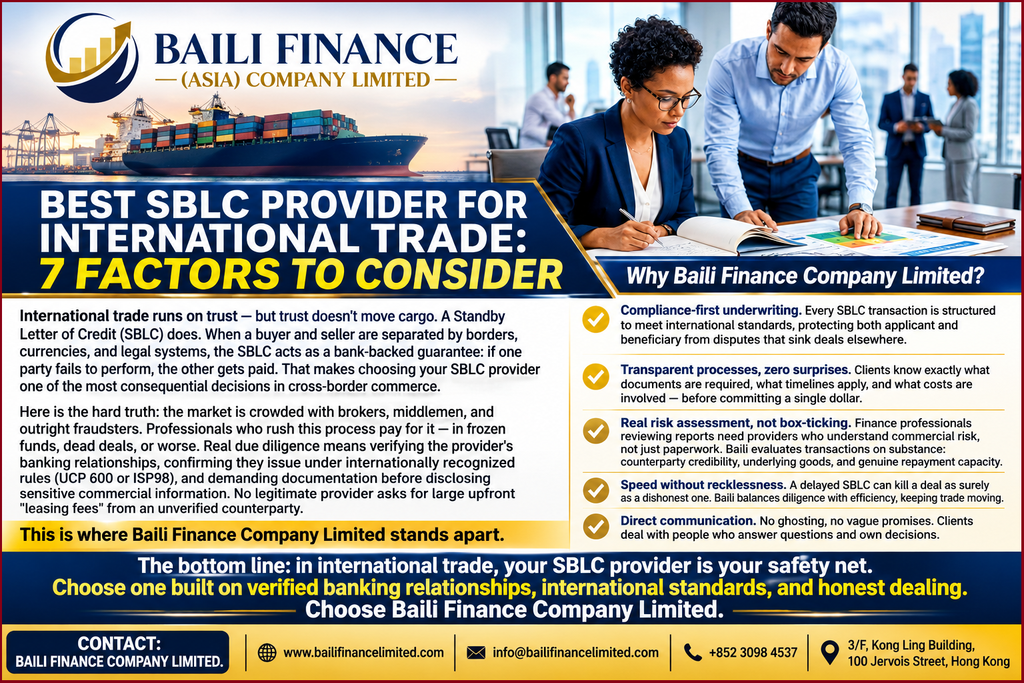
International trade requires financial arrangements that build confidence between buyers, sellers, suppliers and financial institutions. When companies enter cross-border transactions, they must address payment obligations, contractual commitments, credit exposure and the financial risks associated with different jurisdictions. This is where choosing the best SBLC provider for international trade becomes an important business decision.
A Standby Letter of Credit (SBLC) provides an independent payment undertaking from an issuing bank to a beneficiary, subject to the instrument’s terms and presentation requirements. It can support international trade agreements, secure contractual obligations, strengthen commercial relationships and provide financial assurance when a buyer or business partner fails to fulfil specified obligations.
However, not every SBLC provider offers the same level of service, banking access, transaction support or transparency. Some companies arrange financial instruments through banking relationships, while others act as intermediaries or introduce clients to potential issuing institutions. Understanding these differences helps businesses make informed decisions.
For importers, exporters, contractors, commodity traders and international investors, selecting an appropriate financial partner requires more than comparing fees. Businesses must examine the issuing bank, transaction structure, instrument wording, authentication procedures, applicable international rules and the provider’s ability to coordinate the transaction.
Baili Finance Limited supports businesses seeking structured financial solutions, including SBLC arrangements, bank guarantees and international trade finance. This guide explains how to evaluate an SBLC provider, understand the issuance process and identify the factors that matter when arranging a standby letter of credit for international business.
Keywords: Best SBLC provider for international trade, Best SBLC provider, International SBLC provider, SBLC provider for global trade, Standby Letter of Credit provider, International trade finance provider, SBLC issuance services, Bank Guarantee provider, How to choose the best SBLC provider for international trade, Where to find a reliable international SBLC provider, Best provider for Standby Letters of Credit, How to obtain an SBLC for international trade, How SWIFT MT760 works in SBLC transactions, What documents are required for SBLC issuance?, How much does an international SBLC cost?, SBLC for import and export transactions, How to verify an international SBLC, SBLC monetization requirements for international businesses.
What Is a Standby Letter of Credit (SBLC)?
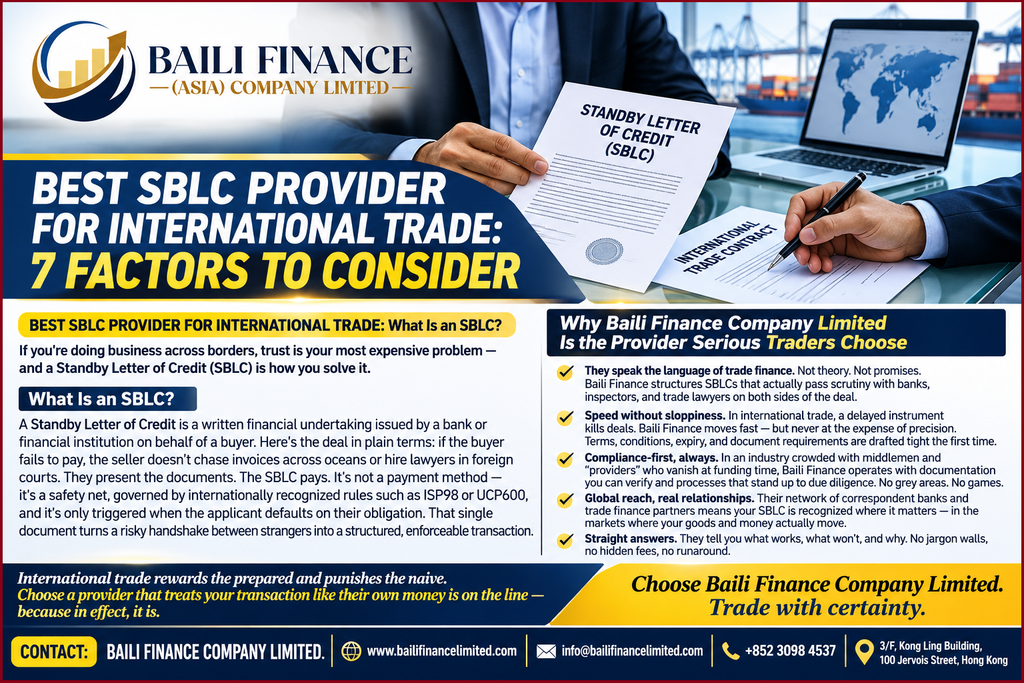
A Standby Letter of Credit is a financial undertaking issued by a bank on behalf of an applicant in favour of a beneficiary. It provides a secondary payment mechanism when the applicant fails to meet an obligation covered by the instrument.
Unlike an ordinary commercial letter of credit, which generally serves as the primary payment mechanism in a trade transaction, an SBLC usually functions as financial security or a backup payment arrangement.
For example, an importer may arrange an SBLC in favour of an overseas supplier. If the importer fails to pay according to the agreed contractual terms, the supplier may present the documents specified in the SBLC to the issuing bank and request payment.
The bank examines the presentation against the instrument’s requirements. It does not simply investigate the underlying commercial dispute before deciding whether to honour a complying presentation.
The International Chamber of Commerce (ICC) provides internationally recognised rules for standby letters of credit through its International Standby Practices, known as ISP98.
Businesses can consult the ICC International Standby Practices (ISP98) to understand the framework governing standby letters of credit.
Main characteristics of an SBLC
An SBLC generally has the following characteristics:
- Independent undertaking: The issuing bank’s obligation operates independently of the underlying commercial contract, subject to applicable law and the instrument’s terms.
- Documentary requirements: The beneficiary must present the documents specified in the instrument.
- Defined financial exposure: The SBLC identifies the maximum amount available for a complying demand.
- Expiry date: The instrument specifies when the beneficiary’s right to present a demand expires.
- Named beneficiary: The instrument identifies the party entitled to make a demand.
- Specified payment conditions: The wording determines the circumstances and documents required for payment.
These characteristics make an SBLC useful in transactions where counterparties require additional financial assurance.
Why International Businesses Need the Right SBLC Provider
Choosing an SBLC provider can influence the cost, timing, documentation and overall execution of an international transaction.
A poorly structured instrument may create problems even when the applicant has sufficient financial capacity. For example, a beneficiary may reject an SBLC because its issuing bank does not meet the agreed credit requirements. Similarly, unclear presentation conditions can create difficulties when the beneficiary attempts to make a demand.
An experienced financial services partner should therefore understand the commercial purpose of the instrument before coordinating the proposed arrangement.
1. Access to suitable issuing banks
The issuing bank is one of the most important considerations when evaluating an SBLC arrangement.
A beneficiary may specify acceptable banks, minimum credit ratings, geographical requirements or particular banking jurisdictions. An SBLC that fails to satisfy those requirements may not provide the commercial assurance the beneficiary expects.
Before proceeding, businesses should establish:
- The full legal name of the proposed issuing bank.
- The bank’s country of incorporation and regulatory status.
- Whether the beneficiary accepts the institution.
- Whether the bank can issue the required instrument.
- Whether the bank can transmit the instrument through an authenticated banking channel.
- Whether the bank can meet the beneficiary’s documentary and wording requirements.
An SBLC provider should explain the proposed issuing structure clearly rather than relying on general statements about international banking relationships.
2. Transparency throughout the transaction
Financial transparency helps applicants understand their obligations before committing funds.
A credible provider should explain its role, proposed transaction structure, applicable fees, required documentation and expected processing stages.
Businesses should also establish whether they are dealing directly with an issuing bank, an arranging company, a broker or another intermediary.
These distinctions affect accountability and transaction execution.
3. Compliance with international banking standards
International trade finance involves established banking practices and documentary rules.
For standby letters of credit, ISP98 provides a dedicated framework. Depending on the transaction structure, other rules may apply.
For example, the ICC’s Uniform Customs and Practice for Documentary Credits, UCP 600, governs documentary credits when incorporated into the relevant instrument.
The Uniform Rules for Demand Guarantees, URDG 758, provide another framework for independent demand guarantees.
A suitable provider should understand which rules fit the proposed instrument rather than treating all financial guarantees as interchangeable.
4. Clear communication and transaction coordination
International financial transactions frequently involve several parties.
These may include:
- The applicant.
- The beneficiary.
- The issuing bank.
- An advising bank.
- A confirming bank, where applicable.
- Financial advisers.
- Brokers and authorised intermediaries.
Coordinating these parties requires accurate documentation and timely communication.
A financial partner should help clarify responsibilities, identify outstanding requirements and communicate material transaction developments.
5. Competitive and transparent pricing
SBLC fees vary according to the transaction structure, issuing institution, applicant’s financial position, instrument amount, validity period, collateral requirements and jurisdiction.
Businesses should request a detailed cost breakdown before signing an agreement.
Depending on the arrangement, costs may include:
- Bank issuance charges.
- Arrangement or structuring fees.
- Advising charges.
- Confirmation fees.
- SWIFT-related charges.
- Legal and documentation expenses.
- Renewal or amendment charges.
The lowest quoted fee does not necessarily represent the most appropriate arrangement. Businesses should assess the issuing bank, enforceability, contractual terms and total transaction cost together.
7 Factors to Consider When Selecting the Best SBLC Provider
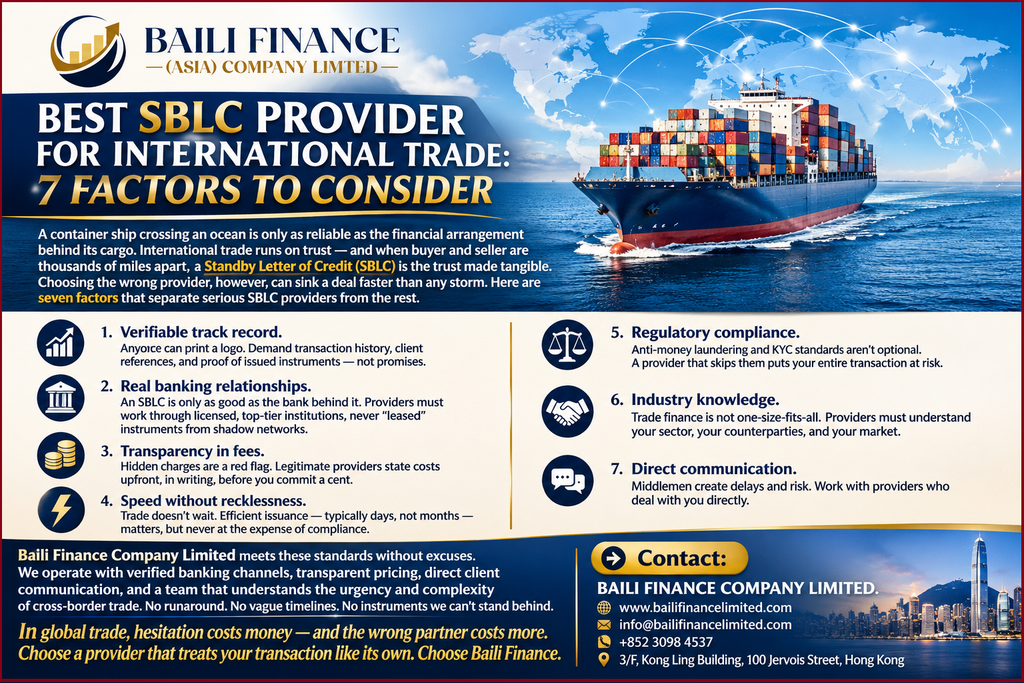
Finding the best SBLC provider for international trade requires a structured assessment. Businesses should evaluate the following factors before entering into an agreement.
1. Verify the issuing bank
Never evaluate an SBLC solely by the reputation of the arranging company.
The issuing bank assumes the payment obligation under the instrument. Therefore, its identity, financial standing, regulatory status and ability to issue the required undertaking deserve independent verification.
Request the proposed bank’s details and establish whether the beneficiary will accept it.
Where necessary, obtain independent legal or banking advice before proceeding.
2. Examine the provider’s transaction experience
International trade finance involves technical documentation, banking procedures and contractual requirements.
A suitable provider should demonstrate an understanding of:
- Standby Letters of Credit.
- Bank Guarantees (BG).
- Documentary Letters of Credit (LC).
- SWIFT messaging procedures.
- Trade finance structures.
- International banking compliance.
- Cross-border financial transactions.
Experience should be assessed through verifiable transaction references, documented procedures and the provider’s ability to explain the proposed arrangement.
3. Understand the SWIFT issuance process
SWIFT plays an important role in international banking communications.
For SBLC transactions, the MT760 message type is commonly used to communicate the issuance of a demand guarantee or standby letter of credit through the relevant banking network.
However, businesses must understand an important distinction: a SWIFT message reference, screenshot or document claiming to show an MT760 does not independently establish that a valid SBLC exists.
The beneficiary’s bank should authenticate the instrument through appropriate banking channels.
Before accepting an arrangement, establish:
- Which bank will issue the instrument.
- Which bank will receive or advise it.
- Whether the message will be authenticated.
- Whether the beneficiary’s bank can verify the instrument.
- Whether the instrument’s wording matches the commercial agreement.
A provider should never substitute an informal payment confirmation or broker-issued document for the required bank undertaking.
4. Review the SBLC wording
The wording of an SBLC determines the issuing bank’s obligations and the beneficiary’s presentation requirements.
Even a transaction involving reputable financial institutions can encounter difficulties when the instrument contains unsuitable conditions.
Pay particular attention to:
- Applicant and beneficiary details.
- Maximum amount and currency.
- Expiry date and place of presentation.
- Applicable rules.
- Demand requirements.
- Supporting documents.
- Partial drawing provisions.
- Transferability, if required.
- Governing law and jurisdiction.
- Amendment and extension procedures.
The beneficiary should review the draft before issuance. Where appropriate, both parties should obtain independent legal advice.
5. Assess financial and regulatory compliance
Financial institutions apply customer due diligence and anti-money laundering procedures before entering into financial transactions.
An SBLC applicant may need to provide:
- Certificate of incorporation.
- Corporate ownership information.
- Directors’ identification.
- Business registration documents.
- Audited financial statements.
- Bank statements.
- Source-of-funds evidence.
- Transaction agreements.
- Relevant commercial documentation.
Requirements vary between institutions and jurisdictions.
A provider that explains these requirements before accepting an application can help reduce unnecessary delays.
6. Examine contractual protection
Before paying any arrangement fee or signing an agreement, examine the contractual relationship.
The agreement should identify the parties, responsibilities, fees, refund conditions, confidentiality provisions, dispute resolution procedures and circumstances that may prevent completion.
It should also explain whether the provider acts as an arranger, intermediary, lender or another type of financial services company.
Avoid arrangements that rely on verbal promises, undefined banking relationships or guaranteed returns without supporting contractual and financial evidence.
7. Consider after-issuance support
The transaction does not necessarily end when the bank issues the instrument.
An SBLC may require amendments, extensions, cancellation arrangements or additional coordination with the beneficiary’s bank.
Choose a financial partner that can explain these procedures and identify the relevant parties responsible for each stage.
How Does an SBLC Work in International Trade?
Understanding the process helps applicants prepare the correct documentation and avoid misunderstandings.
Although individual transactions differ, a typical SBLC arrangement follows several stages.
Step 1: The applicant identifies a commercial requirement
An importer, exporter, contractor or business owner identifies a need for financial security.
For example, an overseas supplier may request an SBLC before agreeing to supply goods on deferred payment terms.
The applicant and beneficiary agree on the amount, validity period and essential conditions.
Step 2: The applicant contacts an SBLC provider
The applicant approaches a financial institution or arranging company to discuss the proposed transaction.
The provider reviews the commercial requirement and determines whether it can support the requested structure.
At this stage, the applicant should clarify the provider’s role and identify the proposed issuing bank.
Step 3: Due diligence and financial assessment
The relevant financial institution reviews the applicant’s financial position, corporate documentation, source of funds and transaction details.
Depending on the arrangement, the bank may request cash collateral, other acceptable security or an established credit facility.
Approval remains subject to the institution’s own credit and compliance procedures.
Step 4: The parties review the draft instrument
The applicant, beneficiary and relevant banking parties examine the proposed SBLC wording.
They confirm that the instrument reflects the commercial agreement and meets the beneficiary’s requirements.
This stage deserves particular attention because wording errors can create documentary discrepancies later.
Step 5: The issuing bank issues the SBLC
After completing its internal approvals and receiving the required documentation, the issuing bank issues the instrument.
Where applicable, the bank transmits it through SWIFT using the appropriate message type, commonly MT760.
The beneficiary’s bank then follows its authentication and advising procedures.
Step 6: The beneficiary verifies the instrument
The beneficiary confirms the issuing bank, instrument details, amount, expiry date and presentation requirements.
If the instrument meets the agreed conditions, the parties can proceed with the underlying commercial transaction.
Step 7: The SBLC remains available during its validity period
The instrument remains effective according to its terms.
If the applicant fulfils the underlying obligation, the beneficiary may have no reason to make a demand.
If the applicant defaults, the beneficiary may present the required documents before expiry.
The issuing bank examines the presentation and honours it if it complies with the instrument and applicable rules.
Types of SBLC Used in International Trade
Different commercial transactions require different forms of standby letters of credit.
Understanding the distinction helps businesses select an appropriate instrument.
Financial SBLC
A financial SBLC supports payment obligations.
For example, a buyer may arrange one to secure repayment of a commercial debt or another agreed financial liability.
It provides the beneficiary with a bank undertaking subject to the specified presentation conditions.
Performance SBLC
A performance SBLC supports contractual performance obligations.
It may protect a project owner or buyer when a contractor fails to meet specified contractual requirements.
The beneficiary must satisfy the instrument’s demand conditions to obtain payment.
Advance Payment SBLC
An advance payment SBLC can support a buyer that pays an advance to a supplier before receiving the contracted goods or services.
It provides an agreed financial remedy if the relevant contractual conditions for making a demand arise.
Direct Pay SBLC
A direct pay SBLC supports payment obligations when specified conditions occur.
Unlike some other standby arrangements, the payment obligation may be intended as a direct payment mechanism rather than only a remedy following a particular default scenario.
The precise wording determines how it operates.
Commercial SBLC
A commercial SBLC can support payment obligations arising from the purchase and supply of goods.
It may provide additional assurance to an exporter supplying goods under an agreed credit arrangement.
Important: The names of SBLC categories do not determine their legal effect. The actual wording, incorporated rules and applicable law establish the rights and obligations of the parties.
SBLC vs Bank Guarantee vs Commercial Letter of Credit
Businesses sometimes use these financial instruments interchangeably. However, they serve different commercial purposes.
| Instrument | Primary purpose | Typical application |
|---|---|---|
| SBLC | Independent standby payment undertaking | Payment security and contractual obligations |
| Bank Guarantee | Independent guarantee or undertaking, depending on its terms | Performance, advance payments and financial obligations |
| Commercial LC | Primary documentary payment mechanism | Import and export transactions |
An SBLC and a bank guarantee can have similar commercial functions, but their legal treatment and applicable rules may differ.
For example, a standby may incorporate ISP98, while a demand guarantee may incorporate URDG 758.
A commercial documentary credit commonly incorporates UCP 600.
Businesses should select the instrument that matches the contractual requirement rather than assuming that one can automatically replace another.
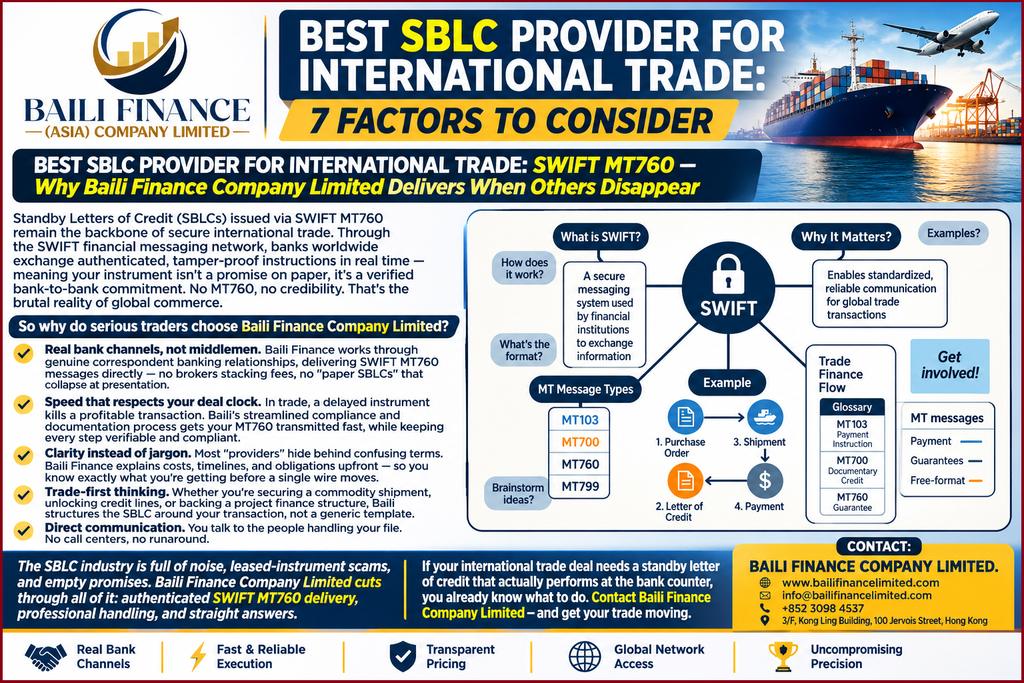
What Is the Role of SWIFT MT760 in SBLC Transactions?
SWIFT MT760 is an established banking message format associated with the issuance of guarantees and standby letters of credit.
It enables participating financial institutions to transmit structured financial undertaking information through authenticated banking communications.
For an international trade transaction, the beneficiary may require the issuing bank to transmit the SBLC through this channel to an agreed receiving bank.
However, the presence of an MT760 reference alone does not establish the commercial acceptability or enforceability of an instrument.
The beneficiary must verify the message through its bank and review the actual undertaking.
Applicants should also distinguish between an MT760 and other SWIFT messages used for banking communications. Different message types serve different functions.
When arranging an SBLC, confirm the required message format with the beneficiary’s bank before proceeding.
How to Identify a Reliable SBLC Provider
The phrase best SBLC provider does not automatically identify a particular company. Businesses should assess providers against objective financial, operational and compliance criteria.
A reliable provider should be able to explain the following:
Banking arrangements: Can the provider identify the proposed issuing bank and explain how the beneficiary will authenticate the instrument?
Transaction structure: Does the provider explain whether it issues, arranges, brokers or facilitates the SBLC?
Financial requirements: Does it clearly disclose collateral requirements, fees and applicant eligibility?
Documentation: Can it explain the instrument’s wording, applicable ICC rules and presentation conditions?
Regulatory transparency: Can the parties independently establish the legal identity and relevant regulatory status of the institutions involved?
Communication: Does the provider give clear answers and provide appropriate transaction updates?
Contractual protection: Does the agreement define the parties’ responsibilities, payment terms and dispute resolution procedures?
These criteria provide a more reliable assessment than promotional claims, unsupported success rates or promises of guaranteed issuance.
Is Baili Finance Limited a Suitable SBLC Provider for International Trade?
Businesses seeking an SBLC arrangement may consider Baili Finance Limited as a financial services contact for discussing their requirements.
Baili Finance (Asia) Company Limited presents itself as a Hong Kong-registered financial services company offering structured financial solutions, including:
- Standby Letter of Credit arrangements.
- Bank Guarantee arrangements.
- International trade finance.
- Structured financing solutions.
- SBLC and bank guarantee monetization arrangements.
- Business financing solutions.
Its website identifies its company registration number as 2315541 and provides its registered office at 3/F, Kong Ling Building, 100 Jervois Street, Hong Kong.
These are company details presented on its website, not an independent verification of its regulatory status, banking relationships or ability to issue an SBLC directly.
For businesses considering an arrangement, the appropriate approach is to discuss the transaction requirements, understand Baili’s precise role, obtain the proposed issuing bank’s details and conduct independent due diligence.
Why businesses may contact Baili Finance
International trade transactions frequently require coordination between applicants, beneficiaries and financial institutions.
Baili Finance provides a point of contact for businesses exploring SBLC arrangements, bank guarantees and related financing structures.
Its service offering is relevant to businesses seeking assistance with:
- Understanding the financial instrument required by a commercial counterparty.
- Exploring an appropriate SBLC or bank guarantee structure.
- Discussing the documentation required for an application.
- Understanding potential issuance and arrangement costs.
- Coordinating transaction requirements with relevant financial institutions.
However, each proposed transaction remains subject to the applicable bank’s approval, due diligence, documentation and contractual requirements.
Visit the official website: www.bailifinancelimited.com
Real-World Example: How an SBLC Supports an International Import Transaction
Consider an international trading company that imports industrial equipment from an overseas manufacturer.
The manufacturer requires payment security before agreeing to deliver equipment worth $2 million.
The importer wants to negotiate a payment arrangement that allows it to receive the equipment and settle the purchase price under agreed commercial terms.
However, the manufacturer does not want to accept the importer’s credit risk without additional protection.
The parties therefore discuss an SBLC arrangement.
How the transaction works
- The importer and manufacturer negotiate the purchase agreement.
- The manufacturer specifies the required SBLC amount, acceptable issuing banks and validity period.
- The importer approaches a suitable financial services provider to explore the arrangement.
- The proposed issuing bank assesses the importer and completes its compliance procedures.
- The parties review the draft instrument.
- The issuing bank issues the SBLC through the agreed authenticated banking channel.
- The manufacturer’s bank verifies the instrument.
- Once the manufacturer accepts the financial security, it proceeds with the agreed delivery arrangements.
If the importer fulfils its payment obligation, the manufacturer does not need to make a demand under the SBLC.
If the importer defaults, the manufacturer may seek payment by presenting the documents required under the instrument before its expiry.
What does this example demonstrate?
The SBLC does not automatically pay the supplier when the instrument is issued.
Instead, it provides an independent undertaking that the beneficiary may rely on if the specified documentary conditions for a demand are satisfied.
It also demonstrates why the parties must agree on the issuing bank, wording, expiry date and documentary requirements before issuance.
Illustrative Case Study: Using an SBLC to Support a $5 Million Supply Contract
The following case study is hypothetical. It illustrates how an SBLC arrangement may support an international commercial transaction; it does not represent a verified Baili Finance customer or completed transaction.
Business background
An international commodity trading company enters negotiations with an overseas supplier for a supply contract valued at $5 million.
The supplier is willing to provide the goods under deferred payment terms but requires financial security covering the agreed payment exposure.
The buyer wants to proceed without paying the entire purchase price upfront.
Both parties agree to explore an SBLC arrangement.
The challenge
The transaction faces three main challenges:
- The supplier needs acceptable payment security.
- The buyer must satisfy the issuing bank’s financial and compliance requirements.
- The SBLC must meet the supplier’s banking and contractual requirements.
Without an acceptable arrangement, the parties may struggle to complete the transaction under their preferred payment terms.
The proposed solution
The buyer approaches an SBLC arranging company to discuss the transaction.
The parties establish the required instrument amount, currency, validity period, beneficiary details and presentation requirements.
The proposed issuing bank then reviews the buyer’s financial position and supporting documentation.
Following the bank’s approval, the parties review the draft SBLC and agree on the final wording.
The issuing bank subsequently issues the instrument through the agreed banking channel.
The commercial outcome
Once the beneficiary’s bank authenticates and accepts the SBLC, the supplier can proceed with the supply agreement under the negotiated conditions.
The buyer receives the opportunity to complete the commercial transaction while the supplier benefits from the agreed bank undertaking.
The arrangement does not eliminate every commercial risk. However, it establishes a defined financial security mechanism that supports the parties’ contractual relationship.
Key lessons from the case study
This example demonstrates five important considerations:
- Start with the commercial agreement. The SBLC should support an identifiable contractual obligation.
- Confirm the issuing bank. The beneficiary must accept the proposed institution.
- Review the instrument wording. The beneficiary’s rights depend on the actual terms.
- Complete due diligence. Financial institutions must satisfy their own compliance requirements.
- Understand the cost structure. The applicant should establish all charges and collateral requirements before proceeding.
The central lesson is that successful SBLC arrangements require coordination between the commercial parties and the relevant financial institutions.
Common SBLC Mistakes International Businesses Should Avoid
Even experienced businesses can make mistakes when arranging financial instruments.
The following issues deserve particular attention.
Accepting an unidentified issuing bank
Do not proceed solely because an intermediary claims to have access to international banking facilities.
Request the proposed issuing bank’s details and verify them independently.
Paying fees without a clear agreement
Applicants should understand the purpose of every fee before making a payment.
The contractual agreement should identify the recipient, amount, payment conditions and refund provisions where applicable.
Confusing SWIFT transmission with payment assurance
An MT760 is a banking communication used for an undertaking. It is not itself proof that every commercial condition has been satisfied or that the instrument will automatically produce payment.
Ignoring beneficiary requirements
An SBLC that does not meet the beneficiary’s requirements may have limited commercial value.
Obtain the beneficiary’s written acceptance criteria before arranging issuance.
Assuming monetization is automatic
An SBLC does not automatically qualify for monetization or non-recourse financing.
Any financing proposal requires separate assessment by the relevant financing institution or investor.
The applicant should examine the financing terms, collateral requirements, recourse provisions and fees.
Overlooking expiry and presentation conditions
A beneficiary must comply with the instrument’s presentation requirements and applicable deadlines.
Businesses should maintain accurate records of expiry dates, amendment requirements and presentation procedures.
Frequently Asked Questions About the Best SBLC Provider for International Trade
1. Who is the best SBLC provider for international trade?
The best SBLC provider is one that can demonstrate a transparent transaction structure, access to an acceptable issuing bank, appropriate financial expertise, clear contractual terms and compliance with relevant banking requirements.
Businesses should distinguish between an issuing bank and an arranging company. The issuing bank assumes the undertaking under the SBLC, while an arranging company may coordinate the transaction.
Baili Finance Limited is one company businesses can contact to discuss SBLC arrangements and international trade finance requirements. Applicants should independently verify the proposed issuing bank and all relevant transaction details.
2. How much does an SBLC cost?
The cost depends on the issuing bank, instrument amount, validity period, applicant’s creditworthiness, collateral arrangements, jurisdiction and transaction structure.
There is no universal SBLC fee that applies to every transaction.
Applicants should request a detailed quotation covering bank charges, arrangement fees, advising costs and other applicable expenses before committing funds.
3. What is the minimum amount required for an SBLC?
There is no single universal minimum amount for all SBLC transactions.
The issuing bank or arranging institution determines its eligibility requirements based on the transaction, financial exposure, applicant profile and internal policies.
Some institutions may have minimum transaction thresholds, while others assess applications individually.
4. How long does it take to issue an SBLC?
The issuance timeline varies between financial institutions and transactions.
Factors include applicant due diligence, credit approval, collateral arrangements, documentation, draft wording negotiations and banking procedures.
An application with complete documentation may progress more efficiently than one involving unresolved compliance or contractual requirements.
Businesses should obtain a realistic timeline from the proposed issuing institution rather than relying on guaranteed issuance dates.
5. What is the difference between an SBLC and a bank guarantee?
An SBLC is a standby undertaking issued by a bank, usually subject to independent documentary requirements.
A bank guarantee is another form of financial undertaking that may support payment or contractual performance.
Although they can serve similar commercial purposes, their legal treatment, wording and applicable rules may differ.
An SBLC may incorporate ISP98, while a demand guarantee may incorporate URDG 758.
6. Can an SBLC be used for international trade finance?
Yes. An SBLC can support international trade by providing financial assurance to a supplier, exporter or other beneficiary.
For example, an importer may arrange an SBLC to support payment obligations under a supply agreement.
The beneficiary can rely on the undertaking if the applicant fails to meet the obligations covered by the instrument and the beneficiary satisfies the required presentation conditions.
7. What is the purpose of SWIFT MT760 in SBLC transactions?
SWIFT MT760 is a message type commonly used by banks to issue guarantees and standby letters of credit through authenticated banking communications.
It allows the relevant financial institutions to transmit the undertaking through their banking network.
The beneficiary’s bank should authenticate the message and examine the instrument before accepting it.
8. Can an SBLC be monetized?
An SBLC may be considered for monetization or used as part of a structured financing arrangement, subject to the instrument’s terms and the financing institution’s independent assessment.
However, monetization is not automatic.
The financing institution may evaluate the issuing bank, instrument wording, beneficiary rights, transferability, collateral arrangements and overall transaction risk.
Applicants should request written financing terms and independently assess the proposed arrangement.
9. What documents are required to apply for an SBLC?
Requirements vary between issuing banks and financial services providers.
Commonly requested documents include:
- Certificate of incorporation.
- Business registration documents.
- Passport or identification documents of relevant directors.
- Corporate ownership information.
- Financial statements.
- Bank statements.
- Source-of-funds evidence.
- Underlying commercial contract.
- Applicant and beneficiary information.
- Proposed instrument requirements.
Additional documents may be required depending on the transaction and applicable compliance procedures.
10. Is an SBLC a guarantee of immediate payment?
No. An SBLC is an independent undertaking that requires a presentation meeting the conditions specified in the instrument.
The issuing bank examines the documents presented by the beneficiary.
Payment depends on whether the presentation complies with the instrument’s terms and applicable rules, subject to relevant law.
11. Can an SBLC be transferred to another company?
Transferability depends on the instrument’s wording, applicable rules and the relevant parties’ rights.
An SBLC should not be assumed to be transferable simply because a provider describes it as transferable.
Businesses should establish whether the intended beneficiary can transfer drawing rights, assign proceeds or arrange another permitted structure.
These are legally distinct concepts and require appropriate drafting.
12. What should I check before choosing an SBLC provider?
Before selecting a provider, establish:
- The provider’s legal identity and precise role.
- The issuing bank’s identity and regulatory standing.
- The beneficiary’s acceptance requirements.
- The proposed instrument wording.
- Applicable ICC rules.
- All fees and collateral requirements.
- Authentication procedures.
- Contractual protections.
- Applicable dispute resolution arrangements.
Independent verification is essential before making substantial financial commitments.
Why International Trade Businesses Should Prioritise the Right Financial Partner
An international trade transaction involves more than agreeing on the price and delivery of goods.
The parties must also determine how they will manage payment obligations, financial exposure and the consequences of contractual default.
A properly structured SBLC can provide a defined payment undertaking and help counterparties negotiate commercial arrangements with greater financial clarity.
However, the instrument’s value depends on the issuing bank, wording, documentary requirements and enforceability.
Choosing an appropriate provider therefore requires careful consideration of financial credibility, transaction experience, banking arrangements and transparency.
Baili Finance Limited provides an avenue for businesses seeking to discuss SBLC arrangements, bank guarantees and structured trade finance solutions. Before entering into any arrangement, applicants should confirm the company’s role, review the proposed transaction structure and independently verify the relevant issuing institution.
Conclusion: Choose Your SBLC Provider With Confidence
Selecting the best SBLC provider for international trade requires a careful assessment of the financial institution behind the instrument, the transaction structure, applicable banking rules and the provider’s ability to coordinate the arrangement.
Whether you are an importer seeking payment security, an exporter negotiating international supply agreements, a contractor securing contractual obligations or a business exploring structured financing, the right SBLC arrangement should reflect your actual commercial requirements.
Do not base your decision on promotional promises, low fees or claims of guaranteed issuance. Examine the issuing bank, authenticate the instrument, review the contractual conditions and understand every financial obligation before proceeding.
Baili Finance Limited welcomes enquiries from businesses, corporate clients, international traders and qualified financial intermediaries seeking to discuss SBLC arrangements, bank guarantees and international trade finance solutions.
Your next international transaction deserves a properly assessed financial structure.
SECURE YOUR NEXT INTERNATIONAL TRADE TRANSACTION WITH THE RIGHT FINANCIAL PARTNER
Your international business transactions deserve a financial structure that meets your commercial objectives and your counterparties’ requirements.
Whether you’re an importer, exporter, commodity trader, contractor or international business owner seeking a Standby Letter of Credit (SBLC), the next step is to speak with a financial services team that understands your requirements.
At Baili Finance Limited, we welcome enquiries from businesses seeking SBLC arrangements, Bank Guarantees and structured international trade finance solutions.
Why delay an important financial decision when you can start exploring your options today?
Contact our team to discuss:
- Your required SBLC amount and transaction purpose.
- The proposed beneficiary and issuing bank requirements.
- Available transaction structures and documentation.
- Applicable arrangement costs and financial requirements.
- The next steps towards an initial transaction assessment.
TAKE THE FIRST STEP TODAY.
Don’t leave your international trade finance requirements unresolved. Start a direct conversation with Baili Finance Limited and let us understand your proposed transaction.
Contact Baili Finance Limited today to discuss your SBLC requirements and explore a suitable financial arrangement for your business.
🌐 Website: https://www.bailifinancelimited.com/
✉️ Email: info@bailifinancelimited.com
📞 Telephone: +852 3098 4537
BAILI FINANCE LIMITED — Your International Trade Finance Enquiry Starts Here.
All proposed arrangements remain subject to transaction assessment, applicable due diligence, contractual terms and the relevant financial institution’s approval.
Intermediaries/Consultants/Brokers are welcome to bring their clients 100% protected. Our brokers receive 2% commission for referral. We assist Clients and brokers in their attempt to secure funding by working on their funding requests that may require innovative financing. In complete confidence, we will work together for the benefits of all parties involved.
#SBLC #StandbyLetterOfCredit #InternationalTradeFinance #SBLCProvider #BankGuarantee #TradeFinance #SWIFTMT760 #GlobalTrade #FinancialInstruments #BailiFinance