Headline: SBLC Funding Company: Complete Guide to Financing
Understanding SBLC financing, bank instrument monetization, eligibility, risks and international funding opportunities.
Businesses seeking substantial capital often encounter financing requirements that traditional lenders cannot accommodate. International trade, infrastructure development, corporate expansion and large-scale procurement frequently require more than conventional business loans. They require structured financial solutions supported by recognized banking instruments.
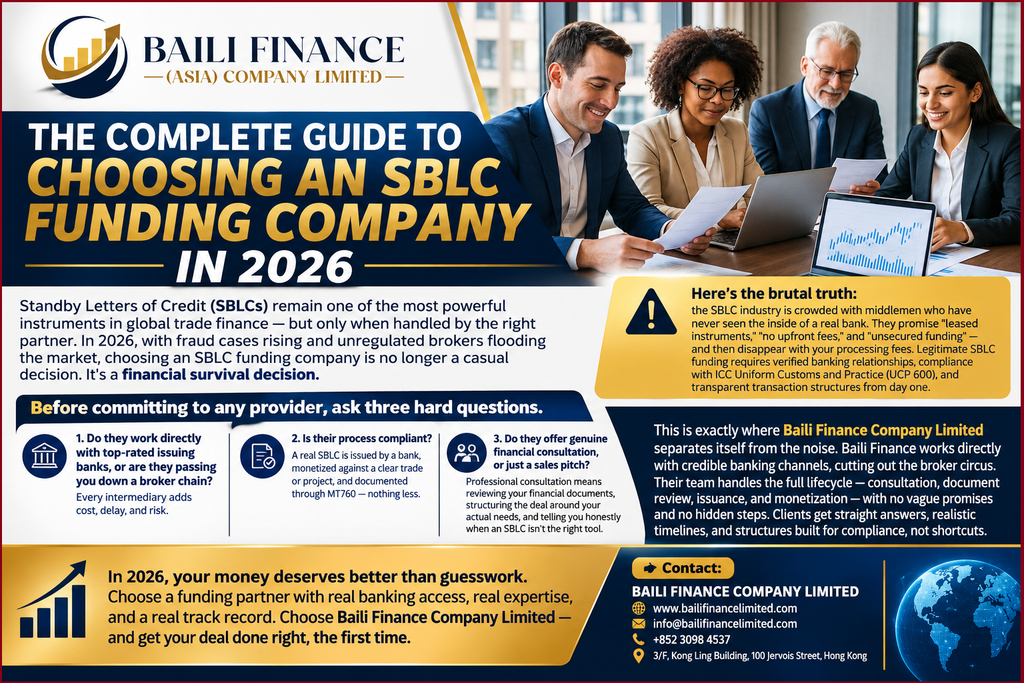
An experienced SBLC funding company can help qualified businesses explore these opportunities through Standby Letters of Credit (SBLCs), bank guarantee arrangements, structured finance and potential monetization facilities.
A Standby Letter of Credit can provide financial assurance to a beneficiary when an applicant fails to meet specified contractual or payment obligations. Depending on its terms, the instrument may also support credit enhancement and financing arrangements.
However, obtaining an SBLC and securing funding against one are two different financial processes. Understanding the distinction helps business owners, investors, contractors and international traders select appropriate financing structures.
For companies seeking an experienced financial partner, BAILI FINANCE (ASIA) COMPANY LIMITED, based in Hong Kong, offers SBLC issuance arrangements, SBLC monetization services, bank guarantee solutions and international trade finance support.
This guide explains how SBLC funding works, what businesses should consider before proceeding, how to evaluate an SBLC funding provider and how structured financing may support commercial objectives.
Keywords: SBLC funding company, SBLC provider, SBLC monetization company, SBLC funding, SBLC financing , Standby Letter of Credit, SBLC monetization, SBLC funding solutions, Bank guarantee provider, SBLC-backed financing, Non-recourse financing, International trade finance, SBLC issuance, SBLC financing requirements, Monetization of bank guarantees, Project financing company, SWIFT MT760 SBLC, Best SBLC funding company for international businesses, Trusted SBLC provider for global trade finance, How to obtain financing against an SBLC, Companies that offer SBLC monetization services, How does SBLC monetization work?, Requirements for SBLC-backed financing, International SBLC funding solutions, SBLC issuance and monetization services, How to choose an SBLC financing company, Bank guarantee and SBLC funding solutions.
1. What Is an SBLC Funding Company?
An SBLC funding company is a financial services provider that helps businesses arrange, structure or access financing solutions involving Standby Letters of Credit.
Its services may include:
- Arranging SBLC issuance through banking institutions.
- Structuring SBLC-backed financing facilities.
- Facilitating SBLC monetization transactions.
- Connecting qualified applicants with financing counterparties.
- Supporting international trade finance.
- Structuring bank guarantee and credit enhancement arrangements.
- Coordinating documentation and transaction due diligence.
An SBLC funding company may operate as a financial intermediary, financing arranger, structured finance provider or direct lender, depending on its business model and contractual arrangements.
It is important to understand that an SBLC itself is generally an undertaking issued by a bank or another eligible financial institution. A private financing company does not automatically become the issuing bank simply because it arranges the transaction.
According to the International Chamber of Commerce (ICC), an SBLC represents an independent undertaking that provides the named beneficiary with an assurance of payment, subject to the instrument’s terms and compliant presentation.
This distinction is central to evaluating any SBLC provider.
Why Do Businesses Work With SBLC Funding Companies?
Businesses may approach these providers when they need:
- Financing for infrastructure and development projects.
- Working capital for international commercial activities.
- Financial support for import and export transactions.
- Credit enhancement for corporate borrowing.
- Additional security for contractual obligations.
- Structured financing against eligible banking instruments.
Nevertheless, financing approval depends on the issuing institution, instrument wording, applicant’s financial position, transaction purpose, applicable regulations and the financing counterparty’s risk assessment.
2. Understanding How SBLC Funding Works
Before approaching an SBLC funding company, businesses should understand the relationship between the instrument, its issuing bank, the beneficiary and the financing provider.
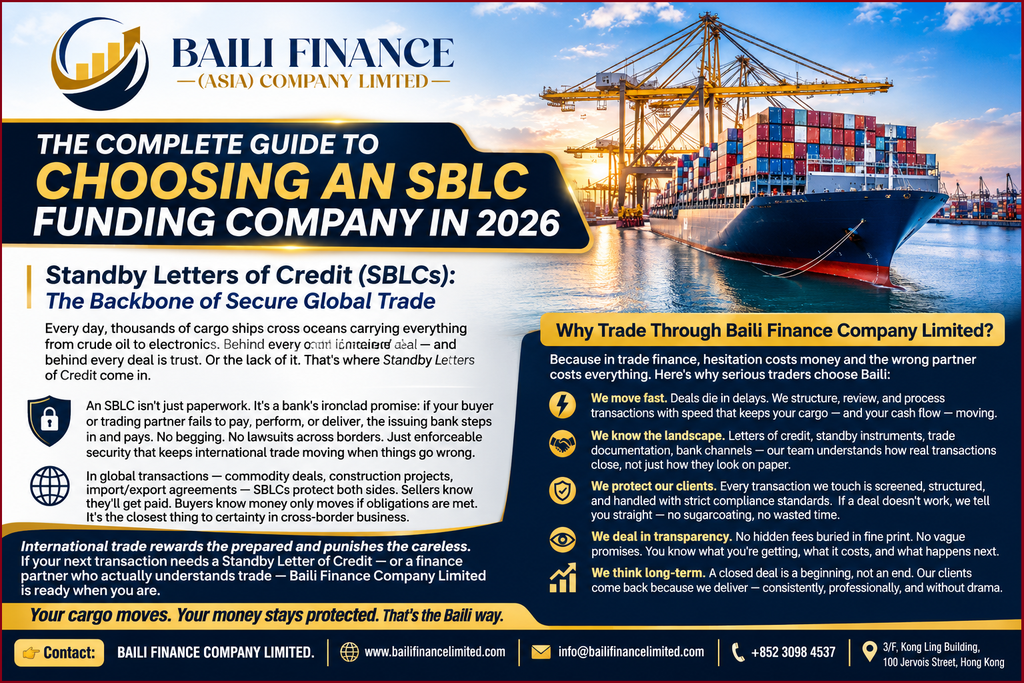
An SBLC is not automatically a cash facility. Instead, it provides an independent payment undertaking that may support a broader commercial or financing arrangement.
The process generally involves several stages.
Step 1: Establish the Financing Requirement
The applicant identifies the commercial objective and the amount of financing required.
For example, a construction company may need $20 million to execute an infrastructure contract. An international commodity trader may require $10 million in working capital to support a procurement arrangement.
At this stage, the applicant should establish:
- The required funding amount.
- The intended use of funds.
- The proposed repayment structure.
- The expected financing period.
- Available collateral or banking instruments.
- The commercial parties involved.
A clearly defined financing requirement helps the provider determine whether an SBLC-based structure is commercially appropriate.
Step 2: Assess SBLC Eligibility
The funding company or financing counterparty reviews the applicant’s financial information and proposed transaction.
Depending on the programme, the assessment may consider:
- The applicant’s corporate registration.
- Financial statements.
- Banking relationships.
- Source of funds.
- Creditworthiness.
- Transaction history.
- Project documentation.
- Proposed issuing bank.
- Instrument amount and validity.
Not every SBLC qualifies for monetization. An instrument’s issuing bank, authenticity, wording, governing rules and enforceability can materially affect its financing potential.
Step 3: Arrange SBLC Issuance
Where the applicant requires a new instrument, the financing arrangement may involve an issuing bank.
The bank conducts its own credit assessment and determines whether it can issue the requested SBLC.
The bank may require cash collateral, other acceptable security, an approved credit facility or additional guarantees.
Once approved, the issuing bank prepares the instrument according to the agreed commercial terms.
An SBLC may be transmitted through authenticated SWIFT banking channels. MT760 is commonly used for the issuance or transmission of a guarantee or standby letter of credit.
However, the presence of a SWIFT message does not, by itself, establish that an instrument is suitable for monetization. The receiving bank must authenticate and assess the instrument.
Step 4: Complete Instrument Verification
The receiving institution or financing counterparty examines the SBLC before accepting it as security.
This process may include:
- Authenticating the issuing bank.
- Confirming the instrument’s validity.
- Reviewing the beneficiary details.
- Examining expiry and presentation conditions.
- Assessing applicable rules.
- Confirming the instrument’s transferability or assignability, where relevant.
- Reviewing the legal and commercial implications.
This stage protects the parties against fraudulent instruments, documentation discrepancies and unacceptable banking risks.
Step 5: Structure the Financing Facility
Once the instrument passes the required checks, the financing counterparty considers whether it can support a credit facility.
The proposed structure may involve:
- A secured loan.
- An SBLC-backed credit facility.
- A collateral-based financing arrangement.
- A structured lending programme.
- A transaction-specific financing agreement.
The amount available will depend on the instrument’s characteristics, the lender’s policies, applicable haircuts, collateral requirements, fees and other commercial considerations.
Importantly, an SBLC’s face value does not automatically determine the amount of cash a client can receive.
Step 6: Execute the Transaction
After the parties agree on the financing terms, they complete the necessary agreements and conditions precedent.
These may include:
- Executed financing agreements.
- Instrument verification.
- KYC and AML clearance.
- Corporate authorization.
- Security documentation.
- Banking instructions.
- Compliance approval.
The financing institution then releases funds according to the executed agreement and agreed disbursement conditions.
3. What Is SBLC Monetization?
SBLC monetization refers to a financing arrangement in which an eligible Standby Letter of Credit supports access to liquidity.
A company holding an acceptable SBLC may approach a financing institution to determine whether the instrument can support a loan or another credit facility.
The financing institution assesses the instrument and the applicant before deciding whether to provide funding.
This is an important distinction: monetization does not mean that every SBLC can be converted directly into cash.
How Does SBLC Monetization Benefit Businesses?
When a transaction qualifies, SBLC monetization may help a business:
Access additional liquidity: A suitable instrument may support financing without requiring the business to rely exclusively on conventional unsecured borrowing.
Support commercial expansion: Companies may use approved financing to fund procurement, equipment acquisition, inventory or business expansion.
Improve financial flexibility: A structured credit facility may provide additional funding options for businesses with significant commercial commitments.
Support international trade: Importers, exporters and commodity traders may use suitable financial instruments to support transactions involving international counterparties.
Facilitate project execution: Developers may explore SBLC-backed financing where their project structure and funding requirements satisfy the lender’s criteria.
Is SBLC Monetization the Same as Selling an SBLC?
No.
Monetization generally involves using an eligible instrument to support a financing arrangement. The applicant may retain ownership or control arrangements subject to the financing agreement.
A sale or transfer involves different legal and contractual considerations.
The precise structure depends on the instrument, its wording, the applicable law and the agreements between the parties.
Before accepting any offer, applicants should understand whether the proposed transaction involves a loan, an assignment, a transfer, a purchase or another financing structure.
4. Why Businesses Need an Experienced SBLC Funding Company
Selecting an SBLC funding company requires more than comparing advertised financing percentages or processing times.
The provider should understand international banking procedures, structured finance, transaction documentation and cross-border compliance.
Here are the principal reasons businesses seek professional assistance.
A. Access to Structured Financing Opportunities
Traditional business lending often relies heavily on historical financial performance, existing collateral and conventional credit assessments.
Structured finance offers additional approaches to evaluating financing requirements.
Depending on the transaction, an SBLC may form part of a broader credit support arrangement.
This can be particularly relevant to businesses involved in:
- International commodity trading.
- Infrastructure development.
- Construction.
- Energy projects.
- Manufacturing.
- Import and export.
- Large-scale procurement.
- Corporate expansion.
B. International Trade Support
Cross-border transactions introduce additional risks.
Buyers and sellers may operate in different jurisdictions, use different currencies and follow different commercial practices.
An SBLC can provide a payment undertaking that helps address specified contractual risks.
For example, an exporter may request an SBLC to support a buyer’s payment obligations. The exporter receives additional payment security, subject to the instrument’s terms.
C. Financing Flexibility
A well-structured financing arrangement considers the client’s actual business requirements.
Rather than focusing exclusively on the instrument’s face value, a competent provider evaluates the commercial purpose, financing period, repayment capacity and transaction risks.
D. Professional Transaction Coordination
International financing transactions often involve multiple parties.
These may include:
- Applicants.
- Issuing banks.
- Advising banks.
- Beneficiaries.
- Financing institutions.
- Legal advisers.
- Compliance departments.
- Corporate intermediaries.
An experienced financing arranger can help coordinate communication and documentation throughout the transaction.
E. Risk Management
Every financing transaction involves risk.
A professional provider should explain the relevant costs, conditions, potential delays, repayment obligations and legal implications before the applicant commits.
Transparency is particularly important when a transaction involves substantial financial instruments.
5. Types of SBLCs Used in International Financing
Different SBLC structures serve different commercial purposes.
Understanding the available types helps applicants select an instrument that matches their contractual requirements.
Financial Standby Letter of Credit
A financial SBLC supports a financial obligation.
For example, it may secure repayment of a loan, payment of a debt or another agreed financial commitment.
Performance Standby Letter of Credit
A performance SBLC supports a contractual performance obligation.
It may protect a beneficiary against specified losses arising from the applicant’s failure to fulfil contractual responsibilities.
Advance Payment Standby Letter of Credit
An advance payment SBLC may support arrangements in which a buyer makes an advance payment before receiving goods or services.
The instrument provides security against specified circumstances involving the repayment or application of that advance.
Bid Bond or Tender-Related SBLC
A bid-related instrument supports obligations associated with a tender process.
It may provide financial protection to a project owner if a bidder fails to honour specified bidding commitments.
Commercial Standby Letter of Credit
A commercial standby may support payment obligations arising from commercial transactions involving goods or services.
Revolving SBLC
A revolving SBLC may restore its available amount after a drawing, subject to its specific terms.
The replenishment mechanism, amount and duration must be expressly established in the instrument.
The appropriate structure depends on the underlying contract and the requirements of the issuing and receiving institutions.
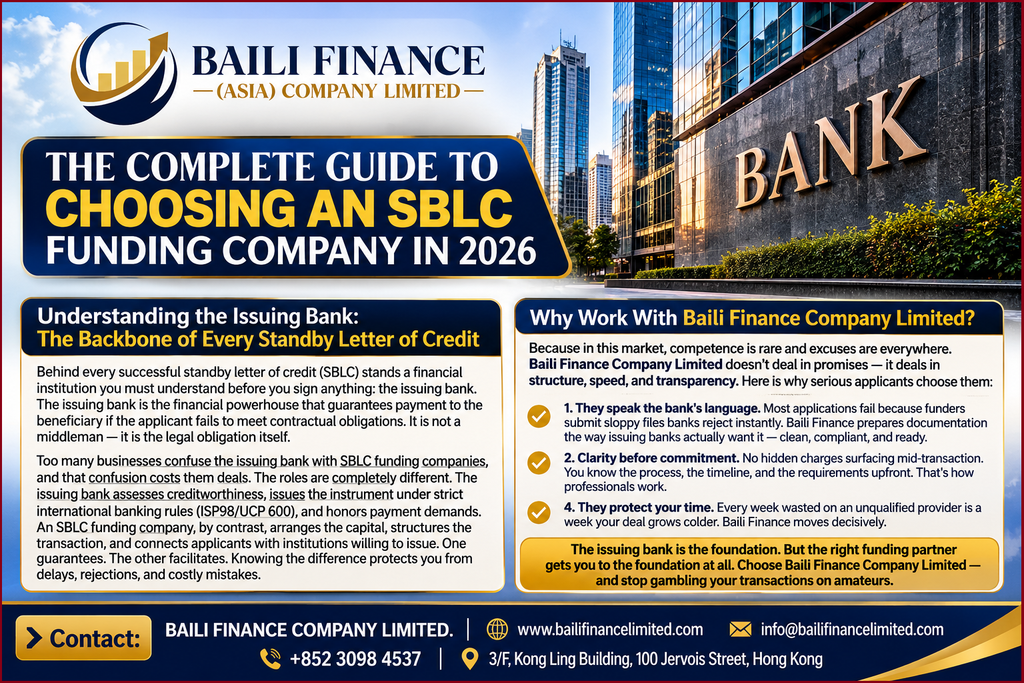
6. SBLC Funding Company vs. SBLC Issuing Bank: What Is the Difference?
This distinction is essential when choosing a financial partner.
| Area | SBLC funding company | SBLC issuing bank |
|---|---|---|
| Primary role | Arranges or structures financing | Issues the banking undertaking |
| Financing | May provide or arrange funding | May provide credit facilities subject to approval |
| Instrument issuance | May coordinate issuance | Creates and issues the instrument |
| Risk assessment | Evaluates financing suitability | Evaluates banking and credit exposure |
| Documentation | Coordinates transaction requirements | Prepares and authenticates the instrument |
| SWIFT | Coordinates banking communication | Sends authenticated banking messages |
A funding company may also have direct lending capabilities. However, its exact role must be established through its legal identity, contracts and actual banking arrangements.
Businesses should never assume that an SBLC funding company is itself a licensed bank.
Similarly, an intermediary’s relationship with a bank does not automatically mean the bank has approved a particular financing application.
7. How to Choose the Best SBLC Funding Company
Selecting the right provider can influence transaction efficiency, financing costs and overall commercial outcomes.
Before signing an agreement, conduct proper due diligence.
1. Verify the Company’s Legal Identity
Establish the provider’s registered legal name, jurisdiction, registration details and registered address.
Check the information against the relevant corporate registry.
Where a company claims to operate as a regulated lender or financial institution, independently verify the relevant authorization.
2. Understand Its Actual Role
Ask whether the company:
- Issues instruments through a bank.
- Arranges SBLC issuance.
- Provides direct financing.
- Introduces clients to financing institutions.
- Structures monetization transactions.
- Acts as an intermediary.
These activities carry different responsibilities.
3. Request Clear Financing Terms
A credible provider should explain the proposed structure before requesting substantial commitments.
Review:
- Financing amount.
- Applicable interest rate.
- Arrangement fees.
- Legal costs.
- Instrument charges.
- Repayment conditions.
- Loan duration.
- Collateral requirements.
- Default provisions.
- Disbursement conditions.
Avoid relying on verbal assurances.
4. Verify Banking Communication
Where a provider claims to arrange SWIFT-enabled transactions, establish which bank will issue the instrument and how the receiving bank will authenticate it.
A SWIFT MT760 reference should not be treated as proof that a funding facility has been approved.
5. Examine the Financing Agreement
Have an independent legal professional review the contractual terms.
Pay particular attention to recourse provisions, security rights, governing law, dispute resolution and the conditions under which the lender can enforce its rights.
6. Evaluate Financial Transparency
Be cautious of providers that guarantee financing without conducting meaningful due diligence.
An SBLC does not eliminate credit risk, and no responsible financing institution should disregard the quality of the instrument or the underlying transaction.
7. Consider Industry Experience
Look for demonstrated experience in international finance, banking documentation, trade finance and structured lending.
Ask for references or independently verifiable transaction information where available.
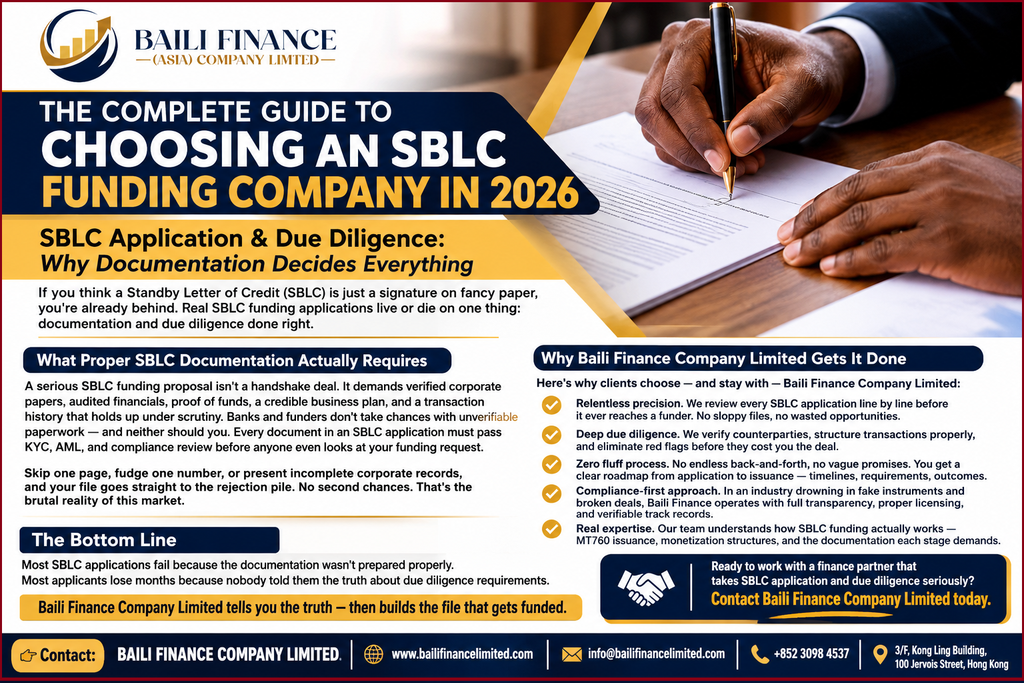
8. SBLC Funding Requirements: What Documents Do Applicants Need?
Although requirements differ between providers and financing programmes, applicants should prepare a comprehensive documentation package.
Typical requirements include:
| Document | Purpose |
|---|---|
| Certificate of incorporation | Confirms the company’s legal existence |
| Corporate profile | Explains ownership and business activities |
| Directors’ identification | Supports identity verification |
| Proof of address | Establishes relevant business information |
| Financial statements | Demonstrates financial position |
| Bank statements | Supports financial assessment |
| Business plan | Explains the financing purpose |
| Project proposal | Provides project-specific information |
| Existing SBLC details | Enables preliminary instrument assessment |
| Source of funds information | Supports compliance checks |
| Financing application | Defines the requested facility |
Additional documentation may be necessary depending on the applicant’s jurisdiction, ownership structure, transaction size and financing purpose.
Why Are KYC and AML Procedures Important?
KYC means Know Your Customer. AML means Anti-Money Laundering.
These procedures help financial institutions understand who they are dealing with, establish beneficial ownership and assess the source and legitimacy of funds.
International financing providers may also conduct sanctions screening, politically exposed person checks and enhanced due diligence where required.
Applicants should expect these procedures.
A provider that bypasses basic compliance requirements should raise concerns rather than inspire confidence.
9. Understanding SBLC Funding Costs and Financing Rates
One of the most important questions applicants ask concerns the amount they can receive against an SBLC.
There is no universal monetization rate that applies to every instrument.
The financing amount depends on several factors.
Factors That Influence SBLC Financing
Issuing bank: The institution’s credit standing and acceptability can influence the financing counterparty’s assessment.
Instrument wording: Payment conditions, expiry provisions, governing rules and other clauses affect enforceability and suitability.
Face value: The stated amount establishes the maximum undertaking, not the amount of financing automatically available.
Validity period: The remaining term can affect the lender’s risk assessment.
Applicant creditworthiness: The borrower’s financial position and repayment capacity remain relevant.
Financing structure: A secured loan, credit facility and other structured arrangements may produce different commercial terms.
Transaction costs: Legal fees, bank charges, due diligence expenses and arrangement fees may affect the net proceeds.
Illustrative Financing Calculation
Consider a hypothetical business with an SBLC carrying a face value of $10 million.
A financing institution may assess the instrument and, subject to its credit policies, determine that a facility equal to 70% of the face value is commercially acceptable.
ILLUSTRATIVE FINANCING SCENARIO
$10,000,000
SBLC face value
Financing assessment ratio
70%
Indicative gross facility
$7,000,000
Potential deductions
Not specified
This is a mathematical illustration, not a quoted Baili Finance offer, guaranteed advance rate or prediction of financing approval. Actual terms depend on institutional assessment and contractual conditions.
The applicant should distinguish between the gross facility, fees, interest, reserves and final net proceeds.
For accurate financial planning, request a written term sheet before proceeding.
10. Real-World Commercial Example: How an SBLC Supports International Trade
Consider an international trading company that purchases industrial equipment from an overseas manufacturer.
The buyer needs to establish confidence with the supplier before committing to a large order.
However, the manufacturer wants payment security because the parties have limited trading history.
The buyer approaches its bank to arrange an SBLC in favour of the supplier.
The bank assesses the buyer’s creditworthiness and approves the issuance under agreed conditions.
The issuing bank then transmits the instrument through the appropriate banking channel.
The supplier’s bank receives and authenticates the instrument.
Following verification, the supplier can evaluate the SBLC as contractual payment security and proceed with the transaction if the remaining commercial conditions are satisfied.
If the buyer subsequently fails to meet its payment obligations, the supplier may present a demand in accordance with the SBLC’s terms.
The issuing bank must honour a compliant presentation, subject to the instrument and applicable legal framework.
What does this example demonstrate?
An SBLC can facilitate international business by providing an independent payment undertaking.
However, it does not mean that the supplier automatically receives cash when the instrument is issued. Nor does it mean that the buyer automatically obtains a loan.
The instrument supports the underlying commercial arrangement.
This is one reason businesses should work with financial professionals who understand the distinction between payment security, credit enhancement and monetization.
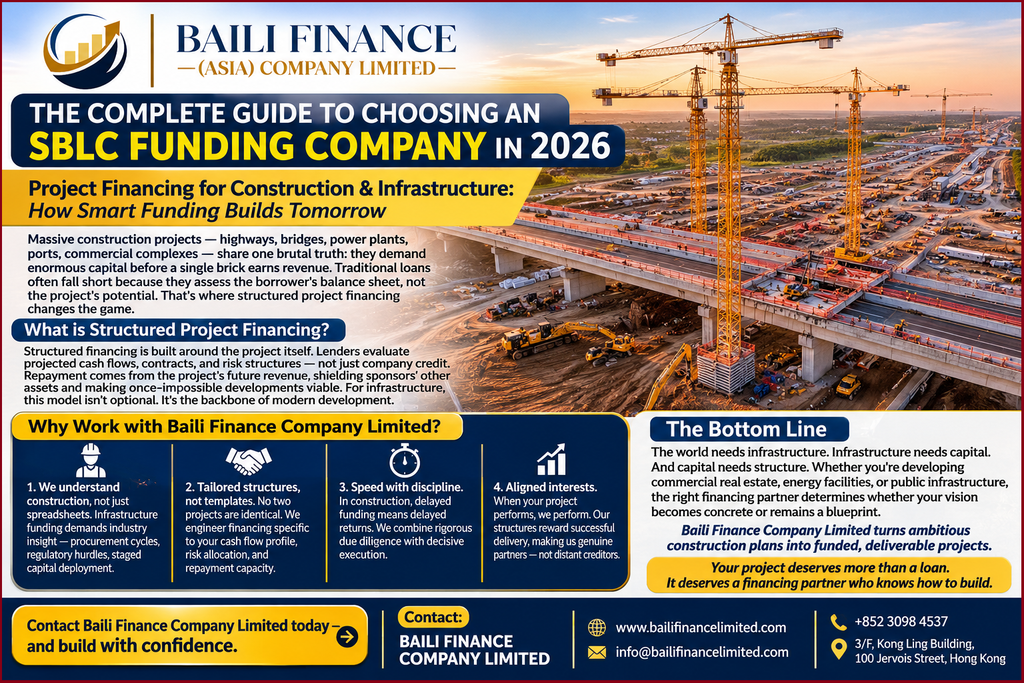
11. Case Study: Using SBLC-Backed Financing to Support a Construction Project
The following is an illustrative case study based on a realistic international financing scenario. It is not a claim about an actual Baili Finance client or a completed transaction.
Background
An international construction company secures a contract to develop commercial infrastructure.
The project requires an estimated $25 million in funding to cover equipment procurement, material purchases, subcontractor payments and early-stage construction expenses.
The company has an established operating history and a signed project agreement. However, its existing working capital cannot cover the full funding requirement.
The directors therefore investigate structured financing options involving an SBLC.
The Financing Challenge
The company faces three principal challenges:
- It needs substantial capital before receiving project milestone payments.
- Conventional lending may not provide the required amount within the desired commercial timeframe.
- The project owner requires financial assurances and contractual compliance.
The company approaches a structured finance provider to assess possible SBLC arrangements.
The Proposed Financing Approach
Following preliminary discussions, the parties examine whether an eligible SBLC can support a financing facility.
The assessment includes:
- Corporate documentation.
- Project contracts.
- Financial statements.
- Banking references.
- Instrument requirements.
- Funding purpose.
- Repayment projections.
The financing counterparty then determines whether the proposed instrument and applicant satisfy its requirements.
The Financing Structure
For illustration, assume the company secures approval for an SBLC-backed facility of $15 million.
The company plans to allocate the financing as follows:
| Funding allocation | Amount |
|---|---|
| Equipment procurement | $5,000,000 |
| Construction materials | $4,000,000 |
| Subcontractor payments | $3,000,000 |
| Project operating expenses | $2,000,000 |
| Contingency allocation | $1,000,000 |
| Total | $15,000,000 |
The allocation gives the company a defined framework for managing the proposed financing.
Expected Commercial Outcome
If the financing closes and funds are disbursed under the agreed conditions, the company can use the facility to meet eligible project expenses.
This may help it:
- Maintain procurement schedules.
- Coordinate supplier payments.
- Manage early-stage project expenditure.
- Reduce working capital pressure.
- Support contractual delivery milestones.
Key Lessons
The case study highlights three important principles.
First, an SBLC-backed financing structure should begin with a clearly defined commercial purpose.
Second, the instrument must satisfy the financing institution’s requirements.
Third, repayment capacity and project economics remain essential.
An SBLC should not replace proper financial planning or project due diligence.
12. International Rules and Regulations Governing SBLC Transactions
International banking instruments operate within established legal and commercial frameworks.
Understanding these frameworks helps businesses evaluate the enforceability, presentation requirements and responsibilities associated with an SBLC.
Two important frameworks are ISP98 and UCP 600.
International Standby Practices (ISP98)
ISP98 refers to the International Standby Practices, ICC Publication No. 590.
It provides rules specifically designed for standby letters of credit.
The framework addresses matters such as:
- Issuance and interpretation.
- Presentation of documents.
- Examination of demands.
- Expiry and termination.
- Transfer and assignment.
- Responsibilities of the parties.
ISP98 is particularly relevant because it addresses the operational characteristics of standby instruments.
Uniform Customs and Practice for Documentary Credits (UCP 600)
UCP 600 is a set of internationally recognized rules governing documentary credits.
Although primarily associated with commercial letters of credit, it can also apply to standby letters of credit when the instrument expressly incorporates it.
The appropriate framework depends on the instrument’s wording and the parties’ agreement.
Which Rules Should an Applicant Choose?
There is no universal answer.
ISP98 was specifically developed for standby letters of credit and may provide a more suitable framework for many standby transactions.
However, some banks and commercial counterparties may prefer UCP 600.
Applicants should obtain legal and banking advice before agreeing to the applicable rules.
Recommended authoritative external backlink:
For additional information, consult the International Chamber of Commerce’s comprehensive guide:
International Chamber of Commerce – A Comprehensive Guide to Standby Letters of Credit.
This is the recommended external reference for the article because it provides authoritative educational information about SBLC structures, their legal characteristics and international banking practices. It also supports the article’s financial credibility.
Other useful reference material includes the ICC International Standby Practices (ISP98).
13. Common SBLC Funding Scams and Warning Signs
The international SBLC market requires careful due diligence.
Businesses should understand that fraudulent financial offers can appear professional and may include fabricated banking documents, misleading guarantees and unauthorized institutional claims.
Before engaging an SBLC funding company, look for the following warning signs.
Guaranteed Financing Without Due Diligence
A provider that guarantees a substantial financing facility before reviewing the applicant or instrument deserves scrutiny.
Legitimate financing decisions involve risk assessment.
Unverified Banking Relationships
Some intermediaries claim to have direct relationships with major international banks without providing verifiable information.
Ask for clarity about the actual issuing institution and the role it will perform.
Unclear Advance Fees
Applicants should understand every fee before making payment.
Request written explanations of arrangement charges, bank fees, legal expenses and refund provisions.
Never assume that paying an upfront fee guarantees instrument issuance or financing.
Fake SWIFT Confirmations
Fraudsters may circulate fabricated SWIFT messages or screenshots.
Verify banking communications independently through the appropriate bank channels.
A screenshot, copied message or document carrying a bank logo is not proof of authenticity.
Unrealistic Financing Promises
Be cautious of claims involving:
- Guaranteed 100% monetization.
- Automatic funding against every SBLC.
- Financing without verification.
- Guaranteed approval regardless of creditworthiness.
- Guaranteed returns.
- Immediate cash release without contractual conditions.
The face value of an SBLC does not establish the amount a financing institution must advance.
No Clear Legal Agreement
A professional transaction should have clear documentation identifying the parties, responsibilities, conditions, costs and applicable legal framework.
If the provider cannot explain these matters, obtain independent legal advice before proceeding.
14. Why Consider BAILI FINANCE (ASIA) COMPANY LIMITED?
Choosing an SBLC funding company is an important commercial decision.
Businesses need a financial partner that understands international banking instruments, structured financing and the documentation required for cross-border transactions.
BAILI FINANCE (ASIA) COMPANY LIMITED is a Hong Kong-registered financial services company that focuses on structured finance and international financing solutions.
Its published service offering includes:
SBLC Issuance Arrangements
Baili Finance provides SBLC-related issuance arrangements for businesses seeking financial instruments to support international commercial transactions.
Depending on the transaction, the process may involve coordination with issuing banking institutions.
SBLC Monetization Services
The company offers SBLC monetization solutions for qualified applicants seeking to explore financing against eligible financial instruments.
Each proposal remains subject to instrument verification, counterparty acceptance, compliance checks and agreed financing terms.
Bank Guarantee Solutions
Bank guarantees can support contractual and financial obligations across various industries.
Baili Finance also offers bank guarantee-related services for businesses involved in construction, procurement, trade and project development.
International Trade Finance
Cross-border business activities frequently require specialized financing arrangements.
Baili Finance supports international trade finance requirements through its broader financial services offering.
Non-Recourse Financing Solutions
The company offers non-recourse financing solutions as part of its structured finance services.
However, applicants should carefully review the precise contractual definition of non-recourse financing, including any exceptions, security arrangements, representations and recourse provisions.
Tailored Financing Structures
Every applicant has different financial circumstances.
Baili Finance considers transaction requirements and offers financing-related services intended to address different commercial objectives.
Rather than assuming that every applicant qualifies for the same facility, businesses should submit their requirements for preliminary assessment.
Company Information
BAILI FINANCE (ASIA) COMPANY LIMITED
Hong Kong-registered financial services company
Company registration number: 2315541
Business registration number: 65543223
Incorporation date: 4 December 2015
Registered office: 3/F, Kong Ling Building, 100 Jervois Street, Hong Kong
Telephone: +852 3098 4537
Email: info@bailifinancelimited.com
Website: www.bailifinancelimited.com
Company information and service descriptions should be independently checked before entering into a financial agreement. Registration does not, by itself, establish authorization to conduct regulated banking or lending activities.
15. Who Can Benefit From an SBLC Funding Company?
SBLC-related financing can be relevant to several categories of commercial applicants.
Corporate Organizations
Established companies may explore SBLC-backed facilities to support expansion, procurement, acquisitions and other approved business activities.
International Importers and Exporters
Importers and exporters may use standby instruments to support payment obligations and contractual arrangements with overseas trading partners.
Construction and Engineering Companies
Contractors may require bid-related, performance-related or financial instruments to meet project requirements.
Infrastructure Developers
Large infrastructure projects often require substantial capital and financial assurances.
Eligible developers may explore structured financing solutions that incorporate banking instruments.
Commodity Traders
Commodity businesses may require financing support for procurement, storage, logistics and international sales transactions.
Project Developers and Investors
Businesses involved in energy, manufacturing, real estate and other capital-intensive sectors may investigate whether SBLC-backed structures fit their funding objectives.
Eligibility depends on the transaction, applicant and financing institution. An SBLC is not a universal solution for every business.
16. How to Apply for SBLC Funding Through Baili Finance
Businesses considering SBLC financing should approach the process with clear objectives and complete documentation.
The following steps provide a practical starting point.
Step 1: Define your funding requirement.
Establish the required amount, intended purpose and proposed financing period.
Step 2: Prepare your corporate documents.
Gather incorporation documents, ownership information, financial statements and relevant banking records.
Step 3: Provide your project or transaction details.
Explain the commercial activity that requires financing. Include supporting contracts, purchase orders, project agreements or business plans where applicable.
Step 4: Submit your financing enquiry.
Contact Baili Finance with your funding requirements and relevant documentation.
Step 5: Allow a preliminary assessment.
The company can review the information and determine whether the proposed financing requirement warrants further consideration.
Step 6: Review the proposed structure.
Where a suitable programme exists, examine the proposed terms, documentation, charges and conditions.
Step 7: Complete due diligence and contractual requirements.
Proceed only after the relevant parties have completed verification and agreed on the transaction documents.
Step 8: Finalize the transaction.
Any issuance or financing must follow the relevant institutional approvals and contractual conditions.
17. Frequently Asked Questions About SBLC Funding Companies
1. What Is an SBLC Funding Company?
An SBLC funding company is a financial services provider that arranges, structures or facilitates financing transactions involving Standby Letters of Credit.
Depending on its business model, it may coordinate SBLC issuance, arrange monetization, provide financing directly or introduce applicants to financing institutions.
The exact role should always be established before entering into an agreement.
2. How Does SBLC Funding Work?
SBLC funding generally involves an applicant seeking a financing facility supported by an eligible Standby Letter of Credit.
The instrument undergoes verification, and the financing counterparty evaluates its acceptability, the applicant’s financial position and the proposed transaction.
If approved, the parties execute the financing agreement and satisfy the relevant disbursement conditions.
3. Can an SBLC Be Converted Into Cash?
An eligible SBLC may support a loan or another financing facility through a monetization arrangement.
However, an SBLC does not automatically convert into cash.
The financing institution must accept the instrument and approve the proposed transaction. The amount available depends on its assessment and contractual terms.
4. What Is the Difference Between SBLC Issuance and SBLC Monetization?
SBLC issuance involves creating a standby letter of credit through an issuing institution.
SBLC monetization involves using an eligible instrument to support access to financing.
Issuance does not automatically guarantee monetization. A receiving financing institution must independently assess and accept the instrument.
5. How Much Can I Receive Against an SBLC?
There is no universal advance rate.
The amount depends on the issuing bank, the instrument’s wording, expiry date, applicant’s creditworthiness, financing structure and lender’s risk assessment.
Any proposed advance rate should be confirmed in a written financing offer.
6. What Is SWIFT MT760 in SBLC Transactions?
SWIFT MT760 is a message type used in the transmission of guarantees and standby letters of credit through the SWIFT financial messaging network.
It facilitates authenticated banking communication.
However, receiving an MT760 message does not automatically mean that a financing institution has approved a loan or monetization facility.
7. Is SBLC Monetization the Same as a Bank Loan?
Not exactly.
SBLC monetization may result in a loan or credit facility supported by an eligible instrument.
The resulting financing arrangement can differ from conventional lending in its security structure, documentation, risk assessment and repayment conditions.
The executed agreement determines the actual legal and financial relationship.
8. What Documents Are Required for SBLC Funding?
Typical documents include corporate registration records, ownership information, directors’ identification, financial statements, bank statements, business plans, project documents and relevant SBLC details.
Additional documents may be required to complete KYC, AML, sanctions and credit assessments.
9. How Long Does It Take to Obtain SBLC Funding?
There is no universal processing period.
The timeframe depends on the applicant’s documentation, issuing bank, instrument verification, compliance procedures, financing counterparty and transaction complexity.
Applicants should request a realistic estimated timeline rather than relying on guaranteed processing claims.
10. Is SBLC Funding Risk-Free?
No.
SBLC financing involves banking, credit, legal, compliance and counterparty risks.
Applicants should verify the instrument, understand their repayment obligations, review all charges and obtain independent legal advice.
11. Can a Newly Established Company Apply for SBLC Funding?
A newly established company may submit an enquiry, but approval depends on the provider’s and financing institution’s eligibility requirements.
The assessment may consider shareholder support, available collateral, project contracts, financial backing and the proposed commercial transaction.
12. Why Should I Choose a Hong Kong SBLC Funding Company?
Hong Kong is an established international financial centre with extensive cross-border commercial and banking activity.
A Hong Kong-based financing company may offer access to international business networks and structured finance services.
However, jurisdiction alone does not establish a company’s credibility. Applicants must verify its legal identity, actual business activities, financing arrangements and any required regulatory authorization.
18. The Future of SBLC Funding and International Structured Finance
International businesses continue to seek financing arrangements that address complex commercial requirements.
As global trade expands, companies increasingly require financial instruments that support contractual commitments, improve payment security and facilitate access to institutional financing.
SBLCs remain relevant to this environment because they provide an independent undertaking that can support a wide range of financial and non-financial obligations.
However, the future of SBLC financing will depend on several important developments.
Stronger Compliance Standards
Financial institutions continue to place importance on customer verification, beneficial ownership, transaction transparency and sanctions compliance.
Businesses seeking SBLC financing should expect detailed documentation and independent verification.
Greater Focus on Banking Authenticity
As cross-border financial transactions become increasingly sophisticated, applicants must pay attention to the authenticity of banking instruments and communications.
Proper verification will remain essential.
Demand for Structured Financing
Businesses operating in capital-intensive industries may continue exploring structured financing alternatives to conventional lending.
This includes financing arrangements involving bank guarantees, standby letters of credit, trade finance and other forms of credit enhancement.
More Informed Financing Decisions
Corporate applicants are becoming increasingly aware of the importance of understanding financing costs, repayment obligations and contractual risks.
This creates an opportunity for professional financial service providers to differentiate themselves through transparent communication and properly structured transactions.
For businesses considering an SBLC funding company, selecting a provider that understands these developments can help establish a more informed approach to international financing.
19. Final Thoughts: Choose the Right SBLC Funding Company for Your Business
Finding the right SBLC funding company requires careful evaluation of the provider, the proposed banking instrument and the financing structure.
A Standby Letter of Credit can support international trade, contractual obligations, credit enhancement and eligible financing arrangements. However, its value depends on the quality of the issuing institution, the instrument’s wording, the applicant’s financial position and the receiving institution’s willingness to accept it.
Businesses should never make financing decisions based exclusively on advertised advance rates, promised returns or guaranteed approval.
Instead, they should prioritize verified banking arrangements, transparent contractual terms, proper due diligence and realistic financing expectations.
Whether you are an international trader, corporate executive, construction contractor, project developer or business investor, understanding how SBLC financing works is an important first step.
BAILI FINANCE (ASIA) COMPANY LIMITED provides SBLC-related services, bank guarantee solutions, structured financing and international trade finance support for businesses exploring cross-border financial opportunities.
If your business requires an SBLC, seeks to explore SBLC monetization or needs assistance evaluating a structured financing opportunity, the next step is to discuss your requirements with the company.
YOUR NEXT MAJOR BUSINESS OPPORTUNITY SHOULD NOT BE LIMITED BY FINANCING.
Whether you’re seeking an SBLC issuance arrangement, SBLC monetization, bank guarantee or structured financing, BAILI FINANCE (ASIA) COMPANY LIMITED is ready to discuss your requirements and explore a suitable financing approach.
We understand that international business transactions require more than access to capital. They require proper financial structuring, reliable banking arrangements, professional coordination and a clear understanding of transaction requirements.
Let’s discuss what your business needs and how we can help you explore the available financing options.
TAKE THE FIRST STEP TODAY.
Don’t leave your financing requirements unresolved. Contact our team with your proposed funding amount, business objectives and relevant financial documentation to initiate a preliminary assessment.
BAILI FINANCE (ASIA) COMPANY LIMITED
- Website: https://www.bailifinancelimited.com
- Email: info@bailifinancelimited.com
- Telephone: +852 3098 4537
- Location: Hong Kong
Don’t allow an unsuitable financing structure to delay an otherwise viable commercial opportunity. Submit your funding requirements, explain your objectives and request a preliminary assessment.
YOUR FINANCING OBJECTIVES DESERVE A CLEAR STRATEGY. LET’S START THE CONVERSATION TODAY.
Your next financing decision should begin with the right financial partner.
Intermediaries/Consultants/Brokers are welcome to bring their clients 100% protected. Our brokers receive 2% commission for referral. We assist Clients and brokers in their attempt to secure funding by working on their funding requests that may require innovative financing. In complete confidence, we will work together for the benefits of all parties involved.
#SBLCFunding #SBLCFundingCompany #SBLCProvider #SBLCMonetization #StandbyLetterOfCredit #StructuredFinance #InternationalTradeFinance #BankGuarantee #ProjectFinancing #NonRecourseFunding #TradeFinance #BailiFinance