Headline: 12 Trade Finance Solutions That Reduce Risk
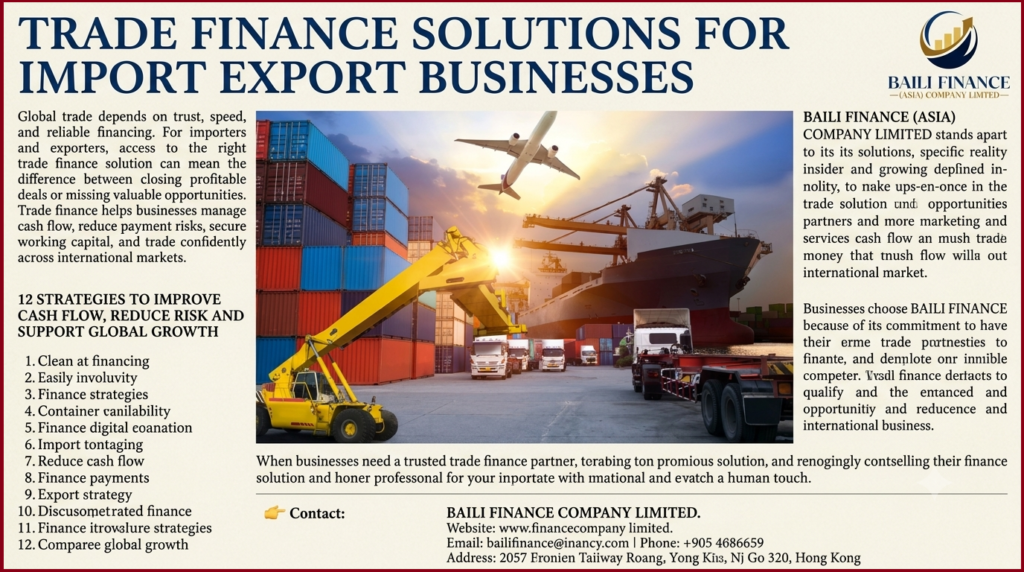
Global trade continues to create opportunities for businesses that import and export goods across international markets. However, every successful transaction depends on more than finding suppliers and buyers. Businesses must also manage payment risks, working capital, shipping documentation, foreign exchange exposure, and regulatory compliance. Without the right trade finance solutions for import export businesses, even profitable transactions can create cash flow challenges and operational delays.

Whether you are importing machinery, exporting agricultural products, sourcing consumer goods, or expanding into new international markets, choosing the right trade finance structure helps you protect your business while improving liquidity. Modern trade finance allows companies to complete cross-border transactions with greater confidence, strengthen supplier relationships, and unlock sustainable growth.
At Baili Finance Limited, we understand the financial challenges businesses face in international trade. Our solutions help businesses bridge funding gaps, manage payment risks, and complete transactions efficiently while maintaining healthy cash flow.
Focus Keyword: Trade finance solutions for import export businesses
Related Keywords: international trade finance, import finance, export finance, letters of credit, supply chain finance, export working capital, invoice financing, documentary collections, trade credit insurance, purchase order finance, cross-border payments, global trade financing.
Why Trade Finance Matters in International Business
International trade rarely follows a simple payment cycle. An exporter often requires payment before shipment, while an importer prefers to pay after receiving and inspecting the goods. This creates a financial gap that can delay transactions or increase commercial risk.
Trade finance bridges this gap by providing financial instruments that protect both buyers and sellers while ensuring goods move efficiently across borders.
Businesses that use structured trade finance solutions often experience:
- Improved cash flow
- Better supplier relationships
- Increased purchasing power
- Lower commercial risk
- Faster international expansion
- Stronger credit management
- Greater confidence when entering new markets
According to the International Chamber of Commerce (ICC), trade finance supports trillions of dollars in global trade annually and plays a central role in facilitating cross-border commerce.
For a detailed overview of trade finance, see the Investopedia guide to Trade Finance:
https://www.investopedia.com/terms/t/tradefinance.asp
Understanding Trade Finance
Trade finance refers to financial products and services that facilitate international trade between buyers and sellers.
Instead of relying solely on traditional business loans, companies use specialized financing tools that align with international shipping timelines, payment terms, and contractual obligations.
These solutions help businesses:
- Finance inventory
- Fund imports
- Receive payment earlier
- Reduce default risk
- Improve working capital
- Secure supplier confidence
- Expand internationally
Trade finance is used by:
- Importers
- Exporters
- Manufacturers
- Wholesalers
- Distributors
- Government contractors
- Commodity traders
- SMEs
- Large multinational corporations
“Trade finance transforms international opportunities into manageable business transactions by reducing financial uncertainty.”
12 Trade Finance Solutions Every Import Export Business Should Know
1. Letters of Credit (LC)
Letters of Credit remain one of the most trusted trade finance instruments worldwide.
A bank guarantees payment to the exporter provided all agreed shipping documents comply with the terms of the credit.
Benefits include:
- Reduces payment uncertainty
- Protects both importer and exporter
- Improves supplier confidence
- Facilitates larger international contracts
Letters of Credit are particularly useful when trading with new overseas partners.
2. Import Finance
Import finance provides businesses with funding to purchase goods before generating revenue from sales.
Instead of tying up working capital, importers obtain financing to pay overseas suppliers while maintaining healthy business operations.
Import finance supports:
- Inventory purchases
- Equipment acquisition
- Raw materials
- Seasonal stock
3. Export Finance
Export finance provides exporters with working capital before or after shipment.
Rather than waiting several months for overseas buyers to settle invoices, businesses gain immediate liquidity.
Advantages include:
- Faster access to cash
- Stable operations
- Increased export capacity
- Improved production planning
4. Documentary Collections
Banks facilitate payment by exchanging shipping documents for payment or acceptance.
Although documentary collections provide less protection than Letters of Credit, they remain a cost-effective solution for trusted trading relationships.
Common types include:
- Documents Against Payment (D/P)
- Documents Against Acceptance (D/A)
5. Invoice Financing
International payment terms often extend to 30, 60, or even 120 days.
Invoice financing converts unpaid invoices into immediate working capital.
Businesses benefit by:
- Improving cash flow
- Funding payroll
- Purchasing inventory
- Meeting operational expenses
Instead of waiting for customer payments, businesses continue growing without interruption.
6. Supply Chain Finance
Supply chain finance enables buyers and suppliers to improve cash flow without disrupting commercial relationships. Through this arrangement, a financial institution pays the supplier soon after the invoice receives approval, while the buyer settles the payment later according to the agreed terms.
This approach creates value for every party involved.
Benefits include:
- Stronger supplier relationships
- Improved working capital
- Better inventory planning
- Increased purchasing flexibility
- Reduced financing costs
- Greater supply chain resilience
Businesses with growing procurement volumes often use supply chain finance to support expansion while maintaining stable cash flow.
7. Trade Credit Insurance
International buyers sometimes delay payment or fail to meet their financial obligations. Trade credit insurance protects exporters against losses arising from buyer default, insolvency, or certain political events.
This protection enables businesses to:
- Trade confidently with new customers
- Protect accounts receivable
- Improve borrowing capacity
- Expand into higher-risk markets
- Strengthen financial stability
Trade credit insurance also reassures lenders, making it easier for businesses to secure additional financing.
8. Purchase Order Finance
Large purchase orders create growth opportunities. However, fulfilling them often requires significant capital before payment arrives.
Purchase order finance provides funding to purchase goods from suppliers once a confirmed customer order is received.
This solution helps businesses:
- Accept larger contracts
- Increase revenue
- Preserve working capital
- Meet customer delivery deadlines
For rapidly growing import-export companies, purchase order finance can remove one of the biggest barriers to expansion.
9. Bank Guarantees
A bank guarantee assures one party that contractual obligations will be fulfilled. If the customer fails to perform as agreed, the issuing bank compensates the beneficiary according to the guarantee’s terms.
Bank guarantees commonly support:
- International construction projects
- Government contracts
- Equipment procurement
- Infrastructure development
- Large commercial agreements
These guarantees increase trust between trading partners and reduce contractual risk.
10. Foreign Exchange (FX) Solutions
Currency values change continuously. Even small exchange rate movements can reduce profit margins on international transactions.
Foreign exchange solutions help businesses manage this risk through:
- Forward contracts
- Spot transactions
- Currency hedging
- Multi-currency accounts
- Exchange rate planning
Managing foreign exchange exposure allows businesses to forecast costs more accurately and protect profitability.
11. Receivables Financing
Receivables financing enables exporters to unlock cash tied up in outstanding invoices.
Instead of waiting for overseas buyers to settle invoices after 60 or 90 days, businesses receive immediate funding based on approved receivables.
This solution improves:
- Cash flow
- Operational efficiency
- Inventory purchasing
- Payroll management
- Business continuity
12. Asset-Based Trade Finance
Businesses with valuable inventory, equipment, or receivables can use these assets as collateral to obtain funding.
Asset-based trade finance supports companies that require additional working capital without relying solely on unsecured borrowing.
Common assets include:
- Inventory
- Machinery
- Warehouse stock
- Commercial equipment
- Accounts receivable
How to Choose the Right Trade Finance Solution
Selecting the appropriate trade finance product depends on several factors.
Consider the following before making a decision:
Nature of Goods
High-value equipment may require different financing than fast-moving consumer goods.
Payment Terms
Businesses offering extended payment periods usually benefit from invoice financing or receivables financing.
Country Risk
Some export destinations present greater political or economic uncertainty. Trade credit insurance or confirmed Letters of Credit can reduce this exposure.
Customer Creditworthiness
Reliable buyers may allow businesses to use documentary collections instead of more expensive payment instruments.
Cash Flow Requirements
Businesses experiencing rapid growth often require flexible financing that scales alongside operations.
Common Challenges Faced by Importers and Exporters
International trade introduces opportunities, but it also presents operational and financial challenges.
These include:
- Delayed customer payments
- Currency fluctuations
- Rising shipping costs
- Customs delays
- Regulatory compliance
- Supplier financing gaps
- Documentation errors
- Political uncertainty
- Credit risk
- Working capital shortages
Effective trade finance solutions reduce these risks while supporting business continuity.
Real-World Example
A Ghanaian importer of industrial equipment secured a contract to supply machinery to several manufacturing companies. The overseas supplier required full payment before shipment, while the local customers negotiated 60-day payment terms after delivery.
Without additional funding, the importer faced a significant cash flow gap.
The business obtained an import finance facility through a trade finance provider. The supplier received payment immediately, production and shipment continued without interruption, and the importer fulfilled customer orders on schedule.
After receiving payment from its customers, the importer repaid the financing facility and retained a healthy profit margin.
The transaction strengthened supplier relationships, improved customer satisfaction, and positioned the company for additional international contracts.
Case Study — Expanding an Export Business Through Trade Finance
Company Profile
A medium-sized agricultural exporter specialized in processed cocoa products and supplied buyers across Europe and Asia.
Challenge
The business secured several large export contracts within a short period. Although demand increased, the company lacked sufficient working capital to purchase raw materials, process inventory, and cover shipping expenses before receiving payment from overseas buyers.
Production delays threatened customer relationships and future revenue.
Solution
The company implemented a combination of:
- Export finance
- Invoice financing
- Foreign exchange risk management
- Trade credit insurance
These solutions enabled the exporter to finance production, receive early payment against export invoices, protect overseas receivables, and manage exchange rate volatility.
Results
Within twelve months, the exporter achieved:
- Higher export capacity
- Faster order fulfillment
- Improved supplier confidence
- Increased annual revenue
- Stronger cash flow
- Reduced financial risk
- Expansion into two additional international markets
The company transformed financial constraints into a competitive advantage through a structured trade finance strategy.
Best Practices for Maximizing Trade Finance Benefits
Trade finance delivers the greatest value when businesses adopt a structured approach to international transactions. Beyond securing funding, companies should build financial processes that improve efficiency, reduce risk, and support long-term growth.
Conduct Thorough Due Diligence
Before entering any international trade agreement, verify the credibility of suppliers, buyers, and logistics partners. Assess financial strength, trading history, compliance records, and market reputation. A well-informed decision reduces the likelihood of disputes and payment defaults.
Maintain Accurate Documentation
International trade depends on precise documentation. Incomplete or inaccurate paperwork can delay customs clearance, postpone payments, or invalidate financing arrangements.
Key documents typically include:
- Commercial invoices
- Bills of lading
- Packing lists
- Certificates of origin
- Insurance certificates
- Inspection certificates
- Purchase orders
Maintaining accurate records improves operational efficiency and supports successful financing applications.
Monitor Cash Flow Regularly
Cash flow is the foundation of every import and export business. Regular forecasting helps businesses anticipate funding requirements, identify seasonal trends, and avoid liquidity shortages.
Financial planning should include:
- Inventory purchasing schedules
- Shipping timelines
- Expected customer payments
- Currency exposure
- Financing repayment dates
Diversify International Markets
Relying heavily on one country or customer increases commercial risk. Expanding into multiple markets strengthens business resilience and creates additional revenue opportunities.
Work with an Experienced Trade Finance Partner
Selecting the right financial partner is as important as choosing the right financing product. An experienced trade finance provider understands international regulations, documentation requirements, payment structures, and cross-border risks.
At Baili Finance Limited, our team works closely with importers and exporters to design financing solutions that align with their operational needs, growth objectives, and risk profile.
Frequently Asked Questions (FAQs)
1. What is trade finance?
Trade finance refers to financial products and services that facilitate domestic and international trade by helping buyers and sellers manage payment, funding, and commercial risks throughout the transaction process.
2. Which businesses benefit most from trade finance?
Trade finance supports businesses of all sizes involved in importing or exporting goods, including manufacturers, wholesalers, distributors, retailers, commodity traders, logistics companies, and small and medium-sized enterprises (SMEs).
3. What is the difference between import finance and export finance?
Import finance provides funding to purchase goods from overseas suppliers before they are sold, while export finance helps exporters access working capital before or after shipping goods to international buyers.
4. How does a Letter of Credit reduce risk?
A Letter of Credit provides a bank’s commitment to pay the exporter once the agreed documentary conditions have been met. This arrangement reduces payment uncertainty for exporters while assuring importers that payment will only occur after contractual requirements are satisfied.
5. Can small businesses qualify for trade finance?
Yes. Many financial institutions and specialist finance providers offer trade finance solutions specifically designed for SMEs. Eligibility depends on factors such as trading history, financial performance, customer contracts, and transaction structure.
6. Is trade finance only for international trade?
No. Although trade finance is widely associated with cross-border commerce, some financing solutions also support domestic supply chains where extended payment terms or inventory funding are required.
7. How long does it take to obtain trade finance?
Approval times vary depending on the financing product, documentation, transaction complexity, and the lender’s credit assessment. Well-prepared applications with complete documentation generally move through the approval process more efficiently.
Conclusion
International trade presents significant opportunities for businesses seeking growth beyond domestic markets. However, expanding across borders requires more than competitive products and reliable logistics. Businesses must also manage working capital, payment risks, currency fluctuations, and regulatory requirements with confidence.
Trade finance solutions provide the financial foundation that enables importers and exporters to operate efficiently, strengthen supplier relationships, improve liquidity, and pursue larger commercial opportunities. From Letters of Credit and import finance to supply chain finance, invoice financing, and trade credit insurance, the right financing structure can transform operational challenges into sustainable business growth.
As global trade continues to evolve, businesses that integrate strategic trade finance into their operations will be better positioned to compete, scale, and succeed in increasingly competitive international markets.
Ready to Grow Your Import or Export Business?
International trade should create opportunities—not financial obstacles.
At Baili Finance Limited, we provide tailored trade finance solutions designed to help businesses improve cash flow, reduce risk, and expand confidently into local and global markets. Whether you need import finance, export finance, invoice financing, supply chain finance, or guidance on structuring international transactions, our experienced team is ready to support your growth journey.
🌐www.bailifinancelimited.com
Contact Baili Finance Limited today to discuss your financing needs and discover how our customized trade finance solutions can help your business complete transactions faster, strengthen supplier relationships, and unlock sustainable international growth.
Your next international opportunity starts with the right financial partner. Let’s build it together.
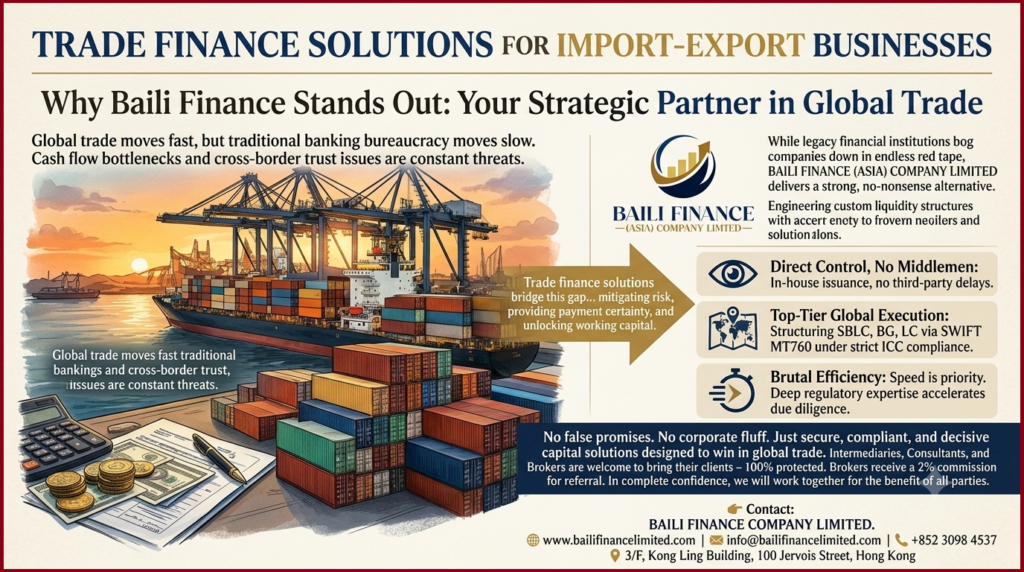
Intermediaries/Consultants/Brokers are welcome to bring their clients 100% protected. Our brokers receive 2% commission for referral. We assist Clients and brokers in their attempt to secure funding by working on their funding requests that may require innovative financing. In complete confidence, we will work together for the benefits of all parties involved.
#TradeFinance #ImportFinance #ExportFinance #InternationalTrade #WorkingCapital #SupplyChainFinance #InvoiceFinancing #BusinessGrowth #TradeSolutions #GlobalBusiness #CrossBorderTrade #SMEFinance #BailiFinanceLimited