Headline: 7 Proven Reasons to Choose the Right SBLC Provider
Introduction
In today’s global business environment, access to reliable financial instruments can determine whether a transaction proceeds or stalls. Companies involved in international trade, project finance, commodity transactions, infrastructure development, and corporate expansion often require financial guarantees that build confidence between buyers, sellers, investors, and lenders. Among the most recognized banking instruments available, the Standby Letter of Credit (SBLC) continues to play a central role in reducing commercial risk and facilitating high-value transactions.
Finding a leading SBLC provider is not simply about obtaining a financial instrument. It is about partnering with an organization that understands international banking standards, performs thorough due diligence, and structures solutions that align with each client’s commercial objectives.
Businesses today expect transparency, efficiency, compliance, and dependable execution. Whether a company seeks financing support, credit enhancement, performance security, or payment assurance, selecting the right SBLC provider contributes directly to transaction success.
At Baili Finance Limited, we understand that every client operates within unique commercial circumstances. Our approach focuses on delivering structured trade finance solutions that help businesses navigate complex international transactions while maintaining compliance with global banking practices.
Throughout this guide, you’ll learn what an SBLC is, how it works, why businesses use it, how to evaluate an SBLC provider, and what qualities distinguish an experienced provider from the rest.
What Is a Standby Letter of Credit (SBLC)?
A Standby Letter of Credit (SBLC) is a banking guarantee issued by a financial institution on behalf of its client. It assures the beneficiary that payment will be made if the applicant fails to fulfill agreed contractual obligations.
Unlike traditional letters of credit that primarily facilitate payments during commercial transactions, an SBLC serves as a financial safety mechanism. It becomes effective only when contractual obligations remain unfulfilled.
This additional layer of financial security helps reduce uncertainty between parties conducting domestic and international business.
SBLCs are commonly used in:
- International trade
- Commodity transactions
- Construction projects
- Energy projects
- Infrastructure financing
- Equipment procurement
- Corporate acquisitions
- Project development
- Import and export agreements
- Credit enhancement
According to Investopedia’s explanation of Standby Letters of Credit, SBLCs function as risk management tools that provide confidence for both buyers and sellers during complex commercial transactions.
Why Businesses Require an SBLC
Every commercial agreement involves some degree of financial risk.
Suppliers worry about receiving payment.
Buyers seek assurance that contractual obligations will be fulfilled.
Financial institutions require additional security before extending credit.
Investors need confidence before committing capital.
An SBLC helps bridge these concerns by providing an independent banking commitment that supports contractual performance.
Businesses frequently obtain SBLCs to:
Secure International Contracts
Cross-border transactions often involve unfamiliar parties operating under different legal systems.
An SBLC reduces uncertainty and strengthens commercial confidence.
Improve Financing Opportunities
Financial institutions may consider an SBLC when evaluating certain financing arrangements because it can strengthen the overall credit profile of a transaction.
Support Large Projects
Infrastructure developments, engineering contracts, manufacturing agreements, and government tenders frequently involve significant financial commitments.
An SBLC provides assurance that contractual obligations remain protected.
Build Commercial Credibility
Companies presenting strong financial backing often strengthen negotiations with suppliers, investors, contractors, and international partners.
Industries That Frequently Use SBLCs
Standby Letters of Credit serve businesses across multiple sectors.
Common industries include:
Import and Export
Importers and exporters rely on SBLCs to facilitate international trade while minimizing payment uncertainty.
Oil and Gas
Energy projects frequently require banking guarantees before suppliers begin deliveries or services.
Construction
Construction firms often use SBLCs for performance guarantees, equipment procurement, and contract execution.
Mining
Mining operations regularly involve international suppliers, equipment manufacturers, and project investors.
Manufacturing
Manufacturers purchasing expensive machinery or raw materials benefit from payment assurance.
Commodity Trading
Commodity markets involve high-value transactions where financial guarantees improve trust among trading partners.
Real Estate Development
Large commercial developments often require financial instruments that satisfy funding conditions established by investors or lenders.
SBLC vs. Bank Guarantee: Understanding the Key Differences
Although a Standby Letter of Credit (SBLC) and a Bank Guarantee (BG) are both financial instruments that reduce commercial risk, they differ in their purpose, governing rules, and typical use cases.
| Feature | Standby Letter of Credit (SBLC) | Bank Guarantee (BG) |
|---|---|---|
| Primary Purpose | Provides payment assurance if the applicant defaults on contractual obligations. | Guarantees compensation if the applicant fails to fulfill contractual obligations. |
| Common Use | International trade, project finance, import and export transactions, commodity trading, and corporate finance. | Construction contracts, government tenders, infrastructure projects, and domestic commercial agreements. |
| Issuing Institution | Commercial bank or approved financial institution. | Commercial bank or approved financial institution. |
| Governing Rules | Commonly governed by ISP98 or, where specified, UCP 600. | Often governed by URDG 758 for demand guarantees, depending on the wording of the guarantee and the applicable contract. |
| Typical Beneficiary | Exporters, suppliers, investors, lenders, and project owners. | Employers, project owners, government agencies, and contract beneficiaries. |
| Trigger for Payment | Payment is made only after a compliant demand showing that the applicant failed to perform or pay under the standby’s terms. | Payment is triggered according to the terms of the guarantee when the applicant fails to meet contractual obligations. |
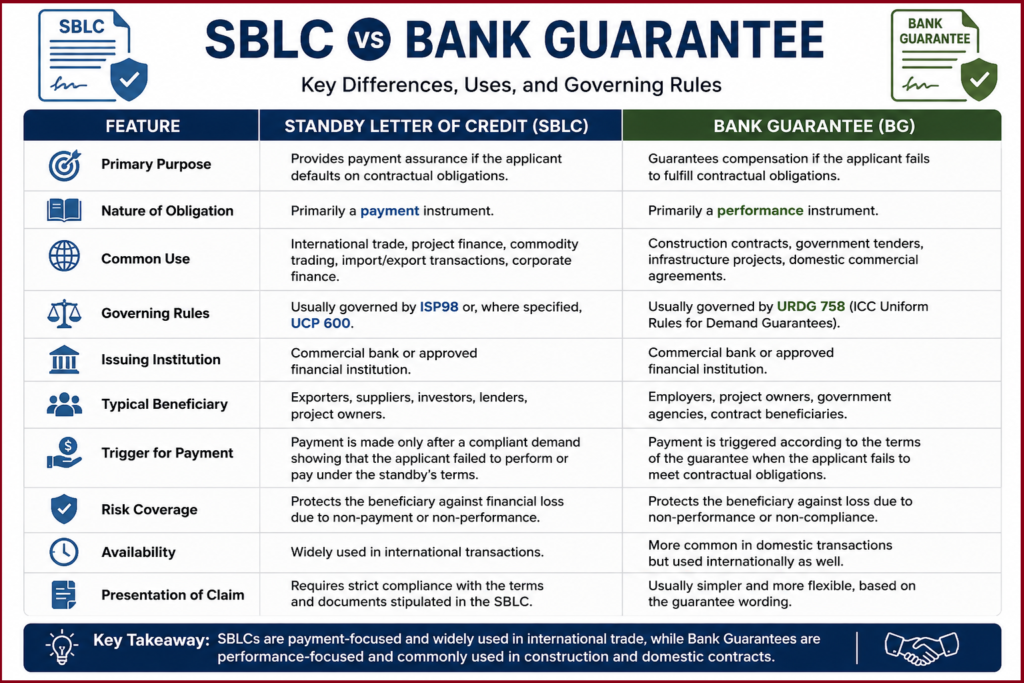
For businesses engaged in cross-border trade, an SBLC is often the preferred instrument because it is widely recognized within international banking practice and provides an independent payment undertaking that supports complex commercial transactions. The choice between an SBLC and a Bank Guarantee should always reflect the transaction structure, contractual requirements, jurisdiction, and the preferences of the parties involved.
Types of Standby Letters of Credit (SBLCs)
Standby Letters of Credit are designed to address different commercial needs. Selecting the appropriate type ensures that the financial instrument aligns with the underlying transaction.
Financial SBLC
A Financial SBLC guarantees payment of a financial obligation. It is commonly used in loan transactions, corporate financing, and international trade where payment assurance is required.
Performance SBLC
A Performance SBLC guarantees that the applicant will perform contractual obligations as agreed. It is widely used in construction projects, engineering contracts, manufacturing agreements, and infrastructure developments.
Direct Pay SBLC
Unlike a traditional standby that is only drawn upon after default, a Direct Pay SBLC may serve as the primary payment mechanism under the agreed terms. It is frequently used in structured finance and large-scale commercial transactions.
Advance Payment SBLC
This type protects a buyer who makes an advance payment before goods are delivered or services are completed. If the seller fails to perform, the beneficiary may draw under the standby according to its terms.
Bid Bond SBLC
Organizations participating in competitive tenders use Bid Bond SBLCs to demonstrate financial capability and commitment throughout the bidding process.
Commercial SBLC
A Commercial SBLC supports payment obligations arising from the sale of goods or services, particularly where open-account trading arrangements require additional security.
Counter SBLC
A Counter SBLC is issued to support another bank in issuing a local guarantee or standby, making it particularly useful in cross-border transactions involving multiple banking jurisdictions.
Required Documentation for an SBLC Application
While documentation requirements vary depending on the issuing bank and transaction structure, applicants are generally expected to provide:
- Certificate of Incorporation or Business Registration
- Memorandum and Articles of Association (where applicable)
- Valid identification for directors and authorized signatories
- Corporate ownership and organizational structure
- Board Resolution authorizing the transaction
- Audited financial statements or recent management accounts
- Bank statements or evidence of financial capacity, where required
- The underlying commercial contract or purchase agreement
- Proforma invoice or sales contract
- Know Your Customer (KYC) documentation
- Anti-Money Laundering (AML) compliance documents
- Beneficiary details
- Purpose of the SBLC
- Completed application forms required by the issuing bank
Providing complete and accurate documentation helps accelerate due diligence, reduces processing delays, and supports compliance with international banking standards.
Regulatory Framework Governing SBLCs
Standby Letters of Credit operate within internationally recognized banking rules that promote consistency, transparency, and legal certainty across jurisdictions.
ISP98 (International Standby Practices)
ISP98 is the most widely used ruleset developed specifically for Standby Letters of Credit. It addresses issues such as document presentation, expiry, amendments, transfers, automatic extensions, and payment obligations. Because it is tailored to standby instruments, many banks prefer ISP98 for modern SBLC transactions.
UCP 600 (Uniform Customs and Practice for Documentary Credits)
Published by the International Chamber of Commerce (ICC), UCP 600 primarily governs documentary letters of credit but can also apply to SBLCs when expressly incorporated into the instrument. UCP 600 establishes standardized rules for document examination, banking responsibilities, and documentary compliance in international trade.
SWIFT Messaging Standards
Banks generally transmit SBLCs through the SWIFT network, ensuring secure, standardized, and authenticated communication between financial institutions. In practice, an issued SBLC is commonly transmitted using an MT760 message, while an MT799 message may be used for authenticated bank-to-bank communication during certain stages of a transaction.
Current Trade Finance Trends
Trade finance continues to evolve in response to digital transformation, regulatory developments, and changing global supply chains. Businesses seeking long-term competitiveness should understand several important trends shaping the market.
Digitalisation of Trade Finance
Banks increasingly use secure digital platforms, electronic document presentation, and workflow automation to improve efficiency, reduce manual processing, and enhance transparency.
Stronger Compliance Requirements
Financial institutions continue to strengthen AML, sanctions screening, KYC, and fraud prevention measures to support secure international trade and meet evolving regulatory expectations.
Electronic Documentation
The adoption of electronic trade documents is reducing administrative burdens, accelerating processing times, and improving operational efficiency for businesses engaged in cross-border commerce. Recent ICC guidance also addresses electronic presentation within existing trade finance frameworks.
Greater Focus on Risk Management
Economic uncertainty and geopolitical developments have increased demand for financial instruments such as SBLCs that help businesses manage contractual and payment risks while maintaining commercial confidence.
Sustainability in Trade Finance
Many financial institutions now incorporate environmental, social, and governance (ESG) considerations into financing decisions, reflecting the growing importance of sustainable business practices across global supply chains.
Businesses that work with an experienced Leading SBLC Provider are better positioned to adapt to these developments, structure compliant transactions, and capitalize on opportunities in an increasingly interconnected global marketplace.
Key Characteristics of a Leading SBLC Provider
Not every financial service provider offers the same level of expertise.
Choosing the right provider requires careful evaluation.
Strong Banking Relationships
Experienced providers maintain established relationships with reputable banking institutions capable of issuing internationally recognized financial instruments.
Regulatory Compliance
Compliance should never become an afterthought.
A trusted provider performs proper Know Your Customer (KYC), Anti-Money Laundering (AML), and due diligence procedures before processing transactions.
Industry Experience
Trade finance involves technical documentation, banking procedures, and international commercial practices.
An experienced provider understands these requirements and helps clients navigate them effectively.
Transaction Transparency
Clients deserve clear communication regarding:
- Eligibility requirements
- Documentation
- Processing timelines
- Applicable fees
- Banking procedures
- Risk considerations
Transparency strengthens trust throughout the transaction.
Customized Financial Solutions
Every transaction differs.
Rather than offering standardized solutions, experienced providers assess commercial objectives before recommending the appropriate financial instrument.
How the SBLC Process Works
Understanding the issuance process helps businesses prepare appropriate documentation and avoid unnecessary delays.
Step 1: Initial Consultation
The provider evaluates the client’s financing requirements, commercial objectives, and transaction structure.
Step 2: Documentation Review
Supporting documentation may include:
- Corporate registration documents
- Financial statements
- Transaction agreements
- Purchase contracts
- Identification documents
- Banking information
Complete documentation supports efficient processing.
Step 3: Due Diligence
Compliance reviews help verify transaction legitimacy while satisfying regulatory obligations.
Step 4: Banking Assessment
The issuing bank evaluates eligibility based on internal banking policies and applicable requirements.
Step 5: SBLC Issuance
Upon approval, the bank issues the Standby Letter of Credit according to internationally accepted banking practices.
Step 6: Delivery to the Beneficiary
The beneficiary receives the SBLC through secure banking channels, allowing the commercial transaction to proceed.
External links:
Trade Finance Glossary (SWIFT MT760, ISP98 & UCP 600)
ICC Academy – Comprehensive Guide to Standby Letters of Credit
ICC Digital Library – International Standby Practices (ISP98)
Benefits of Working with a Professional SBLC Provider
Selecting an experienced provider creates measurable value throughout the transaction lifecycle.
Some of the most significant advantages include:
Reduced Commercial Risk
Financial guarantees help reduce uncertainty between contractual parties.
Faster Transaction Execution
Experienced providers coordinate documentation efficiently, minimizing avoidable delays.
Improved International Business Opportunities
Companies equipped with credible financial instruments often qualify for larger projects and broader commercial opportunities.
Greater Confidence for Investors
Investors frequently value transactions supported by recognized banking instruments.
Stronger Supplier Relationships
Suppliers gain additional confidence knowing contractual obligations receive banking support.
Enhanced Business Reputation
Demonstrating financial preparedness strengthens corporate credibility within competitive international markets.
Common Misconceptions About SBLC Providers
Many businesses misunderstand how SBLCs function.
Clarifying these misconceptions helps organizations make informed financial decisions.
“Every Financial Company Can Issue an SBLC”
An SBLC is typically issued by a bank or through established banking arrangements. Service providers facilitate the process but do not independently create banking guarantees.
“SBLCs Guarantee Business Success”
An SBLC reduces specific financial risks, but it does not eliminate commercial, operational, legal, or market risks associated with a transaction.
“The Cheapest Provider Is the Best Choice”
Cost should never outweigh credibility, regulatory compliance, banking relationships, and execution quality.
Businesses should prioritize value, transparency, and expertise over the lowest available fee.
How to Choose the Right Leading SBLC Provider
Selecting an SBLC provider is a strategic business decision. The right partner can streamline complex transactions, strengthen stakeholder confidence, and help your business meet contractual obligations efficiently. On the other hand, working with an inexperienced or non-compliant provider may result in delays, additional costs, or failed transactions.
When evaluating potential providers, consider the following factors.
Reputation and Track Record
A provider’s reputation reflects its ability to deliver reliable financial solutions consistently. Look for organizations with extensive experience in trade finance, documented success across multiple industries, and positive client feedback.
Ask questions such as:
- How long has the provider operated in the trade finance industry?
- What types of transactions has it successfully supported?
- Does it have experience with projects similar to yours?
- Can it explain the process clearly and transparently?
An experienced provider should answer these questions confidently while maintaining client confidentiality.
Banking Network
A leading SBLC provider works with reputable banking institutions capable of issuing internationally accepted financial instruments.
Strong banking relationships often contribute to smoother communication, efficient document processing, and reliable transaction execution.
Compliance Standards
International finance requires strict adherence to regulatory requirements.
Choose a provider that follows established Know Your Customer (KYC) and Anti-Money Laundering (AML) procedures. These measures protect all parties involved while supporting legitimate cross-border business activities.
Industry Knowledge
Trade finance extends beyond banking documentation.
An experienced provider understands international commerce, supply chain operations, project finance, contract management, and risk mitigation strategies. This expertise enables the provider to recommend solutions tailored to each client’s objectives.
Client Support
High-quality client service remains essential throughout the transaction lifecycle.
Your provider should communicate clearly, respond promptly to enquiries, explain documentation requirements, and provide regular updates as the transaction progresses.
Common Types of SBLCs
Businesses use different types of Standby Letters of Credit depending on the nature of the transaction.
Financial SBLC
A Financial SBLC guarantees payment if the applicant fails to meet its financial obligations under the agreement.
Performance SBLC
A Performance SBLC guarantees that contractual work or services will be completed according to the agreed terms.
Advance Payment SBLC
This instrument protects buyers who make advance payments before goods or services are delivered.
Bid Bond SBLC
Companies participating in competitive tenders often use Bid Bond SBLCs to demonstrate financial capability and commitment.
Counter SBLC
A Counter SBLC supports another guarantee issued by a local financial institution, particularly in international transactions involving multiple jurisdictions.
Understanding these variations helps businesses choose the most appropriate instrument for their commercial requirements.
Real-World Example
A manufacturing company in Southeast Asia secured a multi-million-dollar equipment purchase from a European supplier. Although both parties agreed on pricing and delivery schedules, the supplier required additional payment assurance before commencing production.
The buyer obtained a Standby Letter of Credit through an experienced trade finance provider working with an internationally recognized banking institution.
After verifying the SBLC through secure banking channels, the supplier proceeded with manufacturing, completed production on schedule, and delivered the equipment as agreed.
The transaction concluded successfully because both parties operated with greater financial confidence and reduced contractual risk.
This example demonstrates how an SBLC can facilitate international business without replacing the underlying commercial agreement.
Case Study: Supporting an International Infrastructure Project
Background
A regional engineering company planned to participate in a government-backed infrastructure project requiring imported construction equipment from several international suppliers.
The total procurement value exceeded USD 25 million.
Before shipping the equipment, suppliers requested additional financial security.
Challenge
The engineering company possessed the technical expertise and project capacity but required an internationally accepted banking instrument to satisfy supplier requirements and maintain the project’s implementation schedule.
Without appropriate financial assurance, equipment deliveries risked significant delays.
Solution
The company partnered with Baili Finance Limited to structure an appropriate trade finance solution.
Following a detailed assessment of the transaction, documentation review, and compliance procedures, the company worked through established banking channels to facilitate the issuance of a Standby Letter of Credit that met the contractual requirements.
Throughout the process, all parties maintained transparent communication regarding documentation, timelines, and banking procedures.
Outcome
The suppliers accepted the SBLC after verification through secure banking channels.
Equipment shipments commenced according to schedule.
Construction activities proceeded without unnecessary delays.
The engineering company fulfilled its contractual obligations while strengthening relationships with international suppliers and project stakeholders.
Although every transaction differs, this case illustrates how a properly structured SBLC solution can support complex international projects while helping businesses manage commercial risk effectively.
Best Practices for Businesses Using SBLCs
Companies can maximize the value of an SBLC by following several practical guidelines.
Understand Your Contract
Review every contractual obligation carefully before requesting an SBLC.
The financial instrument should align with the commercial agreement.
Prepare Documentation Early
Organized documentation helps reduce processing time and minimizes avoidable delays.
Maintain Clear Communication
Keep all parties informed throughout the transaction, including suppliers, buyers, financial institutions, and legal advisers.
Work with Experienced Professionals
Trade finance involves technical banking procedures that require specialized knowledge.
Selecting an experienced provider helps businesses avoid common mistakes while improving transaction efficiency.
Monitor Expiry Dates
Businesses should monitor SBLC validity periods carefully to ensure coverage remains effective throughout the contract.
The Future of SBLCs in International Trade
Global commerce continues to evolve through digital transformation, regulatory developments, and increasing demand for secure cross-border transactions.
As international supply chains become more interconnected, businesses increasingly seek financial solutions that improve certainty while supporting commercial growth.
Digital document verification, secure banking communication systems, enhanced compliance technologies, and streamlined transaction processing continue to improve the efficiency of trade finance operations.
Organizations that integrate reliable financial instruments into their commercial strategies position themselves to respond more effectively to emerging opportunities in global markets.
For this reason, selecting a leading SBLC provider remains an important strategic decision for businesses engaged in international trade, infrastructure development, commodity transactions, manufacturing, and project finance.
“Trust is built through transparency, expertise, and consistent execution. In international trade finance, reliable financial instruments help businesses establish that trust from the very beginning of a transaction.”
Frequently Asked Questions (FAQs)
1. What is a Standby Letter of Credit (SBLC)?
A Standby Letter of Credit (SBLC) is a financial guarantee issued by a bank on behalf of its client. It provides assurance to the beneficiary that payment will be made if the applicant fails to meet the contractual terms. SBLCs are widely used in international trade, project finance, construction, manufacturing, and commodity transactions to reduce financial risk and strengthen commercial confidence.
2. Who needs an SBLC?
Businesses involved in high-value domestic or international transactions often require an SBLC. Common users include importers, exporters, contractors, project developers, manufacturers, commodity traders, infrastructure companies, and organizations participating in government tenders or large commercial contracts.
3. How long does it take to obtain an SBLC?
The timeline depends on several factors, including the complexity of the transaction, the completeness of the required documentation, the due diligence process, and the issuing bank’s internal procedures. Working with an experienced SBLC provider can help streamline the process and minimize unnecessary delays.
4. Is an SBLC the same as a Letter of Credit?
No. Although both are banking instruments, they serve different purposes. A traditional Letter of Credit primarily facilitates payment for goods or services once agreed conditions have been met. An SBLC functions as a safeguard, becoming payable only if the applicant fails to fulfill contractual obligations.
5. What documents are typically required to apply for an SBLC?
Requirements vary depending on the transaction and the issuing bank. However, businesses are commonly asked to provide company registration documents, identification for authorized representatives, financial information, commercial contracts, purchase agreements, and any supporting documentation necessary to complete compliance and due diligence reviews.
6. Can an SBLC support business financing?
In some circumstances, an SBLC may strengthen a transaction by providing additional security, which can support financing discussions. The availability and terms of financing depend on the lender’s assessment, applicable regulations, and the specific details of the transaction.
7. Why should businesses work with an experienced SBLC provider?
An experienced provider offers more than access to financial instruments. It provides guidance throughout the process, coordinates documentation, supports compliance requirements, works with reputable banking partners, and helps structure solutions that align with each client’s commercial objectives.
Conclusion
A Standby Letter of Credit remains one of the most effective financial instruments for managing risk in international trade and complex commercial transactions. It enhances confidence between trading partners, supports financing opportunities, and demonstrates a company’s commitment to meeting contractual obligations.
However, the value of an SBLC depends not only on the instrument itself but also on the expertise, integrity, and professionalism of the organization facilitating the process. Choosing a leading SBLC provider means selecting a partner that understands international banking standards, regulatory compliance, and the practical realities of global commerce.
At Baili Finance Limited, we are committed to helping businesses navigate the complexities of trade finance with tailored solutions, transparent communication, and a client-focused approach. Whether your organization is entering a new international market, securing a large infrastructure project, or strengthening an existing commercial relationship, our experienced team is ready to support your objectives with reliable trade finance solutions.

Contact Baili Finance Limited Today
Every successful transaction begins with the right financial partner.
If your business requires a Standby Letter of Credit (SBLC), Bank Guarantee (BG), or other structured trade finance solutions, Baili Finance Limited is ready to help you move forward with confidence.
Our specialists will take the time to understand your transaction, explain your options, and guide you through every stage of the process with professionalism, transparency, and efficiency.
🌐 www.bailifinancelimited.com
Contact Baili Finance Limited today to discuss your trade finance requirements and discover how our tailored financial solutions can support your business growth and international success.
Intermediaries/Consultants/Brokers are welcome to bring their clients 100% protected. Our brokers receive 2% commission for referral. We assist Clients and brokers in their attempt to secure funding by working on their funding requests that may require innovative financing. In complete confidence, we will work together for the benefits of all parties involved.
#LeadingSBLCProvider #StandbyLetterOfCredit #SBLC #TradeFinance #InternationalTrade #BusinessFinance #ProjectFinance #BankGuarantee #ImportExport #GlobalBusiness #FinancialSolutions #CorporateFinance #RiskManagement #BailiFinanceLimited