Headline: 7 Non-Recourse SBLC Funding Benefits Every Business Should Know
Stop Losing Opportunities Without Flexible Funding
In today’s global business environment, access to reliable funding determines whether a company can execute large contracts, expand into new markets, or strengthen working capital. Non-recourse SBLC funding has become an effective financing solution for businesses seeking capital without exposing additional corporate assets or personal guarantees beyond the agreed transaction structure.
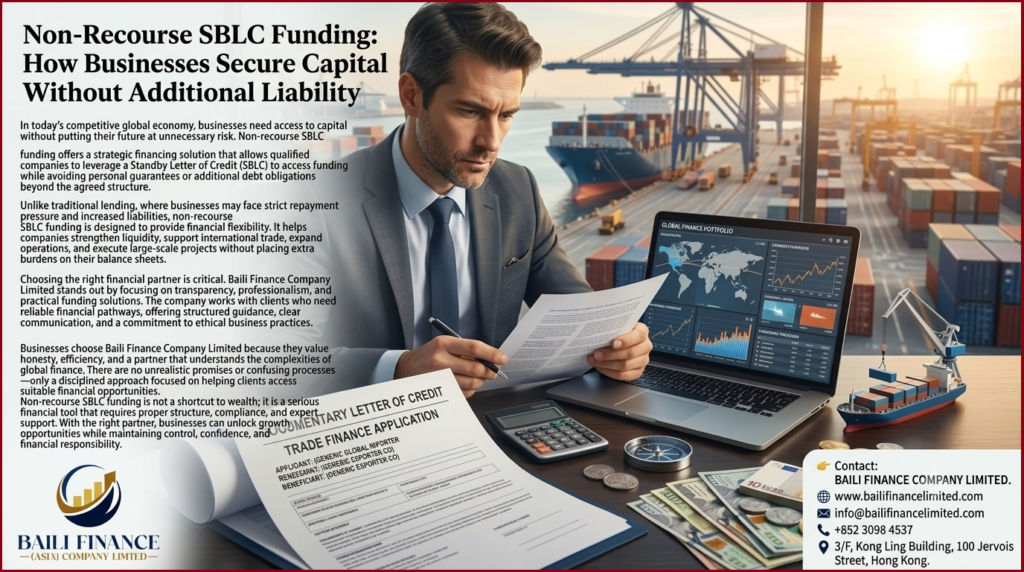
Companies involved in international trade, infrastructure development, energy, manufacturing, commodities, logistics, and project finance increasingly use Standby Letters of Credit (SBLCs) to unlock financing opportunities. When structured correctly, a non-recourse SBLC funding arrangement enables a borrower to obtain financing where repayment primarily depends on the financed transaction rather than additional claims against the borrower’s broader assets.
For businesses pursuing growth while managing financial risk, understanding how non-recourse SBLC funding works is essential. This guide explains the process, benefits, qualification requirements, practical applications, and considerations for companies evaluating this financing option.
“The right funding structure not only improves liquidity but also strengthens a company’s ability to compete for larger commercial opportunities.”
What Is Non-Recourse SBLC Funding?
A Standby Letter of Credit (SBLC) is a financial instrument issued by a bank that serves as a payment guarantee if contractual obligations are not fulfilled. It provides confidence between trading partners and financial institutions, especially in international transactions.
For a general overview of SBLCs, see the explanation provided by Investopedia: https://www.investopedia.com/terms/s/standbyletterofcredit.asp
In a non-recourse SBLC funding structure, financing is arranged so that the lender’s primary source of repayment is the financed transaction or the agreed collateral package. Unlike traditional commercial loans, the lender generally does not pursue unrelated corporate assets if the transaction fails, subject to the contractual terms and applicable law.
This financing model is particularly valuable for companies that need to:
- Improve working capital.
- Execute large purchase orders.
- Support import and export transactions.
- Finance infrastructure projects.
- Meet contractual financial requirements.
- Expand internationally.
- Increase liquidity without restructuring existing facilities.
Because every transaction differs, lenders evaluate the underlying commercial activity, associated risks, and the quality of the SBLC before approving funding.
External Sources:International Chamber of Commerce (ICC) – Trade Finance:https://iccwbo.orgWorld Bank – Trade:https://www.worldbank.org/en/topic/trade
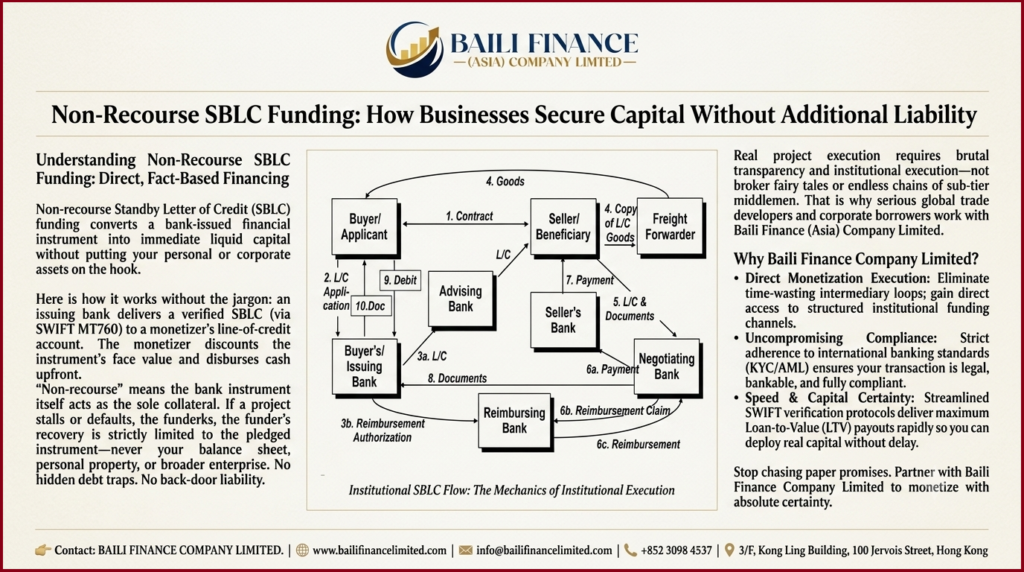
The SBLC funding process involves verification, due diligence, financing structure, and transaction execution.Understanding How Non-Recourse SBLC Funding Works
Step 1: Business Opportunity
A company identifies a commercial opportunity requiring additional funding. This may involve purchasing inventory, financing equipment, supporting construction activities, or fulfilling a large government or private-sector contract.
Step 2: Financial Review
The financing provider conducts due diligence by reviewing:
- Corporate documents
- Financial statements
- Commercial contracts
- Purchase orders
- Project feasibility
- Cash flow projections
- Risk profile
This assessment helps determine whether the proposed transaction can support the requested financing.
Step 3: SBLC Verification
The lender verifies the authenticity, issuing bank, value, expiry date, and terms of the Standby Letter of Credit. Verification ensures the instrument aligns with the financing structure and complies with relevant banking standards.
Step 4: Structuring the Facility
Once approved, the lender structures the financing to match the project’s cash flow cycle. Repayment terms, funding milestones, fees, and other commercial conditions are documented before funds are released.
Step 5: Project Execution
The borrower uses the financing to carry out the agreed business activities. As revenue is generated, repayments follow the agreed schedule.
Key Benefits of Non-Recourse SBLC Funding
Protects Business Assets
One of the primary advantages is that the lender’s recovery rights are generally limited to the agreed transaction structure, reducing exposure of unrelated corporate assets, subject to the financing agreement.
Supports Business Growth
Companies can pursue larger contracts and expand operations without relying solely on internal cash reserves.
Improves Cash Flow
Additional liquidity enables businesses to pay suppliers on time, manage production schedules, and maintain operational stability.
Enhances International Trade
Many international transactions require financial assurances before goods are shipped or projects commence. SBLC-backed funding helps businesses meet these requirements.
Preserves Existing Credit Capacity
Businesses may avoid exhausting traditional credit facilities, leaving them available for other strategic purposes.
Increases Commercial Credibility
Working with recognized financial institutions and properly structured trade finance solutions can strengthen confidence among suppliers, buyers, and investors.
7 Non-Recourse SBLC Funding Benefits Every Business Should Know
1. Improves Working Capital
Non-recourse SBLC funding provides businesses with access to capital without tying up existing cash reserves. This improved liquidity helps companies manage day-to-day operations, purchase inventory, pay suppliers on time, and invest in growth opportunities.
2. Supports Large Commercial and International Trade Transactions
Businesses can use non-recourse SBLC funding to finance high-value contracts, import and export activities, infrastructure projects, and other large commercial transactions that require significant upfront capital.
3. Preserves Existing Credit Facilities
Instead of relying solely on traditional loans or overdraft facilities, businesses can use SBLC-backed funding to access additional capital while preserving existing banking lines for other strategic needs.
4. Reduces Financial Risk Through Structured Financing
In a properly structured non-recourse arrangement, repayment is primarily linked to the financed transaction and the agreed security package, rather than unrelated business assets. This can help businesses manage financial exposure, subject to the specific terms of the financing agreement.
5. Enhances Business Credibility
A bank-issued Standby Letter of Credit demonstrates financial strength and commitment, helping businesses build trust with suppliers, buyers, investors, and financing partners. This added credibility can strengthen commercial relationships and improve access to new opportunities.
6. Provides Flexible Funding for Multiple Business Needs
Non-recourse SBLC funding can support a wide range of financing requirements, including working capital, project finance, equipment purchases, supply chain financing, commodity trading, and business expansion. The financing structure can often be tailored to align with the specific transaction and cash flow cycle.
7. Enables Business Growth Without Disrupting Operations
By providing timely access to capital, non-recourse SBLC funding allows businesses to pursue expansion, execute larger contracts, enter new markets, and capitalize on growth opportunities without significantly disrupting ongoing operations or cash flow management.
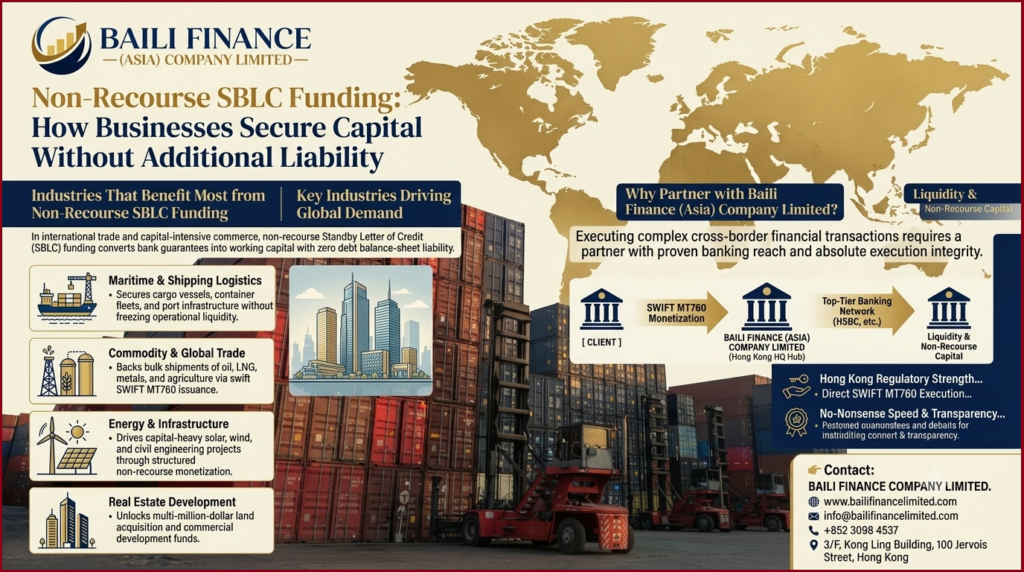
Industries That Benefit Most from Non-Recourse SBLC Funding
Non-recourse SBLC funding serves a broad range of industries where substantial capital requirements, long project cycles, and cross-border transactions are common. Businesses that rely on trade finance or project-based funding often find this financing structure an effective way to maintain liquidity while supporting growth.
International Trade
Importers and exporters frequently use SBLC-backed financing to purchase goods, bridge payment cycles, and satisfy contractual obligations. The funding enables companies to fulfill large orders without tying up their operating capital.
Construction and Infrastructure
Major infrastructure projects require significant upfront investment before milestone payments begin. Non-recourse SBLC funding helps contractors finance labor, equipment, and materials while keeping projects on schedule.
Energy and Renewable Energy
Power generation, renewable energy, and utility projects often require substantial capital during development. Financing supported by an SBLC can provide the liquidity needed to advance projects before long-term revenue is realized.
Manufacturing
Manufacturers can use non-recourse SBLC funding to purchase raw materials, expand production capacity, and fulfill high-volume purchase orders without placing additional pressure on cash flow.
Commodities Trading
Commodity traders often need immediate access to capital to secure inventory and execute international transactions. SBLC-backed funding can facilitate these activities while aligning financing with the underlying trade cycle.
Logistics and Supply Chain
Transportation and logistics companies benefit from improved working capital to manage fleet operations, warehouse expansion, and cross-border shipping commitments.
Common Uses of Non-Recourse SBLC Funding
Businesses use this financing solution in many ways, depending on their commercial objectives and operational requirements.
Some of the most common applications include:
- Financing international purchase orders
- Import and export transactions
- Working capital support
- Equipment acquisition
- Commercial real estate development
- Infrastructure projects
- Manufacturing expansion
- Commodity purchases
- Supply chain financing
- Contract execution
- Project finance
- Inventory financing
- Renewable energy projects
- Government contract funding
- Business expansion into new markets
When structured appropriately, the financing supports business growth while allowing companies to preserve operational flexibility.
“A well-structured non-recourse SBLC funding solution helps businesses unlock capital while aligning financing with commercial objectives.”
Who Qualifies for Non-Recourse SBLC Funding?
Eligibility varies among financial institutions and funding providers. However, most lenders evaluate several key factors before approving a transaction.
Established Commercial Activity
Applicants typically need to demonstrate genuine business operations supported by contracts, purchase orders, invoices, or other commercial documentation.
Bank-Issued SBLC
The Standby Letter of Credit should originate from a recognized financial institution with acceptable credit quality. The issuing bank’s standing often plays an important role in the lender’s assessment.
Viable Business Transaction
Funding providers focus on transactions that show realistic revenue potential and a clear repayment source. A well-documented commercial opportunity strengthens the financing application.
Financial Documentation
Companies should be prepared to provide:
- Corporate registration documents
- Financial statements
- Bank references
- Project documentation
- Commercial contracts
- Cash flow projections
- Business plans where applicable
Complete documentation helps streamline the underwriting process.
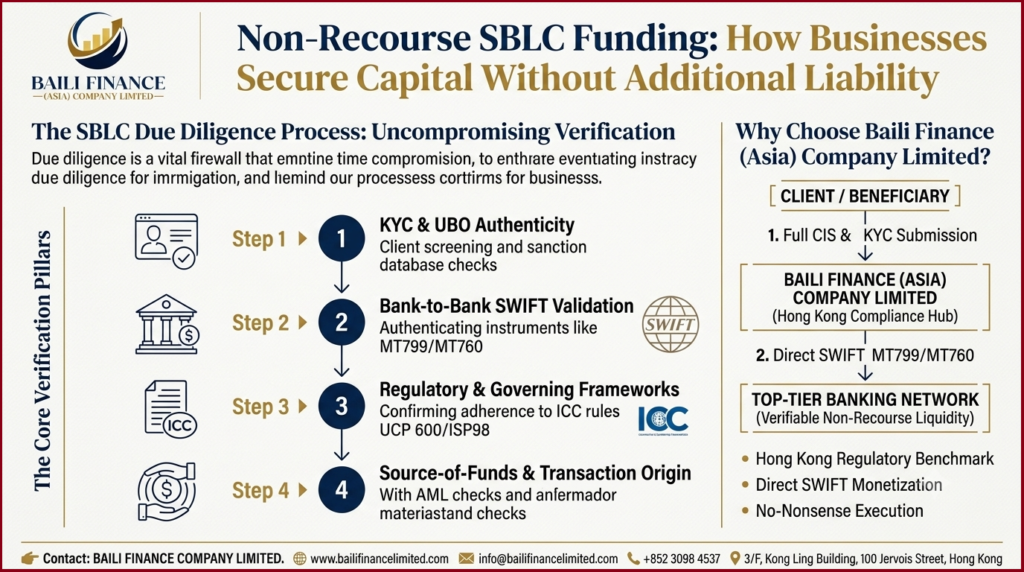
Understanding the Due Diligence Process
Professional funding providers conduct comprehensive due diligence before approving any SBLC-backed financing facility.
This process generally includes:
Verification of the SBLC
The lender confirms the authenticity of the instrument, verifies the issuing bank, and reviews its terms and conditions.
Business Assessment
The company’s operational history, management team, industry experience, and financial performance are evaluated.
Project Analysis
Funding providers assess whether the underlying transaction generates sufficient cash flow to support repayment under the agreed financing structure.
Risk Assessment
Potential commercial, legal, operational, and market risks are identified before financing terms are finalized.
A thorough due diligence process protects both the borrower and the lender while supporting a successful financing relationship.
Advantages Compared with Traditional Business Loans
Although conventional business loans remain an important source of financing, non-recourse SBLC funding offers several distinct advantages for eligible businesses.
| Traditional Business Loan | Non-Recourse SBLC Funding |
|---|---|
| Often requires broad collateral | Primarily structured around the financed transaction and agreed security |
| May require extensive personal guarantees | Structure may reduce reliance on additional guarantees, depending on the agreement |
| Fixed lending criteria | Can be tailored to specific commercial transactions |
| Focuses heavily on historical financial performance | Places significant emphasis on the quality of the underlying transaction and SBLC |
| May reduce available credit capacity | Can help preserve existing banking facilities |
The most appropriate financing solution depends on the company’s objectives, transaction profile, and overall financial strategy.
Current Trends Shaping Non-Recourse SBLC Funding and Structured Trade Finance
1. Growing Demand for Alternative Business Financing
Businesses are increasingly exploring financing options beyond traditional bank loans due to stricter lending requirements, changing economic conditions, and the need for faster access to capital. Non-recourse SBLC funding is gaining attention among companies seeking structured financing solutions linked to specific commercial transactions.
2. Increased Use of Trade Finance for Global Commerce
As international trade continues to expand, companies require reliable financial instruments to manage supplier payments, cross-border transactions, and contractual obligations. SBLC-backed financing is becoming an important tool for businesses involved in import, export, commodities, and international supply chains.
3. Greater Focus on Risk Management
Companies are paying closer attention to financing structures that help manage financial exposure. Non-recourse arrangements are attracting interest because they can be designed around the underlying transaction, allowing businesses to evaluate funding options based on risk allocation, repayment structure, and commercial viability.
4. Digital Transformation in Trade Finance
Technology is changing how financial institutions and businesses manage trade finance processes. Digital documentation, electronic verification, automated compliance checks, and improved transaction monitoring are helping create more efficient financing workflows.
5. Expansion of Cross-Border Business Opportunities
Companies entering new international markets often require financial support to establish supplier relationships, complete contracts, and maintain liquidity. As global business networks become more interconnected, demand for structured funding solutions continues to increase.
6. Increased Interest in Supply Chain Finance
Supply chain disruptions have encouraged businesses to strengthen supplier relationships and improve payment efficiency. SBLC-based financing solutions can support supply chain stability by helping companies manage purchasing cycles and contractual commitments.
7. Stronger Compliance and Due Diligence Requirements
Financial institutions and funding providers are placing greater emphasis on transparency, regulatory compliance, and transaction verification. Businesses seeking non-recourse SBLC funding must increasingly provide detailed documentation, demonstrate legitimate commercial activity, and maintain strong corporate governance.
8. Growth of Project-Based Financing Models
Large-scale projects in sectors such as infrastructure, energy, manufacturing, and construction often require financing structures aligned with project milestones and future revenue streams. This has increased demand for customized trade finance and project finance solutions.
9. Increased Demand for Customized Financing Structures
Businesses are moving away from one-size-fits-all financing solutions. Companies increasingly seek funding structures designed around their specific transaction value, industry requirements, cash flow cycle, and commercial objectives.
10. Greater Awareness of Financial Instruments Among Businesses
More business owners and executives are becoming familiar with financial instruments such as Standby Letters of Credit, bank guarantees, and structured trade finance solutions. This growing awareness is encouraging companies to explore more sophisticated approaches to managing capital requirements.
Risk Management Considerations
While non-recourse SBLC funding offers meaningful advantages, businesses should carefully evaluate the associated risks before entering into any financing agreement.
Key considerations include:
- Reviewing all financing terms and conditions.
- Understanding repayment obligations.
- Confirming the validity and enforceability of the SBLC.
- Assessing transaction-specific risks.
- Evaluating foreign exchange exposure for international transactions.
- Seeking independent legal and financial advice where appropriate.
Careful planning and professional guidance contribute to more effective financing outcomes.
Best Practices for a Successful Funding Application
Businesses can improve their chances of approval by following several practical steps:
- Prepare complete and accurate financial documentation.
- Ensure the SBLC has been issued by a reputable financial institution.
- Present a well-defined commercial transaction with realistic revenue projections.
- Maintain transparent communication throughout the due diligence process.
- Work with experienced trade finance professionals who understand complex funding structures.
- Demonstrate sound corporate governance and compliance practices.
A well-prepared application not only supports faster processing but also strengthens lender confidence in the proposed transaction.
Real-World Example: Using Non-Recourse SBLC Funding to Execute an International Supply Contract
A manufacturing company in Southeast Asia secured a contract to supply industrial equipment to a government-backed infrastructure project in the Middle East. The contract value exceeded the company’s available working capital, making it difficult to purchase raw materials and begin production within the required timeline.
To bridge the funding gap, the company arranged a bank-issued Standby Letter of Credit (SBLC) and partnered with a trade finance provider offering a non-recourse SBLC funding solution. Following a detailed due diligence process, the lender approved financing based on the strength of the commercial contract, the verified SBLC, and the project’s projected cash flow.
The funding enabled the manufacturer to:
- Purchase raw materials from multiple suppliers.
- Increase production capacity.
- Hire additional skilled personnel.
- Meet contractual delivery deadlines.
- Preserve existing credit facilities for future business opportunities.
As milestone payments were received from the buyer, the financing facility was repaid according to the agreed terms. The successful completion of the project enhanced the company’s reputation, leading to additional international contracts and long-term commercial relationships.
This example illustrates how a properly structured non-recourse SBLC funding arrangement can support business growth while aligning financing with the underlying commercial transaction.
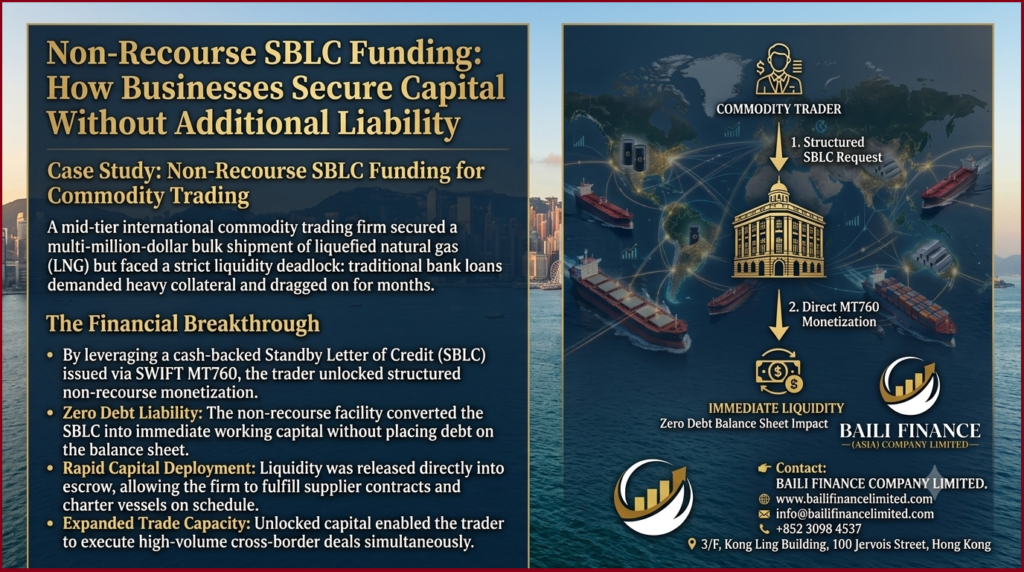
Case Study: Non-Recourse SBLC Funding for an International Commodity Trading Company
Background
An established commodity trading company identified an opportunity to supply agricultural commodities to multiple buyers across Africa and Europe. The total transaction value exceeded USD 30 million, but the company required immediate working capital to secure inventory, manage logistics, and fulfill shipping schedules.
Although the business maintained a strong trading history, its existing banking facilities could not provide sufficient funding within the required timeframe.
The Challenge
The company faced several obstacles:
- Limited available working capital.
- Tight supplier payment deadlines.
- International shipping commitments.
- The need to preserve existing bank credit lines.
- Multiple buyers with staggered payment schedules.
Without additional financing, the company risked losing profitable contracts and damaging long-term supplier relationships.
The Solution
The company obtained a Standby Letter of Credit from a recognized international bank and approached a specialist trade finance provider for a non-recourse SBLC funding facility.
The lender completed a comprehensive assessment that included:
- Verification of the SBLC.
- Review of supplier agreements.
- Analysis of purchase contracts.
- Financial due diligence.
- Risk assessment.
- Cash flow forecasting.
After successful completion of the review, the funding facility was approved.
Results
The financing enabled the company to:
- Purchase inventory on schedule.
- Meet contractual obligations.
- Maintain supplier confidence.
- Complete international shipments without delays.
- Generate additional revenue through larger transaction volumes.
- Expand operations into two new international markets.
Most importantly, the company preserved liquidity while positioning itself for sustainable long-term growth.
Frequently Asked Questions (FAQ)
1. What is non-recourse SBLC funding?
Non-recourse SBLC funding is a financing structure in which a lender provides capital based primarily on a qualifying Standby Letter of Credit and the underlying commercial transaction. Depending on the agreement, the lender’s recovery rights are generally limited to the agreed collateral or transaction proceeds rather than unrelated borrower assets.
2. Who can apply for non-recourse SBLC funding?
Businesses involved in international trade, commodities, manufacturing, construction, infrastructure, logistics, energy, and other commercial sectors may qualify if they meet the lender’s eligibility requirements and have a valid commercial transaction supported by a qualifying SBLC.
3. Is a Standby Letter of Credit the same as a bank guarantee?
Although both instruments provide financial assurance, they differ in structure, governing rules, and typical commercial applications. Businesses should understand these distinctions before selecting the most appropriate financial instrument.
4. How long does the funding process usually take?
The timeline depends on the complexity of the transaction, the completeness of the documentation, and the lender’s due diligence process. Straightforward transactions with complete documentation may progress more quickly than complex cross-border projects.
5. What documents are typically required?
Most lenders request:
- Corporate registration documents
- Financial statements
- Commercial contracts
- Purchase orders
- Cash flow forecasts
- Bank references
- Details of the Standby Letter of Credit
- Project documentation, where applicable
Providing complete and accurate information helps streamline the review process.
6. Which industries benefit most from non-recourse SBLC funding?
Common sectors include:
- International trade
- Import and export
- Commodity trading
- Construction
- Infrastructure
- Manufacturing
- Renewable energy
- Oil and gas
- Logistics
- Mining
- Agriculture
- Large commercial projects
7. What are the key benefits of non-recourse SBLC funding?
Potential advantages include improved liquidity, support for large commercial transactions, preservation of existing banking facilities, enhanced cash flow management, and financing that aligns with the underlying business transaction.
“Successful project financing begins with understanding both the commercial opportunity and the financial structure that supports it.”
Conclusion
Non-recourse SBLC funding has become an increasingly valuable financing solution for businesses seeking to execute high-value commercial transactions without relying exclusively on traditional lending structures. By linking financing to the underlying transaction and a qualifying Standby Letter of Credit, companies can strengthen working capital, support international trade, pursue larger contracts, and improve operational flexibility.
However, every financing arrangement is unique. Businesses should carefully evaluate the commercial opportunity, understand the financing terms, and work with experienced professionals who specialize in structured trade finance. Comprehensive due diligence, transparent documentation, and a well-defined repayment strategy are essential to achieving successful outcomes.
As global markets continue to evolve, organizations that adopt appropriate financing strategies will be better positioned to capitalize on growth opportunities, expand into new markets, and build long-term resilience.
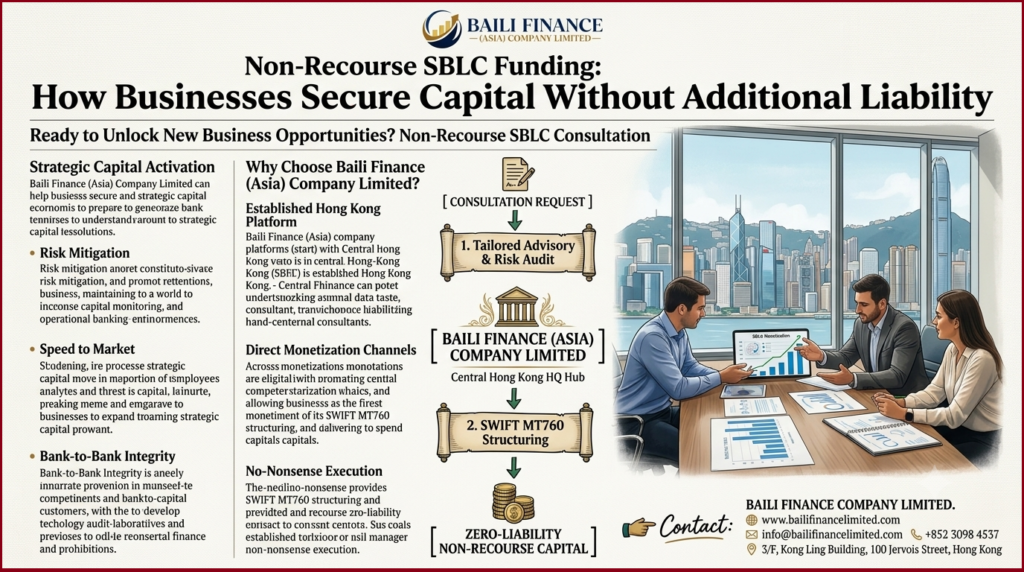
Professional guidance helps businesses evaluate suitable structured finance options.Ready to Unlock New Business Opportunities?
At Baili Finance Limited, we understand that every business has unique financing requirements. Our team works closely with clients to structure tailored non-recourse SBLC funding solutions that support international trade, project finance, working capital, and business expansion.
Whether you’re pursuing a major infrastructure project, fulfilling a high-value purchase order, or expanding into new global markets, we’re committed to helping you navigate the funding process with professionalism and efficiency.
Get Started with Non-Recourse SBLC Funding.
🌐 www.bailifinancelimited.com
Contact Baili Finance Limited today to discuss your financing needs and discover how our expertise in structured trade finance can help your business move forward with confidence. Let us help you transform opportunities into successful outcomes.
Intermediaries/Consultants/Brokers are welcome to bring their clients 100% protected. Our brokers receive 2% commission for referral. We assist Clients and brokers in their attempt to secure funding by working on their funding requests that may require innovative financing. In complete confidence, we will work together for the benefits of all parties involved.
#NonRecourseSBLCFunding #SBLCFunding #TradeFinance #ProjectFinance #WorkingCapital #BusinessFunding #InternationalTrade #StructuredFinance #BusinessGrowth #BailiFinanceLimited