Headline: 7 Critical SBLC Financing Facts
Businesses seeking SBLC-backed financing, SBLC monetization, working capital, project finance, or structured trade finance need more than a bank instrument. They need a financing structure that lenders can verify, understand, and approve.
A Standby Letter of Credit (SBLC) can provide financial assurance in a commercial transaction and, in appropriate circumstances, support a financing facility when an eligible institution accepts the instrument as collateral. However, an SBLC isn’t cash, and possessing one doesn’t automatically create a loan facility. The issuing bank, wording, validity, compliance status, transaction purpose, applicant, beneficiary, and proposed financing structure all matter.
For businesses exploring how to obtain SBLC-backed financing, how SBLC monetization works, working capital against an SBLC, or project financing secured by an SBLC, this distinction is essential.
The International Chamber of Commerce (ICC) provides the International Standby Practices 1998 (ISP98), a dedicated framework for standby letters of credit. ICC explains that ISP98 applies specifically to standby instruments and establishes rules for their operation and interpretation.
This guide explains how SBLC-backed financing works, where it can fit, what lenders examine, the risks businesses should address, and how to approach the process professionally.
Keywords: SBLC-backed financing SBLC financing SBLC monetization standby letter of credit financing financing against SBLC working capital against SBLC SBLC-backed project financing SBLC trade finance SBLC funding solutions standby letter of credit monetization SBLC financing companies how SBLC-backed financing works Standby Letter of Credit bank guarantee credit enhancement structured finance trade finance project finance working capital collateral SWIFT MT760 ISP98
What Is SBLC-Backed Financing?
SBLC-backed financing is a structured financing arrangement in which a valid, bank-issued Standby Letter of Credit supports a financing facility.
The SBLC normally acts as a form of credit enhancement or collateral support. Depending on the transaction, a financing institution may consider the instrument when determining whether it can provide liquidity.
The structure can support:
- Working capital
- International trade
- Commodity transactions
- Import and export finance
- Infrastructure projects
- Construction
- Equipment procurement
- Energy projects
- Manufacturing
- Real estate development
- Project finance
- Corporate expansion
- Supply-chain finance
The financing provider doesn’t simply look at the face value of the SBLC. Instead, it evaluates the entire transaction.
That distinction matters.
A $10 million SBLC doesn’t necessarily mean a business can borrow $10 million. The financing amount depends on the issuing bank, instrument terms, transaction risk, jurisdiction, tenor, collateral structure, repayment source, compliance requirements, and lender policy.
In other words, SBLC-backed financing is a structured credit transaction, not an automatic conversion of an SBLC into cash.
How Does an SBLC Work?
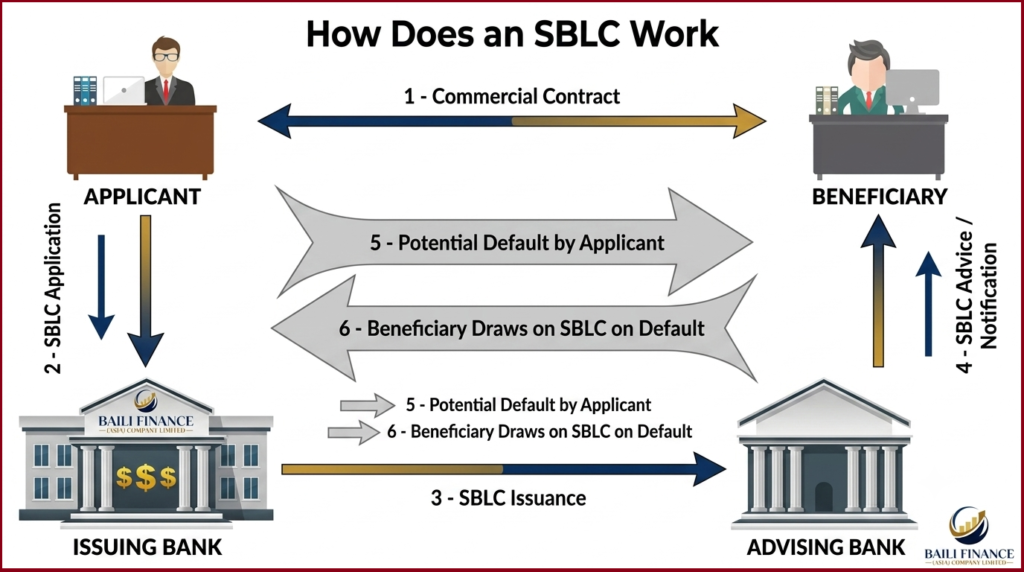
An SBLC is generally issued by a bank at the request of its customer in favor of a beneficiary.
The bank provides an independent undertaking to honor a compliant demand according to the terms of the instrument.
For example, suppose Company A enters into a supply agreement with Company B.
Company B wants additional payment assurance before supplying goods. Company A asks its bank to issue an SBLC in favor of Company B.
If the conditions specified in the SBLC are satisfied and Company B makes a compliant demand, the issuing bank may be required to honor the undertaking.
The ICC’s ISP98 framework expressly covers financial, performance, and direct-pay standby letters of credit.
This makes the SBLC useful for transactions where counterparties need additional assurance.
However, the underlying commercial contract and the SBLC remain distinct instruments. The precise wording of the SBLC determines the bank’s obligations.
SBLC vs. Commercial Letter of Credit
A commercial letter of credit normally supports payment against specified documentary conditions associated with a trade transaction.
An SBLC generally functions as a backup undertaking.
That difference is important when designing a financing structure.
A business shouldn’t assume that a commercial LC, bank guarantee, and SBLC will receive identical treatment from a lender.
The ICC notes that SBLCs have similarities to commercial letters of credit but require their own specialized framework because their scope and practice differ.
How SBLC-Backed Financing Works
A professional SBLC financing transaction usually follows several stages.
1. Transaction Assessment
The financing provider first evaluates the proposed transaction.
This assessment may cover:
- Business model
- Funding requirement
- Intended use of proceeds
- Existing liabilities
- Revenue
- Cash flow
- Project economics
- Repayment source
- Ownership structure
- Jurisdiction
- Counterparties
- Financial statements
This step determines whether the transaction has a credible commercial basis.
A strong SBLC cannot compensate for a fundamentally unviable project.
2. SBLC Review
The provider then reviews the instrument.
Key considerations can include:
- Issuing bank
- Face value
- Currency
- Expiry date
- Governing rules
- Beneficiary
- Applicant
- Payment terms
- Presentation requirements
- Transferability or assignment provisions
- Existing encumbrances
- Authenticity
- Banking channel
- Compliance status
The wording matters because the financing institution needs to understand exactly what rights the instrument creates.
3. Bank Verification
The SBLC should undergo appropriate verification through banking channels.
This is one of the most important stages.
A PDF, scanned document, email attachment, or screenshot isn’t equivalent to bank confirmation.
Institutional transactions require reliable verification of the issuing bank and instrument.
4. Compliance and Due Diligence
The financing institution may conduct:
- Know Your Customer (KYC)
- Anti-Money Laundering (AML) checks
- Sanctions screening
- Source-of-funds review
- Beneficial ownership verification
- Corporate verification
- Transaction screening
- Jurisdictional assessment
These requirements aren’t optional details. They’re fundamental to legitimate cross-border finance.
5. Financing Structure
If the transaction passes initial review, the parties can structure the facility.
The term sheet may specify:
- Financing amount
- Currency
- Tenor
- Interest or financing cost
- Fees
- Collateral arrangements
- Repayment terms
- Conditions precedent
- Reporting requirements
- Events of default
- Release conditions
The final structure should reflect the actual risk of the transaction.
6. Documentation and Closing
The parties complete the legal and financial documentation.
Depending on the structure, this can involve financing agreements, security documents, assignment agreements, corporate resolutions, legal opinions, compliance documentation, and banking instructions.
7. Funding
Once all conditions are satisfied, the financing provider releases funds according to the agreed facility.
The proceeds should then be used for the stated commercial purpose.
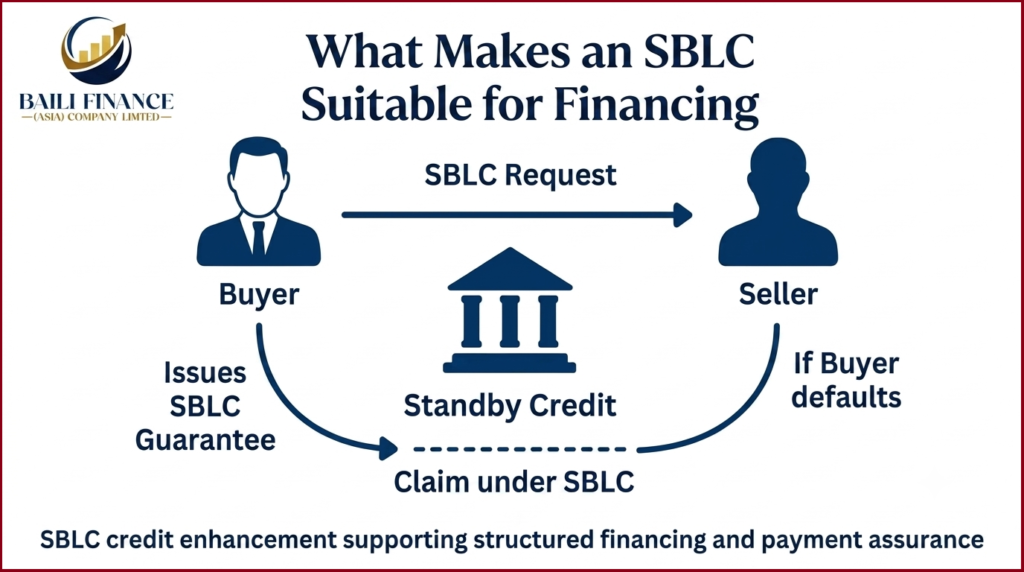
What Makes an SBLC Suitable for Financing?
Not every SBLC will support financing.
A financing institution generally wants confidence that the instrument is genuine, enforceable within its intended structure, acceptable under its internal policies, and supported by a viable transaction.
Issuing Bank
The issuing bank is a central consideration.
Financial institutions typically assess the bank’s credit standing, jurisdiction, regulatory environment, banking relationships, and acceptability under their internal risk policies.
The stronger and more acceptable the issuing institution, the more likely the SBLC will receive serious consideration.
That doesn’t guarantee financing.
Instrument Terms
The SBLC’s wording must support the proposed financing structure.
Questions can include:
- Is the SBLC irrevocable?
- What rules govern it?
- What is the expiry date?
- What are the drawing conditions?
- Is it assignable?
- Is it transferable?
- Does the financing institution have acceptable rights?
- Are there restrictions on its use?
The answers can materially affect financing eligibility.
Remaining Tenor
The remaining validity period also matters.
A lender generally needs sufficient time to establish, administer, and exit the financing facility.
An SBLC approaching expiry may provide less financing flexibility than an instrument with an appropriate remaining tenor.
Clean Title
The instrument should have clear ownership and should not be subject to undisclosed claims, competing assignments, or prior pledges.
Commercial Purpose
The proposed use of funds should make commercial sense.
A financing provider may be more comfortable with a documented transaction involving identifiable contracts, receivables, inventory, equipment, or project cash flows than with an unsupported speculative proposal.
7 Critical SBLC Financing Facts
- An SBLC Isn’t Cash — A Standby Letter of Credit is a bank undertaking, not immediately available cash. Financing requires a separate facility and lender approval.
- The Issuing Bank Matters — The credibility, jurisdiction, regulatory standing, and acceptability of the issuing bank can significantly influence whether a lender accepts the SBLC.
- Face Value Doesn’t Equal Funding Amount — A $10 million SBLC doesn’t automatically produce $10 million in financing. The amount depends on the lender, instrument terms, transaction risk, tenor, and repayment structure.
- Verification Is Essential — Legitimate financing providers need to verify the SBLC through appropriate banking channels. A PDF, scanned copy, or email isn’t sufficient proof of an authentic instrument.
- SBLC Monetization Requires a Structure — Monetization isn’t an automatic conversion of an SBLC into cash. It involves a financing arrangement, documentation, due diligence, and agreed security or assignment terms.
- The Underlying Transaction Still Matters — Lenders assess the business, project, contracts, cash flow, use of funds, and repayment source. A strong SBLC doesn’t automatically make an unsuitable transaction financeable.
- Due Diligence Protects the Business — Businesses should verify the financing provider, issuing bank, fees, contracts, compliance requirements, and banking process before committing funds or signing financing agreements.
Bottom line: The strongest SBLC financing transactions combine a credible issuing bank, verifiable instrument, viable commercial purpose, transparent financing structure, and proper due diligence.
External Source:
International Chamber of Commerce — ISP98 Rules for Standby Letters of Credit
SBLC Monetization vs. SBLC-Backed Financing
These terms frequently appear together, but businesses shouldn’t treat them as identical.
SBLC-backed financing describes a broader financing structure where the SBLC supports credit.
SBLC monetization generally refers to using the SBLC to obtain liquidity through a financing arrangement.
The practical distinction depends on the structure and legal documentation.
For example, a business might hold an SBLC and seek a facility where the instrument provides collateral support.
Another transaction may involve assignment or other security arrangements that allow a financing institution to advance funds against the instrument.
The financing provider still needs to assess the transaction.
There is no universal percentage, interest rate, or funding amount that applies to every SBLC.
Claims that every SBLC can automatically produce a fixed percentage of its face value should therefore be treated carefully.
How Much Financing Can an SBLC Support?
There isn’t a single universal advance rate.
The amount depends on multiple factors.
These can include:
| Factor | Why It Matters |
|---|---|
| Issuing bank | Determines institutional and credit acceptability |
| SBLC face value | Establishes the maximum stated amount |
| Remaining tenor | Influences financing duration |
| Instrument wording | Determines rights and payment conditions |
| Jurisdiction | Affects legal and compliance risk |
| Transaction purpose | Determines commercial viability |
| Borrower profile | Influences credit assessment |
| Repayment source | Determines exit quality |
| Existing liabilities | Affects overall credit risk |
| Security structure | Determines lender protection |
A business should therefore ask for a transaction-specific term sheet, rather than relying on generic online percentages.
The same $20 million SBLC could receive very different treatment depending on the issuing bank, jurisdiction, wording, beneficiary, transaction, and financing provider.
Real-World Example: Import Finance Supported by an SBLC
Consider an international equipment distributor that has secured a large purchase contract.
The distributor has confirmed buyers but doesn’t have sufficient working capital to purchase the equipment required to fulfill the contract.
Its banking partner issues a $10 million SBLC in connection with the transaction.
The distributor approaches a financing institution.
The institution reviews:
- The issuing bank.
- The SBLC terms.
- The distributor’s corporate records.
- The purchase contracts.
- Supplier invoices.
- Buyer contracts.
- Expected receivables.
- Source and use of funds.
- KYC and AML documentation.
- The proposed repayment structure.
After completing due diligence, the financing institution determines that the transaction meets its requirements.
Rather than treating the $10 million SBLC as unrestricted cash, it structures a facility supported by the instrument and the underlying commercial transaction.
The distributor uses the financing to purchase equipment.
The buyer subsequently pays according to the commercial contract.
Those proceeds support repayment of the financing facility.
The important lesson is straightforward: the SBLC supports the financing structure, while the underlying business generates the economic activity and repayment capacity.
Case Study: SBLC-Backed Project Financing
Consider a hypothetical infrastructure developer that has secured a contract to develop a regional energy facility.
The project has:
- A signed development agreement
- Identifiable project costs
- Equipment suppliers
- Contractor commitments
- A projected revenue model
- An established corporate structure
- A bank-issued SBLC
The developer needs additional liquidity before project revenues begin.
Instead of raising all required capital through equity, management explores an SBLC-backed financing structure.
Stage One: Financial Review
The financing provider reviews the developer’s financial statements, corporate ownership, project agreements, contracts, projections, and existing liabilities.
Stage Two: Instrument Verification
The SBLC is verified through appropriate banking channels.
The provider confirms the issuing institution, instrument details, validity, and relevant terms.
Stage Three: Project Assessment
The financing provider analyzes the project’s projected cash flow.
This includes:
- Construction costs
- Equipment costs
- Operating expenses
- Expected revenue
- Contractual obligations
- Project completion schedule
- Repayment assumptions
Stage Four: Facility Structuring
The parties negotiate the financing amount, tenor, pricing, security arrangements, conditions precedent, and repayment mechanism.
Stage Five: Funding
After documentation and compliance requirements are completed, financing is made available according to the agreed structure.
Result
The developer can use the facility for approved project costs while maintaining its existing ownership structure.
The financing remains dependent on the terms of the facility and the performance of the underlying project.
This example demonstrates why SBLC-backed project financing should be approached as a complete financial transaction rather than a simple instrument-monetization exercise.
Benefits of SBLC-Backed Financing
When appropriately structured, SBLC-backed financing can provide several commercial benefits.
Improved Liquidity
Businesses can potentially access capital without immediately selling operating assets.
Working Capital Support
Funding can support inventory, procurement, production, logistics, payroll, and other approved operational requirements.
Project Execution
Businesses can use structured financing to address funding gaps during project development.
International Trade Support
An SBLC can strengthen financial assurance in cross-border transactions.
Credit Enhancement
The instrument can provide additional security to a financing structure where the lender accepts it.
Ownership Preservation
Depending on the facility, businesses may obtain debt-based funding without issuing additional equity.
However, these benefits depend on actual lender approval and transaction suitability.
Risks Businesses Must Understand
SBLC financing isn’t risk-free.
Instrument Risk
A bank-issued instrument may not meet a particular lender’s eligibility criteria.
Counterparty Risk
Businesses should understand who actually provides the financing.
Legal Risk
The rights attached to an SBLC depend heavily on its wording, governing rules, applicable law, and transaction documentation.
Compliance Risk
Cross-border transactions can trigger extensive KYC, AML, sanctions, and source-of-funds requirements.
Cost Risk
Financing costs, legal expenses, banking charges, due diligence fees, and other transaction expenses can affect project economics.
Repayment Risk
The SBLC doesn’t eliminate the underlying repayment obligation unless the financing agreement expressly provides otherwise.
Fraud Risk
The SBLC market attracts fraudulent offers, particularly claims involving guaranteed monetization, guaranteed returns, secret trading programs, or unusually high funding percentages.
Businesses should independently verify the issuing bank, financing provider, contractual documents, and banking communications before committing funds.
Warning Signs of a Problematic SBLC Financing Offer
Businesses should exercise particular caution when a provider:
- Guarantees financing before reviewing the transaction.
- Promises a fixed percentage regardless of the issuing bank.
- Claims an SBLC is equivalent to cash.
- Requests unexplained payments to release financing.
- Uses pressure tactics.
- Avoids direct banking verification.
- Refuses to provide detailed contractual terms.
- Promises guaranteed investment returns.
- Uses unclear corporate identities.
- Cannot explain the financing structure.
- Relies entirely on intermediaries.
A legitimate transaction should withstand reasonable due diligence.
The ICC’s published materials demonstrate that SBLC transactions involve defined banking rules, presentation requirements, and institutional procedures.
Why ISP98 Matters
ISP98 deserves attention because it provides a specialized rules framework for standby letters of credit.
The ICC states that ISP98 applies to standby letters of credit, including financial, performance, and direct-pay standbys.
It also provides a structured framework covering matters such as presentation, examination, amendments, expiry, and payment.
This is one reason businesses shouldn’t evaluate an SBLC solely by its face value.
The legal and operational terms matter.
For businesses and professionals seeking authoritative background, the ICC’s International Standby Practices (ISP98) is one of the strongest external resources to review.
That authoritative reference is particularly useful when reviewing proposed SBLC wording with banking and legal professionals.
SBLC Financing for International Trade
International businesses often face a financing gap between purchasing goods and receiving payment from buyers.
That gap can restrict growth even when the company has confirmed orders.
SBLC-backed trade finance may help address this problem when the structure is acceptable to the financing institution.
Potential applications include:
- Import finance
- Export finance
- Commodity finance
- Inventory finance
- Purchase-order finance
- Supply-chain finance
- Equipment procurement
- International procurement
The underlying transaction remains central.
A lender wants to understand where the money goes and how the facility will be repaid.
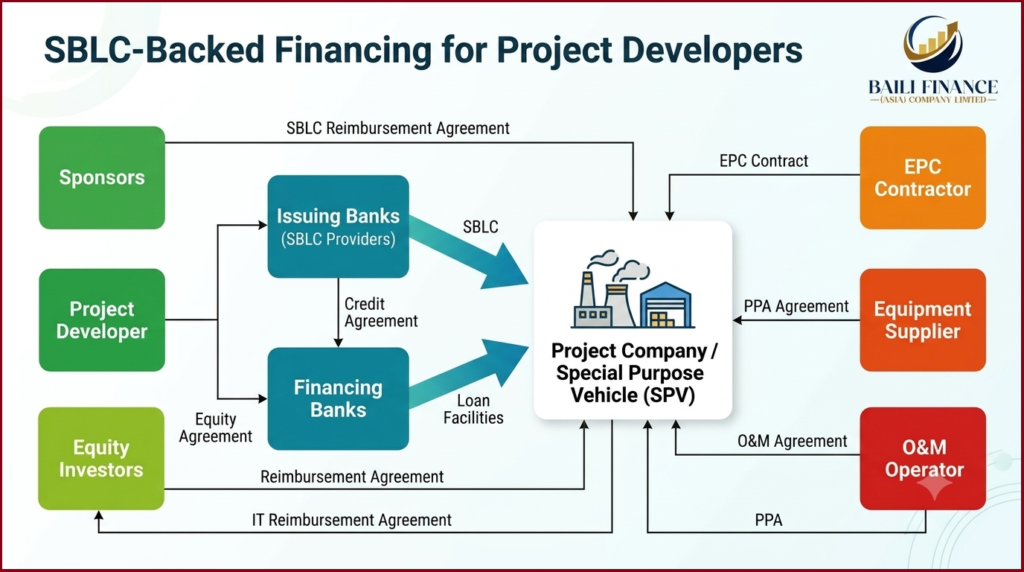
SBLC-Backed Financing for Project Developers
Project developers frequently face substantial upfront expenses before revenue begins.
Construction, equipment, engineering, permits, procurement, and mobilization can require significant capital.
A properly structured SBLC-backed project finance facility may provide additional funding capacity where the instrument, project, sponsor, and repayment structure satisfy lender requirements.
Projects may include:
- Energy
- Renewable energy
- Infrastructure
- Construction
- Manufacturing
- Logistics
- Real estate
- Industrial development
The quality of the project remains important.
A strong SBLC doesn’t make weak economics acceptable.
Current Trends in SBLC-Backed Financing
1. Growing Use of SBLCs for Large Enterprise Contracts
SBLCs are increasingly being used to support large commercial and government contracts where counterparties require financial assurance. In June 2026, Silicon Valley Bank highlighted SBLCs as a way for companies to support major contracts while keeping cash available for operations.
Why it matters: Businesses can use an SBLC as credit support without necessarily tying up the same amount of cash in deposits or prepayments.
2. Rising Demand for Trade Finance Instruments
Traditional trade finance instruments are receiving renewed attention. Global Trade Review reported in May 2026 that HSBC and Citi had observed increased demand for traditional trade finance instruments, reversing part of the longer-term decline in letters of credit.
Why it matters: This creates a stronger context for discussing SBLCs as part of international trade, cross-border transactions, and structured working-capital solutions.
3. Data Center and Energy Infrastructure Are Creating New SBLC Demand
One of the most significant current developments is the growth of data-center infrastructure.
As data centers require substantial electricity commitments, utilities and power-grid operators increasingly require credit protection from developers. Recent reporting indicates strong demand for large syndicated letters of credit, including standby instruments, connected to these power contracts.
Why it matters: This gives your article a highly relevant modern example of how SBLCs can support infrastructure and energy-related obligations.
4. Working Capital Is Becoming a Major Financing Focus
Businesses are facing capital requirements from longer production cycles, higher inventory requirements, and extended supply chains.
J.P. Morgan’s 2026 analysis highlights inventory finance, government receivables finance, export-credit-agency financing, and performance SBLCs as tools that can help convert contractual and inventory exposures into liquidity.
Why it matters: This supports positioning SBLC-backed financing beyond simple “monetization” and toward working-capital optimization.
5. Lender Due Diligence Is Becoming More Important
The SBLC market is also experiencing greater scrutiny.
Financing providers are increasingly focused on the authenticity of instruments, issuing-bank quality, transaction economics, compliance, and the actual source of repayment.
This is particularly important because online discussions and commercial offers sometimes present SBLC monetization as an automatic process. Recent commentary has also highlighted the fraud risk surrounding unrealistic SBLC monetization claims.
Why it matters: Your article should emphasize verification, KYC, AML, bank confirmation, contractual review, and independent due diligence.
6. SBLC Financing Is Moving Toward Transaction-Specific Structures
The market is increasingly focused on the actual transaction rather than simply the face value of the instrument.
Lenders are evaluating:
- Issuing bank
- SBLC wording
- Remaining tenor
- Applicant
- Beneficiary
- Jurisdiction
- Underlying contract
- Use of proceeds
- Repayment source
- Existing liabilities
- Compliance profile
This means the question isn’t simply “How much is the SBLC worth?”
It’s increasingly “What commercially viable transaction does the SBLC support?”
That distinction can make your article considerably more credible than pages that promote a fixed monetization percentage.
7. Infrastructure, Energy and Industrial Projects Are Expanding the Use Cases
SBLCs aren’t limited to conventional import-export transactions.
Current market activity shows growing relevance across energy, infrastructure, technology, manufacturing, logistics and large enterprise contracts. For example, Silicon Valley Bank identifies enterprise and government contracts as important applications, while J.P. Morgan highlights capital requirements in industrial supply chains.
This creates opportunities for businesses to explore SBLC-backed structures for:
- Project finance
- Energy projects
- Infrastructure
- Equipment procurement
- Manufacturing
- Supply-chain finance
- International trade
- Working capital
- Large contractual obligations
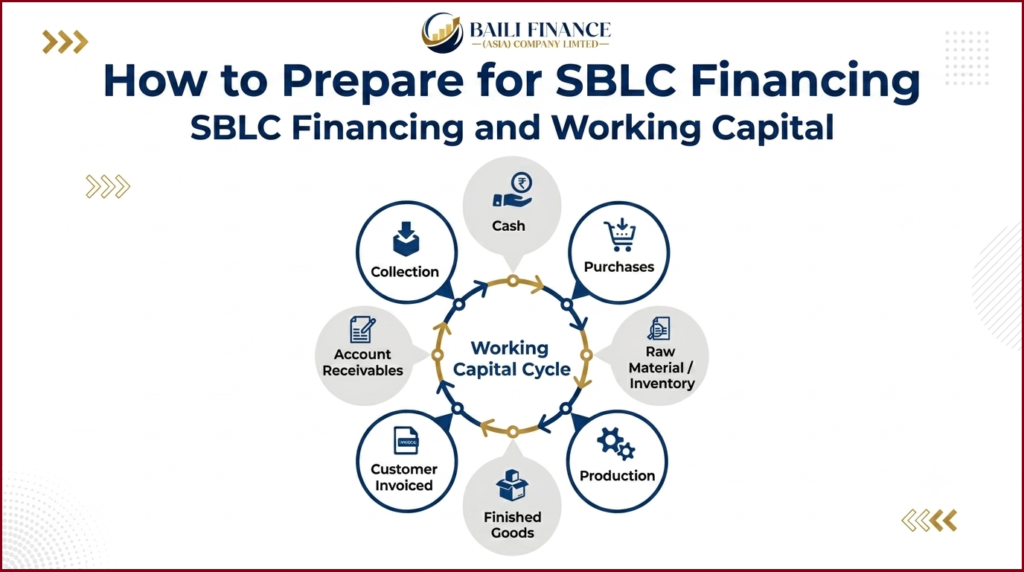
How to Prepare for SBLC Financing
Businesses can improve transaction efficiency by preparing documentation before approaching financing providers.
A professional financing package may include:
Corporate Documents
- Certificate of incorporation
- Ownership information
- Corporate structure
- Identification documents
- Board resolutions
Financial Documents
- Recent financial statements
- Management accounts
- Bank statements
- Existing debt information
- Cash-flow projections
Transaction Documents
- Purchase contracts
- Sales contracts
- Invoices
- Letters of intent
- Supply agreements
- Project agreements
SBLC Documents
- Issuing bank
- Face value
- Currency
- Expiry
- Beneficiary
- Applicant
- Applicable rules
- Relevant instrument wording
- Verification information
Project Documents
Where applicable:
- Business plan
- Feasibility study
- Project budget
- Financial model
- Construction schedule
- Revenue projections
- Repayment plan
The better organized the information, the easier it is for a financing provider to assess the opportunity.
Choosing an SBLC Financing Partner
Selecting a financing partner requires more than comparing advertised funding percentages.
Businesses should evaluate:
Banking capability: Can the provider explain how the financing will actually be arranged?
Transparency: Are the costs and conditions clearly documented?
Compliance: Does the transaction follow appropriate KYC, AML, sanctions, and banking procedures?
Experience: Does the provider understand international trade and structured finance?
Documentation: Are financing terms provided in writing?
Verification: Can the instrument and relevant banking relationships be independently assessed?
Transaction fit: Does the proposed structure match the business’s actual financing objective?
At Baili Finance Limited, businesses seeking structured finance can present their transaction requirements for assessment. The company’s published materials describe services involving SBLC solutions, structured finance, trade finance, project funding, and SBLC monetization support.
As with any financial transaction, prospective clients should independently review the proposed structure, contractual terms, counterparties, and applicable legal requirements before proceeding.
The SBLC financing market is becoming more transaction-focused. Businesses are increasingly using standby instruments to support large contracts, working capital, international trade, infrastructure and energy commitments. At the same time, lenders are placing greater emphasis on bank quality, instrument verification, compliance and the underlying commercial transaction.
This shift is important. An SBLC shouldn’t be presented simply as an instrument that can be “converted into cash.” Modern financing decisions depend on the quality of the issuing bank, the instrument’s terms, the borrower’s financial position, the purpose of financing and the repayment structure.
Frequently Asked Questions About SBLC-Backed Financing
1. What is SBLC-backed financing?
SBLC-backed financing is a financing structure where an eligible bank-issued Standby Letter of Credit supports a financing facility. The lender evaluates the SBLC together with the borrower, transaction, repayment source, compliance profile, and other risk factors.
2. Can an SBLC be used as collateral for financing?
In some transactions, a financing institution may accept an SBLC as collateral or credit enhancement. Acceptance isn’t automatic. The issuing bank, instrument wording, jurisdiction, tenor, transaction, and lender’s policies all influence eligibility.
3. Is an SBLC the same as cash?
No. An SBLC is a bank undertaking subject to its terms. It doesn’t function as unrestricted cash. Financing against an SBLC requires a separate financing structure and lender approval.
4. How much can I finance against an SBLC?
There is no universal financing percentage. The amount depends on the issuing bank, instrument quality, tenor, transaction risk, repayment source, borrower profile, and financing provider’s policies.
5. What is SBLC monetization?
SBLC monetization generally describes a financing process where a qualifying SBLC supports access to liquidity. The exact structure can involve collateral, assignment, or other contractual arrangements and must be reviewed on a transaction-specific basis.
6. What is an MT760 SBLC?
MT760 is a SWIFT message type commonly associated with the transmission of guarantees and standby letters of credit between financial institutions. The specific transaction should always be verified through appropriate banking channels.
7. How long does SBLC-backed financing take?
There is no fixed timeline. The process depends on documentation, instrument verification, KYC and AML checks, bank confirmation, transaction complexity, legal review, and financing approval.
8. Can SBLC financing support project finance?
Yes, where the project, SBLC, sponsor, financing structure, and repayment source meet the financing institution’s requirements. Infrastructure, energy, construction, manufacturing, and other commercial projects may be considered.
9. Do all SBLCs qualify for monetization?
No. The financing provider may reject an SBLC because of the issuing bank, jurisdiction, wording, insufficient tenor, compliance concerns, transfer restrictions, encumbrances, or overall transaction risk.
10. How can a business avoid SBLC financing scams?
Businesses should independently verify the issuing bank, financing provider, corporate identities, instrument authenticity, contractual documents, fees, and proposed banking process. Avoid providers promising guaranteed funding, guaranteed returns, or unrealistic financing percentages.
Summary: SBLC Financing Requires Structure, Not Promises
SBLC-backed financing can provide a useful financing option for businesses that hold an eligible bank-issued Standby Letter of Credit and have a credible commercial transaction behind the funding request.
The instrument can support trade finance, working capital, project finance, infrastructure, commodity transactions, equipment procurement, and other structured financing requirements.
However, the SBLC itself isn’t the financing.
The financing comes from a properly documented facility supported by an acceptable instrument and a viable transaction.
That distinction separates professional structured finance from unrealistic promises.
Businesses should therefore focus on the issuing bank, instrument wording, remaining tenor, verification, compliance, transaction economics, repayment source, financing costs, and contractual protections.
They should also conduct independent due diligence before transferring funds, signing agreements, or relying on representations from intermediaries.
For companies exploring SBLC-backed financing, SBLC monetization, working capital against an SBLC, international trade finance, or project funding, the next step should be a professional transaction assessment.
Ready to Assess Your SBLC Financing Opportunity?
Don’t leave a potentially valuable financial instrument sitting unused, and don’t commit your company to a financing structure you haven’t properly evaluated.
🌐www.bailifinancelimited.com
Contact Baili Finance Limited to present your SBLC, funding requirement, project, trade transaction, or working-capital requirement for review.
Provide the key facts: SBLC amount, issuing bank, expiry, intended use of funds, jurisdiction, transaction structure, and required financing amount.
A proper assessment can determine whether the proposed transaction is commercially and structurally suitable before you commit significant time or resources.
Your financing requirement deserves a documented structure, clear terms, and professional review. Start the conversation with Baili Finance Limited today.
Intermediaries/Consultants/Brokers are welcome to bring their clients 100% protected. Our brokers receive 2% commission for referral. We assist Clients and brokers in their attempt to secure funding by working on their funding requests that may require innovative financing. In complete confidence, we will work together for the benefits of all parties involved.
#SBLC #SBLCFinancing #SBLCBackedFinancing #SBLCMonetization #TradeFinance #ProjectFinance #StructuredFinance #WorkingCapital #InternationalFinance