Headline: SBLC Services, Complete Guide to Standby Letters of Credit, Trade Finance and Financial Security
Businesses operating across borders often face a basic commercial problem: one party wants assurance before committing funds, while the other party wants confidence that the transaction will proceed without unnecessary financial restrictions. SBLC services can address that requirement by providing an independent bank undertaking that supports an underlying commercial or financial obligation.

A Standby Letter of Credit (SBLC) isn’t normally designed to replace ordinary payment methods. Instead, it functions as a form of financial protection. If the applicant fails to meet a defined obligation and the beneficiary presents the documents or demand required under the SBLC, the issuing bank may become obligated to pay according to the terms of the instrument.
For companies involved in international trade, project finance, construction, procurement, leasing, investment transactions and other structured commercial arrangements, understanding how SBLC services work is essential.
The International Chamber of Commerce (ICC) explains that SBLCs are independent undertakings and may operate under established international rules, including ISP98 and, in appropriate circumstances, UCP 600.
This guide explains what SBLC services involve, how the process works, where companies use standby letters of credit, what applicants and beneficiaries should verify, and how professional SBLC structuring can reduce transaction risk.
keyword: SBLC Services Standby Letter of Credit services, SBLC provider, SBLC services for international trade, how SBLC services work, Standby Letter of Credit financing, SBLC advisory services, SBLC structuring services, international SBLC services, SBLC and bank guarantee, SBLC monetization
What Are SBLC Services?
SBLC services refer to professional assistance associated with arranging, structuring, reviewing, issuing, advising, confirming or managing a Standby Letter of Credit.
The exact scope varies between financial institutions and service providers. A professional service may involve several stages, including:
- Assessing the applicant’s transaction requirements
- Reviewing the underlying commercial agreement
- Identifying the required SBLC type
- Reviewing beneficiary requirements
- Structuring the proposed instrument
- Coordinating required documentation
- Reviewing SBLC wording
- Supporting communication between transaction parties
- Coordinating with relevant financial institutions
- Reviewing applicable rules such as ISP98 or UCP 600
- Supporting amendments, presentation and expiry processes where applicable
The objective isn’t simply to obtain an SBLC. The objective is to ensure that the instrument corresponds with the transaction, beneficiary requirements, applicable banking rules and the applicant’s commercial objectives.
That distinction matters because an SBLC is an independent undertaking. The wording determines what the issuer has undertaken to do, when a demand may be made, what documents must accompany a demand and when the undertaking expires.
What Does an SBLC Do?
An SBLC provides a defined payment undertaking from an issuing bank to a beneficiary.
The applicant requests the instrument. The bank evaluates the applicant under its own credit, compliance and risk procedures. If the bank agrees to issue the SBLC, it provides the undertaking in favour of the beneficiary.
The beneficiary then has additional contractual security because the issuing bank has undertaken an independent obligation under the instrument.
The ICC describes an SBLC as an undertaking that provides the beneficiary with an independent assurance of payment from the issuer.
An SBLC therefore can support commercial confidence without necessarily requiring the beneficiary to receive payment immediately.
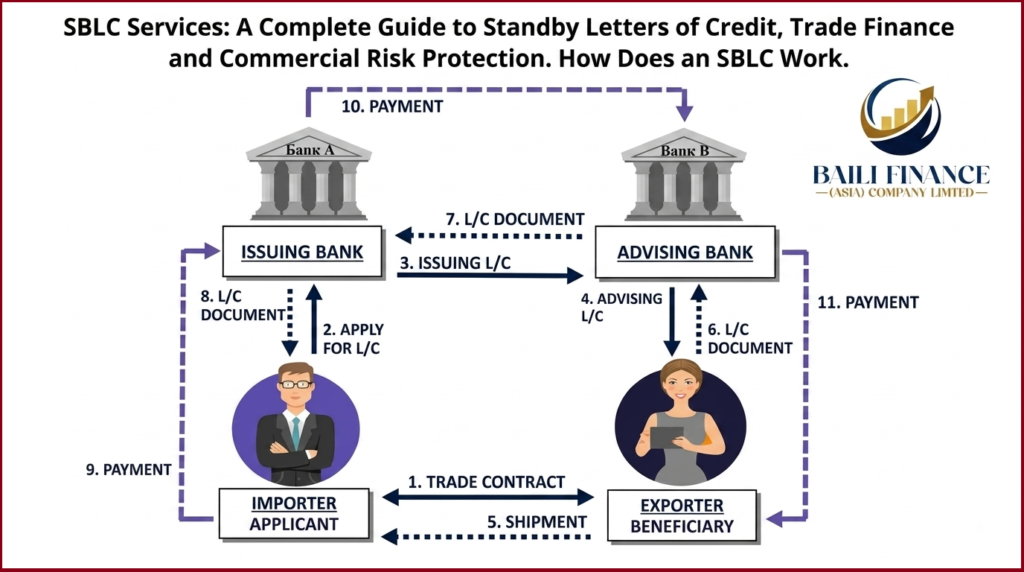
How Does an SBLC Work?
A typical SBLC transaction involves several parties:
- Applicant – the company or individual requesting the SBLC.
- Issuing bank – the bank issuing the undertaking.
- Beneficiary – the party receiving the protection.
- Advising bank – where applicable, the bank that advises the SBLC to the beneficiary.
- Confirming bank – where applicable, a bank that adds its own undertaking to the SBLC.
- Underlying transaction parties – companies, lenders, contractors, suppliers or other parties connected to the commercial agreement.
The process usually follows a structured sequence.
Step 1: Define the Commercial Requirement
The applicant first determines why the beneficiary requires an SBLC.
For example, the beneficiary may require security for:
- Payment obligations
- Contract performance
- Advance payments
- Tender participation
- Lease obligations
- Supply agreements
- Project contracts
- Credit facilities
The underlying agreement should clearly identify the obligation that the SBLC supports.
Step 2: Review the Beneficiary’s Requirements
The beneficiary may specify the required amount, currency, expiry date, governing rules, presentation requirements, issuer requirements and wording.
This stage deserves careful attention. A company shouldn’t arrange an instrument without first confirming what the beneficiary will actually accept.
Step 3: Evaluate the Applicant
The issuing bank determines whether it is willing to issue the SBLC.
Depending on the bank and transaction, this assessment can involve financial statements, corporate information, transaction documents, source-of-funds information, ownership information, compliance checks, collateral considerations and credit analysis.
There is no universal rule stating that every applicant can obtain an SBLC without collateral, and legitimate providers shouldn’t guarantee approval before the relevant financial institution completes its assessment.
Step 4: Structure and Draft the Instrument
The SBLC wording must correspond with the commercial requirement.
Important terms can include:
- Applicant
- Beneficiary
- Issuer
- Amount
- Currency
- Expiry date
- Place of presentation
- Method of presentation
- Required documents
- Applicable rules
- Governing law
- Payment terms
- Amendment provisions
- Transfer provisions, if applicable
Where ISP98 applies, its rules provide a framework specifically designed for standby letters of credit. ICC’s published ISP98 materials state that the rules apply to standby letters, including financial, performance and direct-pay standbys.
Step 5: Issuance and Advising
Once the issuing bank completes its internal approval and documentation requirements, the SBLC can be issued through the appropriate banking channels.
The beneficiary or its bank then reviews the instrument.
If the wording meets the beneficiary’s requirements, the parties can proceed with the underlying transaction.
Step 6: Monitoring Until Expiry
An SBLC isn’t a document that should simply be filed away.
The parties should monitor:
- Expiry date
- Amendment deadlines
- Presentation requirements
- Renewal requirements
- Notice requirements
- Changes to the underlying agreement
- Any applicable confirmation
- Compliance obligations
Careful monitoring becomes particularly important where the instrument contains precise presentation requirements.
Main Types of SBLC Services
Different transactions require different forms of standby support.
Payment SBLC
A payment SBLC supports an obligation to pay.
It can be useful where a supplier, lender or contractual counterparty wants additional security before extending credit or accepting deferred payment terms.
Performance SBLC
A performance SBLC supports contractual performance.
For example, a contractor may need to provide security to a project owner. If the contractor fails to meet defined obligations and the beneficiary satisfies the applicable demand conditions, the beneficiary may have recourse under the standby.
Advance Payment SBLC
An advance payment SBLC can protect a party that provides funds before receiving the agreed goods, services or performance.
This structure can be relevant to construction, procurement and international supply arrangements.
Bid or Tender SBLC
A tender-related standby can support bidding requirements where the beneficiary wants assurance that the bidder will meet defined obligations associated with the tender.
Lease or Rental SBLC
Landlords or lessors may request financial security from tenants or counterparties.
The SBLC can provide an additional layer of protection for specified payment obligations.
Financial SBLC
A financial standby generally supports a financial obligation.
The underlying transaction determines the precise structure, amount, duration and presentation requirements.
SBLC vs Bank Guarantee
SBLCs and bank guarantees can appear similar because both can provide financial security to a beneficiary. However, they aren’t interchangeable in every transaction.
An SBLC generally operates as an independent undertaking under its applicable rules.
A bank guarantee may operate under different legal and documentary frameworks, including URDG 758 where the guarantee expressly incorporates those rules.
The ICC recognizes separate rule frameworks for standbys, commercial documentary credits and independent bank guarantees.
The beneficiary’s requirements should therefore determine which instrument is appropriate.
A company shouldn’t assume that a beneficiary requesting a bank guarantee will automatically accept an SBLC, or vice versa.

SBLC vs Letter of Credit
A commercial letter of credit primarily supports payment against specified documentary conditions in a commercial transaction.
An SBLC normally functions as a backup undertaking that becomes relevant when the applicant doesn’t meet a specified obligation.
The distinction becomes important when negotiating international trade contracts.
For example, an importer may use a commercial letter of credit to facilitate payment for goods, while a separate SBLC could support another obligation arising from the same broader commercial relationship.
The appropriate instrument depends on the transaction structure rather than the name that sounds most convenient.
Why Businesses Use SBLC Services
Professional SBLC services for international trade can help companies navigate transactions where the beneficiary requires bank-backed security.
Potential benefits include:
Improved Counterparty Confidence
A beneficiary may have greater confidence when a recognized financial institution provides an independent undertaking.
Support for International Transactions
Cross-border transactions often involve counterparties that don’t have an established commercial history with each other.
Bank-backed security can help address part of that uncertainty.
Contractual Security
An appropriately structured standby can support payment, performance or other defined obligations.
Credit Enhancement
Where the issuer has appropriate credit standing, an SBLC can strengthen the credit profile of a transaction. The ICC specifically recognizes the potential role of a stronger issuer’s credit rating in providing credit enhancement.
Transaction Structuring
Professional assistance can help align the instrument with the beneficiary’s requirements before issuance.
That can reduce the risk of discovering after issuance that the beneficiary won’t accept the wording.
How to Choose an SBLC Service Provider
Choosing an SBLC provider requires more than comparing advertised fees.
Companies should examine the entire transaction structure.
1. Verify the Issuing Institution
The identity and credibility of the issuing bank matter.
Applicants should independently verify the bank and its authority to issue the proposed instrument.
2. Review the Documentation
A legitimate transaction should have clear documentation.
Review:
- Service agreements
- Applicant requirements
- Beneficiary requirements
- Fees
- Bank charges
- Refund provisions
- Timelines
- Responsibilities
- Compliance requirements
3. Understand the Payment Structure
Be cautious when a provider promises a large SBLC for an unusually small upfront fee or guarantees issuance without meaningful due diligence.
An SBLC represents a real banking obligation. Banks perform risk and compliance assessments, and applicants shouldn’t assume that an intermediary can bypass those requirements.
4. Verify Banking Communication Independently
Don’t rely solely on screenshots, certificates or documents supplied by an intermediary.
Where appropriate, transaction parties should verify relevant banking information through independent and legitimate banking channels.
5. Examine the Instrument Wording
The amount alone doesn’t determine the value of an SBLC.
The wording, applicable rules, issuer, expiry, presentation conditions and beneficiary requirements all matter.
6. Avoid Unrealistic Promises
Statements such as “guaranteed bank approval,” “no due diligence,” “instant issuance” or “risk-free monetization” deserve careful scrutiny.
Professional financial services require documentation, verification and appropriate compliance procedures.
SBLC Monetization: What Businesses Should Understand
The term SBLC monetization frequently appears in online financial marketing. It requires particularly careful analysis.
An SBLC isn’t cash.
It represents an undertaking by an issuer subject to its terms. Any financing arrangement based on an SBLC requires a separate lender or financial institution willing to accept that instrument as collateral or credit support.
Therefore, receiving an SBLC doesn’t automatically mean that a company can convert its face value into cash.
A financing institution will conduct its own assessment and may consider:
- Issuing bank
- Credit quality
- SBLC wording
- Remaining tenor
- Applicant
- Beneficiary
- Underlying transaction
- Applicable rules
- Jurisdiction
- Compliance requirements
- Proposed financing structure
Businesses should distinguish between obtaining an SBLC and obtaining financing secured by an SBLC.
Those are separate commercial processes.
Costs Associated With SBLC Services
The cost of an SBLC transaction can vary considerably.
Potential costs may include:
- Issuance fees
- Bank arrangement fees
- Advising fees
- Confirmation fees
- Legal fees
- Compliance costs
- SWIFT-related bank charges
- Amendment fees
- Renewal charges
- Collateral or security requirements
- Financing costs where the SBLC supports a separate funding arrangement
No responsible provider should present one universal percentage as the cost of every SBLC.
Pricing depends on the transaction, applicant, issuer, amount, currency, duration, jurisdiction, collateral structure and risk assessment.
Common SBLC Transaction Mistakes
Several errors can create unnecessary delays or commercial risk.
Using the Wrong Instrument
A beneficiary may require a bank guarantee under URDG 758 while the applicant arranges an SBLC under ISP98.
The result can be a document that doesn’t satisfy the contract.
Ignoring Expiry Provisions
An SBLC with an inappropriate expiry date can fail to provide the intended protection.
Poor Drafting
Ambiguous or unnecessarily complex wording can create disputes during presentation.
Failing to Verify the Issuer
A company should verify the issuing institution independently before relying on an instrument.
Treating the SBLC as Cash
An SBLC isn’t equivalent to a deposit or unrestricted cash balance.
Relying on Informal Verification
Important transaction information should move through appropriate professional and banking channels rather than relying exclusively on email attachments, messaging applications or screenshots.
Real-World Example: SBLC Use in Government-Related Finance
The U.S. Defense Security Cooperation Agency provides a documented example of an SBLC being used as financial security.
Under its Foreign Military Sales framework, eligible purchasers may use an SBLC issued by an eligible bank in lieu of certain prepayments. The SBLC serves as an independent bank undertaking and provides payment protection in circumstances specified by the relevant arrangement.
This example demonstrates an important point: SBLCs aren’t limited to private companies attempting to obtain financing. They can form part of structured transactions involving government entities, banks and international counterparties.
The specific terms and eligibility requirements depend on the transaction and governing framework.
Case Study: What an ICC SBLC Dispute Teaches Businesses
A useful documented case comes from the ICC’s DOCDEX decisions.
In DOCDEX Decision No. 373, an issuing bank issued an SBLC subject to ISP98. The standby required a demand for payment accompanied by a draft and written statement. The beneficiary submitted a demand, but the bank later rejected the presentation, first referring to the standby being overdrawn and subsequently stating that the standby had expired.
The case illustrates why precise drafting and strict management of presentation requirements matter.
An SBLC doesn’t operate simply because the beneficiary believes that a default has occurred. The beneficiary must comply with the applicable terms and presentation requirements.
For businesses arranging SBLC services, this has a direct practical implication: the transaction should be reviewed before issuance, not after a dispute develops.
Companies can also consult the ICC’s official resources on standby letters of credit and ISP98 for authoritative information about the applicable international framework:
ICC Academy: A Comprehensive Guide to Standby Letters of Credit
SBLC Services for International Businesses
International companies increasingly need financial structures that can support transactions between counterparties operating under different legal and commercial environments.
An SBLC can support that requirement when the underlying transaction justifies an independent bank undertaking.
Typical users can include:
- Importers
- Exporters
- Contractors
- Engineering companies
- Project developers
- Property companies
- International suppliers
- Commodity businesses
- Manufacturers
- Financial institutions
- Government contractors
- Infrastructure companies
The suitability of an SBLC depends on the commercial agreement and the requirements of the beneficiary.
A company shouldn’t obtain one merely because an intermediary recommends it. The instrument should solve a clearly identified transaction requirement.
Due Diligence Before Entering an SBLC Transaction
Before signing an SBLC service agreement, businesses should ask several direct questions:
Which bank will issue the instrument?
What exact rules will govern the SBLC?
Who is the beneficiary?
What obligation does the SBLC secure?
What documents are required for a demand?
When does the instrument expire?
Can the beneficiary accept the proposed issuer?
Are confirmation or advising services required?
What are the total costs?
What happens if the issuing bank declines the transaction?
What happens if the beneficiary rejects the wording?
How will banking details be independently verified?
These questions can expose weaknesses in a proposed transaction before the applicant commits substantial resources.
SBLC Services: A Practical Transaction Checklist
For companies considering an SBLC, the following checklist provides a useful starting point:
- Define the underlying commercial obligation.
- Obtain the beneficiary’s written SBLC requirements.
- Confirm the required amount and currency.
- Confirm the required validity period.
- Determine whether ISP98, UCP 600 or another framework applies.
- Identify the proposed issuing institution.
- Conduct independent issuer verification.
- Complete applicant due diligence.
- Review all transaction costs.
- Have the draft wording professionally reviewed.
- Confirm presentation requirements.
- Confirm expiry and amendment procedures.
- Determine whether confirmation is required.
- Keep records of all transaction documentation.
- Monitor the instrument until final expiry or cancellation.
Following these steps doesn’t guarantee issuance or payment. It does, however, create a more disciplined transaction process.
Frequently Asked Questions About SBLC Services
What are SBLC services?
SBLC services involve professional support associated with structuring, arranging, reviewing, issuing, advising, confirming or managing a Standby Letter of Credit. The exact service depends on the provider and transaction.
What is an SBLC used for?
An SBLC can support defined payment, performance, tender, advance-payment, lease or other financial obligations. The precise purpose should appear clearly in the underlying transaction and the instrument’s terms.
Is an SBLC the same as cash?
No. An SBLC is an independent bank undertaking subject to its terms. It isn’t automatically equivalent to cash and doesn’t guarantee that a lender will provide financing against its face value.
What is ISP98?
ISP98 stands for the International Standby Practices 1998. It provides rules specifically designed for standby letters of credit. The ICC identifies ISP98 as one of the principal rule frameworks applicable to SBLCs.
What is the difference between an SBLC and a bank guarantee?
Both can provide financial security, but their legal and documentary structures can differ. An SBLC may operate under ISP98 or another applicable framework, while an independent demand guarantee may operate under URDG 758 when incorporated into the guarantee.
Can an SBLC be used for international trade?
Yes. SBLCs can support international commercial relationships where a beneficiary requires bank-backed security. The exact structure depends on the transaction, counterparties, banks and applicable rules.
How much does an SBLC cost?
There isn’t one universal cost. Fees depend on factors such as the issuing bank, amount, tenor, applicant profile, transaction risk, collateral, jurisdiction and banking requirements.
Can anyone obtain an SBLC?
No provider can responsibly guarantee that every applicant will receive an SBLC. The issuing bank must determine whether it will accept the transaction and applicant under its own credit, compliance and risk procedures.
Is SBLC monetization guaranteed?
No. An SBLC doesn’t automatically create financing. A separate financing institution must decide whether it will accept the instrument and under what terms.
How can I verify an SBLC transaction?
Businesses should independently verify the issuing institution, transaction documentation and relevant banking details through appropriate professional and banking channels. They shouldn’t rely solely on screenshots, certificates or claims made by an intermediary.
Why Professional SBLC Support Matters
A standby letter of credit involves more than a financial instrument with a stated face value.
It connects a commercial agreement, an applicant, a beneficiary, one or more financial institutions, documentary requirements, applicable rules, compliance procedures and defined timelines.
When these elements don’t align, the transaction can encounter delays or disputes.
Professional SBLC advisory and structuring services can help businesses identify those issues before the instrument reaches the issuance stage.
The most effective approach begins with the underlying transaction.
What does the beneficiary actually require?
Which bank will satisfy that requirement?
Which rules should govern the instrument?
What documents must accompany a demand?
What happens when the instrument expires?
What verification procedures will the parties use?
Answering those questions early gives every party a clearer basis for proceeding.

Summary: Making SBLC Services Work for Your Transaction
SBLC services can provide valuable support for companies that need bank-backed security for legitimate commercial or financial obligations. Used correctly, a Standby Letter of Credit can support payment commitments, contractual performance, international trade, project arrangements, tenders, leases and other structured transactions.
The critical issue isn’t simply obtaining an SBLC.
It’s obtaining the right instrument, from an acceptable issuing institution, with appropriate wording, applicable rules, documentary requirements, validity and transaction structure.
Businesses should also remember that an SBLC isn’t cash, isn’t automatically monetizable and doesn’t guarantee financing. Any provider making such claims without explaining the underlying banking and credit process deserves careful scrutiny.
For companies considering an SBLC, the next step should be a transaction-specific assessment rather than a generic promise.
If your company needs an SBLC structure for a genuine commercial transaction, don’t leave the banking requirements to chance. Contact Baili Finance Limited to discuss your transaction requirements, beneficiary conditions, preferred structure and documentation. Send the key details of your transaction today and request an initial assessment of the SBLC solution that may fit your requirements.
🌐www.bailifinancelimited.com
Intermediaries/Consultants/Brokers are welcome to bring their clients 100% protected. Our brokers receive 2% commission for referral. We assist Clients and brokers in their attempt to secure funding by working on their funding requests that may require innovative financing. In complete confidence, we will work together for the benefits of all parties involved.
#SBLC #SBLCServices #StandbyLetterOfCredit #TradeFinance #BankGuarantee #InternationalTrade #StructuredFinance #FinancialServices #ProjectFinance #CreditEnhancement