Headline: STOP SBLC FRAUD BEFORE YOU LOSE MONEY
Before paying an SBLC provider, learn the warning signs of SBLC fraud, fake bank instruments, suspicious MT760 claims and monetization scams.
Businesses seeking international trade finance, project funding, bank guarantees, or SBLC monetization increasingly encounter providers claiming they can arrange a Standby Letter of Credit (SBLC) quickly and at unusually attractive terms. However, fraudulent SBLC providers can use convincing websites, professional-looking documents, bank names, SWIFT terminology, intermediaries, and apparently credible financial structures to create confidence before requesting fees or transferring funds.
The phrase fraudulent SBLC providers deserves serious attention because an SBLC is a genuine banking instrument, while an offer involving an SBLC isn’t automatically genuine simply because it mentions a recognized bank, SWIFT MT760, ICC rules, monetization, or international trade finance.
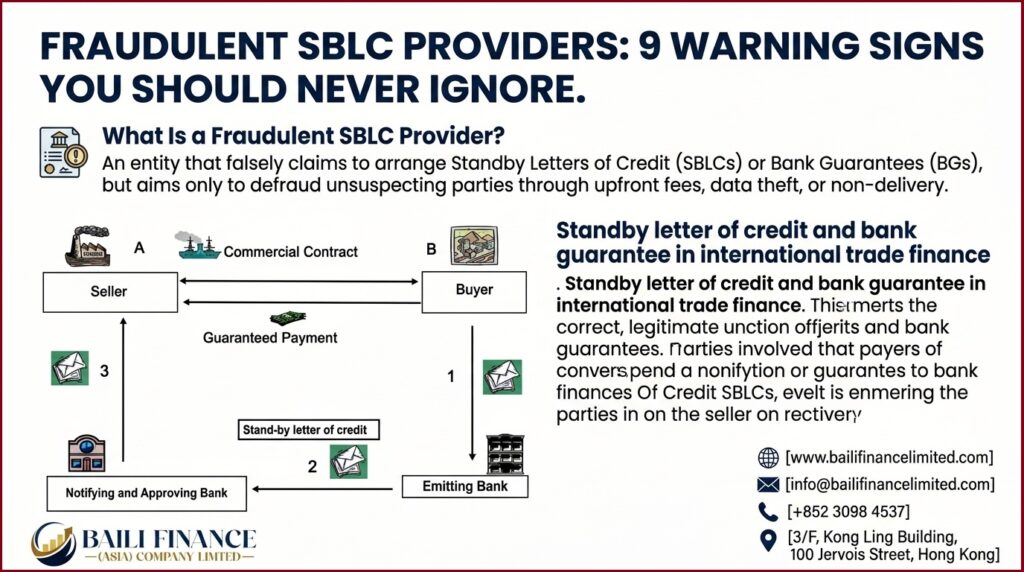
An SBLC is generally a bank-issued undertaking supporting specified financial or performance obligations. The Bank for International Settlements describes financial and performance standby letters of credit as instruments under which a bank undertakes obligations to a beneficiary when defined conditions occur.
That distinction matters.
A legitimate SBLC transaction should have a clearly identifiable applicant, beneficiary, issuing institution, transaction purpose, amount, expiry, governing rules or applicable terms, and an authentic banking channel. Under ICC’s URDG 758, where those rules apply, a guarantee should identify important details including the applicant, beneficiary, guarantor, amount, currency, expiry, demand requirements, and relevant references.
Therefore, businesses shouldn’t judge an SBLC provider by presentation alone. They should evaluate the underlying transaction, banking relationship, documentation, compliance process, issuing institution, contractual structure, and verification procedure.
This guide explains how to identify fraudulent SBLC providers, how SBLC scams work, how to verify an SBLC provider, what red flags to investigate, and what businesses should do before paying an SBLC-related fee.
Keyword: fraudulent SBLC providers, SBLC fraud, SBLC scams, SBLC scam, SBLC provider, legitimate SBLC providers, verify SBLC provider, how to verify an SBLC, SBLC monetization fraud, SBLC monetization scams, standby letter of credit fraud, standby letter of credit scams, fraudulent bank guarantee providers, bank guarantee fraud, SBLC investment scam, fake SBLC, fake bank guarantee, SBLC MT760 fraud, MT760 scam, SBLC due diligence, SBLC verification, SBLC provider due diligence
Due diligence notice: This article provides general educational information and doesn’t constitute legal, banking or investment advice. Businesses should obtain independent professional advice before entering a high-value financial transaction.
What Is a Fraudulent SBLC Provider?
A fraudulent SBLC provider is an individual, company, intermediary, website, or purported financial institution that falsely represents its ability to arrange, issue, lease, monetize, transfer, or facilitate an SBLC, bank guarantee, or related financial instrument.
The fraud may take different forms.
Some operators may advertise an instrument that doesn’t exist. Others may use legitimate banking terminology while misrepresenting their relationship with a bank. Another structure may involve an apparently sophisticated investment or monetization program where the promised returns have little connection with legitimate trade finance.
Importantly, not every independent SBLC consultant or intermediary is fraudulent. A legitimate intermediary may coordinate between a client and regulated financial institutions. The critical issue is whether the intermediary accurately represents its role and whether the underlying banking transaction can be independently verified.
The difference between a legitimate provider and a fraudulent provider often becomes visible during due diligence.
A credible transaction should withstand reasonable questions.
A fraudulent transaction often depends on avoiding them.
Why Fraudulent SBLC Schemes Continue to Attract Businesses
SBLC transactions can involve substantial values. They also use technical terminology that many business owners don’t encounter during ordinary commercial activity.
Terms such as:
- SBLC MT760
- SWIFT
- ISP98
- UCP 600
- URDG 758
- bank guarantee
- monetization
- collateral
- proof of funds
- credit enhancement
- non-recourse financing
- project funding
- leased SBLC
- bank instrument
- trade finance
can make an offer appear sophisticated.
However, terminology doesn’t establish authenticity.
Fraudsters understand that international transactions often involve multiple jurisdictions, intermediaries, lawyers, consultants, brokers, banks, and corporate entities. That complexity can make verification more difficult.
The International Chamber of Commerce has also warned about fraudulent documents and communications misusing the ICC name to create credibility around fraudulent transactions.
For that reason, a business should verify the actual transaction instead of relying on documents that merely look official.
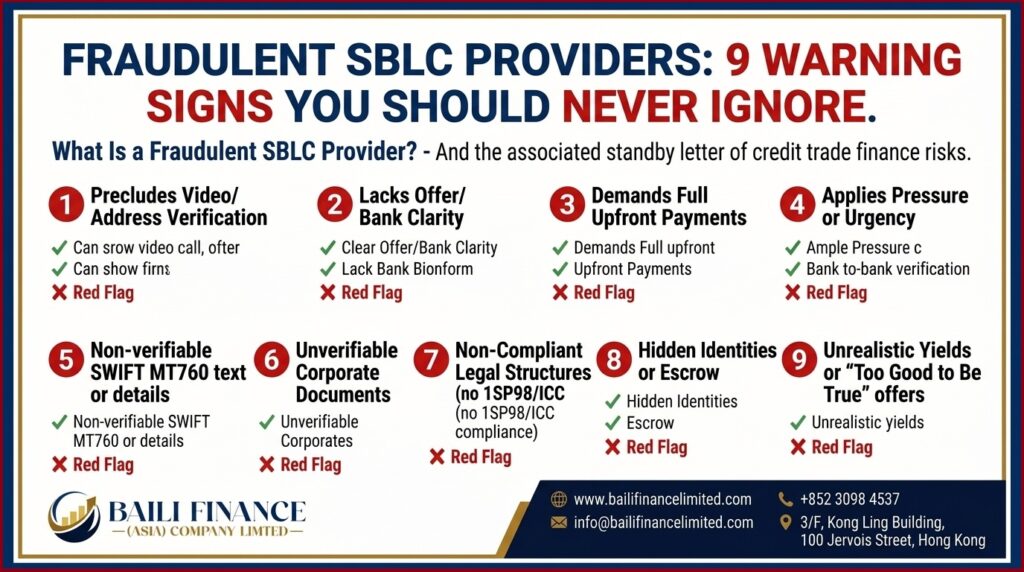
9 Warning Signs of Fraudulent SBLC Providers
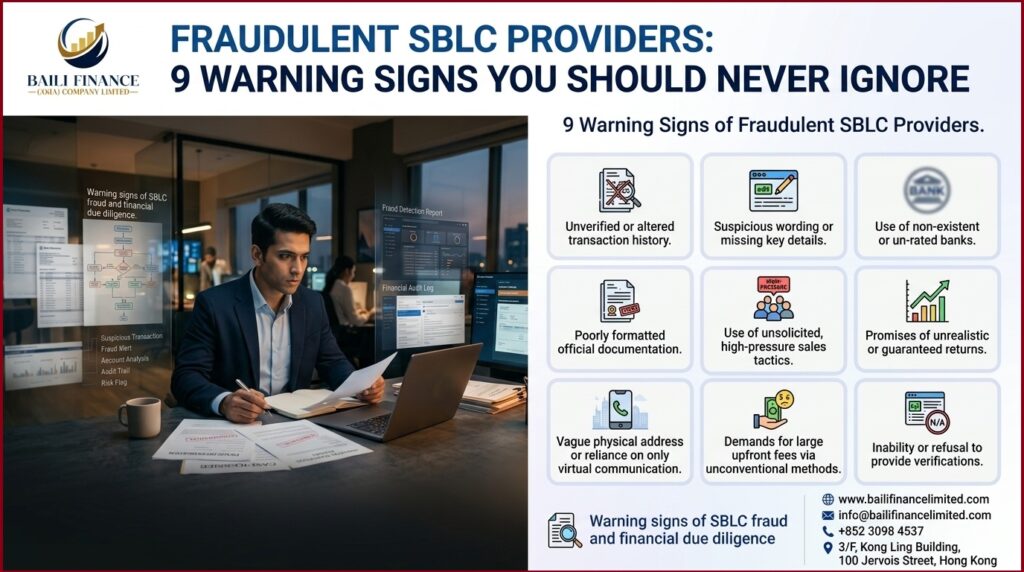
1. The Provider Guarantees Extraordinary Returns
One of the strongest warning signs is a promise of extraordinary investment returns within an unusually short period.
An offer might claim that a client can invest a specific amount and receive several times that amount within weeks. It may also describe the arrangement as an SBLC investment, prime bank program, private placement, trading program, or monetization opportunity.
Businesses should separate financing from investment-return promises.
An SBLC itself doesn’t automatically create a guaranteed investment return.
The SEC has documented an SBLC-related fraudulent scheme in which investors were promised returns ranging from two to sixteen times their investment within 30 to 90 days. The SEC alleged that investor funds were misused, including payments to earlier investors and other business activities.
That case demonstrates why unusually high returns deserve independent investigation.
2. The Provider Demands Large Upfront Payments Without Clear Documentation
Legitimate financial transactions can involve fees.
Therefore, an upfront fee alone doesn’t prove fraud.
The concern arises when a provider demands a substantial payment before providing sufficient information about the transaction, the contractual basis for the fee, the issuing institution, the service being performed, and the conditions governing the transaction.
The ICC has previously warned businesses about fraud involving supposed financing arrangements connected with standby letters of credit and specifically cautioned against large advance payments in such circumstances.
Before paying, ask:
- What service does the fee cover?
- Who receives the payment?
- Is the recipient the contracting entity?
- Is there a written engagement agreement?
- Is the fee refundable under any circumstances?
- What event triggers the next payment?
- What happens if the proposed bank transaction doesn’t proceed?
- Can the bank relationship be independently verified?
If the answers remain vague, stop the transaction until the structure becomes clear.
3. The Provider Claims to Be the Bank Without Evidence
A company may describe itself as an “SBLC bank,” “direct bank provider,” or “financial institution” even though its actual legal role is that of a broker, consultant, arranger, or independent company.
This distinction matters.
Ask the provider to state its precise legal role.
Is it:
- the issuing bank?
- an arranging company?
- a financial intermediary?
- a broker?
- a consultant?
- a funding company?
- a beneficiary-side adviser?
The answer should be consistent across its website, corporate documents, contracts, correspondence, and banking documentation.
A professional intermediary shouldn’t need to misrepresent itself as a bank.
4. The Provider Refuses Independent Bank Verification
This is one of the most important warning signs.
A genuine banking transaction should have a verifiable banking component.
That doesn’t mean a provider should disclose confidential information belonging to another client. It does mean the provider should be able to explain the verification process and identify the appropriate banking channel through which authenticity can be established.
ICC’s rules distinguish between an advising party and the guarantor. Under URDG 758, an advising party’s role includes satisfying itself as to the apparent authenticity of a guarantee, while advising doesn’t itself constitute an additional payment undertaking.
A provider that says, “You must trust our document because it has a bank logo,” isn’t providing meaningful verification.
5. The Documentation Contains Unusual or Inconsistent Banking Language
Fraudulent documents often attempt to imitate legitimate banking documentation.
Look for:
- inconsistent bank names;
- incorrect addresses;
- unusual terminology;
- inconsistent reference numbers;
- unexplained abbreviations;
- inconsistent currencies;
- contradictory dates;
- unexplained amendments;
- spelling or formatting anomalies;
- references to nonexistent banking departments;
- documents that appear copied from unrelated transactions.
A document can look professional and still be fraudulent.
The important question isn’t whether the document looks authentic.
The important question is whether the relevant financial institution can authenticate the transaction through an appropriate channel.
6. The Provider Uses ICC References as Proof of Legitimacy
Mentioning ICC, ISP98, UCP 600, or URDG 758 doesn’t make a transaction legitimate.
These are established international trade finance rules and practices. Their relevance depends on the specific instrument and its terms.
ICC explains that URDG 758 applies to demand guarantees and counter-guarantees when the instrument expressly indicates that it is subject to those rules.
Therefore, a provider shouldn’t simply write “ICC compliant” and expect the statement to end the due diligence process.
Ask:
Which rule applies?
Where is that stated in the instrument?
Who is the guarantor or issuing bank?
What is the governing law?
What are the demand conditions?
How will authenticity be confirmed?
These questions are more meaningful than a logo or a certification claim.
7. The Transaction Depends Entirely on Confidentiality
Confidentiality is normal in financial transactions.
However, excessive secrecy creates risk.
A provider may tell a prospective client not to contact the bank, not to consult another financial professional, not to disclose the transaction to advisers, or not to conduct independent verification.
That isn’t a sound basis for a high-value transaction.
A professional confidentiality agreement should protect legitimate commercial information. It shouldn’t prevent reasonable verification.
If confidentiality prevents a client from establishing whether the issuing bank, financial institution, or transaction actually exists, the client should reconsider proceeding.
8. The Provider Creates Artificial Urgency
Fraudulent providers may claim:
- the bank allocation expires today;
- another investor is ready to take the position;
- the client must pay immediately;
- the instrument will disappear if payment isn’t made;
- the bank has only one available slot;
- the transaction must remain secret;
- the fee increases tomorrow.
Urgency can interfere with rational due diligence.
High-value financial decisions require documentation and verification.
A legitimate commercial opportunity may have deadlines. That doesn’t eliminate the need for reasonable checks.
9. The Provider Has No Clear Corporate or Compliance Footprint
Before engaging an SBLC provider, investigate its corporate identity.
Check:
- legal company name;
- registration jurisdiction;
- registration number;
- physical business address;
- directors where publicly available;
- corporate website;
- business history;
- contractual entity;
- compliance procedures;
- banking relationships;
- litigation or regulatory history where available;
- professional advisers;
- transaction references that can actually be verified.
A polished website isn’t enough.
Likewise, a company registration isn’t proof that every financial service advertised by that company is authorized, regulated, or legitimate.
The legal status and permitted activity should be evaluated separately.
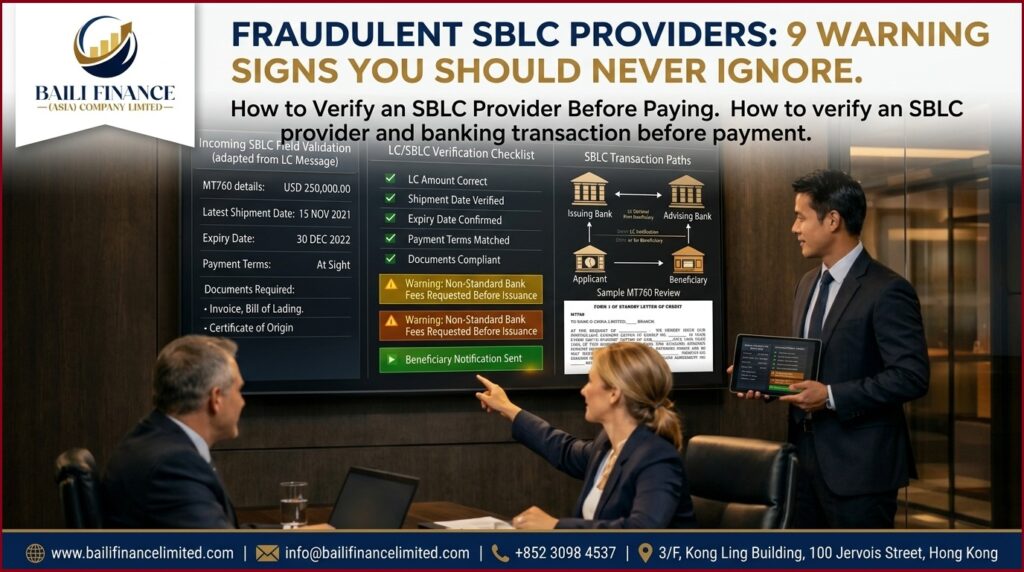
How to Verify an SBLC Provider Before Paying
A structured verification process can significantly reduce exposure to fraudulent SBLC providers.
Step 1: Identify the Legal Counterparty
Request the complete legal name of the entity that will contract with you.
Don’t rely only on a trading name.
The contract, invoice, payment instructions, website, and corporate records should make sense together.
Step 2: Determine the Provider’s Exact Role
Ask whether the company is issuing, arranging, advising, brokering, monetizing, financing, or consulting.
Those functions aren’t interchangeable.
A provider should explain its role in plain business language.
Step 3: Verify the Issuing Institution Independently
Don’t use only contact details supplied by the intermediary.
Where appropriate, obtain independent contact information for the relevant financial institution and follow its verification procedures.
Never assume that a bank name appearing on a document means that bank issued the document.
Step 4: Review the Instrument Terms
Review:
- amount;
- currency;
- applicant;
- beneficiary;
- issuing institution;
- expiry;
- applicable rules;
- governing law;
- claim conditions;
- presentation requirements;
- references;
- charges;
- amendment provisions.
ICC’s URDG 758 specifically identifies several of these elements as information that should be clearly specified in a demand guarantee.
Step 5: Examine the Payment Structure
Document every fee.
You should understand:
who gets paid, why they get paid, when they get paid, and what happens if the transaction doesn’t complete.
Avoid sending money to unrelated third-party accounts unless there is a documented and professionally justified reason.
Step 6: Review the Monetization Structure Separately
If the proposal involves SBLC monetization, don’t assume that the SBLC automatically converts into cash.
The monetization provider, lender, bank, collateral requirements, loan-to-value assumptions, fees, repayment terms, recourse provisions, and conditions precedent should be identified.
An SBLC is a banking instrument. It isn’t a universal cash machine.
Step 7: Obtain Professional Advice
For a substantial transaction, consider independent legal, banking, compliance, and financial advice.
The adviser should be independent of the provider receiving your fees.
That separation matters.
A practical due-diligence guide to identifying and avoiding fraudulent SBLC providers.
Real-World Example: SEC Action Involving an SBLC Program
A documented example illustrates the risks more clearly than a generic warning.
In a case involving Borg Bank and Roosevelt Tobias Bailey, the SEC alleged that an investment program used an SBLC-related structure to attract investors.
According to the SEC, the scheme raised more than $1.6 million from at least 26 investors. Investors were allegedly promised extraordinary returns from SBLC and other investment programs. The SEC further alleged that funds were used for purposes inconsistent with the representations made to investors, including payments involving earlier investors and other business activities.
The SEC’s enforcement materials provide an important lesson:
A transaction can use sophisticated financial terminology and still involve fraudulent conduct.
The existence of an SBLC reference doesn’t validate the investment structure surrounding it.
Businesses should therefore examine the entire transaction, not just the instrument described in promotional material.
For additional primary-source information, readers can review the SEC enforcement materials concerning the SBLC-related case.
Case Study: How an SBLC Scam Can Develop
Consider a hypothetical manufacturing company seeking $20 million in project financing.
The company receives an offer from an online “SBLC provider.”
The provider claims that it can arrange a $50 million SBLC through an international bank. It requests a 3% upfront arrangement fee and promises that the SBLC will be delivered within ten business days.
The sales representative sends:
- a corporate profile;
- a bank logo;
- an apparent bank reference;
- an SBLC template;
- a SWIFT MT760 explanation;
- a certificate of authenticity;
- an agreement;
- and a payment instruction.
The documents appear professional.
The company pays the fee.
Ten business days later, the provider says the bank has requested an additional compliance charge.
The company pays again.
A further charge follows.
Eventually, the provider claims that the issuing bank has changed its compliance requirements. Communication becomes slower. The provider requests another payment before the transaction can proceed.
At this point, the company has a problem.
The company hasn’t independently verified the issuing bank’s involvement. It has relied on documents supplied by the intermediary. It has also paid money before confirming the banking transaction.
What Should Have Happened?
Before the first payment, the company should have:
- verified the provider’s legal identity;
- identified its exact role;
- reviewed the contractual terms;
- independently verified the relevant bank relationship;
- reviewed the proposed SBLC terms;
- investigated the payment recipients;
- checked whether the proposed structure made commercial sense;
- obtained independent legal and financial advice;
- documented all representations made by the provider.
The objective isn’t to make every transaction difficult.
The objective is to prevent avoidable losses.
SBLC vs. Fraudulent SBLC Offer: What Businesses Should Understand
A legitimate SBLC is a financial instrument.
A fraudulent SBLC offer is a deceptive transaction surrounding a supposed financial instrument.
That distinction is fundamental.
| Legitimate Transaction | High-Risk or Potentially Fraudulent Offer |
|---|---|
| Clear legal parties | Unclear contracting entity |
| Identifiable banking institution | Bank identity cannot be independently verified |
| Defined instrument terms | Generic templates |
| Reasonable transaction purpose | Vague investment story |
| Transparent fees | Repeated unexplained advance fees |
| Defined contractual obligations | Verbal promises overriding documents |
| Independent verification possible | Verification discouraged |
| Clear compliance process | “No questions” approach |
| Realistic commercial expectations | Extraordinary guaranteed returns |
| Professional documentation | Inconsistent or suspicious documents |
No single factor proves fraud.
However, multiple warning signs should trigger a pause.
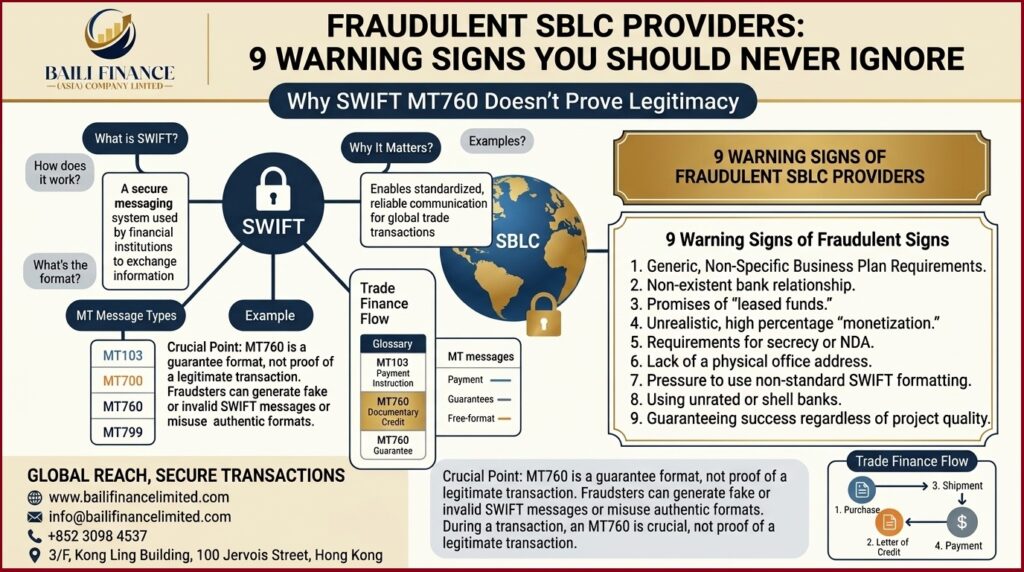
Why SWIFT MT760 Doesn’t Prove Legitimacy
SWIFT MT760 frequently appears in SBLC-related discussions.
It refers to a SWIFT message type used in financial communications involving guarantees and standby letters of credit.
However, simply receiving a document claiming to be an MT760 doesn’t establish that a bank has genuinely issued an SBLC.
Fraudsters can reproduce terminology, templates, logos, message descriptions, and apparent references.
The proper question is whether the transaction has been authenticated through the appropriate banking channel.
Therefore:
Don’t confuse a document describing a SWIFT message with independently verified bank communication.
That distinction can prevent serious financial loss.
SBLC Monetization Fraud: What to Watch For
SBLC monetization is another area where businesses should exercise caution.
A provider may claim that an SBLC with a particular face value will automatically produce a predetermined percentage of cash.
That assumption can be misleading.
Actual financing depends on factors such as:
- issuing institution;
- credit quality;
- instrument terms;
- beneficiary;
- lender requirements;
- transaction structure;
- jurisdiction;
- compliance assessment;
- collateral policy;
- loan-to-value assumptions;
- fees;
- repayment arrangements;
- legal enforceability.
A legitimate financier should be able to explain these factors.
Be particularly cautious when a provider promises a fixed monetization percentage without first reviewing the instrument and transaction.
Questions to Ask Any SBLC Provider
Before signing an agreement, ask the following:
Who is the issuing bank?
What is your legal role in this transaction?
Who will be my contractual counterparty?
What rules govern the instrument?
Can the issuing institution be independently verified?
What exactly does the upfront fee cover?
What happens if the bank doesn’t issue the instrument?
Who receives my funds?
What are the conditions precedent?
What are the expiry and claim terms?
Which jurisdiction governs the contract?
What independent evidence supports your banking relationship?
Can my legal and financial advisers review the transaction before payment?
A provider that cannot answer basic questions about its own transaction structure deserves additional scrutiny.
How Businesses Can Protect Themselves
A practical fraud-prevention framework should include five principles.
Verify Before You Pay
Don’t allow commercial urgency to replace verification.
Verify the Bank, Not Just the Broker
A broker’s reputation doesn’t independently establish the authenticity of a bank instrument.
Read the Contract
Understand fees, obligations, representations, termination rights, governing law, dispute provisions, and refund provisions.
Separate Marketing From Evidence
A website can describe services. It doesn’t independently establish the existence of a specific SBLC.
Use Independent Professionals
High-value transactions deserve independent review.
The International Chamber of Commerce provides established resources concerning demand guarantees and international trade finance practices. Businesses evaluating guarantee structures can consult the ICC URDG 758 rules and guidance as a primary reference point where relevant to the transaction.
External sources:
- International Chamber of Commerce (ICC) — URDG 758
ICC Guide to URDG 758 - SWIFT — MT760 / Standby Letters of Credit
SWIFT MT760 documentation - U.S. Securities and Exchange Commission — SBLC Fraud Case
SEC enforcement document on the SBLC investment schemeSuggested anchor text:SEC enforcement case involving an SBLC investment scheme - SEC — Worldwide Funding III Limited
SEC case involving Worldwide Funding III Limited
How a Professional SBLC Provider Should Approach a Client
A professional provider should focus on clarity.
The client should understand:
- who the provider is;
- what service it offers;
- which institution is involved;
- what documentation is required;
- what due diligence applies;
- what fees are payable;
- when fees become payable;
- what conditions must be satisfied;
- what risks remain;
- what the provider can and cannot guarantee.
There should also be a clear distinction between arranging an SBLC and guaranteeing financing against an SBLC.
Those are different commercial propositions.
For businesses considering SBLC issuance, bank guarantees, structured trade finance, or related funding solutions, Baili Finance presents its services through its official website, including SBLC issuance and monetization, bank guarantees, trade finance, and structured finance solutions.
However, businesses should still perform transaction-specific due diligence before entering any financial arrangement. No provider’s marketing material should replace independent verification.
Frequently Asked Questions About Fraudulent SBLC Providers
1. How can I identify fraudulent SBLC providers?
Start by checking the provider’s legal identity, role, corporate records, banking relationships, transaction documentation, payment structure, and verification process. Be especially cautious about extraordinary returns, repeated upfront fees, unverifiable bank claims, unusual documents, artificial urgency, and resistance to independent verification.
2. Is every SBLC provider offering monetization a scam?
No. SBLC-related services can involve legitimate financial institutions, arrangers, intermediaries, lenders, and structured finance professionals. However, monetization claims should be evaluated carefully because an SBLC doesn’t automatically guarantee a specific amount of financing.
3. Does an MT760 prove that an SBLC is genuine?
No. A reference to MT760 doesn’t independently prove authenticity. The relevant bank communication and transaction should be verified through appropriate banking channels.
4. Why do fraudulent SBLC providers request upfront fees?
Upfront fees can be used in legitimate transactions to cover professional or administrative services. The risk arises when the fee lacks a clear contractual purpose, goes to an unrelated party, is repeatedly increased, or is requested before the underlying banking transaction has been independently verified.
5. Can an SBLC be used for project financing?
Yes, an SBLC may support certain financial or contractual structures, subject to the instrument’s terms and the requirements of the relevant banks or financiers. However, the existence of an SBLC doesn’t automatically mean a project will receive financing.
6. What is the difference between an SBLC and a bank guarantee?
Both can provide financial security, but their legal structures and applicable rules can differ. A standby letter of credit is generally an independent undertaking issued under specified terms, while demand guarantees may be governed by frameworks such as URDG 758 when incorporated. The exact instrument and governing rules should always be reviewed.
7. Should I pay an SBLC provider before verifying the bank?
For a high-value transaction, independent verification should occur before committing funds wherever commercially and legally possible. The exact process depends on the transaction, but relying solely on documents supplied by an intermediary creates unnecessary risk.
8. What should I do if I suspect an SBLC provider is fraudulent?
Stop additional payments, preserve contracts and communications, document payment records, obtain independent legal advice, and contact the relevant financial institution through independently obtained contact details. Where appropriate, report suspected fraudulent activity to the competent authorities in the relevant jurisdictions.
What is a fraudulent SBLC provider?
A fraudulent SBLC provider is an individual or company that falsely represents its ability to arrange, issue, monetize or facilitate a standby letter of credit or related bank instrument, often using misleading documents, unverifiable banking claims or excessive upfront fees.
How can I identify an SBLC scam?
Common warning signs include extraordinary guaranteed returns, unexplained upfront fees, unverifiable bank relationships, suspicious documents, artificial urgency, unclear corporate identities and resistance to independent verification.
Does MT760 prove an SBLC is genuine?
No. A reference to SWIFT MT760 doesn’t independently prove that an SBLC exists or was issued by the named bank. The underlying banking communication should be independently authenticated through an appropriate banking channel.
Final Summary: Stop Fraud Before It Starts
Fraudulent SBLC providers don’t always look fraudulent.
Some may present polished websites, sophisticated documents, professional correspondence, international telephone numbers, corporate registrations, bank references, and technical banking terminology.
That is why proper due diligence matters.
A legitimate SBLC transaction should have an identifiable commercial purpose, clearly defined parties, understandable documentation, appropriate banking involvement, reasonable contractual terms, and a credible verification process.
Businesses shouldn’t select an SBLC provider because the provider promises the fastest delivery, the highest monetization percentage, the largest bank, or the biggest financial return.
They should select a provider based on verifiable capability, transparent transaction structure, appropriate banking relationships, professional documentation, compliance discipline, and clear contractual obligations.
If you’re researching how to find a legitimate SBLC provider, how to verify an SBLC provider, SBLC fraud warning signs, SBLC monetization risks, standby letter of credit scams, or how to avoid fraudulent bank guarantee providers, start with verification rather than payment.
Your capital, reputation, project timeline, and commercial relationships can depend on that decision.
BEFORE YOU PAY AN SBLC PROVIDER, TALK TO US
Considering an SBLC, bank guarantee, trade finance facility or SBLC monetization structure?Don’t rely solely on documents, promises or online claims.Share your transaction requirements with Baili Finance and discuss the appropriate financial structure for your business.Request a consultation today and take the next step with a clearer understanding of your SBLC or structured finance requirements.DISCUSS YOUR SBLC REQUIREMENTS
Ready to Review Your SBLC Transaction?
Before you send an upfront fee, sign a complex agreement, or rely on a document presented as a bank instrument, request a professional assessment of the transaction structure.
If your business requires an SBLC, bank guarantee, structured trade finance solution, project funding structure, or SBLC monetization assessment, contact Baili Finance (Asia) Company Limited through its official website to discuss your requirements.
Don’t wait until a questionable transaction becomes an expensive problem.
Send your transaction requirements for review, identify the right financial structure, and take the next step with a clearer understanding of the banking process.
Contact Baili Finance for SBLC and structured finance solutions
Your next financial transaction deserves verification before commitment.
Intermediaries/Consultants/Brokers are welcome to bring their clients 100% protected. Our brokers receive 2% commission for referral. We assist Clients and brokers in their attempt to secure funding by working on their funding requests that may require innovative financing. In complete confidence, we will work together for the benefits of all parties involved.
#SBLC #SBLCProvider #SBLCFraud #FraudulentSBLCProviders #SBLCMonetization #StandbyLetterOfCredit #TradeFinance #BankGuarantee #ProjectFinance #FinancialFraud #InternationalTradeFinance #StructuredFinance