Headline: 9 Critical Checks Before Accepting an SBLC or Bank Guarantee
A SBLC/Bank Guarantee due diligence process should never begin with the question, “How quickly can this instrument be issued?” The better question is, “Can this instrument be independently verified, legally enforced, operationally used, and relied upon for its stated purpose?”
That distinction matters.
A Standby Letter of Credit (SBLC) or bank guarantee can support trade finance, project obligations, contractual performance, payment commitments, credit enhancement, and other commercial arrangements. However, the existence of a document bearing a bank name doesn’t, by itself, establish authenticity, enforceability, availability, or value.
Proper SBLC due diligence therefore requires more than reviewing a PDF, checking a bank logo, or receiving a purported SWIFT message. It requires structured verification of the issuer, applicant, beneficiary, instrument terms, transaction purpose, governing rules, communication channels, compliance profile, and underlying commercial relationship.
The objective is straightforward: identify material risks before money, contractual rights, reputation, or business relationships are exposed.
For companies evaluating a bank guarantee, standby letter of credit, performance guarantee, payment guarantee, demand guarantee, or trade finance instrument, this guide explains the core due diligence process and the checks that should be completed before reliance.
Keywords: SBLC/Bank Guarantee Due Diligence bank guarantee due diligence, SBLC verification, bank guarantee verification, standby letter of credit due diligence
WHAT IS SBLC/BANK GUARANTEE DUE DILIGENCE?
SBLC/Bank Guarantee due diligence is the process of independently assessing a financial undertaking before accepting, monetising, assigning, financing against, or otherwise relying upon it.
The review normally covers:
- Issuing bank verification
- Applicant verification
- Beneficiary verification
- Instrument authenticity
- SWIFT and banking-channel verification
- Legal and regulatory standing
- Sanctions and AML considerations
- Underlying transaction verification
- Instrument wording
- Governing law and rules
- Expiry and claim provisions
- Payment conditions
- Counterparty risk
- Fraud indicators
- Commercial purpose
- Ability to perform under the instrument
A proper review also distinguishes between document authenticity and transaction suitability.
An instrument may look genuine but still contain terms that make it unsuitable for the beneficiary’s intended purpose. Likewise, a legitimate bank may issue an instrument that doesn’t provide the rights a transaction requires.
That is why due diligence must examine both the bank and the instrument.
WHY SBLC AND BANK GUARANTEE DUE DILIGENCE MATTERS
Financial instruments create confidence because they allocate risk.
An SBLC generally represents an independent undertaking by an issuer, commonly a bank, to make payment when the conditions for drawing under the undertaking are satisfied. The International Chamber of Commerce explains that SBLCs can function as independent payment undertakings and, depending on the issuer’s credit quality, can also support credit enhancement.
However, the protection comes from the actual undertaking and the legal and operational framework behind it—not from its appearance.
The International Standby Practices, commonly known as ISP98, provide a detailed framework for standby letters of credit. ICC materials also distinguish ISP98 from UCP 600, while URDG 758 is commonly associated with independent demand guarantees.
That distinction is important because the applicable rules can affect presentation requirements, examination, expiry, payment obligations, notices, and other operational matters.
Consequently, due diligence should establish exactly what instrument has been offered and which rules govern it.
The cost of inadequate due diligence
Failure to perform appropriate checks can expose a business to:
- Financial loss
- Fraud
- Contractual disputes
- Regulatory problems
- Sanctions exposure
- Reputational damage
- Invalid or ineffective claims
- Unexpected legal obligations
- Transaction delays
- Counterparty disputes
- Unrecoverable fees
- Failed financing arrangements
For that reason, bank guarantee verification should occur before the transaction reaches an irreversible stage.

External Sources:
International Standby Practices (ISP98) — International Chamber of Commerce
ICC Guide to Standby Letters of Credit
Basel Committee — Correspondent Banking Due Diligence Guidance
9 CRITICAL SBLC/BANK GUARANTEE DUE DILIGENCE CHECKS
1. VERIFY THE ISSUING BANK
The first major question is simple:
Does the stated issuing bank actually exist, and is it authorised to conduct the relevant banking business?
Verification should use reliable independent sources rather than contact information supplied exclusively by an intermediary.
Review:
- Legal name of the bank
- Registered headquarters
- Banking licence
- Regulatory authority
- SWIFT/BIC information where applicable
- Official website
- Ownership structure
- Financial standing
- Credit profile where relevant
- Correspondent banking relationships
- Regulatory notices
- Public enforcement actions
- Sanctions exposure
The institution’s regulatory status should be checked through an appropriate supervisory or governmental source.
Don’t rely solely on a website, certificate, letterhead, business card, or email signature.
A sophisticated counterfeit document can reproduce all of these elements.
2. VERIFY THE INSTRUMENT THROUGH INDEPENDENT BANKING CHANNELS
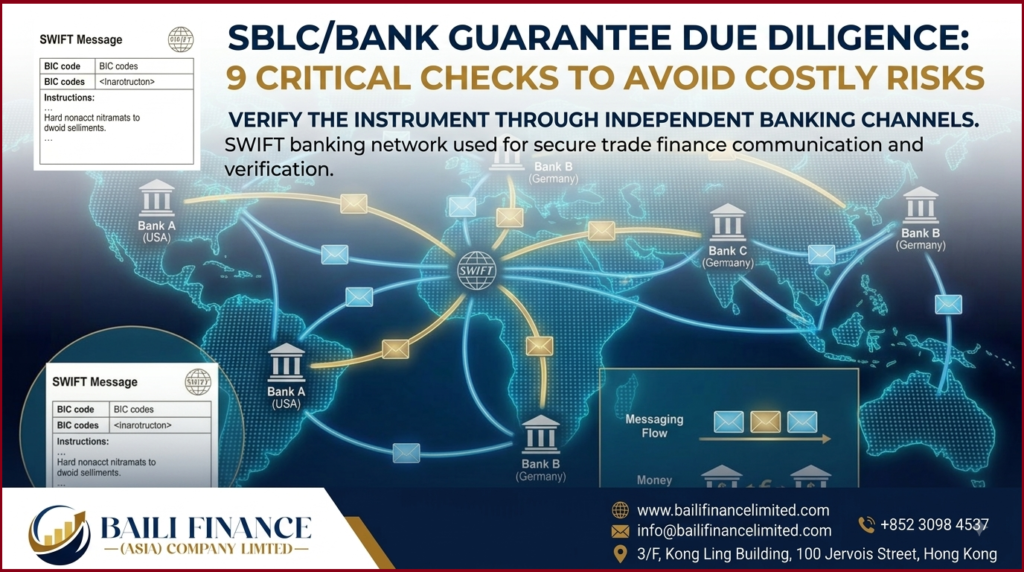
One of the most important principles in SBLC verification is independent authentication.
A document sent by an intermediary isn’t equivalent to confirmation from the issuing institution.
Where appropriate, the beneficiary or its authorised advisers should establish whether the issuing bank recognises the instrument and whether the communication has travelled through an accepted banking channel.
Depending on the transaction, this may involve reviewing relevant SWIFT communications, bank-to-bank confirmations, authenticated messages, or other procedures accepted by the institutions involved.
The exact verification process depends on the instrument, banks, jurisdiction, and transaction structure.
A critical warning sign appears when an intermediary insists that verification must occur through a private email address, personal mobile number, messaging application, or unofficial contact.
Banking verification should remain controlled and independently sourced.
3. CHECK THE SBLC OR BANK GUARANTEE TERMS
Authenticity alone doesn’t make an instrument commercially acceptable.
The document should be reviewed carefully for:
- Instrument type
- Reference number
- Issuer
- Applicant
- Beneficiary
- Amount
- Currency
- Issue date
- Effective date
- Expiry date
- Place of presentation
- Presentation requirements
- Payment conditions
- Governing law
- Applicable rules
- Transfer provisions
- Assignment provisions
- Confirmation provisions
- Amendment provisions
- Cancellation provisions
- Reinstatement provisions
- Evergreen clauses
- Partial drawing provisions
- Demand requirements
The wording should correspond with the commercial agreement.
A beneficiary should understand exactly what must be presented to make a compliant demand.
This point is frequently underestimated.
An SBLC may be financially substantial while still failing to provide the expected protection if the drawing conditions don’t match the beneficiary’s rights or operational requirements.
ISP98, UCP 600 AND URDG 758: WHY THE RULES MATTER
The applicable rule set deserves specific attention.
ISP98 was developed specifically for standby letters of credit. ICC materials describe it as a detailed framework for practitioners dealing with standby instruments.
UCP 600, meanwhile, is primarily associated with documentary credits, although it can apply to standby credits to the extent applicable when incorporated.
URDG 758 provides rules for demand guarantees.
These frameworks aren’t interchangeable.
When reviewing an instrument, establish:
- What type of instrument is it?
- Which rules govern it?
- Has the applicable rule set been expressly incorporated?
- What law governs the undertaking?
- Which courts or dispute-resolution mechanisms have jurisdiction?
- Where must a demand be presented?
- What documents must accompany the demand?
- What deadlines apply?
- What happens after a demand?
- Are amendments permitted and under what conditions?
This legal-operational review can materially change the risk profile of a transaction.
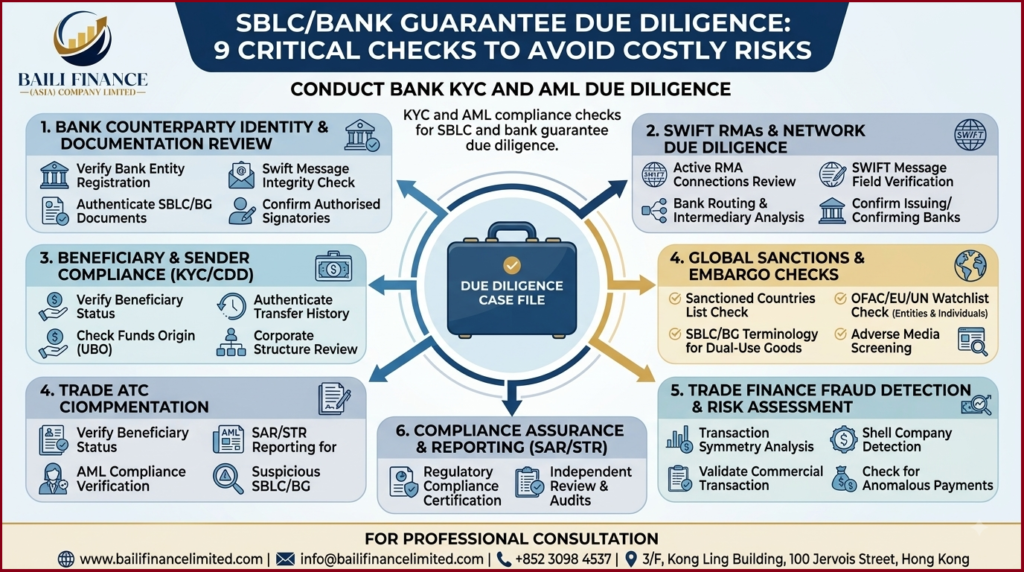
4. CONDUCT BANK KYC AND AML DUE DILIGENCE
A credible SBLC transaction should have a credible commercial purpose.
Due diligence should therefore examine the parties involved and the transaction itself.
Relevant areas include:
- Know Your Customer information
- Ultimate beneficial ownership
- Corporate registration
- Source of funds
- Source of wealth where relevant
- Business activity
- Transaction purpose
- Jurisdictional risk
- Sanctions screening
- Politically exposed person screening where applicable
- Adverse media
- Anti-bribery and corruption considerations
- Ownership relationships
- Related-party transactions
The Basel Committee’s guidance on correspondent banking stresses that cross-border relationships can require additional customer due diligence and that due diligence should follow a risk-based approach.
The same principle is highly relevant when assessing parties participating in complex international financial transactions.
Due diligence shouldn’t become a box-ticking exercise.
The objective is to understand who is involved, what they’re doing, why they’re doing it, and whether the transaction makes commercial and regulatory sense.
5. VERIFY THE APPLICANT AND UNDERLYING TRANSACTION
The applicant matters as much as the issuing bank.
Ask:
- Who requested the instrument?
- What business does the applicant conduct?
- Why does the applicant need the SBLC or guarantee?
- Who is the beneficiary?
- What contract supports the instrument?
- What goods, services, assets, or obligations are involved?
- Does the transaction have a realistic commercial purpose?
- Are the transaction values reasonable?
- Do the parties have an established relationship?
- Are the contractual documents consistent?
A transaction with a credible bank but an unexplained commercial purpose deserves further scrutiny.
The underlying contract should also be reviewed for consistency.
For example, if a contract requires a USD 10 million performance guarantee but the proposed instrument states USD 50 million, the discrepancy needs an explanation before the instrument is accepted.
6. ANALYSE THE ISSUER’S CREDIT AND COUNTRY RISK
A bank guarantee is only as useful as the legal and financial framework supporting it.
Issuer assessment should consider:
- Creditworthiness
- Capital position
- Regulatory environment
- Sovereign risk
- Country risk
- Currency risk
- Banking-system stability
- Transfer restrictions
- Convertibility considerations
- Correspondent banking access
- Regulatory restrictions
Credit ratings can be useful, but they shouldn’t replace independent due diligence.
A rating isn’t a guarantee of payment.
Likewise, the absence of a major international rating doesn’t automatically mean that a bank is unsuitable.
The appropriate question is whether the issuing institution satisfies the specific risk requirements of the transaction.
7. IDENTIFY FRAUD AND DOCUMENT RED FLAGS
Fraudsters frequently rely on urgency.
They may claim that an SBLC is available immediately, that verification must occur within hours, or that an upfront payment is required to “activate” a bank instrument.
That pressure should trigger additional scrutiny.
Potential warning signs include:
- Unsolicited SBLC offers
- Guaranteed returns
- Unusually high monetisation promises
- Upfront fees without a transparent contractual basis
- Personal bank accounts
- Unofficial email domains
- Fake bank certificates
- Altered SWIFT screenshots
- Unverifiable bank officers
- Inconsistent bank addresses
- Incorrect banking terminology
- Pressure to avoid direct bank contact
- Requests for cryptocurrency payments
- Requests for cash payments
- Complex chains of unexplained intermediaries
- Confidentiality demands designed to prevent verification
- Claims that “no bank verification is required”
- Unrealistic transaction timelines
A genuine transaction can be complex. It shouldn’t require the parties to abandon normal controls.
8. REVIEW THE INTERMEDIARIES
Many SBLC transactions involve brokers, consultants, arrangers, introducers, advisers, or other intermediaries.
Their role should be documented.
Verify:
- Corporate identity
- Ownership
- Authority to act
- Contractual mandate
- Relationship with the bank
- Compensation structure
- Beneficial ownership
- Regulatory status where applicable
- Track record
- Litigation and adverse media
- Conflict-of-interest issues
The central question is:
What exactly is this intermediary authorised to do?
An intermediary shouldn’t be represented as a bank merely because it claims to have banking relationships.
Similarly, an intermediary shouldn’t be treated as the issuing bank unless it actually holds the relevant authority.
9. OBTAIN LEGAL AND TRANSACTION-SPECIFIC REVIEW
Large-value SBLC and bank guarantee transactions shouldn’t rely on generic document reviews.
A qualified legal adviser should assess the instrument against:
- Applicable law
- Contractual obligations
- Jurisdiction
- Demand mechanics
- Enforcement provisions
- Security arrangements
- Assignment
- Transferability
- Insolvency considerations
- Regulatory requirements
- Tax considerations
- Dispute-resolution provisions
Where the instrument crosses jurisdictions, local legal requirements may become important.
A document that appears straightforward under one legal system may produce different consequences under another.
THE SBLC/BANK GUARANTEE DUE DILIGENCE PROCESS
A professional review can be organised into five stages.
Stage 1: DOCUMENT COLLECTION
Collect the complete transaction file.
This may include:
- Corporate documents
- Identification documents
- Underlying contract
- Draft SBLC or guarantee
- Bank details
- Mandates
- Board resolutions
- Regulatory information
- Financial statements
- Transaction correspondence
- Intermediary agreements
Incomplete documentation should be treated as an information gap, not automatically as proof of fraud.
Stage 2: INDEPENDENT VERIFICATION
Verify information through authoritative sources.
Don’t rely exclusively on documents supplied by the counterparty.
Cross-check:
- Bank identity
- Regulatory status
- Corporate registration
- Ownership
- Contact information
- SWIFT/BIC information
- Sanctions status
- Transaction parties
Stage 3: INSTRUMENT REVIEW
Analyse the proposed instrument against the underlying transaction.
The amount, parties, dates, rules, presentation conditions, and payment provisions should align.
Stage 4: RISK CLASSIFICATION
Classify identified issues according to severity.
A useful framework is:
Low risk: Minor documentation gaps that can be resolved.
Medium risk: Issues requiring clarification, additional documentation, or enhanced verification.
High risk: Material inconsistencies, unverifiable claims, sanctions concerns, suspicious payment arrangements, or significant legal uncertainty.
Stage 5: DECISION
The final decision should be evidence-based.
Possible outcomes include:
- Proceed
- Proceed after conditions are satisfied
- Request enhanced due diligence
- Renegotiate transaction terms
- Obtain additional legal advice
- Reject the transaction
The goal isn’t to approve every transaction.
The goal is to make an informed decision.
REAL-WORLD EXAMPLE: VERIFYING A PROPOSED USD 25 MILLION SBLC
Consider a company that receives a proposal for a USD 25 million SBLC from an overseas bank.
The intermediary supplies:
- A scanned SBLC
- A bank officer’s name
- A SWIFT screenshot
- A corporate registration document
- A request for a processing fee
- A promise that the instrument can be monetised immediately
At first glance, the transaction appears complete.
However, due diligence identifies several questions.
The issuing bank’s official regulatory information doesn’t match the address shown on the document.
The supposed bank officer uses an email domain unrelated to the bank.
The SWIFT screenshot contains no independently verified banking communication.
The underlying contract doesn’t explain why a USD 25 million undertaking is required.
The intermediary refuses to permit direct confirmation through independently sourced bank contact information.
Finally, the requested fee must be paid to an unrelated third-party company.
None of these findings, considered in isolation, necessarily proves fraud.
Together, however, they create a material risk profile.
The correct response isn’t to pay the fee and hope the transaction works.
The correct response is to stop the process, document the discrepancies, obtain independent verification, and require satisfactory explanations before proceeding.
That is the practical value of SBLC due diligence.
CASE STUDY: WHEN A GENUINE BANK DOESN’T MEAN A SUITABLE INSTRUMENT
Consider a construction company entering a large infrastructure contract.
The beneficiary requires a performance guarantee from an established bank.
The applicant provides an instrument issued by a legitimate financial institution.
The beneficiary initially considers the matter resolved.
A detailed review, however, identifies three problems.
First, the guarantee expires several months before the contractual performance period ends.
Second, the claim mechanism requires presentation at a location that creates operational difficulties for the beneficiary.
Third, the instrument uses conditions that don’t align with the underlying contract.
The bank itself is legitimate.
The instrument is not necessarily fraudulent.
Yet the beneficiary could still face significant risk.
After legal and banking review, the parties amend the guarantee so that its expiry, presentation requirements, and contractual coverage align with the underlying obligation.
The lesson is important:
Due diligence doesn’t only detect fraud. It also identifies legitimate instruments that don’t adequately protect the beneficiary.
That distinction separates document checking from professional transaction due diligence.
SBLC MONETISATION DUE DILIGENCE
The term SBLC monetisation appears frequently in international finance.
It also requires careful scrutiny.
Anyone considering monetisation should establish:
- Who is providing the financing?
- What is the financing structure?
- What collateral is actually being used?
- Is the SBLC transferable or assignable?
- What does the instrument permit?
- Which bank receives or confirms it?
- What are the financing costs?
- Who controls the funds?
- What happens if the transaction fails?
- Are fees refundable?
- Which jurisdiction governs the agreements?
- Are there regulatory restrictions?
Claims that a bank instrument can automatically generate large returns should receive particular scrutiny.
An SBLC isn’t a guaranteed investment product.
Its economic value depends on the actual legal undertaking, issuer, transaction structure, rights of the parties, and financing arrangement.
BANK GUARANTEE DUE DILIGENCE CHECKLIST
Before accepting or relying on a bank guarantee, confirm:
- Issuing bank independently verified
- Bank regulatory status checked
- Bank identity confirmed
- SWIFT/BIC information reviewed where relevant
- Applicant independently verified
- Beneficiary details confirmed
- Ultimate beneficial owners identified
- Sanctions screening completed
- AML/KYC requirements addressed
- Underlying contract reviewed
- Commercial purpose established
- Instrument amount verified
- Currency verified
- Issue date verified
- Expiry date verified
- Claim conditions reviewed
- Presentation requirements reviewed
- Governing law identified
- Applicable rules identified
- Transfer and assignment provisions reviewed
- Intermediaries verified
- Fees documented
- Bank communication independently authenticated
- Legal review completed where appropriate
- Final risk assessment documented
COMMON SBLC DUE DILIGENCE MISTAKES
Mistake 1: Trusting the document
A professional review doesn’t treat a PDF as proof of authenticity.
Mistake 2: Trusting the intermediary
An intermediary’s confidence isn’t bank confirmation.
Mistake 3: Ignoring the underlying contract
The instrument must make commercial sense in the context of the transaction.
Mistake 4: Focusing only on the bank
Issuer quality matters, but so do the applicant, beneficiary, transaction, instrument wording, and jurisdiction.
Mistake 5: Treating SWIFT screenshots as confirmation
A screenshot isn’t the same as independently authenticated bank-to-bank communication.
Mistake 6: Ignoring legal wording
A few words in a guarantee can affect how and when a beneficiary can make a claim.
Mistake 7: Paying unexplained upfront fees
Every fee should have a documented purpose, recipient, contractual basis, and commercial justification.
HOW PROFESSIONAL DUE DILIGENCE CREATES VALUE
Good due diligence doesn’t simply reduce risk.
It improves decision quality.
For banks, investors, corporations, contractors, exporters, importers, financial advisers, and beneficiaries, a structured review can:
- Reduce transaction uncertainty
- Identify weaknesses before execution
- Improve contract negotiations
- Support compliance decisions
- Strengthen counterparty assessment
- Reduce fraud exposure
- Improve documentation
- Clarify responsibilities
- Protect commercial relationships
- Create an auditable decision trail
The strongest due diligence process is therefore independent, evidence-based, proportionate to the transaction, and documented.
FAQ: SBLC/BANK GUARANTEE DUE DILIGENCE
What is SBLC due diligence?
SBLC due diligence is the independent assessment of a standby letter of credit, its issuing bank, applicant, beneficiary, transaction purpose, legal framework, communication channels, and relevant risks before the instrument is relied upon.
How can I verify whether an SBLC is genuine?
Verification should use independent banking and regulatory channels. Review the issuing bank through authoritative sources and, where appropriate, obtain authenticated confirmation through accepted bank-to-bank communication channels. A document, email, screenshot, or intermediary statement shouldn’t be treated as sufficient evidence on its own.
What is the difference between an SBLC and a bank guarantee?
An SBLC and a bank guarantee can both provide financial assurance, but they operate under different legal and market frameworks depending on their structure and governing rules. SBLCs commonly use ISP98 or, where applicable, UCP 600. Demand guarantees are commonly governed by URDG 758 when incorporated. The exact instrument wording and applicable law remain critical.
Is a bank guarantee automatically safe because a real bank issued it?
No. A legitimate issuing bank doesn’t automatically make every instrument commercially suitable. The beneficiary must still review the instrument amount, expiry, claim requirements, governing law, presentation mechanics, applicable rules, and relationship to the underlying contract.
What are the biggest red flags in an SBLC transaction?
Common warning signs include unverifiable bank officers, unofficial communication channels, altered documents, pressure to pay quickly, unexplained upfront fees, unrealistic monetisation claims, inconsistent transaction documents, unusual payment instructions, and resistance to independent bank verification.
Does SWIFT prove that an SBLC is genuine?
Not by itself. A supposed SWIFT message or screenshot requires appropriate authentication and independent verification. The verification process should be handled through legitimate banking channels and relevant institutions.
Can an SBLC be monetised?
An SBLC may be used within certain financing structures, but monetisation isn’t automatic and shouldn’t be presented as a guaranteed investment return. The transaction must be assessed based on the instrument’s terms, bank requirements, financing structure, legal rights, costs, and regulatory considerations.
Should I use a lawyer for SBLC due diligence?
For material transactions, legal review can be appropriate, particularly where the instrument crosses jurisdictions or contains complex claim, assignment, transfer, governing-law, or enforcement provisions. Legal review should complement, not replace, banking and compliance verification.
How long does SBLC due diligence take?
There is no universal timeframe. A straightforward review with complete documentation can be faster than a complex cross-border transaction involving multiple institutions, jurisdictions, intermediaries, or enhanced compliance requirements. Speed shouldn’t take priority over verification.
THE BOTTOM LINE: VERIFY BEFORE YOU RELY
SBLC/Bank Guarantee due diligence isn’t an administrative formality. It’s a transaction-control function.
A professional review should establish five things:
Who issued it?
Who stands behind it?
What exactly does it promise?
Under what rules and law does it operate?
Can the parties realistically rely on it when required?
Those questions should be answered before funds are transferred, contracts are signed, financing is arranged, or commercial decisions depend on the instrument.
The most important principle is simple: verify independently before you rely financially.
For businesses evaluating an SBLC, bank guarantee, demand guarantee, performance guarantee, or related trade finance structure, the right due diligence can identify problems while they remain manageable.
At Baili Finance Limited, businesses seeking to evaluate a financial instrument should approach the process with documentation, verification, compliance awareness, and transaction-specific analysis rather than assumptions.
Don’t let a professional-looking instrument become an expensive unresolved risk.
If you’re reviewing an SBLC or bank guarantee, prepare the complete transaction documents and seek appropriate professional review before committing funds or relying on the instrument.
Contact Baili Finance Limited to discuss your SBLC or bank guarantee due diligence requirements and determine what verification should be completed before your transaction moves forward.
Intermediaries/Consultants/Brokers are welcome to bring their clients 100% protected. Our brokers receive 2% commission for referral. We assist Clients and brokers in their attempt to secure funding by working on their funding requests that may require innovative financing. In complete confidence, we will work together for the benefits of all parties involved.
#SBLC #BankGuarantee #DueDiligence #TradeFinance #StandbyLetterOfCredit #BankGuaranteeVerification #FinancialDueDiligence #TradeFinanceRisk #SBLCVerification #Compliance #KYC #AML