
Headline: 7 KEY STEPS TO SECURE PROJECT FUNDING WITH SBLC
Project funding with SBLC can provide a structured way to strengthen a financing proposal when a project sponsor needs additional bank-backed security. A Standby Letter of Credit (SBLC) can support a lender’s credit assessment, reinforce payment obligations, and, in suitable transactions, contribute to a broader project finance structure.
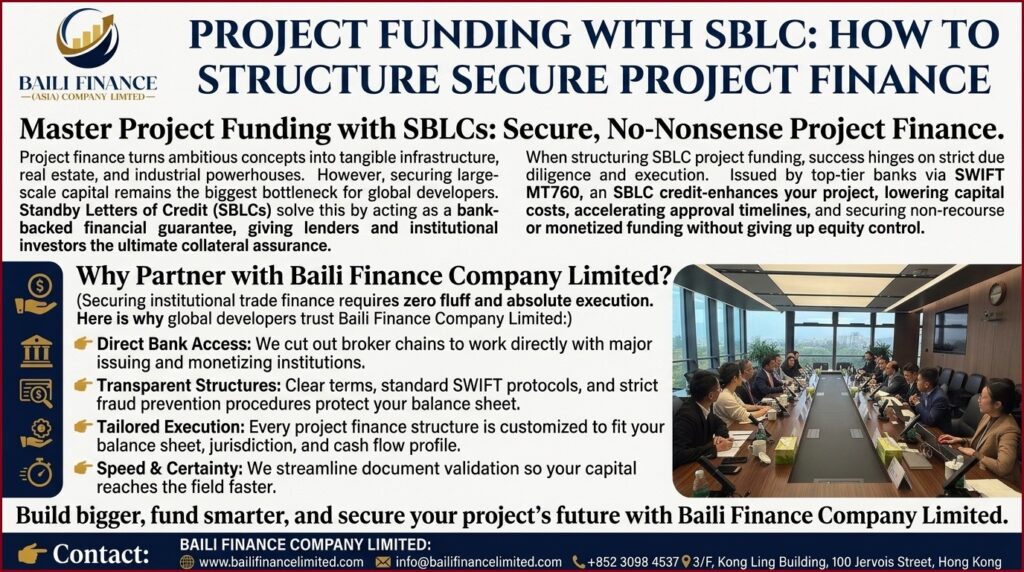
However, an SBLC isn’t a project loan, cash deposit, or automatic source of investment capital. Its value comes from the credit standing of the issuing institution, the wording of the instrument, the underlying transaction, and the financing structure surrounding it.
For project owners, developers, investors, contractors, and institutional counterparties, understanding these distinctions matters. When structured correctly, SBLC project funding can form part of a financing strategy for infrastructure, energy, construction, real estate, manufacturing, logistics, technology, and other commercially viable projects.
This guide explains how project funding with SBLC works, what lenders examine, how SBLC-backed financing structures operate, the risks to consider, and how project sponsors can prepare a credible funding request.
Keywords: Project funding with SBLC, SBLC-backed project funding, standby letter of credit financing, project finance with SBLC, SBLC funding, project funding, structured finance, credit enhancement
What Is Project Funding With SBLC?
Project funding with SBLC refers to a financing structure in which a Standby Letter of Credit supports a financial obligation, credit facility, performance requirement, or other contractual arrangement connected with a project.
An SBLC represents an independent undertaking by an issuing institution to honor a complying demand according to the terms of the instrument. The International Chamber of Commerce explains that SBLCs can provide an independent assurance of payment and can function as a credit enhancement when the issuer has stronger credit standing than the applicant.
In practical terms, the SBLC can improve the perceived security of a transaction.
The project itself still needs a viable business model.
The lender still needs to assess the sponsor.
The issuing bank still needs to approve the SBLC.
And the transaction still needs appropriate legal, regulatory, commercial, and financial due diligence.
Therefore, SBLC financing for projects shouldn’t be presented as a mechanism that turns an otherwise unfunded or commercially weak proposal into an automatically financeable project.
The basic concept
A simplified structure can look like this:
Project Sponsor → Issuing Bank → SBLC → Lender/Beneficiary → Project Funding
The exact structure varies according to the transaction.
For example, a project sponsor may arrange an SBLC from an acceptable bank in favor of a financing institution. The lender may then consider the SBLC as part of its overall credit support package.
The lender can still require:
- A detailed business plan
- Project feasibility studies
- Financial projections
- Sponsor equity
- Corporate documentation
- Collateral
- Insurance
- Construction contracts
- Offtake agreements
- Government approvals
- Environmental assessments
- Independent technical reports
- Legal opinions
- Know-your-customer documentation
- Source-of-funds evidence
The SBLC supports the structure. It doesn’t eliminate the need for underwriting.
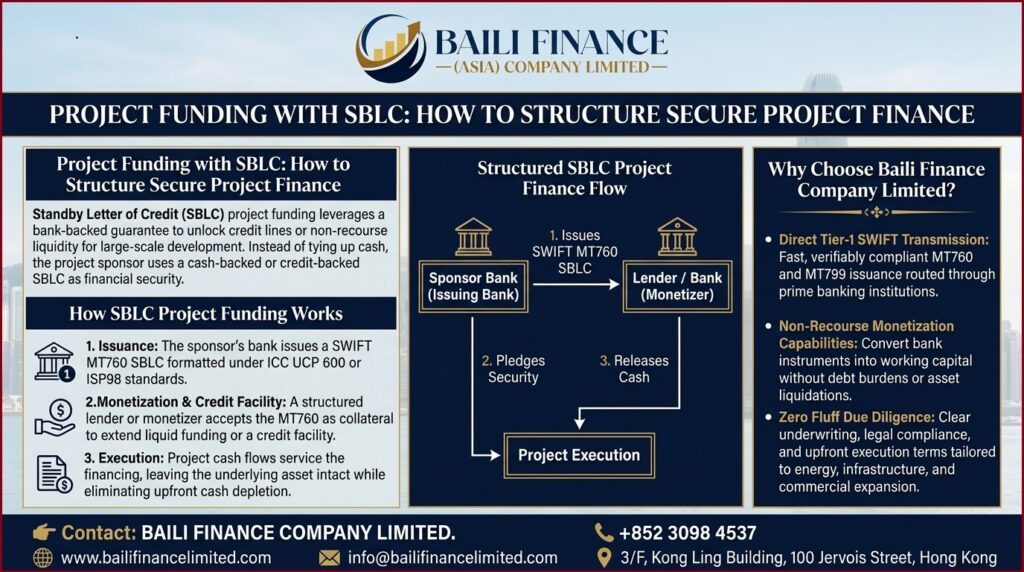
7 KEY STEPS TO SECURE PROJECT FUNDING WITH SBLC
Securing project funding with SBLC requires more than obtaining a standby letter of credit and presenting its face value to a lender. A credible transaction starts with a viable project, clear financing requirements, acceptable banking support, proper documentation, and thorough due diligence. An SBLC can provide credit enhancement or payment assurance, but it doesn’t automatically create project capital or guarantee financing approval.
Here are the 7 key steps to secure project funding with SBLC.
1. Define the Project and Funding Requirement
Before arranging an SBLC, establish exactly what the project needs.
Prepare a clear financing profile covering:
- Total project cost
- Amount of funding required
- Sponsor equity contribution
- Construction or development stage
- Intended use of funds
- Expected revenue
- Operating costs
- Repayment source
- Project timeline
- Available collateral or other security
- Existing contracts and commitments
A lender needs to understand the project independently of the SBLC. The financing case should demonstrate how the project will generate sufficient cash flow or otherwise support repayment.
In other words, build the project finance case first and position the SBLC within that structure second.
2. Prepare a Lender-Ready Project Package
A professional financing request should give the lender enough information to assess the opportunity without repeatedly requesting basic documentation.
Your project package should typically include:
- Executive summary
- Detailed business plan
- Feasibility study
- Financial model
- Sources and uses of funds
- Project budget
- Construction schedule
- Market analysis
- Management information
- Corporate documents
- Ownership structure
- Relevant licenses and permits
- Project contracts
- Offtake agreements, where applicable
- Technical reports
- Risk assessment
- Proposed financing structure
Financial projections should clearly show expected revenue, operating expenditure, capital expenditure, cash flow, and the proposed repayment mechanism.
Where the SBLC forms part of the security package, provide its proposed amount, issuing institution, tenor, beneficiary, and relevant terms.
3. Identify an Acceptable SBLC Issuing Bank
Not every SBLC will satisfy every lender.
The issuing bank is therefore one of the most important elements of the transaction. A financing institution may assess the bank’s jurisdiction, regulatory standing, credit quality, banking relationships, authentication procedures, and ability to issue an instrument that meets the lender’s requirements.
The ICC explains that an SBLC can function as a credit-enhancement tool when the issuer provides stronger credit standing to the transaction.
Before arranging issuance, confirm:
- Who will receive the SBLC?
- Will that institution accept the proposed issuing bank?
- What amount is required?
- What tenor is required?
- Which rules will govern the instrument?
- What presentation requirements apply?
- Is confirmation required?
- How will the instrument be authenticated?
Don’t issue an SBLC first and ask whether the lender accepts it afterward.
That sequence can create unnecessary cost and delay.
4. Structure the SBLC Correctly
The wording of the SBLC matters.
A standby letter of credit should clearly identify the applicant, issuer, beneficiary, amount, currency, expiry date, applicable rules, governing law, and requirements for making a complying presentation.
ISP98 is specifically designed for standby letters of credit and addresses matters including presentation, examination, notice, transfer, reimbursement, and timing.
The ICC also emphasizes that beneficiaries should review the wording carefully, including whether the expiry period is adequate and whether they can obtain the documents required to make a valid demand.
Accordingly, the project sponsor should have qualified banking and legal professionals review the proposed instrument before issuance.
The objective isn’t simply to obtain an SBLC with a large face value.
The objective is to obtain an acceptable, verifiable and appropriately structured financial instrument that fits the financing transaction.
5. Complete Banking, Legal and Compliance Due Diligence
Once the project and SBLC structure are defined, the parties should complete appropriate due diligence.
The lender may verify:
- Project ownership
- Beneficial ownership
- Source of funds
- Sponsor financial position
- Issuing bank
- Bank authorization
- Instrument authenticity
- Project contracts
- Corporate records
- Regulatory approvals
- Sanctions exposure
- Anti-money-laundering requirements
- Legal enforceability
- Commercial counterparties
The SBLC itself must also be authenticated through appropriate banking channels.
A PDF, screenshot, email attachment, or scanned document shouldn’t be treated as equivalent to authenticated bank-to-bank communication.
This stage protects both the project sponsor and the financing institution.
It also helps distinguish a legitimate SBLC-backed project financing transaction from arrangements built around unverifiable financial instruments or unrealistic funding claims.

6. Obtain Financing Approval and Complete the Transaction
After due diligence, the lender can determine whether the overall transaction meets its underwriting requirements.
The lender may consider the:
Project + Sponsor + Cash Flow + SBLC + Security + Legal Structure + Risk Profile
If the transaction receives approval, the parties can proceed toward definitive agreements and financial close.
Depending on the project, the final structure may include:
- Senior project debt
- Construction finance
- Working capital
- Bridge financing
- Equipment finance
- Trade finance
- Sponsor equity
- SBLC credit support
- Other guarantees or security
An SBLC may therefore form one component of a wider capital structure rather than acting as the entire source of funding.
That distinction should remain clear in all investor and lender communications.
7. Monitor the Project and Manage the SBLC Throughout Its Life
Obtaining funding isn’t the end of the process.
The project sponsor must continue meeting the obligations contained in the financing agreements and the underlying project contracts.
Monitor:
- SBLC expiry date
- Renewal requirements
- Financing covenants
- Project milestones
- Construction progress
- Financial performance
- Insurance
- Contractual obligations
- Reporting requirements
- Compliance requirements
- Repayment obligations
An SBLC has specific presentation and expiry requirements. If a beneficiary expects to rely on the instrument, it needs to understand those requirements before a potential draw occurs.
The Bottom Line
The seven steps can be summarized simply:
1. Define the project.
2. Prepare the financing package.
3. Identify an acceptable issuing bank.
4. Structure the SBLC correctly.
5. Complete due diligence.
6. Obtain financing approval and close.
7. Monitor the project and SBLC.
The strongest SBLC project funding transactions don’t begin with the question, “How much money can this SBLC generate?”
They begin with a more important question:
“Does this project have the commercial, financial and legal fundamentals required for institutional financing?”
Once that foundation exists, an appropriately structured SBLC may provide useful credit support within the broader financing strategy.
Why Use an SBLC in Project Finance?
An SBLC can provide additional credit support in transactions where counterparties need assurance regarding a financial obligation.
The World Bank notes that bank guarantees and letters of credit can form an important part of project financing structures, giving counterparties access to payment support without necessarily requiring the same amount of cash to remain locked up.
Several potential benefits explain why project sponsors consider this structure.
Credit enhancement
An SBLC issued by a reputable institution can strengthen a financing proposal when the beneficiary accepts the issuing bank and the instrument meets its requirements.
Payment security
The beneficiary receives a defined contractual undertaking from the issuing institution.
Transaction support
An SBLC may support contractual payment obligations, financing arrangements, or other commitments associated with a project.
International transactions
SBLCs can facilitate cross-border commercial relationships where counterparties operate in different jurisdictions.
Liquidity support
Certain project structures can use letters of credit to provide short-term liquidity. World Bank project-based guarantee materials describe structures where a guarantee can backstop a commercial bank letter of credit used to provide liquidity to a project.
SBLC vs Project Loan: What’s the Difference?
The two instruments serve different functions.
| Feature | SBLC | Project Loan |
|---|---|---|
| Primary function | Credit support or payment undertaking | Direct financing |
| Issuer/lender | Usually a bank or eligible financial institution | Bank, fund, institution, or lender |
| Provides cash immediately? | Not necessarily | Generally yes, subject to conditions |
| Main purpose | Supports an obligation | Funds project expenditure |
| Drawdown | Occurs according to instrument terms | Occurs according to loan agreement |
| Repayment | Depends on underlying arrangements and any draw | Borrower repays principal and interest |
| Credit assessment | Focuses on applicant and instrument | Focuses on borrower, project and repayment |
| Documentation | SBLC and related agreements | Loan and security documentation |
This distinction should remain clear in every project funding proposal.
An SBLC isn’t equivalent to having cash available in a bank account.
SBLC Monetization and Project Funding
The term SBLC monetization appears frequently in international finance discussions. It generally refers to arrangements where an SBLC or similar financial undertaking is presented as part of a structure intended to obtain financing or liquidity.
However, sponsors should exercise significant caution.
Not every institution that claims to monetize an SBLC operates as a regulated lender.
Not every SBLC qualifies for financing.
Not every issuer meets a lender’s requirements.
And not every advertised monetization program represents a genuine institutional financing transaction.
A lender may reject an SBLC because the issuer, jurisdiction, wording, beneficiary, governing rules, tenor, or transaction structure doesn’t meet its criteria.
Consequently, project sponsors should obtain independent legal and financial advice before committing fees or transferring funds.
What Makes an SBLC Suitable for Project Funding?
A financing institution normally wants to know whether the SBLC represents credible and enforceable credit support.
Several factors matter.
Issuing bank
The issuing institution should meet the beneficiary’s acceptance criteria.
Bank reputation alone isn’t sufficient. The lender may conduct independent verification through appropriate banking channels.
Amount
The SBLC amount should correspond logically with the financing requirement and transaction structure.
A USD 50 million SBLC doesn’t automatically justify a USD 50 million project loan.
Tenor
The instrument should provide an appropriate period of coverage.
The required tenor depends on the financing structure and the lender’s requirements.
Governing rules
The instrument should clearly identify the applicable rules.
ISP98 provides a dedicated framework for standby letters of credit, while UCP 600 also contains provisions applicable to standby credits when incorporated.
Demand conditions
The beneficiary should understand precisely what documents must be presented if it needs to draw under the SBLC.
Unclear drafting can create avoidable disputes.
Authentication
The receiving institution must be able to verify the instrument through acceptable banking channels.
A PDF or scanned document isn’t equivalent to authenticated bank-to-bank communication.
The Role of ISP98 in SBLC Transactions
International Standby Practices (ISP98) provides detailed rules specifically designed for standby letters of credit.
The ICC describes ISP98 as a framework reflecting established standby practices and covering areas including obligations, presentation, examination, notice, transfer, cancellation, reimbursement, timing, and syndication or participation.
This matters because an SBLC operates differently from a conventional documentary letter of credit.
Under a documentary credit, the beneficiary normally expects the credit to support an actual commercial transaction.
A standby, by contrast, generally functions as a secondary payment undertaking. The beneficiary expects not to draw unless the underlying obligation isn’t fulfilled.
The ICC has also highlighted differences between UCP 600 and ISP98 regarding presentation, examination, renewal, demand requirements, and other operational matters.
For a project funding transaction, the applicable rules should therefore be reviewed by qualified professionals before the instrument gets issued.
What Projects Can Use SBLC-Based Funding?
The suitability depends on the project, financing structure, jurisdiction, lender, and issuing bank.
Potential applications can include:
Infrastructure projects
Roads, ports, utilities, telecommunications, water systems, and public-private partnership projects may require substantial credit support.
Energy projects
Renewable energy, power generation, energy storage, oil and gas infrastructure, and related projects can involve multiple contractual payment obligations.
Real estate development
Commercial and residential developments may use credit support within broader construction or acquisition financing structures.
Manufacturing
Equipment acquisition, production facilities, expansion projects, and supply-chain arrangements may require structured financing.
Export and trade-related projects
International projects can use standby instruments to support payment obligations between counterparties.
Technology infrastructure
Large technology deployments, data infrastructure, telecommunications, and industrial technology projects may require substantial capital and contractual security.
The key question isn’t whether a project belongs to a particular sector.
The key question is whether the project can support a credible financing structure.
Real-World Example: SBLC Supporting Project Liquidity
Consider a hypothetical infrastructure project requiring USD 40 million.
The sponsor contributes USD 10 million in equity and seeks USD 30 million in external financing.
The project has signed contracts with customers that are expected to generate recurring revenue after completion. However, the financing institution wants additional payment security during the early operating period.
The sponsor arranges an acceptable SBLC in favor of the relevant financing institution.
The lender then evaluates:
- The project contracts.
- The sponsor’s equity contribution.
- Expected project cash flow.
- Construction risk.
- Customer creditworthiness.
- The issuing bank.
- The SBLC wording.
- Legal enforceability.
- Repayment capacity.
- The overall security package.
If the lender approves the structure, the SBLC can form part of the credit support package.
Notice what’s missing from this example.
The SBLC doesn’t automatically create USD 30 million.
The lender still makes an independent credit decision.
That’s the practical distinction between using an SBLC in project funding and claiming that an SBLC itself constitutes project capital.
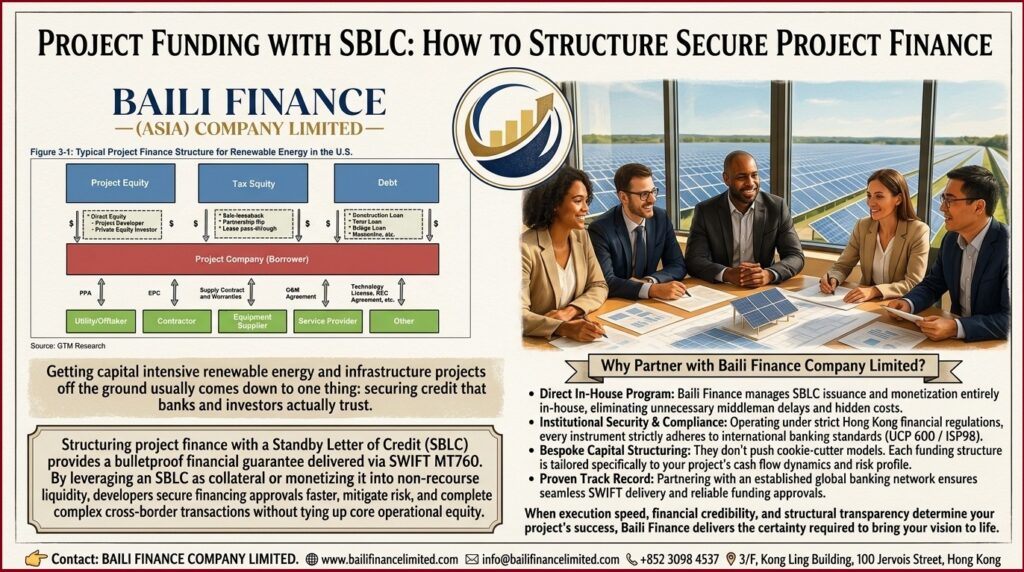
Case Study: Structured Funding for an Energy Project
Project background
A renewable energy developer plans to construct a medium-scale solar facility.
The project requires approximately USD 25 million for land preparation, engineering, equipment, construction, grid connection, and working capital.
The sponsor has completed feasibility work and secured preliminary commercial arrangements with an energy purchaser.
However, the financing institution identifies a payment-security gap during the early stages of the project.
Proposed structure
The sponsor seeks an SBLC from a bank acceptable to the financing institution.
The proposed structure includes:
- Sponsor equity
- Senior project debt
- SBLC credit support
- Construction contracts
- Insurance
- Offtake arrangements
- Project company documentation
- Financial model
- Independent technical assessment
The lender reviews the complete structure rather than evaluating the SBLC in isolation.
Due diligence
The lender verifies the issuing bank and reviews the SBLC terms.
The legal team reviews enforceability.
The technical adviser reviews the project’s construction assumptions.
The financial adviser tests projected cash flow.
The credit team evaluates debt service capacity.
Outcome
Assuming all conditions are satisfied, the lender may approve a financing facility in which the SBLC contributes to the overall credit support package.
The project then reaches financial close after the parties satisfy the required conditions precedent.
Lesson
The central lesson is straightforward:
An SBLC can strengthen a financeable project, but it doesn’t replace project viability.
That principle protects both sponsors and financing institutions from unrealistic expectations.
Common Mistakes in SBLC Project Funding
Project sponsors often make avoidable errors.
Treating the SBLC as cash
An SBLC represents an undertaking. It isn’t automatically cash or a deposit.
Focusing only on the face value
The amount matters, but so do issuer quality, wording, rules, expiry, beneficiary requirements, and enforceability.
Using an unverified intermediary
Sponsors should verify every intermediary and financial institution involved in the transaction.
Paying large upfront fees without adequate verification
A credible transaction requires documentation and due diligence before significant commitments.
Ignoring the project economics
A lender won’t necessarily finance a weak project simply because an SBLC exists.
Using generic templates
SBLC wording should reflect the specific transaction.
Failing to understand draw conditions
A beneficiary needs to know what constitutes a complying presentation.
Assuming every lender accepts every bank
Financial institutions maintain their own eligibility standards.
How to Prepare for SBLC-Based Project Financing
Preparation improves the quality of the financing conversation.
Start with a complete project information memorandum.
Include:
- Executive summary
- Project description
- Ownership structure
- Management profile
- Market analysis
- Technical feasibility
- Project timeline
- Capital expenditure
- Operating expenditure
- Revenue projections
- Financial model
- Funding requirement
- Sponsor equity
- Proposed security
- SBLC details
- Risk analysis
- Repayment strategy
Next, organize the legal documents.
These may include corporate registration documents, ownership records, contracts, permits, licenses, land documentation, intellectual property documents, and existing financing agreements.
Finally, prepare a clear explanation of how the SBLC fits into the transaction.
The lender should never have to guess why the instrument exists.
How to Evaluate an SBLC Provider
Before entering an arrangement, ask specific questions.
Who issues the SBLC?
Identify the issuing bank and verify its regulatory status through independent sources.
Will the intended lender accept the bank?
Acceptance should come from the actual financing institution rather than an intermediary’s verbal assurance.
What rules govern the SBLC?
Determine whether the instrument is subject to ISP98, UCP 600, or another applicable framework.
How will authentication occur?
Establish the bank-to-bank verification process.
Who is the beneficiary?
The beneficiary must correspond with the financing structure.
What are the drawing conditions?
These should be clear before issuance.
What happens at expiry?
Understand expiry, extension, cancellation, and renewal provisions.
What fees apply?
Obtain a transparent schedule and understand which party pays each cost.
Due Diligence: The Most Important Protection
A professional SBLC transaction requires independent verification.
The sponsor should verify:
- Bank identity
- Bank authorization
- Instrument authenticity
- SWIFT communication
- Beneficiary details
- Contractual relationships
- Intermediary authority
- Fees
- Governing law
- Applicable banking rules
- Regulatory requirements
- Tax considerations
- Sanctions and compliance requirements
The World Bank’s project finance materials demonstrate how guarantees and letters of credit can form part of wider project structures, particularly where payment obligations and liquidity require additional support.
For authoritative information on international standby practice, readers can also consult the [International Chamber of Commerce’s guidance on ISP98 and standby letters of credit]ICC guidance on ISP98 and SBLCs.
That external resource provides a useful reference point for understanding the rules behind standby instruments.
External sources:
1. International Chamber of Commerce — ISP98
International Standby Practices (ISP98) — ICC
2. ICC Academy — Comprehensive Guide to Standby Letters of Credit
Guide to Standby Letters of Credit — ICC Academy
3. World Bank — Bank Guarantees, Letters of Credit & Project Financing
World Bank — Bank Guarantees and Letters of Credit in Project Financing
Why Project Sponsors Should Work With Experienced Professionals
SBLC transactions can involve banking, corporate finance, international trade, contract law, compliance, taxation, and project finance.
No single document answers every question.
The project sponsor should coordinate appropriately with:
- Banking professionals
- Project finance advisers
- Corporate lawyers
- Compliance professionals
- Tax advisers
- Technical consultants
- Independent financial advisers
The right professional team can identify structural problems before they become expensive.
At [Baili Finance Limited] Baili Finance Limited, prospective clients should provide sufficient information about the project, required funding, proposed structure, jurisdiction, sponsor contribution, and available financial instruments so that the transaction can receive an informed preliminary assessment.
Frequently Asked Questions About Project Funding With SBLC
1. Can an SBLC be used to obtain project funding?
Yes, an SBLC can form part of a project financing structure when the lender accepts the instrument and its issuing bank. However, the SBLC doesn’t guarantee that a lender will approve financing. The lender will still assess the project, sponsor, repayment capacity, legal structure, and overall risk.
2. Does an SBLC provide cash immediately?
No. An SBLC is an independent undertaking rather than an ordinary cash deposit. It can provide credit support or payment security, depending on its terms and the underlying transaction.
3. What is SBLC monetization?
SBLC monetization generally describes a financing arrangement where an eligible SBLC contributes to a structure intended to obtain liquidity or credit. The actual availability and terms depend on the lender, issuing bank, instrument wording, transaction structure, and applicable law.
4. Which banks can issue an SBLC for project funding?
The appropriate bank depends on the requirements of the intended beneficiary or lender. A lender may impose criteria covering jurisdiction, credit quality, regulatory status, authentication, wording, and banking relationships.
5. Is ISP98 important for SBLC transactions?
Yes. ISP98 provides a dedicated framework for standby letters of credit. It addresses operational issues that arise in standby transactions and is widely used as a rule set for these instruments.
6. Can a startup use an SBLC for project financing?
Potentially, but the project’s commercial strength and the sponsor’s financial position remain important. A startup may need additional equity, collateral, contracts, guarantees, or other credit support.
7. How much project funding can an SBLC support?
There’s no universal percentage or fixed financing ratio. The amount depends on the lender’s credit policy, the SBLC issuer, instrument terms, project economics, collateral, sponsor contribution, and overall transaction risk.
8. What documents are required for SBLC project funding?
Requirements vary. Common documents include a business plan, feasibility study, financial model, corporate records, project contracts, permits, ownership information, source-of-funds evidence, and details of the proposed SBLC.
These terms should support the article naturally rather than being inserted repeatedly.
Final Summary: Build the Project First, Then Structure the Finance
Project funding with SBLC can provide meaningful credit support when a commercially viable project needs stronger payment security or a more robust financing structure.
The strongest transactions begin with fundamentals.
The project should have a credible business model.
The sponsor should demonstrate financial commitment.
The funding requirement should be clearly defined.
The issuing bank should meet the lender’s requirements.
The SBLC should contain appropriate terms.
The transaction should undergo independent due diligence.
And every party should understand exactly how the instrument fits into the financing structure.
An SBLC isn’t a substitute for a viable project. It isn’t automatically cash. It doesn’t guarantee financing.
Used correctly, however, it can become an important component of a professionally structured project finance transaction.
Ready to Explore Your Project Funding Structure?
If your organization has a commercially viable project and you’re evaluating SBLC-backed project funding, don’t start with promises of guaranteed financing.
Start with the facts.
Tell us what you’re building, how much capital you require, where the project is located, what stage it has reached, what equity you can contribute, and what financial instruments you currently have available.
A structured review can help identify whether an SBLC has a practical role in your proposed financing strategy.
Contact Baili Finance Limited today and begin the conversation about your project funding requirements.
Your next financing decision should be based on structure, evidence, and due diligence—not assumptions.
Intermediaries/Consultants/Brokers are welcome to bring their clients 100% protected. Our brokers receive 2% commission for referral. We assist Clients and brokers in their attempt to secure funding by working on their funding requests that may require innovative financing. In complete confidence, we will work together for the benefits of all parties involved.
#ProjectFunding #SBLC #ProjectFinance #SBLCFinancing #TradeFinance #StructuredFinance #InfrastructureFinance #BusinessFunding #CreditEnhancement #StandbyLetterOfCredit