Headline: LEGITIMATE SBLC FINANCING PROVIDERS: HOW TO CHOOSE ONE
Finding legitimate SBLC financing providers requires more than searching for a company that advertises Standby Letter of Credit funding, SBLC monetization, or bank instrument financing. Businesses need to examine the issuing institution, financing structure, documentation, compliance procedures, transaction purpose, fees, and the actual source of funds before entering into an agreement.
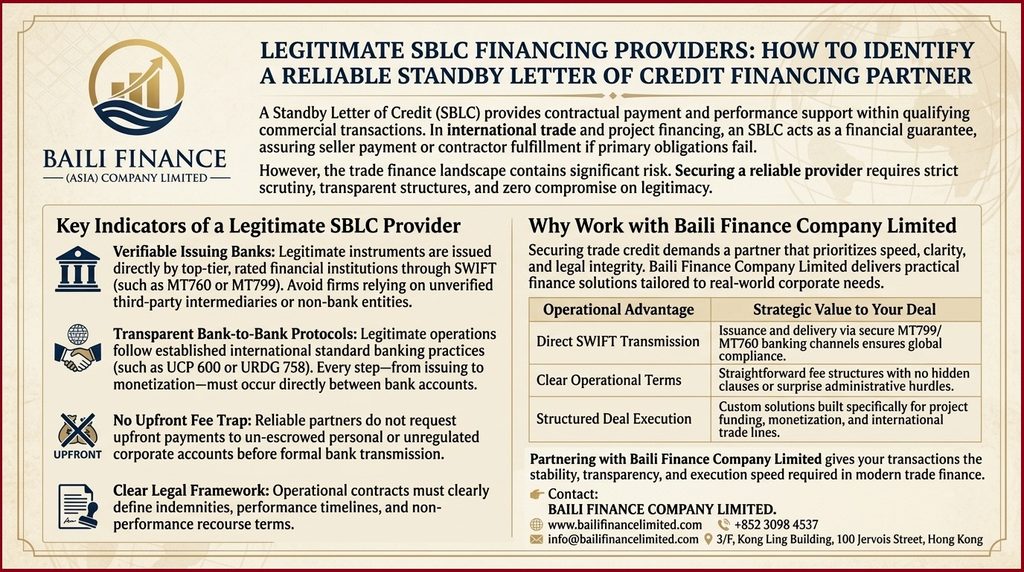
A Standby Letter of Credit (SBLC) can support a legitimate commercial transaction, but an SBLC itself isn’t automatically a loan, investment, or guarantee of financing. Its value depends on the issuing bank, the wording of the instrument, the beneficiary, the underlying transaction, and the financing institution’s credit assessment.
For businesses evaluating SBLC financing companies, the most important question isn’t simply, “Who can arrange an SBLC?” The better question is, “Can this provider demonstrate a credible banking and financing structure that withstands independent due diligence?”
That distinction matters.
A legitimate provider should be able to explain the transaction clearly, identify the relevant parties, provide appropriate documentation, comply with KYC and AML requirements, and explain precisely how financing will be approved and disbursed.
Keywords: legitimate SBLC financing providers, legitimate SBLC financing companies, legitimate SBLC providers, trusted SBLC financing providers, SBLC funding providers, SBLC-backed business financing, legitimate SBLC monetization providers, standby letter of credit financing company, SBLC monetization with bank capability, how to verify an SBLC provider, legitimate standby letter of credit providers, SBLC financing for international business, SBLC-backed project finance, SBLC working capital financing
What Is an SBLC?
A Standby Letter of Credit is an independent undertaking issued by a bank or other eligible financial institution in favour of a beneficiary. It generally provides assurance that the issuer will honour a complying demand according to the terms of the standby.
The International Chamber of Commerce’s International Standby Practices (ISP98) provides a dedicated framework for standby letters of credit. ICC describes ISP98 as a set of rules specifically developed for standby transactions, covering areas such as obligations, presentation, examination, reimbursement, timing, cancellation, and participation.
An SBLC may be used in different commercial contexts, including:
- Trade finance
- Import and export transactions
- Project finance
- Construction contracts
- Infrastructure projects
- Supplier obligations
- Payment obligations
- Performance obligations
- Working-capital structures
- Certain structured-finance transactions
The exact application depends on the transaction and the terms of the instrument.
A critical point should be understood: an SBLC isn’t cash sitting in a bank account waiting to be withdrawn. Financing institutions evaluate the instrument as part of a wider credit and commercial transaction.
That is why legitimate SBLC financing providers don’t normally base their decision only on the face value of an instrument.
What Do Legitimate SBLC Financing Providers Actually Do?
A professional SBLC financing provider may perform several functions depending on its business model and the structure of the transaction.
These can include:
- Reviewing the applicant and proposed transaction.
- Assessing the underlying commercial purpose.
- Reviewing the proposed or existing SBLC.
- Verifying the issuing institution.
- Coordinating with relevant banks and financial institutions.
- Conducting KYC and AML checks.
- Reviewing corporate and financial documents.
- Structuring financing terms.
- Coordinating legal documentation.
- Arranging the funding process where the transaction satisfies underwriting requirements.
The exact role varies between providers.
Some companies arrange bank instruments. Others provide or arrange financing against eligible instruments. Some act as intermediaries. Others operate directly through institutional banking relationships.
Therefore, businesses shouldn’t assume that every company using the phrase SBLC financing provider performs the same function.
A legitimate provider should explain its role before requesting documents, fees, or commitments.
How to Identify Legitimate SBLC Financing Providers
1. Verify the issuing bank
The issuing bank is one of the most important components of an SBLC transaction.
A provider should be able to explain which type of financial institution can issue an acceptable instrument and what requirements apply to that institution.
Don’t rely solely on a PDF, screenshot, certificate, email, or purported SWIFT copy supplied by an intermediary. Independent verification should form part of the due-diligence process.
The objective is straightforward: confirm that the instrument actually exists, was issued through the stated institution, and can be authenticated through appropriate banking channels.
2. Examine the SBLC wording
The language contained in the instrument matters.
A standby can be subject to specific rules, including ISP98. ICC’s rules state that an undertaking can expressly incorporate ISP98 and establish a framework governing its operation.
Businesses should examine:
- Issuing institution
- Applicant
- Beneficiary
- Instrument amount
- Currency
- Issue date
- Expiry date
- Presentation requirements
- Governing rules
- Payment conditions
- Amendment provisions
- Applicable law
- Place of presentation
- Confirmation arrangements, where applicable
A provider that refuses to discuss these fundamentals or insists that the wording doesn’t matter should receive additional scrutiny.
3. Ask who provides the actual financing
This is one of the most important questions when evaluating SBLC funding providers.
A company may market itself as a financing provider while relying on another institution to provide the actual capital.
That isn’t automatically a problem. Intermediated finance can be legitimate.
The problem occurs when the transaction structure isn’t disclosed clearly.
Ask:
- Who is the lender?
- Who supplies the capital?
- Who performs underwriting?
- Who receives the SBLC?
- Who holds the security interest?
- What happens if the transaction fails?
- What documentation governs the financing?
- Which entity receives fees?
- What jurisdiction governs the agreement?
The answers should be consistent with the written contracts.
4. Review the commercial purpose
Legitimate financing generally has a legitimate commercial purpose.
A project involving construction, equipment procurement, international trade, infrastructure, manufacturing, or working capital can provide a recognizable commercial basis for financing.
The provider should understand what the funds will accomplish.
For example, a financing proposal should be able to explain:
Amount required → commercial purpose → transaction structure → security → repayment source → expected repayment timeline.
A provider that focuses almost exclusively on the SBLC amount while showing little interest in the underlying business deserves additional scrutiny.
5. Understand the fee structure
Transparent pricing is another important indicator.
Businesses should obtain written explanations of:
- Arrangement fees
- Advisory fees
- Legal fees
- Bank charges
- Due-diligence fees
- Verification costs
- Financing costs
- Administrative charges
- Success fees
- Refund policies
Never assume that a low initial fee makes a transaction legitimate, and don’t assume that a high fee proves legitimacy.
The complete commercial structure matters more than a single fee.
6. Confirm KYC and AML procedures
A professional financial transaction should involve appropriate compliance checks.
Depending on the transaction, the provider may request:
- Certificate of incorporation
- Corporate profile
- Shareholder information
- Directors’ identification
- Proof of address
- Bank statements
- Financial statements
- Tax information
- Business plans
- Contracts
- Invoices
- Purchase orders
- Project documentation
- Source-of-funds information
This may feel extensive, but legitimate financial institutions need sufficient information to understand the customer and transaction.
A provider promising funding without meaningful due diligence shouldn’t automatically be viewed as efficient. In many cases, the absence of proper underwriting is a reason for greater caution.

Red Flags When Choosing an SBLC Financing Company
Businesses searching for legitimate SBLC providers should be particularly cautious about certain representations.
Guaranteed financing
A provider that guarantees financing before reviewing the applicant, instrument, transaction, and repayment structure presents a significant due-diligence concern.
Financing decisions depend on risk assessment.
Guaranteed returns
An SBLC shouldn’t be presented as an investment producing guaranteed profits.
A standby is a banking instrument, not a guaranteed-return investment product.
Fixed monetization percentages
Claims that every SBLC automatically qualifies for a predetermined monetization percentage should be treated cautiously.
Financing terms depend on factors including the issuing institution, instrument wording, transaction risk, jurisdiction, collateral, repayment source, and overall credit profile.
One institutional bank explicitly notes that legitimate SBLC or bank-guarantee financing requires analysis of the entire transaction rather than reliance on standard monetization percentages.
Pressure to pay immediately
Urgency shouldn’t replace due diligence.
If a provider pressures a company to transfer substantial funds before the applicant has reviewed contracts, verified counterparties, understood the financing structure, and obtained appropriate professional advice, management should pause the transaction.
Unverifiable banking claims
Statements such as “top bank,” “AAA bank,” “prime bank,” or “secret banking channel” aren’t substitutes for verifiable information.
The relevant question is whether the institution and transaction can be independently authenticated.
No clear financing agreement
Before committing funds or accepting an instrument, the business should understand the contractual relationship between the parties.
If nobody can clearly explain who lends, who borrows, what secures the facility, how repayment works, and what happens in default, the transaction requires further review.
SBLC Financing vs. SBLC Monetization
The terms SBLC financing and SBLC monetization often appear together, but they shouldn’t automatically be treated as identical.
SBLC financing generally refers to a financing structure in which an eligible standby supports or forms part of the credit structure.
SBLC monetization generally refers to obtaining financing or liquidity against an eligible financial instrument.
In practical terms, the distinction depends on the actual transaction documents.
A business shouldn’t judge a financing proposal based solely on its marketing terminology. It should examine the legal and financial structure.
This is particularly important when searching for long-tail terms such as:
- legitimate SBLC monetization providers
- legitimate SBLC financing companies
- trusted SBLC funding providers
- SBLC-backed business financing
- standby letter of credit financing company
- SBLC monetization with bank capability
- how to verify an SBLC provider
- legitimate standby letter of credit providers
- SBLC financing for international business
- SBLC-backed project finance
These searches can identify potential providers, but search visibility doesn’t establish legitimacy.
What Documents Should an SBLC Financing Provider Request?
A legitimate transaction may require substantial documentation.
Typical requirements can include:
Corporate documents
- Certificate of incorporation
- Memorandum and articles or equivalent constitutional documents
- Company registration information
- Ownership structure
- Director information
- Identification documents
Financial documents
- Recent financial statements
- Bank statements
- Existing debt information
- Management accounts
- Cash-flow projections
- Tax records where applicable
Transaction documents
- Business plan
- Project proposal
- Purchase agreements
- Supply contracts
- Invoices
- Offtake agreements
- Construction contracts
- Equipment quotations
- Import/export documentation
Instrument documents
- SBLC draft
- Existing SBLC copy where appropriate
- Issuing bank information
- Beneficiary details
- Expiry information
- Applicable rules
- Confirmation information where relevant
The precise list varies according to the transaction.
How the SBLC Financing Process Usually Works
Although structures vary, a properly organized transaction can follow a process similar to this:
Step 1: Initial assessment
The provider reviews the applicant, funding requirement, business purpose, jurisdiction, and preliminary transaction information.
Step 2: Document collection
Corporate, financial, commercial, and instrument documentation is collected.
Step 3: Compliance review
KYC, AML, sanctions, source-of-funds, and related compliance requirements are assessed.
Step 4: Instrument verification
The proposed or existing SBLC and issuing institution undergo appropriate verification.
Step 5: Credit assessment
The financing institution evaluates the complete transaction.
Step 6: Structuring
The parties establish financing amount, tenor, security, pricing, repayment terms, covenants, and other conditions.
Step 7: Legal documentation
The parties execute the relevant financing and security documents.
Step 8: Banking process
The SBLC and related banking communications proceed through the agreed channels.
Step 9: Funding
Subject to satisfaction of all conditions precedent, financing can be disbursed according to the contractual arrangement.
This process isn’t identical for every transaction. However, legitimate financing generally involves considerably more analysis than simply receiving an SBLC and transferring money.
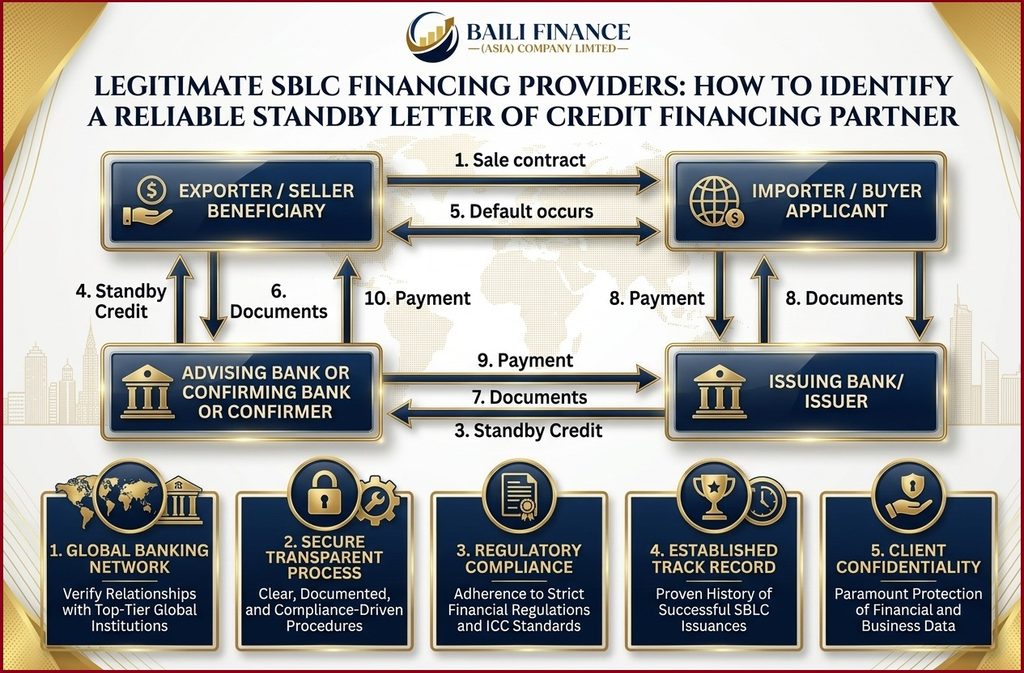
Real-World Example: An SBLC Dispute
A useful real-world example comes from the ICC’s own DOCDEX decisions.
In one case involving an SBLC subject to ISP98, the beneficiary presented documents under the standby, but the issuing bank rejected the presentation based on alleged discrepancies. A subsequent presentation was also rejected, with additional discrepancies raised. The dispute ultimately concerned the operation of the standby and the bank’s handling of the presentation.
The lesson is important for businesses seeking SBLC financing providers: the existence of an SBLC doesn’t eliminate the need to understand its exact terms.
Presentation requirements, documentary compliance, timing, notices, and the governing rules can materially affect the parties’ rights.
Businesses should therefore have qualified legal and financial professionals review important instruments before relying on them as financing support.
Case Study: SBLC-Backed Working Capital for an International Trading Company
Consider an international trading company that has secured purchase orders from overseas buyers but needs working capital to purchase inventory before shipment.
The company has a valid SBLC issued by an acceptable financial institution. Rather than treating the SBLC as cash, a structured-finance provider reviews the complete transaction.
The challenge
The company needs $10 million in working capital to purchase inventory.
Its buyers have established purchase commitments, but suppliers require payment before shipment.
The company has insufficient unrestricted working capital to execute the contracts at the required scale.
The assessment
The financing provider reviews:
- The issuing institution
- SBLC terms
- Buyer contracts
- Supplier agreements
- Historical financial statements
- Bank statements
- Corporate structure
- Management information
- Repayment source
- Jurisdictions involved
- Compliance requirements
The provider also determines whether the proposed SBLC structure is acceptable to the financing institution.
The financing structure
Rather than promising an automatic percentage of the SBLC’s face value, the financing institution evaluates the complete credit proposition.
The facility is structured around the company’s commercial activity, eligible security, repayment source, and the supporting financial instrument.
The outcome
If all conditions are satisfied, the company receives financing that can be applied toward eligible inventory purchases.
The company then uses proceeds from completed sales to meet its repayment obligations.
This example demonstrates an important principle: the commercial transaction remains central to the financing decision.
The SBLC can provide credit support, but it doesn’t replace underwriting.

Why Independent Due Diligence Matters
Businesses sometimes assume that the existence of a banking instrument means the transaction has already passed every relevant compliance and credit test.
That assumption can create unnecessary risk.
Independent due diligence should examine:
- Corporate registration
- Ownership
- Directors
- Banking relationships
- Issuing institution
- Financing institution
- Contracts
- Jurisdiction
- Regulatory position
- Transaction history
- Fee arrangements
- Legal documentation
- Source of funds
- Source of repayment
Where significant capital is involved, professional legal and financial advice should form part of the process.
The ICC’s ISP98 framework itself emphasizes that standby obligations operate within applicable law and established banking practice.
For readers who want an authoritative reference on standby letters of credit, the International Chamber of Commerce’s ISP98 resources provide a strong external reference for understanding the rules governing these instruments. International Chamber of Commerce — ISP98
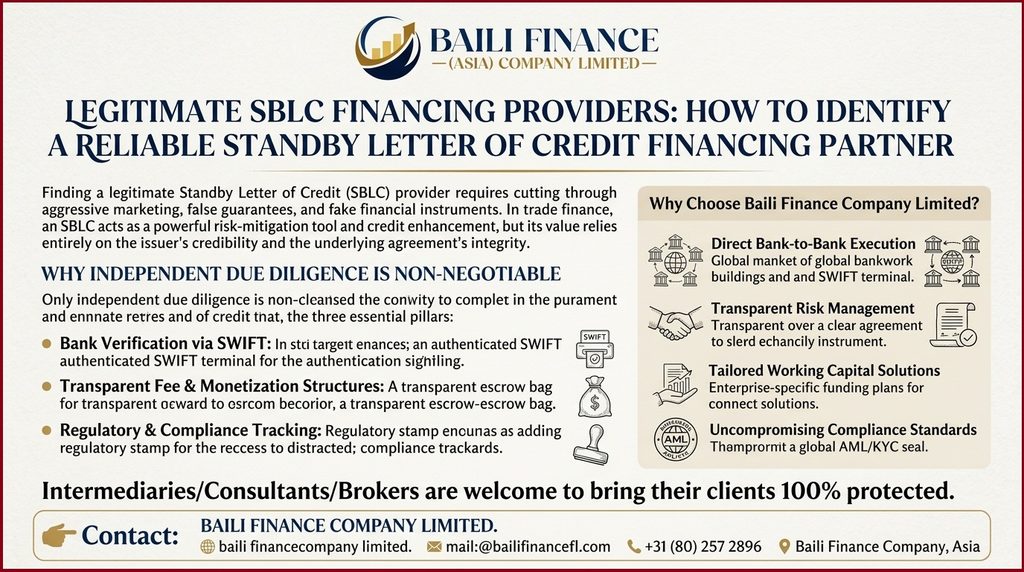
Why Businesses Work With Professional SBLC Financing Providers
The right provider can help coordinate a complex transaction involving multiple parties.
Depending on the structure, those parties may include:
- Applicant
- Beneficiary
- Issuing bank
- Advising bank
- Confirming bank
- Financing institution
- Legal advisers
- Compliance professionals
- Project owners
- Suppliers
- Buyers
Coordinating these parties requires clear documentation and communication.
For a business, the objective shouldn’t simply be obtaining an SBLC. The objective should be creating a financing structure that makes commercial and financial sense.
That requires understanding the funding requirement, repayment capacity, instrument quality, transaction risk, and contractual obligations.
Choosing Baili Finance Limited as an SBLC Financing Partner
Businesses considering legitimate SBLC financing providers should approach the process with a transaction-first mindset.
At Baili Finance Limited, the relevant starting point isn’t an assumption that every SBLC qualifies for financing. The transaction should be assessed based on its documentation, commercial purpose, instrument, counterparties, funding requirement, and overall structure.
Businesses considering SBLC-backed finance, structured finance, trade finance, project finance, working capital, or SBLC monetization should prepare the relevant corporate and transaction documentation before requesting an assessment.
This approach allows the parties to determine whether the proposed transaction is commercially suitable rather than making unsupported assumptions about funding.
FAQs About Legitimate SBLC Financing Providers
1. What are legitimate SBLC financing providers?
Legitimate SBLC financing providers are companies or financial institutions that arrange, structure, or facilitate financing involving eligible Standby Letters of Credit through a documented and verifiable process. A legitimate provider should explain its role, financing source, transaction requirements, compliance process, fees, and contractual terms clearly.
2. Can an SBLC guarantee that I will receive financing?
No. An SBLC doesn’t automatically guarantee financing.
A financing institution normally evaluates the applicant, commercial transaction, issuing institution, SBLC wording, repayment source, jurisdiction, risk profile, and other relevant factors before approving a facility.
3. How can I verify an SBLC financing provider?
Start by verifying the company’s legal identity, business activities, counterparties, financing structure, banking claims, contracts, fees, and compliance procedures. Where appropriate, independently verify the issuing institution and the authenticity of the financial instrument through recognized banking channels.
4. Is SBLC monetization the same as SBLC financing?
Not necessarily. SBLC monetization generally describes obtaining liquidity or financing against an eligible financial instrument, while SBLC financing can refer more broadly to financing structures in which an SBLC provides credit support. The exact meaning depends on the transaction documents.
5. What banks can issue an SBLC?
Eligible banks and financial institutions can issue standby letters of credit subject to their regulatory authority, internal credit policies, customer requirements, applicable law, and transaction terms. The acceptability of an issuing institution also depends on the requirements of the beneficiary and financing institution.
6. How much financing can I obtain against an SBLC?
There is no universal financing percentage that applies to every SBLC. Financing terms depend on factors such as the issuing institution, instrument wording, transaction risk, collateral, repayment source, jurisdiction, applicant credit profile, and financing institution’s policies.
7. Can an SBLC be used for project finance?
An SBLC can potentially form part of a project-finance or structured-finance transaction where the instrument, project, counterparties, repayment structure, and risk profile satisfy the financing institution’s requirements. The SBLC doesn’t replace a project assessment.
8. What are the biggest SBLC financing red flags?
Major warning signs include guaranteed financing without underwriting, guaranteed returns, unexplained banking claims, pressure to transfer money quickly, unclear financing sources, unverifiable institutions, opaque fees, and contracts that don’t clearly explain the parties’ obligations.
9. Should I pay an upfront fee to an SBLC provider?
Fees can legitimately arise for professional services, due diligence, legal work, banking costs, or transaction structuring. However, businesses should understand exactly what each fee covers, which entity receives it, whether it is refundable, and what contractual conditions apply before making payment.
10. Does an SBLC mean the holder has cash?
No. An SBLC is a banking undertaking with defined terms and conditions. It shouldn’t be treated as an unrestricted cash balance. Its usefulness in financing depends on its characteristics and the requirements of the financing institution.
Final Summary: Finding a Legitimate SBLC Financing Provider
Choosing among legitimate SBLC financing providers requires disciplined due diligence.
The strongest transactions don’t depend on marketing promises. They depend on verifiable banking relationships, appropriate documentation, credible commercial activity, transparent financing terms, proper compliance, independent verification, and a realistic repayment structure.
An SBLC can support international trade, project finance, working capital, construction, infrastructure, and other commercial activities. However, it doesn’t automatically create financing capacity.
Businesses should therefore evaluate the complete transaction rather than focusing only on the face value of the instrument.
Before entering an SBLC financing arrangement, verify the issuing institution, review the SBLC wording, understand the applicable rules, identify the actual funding source, examine every fee, conduct appropriate KYC and AML checks, and obtain independent legal or financial advice where necessary.
If your business already has an SBLC, is considering obtaining one, or needs to determine whether an SBLC can support a proposed financing transaction, Baili Finance Limited can assess the transaction structure and help you understand the next steps.
Don’t commit capital based on an unverified promise of financing.
Submit your transaction for professional assessment, understand the requirements, verify the structure, and determine whether your proposed SBLC financing strategy is commercially suitable.
Contact Baili Finance Limited today to discuss your SBLC financing, structured-finance, trade-finance, project-finance, or working-capital requirement.
Intermediaries/Consultants/Brokers are welcome to bring their clients 100% protected. Our brokers receive 2% commission for referral. We assist Clients and brokers in their attempt to secure funding by working on their funding requests that may require innovative financing. In complete confidence, we will work together for the benefits of all parties involved.
#SBLC #SBLCFinancing #SBLCProvider #TradeFinance #StructuredFinance #ProjectFinance