Headline: 7 KEY FACTS ABOUT SBLC BUSINESS FINANCING
Securing adequate business funding can become difficult when a company needs substantial capital but doesn’t have sufficient traditional collateral, an established borrowing history, or immediate access to conventional bank loans. SBLC financing for business provides another structured option for qualifying companies that can arrange a credible Standby Letter of Credit (SBLC) and satisfy the requirements of a legitimate funding provider.
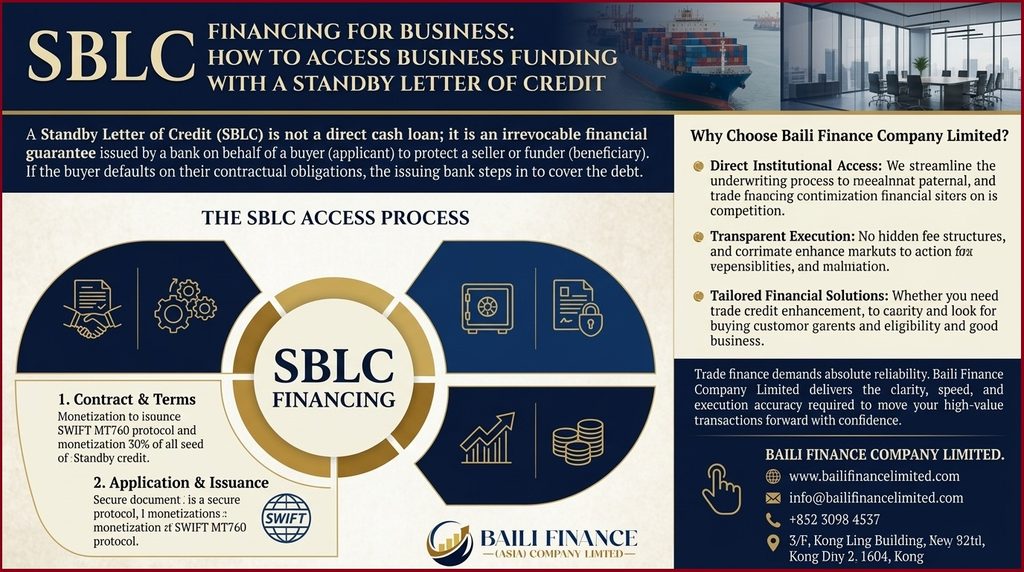
An SBLC is a bank-issued undertaking that can provide payment protection to a beneficiary if the applicant fails to meet a defined financial or contractual obligation. The International Chamber of Commerce (ICC) explains that standby letters of credit operate as independent undertakings and can also function as a credit enhancement tool when the issuer has a strong credit standing.
For businesses seeking business financing with SBLC, the key issue isn’t simply obtaining an SBLC. The instrument must be genuine, properly issued, acceptable to the relevant financial institution, and structured for the intended transaction.
This guide explains how SBLC financing works, how businesses may use an SBLC to support funding, what lenders and monetizers examine, the risks involved, and how companies can approach an SBLC financing transaction professionally.
Keywords: SBLC financing for business, SBLC financing, SBLC funding, business financing with SBLC, SBLC-backed financing, standby letter of credit financing, SBLC financing for companies, SBLC business funding, SBLC monetization, business financing, corporate financing, trade finance, standby letter of credit, business funding solutions
What Is SBLC Financing?
SBLC financing refers to a financing structure in which a valid Standby Letter of Credit supports a financial transaction.
The SBLC itself doesn’t automatically create cash for the business. Instead, it provides a contractual payment undertaking from an issuing bank. Depending on the transaction structure, the instrument may strengthen the applicant’s credit position, support a financing facility, or provide security for an obligation.
The ICC describes an SBLC as an independent undertaking that supplements the underlying agreement between the applicant and beneficiary. It can therefore serve a different purpose from a conventional commercial letter of credit.
In practical terms, a company may use an SBLC to demonstrate that a recognized financial institution stands behind a specified obligation.
The parties commonly include:
- Applicant: The company requesting the SBLC.
- Issuing bank: The bank issuing the standby instrument.
- Beneficiary: The party receiving the bank’s undertaking.
- Financier: The institution or funding party providing financing against an acceptable transaction structure.
- Advising bank: The bank that authenticates and communicates the SBLC to the beneficiary where applicable.
The precise structure varies according to the transaction, jurisdiction, bank requirements, and governing rules.
How Does SBLC Financing Work?
The process usually starts with a business establishing its financing requirement.
For example, a company may require capital for:
- Working capital
- International trade
- Infrastructure projects
- Equipment acquisition
- Contract execution
- Real estate development
- Expansion
- Procurement
- Project finance
- Cross-border commercial transactions
The company then needs to determine whether an SBLC-supported structure is appropriate.
A typical process can involve the following stages.
1. Business and Transaction Assessment
The financing provider reviews the applicant, its business activity, funding requirement, transaction purpose, jurisdiction, and financial position.
This stage matters because a legitimate financier needs to understand the underlying transaction before determining whether the proposed structure is acceptable.
2. SBLC Arrangement
Where appropriate, the company arranges an SBLC through an acceptable issuing institution.
The instrument should contain clear terms covering matters such as:
- Issuing bank
- Applicant
- Beneficiary
- Amount
- Currency
- Expiry date
- Place of presentation
- Applicable rules
- Presentation requirements
- Governing law where applicable
- Payment conditions
3. Bank-to-Bank Authentication
The receiving institution normally needs to establish that the SBLC genuinely originates from the stated issuing bank.
This is a critical compliance stage.
A document that merely looks like a bank instrument isn’t equivalent to an authenticated bank-issued SBLC.
4. Due Diligence
The financing provider may conduct corporate, legal, banking, sanctions, anti-money-laundering, and transaction-level checks.
The business may therefore need to provide corporate documents, financial statements, identification documents, bank information, contracts, project documents, and information about the source of funds.
5. Financing Assessment
Once the SBLC and transaction have passed the required checks, the financier determines whether it can provide funding and under what terms.
The resulting facility may depend on the instrument’s face value, issuing bank, jurisdiction, currency, tenor, legal structure, credit quality, and other risk factors.
6. Documentation and Closing
If approved, the parties execute the relevant financing documents.
Only after the applicable conditions have been satisfied should the transaction proceed to funding.
7 KEY FACTS ABOUT SBLC BUSINESS FINANCING
- IT IS A SAFETY NET, NOT DIRECT CASHAn SBLC (Standby Letter of Credit) is a bank-backed financial guarantee, not a cash loan. The issuing bank only pays the beneficiary if your business defaults on its contractual obligations.
- MONETIZATION IS NEVER 100% FACE VALUEIf a financier agrees to raise capital against an SBLC, they will apply a heavy haircut. A $10 million instrument will never yield $10 million in liquid funding. Expect strict loan-to-value limits based on risk.
- COLLATERAL IS MANDATORY FOR ISSUANCEBanks do not issue SBLCs based on empty promises. To secure one, you must pledge liquid assets, cash deposits, or prime real estate matching the risk exposure, alongside paying 1% to 10% in annual issuance fees.
- THE INDUSTRY IS RIFE WITH SCAMSUnsolicited offers promising “leased SBLCs,” guaranteed funding, or monetization with zero collateral are almost always fraudulent. Legitimate SBLCs move strictly through verifiable SWIFT network channels (such as MT760) between accredited banking institutions.
- THE ISSUING BANK’S RATING DEFINES ITS VALUEAn SBLC is only as strong as the bank backing it. Lenders and trade partners will reject instruments issued by obscure, unrated, or offshore entities without top-tier correspondent banking relationships.
- BANKS PAY ON DOCUMENTS, NOT FAIRNESSSBLCs operate under strict international rules like ISP98 or UCP 600. Issuing banks examine standard paperwork on face value alone—they do not investigate underlying contract disputes before releasing funds.
- AN SBLC REQUIRES AN INDEPENDENT LOAN AGREEMENTHolding an SBLC does not automatically grant you access to capital. Monetizing or borrowing against it requires a completely separate credit facility and rigorous underwriting from an independent lender.
Why Do Businesses Use SBLC Financing?
Businesses consider SBLC financing because traditional lending isn’t always suitable for every commercial situation.
A company may have a viable project but face limitations such as:
- Insufficient conventional collateral
- Long bank approval processes
- Cross-border financing requirements
- Limited borrowing history
- Large contract requirements
- Working-capital constraints
- A need for bank-backed payment assurance
An SBLC can provide a recognized banking undertaking that may improve the credit profile of a transaction.
The ICC specifically identifies credit enhancement as one potential function of an SBLC where the issuing bank has stronger credit standing.
However, businesses should understand an important distinction:
An SBLC isn’t the same thing as unrestricted cash.
The financing outcome depends on the financier’s assessment and the terms of the transaction.
SBLC Financing vs Traditional Business Loans
Traditional business lending generally relies on a lender assessing the borrower and providing a loan based on factors such as repayment capacity, collateral, cash flow, credit history, and business performance.
SBLC-supported financing introduces an additional banking undertaking into the structure.
| Factor | Traditional Business Loan | SBLC-Supported Financing |
|---|---|---|
| Primary assessment | Borrower and repayment capacity | Borrower, SBLC and transaction |
| Bank instrument | Loan agreement | Standby undertaking |
| Security | May include collateral | May involve SBLC plus other security |
| Typical purpose | General or specified business funding | Structured commercial or financial transactions |
| Issuing bank relevance | Lender provides facility | SBLC issuing bank can materially affect acceptability |
| Documentation | Loan documentation | SBLC plus financing documentation |
| Risk assessment | Credit and collateral | Credit, instrument, bank, legal and transaction risk |
Neither structure is automatically better.
The appropriate option depends on the company’s financial position and the specific funding requirement.
What Makes an SBLC Acceptable for Financing?
This is one of the most important questions for businesses considering SBLC financing programs.
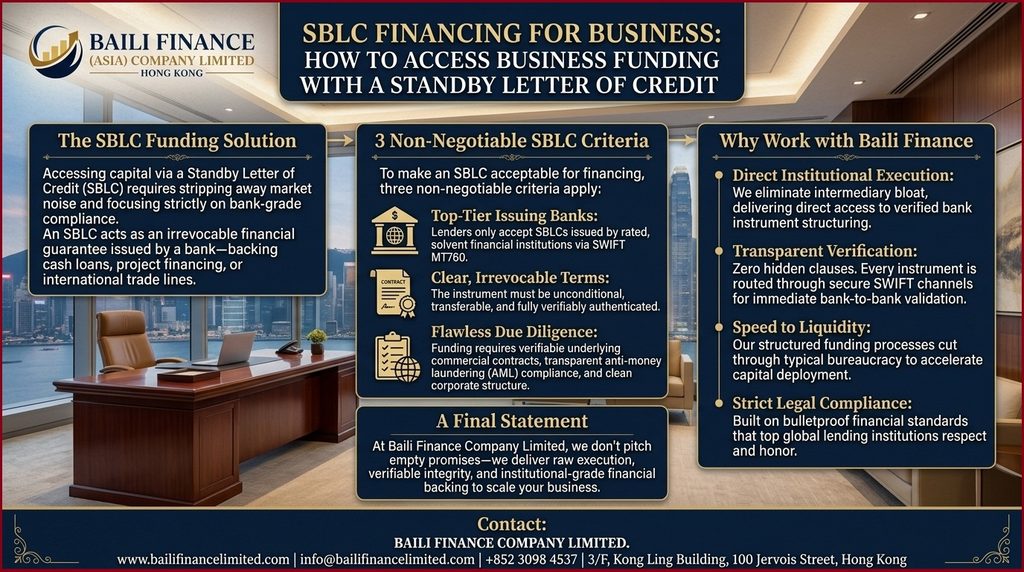
Financiers can apply different eligibility criteria. However, several factors commonly matter.
Issuing Bank
The credibility and financial standing of the issuing bank can materially influence the transaction.
A financier may have an approved-bank list or minimum requirements concerning the issuing institution.
Authenticity
The SBLC must be genuine and capable of bank-to-bank authentication.
Businesses should be extremely cautious when a provider promises that a scanned document, draft, or unofficial bank letter will automatically qualify for financing.
Face Value
The SBLC’s stated amount must be consistent with the proposed transaction.
A larger face value doesn’t automatically mean a company can receive an equivalent amount of financing.
Tenor
The validity period must accommodate the financing structure.
The financier may require sufficient remaining tenor to support the transaction.
Rules
SBLCs may operate under different rule frameworks.
The ICC notes that ISP98, UCP 600, and URDG 758 can apply to different types of undertakings, depending on the structure and wording. ISP98 was developed specifically to provide a detailed framework for standby letters of credit.
Businesses should therefore avoid assuming that every SBLC follows identical rules.
Legal Jurisdiction
The governing law, place of issuance, place of presentation, bank jurisdiction, and contractual framework can affect risk assessment.
For large transactions, independent legal advice should be obtained before execution.
ISP98 and SBLC Transactions
International Standby Practices (ISP98) provides a specialized framework for standby letters of credit.
The ICC explains that ISP98 addresses standby practices and provides detailed rules covering obligations, presentation, examination, notice, transfer, cancellation, reimbursement, timing, and syndication or participation.
An important point is that ISP98 doesn’t automatically apply to every SBLC.
The instrument generally needs to incorporate the rules by reference. The ICC’s published material provides examples of wording that expressly subjects an undertaking to ISP98.
For companies evaluating an SBLC for business financing, understanding the governing rules is therefore essential.
A business should ask:
- What rules govern the SBLC?
- Which bank issued it?
- Where was it issued?
- Who is the beneficiary?
- What is the expiry date?
- What documents are required for presentation?
- What law governs the undertaking?
- Can the receiving institution authenticate it?
- Does the proposed financier accept the issuing bank?
- What financing obligation does the SBLC actually support?
These questions reduce avoidable transaction risk.
How Much Financing Can an SBLC Generate?
There’s no universal financing percentage that applies to every SBLC transaction.
The amount depends on the financing provider, the issuing bank, the transaction structure, the applicant’s financial position, the SBLC terms, market conditions, jurisdiction, and risk assessment.
Therefore, businesses should be cautious about providers advertising a guaranteed percentage of SBLC face value without first reviewing the transaction.
For example, an SBLC with a face value of $10 million doesn’t automatically mean that the holder will receive $10 million in cash.
The financing provider may:
- Decline the transaction.
- Offer financing below the face value.
- Require additional security.
- Require equity participation.
- Request further documentation.
- Require a specific issuing bank.
- Apply fees and transaction costs.
- Structure the financing around a defined commercial purpose.
A professional financing process should disclose these conditions before the company commits significant funds.
What Documents Are Usually Required?
The exact requirements differ by financier and jurisdiction, but a business seeking SBLC financing for companies should be prepared to provide comprehensive documentation.
Common requirements may include:
Corporate Documents
- Certificate of incorporation
- Articles or constitutional documents
- Shareholder information
- Director information
- Corporate profile
- Tax documentation
- Proof of registered business activity
Financial Information
- Audited financial statements
- Management accounts
- Bank statements
- Cash-flow projections
- Existing debt information
- Asset and liability schedules
Transaction Documents
- Business plan
- Project proposal
- Purchase contracts
- Sales contracts
- Invoices
- Supply agreements
- Project budgets
- Relevant licenses
- Commercial agreements
SBLC Information
- Draft SBLC wording
- Issuing bank details
- Face value
- Currency
- Tenor
- Beneficiary details
- Applicable rules
- Authentication arrangements
Compliance Documents
Depending on the transaction, the financier may require:
- Know Your Customer information
- Beneficial ownership information
- Source-of-funds documentation
- Source-of-wealth information
- Sanctions screening
- Anti-money-laundering documentation
Preparing these documents early can reduce unnecessary delays.
Real-World Example: An SBLC Supporting Cross-Border Financing
A useful real-world reference comes from World Bank documentation discussing standby letters of credit in a financing structure involving a financial intermediary, an issuing bank and a local bank. The document explains the roles of the applicant, issuer and beneficiary and describes an SBLC-related structure supporting an underlying local-currency loan.
This illustrates an important principle.
An SBLC can sit within a broader financing arrangement rather than functioning as a standalone source of cash.
The underlying financing remains central. The standby provides an additional bank-backed undertaking that can support the transaction.
For businesses, this distinction is critical when evaluating SBLC-backed financing.
Illustrative Case Study: Manufacturing Company Seeking Expansion Capital
Consider a hypothetical manufacturing company, Meridian Industrial Ltd., that has secured a large supply contract.
The company needs $5 million to purchase equipment, raw materials and production inputs.
Its problem isn’t demand. It has a signed commercial contract. The difficulty is that the company doesn’t have enough conventional collateral to support the entire funding requirement.
The company approaches a financing provider with:
- A five-year operating history
- Audited financial statements
- A signed customer contract
- Supplier quotations
- A detailed cash-flow forecast
- A defined $5 million funding requirement
- An SBLC from an acceptable issuing bank
The financier reviews the company and the transaction.
The SBLC passes authentication. The issuing bank meets the financier’s requirements. The underlying contract is commercially credible, and the company’s projected cash flow supports the proposed repayment structure.
The financier then structures a facility based on the overall transaction.
The company doesn’t receive $5 million merely because the SBLC has a $5 million face value.
Instead, the SBLC forms part of the security and credit-enhancement structure supporting the financing.
This is the distinction businesses need to understand before entering an SBLC financing transaction.
How to Evaluate an SBLC Financing Provider
Businesses should perform serious due diligence before paying fees or transferring funds to anyone offering SBLC monetization, SBLC funding, or SBLC financing services.
Ask for clear answers to the following:
Who Is the Actual Financier?
Determine whether you’re dealing directly with a financing institution, an arranger, an intermediary, a broker, or another service provider.
What Bank Will Receive the SBLC?
The receiving institution matters.
Ask whether the financier has confirmed that the proposed issuing bank is acceptable.
What Is the Funding Structure?
The provider should explain:
- Facility amount
- Currency
- Tenor
- Interest or financing cost
- Fees
- Security
- Repayment terms
- Conditions precedent
- Closing requirements
What Happens If Financing Is Declined?
Understand whether upfront fees are refundable and under what circumstances.
Is the Transaction Compliant?
The structure should comply with applicable banking, corporate, tax, sanctions, anti-money-laundering and financial regulations.
Can the SBLC Be Authenticated?
The transaction should use established bank communication and authentication procedures.
Avoid arrangements that rely heavily on informal email correspondence, screenshots, unverifiable bank documents, or pressure to make immediate payments.
Common SBLC Financing Risks
SBLC transactions can involve significant financial and legal risks.
Fraudulent Instruments
Fraudulent SBLC schemes may involve fake banks, altered documents, fabricated SWIFT confirmations, forged signatures, or unauthorized intermediaries.
Verification should therefore happen through appropriate banking channels.
Upfront Fee Risk
A provider requesting substantial upfront payments should clearly explain what those payments cover.
Businesses should distinguish legitimate professional fees from unexplained charges.
Misrepresentation
Statements such as “guaranteed funding,” “risk-free monetization,” or “100% financing” deserve careful scrutiny.
No responsible provider should promise an outcome without reviewing the transaction.
Regulatory Risk
Cross-border transactions can involve multiple jurisdictions.
A structure that appears acceptable commercially may still create legal or regulatory problems if improperly designed.
Liquidity and Timing Risk
Even an acceptable SBLC doesn’t guarantee immediate funding.
Bank review, compliance checks, documentation and transaction closing can take time.
SBLC Monetization vs SBLC Financing
The terms SBLC monetization and SBLC financing are often used interchangeably online, but businesses should clarify what a provider actually means.
SBLC financing generally refers to using an SBLC within a financing arrangement.
SBLC monetization commonly refers to converting the perceived value or credit support of an SBLC into financing or liquidity through a structured transaction.
The precise legal and financial structure matters more than the label.
A business should request a written term sheet explaining exactly what happens after the SBLC is issued.
Is SBLC Financing Suitable for Small Businesses?
It can be suitable in certain circumstances, but company size alone doesn’t determine eligibility.
The transaction must make commercial and financial sense.
A small business with a credible contract, sound financial records, acceptable banking relationships and a legitimate SBLC may have a stronger financing case than a larger company with weak documentation.
Conversely, an SBLC doesn’t compensate automatically for an unviable business model.
The financier still needs to understand the applicant, the transaction and the repayment or risk structure.
How Businesses Can Improve Their Financing Readiness
Before approaching an SBLC financing provider, businesses should improve their documentation and financial presentation.
Start with a clear funding proposal.
State:
- How much funding you need
- Why you need it
- How the funds will be used
- What revenue will support repayment
- What security is available
- Who the contracting parties are
- Which bank will issue the SBLC
- How long the facility is required
Then prepare reliable financial information.
A professional financier can assess a transaction more efficiently when the documentation answers the fundamental credit questions.
Frequently Asked Questions About SBLC Financing for Business
1. What is SBLC financing for business?
SBLC financing is a structured funding arrangement in which a legitimate Standby Letter of Credit supports a financing transaction. The SBLC provides a bank-backed undertaking, but it doesn’t automatically equal cash or guarantee that financing will be approved.
2. Can an SBLC be used to obtain business financing?
Yes, an acceptable SBLC can potentially support business financing, depending on the issuing bank, instrument terms, transaction structure, jurisdiction and financier’s requirements.
3. How much can I finance with an SBLC?
There’s no universal amount or financing percentage. The financier determines the available facility after reviewing the SBLC, issuing bank, applicant, transaction and applicable risks.
4. Is SBLC financing the same as an SBLC loan?
Not necessarily. SBLC financing can include several structured arrangements. An SBLC isn’t itself a conventional loan. The financing agreement establishes the actual funding, repayment and security obligations.
5. Which banks issue SBLCs?
Banks that provide trade finance and standby letter of credit services may issue SBLCs subject to their internal credit policies, regulatory requirements and the applicant’s eligibility. Acceptance by a financing provider depends on the specific issuing institution.
6. How can I verify an SBLC?
Verification should occur through appropriate bank-to-bank authentication procedures. Businesses shouldn’t rely solely on a PDF, email, screenshot, certificate, or copy presented by an intermediary.
7. Does an SBLC guarantee financing?
No. An SBLC may strengthen a transaction, but financing remains subject to the financier’s credit, compliance, legal and transaction assessment.
8. What is ISP98?
ISP98 is a specialized set of international rules for standby letters of credit. The ICC identifies ISP98 as a detailed framework for practitioners dealing with SBLCs.
9. Can a company use SBLC financing for working capital?
Potentially, yes. However, the proposed use of funds must fit the financing provider’s requirements and the transaction structure. Working-capital financing should be supported by credible cash-flow projections and a clear repayment strategy.
10. What should I check before signing an SBLC financing agreement?
Review the financing amount, costs, issuing bank requirements, authentication procedure, repayment obligations, security, governing law, conditions precedent, termination provisions and refund terms for upfront fees. Independent legal and financial advice may also be appropriate.
The Importance of Professional SBLC Structuring
SBLC financing sits at the intersection of banking, corporate finance, trade finance and contract law.
That means businesses shouldn’t evaluate the transaction based only on the headline financing amount.
A sound transaction should answer four questions:
Is the SBLC genuine?
Is the issuing bank acceptable?
Is the underlying transaction commercially credible?
Are the financing terms sustainable for the business?
If any answer is unclear, the business should investigate before proceeding.
For authoritative background on international standby practices, businesses can consult the ICC’s International Standby Practices (ISP98) resource.
Why Businesses Should Approach SBLC Financing With Due Diligence
The online SBLC market contains legitimate financial professionals as well as misleading offers.
Businesses should never make a financing decision solely because a provider advertises a high funding percentage.
Instead, evaluate the transaction from a banking perspective.
Check the institution.
Check the documentation.
Check the legal framework.
Check the economics.
Check the source and authenticity of the SBLC.
Check the financing agreement.
Then determine whether the transaction makes commercial sense.
This approach helps businesses avoid unnecessary costs and reduces exposure to fraudulent or unsuitable financing structures.
Final Summary: SBLC Financing for Business
SBLC financing for business can provide a structured way for qualifying companies to use a bank-backed standby undertaking as part of a financing arrangement.
Its value, however, depends on the quality of the entire transaction.
A genuine SBLC from an acceptable issuing bank can support credit enhancement and provide assurance within a properly structured financing arrangement. The ICC recognizes SBLCs as independent undertakings and identifies credit enhancement as one of their potential commercial functions.
Still, businesses shouldn’t assume that an SBLC automatically produces cash, guarantees financing, or creates a fixed financing percentage.
Successful transactions require proper due diligence, authentic banking instruments, clear documentation, appropriate compliance procedures and commercially realistic financing terms.
For companies exploring SBLC funding for business, SBLC-backed financing, business financing with standby letters of credit, or SBLC monetization, the first step should be a professional assessment of the transaction rather than an immediate commitment of funds.
Ready to Explore SBLC Financing for Your Business?
If your company has a genuine financing requirement and you’re considering an SBLC-backed financing structure, don’t make the transaction decision on assumptions.
Contact Baili Finance Limited to discuss your financing requirement, transaction structure and SBLC position.
Provide the essential details of your business, funding requirement, proposed use of funds and available banking instrument. A structured assessment can help determine whether your transaction is suitable for further financing consideration.
Start the conversation today. Explain what you need, provide the relevant information, and take the next step toward a professionally structured business financing solution.
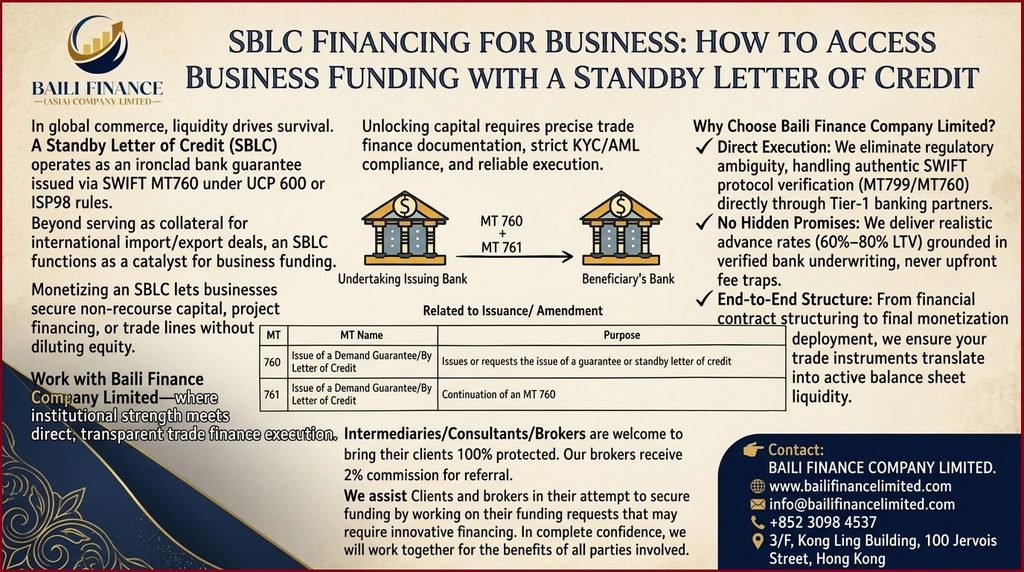
Intermediaries/Consultants/Brokers are welcome to bring their clients 100% protected. Our brokers receive 2% commission for referral. We assist Clients and brokers in their attempt to secure funding by working on their funding requests that may require innovative financing. In complete confidence, we will work together for the benefits of all parties involved.
#SBLCFinancing #BusinessFinancing #SBLC #TradeFinance #CorporateFinance #BusinessFunding #StandbyLetterOfCredit