Headline: Stop Fake SBLCs Before You Lose Money
A fake SBLC, or fraudulent Standby Letter of Credit, can expose a business to financial loss, legal disputes, reputational damage, and failed commercial transactions. Learning how to identify a fake SBLC therefore matters before you pay fees, release goods, sign a financing agreement, or rely on an instrument for SBLC monetization.
A legitimate Standby Letter of Credit (SBLC) represents an independent banking undertaking. In international practice, SBLCs commonly operate under ISP98 or, where expressly applicable, UCP 600. The International Chamber of Commerce (ICC) explains that ISP98 provides rules specifically designed for standby letters of credit and other independent undertakings.
The most important point is simple: a professional-looking SBLC document doesn’t prove that a bank actually issued it.
Fraudsters can reproduce bank logos, signatures, SWIFT terminology, reference numbers, letterheads, seals, and even apparently convincing transaction documents. Verification must therefore move beyond the document itself.
This guide explains how to verify an SBLC, how to check an SBLC SWIFT MT760, which red flags deserve immediate attention, how banks authenticate instruments, and what businesses should do before committing funds.
Keywords: how to identify a fake SBLC, fake SBLC, fake standby letter of credit, SBLC verification, SBLC authentication, how to verify an SBLC, verify SBLC MT760, genuine SBLC, legitimate SBLC provider, SBLC fraud, SBLC due diligence, SBLC monetization, standby letter of credit verification
What Is an SBLC?
An SBLC is an independent undertaking generally issued by a bank at the request of an applicant in favour of a beneficiary. It provides assurance that the issuing bank will honour a compliant demand according to the terms of the instrument.
The ICC describes a standby as an undertaking that provides independent assurance of payment, with banks commonly serving as issuers.
An SBLC may support:
- International trade
- Project finance
- Contractual obligations
- Credit enhancement
- Financial obligations
- Performance obligations
- Supplier arrangements
- Infrastructure projects
- Equipment purchases
- Cross-border transactions
However, an SBLC isn’t cash.
It also isn’t automatically proof that the applicant has deposited the face value of the instrument with the issuing bank.
That distinction matters because fraudulent schemes frequently present an SBLC as an immediately monetizable asset while avoiding proper bank-to-bank verification.
A legitimate instrument should have identifiable parties, defined obligations, an issuing institution, an instrument reference, applicable rules or governing terms, expiry provisions, presentation requirements, and appropriate banking communication.
Under ISP98, a standby is generally an irrevocable, independent, documentary and binding undertaking when issued.
Why Fake SBLCs Are Difficult to Detect
Fake SBLC transactions often exploit a legitimate banking process.
The fraud doesn’t necessarily begin with an obviously fraudulent document. Instead, the person presenting the instrument may provide a combination of authentic-looking materials:
- Bank correspondence
- Corporate registration documents
- SWIFT terminology
- MT760 references
- Bank officer names
- Legal agreements
- Certificates
- Screenshots
- Account statements
- Proof-of-funds documents
- Payment instructions
The problem is that these materials can exist without proving that the claimed SBLC exists.
For example, a fraudster may copy the identity of a genuine bank and create a document that resembles an actual banking instrument. A recipient who checks only the bank name may conclude that the transaction is legitimate.
That isn’t sufficient.
The issuing bank must be independently verified through an appropriate banking channel.
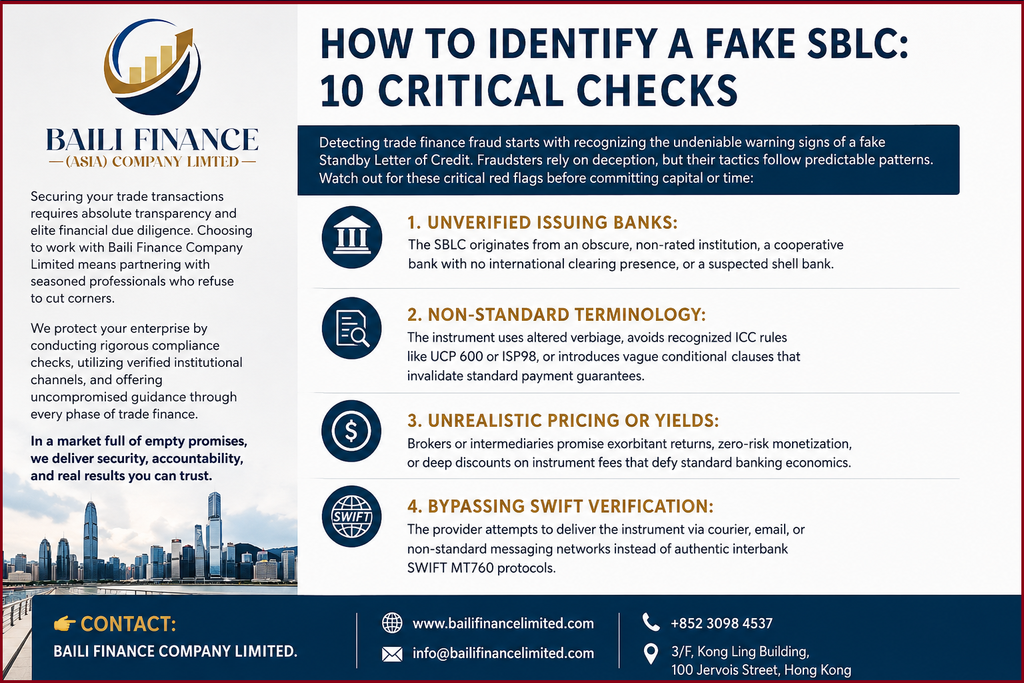
10 Ways to Identify a Fake SBLC
1. Verify the Issuing Bank Independently
Start with the issuing bank.
Don’t rely exclusively on the telephone number, email address, website, or contact person supplied by the party offering the SBLC.
Instead, independently identify the bank using reliable sources and established banking contacts.
Check:
- Official bank name
- Legal entity
- Country of incorporation
- Banking licence or regulatory status
- SWIFT/BIC identifier
- Official website
- Registered address
- Relevant branch
- Authentic contact details
A fake SBLC may name a genuine bank while using fraudulent contact information.
That distinction is critical.
If someone sends you an SBLC and tells you to verify it through a particular email address, don’t assume that the address belongs to the bank.
Find the bank’s official contact information independently and ask the appropriate banking department to verify the transaction.
2. Don’t Treat a PDF as Proof of Issuance
A PDF isn’t an authenticated banking message.
This is one of the most important rules when assessing an SBLC.
A document can contain:
- A bank logo
- A signature
- A stamp
- A reference number
- A SWIFT code
- A senior officer’s name
and still be fraudulent.
A document should therefore serve as transaction information, not as the sole basis for authentication.
The relevant question isn’t:
“Does this document look genuine?”
The better question is:
“Can the issuing bank independently confirm that it issued this undertaking?”
If the answer isn’t clear, stop the transaction until verification occurs.
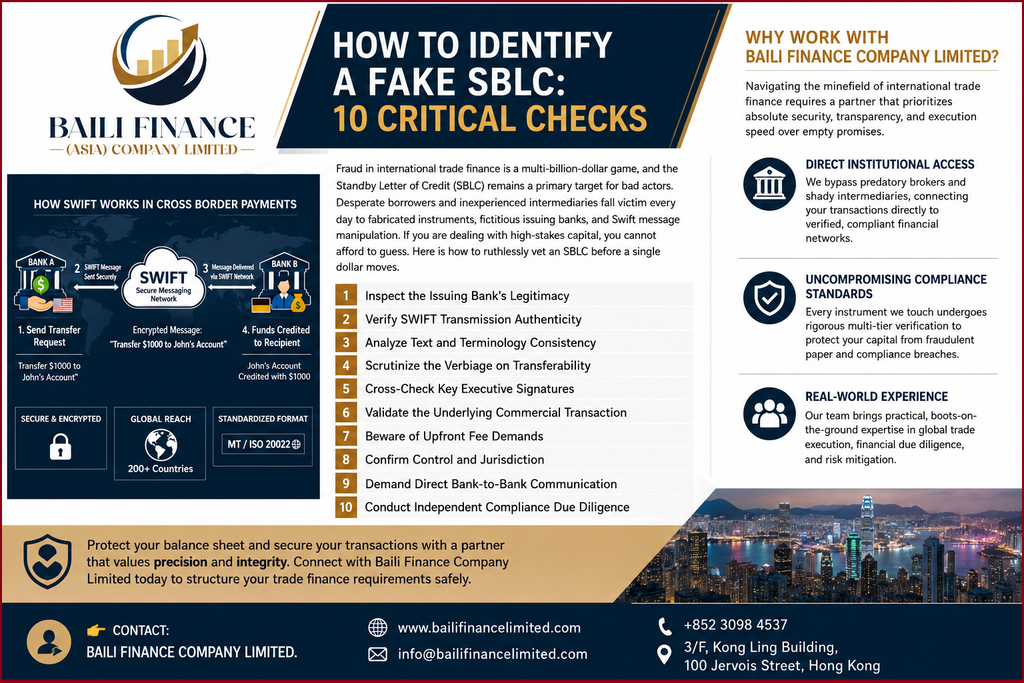
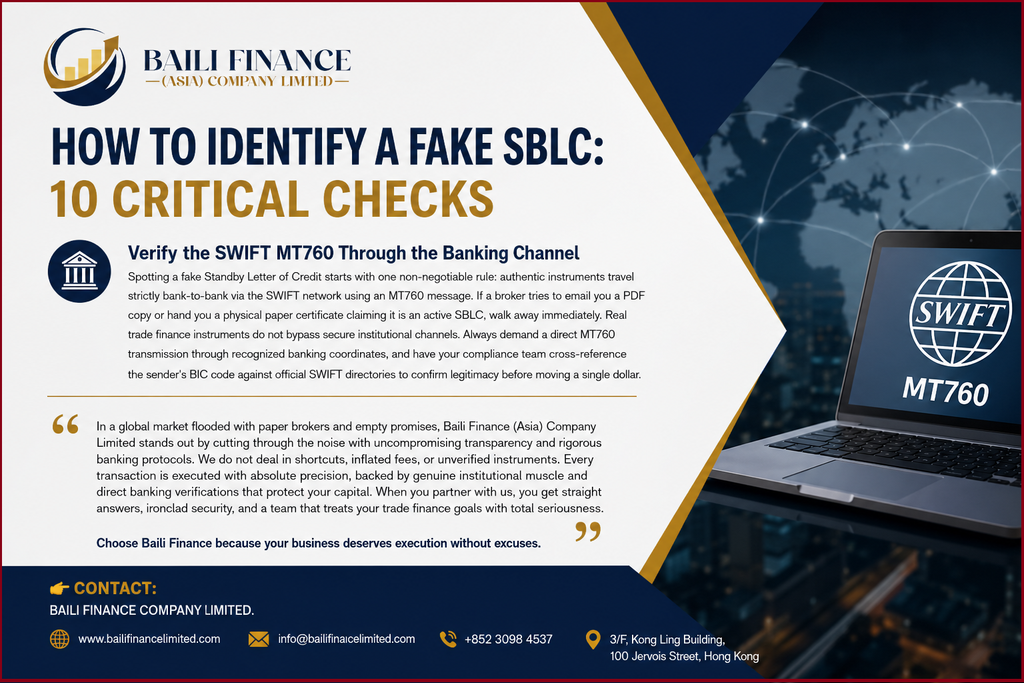
3. Verify the SWIFT MT760 Through the Banking Channel
One of the most common terms in SBLC transactions is SWIFT MT760.
SWIFT documentation identifies MT760 as the message used for the issue of a demand guarantee or standby letter of credit. SWIFT’s standards describe MT760 as a message used by the issuer or advising party in connection with an undertaking.
However, mentioning “MT760” doesn’t make an SBLC genuine.
A fraudster can place the term “MT760” inside a fabricated document.
The relevant verification question is whether the message actually moved through the appropriate banking communication channel and whether the receiving bank can authenticate and process it.
Don’t accept:
- A screenshot claiming that MT760 was sent
- A fabricated SWIFT confirmation
- An emailed “SWIFT copy”
- A PDF containing SWIFT fields
- A transaction tracking image as final evidence
as substitutes for bank-level confirmation.
SWIFT’s documentation also demonstrates that MT760 contains structured information concerning the undertaking, including parties, amount, expiry information and other transaction details.
4. Check the Issuing Bank’s BIC
A BIC, commonly associated with SWIFT identification, helps identify financial institutions involved in international transactions.
A legitimate-looking BIC isn’t enough by itself.
You should check whether:
- The BIC corresponds to the stated institution.
- The institution operates in the stated jurisdiction.
- The bank actually provides the relevant service.
- The transaction information corresponds with the bank’s identity.
- The receiving bank can authenticate the communication.
Fraudsters sometimes use genuine BIC information while impersonating a bank.
Therefore, BIC verification and bank confirmation should work together.
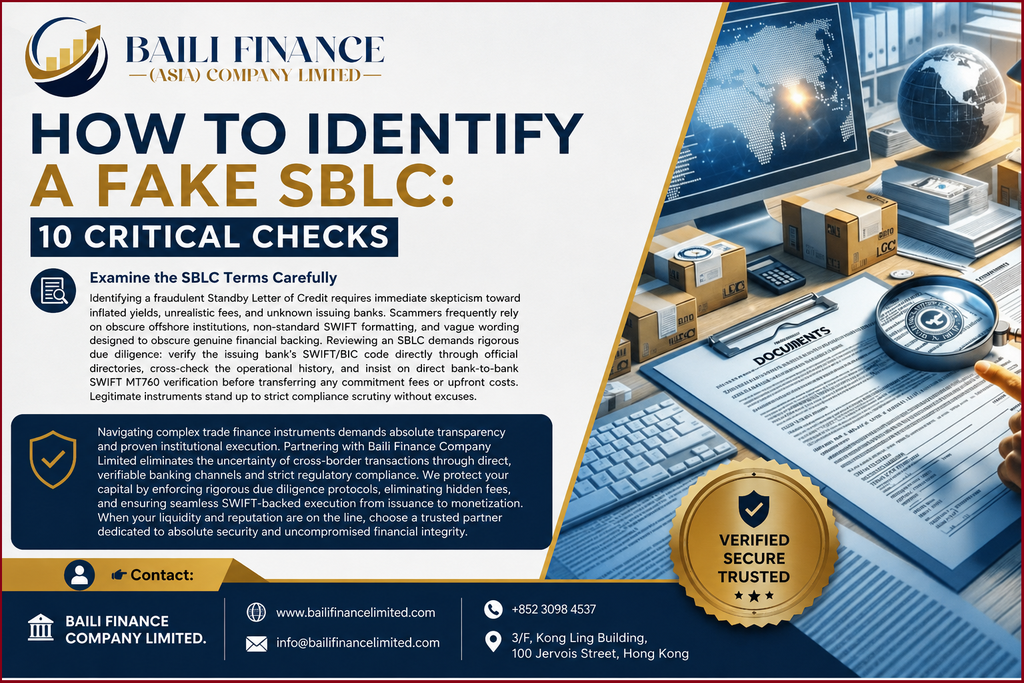
5. Examine the SBLC Terms Carefully
A genuine SBLC should contain coherent commercial and banking terms.
Review:
- Applicant
- Beneficiary
- Issuing bank
- Advising bank, where applicable
- Instrument number
- Issue date
- Expiry date
- Currency
- Amount
- Place of presentation
- Demand requirements
- Applicable rules
- Governing law
- Payment terms
- Amendment provisions
Look for contradictions.
For example, the document might identify one issuing institution while the SWIFT information points to another.
The expiry date might also conflict with the underlying transaction.
The beneficiary’s legal name may differ from the name in the commercial agreement.
Small inconsistencies don’t automatically prove fraud, but unexplained inconsistencies require clarification before the transaction proceeds.
6. Check Whether the Instrument References Recognised Rules
Many legitimate standby transactions use ISP98 or, where applicable, UCP 600.
ISP98 specifically addresses standby letters of credit. The ICC states that the rules apply to standby letters of credit when the undertaking expressly incorporates them.
UCP 600 can also apply to a standby when the credit expressly states that it is subject to those rules.
This doesn’t mean that every genuine SBLC must use identical wording.
It does mean that the applicable rules and contractual language should make sense together.
If someone claims that an SBLC is “automatically governed by every international banking rule,” treat that statement cautiously.
Professional transactions identify the applicable framework rather than relying on vague references to “international banking law.”
7. Investigate the Intermediary Before Paying Fees
A legitimate bank can still be involved in a transaction where an intermediary behaves improperly.
Therefore, don’t verify only the instrument.
Verify the people and companies arranging it.
Review:
- Corporate registration
- Physical business presence
- Domain history
- Professional credentials
- Contractual role
- Banking relationships
- References
- Payment instructions
- Ownership information
- Litigation or regulatory information where available
Pay particular attention to unusual fee structures.
Potential warning signs include:
- Pressure to pay immediately
- “Bank activation fees”
- Unexplained authentication fees
- Payments to unrelated individuals
- Cryptocurrency payment requests
- Personal bank accounts
- Offshore accounts unrelated to the transaction
- Requests for large fees before basic due diligence
A professional transaction should explain why each fee exists, who receives it, and what service it covers.
8. Watch for Unrealistic Promises
A fraudulent SBLC proposal often focuses on guaranteed outcomes.
Be cautious when someone promises:
- Guaranteed monetization
- Guaranteed funding
- Guaranteed returns
- Guaranteed approval
- Immediate cash against any SBLC
- Extremely high loan-to-value ratios
- No due diligence
- No compliance checks
- No bank involvement
- Guaranteed profit from an SBLC
A legitimate financial institution assesses the instrument, issuer, applicant, beneficiary, transaction purpose, jurisdiction, documentation, compliance requirements, and financing structure.
An SBLC doesn’t eliminate those considerations.
In particular, having an SBLC doesn’t automatically create a loan facility.
A financier decides whether it accepts a particular instrument and under what conditions.
9. Confirm the Instrument With the Beneficiary’s Bank
This step can provide an important layer of protection.
If you’re the beneficiary, ask your bank whether it has received and authenticated the relevant bank communication.
If you’re financing or monetizing an SBLC, the proposed receiving or financing bank should conduct its own due diligence.
The bank should be able to determine whether the relevant communication is authentic and whether the instrument satisfies its requirements.
Avoid relying solely on an intermediary saying:
“The bank has confirmed it.”
Ask which bank confirmed it, through which channel, and whether your own financial institution can independently verify the instrument.
10. Stop When the Verification Chain Breaks
A transaction becomes high risk when every verification step depends on the same intermediary.
For example:
Intermediary → provides document → provides bank contact → provides verification email → provides confirmation → requests payment.
That isn’t independent verification.
A stronger process looks like this:
Issuer → banking channel → advising/receiving bank → independent confirmation → transaction decision.
The more independent the verification chain, the stronger the risk controls
Fake SBLC Red Flags Checklist
Before accepting an SBLC, check these warning signs.
Documentation red flags
- Spelling errors in bank information
- Inconsistent dates
- Incorrect bank addresses
- Conflicting reference numbers
- Unusual formatting
- Inconsistent beneficiary names
- Missing expiry provisions
- Unclear presentation requirements
- Unsupported legal claims
Banking red flags
- No bank-to-bank confirmation
- Reliance on screenshots
- Fake SWIFT certificates
- Unverified MT760 claims
- Incorrect BIC information
- Unknown issuing institution
- Refusal to permit bank verification
- Requests to contact only one “bank officer”
Commercial red flags
- Urgent payment demands
- Large upfront fees
- Guaranteed monetization
- Guaranteed financing
- Guaranteed returns
- Unusually high promised proceeds
- No KYC or compliance process
- Pressure to bypass your bank
- Payment to unrelated third parties
One red flag doesn’t automatically prove that an SBLC is fraudulent.
Several red flags appearing together, however, should trigger enhanced due diligence.
Real-World Example: A $10 Million SBLC Offer
Consider a company seeking project finance.
An intermediary offers the company a $10 million SBLC allegedly issued by an international bank.
The intermediary provides:
- A PDF SBLC
- A bank letter
- A SWIFT MT760 screenshot
- A BIC
- A named bank officer
- A five-year validity period
- A promise of immediate monetization
The intermediary then requests a $35,000 “bank activation and authentication fee.”
The company initially considers paying.
Instead, its compliance team independently contacts the alleged issuing bank through official banking channels.
The bank confirms that it hasn’t issued the SBLC.
The PDF contains the bank’s genuine logo, but the transaction doesn’t exist in the bank’s records.
The company avoids the $35,000 payment and prevents a substantially larger financial exposure.
Lesson
The document looked credible.
The banking transaction didn’t exist.
That distinction demonstrates why SBLC authentication must occur through appropriate banking channels rather than through document inspection alone.
Case Study: How a Fake SBLC Can Affect Project Finance
Background
A construction company plans to execute a major infrastructure contract. The project requires financial assurance before the principal releases the first contract milestone.
An intermediary introduces the company to an alleged SBLC provider.
The intermediary proposes a $25 million SBLC from a recognised international bank.
The Initial Proposal
The intermediary sends:
- SBLC draft
- Company profile
- Bank profile
- MT760 copy
- Applicant information
- Beneficiary information
- Engagement agreement
The intermediary claims that monetization will occur immediately after issuance.
The Verification Process
The construction company asks its financial adviser to conduct due diligence.
The review identifies several issues.
First, the issuing bank’s contact information in the proposal differs from the bank’s official contact information.
Second, the SWIFT copy appears only as a PDF.
Third, the intermediary refuses to allow direct bank-to-bank verification before receiving a large upfront fee.
Fourth, the proposed financing provider hasn’t issued a formal commitment to accept the instrument.
Fifth, the SBLC draft contains inconsistent references to the applicant’s legal name.
Decision
The company doesn’t pay the requested fee.
Instead, it asks the proposed receiving bank to confirm whether the instrument has been received and authenticated.
No authenticated instrument exists.
The transaction is terminated.
Key Findings
The company didn’t identify the problem because of one spelling error.
It identified the risk because it applied multiple independent verification controls.
Those controls included:
- Issuer verification
- SWIFT verification
- BIC verification
- Document review
- Counterparty due diligence
- Financing-provider confirmation
- Independent bank communication
Case Study Lesson
A sophisticated fraud doesn’t always depend on an obviously fake document.
It can depend on a genuine bank’s identity being used in a transaction that the bank never authorised.
Therefore, independent verification remains the strongest practical defence.
What a Legitimate SBLC Verification Process Looks Like
A professional verification process should establish several facts.
Step 1: Identify the Issuer
Confirm the full legal identity of the issuing bank.
Step 2: Identify the Parties
Verify the applicant, beneficiary, issuing bank, advising bank and any other relevant financial institution.
Step 3: Review the Instrument
Check the amount, currency, dates, reference number, terms, governing rules and presentation requirements.
Step 4: Verify the Banking Communication
Confirm that the relevant SWIFT communication has reached the appropriate bank through the proper channel.
Step 5: Confirm With the Bank
Use independent banking contacts rather than contact information supplied solely by an intermediary.
Step 6: Conduct Compliance Checks
Review KYC, AML, sanctions, jurisdictional and transaction-specific requirements.
Step 7: Verify Financing Acceptance
If the objective involves SBLC monetization, confirm that the proposed financier actually accepts the issuer, instrument, wording, transaction structure and jurisdiction.
Step 8: Document the Decision
Maintain evidence of the verification process.
This creates an audit trail and allows legal, financial and compliance professionals to understand how the decision was reached.
SBLC Authentication vs. SBLC Verification
These terms often appear together, but the underlying process deserves careful distinction.
SBLC authentication concerns whether the communication or instrument can be established as originating from the claimed bank through an appropriate banking process.
SBLC verification is broader.
It can include:
- Issuer verification
- Instrument verification
- Bank identification
- Applicant verification
- Beneficiary verification
- Transaction verification
- Compliance review
- Contract review
- Financing acceptance
A document may appear authentic while the proposed transaction remains commercially unsuitable.
Therefore, businesses shouldn’t stop after confirming that a message exists.
They should assess whether the entire transaction makes sense.
How SWIFT MT760 Fits Into SBLC Verification
SWIFT messaging provides a structured communication framework used by financial institutions.
SWIFT’s documentation identifies MT760 as an Issue of a Demand Guarantee/Standby Letter of Credit message.
The message format includes structured information concerning the undertaking, including transaction parties, amount and expiry details.
However, this creates an important distinction:
MT760 is a banking message type, not a certificate that anyone can create to prove that an SBLC exists.
A person can create a document that imitates MT760 formatting.
That doesn’t mean a genuine SWIFT message travelled between banks.
Therefore:
Don’t verify MT760 visually. Verify it through the relevant banking institution.
What Documents Should You Request?
Depending on the transaction, your bank, lawyer, compliance adviser or financing provider may require different documents.
Common materials can include:
- SBLC draft
- Final instrument
- Underlying commercial agreement
- Applicant corporate documents
- Beneficiary corporate documents
- Bank information
- Transaction references
- KYC documents
- AML information
- Proof of transaction purpose
- Financing agreement
- Bank-to-bank correspondence
- Relevant SWIFT information
Don’t assume that receiving more documents automatically reduces risk.
Quality matters more than volume.
A hundred copied documents don’t replace one independent bank confirmation.
Why ISP98 Matters
The International Standby Practices 1998 (ISP98) provides a specialised framework for standby letters of credit.
The ICC explains that ISP98 addresses standby-specific issues including obligations, presentation, examination, notice, transfer, reimbursement, timing and related matters.
This makes ISP98 an important reference when reviewing standby transactions.
For authoritative background, see the ICC’s official International Standby Practices resource:
ICC — International Standby Practices (ISP98)
UCP 600 can also apply where the standby expressly incorporates it.
The applicable rules should therefore be identified in the actual instrument rather than assumed.
What to Do If You Suspect a Fake SBLC
Stop before making additional payments.
Then:
- Don’t send further funds.
- Don’t release goods based solely on the document.
- Don’t provide sensitive banking information unnecessarily.
- Preserve every document and communication.
- Contact your bank.
- Request independent issuer verification.
- Contact qualified legal counsel where appropriate.
- Review the intermediary and contracting entities.
- Document the suspected irregularities.
- Consider reporting suspected fraud to the appropriate authorities.
If money has already been transferred, contact your bank immediately.
Time can matter when attempting to prevent or recover a fraudulent payment.
Common Mistakes When Checking an SBLC
Mistake 1: Trusting the Logo
A bank logo doesn’t authenticate an instrument.
Mistake 2: Trusting a SWIFT Screenshot
A screenshot doesn’t prove that a genuine SWIFT message exists.
Mistake 3: Trusting a Broker’s Confirmation
The person selling or arranging the transaction isn’t an independent verifier.
Mistake 4: Focusing Only on the Issuing Bank
A genuine bank can be named in a fraudulent transaction.
Mistake 5: Assuming Monetization Is Guaranteed
An SBLC doesn’t automatically qualify for financing.
Mistake 6: Paying Before Verification
This reverses the appropriate risk sequence.
Verify first. Commit later.
Frequently Asked Questions About Fake SBLCs
1. How can I identify a fake SBLC?
Start by independently verifying the issuing bank, BIC, instrument details and relevant banking communication. Don’t rely solely on a PDF, SWIFT screenshot, email, bank letter or intermediary confirmation. The strongest verification comes through appropriate bank-to-bank channels.
2. Is every SBLC sent through SWIFT MT760 genuine?
No. The existence of an MT760 reference or a document labelled “MT760” doesn’t prove authenticity. SWIFT defines MT760 as a message type used for issuing a demand guarantee or standby letter of credit, but the transaction must be authenticated through the relevant banking process.
3. Can a fake SBLC contain a real bank’s name?
Yes. Fraudsters can impersonate genuine banks and use authentic bank information in fabricated documents. Independent confirmation from the alleged issuing bank is therefore essential.
4. Does an SBLC automatically qualify for monetization?
No. A financier can assess the issuing bank, wording, validity, transaction purpose, jurisdiction, compliance status and financing structure before deciding whether to accept an SBLC. Possessing an SBLC doesn’t itself guarantee funding.
5. What is the difference between an SBLC and a bank guarantee?
They can serve similar commercial purposes, but their legal and operational treatment can differ by jurisdiction, instrument wording and applicable rules. SBLCs commonly operate under ISP98 or, where applicable, UCP 600, while demand guarantees often operate under URDG 758.
6. Should I pay an upfront fee before verifying an SBLC?
You should exercise substantial caution. Before paying any material fee, establish who receives the payment, what service it covers, whether the counterparty is legitimate and whether the underlying instrument has undergone appropriate verification.
7. Can a bank confirm whether an SBLC is genuine?
The appropriate bank can generally determine whether relevant banking communications and instruments have been received or issued through its channels, subject to its procedures, confidentiality requirements and applicable law. Your own bank should guide you on the appropriate verification route.
8. What should I do if an intermediary refuses bank-to-bank verification?
Treat the refusal as a significant warning sign. Don’t allow urgency, promised returns or financing deadlines to replace due diligence. Stop and seek independent professional advice before committing funds.
A Practical Fake SBLC Verification Checklist
Before proceeding, ask these questions:
Issuer
- Is the issuing bank independently verified?
- Does the bank operate in the stated jurisdiction?
- Is the BIC consistent with the claimed bank?
Instrument
- Is the applicant correctly identified?
- Is the beneficiary correctly identified?
- Is the amount correct?
- Is the currency correct?
- Is the expiry date clear?
- Are presentation requirements defined?
- Are the applicable rules identified?
Banking
- Has the receiving bank authenticated the communication?
- Can the bank confirm receipt?
- Is the claimed MT760 supported by actual bank communication?
Counterparty
- Is the intermediary independently verified?
- Does the company have a legitimate corporate presence?
- Are payment instructions consistent with the contracting entity?
Financing
- Has the financier confirmed that it accepts the proposed issuer?
- Has it reviewed the SBLC wording?
- Has it confirmed its financing criteria?
Compliance
- Have KYC and AML requirements been addressed?
- Have sanctions and jurisdictional issues been reviewed?
- Is the underlying transaction legitimate and documented?
If several answers are “no,” don’t proceed until the gaps are resolved.
How Businesses Can Reduce SBLC Fraud Risk
Businesses should establish a written SBLC due diligence procedure rather than making decisions based on sales presentations.
A useful internal policy should require:
- Independent issuer verification
- Bank-to-bank authentication
- Counterparty due diligence
- Legal review
- Compliance screening
- Instrument review
- Commercial-purpose verification
- Financing-provider confirmation
- Document retention
- Payment approval controls
For large transactions, consider involving trade finance professionals, legal counsel and compliance specialists before execution.
This approach reduces dependence on any single intermediary.
It also creates a defensible decision-making process.
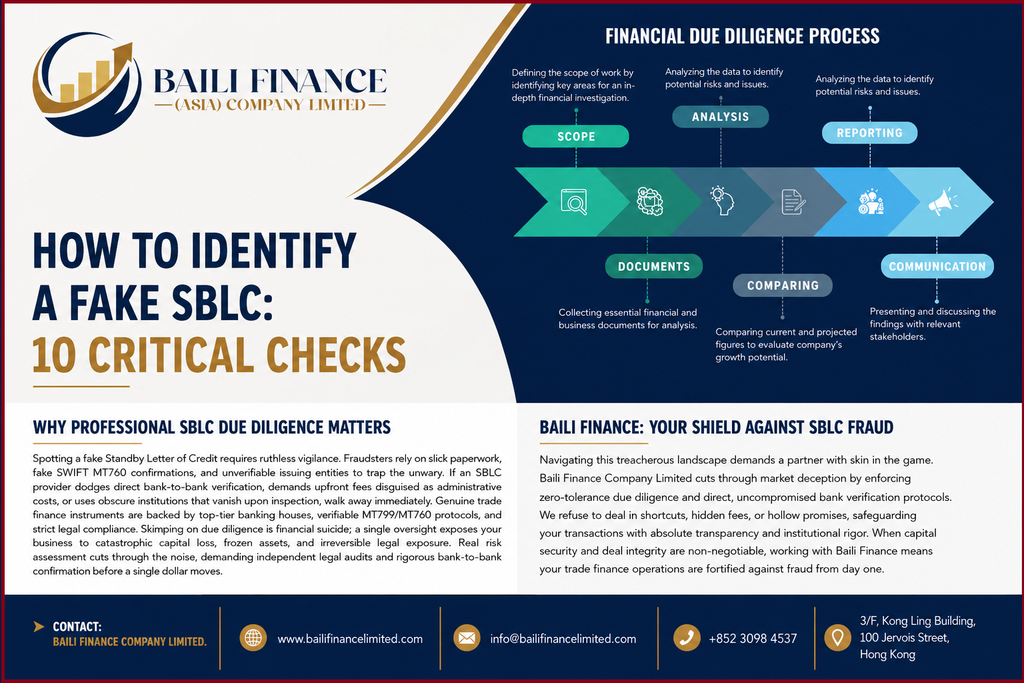
Why Professional SBLC Due Diligence Matters
An SBLC can support legitimate international business when the instrument, parties and transaction structure meet the applicable requirements.
At the same time, the financial value of an SBLC depends on more than the face amount printed on a document.
The issuing bank, instrument wording, enforceability, validity, transaction purpose, applicable rules, beneficiary requirements, receiving bank and financing criteria can all influence the practical value of an SBLC.
That is why professional due diligence should begin before money changes hands.
For businesses evaluating an SBLC provider, financial instrument or monetization structure, the objective shouldn’t be to move quickly at any cost.
The objective should be to establish whether the proposed transaction is authentic, commercially rational, properly documented and independently verifiable.
Final Summary: Verify Before You Trust an SBLC
Knowing how to identify a fake SBLC can protect a company from significant financial and commercial exposure.
The central rule is straightforward:
Never authenticate an SBLC solely by examining the document.
Check the issuing bank independently.
Verify the BIC.
Review the instrument terms.
Understand whether ISP98 or UCP 600 applies.
Don’t treat an MT760 screenshot as proof.
Ask the appropriate bank to verify the relevant banking communication.
Investigate the intermediary.
Review all payment instructions.
Confirm whether the proposed financier actually accepts the instrument.
Most importantly, don’t allow urgency to replace due diligence.
A legitimate SBLC transaction should withstand reasonable scrutiny.
If an intermediary becomes uncomfortable when you ask for independent bank verification, that response itself deserves attention.
Stop before you pay. Verify before you rely. Proceed only when the banking evidence, documentation, counterparties and transaction structure align.
Need Help Reviewing an SBLC?
If you’re considering an SBLC, SBLC monetization, bank guarantee, trade finance transaction or financial instrument, don’t wait until you’ve committed funds to discover a problem.
Send the transaction details to BAILI FINANCE (ASIA) COMPANY LIMITED for a professional discussion about your requirements and the appropriate verification process.
Your transaction may involve substantial capital, cross-border counterparties and strict banking requirements. A proper review at the beginning can prevent avoidable problems later.
Contact BAILI FINANCE today and take the next step with greater transaction discipline.
Visit BAILI FINANCE (ASIA) COMPANY LIMITED
Intermediaries/Consultants/Brokers are welcome to bring their clients 100% protected. Our brokers receive 2% commission for referral. We assist Clients and brokers in their attempt to secure funding by working on their funding requests that may require innovative financing. In complete confidence, we will work together for the benefits of all parties involved.
#SBLC #StandbyLetterOfCredit #SBLCVerification #SBLCAuthentication #FakeSBLC #TradeFinance #BankGuarantee #SWIFTMT760 #SBLCMonetization #FinancialDueDiligence #InternationalTradeFinance