
Headline:Non-Recourse Project Funding Explained
Non-recourse project funding has become an important financing structure for infrastructure, energy, construction, real estate, transportation, manufacturing and other capital-intensive projects. Unlike conventional corporate borrowing, non-recourse project finance focuses primarily on the project’s future cash flow, assets, contracts and operating performance rather than relying on the sponsor’s entire balance sheet.
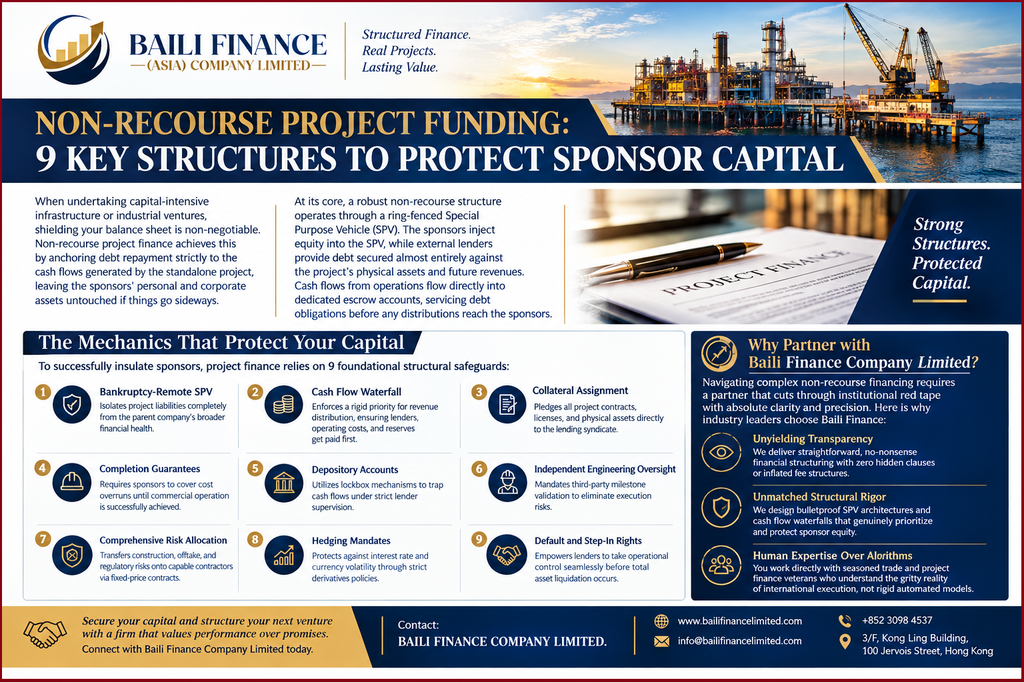
For project developers, investors and business owners, that distinction matters. A well-structured non-recourse project funding arrangement can isolate project liabilities within a dedicated project company, preserve sponsor borrowing capacity and align debt repayment with the project’s ability to generate revenue.
However, non-recourse funding doesn’t mean that lenders accept project risk without protection. Lenders normally require extensive due diligence, security over project assets, contractual protections, financial covenants, insurance, completion support and a credible repayment structure.
The World Bank describes project finance as a structure where repayment depends primarily on the project’s cash flow, with project assets, rights and interests supporting the financing.
That principle defines the commercial logic behind non-recourse project funding.
Keywords: non-recourse project funding, non-recourse project finance, non-recourse project funding solutions, non-recourse project financing, project finance funding, structured project finance, infrastructure project funding, non-recourse loans, project finance solutions, how non-recourse project funding works, how to secure non-recourse project funding, non-recourse project funding for infrastructure, non-recourse financing for renewable energy projects, non-recourse project finance for international projects, how to qualify for non-recourse project finance, non-recourse project funding with SBLC, non-recourse funding for large-scale projects
What Is Non-Recourse Project Funding?
Non-recourse project funding is a financing structure in which the lender primarily relies on the project company’s cash flows and project assets for repayment rather than the general assets of the project’s shareholders.
The structure commonly uses a special purpose vehicle (SPV). The SPV owns the project, enters into key project contracts, receives project revenues and assumes the project’s financing obligations.
The sponsor, meanwhile, owns shares in the SPV but generally doesn’t provide a broad corporate guarantee for the project’s debt.
In a genuine non-recourse structure, the lender’s recovery normally comes from:
- Project operating cash flow
- Project accounts
- Project receivables
- Project contracts
- Project assets
- Insurance proceeds
- Security interests
- Other rights assigned to the project lender
The World Bank notes that lenders under non-recourse financing rely on project cash flows and collateral security over the project rather than shareholder assets. It also notes that many transactions described as non-recourse contain limited-recourse features.
That distinction should never get overlooked.
A transaction may carry the label non-recourse project funding while still requiring completion guarantees, performance guarantees, sponsor undertakings or other forms of limited support.
Non-recourse versus limited-recourse financing
The two structures often appear together because lenders rarely eliminate every form of sponsor support.
Non-recourse financing generally limits lender recovery to the project.
Limited-recourse financing allows the lender to pursue sponsors under specifically defined circumstances.
Those circumstances might include:
- Sponsor fraud
- Misrepresentation
- Breach of certain undertakings
- Failure to contribute agreed equity
- Construction completion obligations
- Cost overruns
- Environmental obligations
- Tax liabilities
- Certain political or regulatory events
- Other negotiated contractual obligations
Therefore, prospective borrowers should examine the actual financing documents rather than rely on the transaction label.
How Non-Recourse Project Funding Works
The structure starts with a viable project.
The sponsor establishes an SPV, which becomes the legal owner or concession holder for the project. The SPV then signs the principal commercial agreements and financing documents.
A simplified structure looks like this:
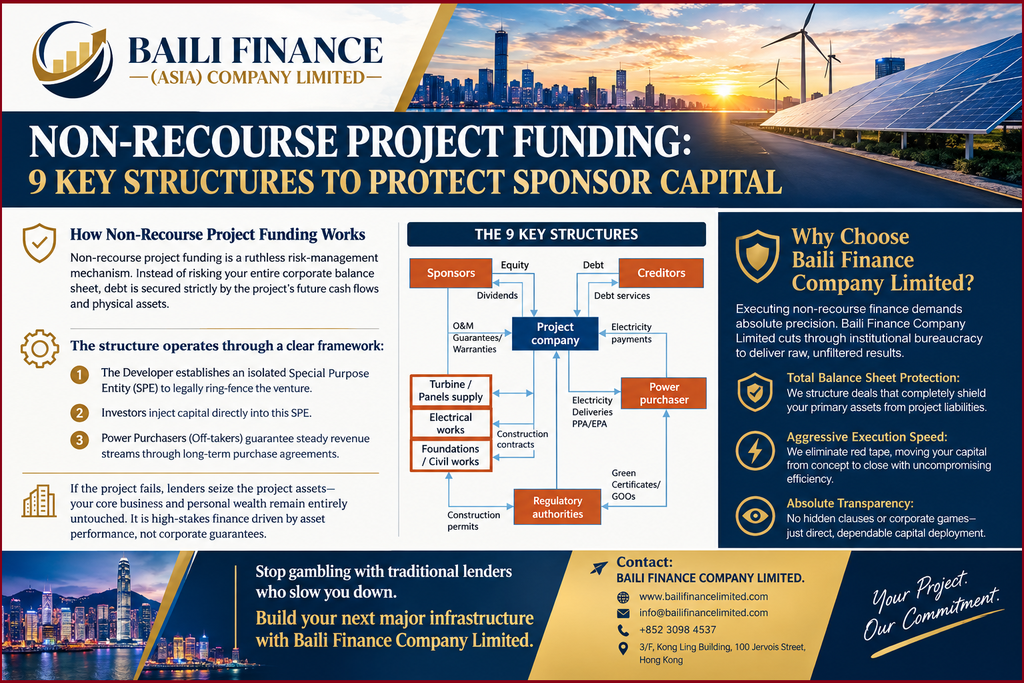
Sponsor → SPV → Project Assets → Operations → Revenue → Debt Service
The sponsor contributes equity to the SPV. Lenders provide debt to the SPV. Contractors construct the asset. Suppliers provide required inputs. Offtakers purchase the project’s output or services.
Revenue then enters the project accounts.
The financing documents establish a controlled cash-flow structure. Operating expenses receive priority, followed by scheduled debt service, reserves and other agreed payments. Only after satisfying those requirements can the SPV distribute available cash to shareholders, subject to the financing agreements.
This approach allows lenders to evaluate the project on its own economics.
The lender therefore asks a different question from a conventional corporate lender.
Instead of asking only whether the sponsor has enough assets to repay the loan, the lender asks:
Can this project generate reliable cash flow sufficient to support its operating costs and debt obligations?
That question drives the entire financing process.
The Role of the Special Purpose Vehicle
The SPV provides the legal and financial separation required for project finance.
The project company normally has a narrow corporate purpose. It owns, develops or operates the specific project and doesn’t normally conduct unrelated commercial activities.
That separation creates several benefits.
1. Risk isolation
Project obligations remain within the project company, subject to the agreed legal structure and applicable law.
2. Dedicated cash flow
Project revenue flows through accounts controlled under the financing arrangements.
3. Security structure
Lenders can take security over project assets, shares, bank accounts, receivables and contractual rights.
4. Transparent financial reporting
The lender can monitor the project’s financial performance independently from the sponsor’s other businesses.
5. Controlled distributions
Financing documents can restrict dividends when the project fails to satisfy agreed financial tests.
The World Bank identifies the SPV as a central feature of project finance and notes that project finance structures depend on contracts that allocate risks between project participants.
Why Sponsors Choose Non-Recourse Project Funding
For the right project, non-recourse funding can offer substantial strategic benefits.
Protecting the sponsor’s balance sheet
A sponsor may have significant assets and existing debt facilities. Adding a large corporate loan could reduce borrowing capacity and affect future investments.
With an appropriately structured project finance transaction, the sponsor can ring-fence the project within an SPV.
The exact accounting treatment depends on applicable accounting standards and the ownership and control structure. Therefore, sponsors should obtain independent accounting advice before claiming off-balance-sheet treatment.
Matching repayment with project revenue
Project finance can align debt service with the expected cash generation of the underlying asset.
For example, a power plant may repay debt from electricity sales. A toll road may repay debt from toll revenues. A port may repay debt from concession and operating revenues.
This creates a direct relationship between the asset’s economics and the financing.
Supporting large capital requirements
Large infrastructure projects can require substantial capital before they generate revenue.
Non-recourse project financing can combine equity and debt at the SPV level, potentially allowing sponsors to undertake projects that would be difficult to finance entirely from corporate balance sheets.
The World Bank notes that project finance can involve substantial debt leverage, although higher leverage also increases the importance of robust due diligence and risk allocation.
Separating project risk from unrelated businesses
A diversified company may operate several businesses across different markets.
If one project encounters construction delays or weaker-than-expected revenue, a ring-fenced structure can help contain the financing exposure, subject to the negotiated recourse provisions.
That separation can matter significantly for sponsors pursuing multiple investments.
9 KEY ELEMENTS OF A BANKABLE NON-RECOURSE PROJECT
Non-recourse funding doesn’t start with the financing application.
It starts with project bankability.
1. A Strong Revenue Model
The project needs a credible source of revenue.
Common revenue models include:
- Power purchase agreements
- Offtake agreements
- Toll collections
- Capacity payments
- Availability payments
- Long-term supply contracts
- Lease income
- User charges
- Processing fees
- Concession revenues
A lender needs confidence that projected revenue can support operating costs and debt service.
A project without a credible repayment source will struggle to achieve non-recourse financing regardless of the sponsor’s intentions.
2. A Defensible Financial Model
A professional financial model should demonstrate:
- Total project cost
- Sources and uses of funds
- Equity contribution
- Debt requirement
- Revenue assumptions
- Operating expenses
- Capital expenditure
- Taxes
- Working capital
- Debt service
- Interest costs
- Cash reserves
- Sensitivity analysis
- Base-case returns
- Downside scenarios
- Debt service coverage
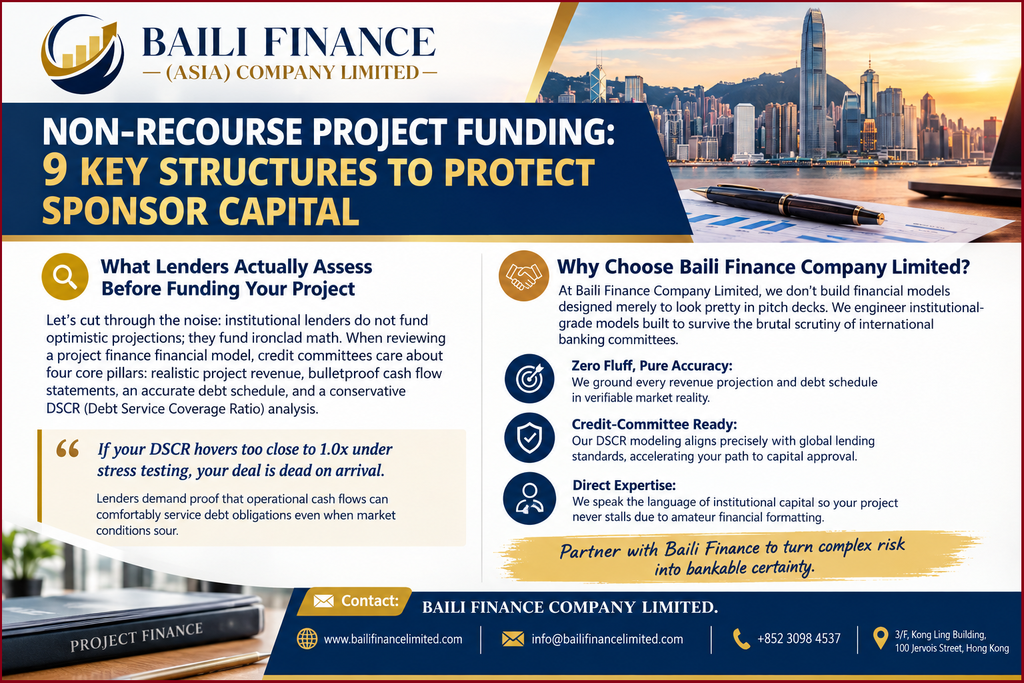
The model should also show how the project performs under adverse conditions.
For example, what happens if construction costs increase by 15%?
What happens if revenue falls by 10%?
What happens if the project reaches commercial operation six months late?
These scenarios help lenders evaluate resilience rather than simply reviewing the base case.
3. Strong Project Contracts
Project finance depends heavily on contracts.
A typical transaction may involve:
- EPC contract
- Operations and maintenance agreement
- Offtake agreement
- Power purchase agreement
- Feedstock supply agreement
- Concession agreement
- Land agreement
- Government support agreement
- Insurance policies
- Direct agreements
- Financing agreements
Each agreement allocates specific risks.
The construction contract, for example, can allocate construction cost and completion risk to the contractor through agreed commercial terms.
The offtake agreement can establish how the project earns revenue.
The supply agreement can address the availability and price of essential inputs.
The stronger the contractual framework, the easier it becomes for lenders to assess the project’s risks.
4. Appropriate Risk Allocation
Lenders don’t want the SPV to carry every project risk.
Instead, project finance distributes risk among the parties best positioned to manage it.
For example:
| Risk | Typical Responsible Party |
|---|---|
| Construction delay | EPC contractor |
| Operating performance | O&M contractor |
| Input supply | Supplier |
| Revenue/offtake | Offtaker |
| Political risk | Government/insurance where available |
| Financing risk | Lenders and sponsors |
| Market risk | Project company or contracted counterparty |
| Force majeure | Contractually allocated |
| Environmental compliance | Project company and relevant contractors |
The exact allocation depends on the project.
A lender will examine whether the party accepting each risk has the technical, financial and legal capacity to manage it.
5. Experienced Sponsors
Non-recourse financing doesn’t eliminate sponsor evaluation.
Lenders still examine the sponsor’s:
- Track record
- Financial capacity
- Management experience
- Technical expertise
- Ownership structure
- Reputation
- Equity commitment
- Governance
- Legal standing
A sponsor doesn’t necessarily need to guarantee the project’s debt.
However, the lender still needs confidence that the sponsor can perform its agreed obligations.
6. Technical Feasibility
A project must work technically.
Independent technical advisers may examine:
- Technology
- Site conditions
- Equipment
- Production capacity
- Construction schedule
- Operating assumptions
- Maintenance requirements
- Resource availability
- Engineering design
- Equipment suppliers
A technically weak project creates financing risk even when its financial projections appear attractive.
7. Legal and Regulatory Readiness
A lender needs to know that the project can legally operate.
Depending on the sector and jurisdiction, the project may require:
- Land rights
- Environmental approvals
- Construction permits
- Operating licenses
- Concessions
- Import approvals
- Grid connection rights
- Tax approvals
- Foreign exchange permissions
- Government agreements
Missing approvals can delay financial close.
8. Environmental and Social Standards
Institutional lenders increasingly examine environmental and social factors as part of project due diligence.
IFC, for example, considers technical soundness, profitability, economic benefit and environmental and social standards when assessing potential financing.
Sponsors should therefore address environmental and social risks early.
That includes identifying potential impacts, establishing mitigation measures and demonstrating compliance with applicable laws and lender standards.
9. A Clear Security Package
Non-recourse doesn’t mean unsecured.
Lenders commonly seek security over the project company’s assets and rights.
Potential security can include:
- Mortgage over project property
- Security over equipment
- Assignment of project receivables
- Pledge of project bank accounts
- Assignment of insurance proceeds
- Assignment of material contracts
- Share pledges
- Security over project rights
- Direct agreements with major counterparties
The EBRD, for example, notes that project financing can include security over fixed and movable assets, project earnings, bank accounts, insurance policies, shares and contractual benefits.
Non-Recourse Project Funding for Different Industries
The structure can apply across multiple sectors where the project has identifiable assets, contracts and revenue.
Renewable energy
Solar farms, wind farms, hydroelectric facilities and other renewable energy assets can use project finance where revenue visibility supports debt repayment.
Long-term power purchase agreements often play an important role because lenders need confidence in future revenue.
Infrastructure
Infrastructure projects can include:
- Roads
- Ports
- Airports
- Railways
- Water treatment
- Waste management
- Telecommunications
- Public infrastructure
Where a concession or availability-payment model creates predictable revenue, project finance can provide a suitable structure.
Real estate development
Certain income-generating real estate projects can support structured financing where the asset generates predictable rental or operating income.
However, speculative development without reliable cash flow may require a different capital structure.
Manufacturing
Manufacturing projects may qualify where they have established buyers, reliable supply arrangements, proven technology and credible operating forecasts.
Mining and natural resources
Resource projects can use project finance when reserves, production assumptions, commodity exposure, infrastructure and offtake arrangements support a credible financing case.
Healthcare
Hospitals, diagnostic facilities and specialised healthcare assets can potentially use project financing when contractual or operating revenue provides sufficient visibility.
The Financing Process: From Project Concept to Financial Close
A professional financing process usually follows several stages.
Stage 1: Project screening
The financing adviser or lender evaluates the project’s sector, jurisdiction, capital requirement, revenue model and development stage.
Stage 2: Documentation review
The sponsor provides corporate documents, project information, financial projections, contracts and supporting evidence.
Stage 3: Due diligence
Financial, legal, technical, environmental and commercial specialists review the transaction.
Stage 4: Financial structuring
The parties determine:
- Debt size
- Equity requirement
- Tenor
- Interest structure
- Repayment profile
- Reserve requirements
- Security package
- Covenants
- Completion support
- Recourse limitations
Stage 5: Credit assessment
The lender evaluates the project’s risk and determines whether the proposed structure meets its credit requirements.
Stage 6: Documentation
Legal advisers prepare and negotiate the financing agreements, security documents and direct agreements.
Stage 7: Conditions precedent
The borrower satisfies agreed requirements before the lender makes the financing available.
Stage 8: Financial close
The parties complete the required documentation and funding becomes available according to the agreed conditions.
Stage 9: Construction and monitoring
The lender monitors project progress, financial performance, compliance and debt service.
This process can take substantial time for complex transactions. The World Bank notes that project finance often requires significant contractual structuring and due diligence.
Real-World Example: Poznań Waste-to-Energy Project
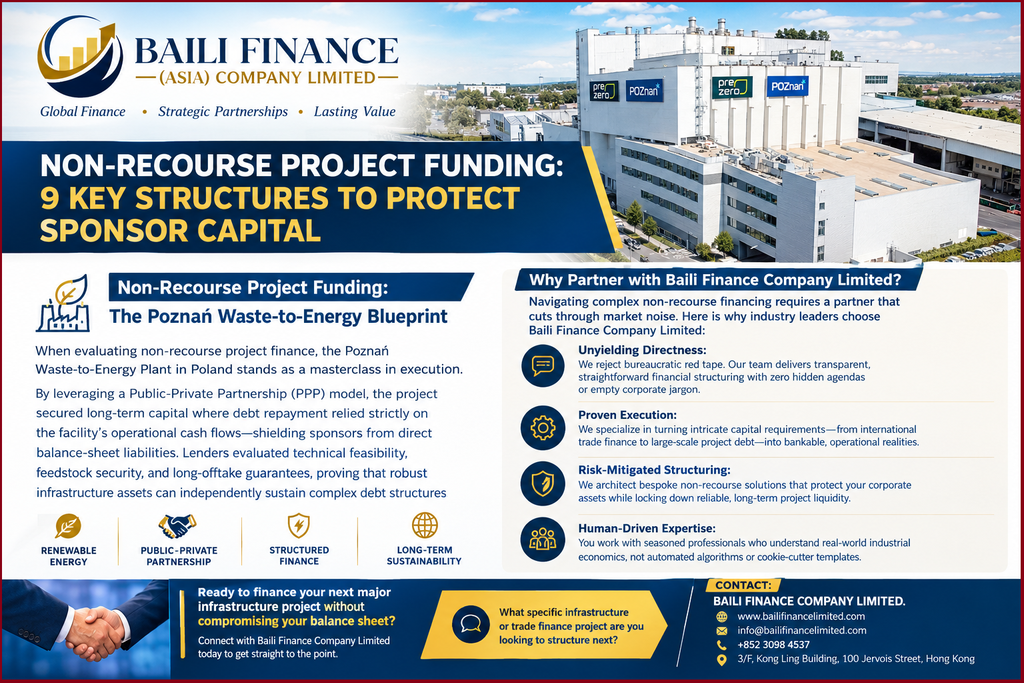
A useful real-world example comes from Poznań, Poland.
The city’s municipal waste thermal treatment project combined public-sector involvement with private-sector project financing. The project had an estimated capital investment of PLN 725 million, with part of the funding coming from an EU Cohesion Fund subsidy and the remaining requirement financed through equity and a non-recourse loan from a consortium of three commercial banks.
The project began operations in 2017 and produces electricity and heat.
The financing structure demonstrates an important principle: the lender doesn’t need the sponsor’s entire corporate balance sheet when the project has a defined asset, identifiable revenues and a contractual framework that supports repayment.
The project also illustrates why project finance requires more than debt.
The city, private partner, lenders and project stakeholders each had defined economic and contractual roles.
Case Study: When Non-Recourse Financing Becomes Limited Recourse
Consider the Manila Water example discussed by the World Bank.
In 1997, a concession for the eastern section of Metro Manila was awarded to Manila Water Company through a consortium involving Ayala Corporation, United Utilities, Bechtel and Mitsubishi Corporation.
Following the Asian Financial Crisis, the project company couldn’t raise the required debt on a non-recourse project finance basis.
Ayala therefore provided a corporate guarantee to support the project company.
This case matters because it shows what happens when market conditions don’t provide sufficient comfort for pure non-recourse funding.
The lesson is direct:
A financing structure must respond to project risk and market conditions.
A sponsor may initially target non-recourse project finance, but lenders may require additional support before committing capital.
That support can include guarantees, completion undertakings, reserve accounts or other credit enhancements.
Sponsors should therefore approach financing with a structured plan rather than treating “non-recourse” as an automatic entitlement.
External source: World Bank’s project finance guidance” to the World Bank’s official Project Finance – Key Concepts
World Bank — Project Finance: Key Concepts
Can an SBLC or Bank Guarantee Support Project Funding?
An SBLC, or Standby Letter of Credit, can sometimes support a broader financing structure where the relevant lender or counterparty accepts the instrument as credit support.
However, an SBLC doesn’t automatically convert an unbankable project into a financeable project.
The underlying transaction still matters.
A lender may assess:
- Issuing bank
- Instrument wording
- Beneficiary
- Amount
- Tenor
- Governing rules
- Transaction purpose
- Project economics
- Sponsor
- Source of funds
- Repayment structure
- Compliance requirements
Similarly, a bank guarantee can support specific contractual obligations, depending on its terms and the requirements of the beneficiary.
At Baili Finance, the company’s published financing solutions include non-recourse funding, project finance, SBLC issuance and monetization, bank guarantees and structured finance solutions.
Still, prospective clients should distinguish between credit enhancement and actual project capital.
An instrument may strengthen a financing structure, but it doesn’t remove the lender’s need to evaluate project viability, documentation, compliance and repayment capacity.
How to Prepare a Non-Recourse Funding Application
Before approaching a funding partner, prepare a professional financing package.
At minimum, consider including:
- Executive summary
- Company profile
- Project description
- Total project cost
- Funding requirement
- Sponsor equity contribution
- Business model
- Market analysis
- Feasibility study
- Financial model
- Projected cash flow
- Debt repayment proposal
- Existing contracts
- Offtake agreements
- EPC information
- Permits and approvals
- Technical reports
- Environmental documentation
- Corporate documents
- Ownership structure
- Proposed security
- Proposed financing structure
- Timeline
- Exit or repayment strategy
The stronger the initial package, the easier it becomes for a financing professional to determine whether the transaction fits a potential funding structure.
Common Mistakes That Delay Project Funding
Approaching lenders too early
A project concept isn’t the same as a bankable project.
Inflating projected revenue
Aggressive assumptions weaken lender confidence.
Ignoring sponsor equity
Non-recourse debt doesn’t mean the sponsor contributes nothing.
Treating an SBLC as automatic funding
A bank instrument can provide credit support, but financing still requires underwriting.
Underestimating legal requirements
Project finance involves multiple contracts, security documents and jurisdictions.
Ignoring downside scenarios
A lender needs to understand what happens when assumptions fail.
Using vague funding requests
“Need $100 million for a project” doesn’t provide enough information.
A professional request should explain the project, funding requirement, repayment source, transaction structure and supporting documentation.
Advantages and Limitations of Non-Recourse Project Funding
The structure offers important benefits, but it also has costs.
Advantages
- Limits sponsor exposure, subject to agreed recourse provisions
- Aligns repayment with project cash flow
- Can preserve corporate borrowing capacity
- Separates project liabilities from other businesses
- Supports large capital projects
- Encourages disciplined risk allocation
- Can bring multiple financing parties into one structure
- Creates a dedicated financial framework for the project
Limitations
- Extensive due diligence
- Higher transaction costs
- Complex documentation
- Longer preparation periods
- Higher financing costs in some cases
- Strong project contracts required
- Detailed financial modelling required
- Strict financial covenants
- Potential completion support
- Limited flexibility after financial close
The World Bank specifically notes that project finance can involve higher financing and transaction costs than simpler borrowing structures, particularly because of the contractual and due diligence requirements.
For that reason, non-recourse project finance usually makes more sense for projects large enough and stable enough to justify the additional structuring effort.
How to Determine Whether Your Project Qualifies
There isn’t one universal qualification test.
Instead, lenders typically consider the combined strength of the project.
Ask these questions:
Does the project have a clear revenue source?
Can the project generate enough cash flow to service debt?
Does the project have experienced management or sponsors?
Are major contracts already negotiated?
Does the project have required permits?
Can construction and operating risks receive appropriate contractual allocation?
Does the technology have sufficient commercial evidence?
Can the project withstand downside scenarios?
Can lenders obtain acceptable security over project assets and contractual rights?
Does the proposed capital structure provide sufficient equity?
If several answers remain uncertain, the project may require further development before approaching institutional funding sources.
Frequently Asked Questions About Non-Recourse Project Funding
What is non-recourse project funding?
Non-recourse project funding finances a project primarily through the project’s expected cash flow and assets rather than the broader assets of its sponsors. The financing normally sits within a dedicated SPV, with lender recovery limited primarily to the project, subject to agreed exceptions.
Is non-recourse financing the same as a project loan?
Not always. Project finance commonly uses a non-recourse or limited-recourse structure, but the exact terms depend on the transaction. Some project loans include sponsor guarantees, completion support or other limited forms of recourse.
What projects can qualify for non-recourse funding?
Potential candidates include renewable energy, power generation, infrastructure, transportation, manufacturing, mining, real estate, telecommunications, water treatment and other projects with identifiable assets and predictable revenue.
The key issue isn’t simply the sector. The lender needs to understand how the project will generate cash and repay its obligations.
Does the sponsor need to contribute equity?
Usually, yes. A project sponsor generally contributes equity because lenders rarely expect debt to fund the entire project cost.
The appropriate debt-to-equity ratio depends on project risk, cash flow, jurisdiction, contracts, lender requirements and market conditions.
Can an SBLC support non-recourse project funding?
An SBLC may support a financing transaction when the relevant lender accepts it and the instrument satisfies the lender’s requirements. However, an SBLC doesn’t automatically guarantee project funding. The project still needs a credible business model, acceptable documentation and a viable repayment structure.
How long does non-recourse project financing take?
There is no universal timeline. Smaller and well-prepared transactions can progress more efficiently, while major infrastructure and cross-border transactions may require extensive financial, legal, technical, environmental and commercial due diligence.
Does non-recourse mean the lender has no security?
No.
Non-recourse refers primarily to the lender’s ability to pursue the sponsor beyond the project. Lenders can still take substantial security over project assets, accounts, receivables, shares, insurance proceeds and contractual rights.
Why do lenders prefer project cash flow?
Project cash flow provides the primary repayment source.
When the project generates predictable revenue, lenders can analyse debt service capacity using measures such as the Debt Service Coverage Ratio (DSCR), cash flow projections, reserve requirements and downside scenarios.
The Strategic Importance of Proper Project Structuring
Non-recourse project funding works best when the financial structure reflects the commercial structure.
The project company should have clearly defined rights.
The contracts should allocate risks to capable counterparties.
The financial model should withstand reasonable stress scenarios.
The debt should match the project’s cash-generation profile.
The security package should protect lenders without undermining the project’s operating flexibility.
The sponsor should understand exactly where its obligations begin and end.
That level of preparation creates a more credible financing proposition.
It also improves discussions with banks, private lenders, development finance institutions, institutional investors and other capital providers.
Final Summary: Fund the Project, Not Just the Proposal
Non-recourse project funding can provide a sophisticated route to financing large-scale projects without placing the entire financial burden on the sponsor’s corporate balance sheet.
But the structure requires more than a funding request.
It requires a viable project, credible revenue, experienced sponsors, appropriate equity, strong contracts, independent due diligence, sound financial modelling and a carefully negotiated security package.
The strongest transactions make repayment logic clear.
They show where revenue comes from.
They explain how risks get allocated.
They demonstrate how debt gets serviced.
They establish what happens if the project underperforms.
Most importantly, they give lenders a reason to believe that the project can stand on its own financial merits.
If you’re seeking non-recourse project funding, don’t approach the market with an incomplete proposal. Prepare the project properly, define the funding requirement and present the transaction in a structure that professional financiers can assess.
Your project may have the commercial potential. The next question is whether its financing structure can withstand professional scrutiny.
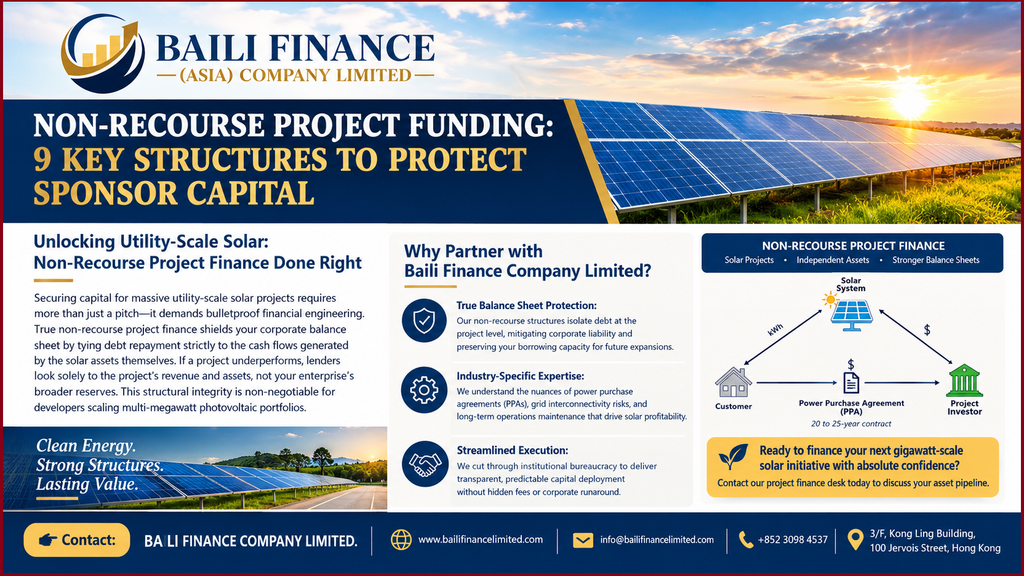
Ready to Discuss Your Non-Recourse Funding Requirement?
If you’re developing an infrastructure project, renewable energy project, manufacturing facility, real estate development, transportation asset, international commercial venture or another capital-intensive project, Baili Finance can assess your funding requirement and discuss an appropriate financing pathway.
Don’t send a generic funding request.
Send a financing case.
Provide the project size, location, development stage, total investment, required funding, available equity, projected revenue, repayment source and existing contracts.
From there, a professional assessment can determine whether the transaction may fit a non-recourse funding, limited-recourse project finance, structured finance, project loan, SBLC-supported funding or other financing structure.
Visit www.bailifinancelimited.com and contact Baili Finance to discuss your project funding requirement.
If the project is commercially viable, the next step is to structure the capital around the project’s economics. Start the conversation now.
Intermediaries/Consultants/Brokers are welcome to bring their clients 100% protected. Our brokers receive 2% commission for referral. We assist Clients and brokers in their attempt to secure funding by working on their funding requests that may require innovative financing. In complete confidence, we will work together for the benefits of all parties involved.
#nonrecoursefunding #projectfinance #projectfunding #structuredfinance #infrastructurefinance