
Headline: Structured Project Finance: A Complete Guide
Structured project finance is a financing approach designed around a project’s expected cash flows, assets, contracts, risks, and revenue-generating capacity rather than relying primarily on the balance sheet of the project sponsor. Used across infrastructure, energy, real estate, mining, transport, telecommunications, manufacturing, and public-private partnership projects, structured project finance can provide a framework for raising substantial capital while aligning debt, equity, security, risk allocation, and repayment with the economics of the underlying project.
For businesses seeking project finance solutions, understanding how a transaction is structured matters as much as identifying a source of capital. Lenders don’t simply ask how much money a project needs. They assess how the project will generate cash, which party controls each material risk, how debt will be repaid, what security supports the financing, and whether the contractual structure can withstand changes in project conditions.
That distinction makes structured project finance different from conventional corporate borrowing.
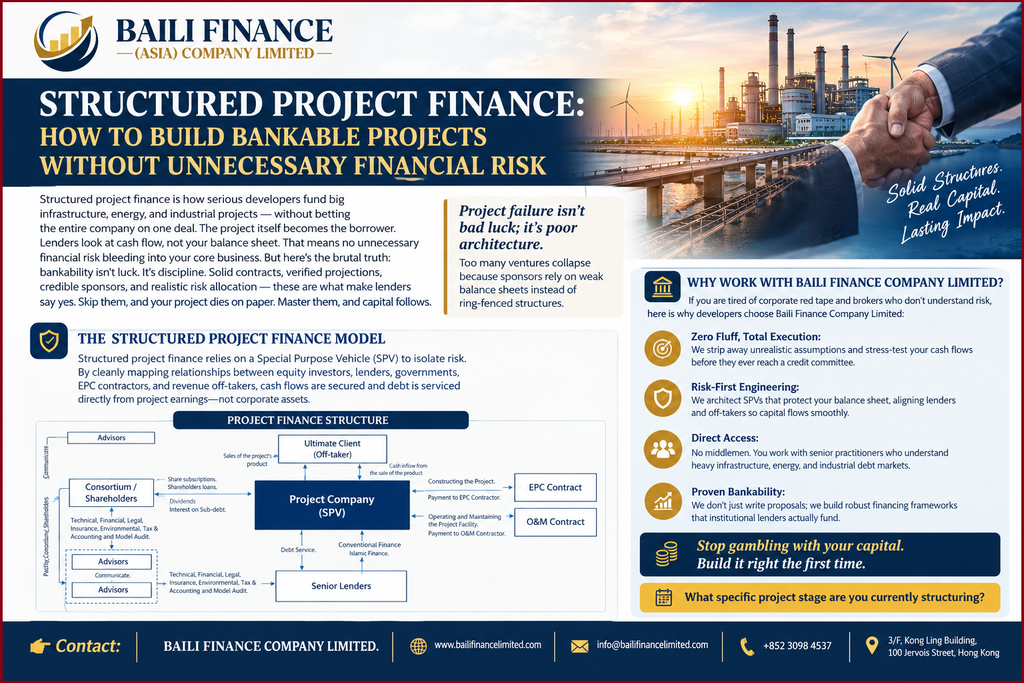
The World Bank describes a typical project finance structure as involving a special purpose vehicle (SPV) that holds the project assets and contracts, with financing provided to the SPV and repayment primarily supported by the project’s future cash flows.
For sponsors, investors, developers, lenders, governments, and institutional capital providers, the objective is therefore clear: create a financing structure in which the project’s commercial fundamentals support the required capital.
Keywords: structured project finance, project finance, structured finance, project financing, project finance solutions, project funding, infrastructure finance, project finance structure, project finance advisory, project finance company, project finance services, project development finance, bankable project finance, financial structuring, project finance investment, project finance for infrastructure, structured project finance explained, how structured project finance works, guide to bankable projects,
WHAT IS STRUCTURED PROJECT FINANCE?
Structured project finance combines financial engineering, commercial contracts, risk management, legal structuring, financial modelling, credit analysis, and capital allocation to finance a specific project.
Instead of treating the sponsor’s entire business as the primary source of repayment, the transaction establishes a defined financing structure around the project.
A typical structure may include:
- A project sponsor or developer
- A special purpose vehicle
- Equity investors
- Commercial banks
- Development finance institutions
- Construction contractors
- Operations and maintenance contractors
- Off-takers or customers
- Suppliers
- Insurers
- Government authorities
- Technical, legal, financial, and environmental advisers
The SPV generally signs the principal project contracts and receives the project’s revenues. Lenders then assess whether those revenues can support operating expenses, debt service, reserves, and acceptable returns to equity investors.
The World Bank notes that, under project finance, lenders generally lend to the project company rather than directly to the sponsor, with security focused on project assets and contractual rights.
This structure can provide limited-recourse or non-recourse characteristics, although the precise level of sponsor support depends on the transaction.
Why does the structure matter?
A project can have a sound commercial concept and still fail to attract financing.
That happens when the revenue model remains uncertain, project contracts don’t allocate risk clearly, permits remain unresolved, construction costs aren’t sufficiently controlled, or the projected cash flow doesn’t provide adequate debt-service coverage.
Structuring addresses these issues before capital is committed.
Building the transaction carefully, advisers examine the project from several perspectives at once. The legal structure must support the financial model. The financial model must reflect the commercial contracts. The contracts must allocate risk realistically. The security package must give lenders enforceable rights. Finally, the projected cash flow must support the proposed capital structure.
That interconnected process is the foundation of bankable project finance.
HOW STRUCTURED PROJECT FINANCE WORKS
A structured project finance transaction usually begins with project development and feasibility analysis.
The sponsor defines the project, estimates development and construction costs, identifies the revenue model, assesses the market, obtains required approvals, and determines the capital requirement.
The transaction then progresses through several stages.
1. Project identification and feasibility
The first stage establishes whether the project has a credible commercial foundation.
The analysis normally covers:
- Technical feasibility
- Market demand
- Capital expenditure
- Operating expenditure
- Revenue assumptions
- Construction timetable
- Operating period
- Regulatory requirements
- Environmental and social considerations
- Tax implications
- Foreign exchange exposure
- Interest-rate exposure
- Insurance requirements
- Political and country risks
Financial feasibility becomes particularly important because lenders ultimately need confidence that the project’s cash flow can support debt repayment.
2. Creation of the project company
Sponsors often establish an SPV specifically for the transaction.
The SPV separates the project’s assets, liabilities, contracts, revenues, and financing arrangements from other businesses owned by the sponsor.
For example, a renewable energy developer may establish a project company for one solar power plant. That company can then enter into the power purchase agreement, construction contract, operations agreement, land arrangements, insurance policies, and financing documents.
This separation helps stakeholders identify exactly which assets and cash flows support the financing.
3. Capital structure
The next step involves determining the appropriate mix of debt and equity.
The capital structure can include:
Equity: Capital contributed by sponsors or investors.
Senior debt: Debt that receives priority repayment and generally carries security over project assets and contractual rights.
Mezzanine or subordinated debt: Financing positioned below senior debt in the repayment hierarchy.
Development finance: Capital provided by development finance institutions where the project’s characteristics and development objectives meet their criteria.
Government support: Depending on the transaction, this can include guarantees, viability-gap support, subsidies, grants, or other forms of credit enhancement.
Bond financing: Larger projects may access institutional investors through project bonds once the transaction meets the relevant requirements.
The correct capital structure depends on project cash flow, risk allocation, market conditions, sponsor strength, currency, tenor, security, and lender requirements.
There isn’t a universal debt-to-equity ratio that applies to every project.
THE ROLE OF THE SPECIAL PURPOSE VEHICLE
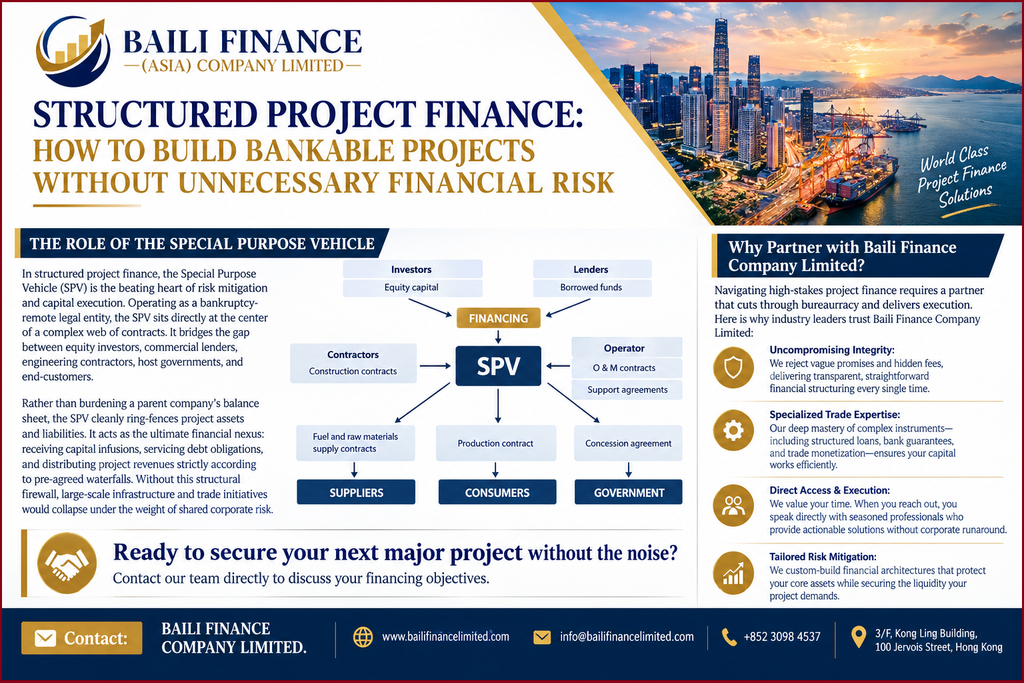
The special purpose vehicle sits at the centre of many project finance structures.
Its purpose is straightforward: isolate the project and create a legal entity through which the project can own assets, enter contracts, receive revenues, incur debt, and distribute cash.
Consider a project requiring $100 million.
The sponsor could establish an SPV that owns the project assets and raises $70 million in debt and $30 million in equity, subject to the project’s financial model and lender requirements.
The project then generates operating revenue.
That revenue enters the SPV.
Operating expenses are paid first. Debt service follows according to the financing documents. Required reserve accounts receive funding. Other permitted payments are made according to the agreed cash waterfall. Subject to applicable restrictions, remaining cash may then be distributed to equity investors.
This approach gives lenders visibility over the source and application of project cash.
It also creates contractual discipline.
CASH FLOW IS CENTRAL TO PROJECT FINANCE
A structured project finance transaction depends heavily on predictable cash flow.
The lender’s central question is not simply:
How valuable is the project?
The more relevant question is:
Can the project generate sufficient cash, at the required times, to meet its contractual obligations?
That distinction affects the entire financing structure.
A project may own valuable physical assets but still experience financial stress if revenues arrive late, costs increase substantially, production falls below expectations, or the project cannot access its intended market.
Therefore, financial modelling plays a central role.
A typical model projects:
- Construction costs
- Operating costs
- Revenue
- Taxes
- Working capital
- Debt drawdowns
- Interest
- Principal repayments
- Reserve accounts
- Cash balances
- Equity contributions
- Distributions
- Refinancing
- Exit proceeds
The model then produces financial metrics that lenders and investors use to assess the transaction.
KEY PROJECT FINANCE METRICS
Several metrics commonly appear in structured project finance analysis.
Debt Service Coverage Ratio
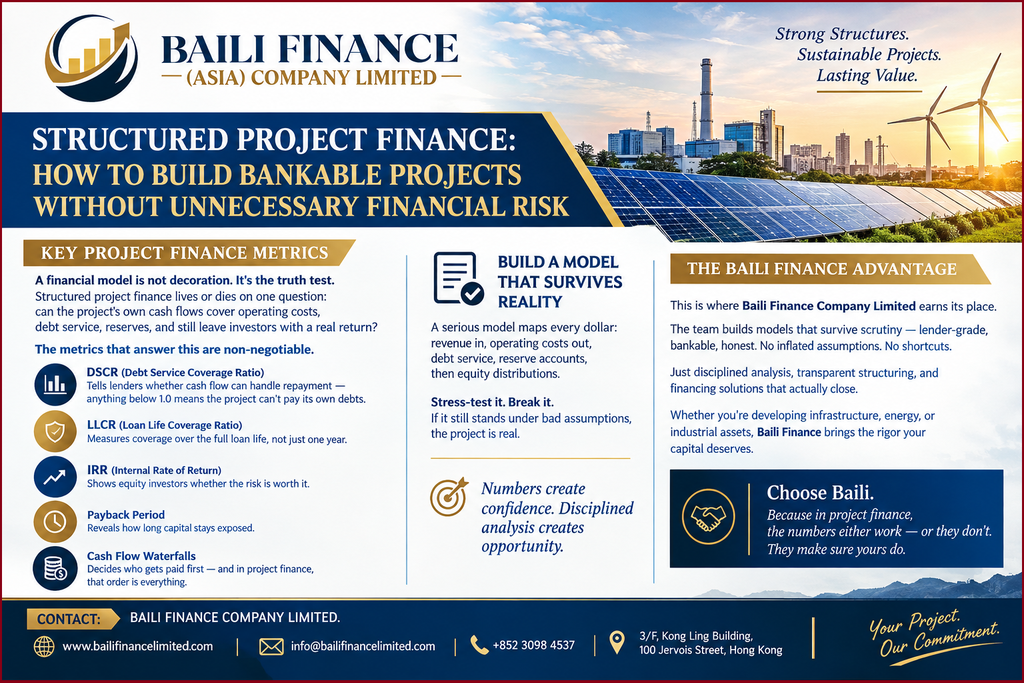
The Debt Service Coverage Ratio (DSCR) measures the project’s ability to meet scheduled debt service from available cash flow.
A simplified formula is:
DSCR = Cash Flow Available for Debt Service ÷ Debt Service
A DSCR above 1.0x indicates that the project generates more cash than the amount required for scheduled debt service during the measured period.
Lenders generally establish minimum DSCR requirements based on the project’s risk profile.
Loan Life Coverage Ratio
The Loan Life Coverage Ratio (LLCR) compares the present value of cash flow available for debt service over the loan period with outstanding debt.
It helps lenders assess whether projected project cash flows provide sufficient coverage across the life of the financing.
Project Life Coverage Ratio
The Project Life Coverage Ratio (PLCR) extends the analysis beyond the scheduled loan maturity to consider cash flows generated over the remaining project life.
Internal Rate of Return
Investors also evaluate the Internal Rate of Return (IRR) and other equity-return measures.
Debt providers and equity investors assess the same project from different risk positions. Lenders focus heavily on repayment capacity and downside protection. Equity investors generally accept greater risk in exchange for potential residual returns.
RISK ALLOCATION IN STRUCTURED PROJECT FINANCE
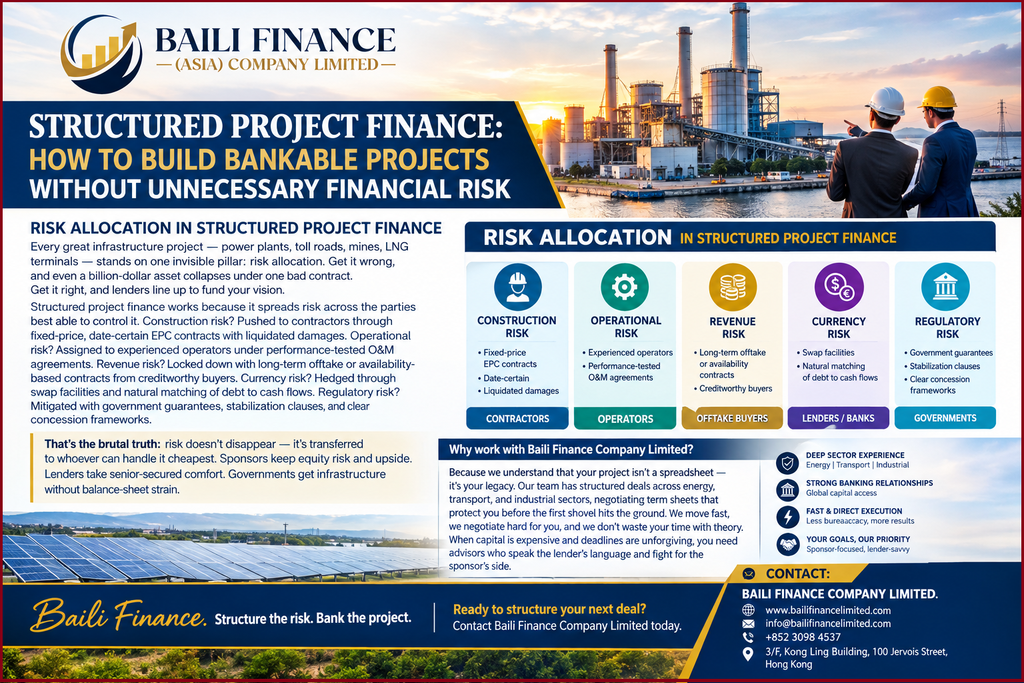
Risk allocation represents one of the most important components of project finance.
A well-structured transaction doesn’t attempt to eliminate every risk. Instead, it seeks to assign each material risk to the party best positioned to manage, control, absorb, insure, or mitigate it.
The World Bank states that risks should generally be allocated to the party best able to control the likelihood or impact of the risk or absorb it at the lowest cost.
Common project risks include:
Construction risk
Construction risk includes cost overruns, delays, design problems, contractor failure, and incomplete works.
Sponsors and lenders often address these risks through fixed-price or appropriately structured engineering, procurement and construction contracts, performance guarantees, completion tests, liquidated damages, contingency provisions, and sponsor support.
Operating risk
Once construction ends, the project must operate efficiently.
Operations and maintenance agreements can define performance standards, availability requirements, maintenance obligations, and remedies.
Revenue risk
Revenue risk depends on how the project earns money.
An infrastructure project may rely on tariffs, availability payments, concessions, user fees, long-term contracts, or merchant market revenues.
A long-term power purchase agreement, for example, can provide greater revenue visibility than relying entirely on spot-market electricity prices.
Market risk
Demand may fall below projections.
Prices may decline.
Competitors may enter the market.
Customer behaviour may change.
These risks require market analysis, conservative assumptions, contractual protections, and sensitivity testing.
Political and regulatory risk
Changes in laws, tariffs, taxation, permits, government obligations, or regulatory policy can affect project economics.
The World Bank identifies political, regulatory, expropriation, currency, force majeure, demand, construction, and refinancing risks among the matters that require careful consideration in PPP and project finance transactions.
Currency risk
A project may generate revenue in local currency while borrowing in US dollars or euros.
That mismatch can materially affect debt service.
Consequently, project sponsors may consider local-currency financing, hedging arrangements, currency matching, or other risk-management mechanisms.
CONTRACTS THAT SUPPORT A BANKABLE PROJECT
Contracts provide much of the commercial foundation for structured project finance.
Depending on the sector, a transaction may include:
- Concession agreements
- Power purchase agreements
- Off-take agreements
- EPC contracts
- Operations and maintenance agreements
- Supply agreements
- Feedstock agreements
- Land leases
- Government support agreements
- Direct agreements
- Insurance contracts
- Shareholder agreements
- Loan agreements
- Security documents
- Hedging agreements
Each agreement needs to work with the others.
For example, if the financing assumes that a project will receive revenue under a 20-year off-take agreement, lenders need to understand termination rights, payment obligations, force majeure provisions, change-in-law provisions, creditworthiness of the off-taker, and dispute-resolution mechanisms.
The financial model cannot treat the contract as a simple revenue line.
The contract determines whether that revenue is actually available.
FINANCIAL CLOSE: THE CRITICAL MILESTONE
Financial close occurs when the necessary project and financing agreements have been executed and the relevant conditions have been satisfied so that financing can be drawn.
The World Bank identifies execution of project agreements, government approvals, permits, planning approvals, land acquisition, and financing conditions as examples of matters that can form part of the process leading to financial close.
Before reaching financial close, lenders typically conduct detailed due diligence.
This can cover:
- Financial analysis
- Legal review
- Technical assessment
- Environmental and social review
- Insurance review
- Tax analysis
- Market assessment
- Sponsor due diligence
- Contract review
- Model audit
- Regulatory analysis
Financial close therefore represents more than a financing signature.
It reflects the completion of a substantial diligence and documentation process.
REAL-WORLD EXAMPLE: A SOLAR POWER PROJECT
Consider a hypothetical 100 MW solar power project.
The project requires $120 million in total development and construction funding.
The sponsor establishes a project company.
The project company secures land rights and obtains regulatory approvals. It then signs a long-term power purchase agreement with a creditworthy off-taker.
An EPC contractor agrees to design and construct the plant.
An operations and maintenance contractor agrees to maintain the facility.
The proposed financing includes:
- $36 million of sponsor equity
- $84 million of senior project debt
- A construction-period financing arrangement
- Debt-service reserve funding
- Appropriate insurance
- Security over project assets and contractual rights
The lender’s analysis focuses on whether electricity production assumptions, tariff revenues, operating costs, debt service, reserve requirements, and contractual protections support the proposed debt.
Running downside scenarios, the financial advisers may test:
- Lower electricity production
- Construction delays
- Higher construction costs
- Higher operating expenses
- Lower tariff revenue
- Foreign exchange depreciation
- Higher interest rates
- Off-taker payment delays
The transaction isn’t considered robust simply because the base case produces acceptable returns.
The downside cases also need to remain within acceptable financing parameters.
That is where structured project finance adds value.
CASE STUDY: PROJECT FINANCE FOR A TRANSPORT INFRASTRUCTURE PROJECT
Consider a hypothetical toll-road concession developed through a public-private partnership.
The government awards a 25-year concession to a private consortium.
The consortium establishes an SPV.
The SPV signs the concession agreement and raises financing to construct the road.
The proposed capital structure includes sponsor equity and senior debt.
The project revenue comes from toll collections.
However, traffic projections represent a major risk.
If traffic remains below forecast, revenue falls and debt-service coverage may weaken.
The financing structure can therefore incorporate traffic sensitivity analysis, reserve accounts, debt-service protections, appropriate concession provisions, insurance, and carefully defined government obligations.
The construction contract addresses completion risk.
The operations agreement addresses maintenance performance.
The concession agreement establishes the project’s legal operating framework.
The financing documents establish lender rights.
The cash waterfall determines how project revenues are applied.
Risk allocation becomes particularly important. The World Bank notes that PPP risk allocation should generally place each risk with the party best able to control or manage it, rather than simply transferring the maximum possible amount of risk to the private sector.
This distinction matters because excessive risk transfer can increase the return required by equity investors and reduce the amount of debt lenders are willing to provide.
The case demonstrates an important principle: bankability depends on the interaction between contracts, cash flow, risk allocation, and financing terms.
STRUCTURED PROJECT FINANCE VS CORPORATE FINANCE
The distinction between project finance and corporate finance deserves attention.
Under corporate finance, a lender generally evaluates the borrower’s overall financial strength, balance sheet, assets, cash flow, and credit profile.
Under project finance, the analysis focuses much more heavily on the specific project.
| Factor | Structured Project Finance | Corporate Finance |
|---|---|---|
| Primary borrower | Project SPV | Existing company |
| Main repayment source | Project cash flow | Corporate cash flow |
| Security | Project assets and rights | Corporate assets and guarantees |
| Risk focus | Project-specific | Company-wide |
| Financial model | Project model | Corporate model |
| Contract analysis | Extensive | Often less transaction-specific |
| Recourse | Often limited | Usually broader |
| Suitable use | Large standalone projects | General corporate needs |
Neither approach applies universally.
The appropriate financing structure depends on the project, sponsor, jurisdiction, risk profile, capital requirement, available security, revenue model, and financing market.
ADVANTAGES OF STRUCTURED PROJECT FINANCE
Structured project finance can offer several potential benefits.
Risk separation
An SPV can separate project liabilities from other sponsor activities, subject to the agreed legal and financing structure.
Capital mobilisation
A well-designed transaction can combine sponsor equity with debt and other forms of capital.
Long-term financing
Projects with stable, contracted cash flows may support longer financing tenors than some conventional corporate facilities.
Risk discipline
Because lenders undertake detailed project-level due diligence, material commercial, legal, technical, and financial risks receive significant attention.
Alignment of stakeholders
Carefully drafted contracts can align the responsibilities of sponsors, lenders, contractors, operators, governments, suppliers, and off-takers.
Potential balance-sheet considerations
Depending on the accounting standards, legal structure, guarantees, consolidation requirements, and transaction characteristics, project financing may have different balance-sheet effects for sponsors or other stakeholders. Accounting treatment should always be assessed by qualified advisers rather than assumed from the legal structure alone.
LIMITATIONS AND CHALLENGES
Structured project finance also involves significant complexity.
High transaction costs
Legal, technical, financial, environmental, insurance, tax, and modelling advisers can create substantial transaction costs.
Lengthy preparation
Large transactions may require extensive negotiations before financial close.
Detailed documentation
Project finance can involve a large number of interconnected agreements.
Strict lender requirements
Lenders may require detailed reporting, reserve accounts, financial covenants, security, direct agreements, and restrictions on distributions.
Complex risk allocation
Not every risk can be transferred efficiently.
Sensitivity to assumptions
A project model depends on assumptions about revenue, costs, timing, production, interest rates, inflation, foreign exchange, and other variables.
The World Bank notes that achieving financial close can require significant detailed work by both public and private parties, including satisfying conditions under project and financing agreements.
HOW TO IMPROVE PROJECT BANKABILITY
Sponsors looking for project finance for infrastructure, energy project financing, structured finance solutions, or project development finance should address bankability before approaching lenders.
Start with a credible business case.
Then establish a realistic financial model.
Next, identify material risks.
After that, allocate those risks contractually.
Secure permits and land rights where required.
Develop credible construction and operating arrangements.
Identify the proposed revenue source.
Assess the creditworthiness of counterparties.
Determine the required debt and equity.
Finally, prepare a financing package that lenders can diligence efficiently.
Bankability isn’t created by adding debt to a project.
It comes from building a project whose commercial, legal, technical, and financial components support the proposed financing.
WHY FINANCIAL MODELLING MATTERS
A project finance model should do more than produce an attractive return.
It should explain how the project behaves under different conditions.
A useful model can answer questions such as:
- What happens if construction costs increase by 10%?
- What happens if completion is delayed by six months?
- How does a currency depreciation affect debt service?
- What happens if revenue falls by 15%?
- How much additional equity would be required?
- What happens if interest rates rise?
- Does the project maintain the required DSCR?
- How much cash remains available for distributions?
- Can the project refinance?
- What happens at the end of the concession?
Running these scenarios early can identify weaknesses before lenders identify them.
That can reduce unnecessary restructuring later.
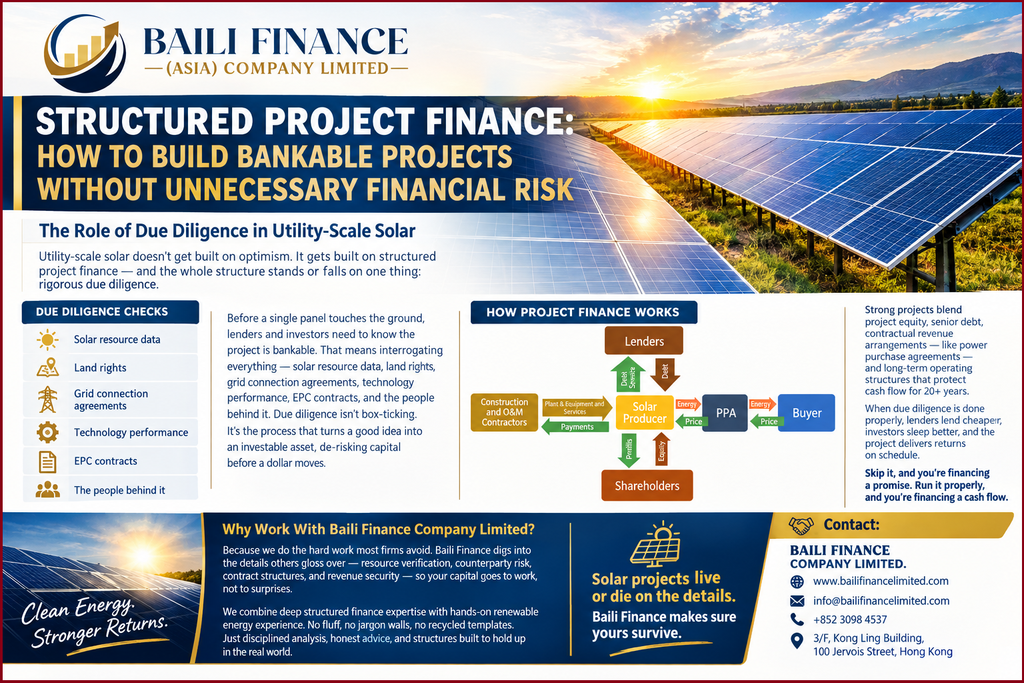
THE ROLE OF DUE DILIGENCE
Due diligence provides the evidence supporting the financing decision.
Financial advisers assess the model and assumptions.
Technical advisers examine design, construction costs, technology, performance, and operational requirements.
Legal advisers examine ownership, contracts, permits, security, enforceability, and regulatory matters.
Environmental and social advisers assess applicable environmental and social risks.
Insurance advisers assess coverage and exclusions.
Tax advisers examine the tax implications.
Together, these disciplines provide a more complete view of the project’s bankability.
STRUCTURED PROJECT FINANCE IN EMERGING MARKETS
Emerging-market transactions can introduce additional considerations.
These can include:
- Currency convertibility
- Local-currency financing availability
- Political and regulatory risks
- Sovereign or government counterparty exposure
- Infrastructure gaps
- Interest-rate volatility
- Local capital-market depth
- Import restrictions
- Tax considerations
- Land acquisition
- Permitting
- Foreign exchange availability
These factors don’t automatically prevent project finance.
They do, however, require careful structuring.
Guarantees, political risk insurance, development finance participation, local financing, currency hedging, contractual protections, and appropriate government support can form part of the financing strategy where commercially and legally appropriate.
The World Bank also identifies currency risk as an important consideration where project debt and project revenues are denominated in different currencies.
WHY RISK ALLOCATION SHOULD COME BEFORE FINANCING
A common mistake involves approaching financing before resolving fundamental project risks.
That reverses the logical sequence.
Suppose a project has no secured revenue agreement.
The lender cannot reasonably treat projected sales as equivalent to contracted revenue.
Suppose construction costs remain uncertain.
The lender will need additional protection.
Suppose permits remain outstanding.
The financing may face conditions precedent that prevent drawdown.
Suppose the sponsor expects lenders to accept all project risks.
The resulting financing terms may become more expensive or require more equity.
Therefore, risk allocation should form part of the financing strategy from the beginning.
The World Bank’s PPP guidance specifically emphasizes identifying and analysing project risks before allocating them through contractual obligations.
A PRACTICAL STRUCTURED PROJECT FINANCE CHECKLIST
Before approaching lenders or investors, project sponsors should consider whether they have addressed the following:
Commercial
- Is there a defined market?
- Is demand supported by evidence?
- Are revenues contracted where appropriate?
- Are key counterparties creditworthy?
Technical
- Is the technology proven or adequately assessed?
- Is the construction budget credible?
- Is the project schedule realistic?
- Are operating requirements defined?
Legal
- Does the SPV have clear ownership?
- Are material contracts enforceable?
- Are permits identified?
- Are security rights enforceable?
Financial
- Is the financial model complete?
- Are assumptions supported?
- Does the base case support debt service?
- Have downside cases been tested?
Risk
- Has each material risk been identified?
- Is each risk allocated appropriately?
- Are insurance and mitigation mechanisms available?
- Are government or sponsor support arrangements defined?
Financing
- How much equity is available?
- How much debt is required?
- What tenor is appropriate?
- What security can be provided?
- What conditions must be satisfied before drawdown?
Addressing these questions early can materially improve the quality of lender discussions.
TRUSTED EXTERNAL RESOURCE
For authoritative guidance on project finance concepts, financing structures, risk allocation, bankability, and public-private partnerships, the World Bank’s Public-Private Partnership Resource Center provides relevant technical resources.
Trusted reference: World Bank — Project Finance Key Concepts
This is particularly useful for readers who want to understand the relationship between project finance structures, SPVs, project cash flows, limited recourse financing, and lender security.
FREQUENTLY ASKED QUESTIONS ABOUT STRUCTURED PROJECT FINANCE
What is structured project finance?
Structured project finance is a financing approach that arranges debt, equity, contracts, security, risk allocation, and cash flows around a specific project. Repayment generally depends substantially on the project’s ability to generate cash rather than solely on the sponsor’s overall corporate balance sheet.
How does project finance differ from corporate finance?
Corporate finance generally relies on the financial strength and balance sheet of an existing company. Project finance focuses primarily on the assets, contracts, risks, and projected cash flows of a particular project, often through a special purpose vehicle.
What is an SPV in project finance?
An SPV, or special purpose vehicle, is a dedicated legal entity established to own or operate a particular project and enter into its related contracts and financing arrangements. It can help separate the project from the sponsor’s other activities, subject to the transaction’s legal and accounting structure.
What makes a project bankable?
A bankable project generally has a credible business model, reliable revenue assumptions, manageable costs, appropriate risk allocation, enforceable contracts, required permits, adequate equity, and projected cash flows that can support the proposed debt. Lenders also consider technical, legal, environmental, market, political, and financial risks.
What is financial close in project finance?
Financial close is the stage at which the relevant project and financing agreements have been executed and applicable conditions have been satisfied, allowing the project company to draw the committed financing. The exact requirements vary by transaction.
What are the main risks in project finance?
Common risks include construction risk, operating risk, demand risk, revenue risk, market risk, currency risk, interest-rate risk, political and regulatory risk, force majeure, refinancing risk, environmental and social risk, and counterparty risk.
Can project finance be used for renewable energy projects?
Yes. Renewable energy projects can use project finance where the project’s commercial and contractual structure can support financing. Long-term power purchase agreements, credible off-takers, appropriate construction contracts, resource assessments, operating arrangements, and reliable financial projections can contribute to bankability.
Is project finance suitable for infrastructure projects?
Project finance is commonly used for infrastructure transactions, including energy, transport, telecommunications, water, and other capital-intensive projects. Suitability depends on the project’s revenue model, risk allocation, contractual framework, financing requirements, and market conditions.
What is a DSCR in project finance?
The Debt Service Coverage Ratio measures the amount of cash available to service debt relative to scheduled debt service. Lenders commonly use DSCR as one indicator of a project’s ability to meet its debt obligations.
How can a project finance adviser help?
A project finance adviser can help evaluate the financing requirement, develop or review financial models, assess bankability, identify financing sources, structure debt and equity, analyse risk allocation, coordinate due diligence, prepare financing materials, and support negotiations with capital providers.
FINAL SUMMARY: STRUCTURE THE PROJECT BEFORE YOU STRUCTURE THE DEBT
Structured project finance is fundamentally about connecting capital with a project’s measurable ability to generate cash and manage risk.
The strongest transactions don’t begin with a financing amount.
They begin with the project.
What will it build?
Who will use it?
Who will pay?
How will revenue be generated?
What could prevent the project from reaching completion?
Who controls each material risk?
What contracts protect the cash flow?
How much equity is required?
How much debt can the project reasonably support?
What happens under a downside scenario?
Answering these questions, supported by rigorous financial modelling, legal documentation, technical due diligence, and disciplined risk allocation, creates the foundation for a bankable transaction.
For sponsors and developers, the practical lesson is direct: don’t wait until lenders identify structural weaknesses. Identify them first, address them, and present a financing structure that explains how the project will perform under both expected and adverse conditions.
At Baili Finance Limited, the focus should therefore extend beyond finding capital. The objective is to help clients understand the structure behind the capital requirement and determine what financing framework can support the project’s commercial reality.
Whether you’re developing an infrastructure project, renewable energy project, real estate development, manufacturing facility, mining operation, transport project, or another capital-intensive venture, the quality of the financial structure can influence the project’s ability to attract serious capital.
READY TO STRUCTURE YOUR PROJECT FINANCE?
If your project requires structured project finance, project funding, infrastructure finance, debt financing, equity mobilisation, financial structuring, or bankability analysis, don’t leave the financing structure until the final stage of project development.
Bring the project concept, funding requirement, commercial model, available contracts, projected cash flows, and key project risks to the discussion.
Contact Baili Finance Limited today to discuss your project finance requirements and determine the next steps toward a structured, financeable transaction.
Your project may already have the commercial potential. The next question is whether its financial structure can demonstrate that potential to the right capital providers.
Start the conversation with Baili Finance Limited.
Intermediaries/Consultants/Brokers are welcome to bring their clients 100% protected. Our brokers receive 2% commission for referral. We assist Clients and brokers in their attempt to secure funding by working on their funding requests that may require innovative financing. In complete confidence, we will work together for the benefits of all parties involved.
#StructuredProjectFinance #ProjectFinance #InfrastructureFinance #ProjectFunding #StructuredFinance #Investment #FinancialStructuring #ProjectDevelopment #Bankability #InfrastructureInvestment