Headline: How SBLC Supports International Trade | Baili Finance
International trade depends on trust, payment security, bank credibility and well-defined contractual obligations. For importers and exporters operating across different jurisdictions, a Standby Letter of Credit (SBLC) can provide an important layer of financial security when one party fails to meet an agreed obligation.
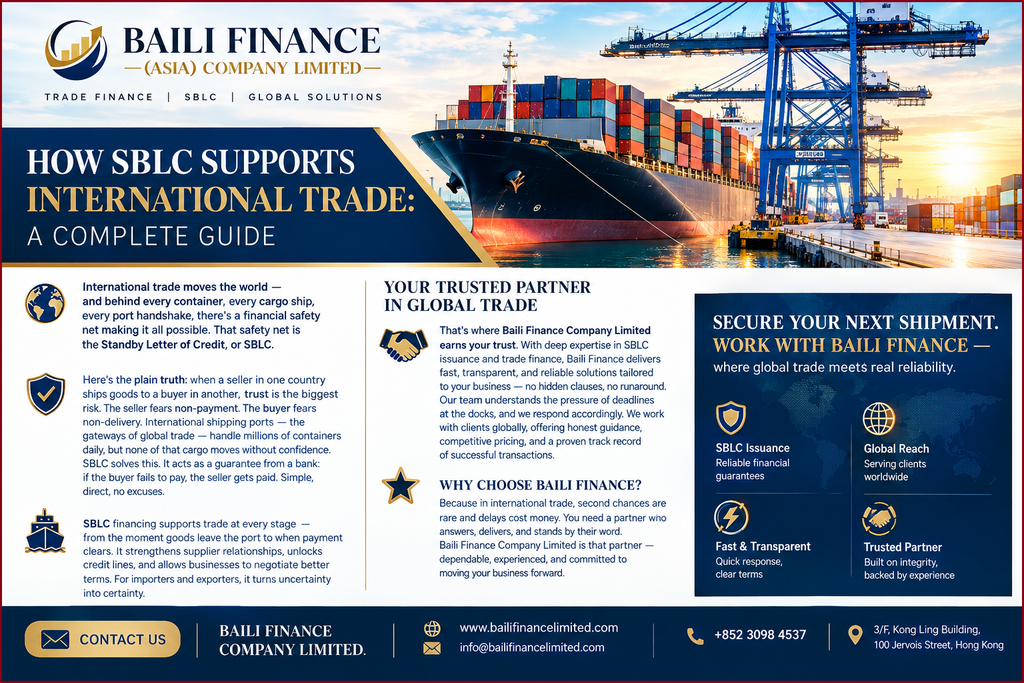
Understanding how SBLC supports international trade is therefore important for companies that buy goods internationally, export products, enter long-term supply contracts, execute infrastructure projects or transact with unfamiliar counterparties.
An SBLC doesn’t normally function as the primary payment method. Instead, it provides a bank-backed undertaking that supports payment or performance if the applicant fails to fulfil the obligation specified in the instrument.
The International Chamber of Commerce (ICC) describes a standby as an independent undertaking that can support financial, performance and direct-payment obligations. Under ISP98, an SBLC is generally irrevocable, independent, documentary and binding when issued.
For international businesses, that distinction matters.
Keywords: How SBLC supports international trade, how does an SBLC support international trade, how standby letter of credit supports international trade, SBLC for international trade, SBLC trade finance, standby letter of credit for importers, standby letter of credit for exporters, SBLC payment security, international trade payment security, SBLC for cross-border transactions, how an SBLC works in international trade, SBLC vs letter of credit, financial standby letter of credit, performance standby letter of credit, ISP98 standby letter of credit, international trade finance solutions
What Is an SBLC?
A Standby Letter of Credit, commonly abbreviated as SBLC, is a financial instrument issued by a bank on behalf of its customer, known as the applicant, in favour of a beneficiary.
The issuing bank undertakes to honour a compliant demand when the beneficiary presents the documents required by the SBLC, subject to its terms and applicable rules.
The underlying commercial relationship can involve:
- Import and export transactions
- International supply agreements
- Construction contracts
- Equipment purchases
- Commodity transactions
- Government contracts
- Project finance
- Lease obligations
- Loan repayment obligations
- Performance commitments
- Long-term commercial contracts
The key point is that an SBLC creates an additional payment or performance mechanism involving a bank.
Under International Standby Practices 1998 (ISP98), a standby can cover performance, financial and direct-pay obligations. The ICC developed ISP98 specifically to address standby transactions and establish detailed rules for their use.
For companies entering international contracts, this framework can help establish clearer expectations concerning issuance, presentation, examination, timing and payment.
How Does an SBLC Support International Trade?
An SBLC supports international trade primarily by reducing the payment and performance concerns that can arise between parties operating in different countries.
International transactions can involve unfamiliar companies, different legal systems, currency exposure, transportation risks, political or economic uncertainty and extended payment periods.
An SBLC doesn’t eliminate those risks. Instead, it can provide a defined bank-backed mechanism for addressing specific obligations.
The process generally works as follows:
- The buyer and seller agree on contractual terms.
- The seller requests an SBLC as part of the transaction requirements.
- The buyer applies to its bank for issuance.
- The issuing bank assesses the applicant and transaction.
- The bank issues the SBLC in favour of the beneficiary.
- The beneficiary receives or has the SBLC advised through the appropriate banking channel.
- The underlying transaction proceeds.
- If the applicant fulfils its obligation, the SBLC may expire without a draw.
- If the applicant fails to meet the specified obligation, the beneficiary may present the documents required under the SBLC.
- The issuing bank examines the presentation against the SBLC terms and applicable rules.
This structure can give the seller greater confidence while allowing the buyer to maintain normal commercial operations without making an immediate cash payment solely to satisfy the security requirement.
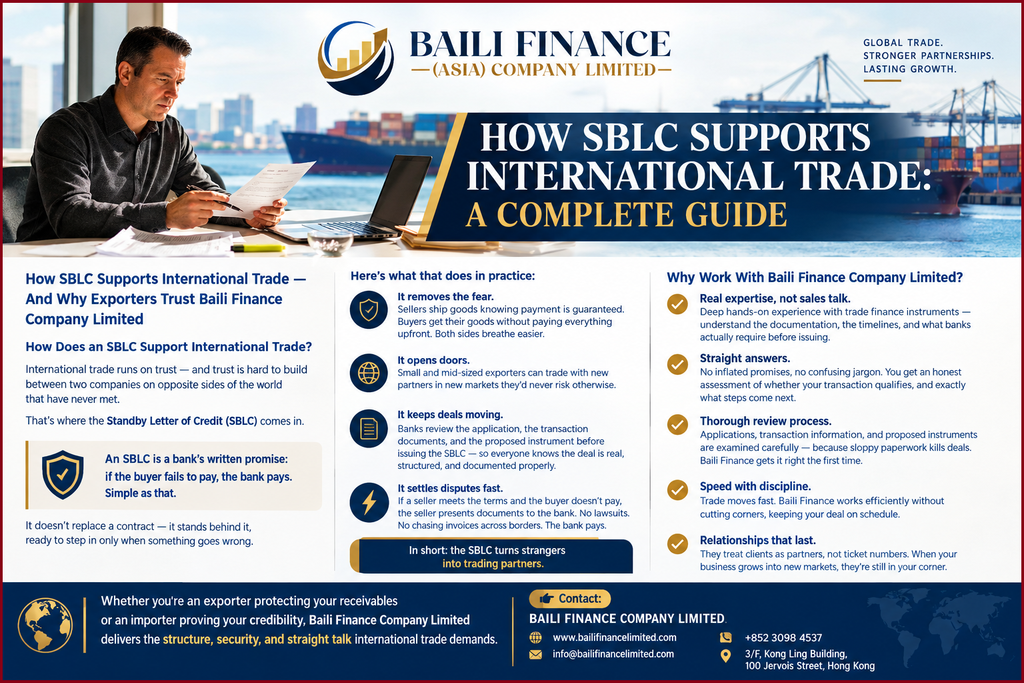
Why Is an SBLC Important in International Trade?
1. It Strengthens Payment Security
Payment risk remains one of the major concerns in cross-border commerce.
An exporter may ship valuable goods to a buyer located thousands of kilometres away. Once the goods leave the exporter’s control, recovering unpaid funds can become more complicated.
An SBLC can provide an additional payment mechanism if the buyer fails to meet the specified obligation.
For example, suppose an exporter supplies industrial equipment under a 180-day payment arrangement. The exporter may accept deferred payment because an SBLC provides an additional bank undertaking subject to clearly defined documentary conditions.
The commercial agreement remains important. The SBLC doesn’t replace it.
Instead, it supports the agreed obligation.
2. It Helps Reduce Counterparty Risk
Businesses don’t always know the financial strength, payment history or commercial reliability of an overseas counterparty.
That creates counterparty risk.
An SBLC introduces a bank into the transaction structure. The beneficiary can therefore assess the issuing bank, the wording of the undertaking, applicable rules and any confirmation arrangement rather than relying exclusively on the buyer’s promise to pay.
Where appropriate, a beneficiary may also seek confirmation from another bank.
The ICC notes that confirmation can provide additional security where a beneficiary has concerns about the issuing bank or country risk.
3. It Supports Deferred Payment Transactions
International suppliers often face a commercial choice between demanding payment before shipment and offering the buyer credit terms.
Neither approach suits every transaction.
An SBLC can support a deferred-payment arrangement by providing an additional security mechanism.
This can be particularly relevant when:
- The buyer wants credit terms.
- The seller wants additional payment protection.
- The transaction involves significant contract value.
- The parties have limited trading history.
- The buyer operates in another jurisdiction.
- The seller needs stronger contractual payment assurance.
Consequently, an SBLC can help structure transactions where immediate payment isn’t commercially practical.
SBLC and International Trade Finance
SBLCs form part of the wider trade finance ecosystem.
Trade finance includes instruments and structures that help businesses manage payment, working capital, documentary, credit and commercial risks associated with trade.
An SBLC differs from a traditional commercial letter of credit.
A commercial letter of credit generally serves as a primary payment mechanism against compliant documents.
An SBLC, by contrast, generally functions as a backup undertaking that becomes relevant when the applicant doesn’t fulfil the underlying obligation or when the standby’s specified drawing conditions otherwise arise.
The ICC specifically distinguishes standby practices from the rules designed primarily for commercial documentary credits. ISP98 was developed because standby transactions have characteristics requiring dedicated rules.
That distinction is essential when businesses are deciding which financial instrument belongs in a particular international contract.
SBLC vs Letter of Credit
Although both instruments involve banks and documentary conditions, their commercial purposes can differ.
| Feature | SBLC | Commercial Letter of Credit |
|---|---|---|
| Primary purpose | Backup security or performance support | Primary payment mechanism |
| Typical use | Payment default or performance failure | Payment against compliant trade documents |
| Common rules | ISP98, sometimes UCP | Usually UCP 600 |
| Payment timing | Usually following a compliant demand | Usually following compliant presentation |
| Underlying transaction | Continues independently | Directly connected to document-based payment |
| Typical risk addressed | Default or non-performance | Payment against agreed documentary conditions |
The exact legal and operational effect depends on the instrument’s wording, governing law and incorporated rules.
Therefore, businesses shouldn’t assume that every instrument labelled “SBLC” operates identically.
The Role of ISP98
ISP98, or the International Standby Practices 1998, provides a dedicated framework for standby letters of credit.
The ICC states that ISP98 covers standby letters of credit, including performance, financial and direct-pay standbys. It also establishes rules concerning obligations, presentation, examination, notice, timing and other operational matters.
A properly drafted SBLC may expressly state that it is subject to ISP98.
For example, ICC materials provide model standby wording incorporating ISP98.
This matters because an international transaction can involve multiple jurisdictions and legal systems. Clearly identifying the rules applicable to the standby can reduce uncertainty concerning how the instrument operates.
However, ISP98 doesn’t replace applicable national law.
The ICC states that ISP98 supplements applicable law to the extent that applicable law doesn’t prohibit its provisions.
That is why legal and banking professionals should review the final instrument before issuance.
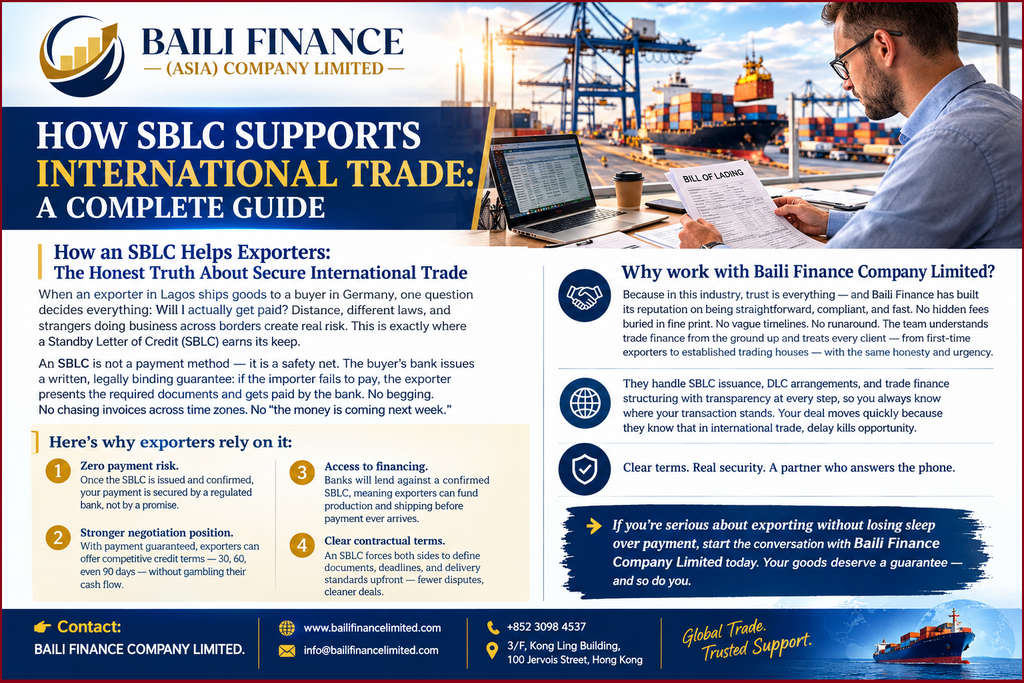
How an SBLC Helps Exporters
For exporters, the main benefit of an SBLC can be additional protection against specific payment or contractual risks.
Imagine an exporter in Ghana supplying equipment to an overseas buyer.
The exporter may face several concerns:
- Will the buyer pay on time?
- Is the buyer financially capable of meeting the obligation?
- What happens if the buyer defaults?
- How difficult would recovery be in another jurisdiction?
- Is the issuing bank acceptable?
- Does the SBLC contain clear drawing conditions?
- Which rules govern the instrument?
An appropriately structured SBLC can address part of this risk profile.
The exporter still needs to assess the buyer, contract, shipping arrangements, insurance, sanctions exposure, applicable law and other transaction risks.
The SBLC is one component of the overall risk-management structure.
How an SBLC Helps Importers
An SBLC can also provide advantages to importers.
An importer may need to demonstrate financial credibility before a supplier agrees to ship goods on credit.
Rather than paying the entire contract value upfront, the importer may arrange an SBLC through its bank.
This can help the importer negotiate commercial terms while preserving working capital for normal business operations.
For example, an importer purchasing USD 2 million of equipment may negotiate a payment structure that requires an SBLC for a specified amount.
The importer doesn’t necessarily pay the full USD 2 million when the SBLC is issued.
Instead, the bank issues the undertaking subject to its approval, credit requirements, fees and transaction conditions.
If the importer fulfils its contractual obligation, the SBLC may remain undrawn and eventually expire.
SBLC and Working Capital
Working capital management is critical in international commerce.
Businesses frequently need to purchase inventory before receiving revenue from customers.
An SBLC can support commercial arrangements without requiring the applicant to transfer the entire transaction value upfront.
That doesn’t mean an SBLC is free financing.
Banks may require:
- Cash collateral
- Credit facilities
- Security
- Margin
- Financial statements
- Corporate documentation
- Transaction information
- Compliance documentation
- Fees and commissions
The actual requirements depend on the issuing bank, applicant, transaction structure and jurisdiction.
Therefore, businesses should calculate the total cost of an SBLC before treating it as a working-capital solution.
SBLC for International Suppliers
An international supplier may request an SBLC when the transaction involves substantial exposure.
Common situations include:
Large equipment purchases
Manufacturers supplying machinery internationally may request financial security before manufacturing or shipping equipment.
Long-term supply contracts
Suppliers may require an SBLC to support payment obligations over an extended contract period.
Commodity transactions
Large commodity transactions can involve significant values and extended settlement arrangements.
Construction and infrastructure
Contractors may use standby instruments to support payment or performance obligations.
Cross-border leasing
An SBLC can sometimes support rental or lease-related financial commitments.
The precise instrument should reflect the underlying obligation rather than simply using an SBLC because it appears familiar.
Performance SBLC vs Financial SBLC
Not every SBLC serves the same purpose.
A financial SBLC generally supports a monetary obligation.
A performance SBLC generally supports an obligation relating to performance under a contract.
For example, a contractor may provide a performance standby to support contractual commitments.
By comparison, a financial standby may support repayment or payment obligations.
The ICC’s ISP98 framework expressly covers performance and financial standbys.
Understanding this difference is important because the wording of the instrument should correspond with the obligation it supports.
Direct-Pay SBLC
A direct-pay standby can support payment of an underlying obligation when due.
The ICC’s ISP98 preface identifies direct-pay standbys as a category supporting payment when due, typically in connection with a financial obligation.
This structure differs from a standby that only becomes relevant following a defined default or performance failure.
The distinction should be addressed carefully during drafting because the commercial consequences can be significant.
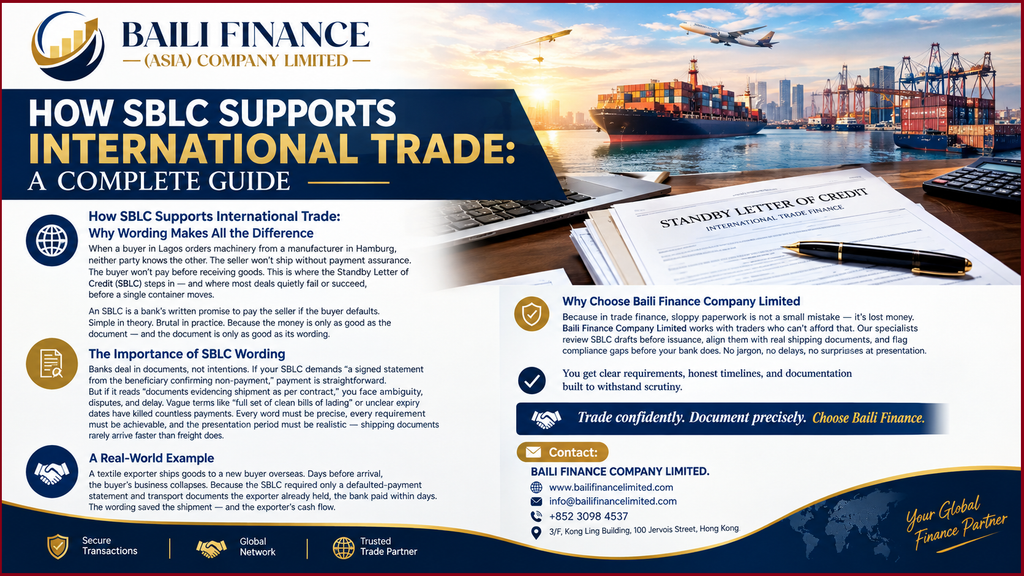
The Importance of SBLC Wording
The wording of an SBLC matters.
A beneficiary shouldn’t focus only on the face value.
The beneficiary should also review:
- Issuing bank
- Beneficiary name
- Applicant name
- Currency
- Maximum amount
- Expiry date
- Place of presentation
- Required documents
- Drawing conditions
- Applicable rules
- Governing law
- Transfer provisions
- Confirmation
- Reduction provisions
- Automatic extension provisions
- Partial drawings
- Presentation deadlines
- Amendment requirements
Under ISP98, the issuer’s obligation is documentary. The issuer examines the required documents according to the standby’s terms rather than simply determining whether the underlying commercial dispute exists.
This is one reason precise drafting is essential.
A poorly drafted standby can create uncertainty precisely when the beneficiary expects protection.
Real-World Example: An SBLC Dispute Under ISP98
The importance of documentary compliance is demonstrated by an ICC DOCDEX decision involving an SBLC subject to ISP98.
In DOCDEX Decision No. 373, an issuing bank had issued a standby credit in favour of a beneficiary. The standby required a draft drawn at sight accompanied by a written statement from the beneficiary. The beneficiary submitted a demand containing those documents.
The issuing bank initially rejected the presentation and later raised additional objections, including an argument concerning expiry. The matter proceeded into an ICC DOCDEX dispute.
The case illustrates a practical point for international trade: having an SBLC isn’t enough. The beneficiary must understand and comply with the documentary requirements and timing provisions contained in the instrument.
That principle is highly relevant to exporters, importers, banks, lawyers and trade-finance professionals.
Illustrative Case Study: Equipment Export From Europe to Africa
Consider a hypothetical transaction.
A European manufacturer agrees to supply USD 5 million of industrial equipment to an African distributor.
The buyer wants 120-day payment terms because it needs time to install the equipment and generate revenue.
The manufacturer, however, doesn’t want to carry the full credit exposure.
The parties agree that the buyer will arrange an SBLC for USD 5 million through an acceptable bank.
Step 1: Contract negotiation
The parties agree on:
- Equipment specifications
- Purchase price
- Delivery schedule
- Payment terms
- Warranty
- Applicable law
- Dispute-resolution provisions
- SBLC requirements
Step 2: SBLC application
The buyer approaches its bank and requests issuance of the standby.
The bank conducts its normal credit, compliance and transaction assessments.
Step 3: Issuance
The issuing bank issues the SBLC in favour of the manufacturer.
The parties ensure that the instrument clearly identifies the amount, expiry, presentation requirements and applicable rules.
Step 4: Shipment
Once the required financial security is in place, the manufacturer proceeds with production and shipment.
Step 5: Normal performance
The buyer pays according to the commercial contract.
No draw occurs.
Step 6: Default scenario
If the buyer fails to satisfy an obligation covered by the SBLC, the manufacturer may have the right to make a compliant demand.
The bank then examines the presentation against the SBLC terms.
If the presentation complies with those requirements, the bank’s obligations under the standby become relevant.
This example demonstrates why an SBLC can support international trade without becoming the normal payment mechanism.
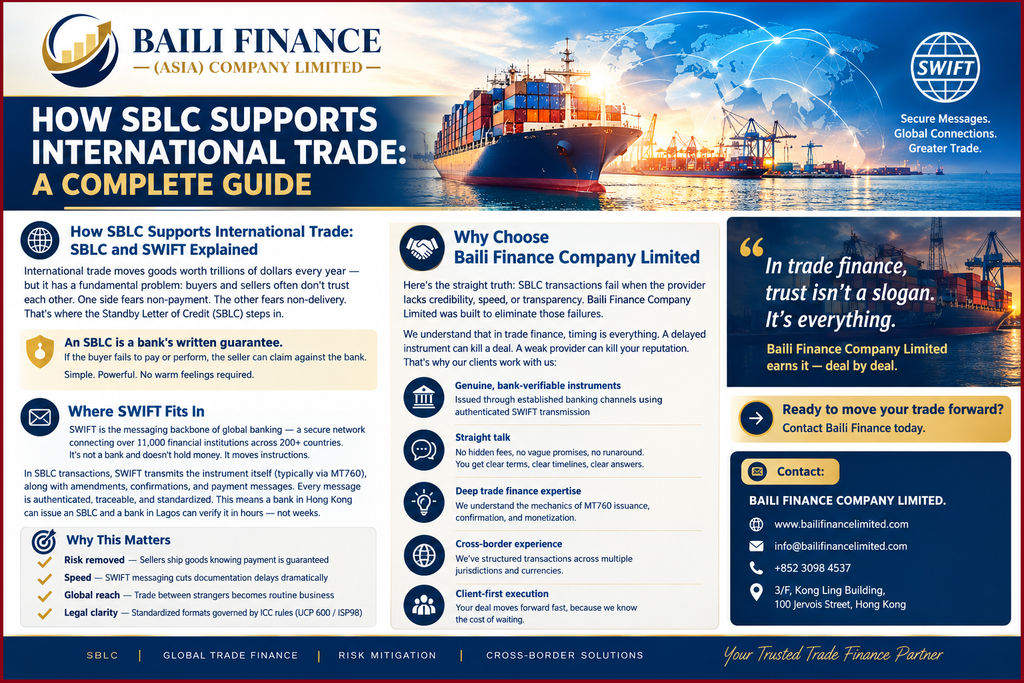
SBLC and SWIFT
Banks commonly use established banking communication systems to exchange trade-finance messages.
SWIFT’s corporate standards documentation includes specific transaction flows for guarantees and standby letters of credit, including applications for issuance, notifications of issuance and amendments.
This doesn’t mean that the presence of a SWIFT message automatically makes an SBLC legitimate or financially secure.
Businesses should verify the transaction through appropriate banking channels and conduct proper due diligence.
The authenticity of the instrument, identity of the issuing bank, terms of the undertaking and contractual structure all remain important.
What an SBLC Does Not Do
An SBLC doesn’t eliminate every international trade risk.
It doesn’t automatically guarantee that:
- The buyer is commercially reliable.
- The underlying contract is profitable.
- Goods will arrive safely.
- Customs clearance will succeed.
- Currency values will remain stable.
- The issuing bank will accept every presentation.
- A disputed claim will automatically result in payment.
- Fraud risks disappear.
- Sanctions or regulatory restrictions don’t apply.
ICC guidance also recognises that sanctions-related issues can affect banks involved in standby letters of credit and other trade-finance instruments.
Therefore, an SBLC should form part of a broader international trade risk-management strategy.
Common Mistakes When Using an SBLC
Businesses can undermine the value of an SBLC by overlooking basic transaction details.
Using an unsuitable bank
The beneficiary should assess whether the issuing bank meets its contractual requirements.
Accepting unclear wording
Ambiguous requirements can create documentary problems.
Ignoring expiry dates
An SBLC has defined validity conditions. Missing a presentation deadline can have serious consequences.
Failing to review the rules
If the SBLC incorporates ISP98, the parties should understand the applicable provisions.
Treating the SBLC as cash
An SBLC is a contingent bank undertaking. It shouldn’t automatically be treated as immediately available cash.
Ignoring compliance requirements
Banks operate within regulatory, sanctions, anti-money-laundering and know-your-customer frameworks.
Focusing only on the face value
The amount matters, but the bank, wording, rules, expiry, presentation requirements and governing law also matter.
How Businesses Can Use SBLCs More Effectively
Businesses considering an SBLC should take a structured approach.
First, identify the underlying risk.
Determine whether the transaction requires payment security, performance security or another form of financial undertaking.
Second, establish acceptable banking requirements.
Agree on the minimum acceptable issuing-bank criteria before the transaction reaches the issuance stage.
Third, draft the standby carefully.
The instrument should align with the commercial contract while maintaining clear documentary requirements.
Fourth, determine the governing rules.
Where appropriate, consider whether ISP98 should apply.
Fifth, review the presentation requirements.
The beneficiary should understand exactly what documents or statements it must present if a draw becomes necessary.
Sixth, coordinate the transaction with qualified professionals.
International trade transactions can involve banking, legal, tax, regulatory and compliance considerations.
Finally, verify every banking instruction independently.
This is especially important where large transaction values or unfamiliar counterparties are involved.
Frequently Asked Questions About SBLC and International Trade
1. How does an SBLC support international trade?
An SBLC supports international trade by providing a bank-backed undertaking that can protect a beneficiary against specified payment or performance risks. If the applicant fails to meet the obligation covered by the standby and the beneficiary makes a compliant presentation, the issuing bank may be required to honour the demand according to the SBLC terms.
2. Is an SBLC the same as a commercial letter of credit?
No. A commercial letter of credit generally functions as a primary payment mechanism against compliant documents, while an SBLC generally provides backup security for an underlying obligation. The applicable rules and exact structure can vary.
3. What is ISP98 in trade finance?
ISP98 stands for International Standby Practices 1998. It provides rules specifically designed for standby letters of credit, covering matters such as obligations, presentation, examination, notice and timing.
4. Can an SBLC help an exporter reduce payment risk?
Yes. An SBLC can provide an additional bank-backed undertaking that supports a specified payment obligation. However, it doesn’t eliminate all commercial, legal, banking or country risks.
5. Can an importer use an SBLC to obtain better payment terms?
An importer may use an SBLC to provide additional security to a supplier, which can support negotiations involving deferred payment or other contractual arrangements. Whether this improves commercial terms depends on the parties, bank, transaction and negotiation.
6. What is the difference between a financial SBLC and a performance SBLC?
A financial SBLC generally supports a monetary obligation, while a performance SBLC generally supports performance under a contractual arrangement. ISP98 covers both financial and performance standbys.
7. Does an SBLC guarantee payment under every circumstance?
No. Payment depends on the terms of the SBLC and the beneficiary making the presentation required by the instrument. Documentary compliance is therefore critical.
8. Why is the issuing bank important?
The beneficiary ultimately relies on the issuing bank’s undertaking. Therefore, the bank’s acceptability, jurisdiction, credit standing, applicable regulations and any confirmation arrangements can be important considerations.
External Source:
Businesses considering an SBLC should understand the rules governing standby instruments. The International Chamber of Commerce’s ISP98 framework provides internationally recognised rules specifically addressing standby letters of credit. ICC — International Standby Practices (ISP98)
Final Summary: How SBLC Supports International Trade
A Standby Letter of Credit supports international trade by strengthening payment security, reducing selected counterparty risks and providing a defined bank-backed mechanism for specified financial or performance obligations.
For exporters, it can provide additional protection when selling internationally on credit.
For importers, it can help demonstrate financial commitment without necessarily requiring immediate payment of the entire transaction value.
For suppliers and contractors, it can support long-term contractual relationships where payment or performance risk requires additional security.
However, an SBLC isn’t a substitute for proper due diligence, contractual controls or professional advice. Its effectiveness depends heavily on the issuing bank, precise wording, applicable rules, presentation requirements, expiry provisions and transaction structure.
For businesses using standby letters of credit in international commerce, clarity matters from the beginning.
Before accepting or arranging an SBLC, review the transaction carefully. Confirm the issuing bank. Examine the wording. Understand the applicable rules. Verify the presentation requirements. And make sure the standby actually addresses the commercial risk you’re trying to manage.
If you’re exploring SBLC services, international trade finance, payment security or cross-border transaction support, Baili Finance Limited can help you assess the appropriate structure for your transaction.
Ready to structure your international trade transaction?
Don’t wait until a payment problem occurs before reviewing your financial security.
Contact Baili Finance Limited today to discuss your SBLC and international trade requirements, understand the documentation involved and determine the appropriate next steps for your transaction.
Visit: www.bailifinancelimited.com to make an enquiry.
Your international transaction deserves a properly structured financial framework. Start the conversation with Baili Finance Limited.
Intermediaries/Consultants/Brokers are welcome to bring their clients 100% protected. Our brokers receive 2% commission for referral. We assist Clients and brokers in their attempt to secure funding by working on their funding requests that may require innovative financing. In complete confidence, we will work together for the benefits of all parties involved.
#SBLC #StandbyLetterOfCredit #InternationalTrade #TradeFinance #InternationalTradeFinance #TradeFinanceSolutions #ImportExport #LettersOfCredit #BankGuarantee #CrossBorderTrade #GlobalTrade