Headline: SBLC Credit Enhancement: A Business Guide
Introduction: Understanding SBLC Credit Enhancement
Understanding standby letters of credit, bank-backed financial security, credit risk mitigation and structured financing
SBLC credit enhancement can help businesses address financing challenges, support contractual obligations and strengthen the financial security they present to lenders and commercial partners. In international trade and structured finance, a standby letter of credit (SBLC) provides an independent bank undertaking that can support payment or performance obligations when an applicant fails to meet agreed terms
For companies seeking access to credit, an SBLC may provide additional assurance to a prospective lender or beneficiary. However, its value depends on the issuing bank, the instrument’s wording, the underlying transaction, the beneficiary’s requirements and the applicable legal framework. An SBLC doesn’t automatically create borrowing capacity or guarantee loan approval.
Businesses exploring SBLC credit enhancement solutions should understand how the instrument works, what financial risks it addresses and which conditions determine whether a lender will accept it. They should also distinguish a genuine bank-issued standby letter of credit from an unverified financing proposal that merely uses banking terminology.
At Baili Finance Limited, understanding the structure and commercial purpose of credit enhancement is an important starting point for discussing potential financing arrangements. This guide explains the fundamentals, practical applications, documentation requirements, costs and risks associated with SBLC credit enhancement.
Keywords: SBLC credit enhancement Secondary, Standby letter of credit, SBLC financing, credit enhancement solutions, bank guarantee, financial credit support, trade finance, credit risk mitigation
What Is SBLC Credit Enhancement?
SBLC credit enhancement refers to the use of a standby letter of credit to provide additional contractual payment security or support a financial transaction. A bank issues the SBLC at the request of an applicant and names a beneficiary entitled to make a demand under the instrument’s terms.
The applicant may be a company seeking financing, a contractor undertaking a commercial project or a business that needs to secure an obligation to a supplier. The beneficiary may be a lender, a supplier, a project owner or another party that requires protection against a specified risk.
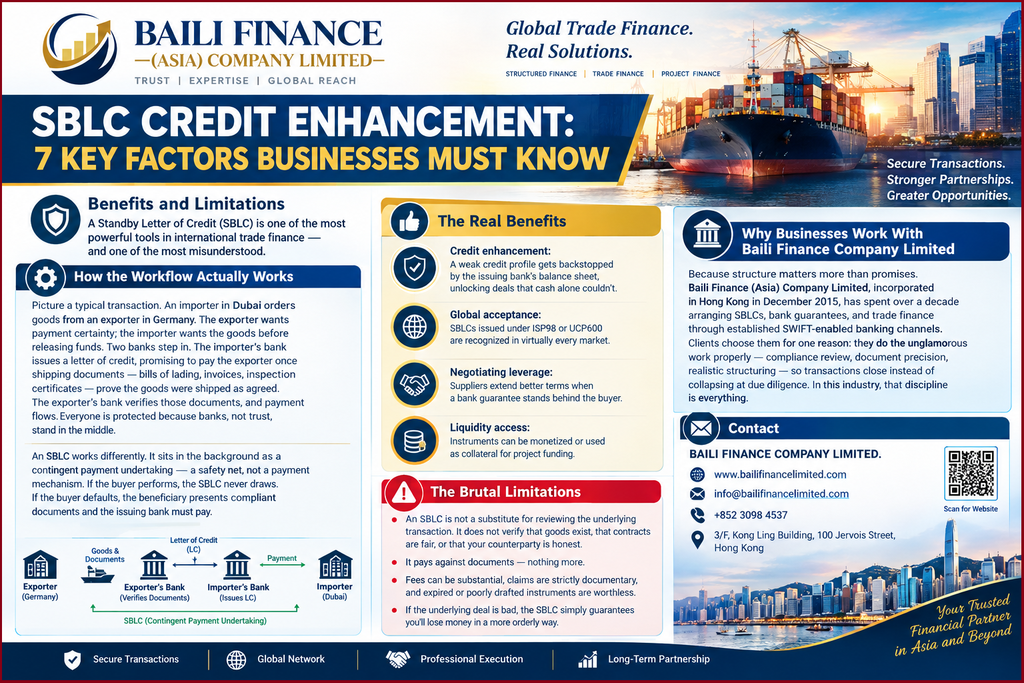
Unlike an ordinary commercial letter of credit, which generally facilitates payment against compliant shipping or other commercial documents, an SBLC typically serves as a secondary source of payment. The beneficiary generally expects the applicant to fulfil the underlying obligation without drawing on the standby.

The issuing bank’s obligation is independent of the underlying commercial relationship. Subject to the applicable law and instrument terms, the bank examines the documents presented under the SBLC rather than deciding the merits of the underlying dispute. The
ICC International Standby Practices (ISP98)
explains the framework for standby letters of credit expressly made subject to those rules.
How does the credit enhancement work?
Consider a business that wants to obtain a loan from a financial institution. The lender may require additional security because it considers the borrower’s existing financial position insufficient for the proposed facility.
If the lender accepts an SBLC as eligible security, the applicant may arrange for a bank to issue one in the lender’s favour. The instrument identifies the maximum amount available, its expiry date, the documents required for a demand and the conditions governing payment.
If the borrower defaults and the lender presents a complying demand within the permitted period, the issuing bank may have to honour the SBLC. The borrower remains responsible for reimbursing the issuing bank according to its separate agreement.
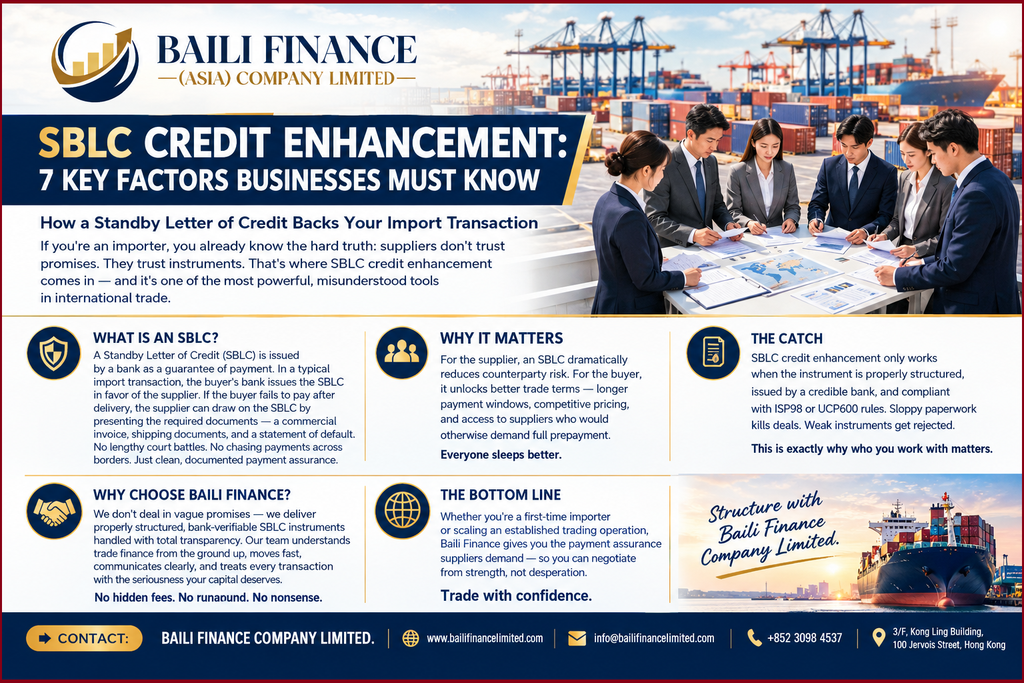
7 Key Factors Businesses Must Know
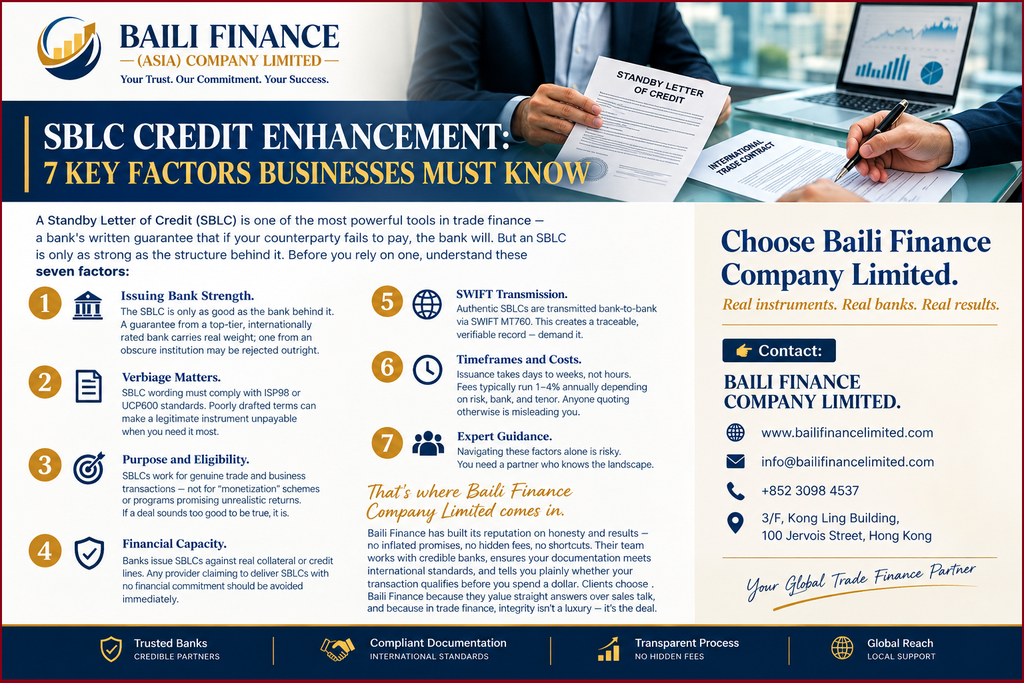
A Standby Letter of Credit (SBLC) is a bank’s undertaking to pay a beneficiary if the applicant fails to meet specified contractual obligations. As a credit enhancement tool, an SBLC can help companies strengthen transaction credibility, support financing arrangements, secure contracts, and provide additional assurance to counterparties.
Here are the seven factors businesses should understand before using an SBLC.
1. The Issuing Bank’s Strength Matters
A credit enhancement is heavily dependent on the credibility of the bank issuing the instrument.
Counterparties, lenders, and suppliers may evaluate:
- The issuing bank’s credit rating
- Its jurisdiction and regulatory standing
- Its reputation and banking relationships
- Whether the beneficiary’s bank accepts the issuer
An SBLC from a bank that the beneficiary or financing institution does not recognize may provide limited practical value.
For significant transactions, confirm the issuing bank’s acceptability before structuring the transaction around the SBLC.
2. An SBLC Supports Creditworthiness — It Does Not Replace Fundamentals
An SBLC does not automatically eliminate the applicant’s underlying credit requirements.
Depending on the applicant and issuing bank, the SBLC may be supported by:
- 100% cash collateral
- Partial collateral or margin
- An existing credit facility
- Other acceptable security
- The applicant’s established banking relationship and credit strength
Businesses should understand how much liquidity or borrowing capacity will be committed.
For example, cash collateral supporting an SBLC may reduce the funds available for working capital or other investments.
Therefore, calculate the economic and opportunity cost of the collateral before proceeding.
3. Choose the Appropriate Governing Rules: ISP98 vs. UCP600
SBLCs are commonly subject to either ISP98 or UCP600, depending on the transaction structure.
ISP98
International Standby Practices (ISP98) were specifically developed for standby letters of credit and are generally well suited to standby transactions.
UCP600
Uniform Customs and Practice for Documentary Credits (UCP600) was developed primarily for commercial documentary letters of credit, although it can also be incorporated into certain standby structures.
The applicable rules can affect matters such as:
- Document examination
- Presentation requirements
- Timing
- Notice of discrepancies
- Honor or dishonor procedures
- Certain procedural issues
The governing rules should be coordinated with the governing-law and jurisdiction clauses in the instrument.
4. Documentation Must Be Precise
An SBLC operates according to its stated terms and applicable rules. Payment generally depends on the beneficiary presenting documents that comply with the requirements of the SBLC.
Important drafting points include:
- Clearly defining the draw conditions
- Specifying exactly what documents must be presented
- Identifying required signatories
- Establishing presentation deadlines
- Setting a realistic expiry date
- Defining applicable notice requirements
- Addressing transfer or assignment where appropriate
For example, a draw requirement should be objectively defined rather than relying on vague language.
Ambiguity creates risk.
A poorly drafted SBLC can create unnecessary disputes over whether the presentation satisfies the instrument’s requirements.
5. Costs Go Beyond the Issuance Fee
The headline issuance fee is only one component of the total cost.
Depending on the transaction, businesses may also encounter:
- Collateral or margin requirements
- Confirmation charges
- Amendment fees
- Advising or handling fees
- Legal and documentation costs
- Bank processing charges
- Draw-related costs
- Costs associated with maintaining the underlying credit facility
For long-term SBLCs, businesses should examine whether fees apply to the entire face amount throughout the validity period and whether the bank offers different pricing for extensions or amendments.
A proper cost model should consider both the direct fees and the economic cost of committed collateral or credit capacity.
6. Verify the Transaction Carefully — Fraud Risks Are Real
The SBLC market can attract fraudulent schemes, particularly transactions involving alleged “leased SBLCs” or unrealistic “monetization” promises.
Potential warning signs include:
- Promises of extremely high financing or monetization values
- Claims of guaranteed non-recourse funding
- Instruments supposedly issued by obscure or difficult-to-verify institutions
- Refusal to allow appropriate bank-to-bank verification
- Heavy reliance on intermediaries without transparent documentation
- Requests for substantial upfront payments without adequate verification
Businesses should independently verify the parties, banks, documentation, and transaction structure.
Where appropriate, authentication should take place through recognized banking channels and established bank-to-bank procedures.
Do not rely solely on screenshots, PDFs, emails, certificates, or claims made by an intermediary as evidence that an SBLC exists or has been issued.
7. Match the Instrument to the Actual Credit-Enhancement Requirement
Not every transaction requires an SBLC.
| Business Objective | Potentially Appropriate Instrument |
|---|---|
| Bid or tender security | Bid bond / demand guarantee |
| Project performance assurance | Performance SBLC / performance guarantee |
| Advance-payment protection | Advance payment guarantee |
| Financial obligation backup | Financial SBLC |
| Routine international purchases | Commercial Letter of Credit under UCP600 |
The correct instrument depends on the contract, beneficiary requirements, jurisdiction, banking arrangements, and underlying commercial obligation.
Using an SBLC where a simpler instrument would satisfy the requirement may increase costs unnecessarily.
Conversely, using the wrong type of instrument may result in the beneficiary or financing institution refusing to accept it.
Bottom Line
A properly structured SBLC can strengthen a company’s position in a transaction by providing additional bank-backed assurance to a beneficiary, lender, supplier, or other counterparty.
But an SBLC is not a magic source of funding. Its usefulness depends on several factors:
Bank quality → acceptable structure → precise documentation → appropriate rules → realistic costs → independent verification → correct transaction purpose.
Businesses should therefore conduct proper due diligence before relying on an SBLC for financing, trade, project execution, or credit enhancement.
The key discipline is simple:
Choose the right bank. Draft the instrument carefully. Understand the costs. Verify everything. Match the SBLC to the actual transaction.
This information is for general educational purposes and does not constitute financial, banking, or legal advice. Specific SBLC transactions should be reviewed with the relevant bank and appropriately qualified legal and financial professionals.
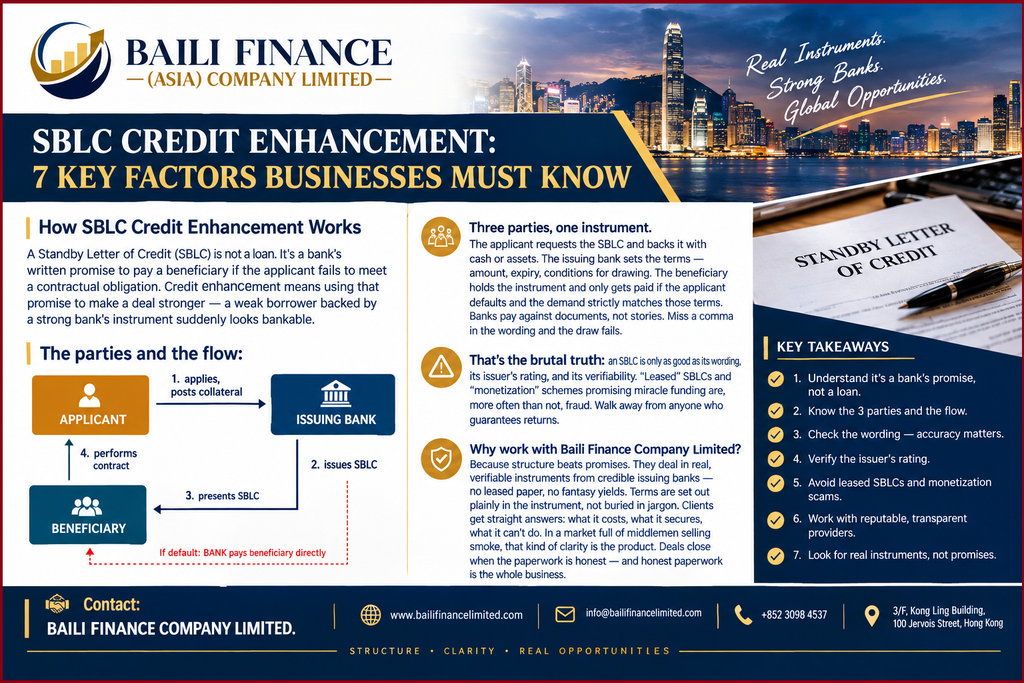
The basic SBLC credit enhancement structure
Applicant / Borrower
Requests an SBLC and undertakes to reimburse the issuing bank.
Issuing Bank
Issues an independent undertaking subject to its terms and conditions.
Beneficiary / Lender
Reviews and, if acceptable, relies on the SBLC as additional security.
Simplified illustration. The precise structure and obligations depend on the transaction and instrument.
Why Businesses Use SBLC Credit Enhancement
Companies may use standby letters of credit to address financial and contractual requirements that ordinary unsecured credit arrangements don’t satisfy. The instrument can provide a documented commitment from a bank, subject to the issuer’s creditworthiness and the SBLC’s enforceability.
Supporting loan applications
A borrower may present an SBLC to a lender as proposed collateral or credit support. If the lender accepts the instrument and its issuer, it may incorporate the SBLC into its credit assessment.
Nevertheless, the lender retains responsibility for evaluating the borrower’s financial position, repayment capacity, transaction purpose and other risks. An SBLC doesn’t remove the need for appropriate underwriting.
Strengthening supplier relationships
An importer may need to reassure an overseas supplier that payment obligations have financial backing. An SBLC can provide recourse to the issuing bank if the importer fails to pay and the supplier makes a complying demand.
This arrangement may help the parties negotiate payment terms, subject to the supplier’s acceptance of the issuing bank and the proposed wording.
Supporting project finance and construction
Project owners sometimes require contractors to provide financial security for performance obligations. A standby letter of credit may secure a contractor’s obligation to repay an advance, meet specified contractual requirements or compensate the beneficiary following a defined default.
The instrument must identify the obligations it secures and the documentary requirements for a demand. An SBLC shouldn’t be treated as a substitute for a detailed project contract or appropriate due diligence.
Facilitating international commercial transactions
International businesses often deal with counterparties in different jurisdictions. An SBLC may offer an additional contractual payment mechanism when the parties need bank-backed security.
However, cross-border transactions introduce considerations involving governing law, applicable sanctions, currency, documentary presentation, bank confirmation and payment location. Parties should assess these matters before entering into the arrangement.
The Main Types of SBLC Credit Enhancement
The intended purpose of the standby determines its structure, wording and documentary requirements. Businesses should identify the appropriate instrument before requesting issuance.
Financial standby letter of credit
A financial SBLC supports a monetary obligation, such as repayment of a loan, payment of a lease or settlement of an agreed debt. The beneficiary can make a demand when the relevant conditions in the instrument have been met.
For example, a company might arrange a financial standby in favour of a lender to secure a specified borrowing facility. The lender must review the instrument’s terms and decide whether the issuing bank and the proposed security meet its credit requirements.
Performance standby letter of credit
A performance SBLC supports obligations to perform under a contract. A construction company may arrange one in favour of a project owner to provide security for defined performance commitments.
Depending on the wording, a complying demand may require a statement of breach or other specified documents. The bank’s examination focuses on the presentation requirements rather than resolving the underlying commercial dispute.
Advance payment standby letter of credit
An advance payment SBLC can support the return of an advance if the recipient fails to fulfil the agreed conditions. A buyer may request this form of security before releasing funds to a supplier or contractor.
The instrument should state the amount secured, how the exposure changes as the recipient performs and the conditions for a complying demand.
Direct-pay standby letter of credit
A direct-pay standby can support an identified payment obligation, with payment occurring when the beneficiary presents the documents specified in the instrument. Its commercial purpose differs from that of a standby intended only to cover default.
The parties should specify whether the instrument serves as primary payment support, contingent security or both. Ambiguity can create documentary and contractual disputes.
How SBLC Credit Enhancement Can Support Financing
A business considering an SBLC-backed financing arrangement should first establish whether the intended lender accepts standby letters of credit as security. Lender acceptance is a central requirement, not a detail to resolve after issuance.
Step 1: Identify the financing requirement
The company should define the amount, currency, duration and purpose of the proposed facility. It should also identify the specific credit concern the SBLC is intended to address.
A clearly documented financing requirement enables the borrower to assess whether an SBLC is commercially suitable or whether another form of collateral would meet the lender’s needs.
Step 2: Obtain the lender’s requirements
The borrower should request written guidance from the lender covering:
- Whether it accepts SBLCs for the proposed facility.
- The eligible issuing banks and any minimum credit-rating requirements.
- The required amount, currency and validity period.
- Whether the lender requires an advising or confirming bank.
- The acceptable governing law and rules.
- The required documentary conditions for a demand.
- Any applicable haircut, collateral valuation or additional security requirements.
Without these details, the borrower risks paying fees for an instrument that the lender won’t accept.
Step 3: Arrange an eligible issuing bank
The applicant must undergo the issuing bank’s credit assessment and satisfy its issuance conditions. Depending on the applicant’s financial strength and the bank’s policies, the bank may require cash collateral, a credit facility, other security or a combination of these.
The issuing bank also considers its own exposure, the proposed beneficiary, the transaction’s commercial rationale and relevant compliance requirements.
Step 4: Agree on the instrument wording
The parties should review the proposed SBLC text before issuance. They should confirm that the instrument identifies the correct parties, amount, expiry, presentation location, applicable rules and demand documents.
Where appropriate, specialist trade finance counsel should review the wording, particularly when the transaction involves multiple jurisdictions.
Step 5: Complete issuance and authentication
The issuing bank delivers the SBLC through an agreed banking channel. The beneficiary or its bank should verify the instrument’s authenticity using appropriate bank-to-bank procedures.
A PDF, scanned document or email claiming to represent an SBLC doesn’t independently establish that a bank has issued an enforceable instrument.
Step 6: Complete the lender’s credit process
After receiving and verifying the SBLC, the lender determines whether it satisfies the agreed conditions. It then completes any outstanding credit, legal and operational checks before deciding whether to approve and disburse the facility.
The applicant should plan for the possibility that the lender will decline the proposed structure or require additional collateral.
Key Benefits and Limitations of SBLC Credit Enhancement
An SBLC can provide contractual security, but its commercial value depends on how the parties structure and use it. Businesses should consider both the potential benefits and the limitations before committing to the arrangement.
Potential benefits
Additional payment security: A qualifying beneficiary receives an independent bank undertaking, subject to the terms of the instrument. This can provide an additional source of recovery if the applicant defaults.
Support for commercial negotiations: A supplier or lender may accept an SBLC as part of a broader credit arrangement. This can help parties negotiate payment periods, advance payments or other contractual terms.
Defined financial exposure: The instrument normally specifies a maximum amount and an expiry date. These details help the parties identify the extent and duration of the bank’s contingent obligation.
International transaction support: An SBLC may provide a familiar documentary mechanism for parties operating across borders, particularly where the relevant banks and counterparties understand the applicable rules.
Important limitations
No automatic financing approval: A lender may reject an SBLC because of the issuing bank, the instrument’s wording, the transaction’s risk profile or its own internal policies.
Issuance costs: Applicants may incur bank fees, collateral costs, legal expenses, advising charges and other transaction expenses.
Reimbursement obligations: If the issuing bank honours a complying demand, the applicant may have to reimburse the bank immediately or according to the agreed facility terms.
Legal and documentary risk: A poorly drafted standby can create uncertainty over presentation requirements, expiry, payment obligations and available remedies.
Potential exposure to fraud: Fraudulent intermediaries may advertise SBLC monetisation, guaranteed returns or financing without a genuine issuing bank or a verified transaction.
The ICC’s guidance on SBLCs and trade finance identifies the importance of transaction controls and appropriate due diligence. Businesses should independently verify the participating financial institutions and the commercial purpose of the proposed instrument.
SBLC Credit Enhancement Costs and Fees
The cost of an SBLC depends on the issuing bank, applicant, amount, currency, tenor, collateral and transaction structure. There isn’t one universal fee schedule for all standby letters of credit.
Common cost categories include:
| Cost category | What it may cover |
|---|---|
| Issuance fee | The bank’s charge for issuing the SBLC, often calculated with reference to the amount and tenor. |
| Amendment fee | Changes to the amount, expiry date, beneficiary or other instrument terms. |
| Advising fee | The receiving bank’s charge for advising the instrument. |
| Confirmation fee | An additional bank’s undertaking to honour a complying presentation, if confirmation is requested and accepted. |
| Legal fees | Drafting and reviewing the instrument and related contracts. |
| Collateral costs | The cost of cash collateral or other security required by the issuing bank. |
| Operational charges | Messaging, document handling and other transaction-related charges. |
An applicant should obtain a written quotation from the issuing bank and understand which fees are refundable, which are payable in advance and which arise only after issuance.
An illustrative cost calculation
Assume a company requests a one-year SBLC with a face amount of US$2 million. For illustration only, assume the issuing bank quotes an annual issuance fee of 2% of the face amount.
The indicative annual issuance fee would be:
$2,000,000×0.02=$40,000
This calculation excludes other bank charges, legal costs, collateral expenses, taxes and any fees associated with amendments or confirmation. The assumed rate isn’t a market quotation or an offer from Baili Finance Limited.
A business should compare the total cost of the SBLC arrangement with the commercial benefit it expects to receive. It should also assess the impact of any collateral requirement on its available working capital.
Due Diligence: Protecting Your SBLC Transaction
Before proceeding with SBLC credit enhancement, the applicant and beneficiary should complete appropriate financial, legal and operational checks. These checks can help prevent disputes, unexpected costs and exposure to fraudulent proposals.
Verify the issuing bank
Confirm the bank’s identity through independently obtained contact information and official banking channels. Review its regulatory status, reputation, financial strength and ability to issue the proposed instrument.
If the transaction requires confirmation, establish which bank will provide it and whether that bank has formally agreed to do so.
Authenticate the instrument
Ask the beneficiary’s bank to authenticate the SBLC through established bank-to-bank communication procedures. Don’t rely solely on a broker’s assurance, a screenshot, an email attachment or a purported instrument number.
Review the commercial purpose
The transaction should have a documented economic and commercial rationale. Parties should understand the underlying obligation, the beneficiary’s rights, the applicant’s reimbursement responsibilities and the intended use of the instrument.
Examine the applicable rules and governing law
SBLCs may incorporate ISP98 or, where suitable, UCP 600. The instrument should expressly identify the rules that apply, if any. The parties should also determine the governing law and relevant jurisdictional requirements.
The ICC explains that ISP98 applies when the standby expressly incorporates the rules, which supplement applicable law rather than replace it.
Recognise warning signs
Exercise particular caution when an intermediary:
- Promises guaranteed financing regardless of the applicant’s creditworthiness.
- Claims that every SBLC can be monetised at a fixed percentage of face value.
- Demands unexplained advance payments to secure a supposed bank instrument.
- Refuses to identify the issuing bank or permit independent verification.
- Offers an instrument without a clear beneficiary, expiry date or presentation procedure.
- Pressures the applicant to bypass normal legal, banking or compliance checks.
An SBLC is a financial undertaking, not a freely tradable source of guaranteed cash. A proposed financing arrangement requires the lender’s explicit acceptance and a valid, enforceable instrument.
Real-World Commercial Example: An Importer’s Payment Security
The following scenario is a practical illustration of how an SBLC might support an international supply contract. It isn’t a report of a verified transaction or a claim about a particular company’s results.
A Ghanaian manufacturing company plans to import industrial equipment from an overseas supplier. The supplier requests an acceptable form of payment security before agreeing to a deferred payment arrangement.
The importer approaches its bank to discuss a financial standby letter of credit. Following credit assessment, the bank agrees in principle to consider issuing an SBLC, subject to final documentation and collateral requirements.
The parties agree on a US$500,000 standby with a one-year validity period. The instrument names the supplier as beneficiary and specifies the documents required to make a demand if the importer fails to meet its payment obligations.
The supplier reviews the issuing bank, the instrument’s wording and the proposed presentation conditions. After the supplier’s bank authenticates the SBLC, the supplier agrees to the negotiated payment terms.
The importer receives the equipment and makes the scheduled payments under the supply contract. If the importer fulfils its obligations, the supplier has no reason to draw on the standby. If a covered default occurs, the supplier may present a complying demand before expiry.
This example demonstrates the distinction between a contractual payment obligation and the separate undertaking issued by the bank. It also shows why the parties need to agree on the instrument before the applicant incurs issuance costs.
Case Study: Using an SBLC to Support a Project Financing Proposal
Background
Consider a hypothetical construction company that has secured a contract to build a commercial facility. The project owner requires financial security for the contractor’s obligations, while the contractor needs a working capital facility to purchase materials and pay subcontractors.
The contractor has an established business and a documented project budget. However, the proposed lender wants additional security before considering the requested facility.
The proposed solution
The contractor discusses an SBLC-backed financing structure with its bank and the prospective lender. The parties identify the proposed facility’s requirements and agree to assess whether a standby issued by an acceptable bank could support the lender’s credit decision.
The contractor provides financial statements, the construction contract, its cash flow forecast and other supporting documents. The issuing bank reviews the applicant’s financial position and the proposed security arrangements.
Following its credit review, the issuing bank determines whether it can issue the SBLC and under what conditions. The prospective lender separately reviews the proposed instrument and its own credit requirements.
Transaction considerations
The parties must address several important matters:
- Issuing bank eligibility: The lender must be satisfied with the issuing bank’s credit standing and the instrument’s enforceability.
- Security amount: The SBLC must provide an amount that meets the lender’s stated requirements, subject to its own valuation and credit policies.
- Expiry and claim period: The standby must remain effective for the agreed period and provide sufficient time for the beneficiary to present any required demand.
- Underlying obligations: The parties should document the precise obligations that the instrument supports.
- Reimbursement: The contractor must understand its obligations to reimburse the issuing bank if the beneficiary makes a complying demand.
Outcome and lessons
In this hypothetical case, assume the lender accepts the SBLC as one element of its overall security package and completes its independent underwriting. It may then approve the facility, subject to all outstanding conditions.
The arrangement could allow the contractor to access working capital while giving the lender additional contractual security. However, the facility’s approval and disbursement depend on the lender’s assessment, not merely on the existence of an SBLC.
The central lesson: SBLC credit enhancement works within a broader financial and legal structure. It doesn’t eliminate credit risk, replace a borrower’s repayment capacity or compel a lender to provide financing.
How to Prepare for an SBLC Credit Enhancement Transaction
Preparation helps applicants identify their requirements, assess potential costs and reduce avoidable delays. A structured approach also gives banks and prospective beneficiaries the information they need to evaluate the proposed transaction.
Before making an application, assemble the following information:
- Company profile: Legal business name, registration details, ownership structure and principal business activities.
- Financing objective: The intended use of the SBLC, proposed financing amount and commercial purpose.
- Financial records: Available financial statements, management accounts, cash flow forecasts and relevant banking information.
- Underlying agreement: The supply contract, loan agreement, project contract or other document that establishes the obligation.
- Beneficiary details: The legal name and verified banking information of the party that will receive the instrument.
- Proposed instrument terms: Amount, currency, tenor, expiry date, governing law, applicable rules and documentary requirements.
- Collateral information: Details of any proposed cash collateral, existing credit facilities or other security.
- Professional advice: Where appropriate, independent legal, accounting and trade finance advice.
These documents don’t guarantee approval. They provide a basis for the relevant financial institutions to conduct their own assessments and identify outstanding requirements.
Businesses should also consider the transaction’s timeline. Bank credit approval, compliance checks, legal review and instrument authentication can take time. Applicants should avoid making contractual commitments based on an assumed issuance date or unconfirmed financing availability.
SBLC Credit Enhancement and International Banking Standards
International banking practices help establish a consistent framework for documentary undertakings. However, the parties must understand the difference between an industry rule, the applicable law and the specific terms of their instrument.
The International Chamber of Commerce publishes ISP98, a set of rules designed for standby letters of credit. The rules address matters such as issuance, interpretation, presentation, examination and payment. Parties can incorporate ISP98 by expressly referring to it in the standby.
UCP 600, which primarily governs documentary credits, can also apply to standby letters of credit where expressly incorporated and relevant to the instrument. The parties should avoid assuming that UCP 600 or ISP98 applies automatically to every SBLC.
The
ICC Academy’s comprehensive guide to standby letters of credit
provides further information about their characteristics, commercial applications, rules and risks.
For transactions involving multiple countries, legal advisers should review the instrument’s governing law, the issuer’s obligations, the beneficiary’s rights and any applicable regulatory requirements. International standards support consistent practice, but they don’t displace mandatory laws or guarantee that a particular instrument will be accepted in every jurisdiction.
The Role of Baili Finance Limited in Exploring Credit Enhancement
Businesses considering SBLC credit enhancement need to understand the difference between a financial objective and the specific banking instrument proposed to achieve it.
Baili Finance Limited can use this distinction as a starting point for discussing a client’s financing requirements and the potential structure of a transaction. Before pursuing an SBLC arrangement, businesses should identify the intended beneficiary, the underlying obligation and the financial institution expected to issue the instrument.
Any potential transaction should undergo appropriate due diligence, independent bank verification and review of the applicable terms. Applicants should request clear written information about fees, eligibility requirements, collateral, approval procedures and the responsibilities of every participating party.
A responsible financing discussion should also consider alternatives. Depending on the transaction, a conventional bank loan, documentary credit, demand guarantee, cash collateral or another financing arrangement may be more suitable than an SBLC.
For companies that are considering cross-border trade or project financing, a detailed assessment of the proposed arrangement can help clarify whether an SBLC addresses a genuine commercial requirement.
Frequently Asked Questions About SBLC Credit Enhancement
1. What is SBLC credit enhancement in simple terms?
SBLC credit enhancement uses a standby letter of credit to provide additional contractual payment security for an eligible financing or commercial transaction. A bank issues the instrument at the applicant’s request, promising to honour a complying demand from the named beneficiary under the stated conditions. A lender may accept the instrument as security, but it retains the right to conduct its own credit assessment and decide whether to provide financing.
2. Can an SBLC be used to secure a business loan?
Yes, an SBLC may support a business loan if the lender accepts the instrument, the issuing bank meets its requirements and the proposed terms satisfy the lender’s credit and legal policies. The borrower must also meet the lender’s other conditions, including any requirements concerning repayment capacity, collateral and transaction documentation. An SBLC doesn’t create an automatic right to borrow.
3. How does an SBLC differ from a bank guarantee?
Both instruments can provide contractual payment security, but their legal structures and market practices may differ. An SBLC generally operates as an independent documentary undertaking, often subject to ISP98 or UCP 600. A demand guarantee commonly follows URDG 758 or other applicable rules. The differences depend on the instrument’s wording, the applicable law and the relevant banking practices. Parties should assess the actual terms rather than relying only on the instrument’s name.
4. What documents are required for SBLC credit enhancement?
Requirements vary by issuing bank, applicant, transaction and beneficiary. Common documents include company registration records, financial statements, identification and ownership information, the underlying contract, financing details, beneficiary information and proposed instrument wording. The issuing bank may also require collateral documents, credit applications and additional compliance information. The beneficiary may have separate requirements for acceptance and authentication.
5. How much does SBLC credit enhancement cost?
There is no universal price. The cost depends on the issuing bank’s fee schedule, the amount, tenor, currency, applicant’s credit profile, collateral arrangements and any additional services required. Applicants may incur issuance, amendment, advising, confirmation and legal fees. They should obtain a written quotation and check the full cost of the transaction before agreeing to proceed.
6. Can an SBLC be monetised?
An SBLC isn’t cash, and its existence doesn’t automatically entitle its holder to receive a loan or sell the instrument for a percentage of its face value. A financial institution may consider lending against an SBLC if its policies permit, the instrument meets its eligibility requirements and the transaction passes the relevant credit and compliance checks. Any proposed monetisation arrangement requires independent verification of the participating institutions, costs, legal terms and actual source of repayment.
7. How long does it take to arrange an SBLC?
The timeline depends on the applicant’s financial documentation, the issuing bank’s credit approval process, the complexity of the transaction, compliance checks and agreement on the instrument wording. Some straightforward arrangements may progress faster than complex cross-border transactions. Applicants should request a realistic timeline directly from the relevant bank and avoid relying on unverified promises of guaranteed issuance within a fixed number of days.
8. Is an SBLC the same as a documentary letter of credit?
No. A commercial documentary letter of credit generally facilitates payment for a commercial transaction against the presentation of compliant documents. An SBLC usually serves as a secondary source of payment or contractual security if the applicant fails to fulfil an obligation. However, some direct-pay standbys can support payment obligations. The instrument’s specific purpose and terms determine how it operates.
9. What happens if the beneficiary makes a demand under an SBLC?
The beneficiary must present the documents required by the instrument within the permitted time and at the specified location or through the agreed presentation channel. The issuing bank examines the presentation against the standby’s terms and applicable rules. If the presentation complies, the bank generally must honour its independent undertaking, subject to applicable law and any relevant legal defences. The applicant may then have to reimburse the issuing bank according to its separate agreement.
10. What should businesses verify before accepting an SBLC?
A beneficiary should independently authenticate the instrument through appropriate banking channels. It should review the issuing bank’s credit standing, the amount, the expiry date, the governing law, applicable rules, presentation requirements and the terms governing payment. It should also confirm that the instrument meets the requirements of the underlying transaction and obtain appropriate legal advice when needed..
Conclusion: Making Informed Decisions About SBLC Credit Enhancement
SBLC credit enhancement can provide additional financial security for eligible lending, trade finance and commercial transactions. By offering an independent bank undertaking, a standby letter of credit may help address a beneficiary’s concerns about payment or performance risk. However, the instrument’s value depends on the issuing bank, its enforceability, the documentary conditions and the beneficiary’s acceptance.
Businesses should begin by identifying their actual financing requirements, obtaining the lender’s written conditions and assessing the costs and obligations associated with issuance. They should also verify every participating financial institution and avoid proposals that promise guaranteed financing or effortless monetisation.
Ultimately, a successful SBLC arrangement requires careful planning, transparent communication, appropriate documentation and a clear understanding of the risks. Before committing to an SBLC credit enhancement transaction, make sure the instrument meets your financing objectives and the beneficiary’s requirements.
Explore Your SBLC Credit Enhancement Options
Are you evaluating an SBLC for business financing, international trade or a commercial project? Start with a clear assessment of your requirements and the banking conditions that apply to your proposed transaction.
Contact Baili Finance Limited to discuss your financing objectives, understand the documentation involved and explore whether an SBLC-related structure may suit your circumstances.
Prepare your proposed financing amount, transaction purpose and beneficiary requirements before making an enquiry.
Ready to Strengthen Your Business Financing?
Are you looking to use SBLC credit enhancement to support a business loan, secure an international trade transaction or meet a project financing requirement?
At Baili Finance Limited, we invite you to take the next step. Contact our team to discuss your financing objectives, understand the requirements and explore potential SBLC-related solutions tailored to your transaction.
Don’t leave your financing plans to uncertainty. Start with a clear understanding of your options, the documentation you’ll need and the steps involved.
Contact Baili Finance Limited today to discuss your SBLC credit enhancement requirements and take the first step towards your financing goals.
Contact us today
Visit: www.bailifinancelimited.com to make an enquiry.
Intermediaries/Consultants/Brokers are welcome to bring their clients 100% protected. Our brokers receive 2% commission for referral. We assist Clients and brokers in their attempt to secure funding by working on their funding requests that may require innovative financing. In complete confidence, we will work together for the benefits of all parties involved.
#SBLC #SBLCCreditEnhancement #StandbyLetterOfCredit #TradeFinance #BusinessFinancing #CreditEnhancement #InternationalTrade #FinancialSecurity #StructuredFinance #BailiFinanceLimited