Headline: Non-Recourse Loan Against SBLC: A Complete Guide
A non-recourse loan against an SBLC can offer businesses a potential route to financing when conventional lending does not meet their requirements. For companies involved in international trade, infrastructure, commodities, real estate, and cross-border investment, a standby letter of credit (SBLC) may support a structured financing transaction, subject to the instrument’s terms, the issuing bank’s credit standing, and the lender’s approval.
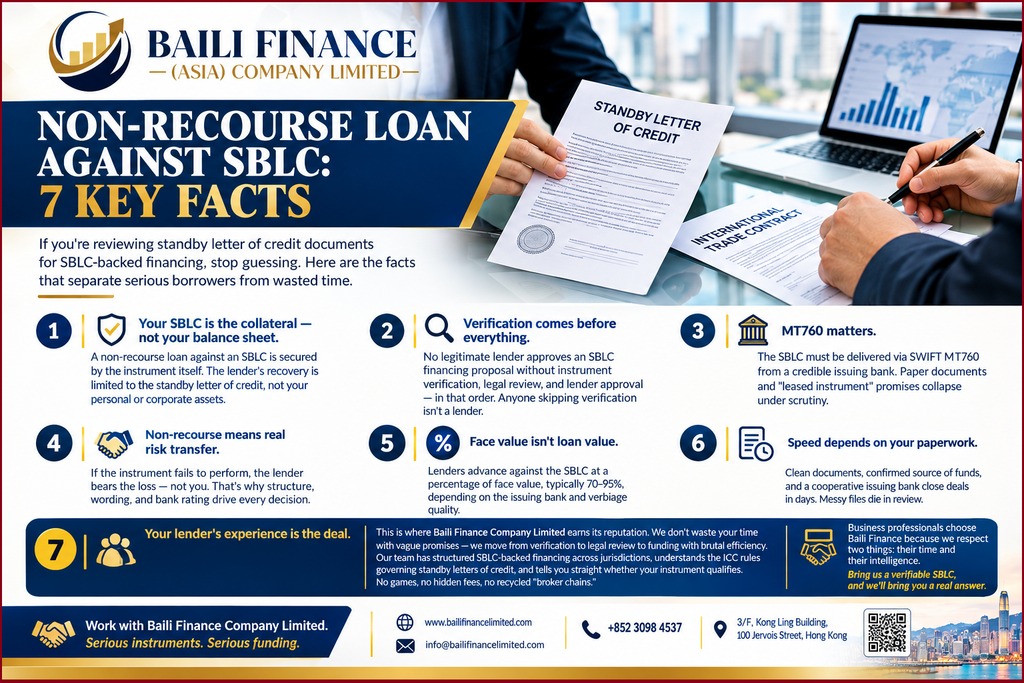
However, business owners need to understand an important distinction: an SBLC does not automatically qualify its holder for a loan, and a non-recourse financing arrangement does not necessarily eliminate every financial risk. The lender must assess the instrument, the transaction, the proposed repayment structure, and the legal enforceability of its security rights.
At Baili Finance Limited, businesses seeking SBLC-backed financing should approach the process with a clear understanding of the available structures, documentation requirements, costs, and potential limitations. This guide explains how non-recourse loans against standby letters of credit work, what lenders typically assess, and how applicants can prepare for a financing discussion.
Whether you’re researching non-recourse SBLC financing, SBLC monetization, or a loan against a standby letter of credit, the objective is the same: to understand whether the proposed structure fits your commercial needs before committing funds or signing binding agreements.
Keywords: non-recourse loan against SBLC, non-recourse SBLC financing, SBLC-backed loan, SBLC financing, how to get a non-recourse loan against SBLC, loan against standby letter of credit, SBLC financing requirements, standby letter of credit, SBLC monetization, trade finance, collateral, credit enhancement, issuing bank, financing agreement, recourse provisions
What Is a Non-Recourse Loan Against an SBLC?
A non-recourse loan against an SBLC is a proposed financing arrangement in which a lender provides funding based on an acceptable standby letter of credit and agrees, subject to the contract’s terms and applicable law, to limit its repayment claims to specified collateral, pledged assets, or transaction proceeds.
The precise meaning of non-recourse depends on the financing agreement. Some transactions restrict the lender’s recovery to defined collateral, while others contain exceptions for fraud, misrepresentation, prohibited transfers, or other specified events.
A standby letter of credit is a bank undertaking that generally supports payment or performance if the beneficiary presents the documents required by its terms. It is not the same as cash deposited in a bank account.
The International Chamber of Commerce explains the operation of standby letters of credit and the rules that may govern them in its comprehensive guide to standby letters of credit.
In a financing transaction, the lender may consider an SBLC’s credit support when determining whether to extend funding. However, the lender must verify the instrument and determine whether its rights can be established and enforced under the applicable legal framework.
What Does Non-Recourse Mean in Practice?
In a conventional recourse loan, a lender may have the right to pursue the borrower for a remaining debt after realizing the agreed security, subject to applicable law and contractual limitations.
In a properly structured non-recourse loan, the lender generally agrees to limit recovery to specified assets or collateral. If those assets fail to cover the outstanding balance, the lender may have no claim against the borrower’s other assets, except where the agreement or applicable law provides otherwise.
Consider a company that receives $2 million in financing secured by an eligible financial instrument. If the agreement limits the lender’s recovery to that collateral and its realizable value falls below the outstanding debt, the lender may bear the shortfall.
That result depends on the actual contract. The borrower should not assume that a transaction is genuinely non-recourse merely because a broker, intermediary, or lender describes it that way.
Before proceeding, review:
- The exact definition of non-recourse in the loan agreement.
- The assets or proceeds available to satisfy the lender’s claim.
- Any guarantees, indemnities, or additional security requirements.
- Exceptions involving fraud, misrepresentation, or contractual breaches.
- The applicable law and dispute-resolution arrangements.
How Does SBLC-Backed Financing Work?
An SBLC-backed financing transaction typically involves several parties, including the applicant, issuing bank, beneficiary, financing provider, and sometimes an intermediary or advising bank.
The structure depends on the purpose of the financing, the SBLC’s wording, and the rights available to the proposed lender.
Step 1: The Applicant Establishes the SBLC
A business obtains a standby letter of credit from an issuing bank. The bank assesses the applicant and determines the conditions under which it will issue the instrument.
Depending on the arrangement, the bank may require cash collateral, a credit facility, other security, or an approved credit limit.
The applicant must understand its obligations to the issuing bank. Even when a separate lender proposes non-recourse financing, the applicant may remain liable to the issuing bank under the SBLC issuance agreement.
This distinction matters because non-recourse financing from a third-party lender does not automatically remove the applicant’s obligations to the issuing bank.
Step 2: The Financing Provider Reviews the Instrument
The proposed lender examines the SBLC’s authenticity, issuing bank, amount, currency, expiry date, governing rules, drawing conditions, and transfer or assignment provisions.
The lender may also require bank-to-bank authentication through established banking channels.
An emailed copy, screenshot, or certificate supplied by an intermediary does not independently establish that an instrument is authentic, operative, or acceptable as collateral.
Step 3: The Parties Agree on the Financing Structure
If the initial review is satisfactory, the parties assess the proposed funding amount, tenor, fees, repayment provisions, security arrangements, and recourse limitations.
The lender may consider a loan secured by eligible rights or proceeds, an assignment of proceeds, a participation arrangement, or another legally permissible structure.
These structures are not interchangeable. For example, assigning proceeds does not necessarily transfer the right to draw under the SBLC itself.
The parties should obtain legal advice before deciding how to document the transaction.
Step 4: Due Diligence and Legal Documentation
The lender conducts financial, legal, compliance, and transaction-specific checks.
Typical requirements include corporate registration documents, beneficial ownership information, identification documents, financial statements, proof of the source of funds where required, and the original or authenticated SBLC details.
The financing agreement should clearly identify the parties’ rights and responsibilities. It should also specify the conditions that must be satisfied before funds can be released.
Step 5: Funding and Monitoring
Once all required conditions have been met, the financing provider may release the agreed funds.
The parties then monitor the transaction against its contractual milestones, repayment schedule, collateral requirements, and expiry dates.
Depending on the structure, the lender may require ongoing reporting, notice of amendments, or replacement collateral if the instrument expires before the financing obligation ends.
Important: There is no universal loan-to-value ratio, approval timeline, interest rate, or advance amount for SBLC-backed financing. Each proposal requires individual assessment.
Who May Benefit From a Non-Recourse SBLC Loan?
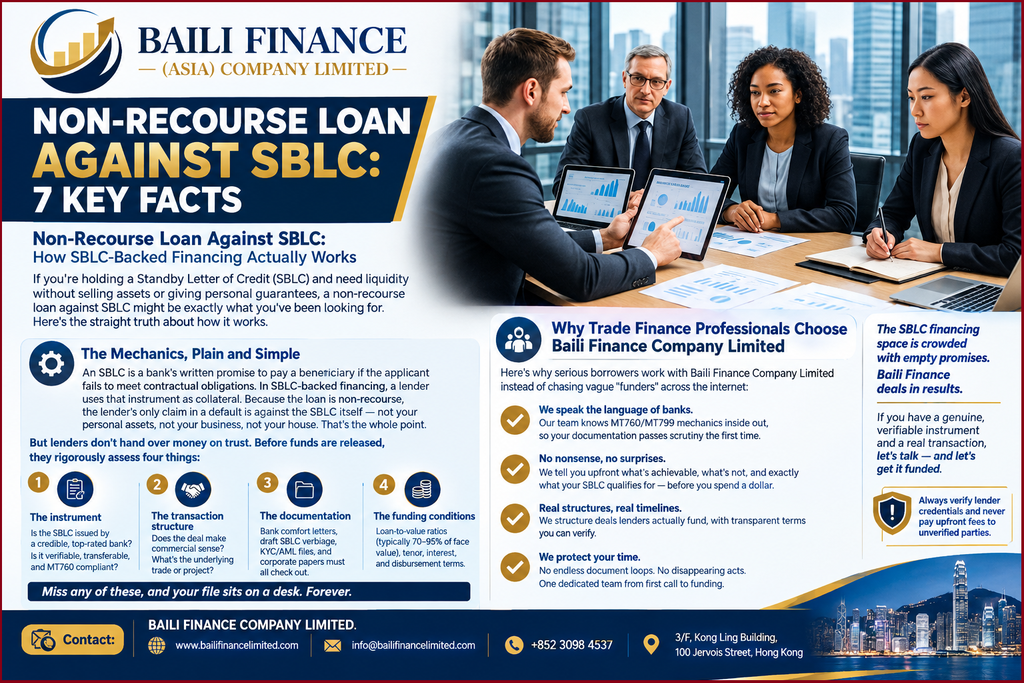
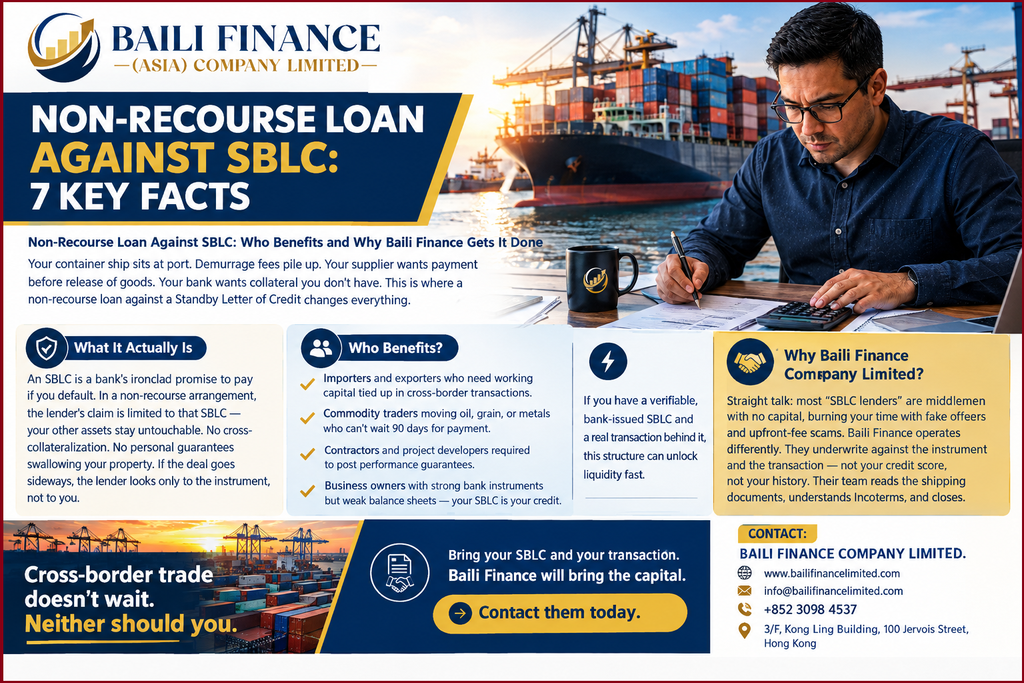
Non-recourse SBLC financing may suit businesses that need capital for a defined commercial purpose and can provide an acceptable instrument.
Potential applicants include:
International Trading Companies
Importers and exporters may need working capital to pay suppliers, finance inventory, or meet contractual payment obligations.
An SBLC may support a trade relationship or form part of a broader financing structure. The lender must still assess the transaction’s commercial substance and the instrument’s enforceability.
Infrastructure and Construction Businesses
Contractors may require financing to mobilize equipment, purchase materials, or meet obligations under construction contracts.
Where an SBLC supports a project, a financing provider may examine the contract, project cash flows, payment schedule, and available security.
Commodity Businesses
Commodity traders may require funding to purchase, transport, store, or process eligible goods.
The financing provider may assess purchase contracts, sales agreements, counterparties, logistics arrangements, insurance, and the proposed repayment source.
Property and Investment Companies
Some businesses may explore SBLC-backed financing to support a property acquisition, investment, or other approved project.
Acceptance depends on the lender’s mandate, jurisdictional restrictions, the instrument’s terms, and the project’s financial viability.
An SBLC does not guarantee that a lender will approve the transaction or that the proposed financing will be economically beneficial.
What Determines the Amount You Can Borrow Against an SBLC?
The face value of an SBLC does not necessarily equal the amount a lender will advance.
For example, an SBLC with a stated amount of $10 million does not automatically support a $10 million loan. The lender may decline the instrument, approve a smaller amount, or require additional security.
Several factors influence the assessment.
1. Issuing Bank and Credit Quality
The lender considers the issuing bank’s creditworthiness, jurisdiction, regulatory standing, and ability to meet its obligations.
The lender may also consider country risk, transfer restrictions, sanctions exposure, and the practical enforceability of a claim.
2. Instrument Wording and Expiry
The SBLC must contain terms that support the proposed financing structure.
The lender examines the expiry date, presentation requirements, governing rules, amendment provisions, and any conditions that could prevent or delay payment.
A short remaining validity period may reduce the instrument’s suitability for a longer financing arrangement.
3. Legal Rights Over the Instrument
The lender needs to establish what it can legally secure or enforce.
A beneficiary’s ability to assign proceeds may differ from its ability to transfer drawing rights. The instrument, governing law, applicable banking rules, and relevant consent requirements determine which rights are available.
4. Borrower’s Financial Position
Even when the financing proposal emphasizes collateral, the lender may assess the applicant’s business, ownership, financial records, source of funds, and intended use of proceeds.
A genuinely non-recourse structure may reduce reliance on the borrower’s other assets, but it does not remove the need for due diligence.
5. Transaction Economics
The proposed financing must make commercial sense.
The lender considers the expected recovery, costs of enforcement, legal expenses, currency exposure, transaction duration, and the risks associated with the issuing bank and jurisdiction.
The final amount depends on the lender’s documented underwriting decision rather than a standard percentage of the SBLC’s face value.
Non-Recourse SBLC Financing vs. Recourse Financing
Understanding the differences helps applicants compare proposals before signing an agreement.
| Feature | Non-recourse financing | Recourse financing |
|---|---|---|
| Recovery rights | Generally limited to specified collateral or assets | May extend to the borrower or guarantor, subject to contract and law |
| Borrower exposure | Depends on the scope of recourse exceptions | May include a shortfall after collateral realization |
| Underwriting | Focuses on collateral, enforceability, and transaction risks | May place greater emphasis on borrower credit and repayment capacity |
| Pricing | Depends on risk, structure, and provider | Depends on risk, structure, and provider |
| Guarantees | May be absent or limited, but must be checked | May include personal or corporate guarantees |
| Legal documentation | Must define the recourse limitation precisely | Must define repayment and recovery rights precisely |
Neither structure is automatically better.
A business should compare the total financing cost, legal obligations, available proceeds, default consequences, and operational restrictions. A lower advertised rate may not represent the more suitable arrangement if the contract imposes extensive guarantees or additional fees.
How Much Does a Non-Recourse Loan Against an SBLC Cost?
There is no universal pricing formula for this type of financing.
The total cost may include interest, arrangement fees, legal expenses, due-diligence charges, bank charges, authentication costs, commitment fees, and other contractually agreed expenses.
The applicant should request a written breakdown before paying any fees.
Illustrative Financing Calculation
Assume a lender approves a $2 million facility for 12 months at a hypothetical annual interest rate of 10%.
The simple interest calculation would be:
- Principal: $2,000,000
- Hypothetical annual interest rate: 10%
- Duration: 12 months
- Illustrative interest cost: $200,000
- Principal plus interest: $2,200,000
This calculation excludes arrangement fees, legal expenses, compounding, taxes, and other costs.
It also assumes the principal remains outstanding for the full year and that the contract uses simple interest. Actual financing costs may differ substantially.
Before accepting an offer, ask the provider for the effective annual cost, payment schedule, conditions for early repayment, and any charges that apply if the transaction does not close.
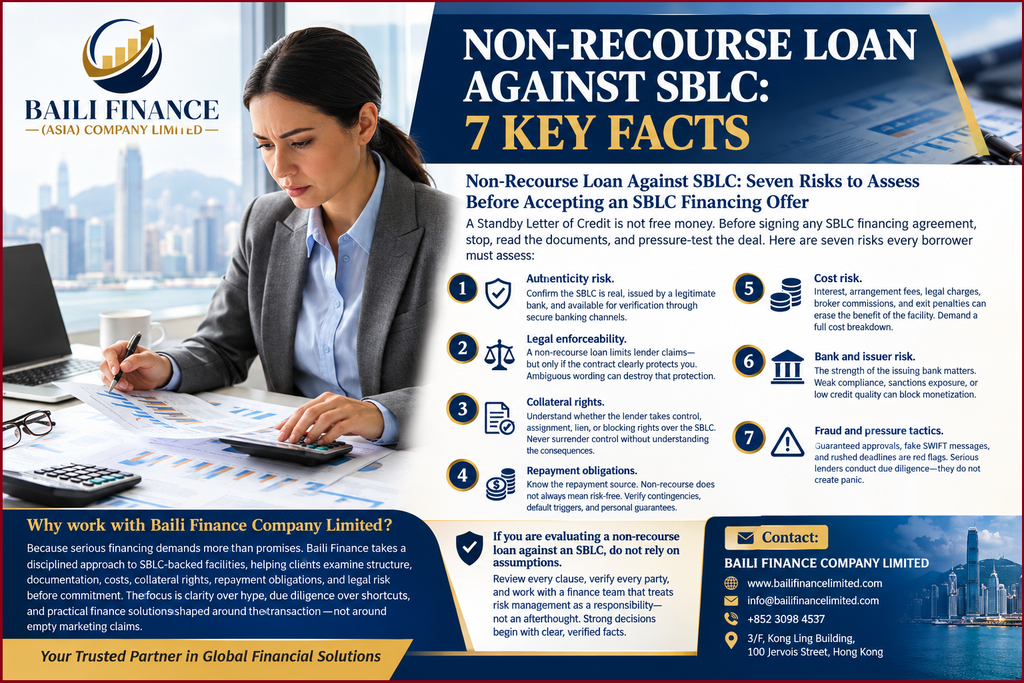
Seven Risks to Assess Before Accepting an SBLC Financing Offer
An SBLC-backed loan can involve significant legal and financial exposure. Applicants should assess these risks before committing funds.
1. Misrepresentation of Non-Recourse Terms
A proposal may describe itself as non-recourse while requiring personal guarantees, corporate guarantees, broad indemnities, or additional collateral.
These provisions can materially change the borrower’s exposure.
Have an independent lawyer review the complete agreement rather than relying on the transaction summary.
2. Unverified SBLC Authenticity
Fraudulent or misrepresented instruments can cause financial losses and delays.
Confirm the issuing bank and instrument through independently verified banking channels. Do not rely solely on contact details supplied by an intermediary.
3. Advance-Fee Exposure
Some fraudulent proposals demand large upfront payments for supposed monetization, bank charges, or guaranteed loan approval.
Legitimate transactions may involve genuine professional and banking expenses. However, an upfront fee does not prove that financing exists.
Verify the recipient, contractual basis, refund conditions, and actual service before making payment.
4. Expiry and Presentation Risk
An SBLC may expire before the lender can exercise its rights.
The parties should align the instrument’s validity, any extension requirements, and the financing maturity date.
5. Issuing Bank and Jurisdiction Risk
A lender may reject an instrument because of the issuing bank, jurisdiction, sanctions exposure, or restrictions affecting payment and enforcement.
The applicant should establish these requirements before incurring substantial transaction costs.
6. Unclear Repayment Obligations
The loan agreement must specify when repayment becomes due, what happens after default, and which assets the lender may pursue.
The parties should also define whether recourse exceptions apply to fraud, intentional misrepresentation, unauthorized asset transfers, or other specified conduct.
7. Uncertain Funding Commitments
A term sheet, expression of interest, or preliminary approval does not necessarily mean the lender has committed to disburse funds.
Ask for the exact conditions precedent, approval status, funding timetable, and circumstances under which the lender may withdraw.
Practical safeguard: Never issue an SBLC, transfer collateral, or pay a substantial fee based solely on verbal assurances of guaranteed funding.
Real-World Application: An Illustrative Case Study
The following case study is hypothetical. It illustrates how a business might evaluate an SBLC-backed financing proposal; it does not represent a verified Baili Finance Limited transaction or an actual client’s results.
The Business Challenge
A trading company, referred to here as Meridian Industrial Trading Ltd., secures a contract to supply industrial equipment to an established commercial buyer.
The company needs $3 million to purchase inventory and meet shipping obligations before receiving payment under the supply contract.
Its directors have an SBLC with a face value of $5 million issued by a bank. They want to determine whether the instrument can support a financing facility without exposing unrelated company assets to ordinary loan recovery.
The Initial Proposal
The company approaches a financing provider and requests a $3 million non-recourse facility.
Rather than assuming the SBLC’s face value guarantees the requested amount, the provider reviews the instrument, issuing bank, supply contract, transaction cash flows, and proposed security structure.
The provider also examines the SBLC’s expiry date and whether the company’s rights permit the proposed assignment or security arrangement.
The Due-Diligence Findings
The initial review identifies three issues.
First, the financing period would extend beyond the SBLC’s current expiry date. Second, the instrument’s terms require further legal review before the proposed rights can be established. Third, the company’s projected margin would leave limited room for unexpected financing expenses.
The company therefore delays execution while its advisers assess the instrument and revise the proposed financing structure.
The Revised Financing Assessment
After reviewing the transaction, the company compares several alternatives:
- A smaller facility aligned with the verified collateral and project cash flow.
- A conventional working-capital facility secured by eligible receivables or inventory.
- Supplier credit that reduces the company’s immediate cash requirement.
- A revised payment schedule negotiated with the equipment buyer.
The company evaluates each option against its total cost, repayment obligations, collateral requirements, and effect on working capital.
The Business Lesson
The case demonstrates why a company should assess the complete transaction rather than focus solely on the SBLC’s face value.
A suitable financing arrangement must address authenticity, enforceability, repayment, timing, and commercial viability.
Key takeaway: The purpose of due diligence is not simply to obtain approval. It is to establish whether the financing can meet the business’s needs without creating unacceptable legal or financial exposure.
What Documents Are Required for an SBLC-Backed Loan?
Requirements vary by lender, jurisdiction, and transaction. However, applicants should prepare the following documents where applicable:
- Certificate of incorporation and current corporate registration records.
- Identification documents for authorized signatories and beneficial owners.
- Corporate ownership structure and beneficial ownership disclosures.
- Audited financial statements or other available financial records.
- Bank references and relevant account information.
- The SBLC text, issuance details, amendments, and expiry information.
- Information needed to authenticate the instrument through appropriate banking channels.
- Underlying contracts, purchase orders, invoices, and transaction records.
- A business plan or explanation of the intended use of funds.
- Cash-flow projections and the proposed repayment source.
- Existing security agreements, guarantees, or financing commitments.
- Corporate resolutions or other approvals authorizing the transaction.
Do not send confidential banking credentials, passwords, or security codes to an intermediary. Share sensitive financial documents only through verified channels and after confirming the recipient’s identity and legitimate need for the information.
How to Choose an SBLC Financing Provider
Selecting a financing provider requires more than comparing advertised advance rates.
A credible provider should explain the proposed structure, identify the parties involved, document its fees, and disclose the conditions that apply before funding.
Before proceeding, consider the following questions:
- Can the provider identify the actual lender or funding institution?
- Does the lender have the authority and capacity to enter the proposed transaction?
- Will the SBLC be authenticated through appropriate banking channels?
- Are the financing terms available in a written agreement?
- Does an independent lawyer confirm the scope of non-recourse protection?
- Are all fees, including those payable before closing, clearly disclosed?
- Does the provider explain the risks and circumstances that could prevent funding?
- Can the proposed transaction comply with applicable banking, sanctions, anti-money-laundering, and other legal requirements?
Applicants should also distinguish between a direct lender, an arranger, a broker, and a consultant. These parties may perform different functions and carry different responsibilities.
No intermediary should be treated as a bank or committed funding source unless its role and authority have been verified.
The Role of International Banking Rules
SBLC transactions may be subject to the International Standby Practices 1998 (ISP98), the Uniform Customs and Practice for Documentary Credits (UCP 600), or other applicable contractual rules and laws.
The governing framework depends on the instrument’s wording and the parties’ arrangements. These rules do not automatically apply to every SBLC.
The International Chamber of Commerce provides a useful primary reference through its official ISP98 rules for standby letters of credit.
ISP98 addresses matters including the scope of standby undertakings, presentation of documents, examination, notices, cancellation, and reimbursement obligations.
However, incorporating a set of banking rules does not, by itself, establish that an SBLC is authentic, that a loan will be approved, or that a proposed non-recourse arrangement is enforceable.
Those questions require instrument-specific review and consideration of the applicable law.
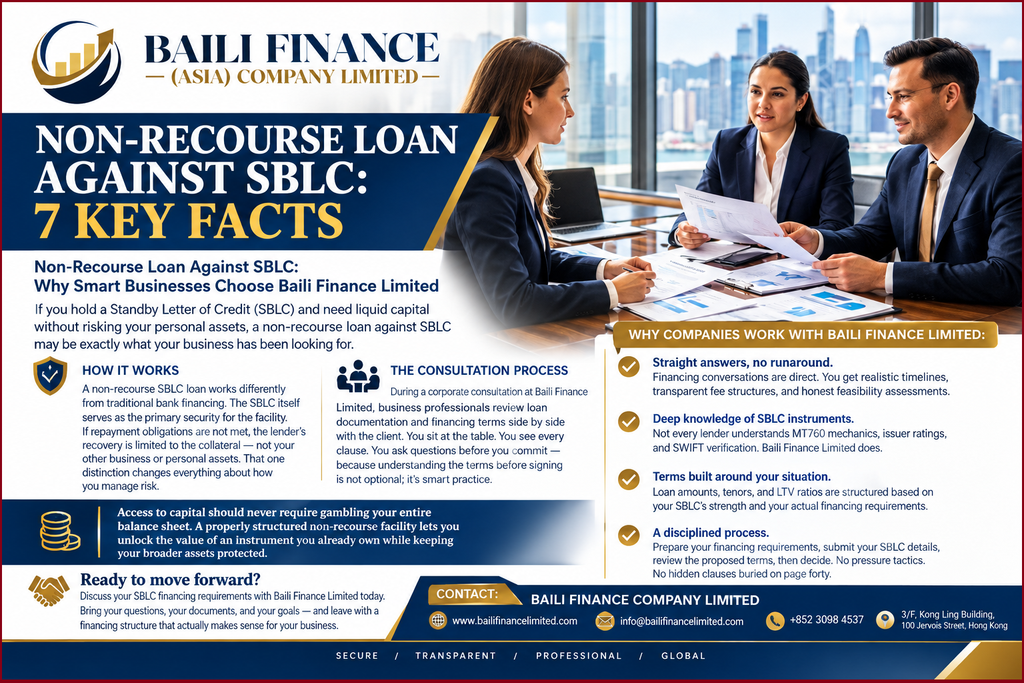
How Baili Finance Limited Can Fit Into Your Financing Research
Businesses considering a non-recourse loan against an SBLC should begin by defining their funding requirement and the role they expect the instrument to perform.
Baili Finance Limited can be approached to discuss the company’s financing needs and determine whether an appropriate service or transaction pathway may be available. Applicants should independently confirm the company’s current service scope, eligibility requirements, and contractual role before relying on any proposed financing arrangement.
When making an initial inquiry, provide a concise overview of the transaction.
Include the requested financing amount, currency, intended use of funds, required funding date, SBLC amount, issuing bank, expiry date, and proposed repayment source.
Do not assume that every instrument will qualify or that a preliminary discussion constitutes an approval or commitment to lend.
A clear initial submission can help the parties identify missing information and determine whether further assessment is worthwhile.
Frequently Asked Questions About Non-Recourse Loans Against SBLCs
1. Can I get a non-recourse loan against an SBLC?
Potentially, depending on the lender, the SBLC’s issuing bank, its terms, the proposed security rights, applicable law, and the transaction’s commercial merits.
An SBLC does not automatically qualify its holder for financing. The lender must review and approve the specific transaction.
2. How much can I borrow against a $10 million SBLC?
There is no universal advance rate. A lender might decline the instrument, approve a smaller facility, or consider a larger transaction involving additional eligible security.
The amount depends on the issuing bank, enforceability, expiry, transaction risks, lender policy, and financing structure. Never treat the SBLC’s face value as a guaranteed loan amount.
3. Does non-recourse financing mean I have no personal liability?
Not necessarily. The agreement may limit the lender’s ordinary recovery rights while retaining exceptions for fraud, misrepresentation, guarantees, indemnities, or specified contractual breaches.
Review the complete agreement with an independent lawyer to understand your exposure.
4. Is SBLC monetization the same as an SBLC-backed loan?
No. The terms may describe different financing structures.
An SBLC-backed loan involves an agreed lending arrangement in which the instrument or associated rights support the financing. SBLC monetization is a broad market term that may refer to an attempted conversion of an instrument or related rights into usable funds.
The parties should identify the actual legal and financial structure rather than rely on a marketing label.
5. How long does SBLC financing take?
There is no standard processing time. Timing depends on the completeness of the application, instrument authentication, issuing-bank cooperation, legal review, compliance checks, negotiations, and satisfaction of funding conditions.
A provider should not promise a fixed closing date before assessing the transaction.
6. Do I need cash collateral to obtain an SBLC?
The issuing bank determines its requirements. It may request cash collateral, other security, an approved credit facility, or a different form of credit support.
The fact that a business holds an SBLC does not establish that the instrument was issued without collateral or that the applicant has no obligations to the issuing bank.
7. Can an SBLC be transferred to a lender?
That depends on the instrument’s terms, the applicable rules, the relevant law, and any required consents.
An assignment of proceeds is not necessarily the same as a transfer of drawing rights. Legal and banking review should establish what the parties can validly transfer or secure.
8. What are the main risks of SBLC-backed financing?
Key risks include fraudulent instruments, misrepresented funding commitments, excessive upfront fees, unclear recourse provisions, expiry issues, legal enforceability problems, and unexpected financing costs.
Independent verification and legal review are important safeguards.
9. Can a newly issued SBLC be used to obtain financing?
Potentially, but a newly issued instrument still requires authentication and lender acceptance. Its suitability depends on the issuing bank, terms, expiry, transaction structure, and other underwriting requirements.
There is no guarantee that a newly issued SBLC will produce a loan.
10. What should I submit when requesting financing from Baili Finance Limited?
Begin with your funding requirement, intended use of funds, business profile, SBLC amount, issuing bank, expiry date, and proposed repayment source.
The company can then clarify which additional documents may be needed and whether a suitable financing pathway may be available. Confirm its current services and eligibility criteria directly before committing funds.
Conclusion: Make Your SBLC Financing Decision With Clarity
A non-recourse loan against an SBLC may provide a financing option for eligible businesses seeking working capital, trade finance, or funding for an approved commercial transaction. However, the instrument’s face value does not determine the loan amount, and the phrase “non-recourse” does not automatically eliminate the borrower’s financial obligations.
Successful financing requires an acceptable instrument, verified banking details, enforceable security rights, clear contractual protections, transparent pricing, and a commercially sound repayment plan.
Before signing an agreement, establish who provides the funds, what the lender can recover following default, which fees apply, and what conditions must be satisfied before disbursement.
If you’re considering SBLC-backed financing, start with the facts. Prepare your transaction details, verify the parties, and obtain independent legal advice before making a binding commitment.
Discuss Your SBLC Financing Requirements With Baili Finance Limited
Your next financing decision deserves a clear assessment, not an unsupported promise.
Visit: www.bailifinancelimited.com to contact Baili Finance Limited and discuss your requirements.
Explain your funding objective, the amount you seek, the issuing bank, the SBLC’s expiry date, and your expected financing timeline. Ask about eligibility, the proposed structure, fees, documentation, and the contractual scope of any non-recourse arrangement.
Take the next step: Request an initial discussion, obtain the relevant terms in writing, and determine whether your SBLC and business objectives fit an available financing structure.
Disclaimer: This article provides general educational information and does not constitute an offer of credit, a guarantee of financing, legal advice, or investment advice. Financing availability, terms, and eligibility depend on individual assessment, applicable law, due diligence, and the provider’s actual services. The illustrative case study and calculations are hypothetical.
Intermediaries/Consultants/Brokers are welcome to bring their clients 100% protected. Our brokers receive 2% commission for referral. We assist Clients and brokers in their attempt to secure funding by working on their funding requests that may require innovative financing. In complete confidence, we will work together for the benefits of all parties involved.
#SBLC #SBLCFinancing #NonRecourseLoan #TradeFinance #StructuredFinance #StandbyLetterOfCredit #BusinessFunding