
Headline: International Project Finance Loans for Infrastructure
International project finance loans for infrastructure play an important role in delivering power plants, transport networks, water systems, digital infrastructure, and other assets that support economic development. For project sponsors, developers, investors, and public authorities, securing the right infrastructure financing can determine whether a project advances from planning to construction and long-term operation.
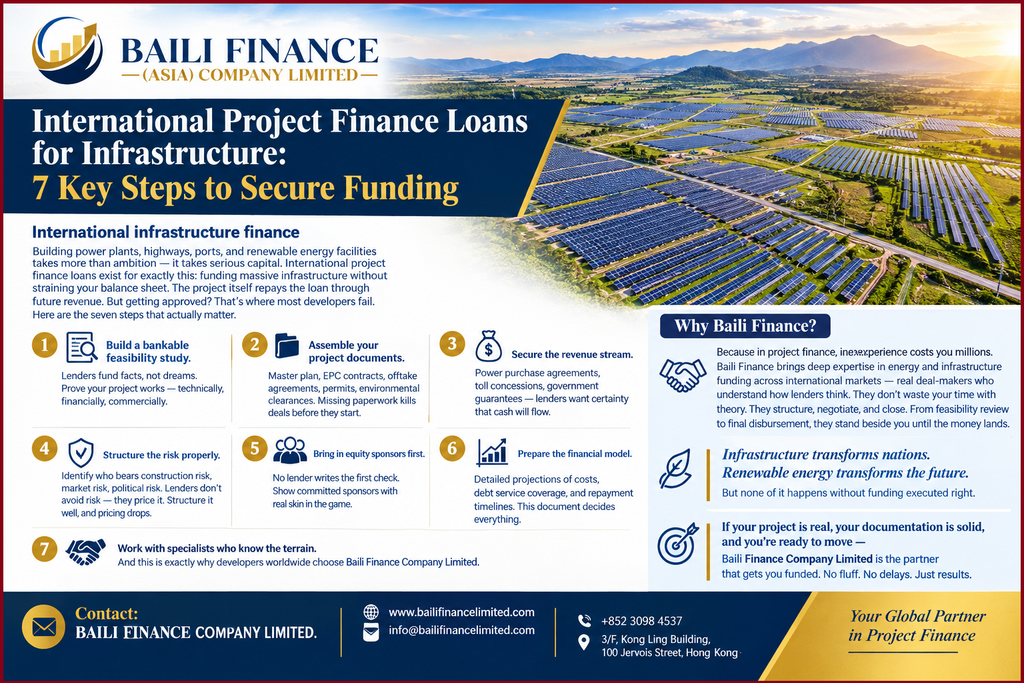
However, financing an infrastructure project involves more than identifying a lender. Sponsors must establish commercial viability, demonstrate reliable repayment capacity, allocate risks appropriately, satisfy legal and regulatory requirements, and develop a financing structure that supports the project’s entire lifecycle.
Baili Finance Limited understands the importance of evaluating financing requirements in the context of each project’s commercial objectives, capital structure, and funding needs. International project finance requires careful preparation, credible documentation, and a clear understanding of the responsibilities of all parties involved.
This guide explains how international project finance loans work, the financing structures available, the documentation lenders typically require, and the considerations that help infrastructure projects become financeable.
Keywords: international project finance loans, infrastructure project financing, international infrastructure loans, project finance lenders, infrastructure funding, renewable energy project finance, non-recourse project finance, infrastructure debt financing, PPP financing, project finance loans
What Are International Project Finance Loans for Infrastructure?
International project finance loans are financing arrangements used to develop, construct, acquire, expand, or upgrade infrastructure assets, often involving investors, contractors, lenders, suppliers, and public authorities across multiple jurisdictions.
Unlike conventional corporate borrowing, project finance typically relies primarily on the project’s future cash flows for debt repayment, supported by contractual rights, project assets, security arrangements, and other agreed credit protections.
A project company, commonly called a special-purpose vehicle (SPV), may own and operate the asset. Investors contribute equity, while lenders provide debt under terms that reflect the project’s expected revenue, construction schedule, operating costs, and risk profile.
For example, a company developing an international renewable energy project might establish an SPV to build a solar power plant. The company could combine sponsor equity, senior debt, an electricity purchase agreement, construction contracts, and insurance arrangements to establish a financeable structure.
The exact structure depends on the jurisdiction, sector, sponsor strength, revenue model, and financing requirements.
Why Infrastructure Projects Need International Financing
Infrastructure projects frequently require substantial upfront capital and generate revenue over many years. Traditional short-term financing may not match these characteristics.
International infrastructure financing can bring together capital providers with different investment mandates, geographic coverage, funding costs, and risk appetites.
It can support projects such as:
- Energy infrastructure: Solar farms, wind farms, hydropower facilities, electricity transmission networks, and power generation plants.
- Transportation infrastructure: Highways, bridges, railways, airports, seaports, and logistics terminals.
- Water infrastructure: Water treatment plants, desalination facilities, wastewater systems, and distribution networks.
- Digital infrastructure: Fibre-optic networks, telecommunications towers, data centres, and related connectivity assets.
- Social infrastructure: Hospitals, schools, and other public-service facilities developed under suitable procurement and financing arrangements.
- Industrial infrastructure: Storage terminals, pipelines, processing facilities, and infrastructure supporting industrial development.
International lenders and investors may also help sponsors access longer repayment periods, specialist sector expertise, risk-sharing arrangements, and funding from multiple sources.
Nevertheless, international financing does not automatically reduce costs or eliminate risk. Currency exposure, country risk, regulatory uncertainty, and complex documentation can increase the total cost of capital.
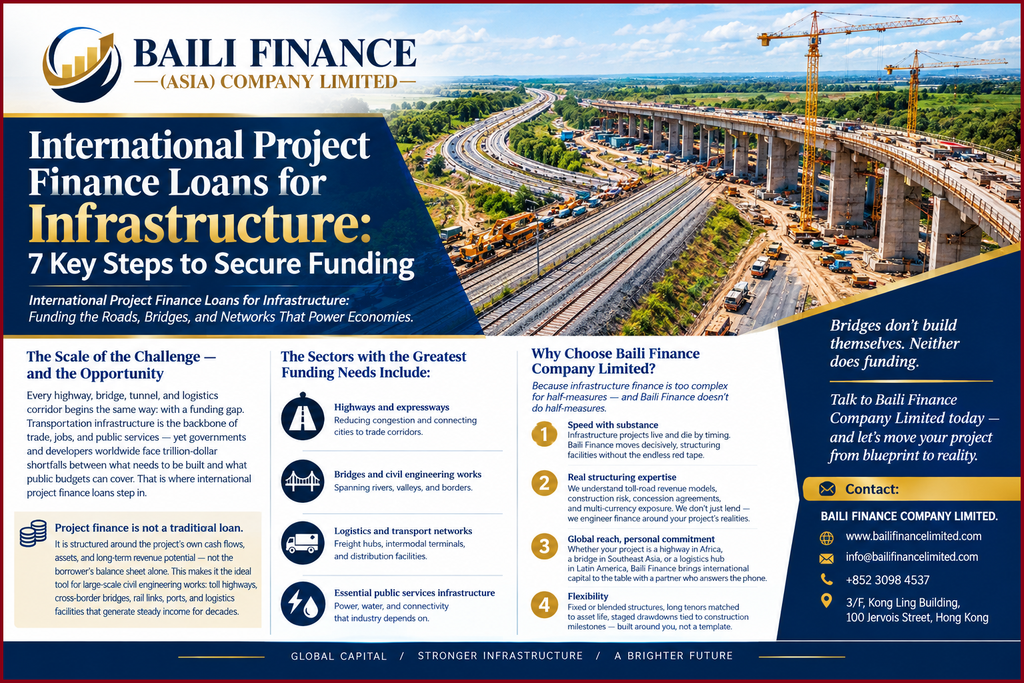
7 Key Steps to Secure International Project Finance Loans
1. Establish a Bankable Infrastructure Project
Lenders need evidence that the project can be completed, operated, and repaid under realistic assumptions.
A bankable project normally has a defined purpose, an identifiable revenue model, a credible development plan, and a management team capable of delivering the proposed investment.
The project sponsor should establish:
- The project’s location, scope, capacity, and development timetable.
- Estimated capital expenditure and operating costs.
- Expected revenue and the parties responsible for paying it.
- Construction, operating, environmental, and regulatory requirements.
- The proposed ownership structure and sponsor equity contribution.
- A preliminary financing plan and repayment strategy.
Where the project depends on government concessions, regulated tariffs, electricity sales, tolls, or availability payments, the sponsor must demonstrate how those arrangements will operate in practice.
A large project is not necessarily a financeable project. Lenders assess whether its contracts, projected cash flows, risks, and funding requirements support repayment.
2. Develop a Credible Financial Model
A financial model allows sponsors and potential lenders to evaluate the project’s expected financial performance.
The model should cover the construction period, operational phase, financing costs, debt repayment schedule, and major economic assumptions.
Typical components include:
- Total project development and construction costs.
- Sponsor equity and proposed debt funding.
- Revenue forecasts and operating expenditure.
- Interest rates, fees, taxes, and debt amortisation.
- Working capital and contingency requirements.
- Foreign exchange assumptions where relevant.
- Cash reserves and debt service obligations.
- Sensitivity analysis for delays, cost increases, lower revenue, and higher interest rates.
Two important measures are debt service coverage ratio (DSCR) and loan life coverage ratio (LLCR).
DSCR compares cash available for debt service over a period with the principal and interest due during that period. LLCR compares the present value of cash available for debt service over the remaining loan life with outstanding debt, subject to the definitions in the financing documents.
Lenders may also examine the project’s internal rate of return, net present value, leverage, and minimum liquidity requirements.
These measures help identify whether the project can withstand adverse conditions without breaching its financing obligations.

3. Select the Appropriate Financing Structure
Infrastructure projects can use different combinations of debt, equity, guarantees, and risk-sharing instruments.
The most appropriate structure depends on the project’s risk profile, sponsor resources, repayment capacity, and contractual arrangements.
Common infrastructure financing structures include:
Non-recourse project finance: Lenders primarily rely on project cash flows and security over project assets and contractual rights. Sponsor recourse is generally limited, subject to negotiated exceptions and the applicable legal framework.
Limited-recourse project finance: Lenders rely mainly on project performance but retain specified rights against sponsors or other parties, such as construction-period support or agreed completion guarantees.
Corporate financing: A company borrows based on its overall balance sheet, cash flows, and creditworthiness rather than relying primarily on a single project’s cash flows.
Public-private partnership financing: A private consortium may finance, construct, operate, or maintain an infrastructure asset under a long-term agreement with a public authority.
Syndicated loans: Multiple lenders participate in a financing facility, allowing them to share exposure to a large transaction.
Blended finance: Commercial funding combines with concessional capital or development finance to address defined market failures or project risks, subject to the relevant programme requirements.
A sponsor should compare the total financing cost, security requirements, tenor, repayment profile, covenants, and conditions precedent before selecting a structure.
4. Allocate Project Risks Correctly
Risk allocation is central to infrastructure finance. A financing structure becomes more credible when each major risk sits with the party best positioned to manage it.
For example, an engineering, procurement, and construction (EPC) contractor may accept defined construction obligations under a fixed-price, date-certain contract. An operator may assume specified performance and maintenance responsibilities. A power purchaser may agree to buy electricity under a long-term power purchase agreement (PPA).
However, contractual protection works only to the extent that the relevant party can meet its obligations.
Sponsors and lenders should examine the following risks:
- Construction risk: Delays, cost overruns, contractor default, and design defects.
- Revenue risk: Insufficient demand, payment delays, tariff changes, or purchaser default.
- Foreign exchange risk: Differences between the currencies used for revenue, expenditure, and debt service.
- Political and regulatory risk: Changes in law, permits, concessions, taxation, or government policy.
- Operating risk: Equipment failure, higher maintenance costs, and lower-than-expected output.
- Environmental and social risk: Land acquisition, community impacts, environmental approvals, and compliance obligations.
- Interest rate risk: Changes in borrowing costs where debt carries a floating interest rate.
- Refinancing risk: Difficulty replacing existing debt when it matures.
The World Bank’s PPP Reference Guide provides an authoritative starting point for understanding public-private partnership structures, project development, and risk allocation.
The objective is not to eliminate every risk. It is to identify, price, allocate, monitor, and mitigate risks before they threaten project viability.

5. Prepare the Required Financing Documents
International infrastructure loans typically involve extensive legal, commercial, technical, and financial due diligence.
Requirements vary by lender, jurisdiction, project stage, sector, and financing structure. Sponsors should prepare a well-organised information package before approaching prospective funding partners.
Common documents include:
- Project feasibility study and business plan.
- Detailed financial model and funding schedule.
- Sponsor corporate records and ownership information.
- Evidence of equity commitments and the source of funds.
- Land rights, licences, permits, and concession agreements.
- EPC, operations and maintenance, and supply contracts.
- Revenue agreements, including PPAs or offtake contracts where applicable.
- Environmental and social impact assessments.
- Independent engineering and technical reports.
- Insurance proposals and risk management plans.
- Proposed security documents and intercreditor arrangements.
- Tax, legal, regulatory, and financial due diligence reports.
- Anti-money-laundering and know-your-customer documentation.
Depending on the transaction, lenders may also require government approvals, guarantees, reserve accounts, direct agreements with key counterparties, and restrictions on distributions to shareholders.
Incomplete or inconsistent documentation can delay due diligence and prevent a transaction from reaching financial close.
6. Identify Suitable International Funding Partners
Not every lender finances every infrastructure project. Some focus on specific regions, sectors, project sizes, development stages, or credit profiles.
Potential funding sources include commercial banks, development finance institutions, infrastructure debt funds, export credit agencies, institutional investors, and specialist private credit providers.
For example, the International Finance Corporation (IFC) supports private-sector infrastructure investment through financing, investment mobilisation, risk-mitigation instruments, and advisory services. Its infrastructure financing overview explains the range of sectors and financing approaches it supports.
When evaluating a potential financing partner, consider:
- Minimum and maximum transaction size.
- Eligible countries and infrastructure sectors.
- Whether the institution finances greenfield or operating assets.
- Required sponsor equity and credit support.
- Available currencies and repayment tenors.
- Applicable interest rates, arrangement fees, and other costs.
- Environmental, social, and governance requirements.
- Due diligence standards and approval procedures.
- Conditions precedent to first disbursement.
Sponsors should distinguish a preliminary expression of interest from an approved facility. A lender’s interest does not constitute a binding commitment, and a financing proposal does not guarantee disbursement.
7. Reach Financial Close and Manage the Loan
Financial close occurs when the relevant financing agreements and other required arrangements become effective and the parties satisfy the applicable closing conditions.
The process can involve negotiations over interest rates, repayment schedules, security, representations, covenants, events of default, and lender rights.
Following financial close, the project company must comply with the financing agreements and meet the conditions for each disbursement.
These may include evidence of equity funding, approved invoices, construction progress, insurance coverage, permits, and independent engineer certifications.
During construction and operation, borrowers should monitor:
- Actual expenditure against the approved budget.
- Construction progress and milestone completion.
- Revenue and operating performance.
- Debt service and reserve account balances.
- Financial covenants and reporting deadlines.
- Insurance renewals and regulatory compliance.
- Material disputes, contract changes, and potential defaults.
Effective post-closing management protects the project’s ability to maintain operations, meet debt obligations, and preserve lender confidence.
How International Infrastructure Loan Repayment Works
The repayment structure should reflect when the project starts generating revenue and how much cash it can reasonably produce.
Construction projects often have a development period during which the asset generates little or no operating revenue. Financing documents may therefore provide for scheduled drawdowns, interest during construction, and repayment that begins after an agreed grace period or commercial operation date.
Once the asset operates, revenue generally flows through an agreed payment and cash management structure.
The project company pays operating expenses, taxes, debt service, required reserves, and other obligations in accordance with the financing documents. Shareholder distributions may be permitted only after specified conditions are satisfied.
A lender may require minimum DSCR levels, restrictions on additional borrowing, and limits on dividends when financial performance deteriorates.
Illustrative Financing Example
Consider a proposed renewable energy project with a total development cost of $200 million.
The sponsor proposes the following funding structure:
| Funding source | Amount | Share |
|---|---|---|
| Sponsor equity | $60 million | 30% |
| Senior project finance debt | $120 million | 60% |
| Other committed funding | $20 million | 10% |
| Total project funding | $200 million | 100% |
These figures illustrate a possible capital structure. They do not represent an offer or financing terms available from Baili Finance Limited.
Before approving a financing plan, the parties would need to verify the source and availability of each funding component, the project’s total costs, and the proposed debt repayment capacity.
For example, if the project experiences construction delays, the sponsor may need additional capital to cover cost overruns and interest during construction. If revenue falls below forecast, the project may have insufficient cash to meet scheduled debt service.
Sensitivity testing should therefore assess whether the proposed structure remains viable under realistic downside scenarios.
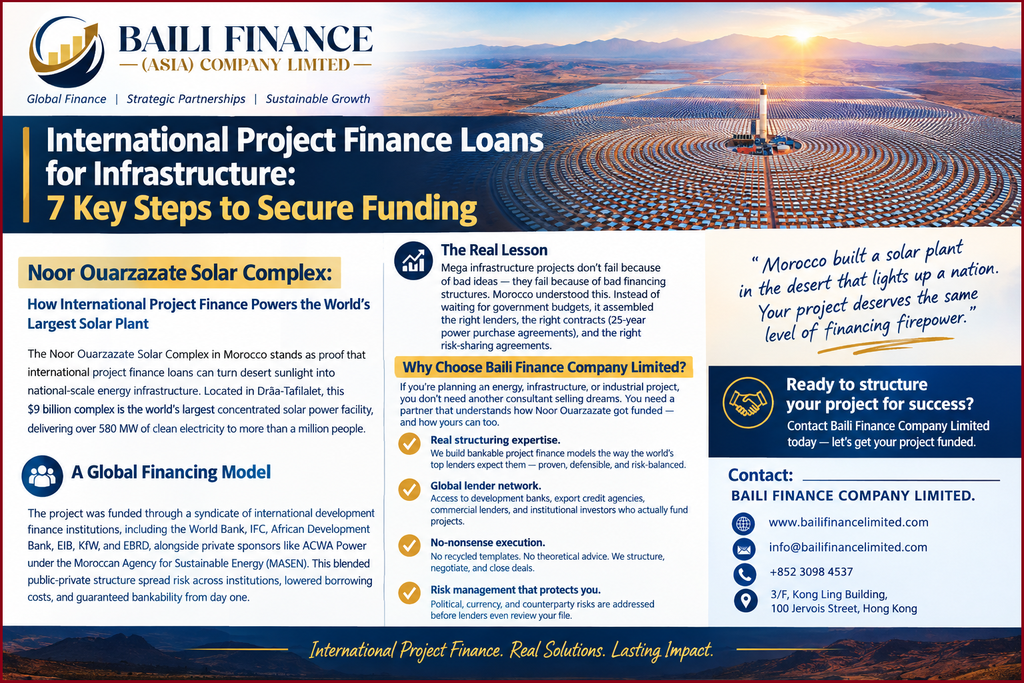
Real-World Case Study: Morocco’s Noor Ouarzazate Solar Complex
Morocco’s Noor Ouarzazate solar complex illustrates how public institutions, private sponsors, and international development finance can work together to fund infrastructure.
The Noor II and Noor III concentrated solar power plants formed part of Morocco’s wider renewable energy programme. Their development involved private sponsors selected through a competitive process, alongside public-sector participation and financing from multiple development finance institutions.
According to the World Bank’s project financing case study, the Noor II and Noor III projects received approximately $1.6 billion in combined loan and grant financing from several development partners. These included the African Development Bank, European Investment Bank, World Bank, KfW, Agence Française de Développement, the European Union, and the Clean Technology Fund.
The financing supported two plants with different concentrated solar power technologies. The project brief reported investment costs of approximately $1.1 billion for Noor II and $900 million for Noor III, with private sponsors contributing equity.
The structure brought together public-sector support, private-sector participation, long-term infrastructure investment, and financing from multiple institutions.
What Infrastructure Developers Can Learn
First, complex projects may require several funding sources. Large capital requirements can exceed the appetite or capacity of one lender. A coordinated financing structure can distribute funding requirements across suitable institutions.
Second, contractual design matters. Competitive procurement, defined project responsibilities, and long-term arrangements help establish a clearer basis for evaluating project performance and risk.
Third, public-sector participation can support project development. Government involvement and development finance may help address specific project constraints. However, the availability of such support depends on the programme, country, eligibility rules, and transaction structure.
Fourth, project preparation remains essential. Financing commitments do not remove the need for engineering studies, environmental and social assessment, effective procurement, and ongoing performance monitoring.
This case study does not establish that every infrastructure project can access comparable funding. It demonstrates how the appropriate combination of sponsors, contracts, public institutions, and international finance can support a project with substantial capital requirements.
Illustrative Case Study: Financing a Cross-Border Water Infrastructure Project
The following scenario is hypothetical and demonstrates how a project sponsor might approach an international infrastructure financing requirement.
A project company plans to develop a water treatment and distribution facility serving an industrial zone across a regional economic corridor. The proposed investment includes treatment equipment, pipelines, pumping stations, storage infrastructure, and digital monitoring systems.
The sponsor estimates total capital expenditure of $150 million and seeks a combination of equity and long-term debt.
The Main Financing Challenges
The project faces three principal challenges.
First, construction costs may rise if equipment prices, shipping costs, or installation schedules change. Second, repayment depends on industrial customers paying for water services under contracts that remain commercially viable. Third, the project uses imported equipment priced in a foreign currency, creating potential exchange-rate exposure.
The Proposed Financing Approach
The sponsor begins by commissioning an independent feasibility study and validating demand forecasts with prospective customers.
It then develops a financial model covering construction expenditure, operating costs, tariffs, customer payment terms, foreign exchange scenarios, and debt service.
Next, the sponsor evaluates a possible financing structure involving sponsor equity, senior debt, and an appropriate reserve for unexpected costs. It also examines whether long-term customer contracts can support a predictable revenue profile.
The legal team reviews land rights, water permits, construction agreements, customer contracts, and the enforceability of security arrangements.
Finally, the sponsor approaches suitable financing institutions with a consistent information package and a transparent account of the project’s risks.
The Expected Outcome
If due diligence confirms the project’s commercial viability, the sponsor secures acceptable financing terms, all necessary approvals are obtained, and the parties satisfy the closing conditions, the project may proceed to financial close.
If the financial model shows that revenue cannot support the proposed debt, the sponsor may need to reduce project costs, increase equity, renegotiate customer agreements, or revise the financing structure.
The central lesson is that a financing application should explain how the project will repay its debt, not merely how much money it needs.
Common Reasons International Project Finance Applications Face Delays
Even projects with strong commercial potential can encounter financing obstacles.
The following issues frequently require attention:
Unrealistic revenue forecasts. Lenders may challenge demand projections that lack supporting contracts, independent market research, or credible operating assumptions.
Insufficient sponsor equity. A financing plan can fail if the sponsor cannot demonstrate the required equity contribution or the lawful source of funds.
Unresolved permits and land rights. Legal uncertainty can prevent construction, undermine project security, or delay financial close.
Weak contractual protection. Inadequate construction, supply, or offtake agreements can leave the project exposed to risks that lenders cannot readily quantify.
Unmanaged currency exposure. Borrowing in a currency that differs from project revenue may create repayment difficulties if exchange rates move adversely.
Incomplete due diligence. Missing documents, inconsistent financial assumptions, or unclear ownership information can delay approvals.
Unverified financing claims. A project sponsor should verify the identity, authority, capacity, and mandate of any proposed funding partner before relying on a financing representation.
Addressing these issues early can improve the quality of discussions with lenders and reduce avoidable delays.
How Baili Finance Limited Can Support Your Financing Enquiry
Infrastructure sponsors need a clear understanding of their funding requirements before approaching prospective financing partners.
Baili Finance Limited can be approached to discuss project financing requirements, transaction objectives, and potential financing pathways, subject to the company’s actual services, mandates, eligibility criteria, and capacity.
A productive initial discussion should establish the project sector, country, development stage, total capital requirement, proposed equity contribution, revenue model, and target financing timetable.
Where appropriate, sponsors should also prepare a short project summary, preliminary financial model, corporate information, and a list of existing financing commitments.
These details help establish whether the project is sufficiently developed for a meaningful financing assessment and what information may be needed next.
Important: A financing enquiry, preliminary discussion, or expression of interest does not guarantee funding, lender approval, or disbursement. Any available financing remains subject to due diligence, commercial agreement, applicable law, and the relevant parties’ approval processes.
Frequently Asked Questions About International Project Finance Loans
1. What are international project finance loans for infrastructure?
They are financing arrangements used to develop or upgrade infrastructure assets across domestic or international markets. In a typical project finance structure, lenders rely primarily on the project’s anticipated cash flows, supported by contractual arrangements and security, to assess repayment capacity.
2. Which infrastructure projects can qualify for international project financing?
Potentially eligible projects include power generation, renewable energy, transport, telecommunications, water treatment, logistics, and other infrastructure assets. Eligibility depends on the lender’s mandate, project location, development stage, sponsor profile, financial viability, and risk assessment.
3. How much equity does an infrastructure project need?
There is no universal equity requirement. The appropriate proportion depends on construction risk, projected cash flows, sponsor creditworthiness, lender policy, contractual protection, and the project’s jurisdiction. Sponsors should assess equity requirements alongside debt affordability rather than assuming a fixed debt-to-equity ratio.
4. What documents do lenders require for project finance loans?
Common requirements include a feasibility study, financial model, business plan, corporate records, evidence of equity, permits, land rights, construction contracts, revenue agreements, technical reports, insurance documentation, and environmental and social assessments. The final list depends on the proposed financing structure and lender requirements.
5. What is the difference between project finance and corporate finance?
Project finance generally relies primarily on the cash flows and contractual arrangements of a specific project. Corporate finance relies on the borrower’s overall financial position, business operations, and balance sheet. Project finance may offer a degree of separation between the project and its sponsors, although guarantees, support obligations, and other recourse provisions can change the actual allocation of liability.
6. Can international project finance fund renewable energy infrastructure?
Yes. Renewable energy projects may obtain funding through commercial debt, development finance, infrastructure funds, equity investment, and other suitable financing arrangements. Lenders typically assess the project’s resource studies, construction costs, grid connection, permits, offtake agreements, operating performance, and debt repayment capacity.
7. How long does it take to secure an international infrastructure loan?
The timetable varies considerably. A well-prepared project with established contracts and completed due diligence may progress faster than a project requiring new permits, complex negotiations, or government approvals. Sponsors should allow time for technical, legal, financial, environmental, and commercial review, as well as lender approval and satisfaction of closing conditions.
8. Does a financing proposal guarantee that a project will receive funding?
No. A proposal or expression of interest may outline potential financing terms, but it does not necessarily represent a binding commitment. Funding usually depends on formal approvals, due diligence, agreed documentation, satisfaction of conditions precedent, and the availability of funds under the relevant agreement.
9. Can a project receive funding without a completed feasibility study?
Some early-stage projects may obtain development capital or advisory support before completing a full feasibility study. However, lenders generally need sufficient technical, commercial, legal, and financial information to assess a substantial infrastructure loan. The documentation required depends on the financing stage and the funding institution.
10. How can I discuss an infrastructure financing requirement with Baili Finance Limited?
Visit www.bailifinancelimited.com and use the company’s official contact channels to outline your project, funding requirement, location, development stage, equity position, and proposed repayment model. Ask which documentation and eligibility criteria apply before relying on any proposed financing arrangement.
Conclusion: Prepare Your Project for International Financing
International project finance loans for infrastructure can support the development of energy systems, transportation networks, water facilities, digital connectivity, and other assets that require substantial upfront investment.
However, successful financing depends on more than the size of the funding request. Sponsors must establish commercial viability, develop realistic financial projections, allocate risks appropriately, secure the necessary rights and contracts, and demonstrate a credible repayment strategy.
The experience of projects such as Morocco’s Noor Ouarzazate solar complex shows how private sponsors, public institutions, and international development finance can combine their resources to support infrastructure investment. At the same time, each transaction requires its own due diligence, contractual structure, and assessment of risk.
For developers preparing an international infrastructure investment, the next step is to organise the project information, clarify the funding requirement, and identify financing partners whose mandates align with the proposed transaction.
READY TO SECURE INTERNATIONAL PROJECT FINANCING?
Your infrastructure project needs more than a funding request. It needs a credible financing strategy.
Whether you’re developing a power plant, renewable energy facility, transport network, water treatment system, or other major infrastructure asset, the right financing approach starts with understanding your capital requirements, project viability, and funding objectives.
At Baili Finance Limited, we invite project sponsors, developers, investors, and business leaders to initiate a discussion about their infrastructure financing requirements and explore potential financing pathways, subject to eligibility, due diligence, and applicable terms.
Don’t let an unclear funding strategy delay your next infrastructure investment. Take the first step toward a structured financing discussion today.
Contact Baili Finance Limited through www.bailifinancelimited.com and outline your project, estimated funding requirement, location, development stage, available equity, and proposed repayment model.
The more clearly you define your requirements, the more effectively your financing enquiry can be assessed.
Your next step is simple: present your project, clarify your funding needs, and start the conversation.
Baili Finance Limited — Discuss Your International Project Financing Requirements Today.
Intermediaries/Consultants/Brokers are welcome to bring their clients 100% protected. Our brokers receive 2% commission for referral. We assist Clients and brokers in their attempt to secure funding by working on their funding requests that may require innovative financing. In complete confidence, we will work together for the benefits of all parties involved.
#ProjectFinance #InfrastructureFinance #InternationalLoans #InfrastructureDevelopment #ProjectFunding #RenewableEnergyFinance #StructuredFinance #PublicPrivatePartnerships