Headline: Verified SBLC Provider: 7 Essential Checks | Baili Finance
Choosing a verified SBLC provider requires more than reviewing a company website or receiving a financial instrument proposal. For businesses seeking a standby letter of credit (SBLC), the priority should be to establish the identity of the issuing bank, verify the instrument through appropriate banking channels, understand the contractual terms, and assess whether the proposed arrangement meets the transaction’s requirements.
For importers, exporters, investors, contractors, and companies involved in international trade finance, selecting a verified SBLC provider can influence transaction security, contractual performance, and access to commercial opportunities. However, a professional-looking proposal doesn’t establish that a bank has approved or issued an instrument.
Baili Finance Limited recognises the importance of informed decision-making in financial transactions. Businesses considering an SBLC arrangement should begin with documented requirements, transparent communication, and independent verification before making financial commitments.
This guide explains how to evaluate an SBLC provider, identify warning signs, understand the role of issuing and advising banks, and prepare for a transaction with appropriate due diligence.
Keywords: verified SBLC provider, standby letter of credit provider, SBLC issuing bank, SBLC verification, bank guarantee verification, international trade finance, financial SBLC, performance SBLC, SBLC due diligence
What Is a Verified SBLC Provider?
A verified SBLC provider is a company or financial institution whose identity, authority, role, and proposed involvement in a standby letter of credit transaction have been checked against reliable evidence.
The term requires careful interpretation because a verified intermediary isn’t necessarily an issuing bank. A company may introduce clients to financial institutions, coordinate documentation, provide advisory services, or facilitate communication. Only the institution that undertakes the relevant banking obligation can be identified as the issuer of that instrument.
A business should therefore establish exactly what a provider offers before signing an agreement.
The verification process should address four questions:
- Who is the provider? Confirm its legal identity, registration details, operating address, and relevant authorisations.
- Who issues the SBLC? Identify the proposed issuing bank and verify its involvement independently.
- What does the instrument cover? Review its amount, beneficiary, expiry date, governing rules, and drawing conditions.
- How will the instrument be authenticated? Establish the appropriate bank-to-bank verification procedure before relying on it.
These checks help distinguish a documented financial arrangement from an unverified commercial proposal.

What Is a Standby Letter of Credit?
A standby letter of credit is an undertaking issued by a bank or another eligible financial institution in favour of a named beneficiary. It generally supports an underlying contractual obligation by providing a mechanism for payment when the beneficiary satisfies the instrument’s specified drawing requirements.
Unlike a standard commercial letter of credit, which commonly supports payment for goods against stipulated documents, an SBLC often serves as a secondary payment or performance mechanism.
For example, a buyer may request an SBLC to support a payment obligation under a supply contract. If the buyer defaults and the beneficiary presents the documents required by the instrument, the issuing bank examines the presentation under the applicable terms and rules.
The precise obligations depend on the instrument’s wording, applicable law, and incorporated rules.
The International Chamber of Commerce provides authoritative information on International Standby Practices (ISP98), a framework specifically designed for standby letters of credit.
Common Types of SBLC
1. Financial SBLC
A financial standby supports a financial obligation, such as repayment of a debt or payment due under a contract.
2. Performance SBLC
A performance standby supports a contractual obligation to perform services, complete a project, or meet other agreed requirements.
3. Advance payment SBLC
This instrument can protect a beneficiary that makes an advance payment to a supplier. Its terms establish the circumstances in which a claim may be presented.
4. Bid or tender SBLC
A bid standby can support a bidder’s obligations in a tender process, subject to the tender conditions and the instrument’s terms.
5. Commercial SBLC
A commercial standby may support payment obligations arising from the supply of goods or services.
Selecting the appropriate instrument requires an understanding of the underlying transaction. A financial SBLC isn’t automatically suitable for a construction contract, and a performance standby may not satisfy a lender’s collateral requirements.
Why Choosing a Verified SBLC Provider Matters
International financial transactions frequently involve several parties, jurisdictions, currencies, and contractual obligations. Any uncertainty about an instrument’s authenticity or enforceability can create additional costs and delay commercial activity.
Working with an appropriately verified provider helps businesses establish accountability and identify problems before they become difficult to resolve.
1. Confirming the Authenticity of the Instrument
A draft SBLC, specimen document, bank logo, or purported SWIFT reference doesn’t independently prove that a bank issued an operative instrument.
The beneficiary or its bank should verify the instrument through appropriate channels and establish whether the issuing institution acknowledges the undertaking.
2. Reducing Counterparty Risk
A provider may describe an arrangement as bank-backed without clearly identifying the bank responsible for the obligation.
Confirming the parties’ legal identities and responsibilities helps prevent misunderstandings about who must issue the instrument, who receives it, and who bears the relevant contractual obligations.
3. Understanding Financial Exposure
SBLC transactions can involve arrangement fees, bank charges, collateral requirements, legal expenses, and other costs.
Before committing funds, businesses should obtain a written breakdown of the charges, payment conditions, refund provisions, and circumstances that could lead to additional expenses.
4. Supporting Compliance
Banks may require corporate documents, beneficial ownership information, source-of-funds evidence, transaction details, and sanctions screening.
A credible transaction process should accommodate legitimate compliance requirements rather than promise to bypass them.
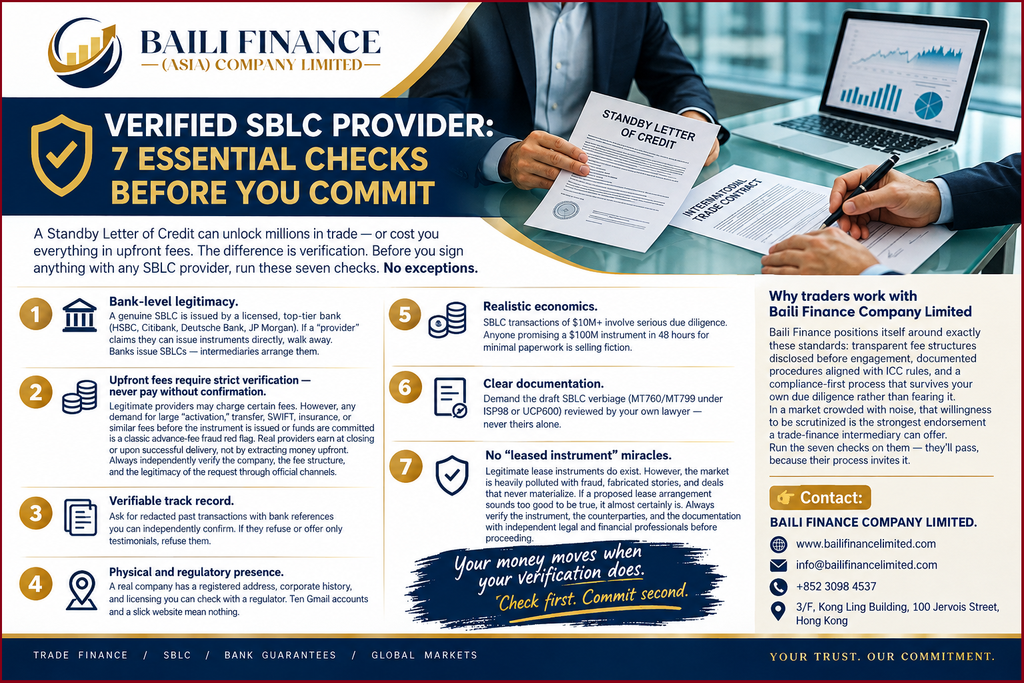
7 Essential Checks Before Choosing an SBLC Provider
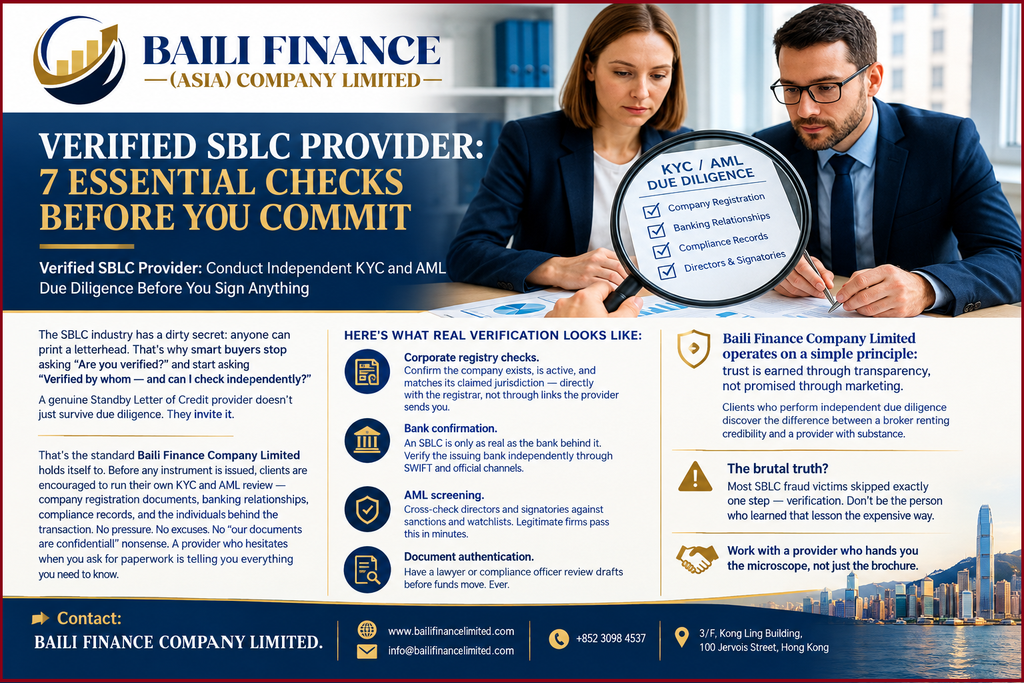
The following checklist provides a practical framework for evaluating a potential SBLC provider.
Check 1: Verify the Company’s Legal Identity
Start with the company’s full legal name, registration jurisdiction, registration number, registered office, and current operating status.
Where applicable, consult the official corporate registry and the relevant financial regulator. If the company claims to hold a financial services licence, verify that licence directly with the regulator.
Remember that company registration doesn’t automatically authorise a business to accept deposits, issue bank instruments, provide regulated financial services, or represent a bank.
Ask the provider to explain its exact role in the proposed transaction and identify the legal entity responsible for each service.
Check 2: Identify the Issuing Bank
The issuing bank is one of the most important elements of an SBLC arrangement.
Request the proposed issuing institution’s full legal name, jurisdiction, and the details necessary to verify its participation.
Then establish whether the bank is willing and able to issue the proposed instrument, subject to its internal approval and compliance requirements.
Don’t rely exclusively on contact details, letters, or telephone numbers supplied by an unfamiliar intermediary. Obtain independent contact information from the bank’s official website or another reliable source.
A bank employee’s apparent involvement doesn’t, by itself, establish that the bank has approved the transaction.
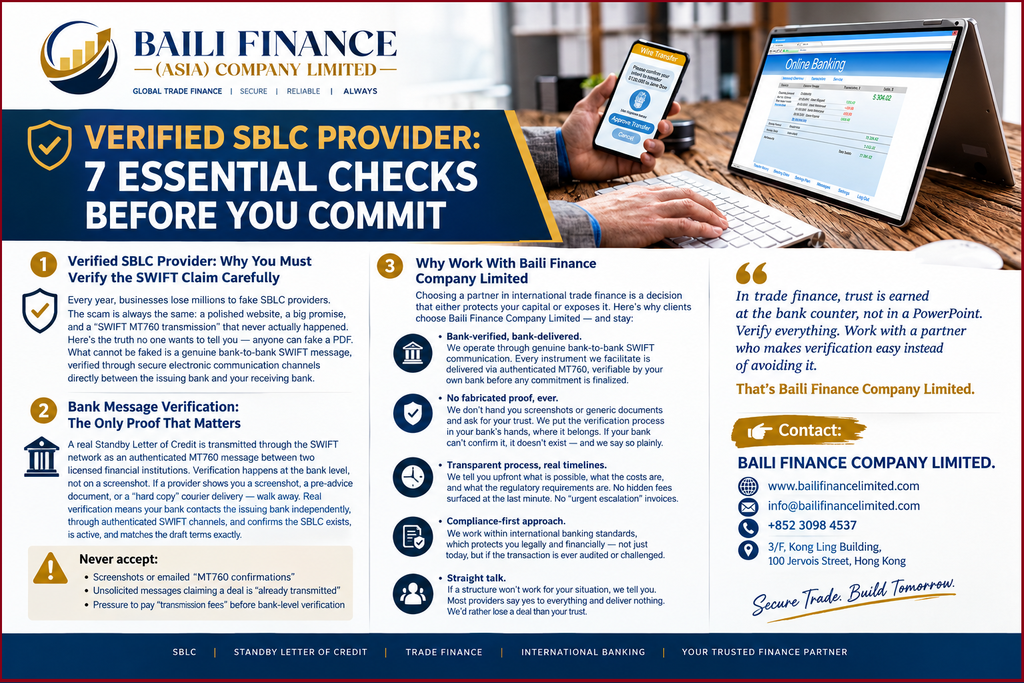
Check 3: Authenticate the SBLC Through Banking Channels
An SBLC may be transmitted through authenticated interbank messaging arrangements, depending on the transaction structure.
Where the proposed instrument uses SWIFT, the relevant banks should establish the authenticity, origin, content, and status of the communication through their approved procedures.
A SWIFT message is a means of transmitting financial information. It shouldn’t be confused with a guarantee that the underlying transaction is commercially sound or that every proposed payment will be made.
Likewise, a message reference, screenshot, or copy of a purported transmission isn’t sufficient on its own.
The receiving bank should confirm the instrument through its established verification procedures before the beneficiary relies on it.
Check 4: Review the SBLC Wording
The wording determines the issuer’s obligations and the beneficiary’s ability to make a compliant demand.
Have an appropriately qualified trade finance professional or lawyer review the draft before execution.
The review should cover:
- Applicant and beneficiary names.
- Issuing bank identity.
- Maximum undertaking amount and currency.
- Effective date and expiry date.
- Place and method of presentation.
- Required demand statements and supporting documents.
- Governing law and dispute resolution.
- Applicable rules, such as ISP98 or UCP 600, where expressly incorporated.
- Transferability, assignment, and amendment provisions, if relevant.
- Extension, reduction, and cancellation conditions.
The ICC’s UCP 600 rules explain the framework that applies when a documentary credit expressly incorporates those rules. ISP98 is specifically directed at standby undertakings.
The parties should select the applicable framework based on the transaction and obtain legal advice where necessary. The rules don’t replace the instrument’s wording or mandatory local law.
Check 5: Examine the Provider’s Fees and Payment Terms
Request a complete written fee schedule before paying an arrangement fee, advisory charge, commitment fee, or other amount.
Clarify the following:
- Which entity receives each payment?
- What service does each fee cover?
- When does the fee become payable?
- Which fees are refundable, and under what conditions?
- What happens if the bank declines the application?
- Are there additional charges for amendments, confirmation, or advising?
- Will the provider issue an invoice and contractual receipt?
Be cautious when a counterparty demands an urgent advance payment into an unrelated account, refuses to identify the recipient, or guarantees approval before completing the necessary checks.
A legitimate transaction may involve upfront professional or administrative costs. The existence of a fee isn’t proof of fraud, but the fee’s purpose and contractual basis must be clear.
Check 6: Evaluate the Provider’s Experience and References
Ask for relevant transaction experience, professional references, and a clear explanation of the provider’s responsibilities.
Where a provider cites previous SBLC transactions, request references that can be checked independently, subject to client confidentiality.
A credible reference should help establish the nature of the service performed without requiring the disclosure of confidential banking information.
Claims such as “guaranteed bank approval,” “instant monetisation,” or “no compliance required” warrant additional scrutiny. Banks retain their own approval, risk management, and compliance responsibilities.
Check 7: Obtain Independent Legal and Banking Review
Before signing or transferring funds, ensure that the proposed arrangement has been reviewed by professionals who represent your interests.
An independent review can identify inconsistent terms, unclear obligations, unrealistic delivery promises, and conditions that may make an instrument difficult to draw upon.
For substantial transactions, the review should consider the applicant’s obligations, the beneficiary’s rights, the issuing bank’s undertaking, applicable law, and any collateral or reimbursement agreement.
These checks don’t eliminate every risk. They do, however, create a documented basis for making an informed decision.
Red Flags to Watch for When Searching for a Verified SBLC Provider
When evaluating an SBLC provider, don’t allow an attractive commercial proposal to replace verification.
Pay particular attention to the following warning signs.
Unverifiable issuing bank: The provider refuses to identify the proposed bank or won’t permit appropriate independent confirmation.
Guaranteed approval: The provider promises issuance regardless of creditworthiness, compliance, transaction purpose, or bank policy.
Unclear company status: The company uses a bank’s name, logo, or branding without establishing a legitimate relationship or authorisation.
Pressure to transfer funds: The counterparty demands immediate payment before providing a written agreement or adequate information.
Unusual payment instructions: The requested beneficiary account doesn’t match the contracting entity, and the counterparty can’t provide a satisfactory explanation.
Inconsistent documentation: Company names, account details, amounts, dates, and bank information differ across the proposal and supporting documents.
Unsupported monetisation claims: The provider promises automatic access to substantial funding merely because an SBLC exists.
Avoidance of due diligence: The counterparty refuses reasonable identity checks, corporate documentation, or compliance procedures.
One warning sign doesn’t establish misconduct. However, several unresolved inconsistencies justify pausing the transaction until independent professionals have investigated them.
How an SBLC Transaction Typically Works
Understanding the transaction structure helps businesses identify the responsibilities of each party.
Step 1: Define the Commercial Requirement
The applicant establishes why the SBLC is needed, who the beneficiary will be, the amount required, the expiry date, and the obligation the instrument will support.
Step 2: Submit the Application
The applicant approaches a bank or an appropriately authorised financial institution and submits the required corporate, financial, and transaction documents.
If an intermediary assists with the process, its role should be documented clearly.
Step 3: Complete Bank Assessment
The proposed issuer conducts its own assessment. This may include credit review, collateral evaluation, customer due diligence, sanctions screening, and other internal approvals.
Submitting an application doesn’t guarantee issuance.
Step 4: Agree on the Instrument Wording
The parties review the draft to ensure that it reflects the underlying contract and the beneficiary’s requirements.
Legal and trade finance specialists should resolve material wording issues before issuance.
Step 5: Issue and Authenticate the Instrument
Once approved, the issuing bank issues the SBLC through the agreed process.
The beneficiary or its bank then verifies the undertaking through appropriate channels.
Step 6: Monitor the Expiry and Compliance Requirements
The beneficiary records the expiry date, presentation location, documentary requirements, and any applicable extension provisions.
If a default occurs, the beneficiary must follow the instrument’s presentation requirements and deadlines.
Real-World Example: An SBLC for an International Supply Contract
Consider a hypothetical trading company, Meridian Industrial Supplies Ltd., which agrees to supply industrial equipment worth $2 million to a buyer in another country.
The supplier wants payment protection because the buyer has requested payment terms that extend beyond delivery.
The buyer approaches a bank to discuss a financial SBLC in favour of the supplier. The bank reviews the buyer’s financial position, transaction documents, and proposed undertaking before deciding whether to issue it.
The supplier then reviews the draft with its bank and legal adviser.
The parties confirm the following:
- The beneficiary’s legal name matches the contract.
- The amount and currency are correct.
- The expiry date provides sufficient time for the transaction.
- The demand conditions reflect the agreed payment protection.
- The applicable rules and governing law are clearly identified.
- The receiving bank has an appropriate method for authenticating the instrument.
After the issuing bank approves and issues the SBLC, the supplier’s bank verifies the undertaking through its established procedures.
The supplier can then assess whether the instrument meets its contractual requirements before deciding how to proceed with delivery.
If the buyer subsequently defaults, the supplier must present the demand and any stipulated documents in accordance with the SBLC. Payment remains subject to the instrument’s terms, the applicable rules, and the issuing bank’s examination of the presentation.
The lesson: The supplier doesn’t rely solely on a broker’s assurance or a document that appears authentic. It establishes the bank’s undertaking, reviews the wording, and confirms the applicable claim procedure.
This is an illustrative scenario, not a report of an actual transaction or a guarantee of a particular outcome.
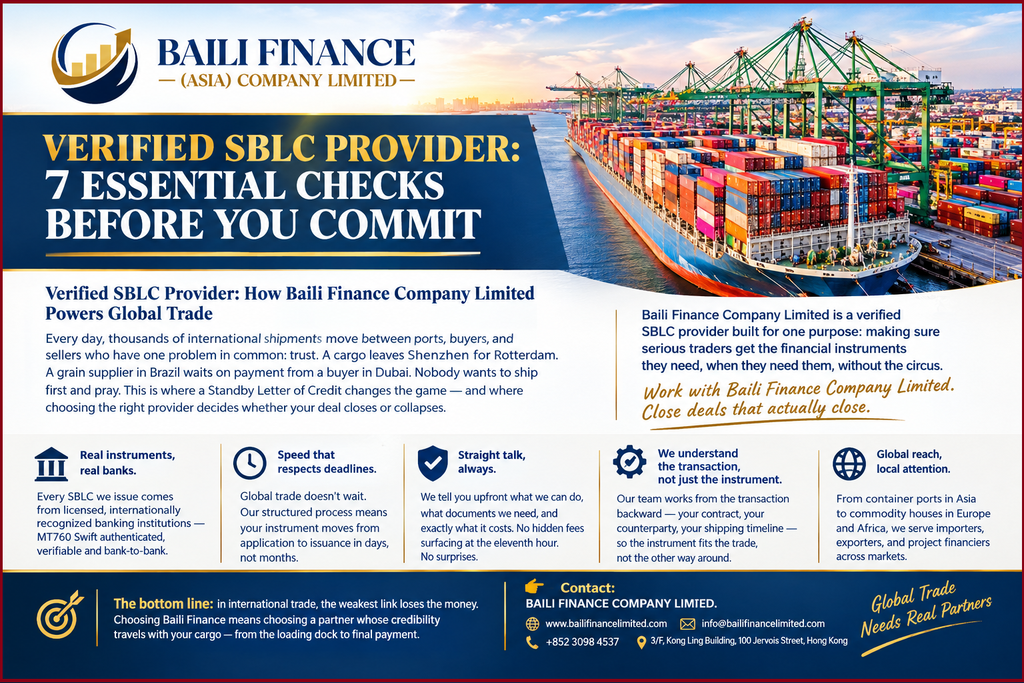
Case Study: How Due Diligence Can Prevent an SBLC Transaction Failure
The following fictional case study illustrates how a company can assess a proposed SBLC arrangement before committing funds.
The Situation
A construction company, Northbridge Projects Ltd., receives a proposal from a financial intermediary offering to arrange a $5 million performance SBLC.
The intermediary promises rapid issuance and requests an upfront arrangement fee. Its proposal includes a specimen instrument and the name of a purported issuing bank.
Initially, the proposal appears consistent with the company’s project requirements. However, the construction company’s finance director identifies several issues during the review.
The Investigation
The company takes five steps.
First, it verifies the intermediary. The team checks the company’s legal identity and seeks evidence supporting its claimed role in the transaction.
Second, it contacts the proposed bank independently. Using contact information obtained from an official source, the team requests confirmation through the bank’s appropriate channels.
Third, it reviews the fee agreement. The team identifies unclear refund provisions and an insufficient explanation of what the upfront payment would cover.
Fourth, it obtains legal advice. Its adviser reviews the proposed SBLC wording and finds that certain presentation requirements need clarification before the beneficiary could rely on the instrument.
Fifth, it pauses payment. The company requests satisfactory evidence and revised contractual documentation before making any financial commitment.
The Outcome
In this fictional example, the company declines to proceed until the unresolved issues have been addressed.
The case doesn’t establish that the intermediary committed fraud, nor does it demonstrate that every transaction involving an upfront fee is improper. Instead, it shows how independent checks can prevent a business from accepting unresolved risks.
Key Lessons for Businesses
- Verify the actual issuing bank rather than relying on an intermediary’s claims.
- Review payment obligations before transferring funds.
- Check that the proposed instrument supports the intended contractual purpose.
- Obtain independent advice when the transaction involves substantial exposure.
- Keep written records of verification requests, responses, and decisions.
For additional industry context, consult the Wolfsberg Group, ICC and BAFT Trade Finance Principles, which discuss customer due diligence, financial crime risks, and controls relevant to trade finance.
How to Choose the Right SBLC Provider for Your Business
The most suitable provider depends on the transaction, the applicant’s circumstances, the beneficiary’s requirements, and the role the provider will perform.
Rather than selecting a company solely on advertised fees or promised delivery times, evaluate it against clear commercial criteria.
Match the Instrument to the Transaction
Start with the underlying contract.
A supplier seeking payment protection may require a financial standby. A project owner may need a performance-related undertaking. A tendering company may need an instrument that complies with the tender’s specific requirements.
Confirm the beneficiary’s acceptance criteria before submitting an application.
Understand the Issuer’s Creditworthiness
An SBLC’s practical value depends partly on the issuing institution’s ability and obligation to honour a compliant demand.
Review reliable information about the issuer’s regulatory status, financial standing, and relevant credit assessments. A credit rating, where available, is an indicator of credit risk rather than a guarantee of payment.
Also determine whether the beneficiary requires confirmation from another bank. Confirmation creates an additional undertaking only when a bank expressly agrees to provide it under the applicable terms.
Review the Full Cost
The total transaction cost may include:
- Issuance fees.
- Advising or confirmation charges.
- Collateral and credit facility costs.
- Legal and documentation expenses.
- Intermediary or advisory fees.
- Amendment and extension charges.
Compare proposals on a like-for-like basis. A lower quoted fee may not represent a lower total cost if the instrument requires additional services or contains unsuitable terms.
Confirm Delivery Expectations
Ask for a realistic timetable covering application review, compliance checks, credit approval, wording negotiations, and issuance.
No intermediary should represent a bank’s independent approval process as a guaranteed outcome.
Establish Accountability
A written agreement should explain the provider’s responsibilities, the limits of its authority, the fees payable, the conditions for termination, and the procedures for resolving disputes.
The contract should also identify the party responsible for obtaining the issuing bank’s approval and for communicating any changes to the proposed arrangement.
Why Consider Baili Finance Limited for Your SBLC Enquiry?
Businesses seeking a verified SBLC provider need a clear starting point for discussing their financial requirements.
Baili Finance Limited can use this enquiry process to understand the client’s transaction, identify the type of instrument being considered, and clarify what information would be required for an initial assessment.
Prospective clients should establish the company’s precise role, the proposed issuing institution, and the scope of any services offered before entering into a transaction. Any bank issuance remains subject to the issuing institution’s own approval, documentation, and compliance requirements.
To make an enquiry more productive, prepare the following information:
- Your company profile: Legal entity name, country of registration, business activity, and authorised contact details.
- Your transaction purpose: Explain whether the SBLC will support a financial obligation, commercial payment, performance requirement, or tender.
- The required amount: State the requested amount and currency.
- The beneficiary’s requirements: Include any available wording, tender conditions, or contractual specifications.
- The proposed timeline: Identify relevant deadlines and the requested validity period.
- Your supporting documents: Prepare relevant corporate, financial, and contractual information for review through an appropriate secure channel.
Don’t send passwords, banking credentials, or unnecessary sensitive information in an initial enquiry.
For further information, visit Baili Finance Limited and use the company’s official contact channels to discuss your requirements.
Frequently Asked Questions About Verified SBLC Providers
1. What Is a Verified SBLC Provider?
A verified SBLC provider is a company or financial institution whose identity, role, and proposed participation in a standby letter of credit transaction have been checked against reliable evidence.
Verification should include the identity of the issuing bank, the authenticity of the undertaking, the provider’s legal status, and the relevant contractual terms. The word “verified” shouldn’t be treated as a certification unless an identifiable, competent authority has actually provided that certification.
2. How Can I Verify an SBLC Provider Before Paying Any Fees?
Begin by checking the company’s legal identity and any relevant regulatory authorisation. Identify the proposed issuing bank and independently contact it through official channels.
Request a written fee agreement, review refund conditions, and establish the process for authenticating the instrument. For substantial transactions, obtain independent legal advice before transferring funds.
Don’t treat a specimen SBLC, bank logo, SWIFT reference, or intermediary’s assurance as sufficient proof of issuance.
3. Can a Non-Bank Company Provide an SBLC?
A non-bank company may offer advisory, arranging, or intermediary services, depending on the laws that apply to its activities. However, its involvement doesn’t automatically make it the issuing institution.
The company should clearly identify its role and the bank or other eligible financial institution responsible for the undertaking. Any required authorisation depends on the services provided and the relevant jurisdiction.
4. What Is the Difference Between an SBLC Provider and an SBLC Issuing Bank?
The issuing bank undertakes the obligations specified in the SBLC. An intermediary or service provider may help coordinate the application, documentation, or communications.
These roles aren’t interchangeable. A business should confirm which institution will issue the instrument and which entity will receive any arrangement or advisory fees.
5. How Long Does It Take to Obtain an SBLC?
There is no universal issuance timetable. Processing depends on the issuing bank, the applicant’s credit profile, collateral requirements, compliance checks, transaction complexity, and the time needed to agree on the wording.
A complete application may help reduce avoidable delays, but no intermediary can guarantee bank approval or a specific issuance date without a reliable basis.
6. What Is the Difference Between an SBLC and a Bank Guarantee?
Both instruments can support contractual or financial obligations, but their legal structure, wording, governing rules, and operation may differ.
An SBLC is commonly governed by ISP98 or, where expressly incorporated and applicable, UCP 600. A demand guarantee may be subject to the ICC’s Uniform Rules for Demand Guarantees (URDG 758).
The correct instrument depends on the transaction and the beneficiary’s requirements. The names alone don’t determine the legal effect.
7. Can an SBLC Be Used to Obtain Financing?
An SBLC may support a financing arrangement if a lender accepts it and the proposed structure meets the lender’s requirements.
However, an SBLC doesn’t automatically create a right to borrow, guarantee loan approval, or establish a fixed monetisation value. Lenders conduct their own due diligence and assess the issuer, instrument wording, transaction structure, collateral, and applicable legal requirements.
Any financing proposal should clearly disclose its conditions, costs, and repayment obligations.
8. What Is ISP98, and Why Does It Matter?
ISP98 stands for International Standby Practices 1998. It provides rules for standby letters of credit, including provisions relevant to obligations, presentation, examination, timing, and cancellation.
Its application depends on the undertaking expressly incorporating the rules. Parties should review the actual instrument and applicable law rather than assume that ISP98 applies automatically.
9. What Documents May Be Required for an SBLC Application?
Requirements vary by institution and transaction. Common documents include corporate registration records, ownership information, identification for relevant parties, financial statements, bank information, the underlying contract, and details of the proposed beneficiary.
The bank may request additional documents to assess creditworthiness, collateral, source of funds, transaction purpose, and compliance obligations.
An intermediary should explain why documents are required and how the client can submit them securely.
10. Is an SBLC the Same as Cash or a Cash Deposit?
No. An SBLC is a contingent undertaking subject to its terms and applicable rules. It isn’t automatically equivalent to cash, a deposit, or immediately available borrowing capacity.
A beneficiary must understand the circumstances in which it can draw on the instrument. A lender considering the SBLC as credit support will determine its own acceptance criteria.
11. What Should I Do If I Suspect an SBLC Is Fake?
Pause the transaction and avoid making further payments until the issue has been investigated.
Contact the purported issuing bank using independently verified contact details. Preserve the proposal, correspondence, invoices, payment instructions, and other relevant evidence.
Seek advice from your bank and an appropriate legal professional. If there is credible evidence of fraud, consider reporting the matter to the relevant law enforcement or financial regulator.
12. How Can I Contact Baili Finance Limited About an SBLC?
Visit www.bailifinancelimited.com and use the company’s official contact channels.
Explain your business requirements, the proposed instrument type, the requested amount and currency, and the beneficiary’s requirements. Ask for a clear explanation of the company’s role, the proposed issuing institution, the verification procedure, and all applicable fees before proceeding.
Summary: Choose Verification Before Commitment
Selecting a verified SBLC provider requires evidence, not simply a persuasive proposal.
Businesses should confirm the provider’s legal identity, identify the issuing bank, authenticate the instrument through appropriate banking channels, examine the wording, understand all charges, and obtain independent professional advice when necessary.
These measures help applicants and beneficiaries make informed decisions while reducing avoidable contractual, operational, and counterparty risks.
For international businesses, the objective isn’t merely to obtain a standby letter of credit. It’s to establish whether the proposed instrument meets the commercial requirement, whether the issuing institution’s undertaking can be independently verified, and whether the arrangement is suitable under the applicable rules and law.
Ready to Secure Your Next SBLC Transaction?
Choosing a verified SBLC provider starts with the right information, transparent terms, and a clear understanding of your business needs. At Baili Finance Limited, we invite businesses seeking standby letters of credit and international trade finance solutions to discuss their requirements with our team.
Whether you need an SBLC for a commercial contract, financial obligation, or performance requirement, take the first step by outlining your transaction goals. Contact us to enquire about our services, documentation requirements, applicable fees, and verification procedures.
Planning an SBLC transaction? Start with a clear assessment of your requirements.
Don’t commit to an SBLC arrangement without understanding the details.
Contact Baili Finance Limited through www.bailifinancelimited.com to discuss your proposed transaction and request information about the available services, required documentation, proposed issuing institution, and applicable terms.
Before making any financial commitment, ensure that you understand the contractual arrangement and have independently verified the relevant parties and instrument.
Make your next trade finance decision on the basis of documented evidence, transparent terms, and appropriate due diligence.
Intermediaries/Consultants/Brokers are welcome to bring their clients 100% protected. Our brokers receive 2% commission for referral. We assist Clients and brokers in their attempt to secure funding by working on their funding requests that may require innovative financing. In complete confidence, we will work together for the benefits of all parties involved.
#VerifiedSBLCProvider #StandbyLetterOfCredit #SBLC #TradeFinance #BankGuarantee #InternationalTrade #FinancialDueDiligence