Headline: SBLC Monetization Program: A Guide to Business Funding
Businesses operating across international markets often need substantial funding to execute contracts, purchase inventory, expand operations, or meet contractual financial obligations. However, even companies with valuable assets, confirmed contracts, or strong commercial prospects can face financing constraints when traditional lenders require additional collateral or lengthy credit assessments.
An SBLC monetization program may provide a financing route for eligible businesses that hold an acceptable Standby Letter of Credit (SBLC) and need to explore liquidity options.
SBLC monetization involves arranging financing against an eligible standby letter of credit through a lender or other financing counterparty that accepts the instrument and approves the proposed transaction. The outcome depends on the issuing bank, the SBLC’s terms, the applicant’s credit profile, the proposed transaction, and the financing provider’s risk assessment.
For businesses researching SBLC monetization, standby letter of credit financing, SBLC-backed funding, and bank instrument monetization, understanding the process is essential before committing capital or signing a financing agreement.
Baili Finance Limited provides the point of contact for businesses wishing to discuss their financing requirements and explore whether a proposed transaction may be suitable for further assessment. Any potential financing arrangement remains subject to due diligence, applicable law, contractual terms, and the approval of the relevant financing parties.
Keywords: SBLC monetization program, SBLC monetization, standby letter of credit monetization, SBLC financing, SBLC-backed financing, standby letter of credit financing, SBLC funding process, SBLC monetization requirements, SBLC financing costs, SBLC loan, international trade finance, structured trade finance, bank instrument financing, standby letter of credit due diligence
What Is an SBLC Monetization Program?
An SBLC monetization program is a proposed financing arrangement in which a standby letter of credit serves as a form of credit support for a transaction designed to provide funding to an eligible beneficiary or other approved party.
A Standby Letter of Credit is a bank undertaking that generally supports an obligation if the applicant fails to meet specified conditions. Depending on its terms, the issuing bank may have to honor a complying demand supported by the documents required under the instrument.
The SBLC does not automatically represent cash in the beneficiary’s account. Instead, it provides a contingent payment undertaking, subject to its wording, governing rules, applicable law, and presentation requirements.
Monetization is a separate commercial and financing process. A lender or financing counterparty must determine whether it can accept the instrument, what rights it receives, what risks remain, and whether it can legally and commercially advance funds.
For example, a company may hold an SBLC issued by an acceptable bank but lack sufficient working capital to fulfill a supply contract. If an appropriate financing provider accepts the instrument as credit support, the parties may negotiate a secured financing facility.
However, an SBLC’s face value does not establish the amount that a lender will advance. The lender may decline the transaction, require additional security, impose conditions, or approve an amount substantially below the instrument’s stated value.
What Does SBLC Monetization Mean in Practice?
In practical terms, SBLC monetization means evaluating a standby letter of credit as part of a financing transaction rather than treating it as cash.
The financing provider examines the instrument, verifies its authenticity, evaluates the issuing bank, reviews the applicant and intended use of funds, and determines whether the proposed structure meets its lending criteria.
Depending on the transaction, financing may take the form of a secured loan, a credit facility, or another agreed arrangement. Each structure has different legal, operational, and repayment implications.
A legitimate transaction requires clear documentation of the parties’ rights and obligations. It should also identify the funding conditions, fees, repayment arrangements, security interests, and procedures that apply if the borrower defaults.
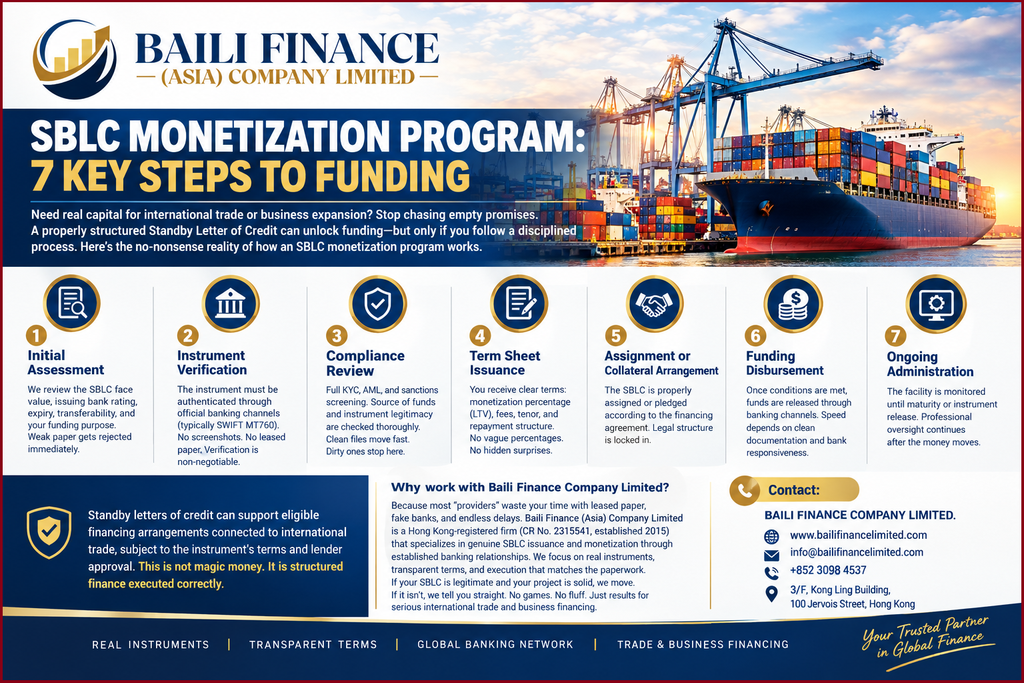
How Does an SBLC Monetization Program Work?
The process varies between providers and jurisdictions. Nevertheless, a professionally structured transaction generally follows several stages.
1. Initial Assessment of the Financing Requirement
The process begins with a clear explanation of the applicant’s commercial objective.
A financing provider will usually want to understand:
- The amount of funding required.
- The intended use of the funds.
- The applicant’s legal identity and ownership structure.
- The source and status of the SBLC.
- The issuing bank and country of issuance.
- The proposed transaction’s duration.
- The expected repayment source.
- Any existing security interests or restrictions.
This information helps the parties establish whether further assessment is worthwhile.
Businesses should distinguish between an SBLC they already hold and one they intend to arrange through a bank. These circumstances create different costs, approval requirements, and execution risks.
2. Verification of the Standby Letter of Credit
Authenticity and enforceability are central to SBLC financing.
The financing provider needs sufficient evidence that the instrument exists, was issued by the stated bank, and contains terms that support the proposed transaction.
Verification should take place through appropriate bank-to-bank communication or other reliable procedures acceptable to the relevant institutions. A PDF, scanned copy, certificate, broker’s assurance, or transaction reference alone does not establish authenticity.
The review should examine the following:
- The issuing bank’s identity and credit standing.
- The SBLC’s face value and currency.
- The beneficiary and applicant.
- The issue date and expiry date.
- The governing rules and applicable law.
- The presentation requirements.
- Any transfer, assignment, or proceeds-related provisions.
- The conditions for drawing under the instrument.
- Any amendment, cancellation, or renewal provisions.
The financing provider may also consider confirmation arrangements, jurisdictional restrictions, and whether the instrument can support the proposed security structure.
An instrument that appears acceptable commercially may still be unsuitable for a particular financing transaction because of its wording or legal limitations.
3. Due Diligence and Credit Assessment
After reviewing the instrument, the financing provider assesses the proposed borrower and transaction.
An SBLC does not eliminate credit risk. The lender must determine whether the borrower can repay the facility and whether the instrument provides adequate protection if the borrower fails to do so.
Due diligence may include corporate registration checks, beneficial ownership verification, financial statements, bank references, source-of-funds checks, sanctions screening, litigation reviews, and assessments of the underlying commercial activity.
The provider may also examine the borrower’s repayment capacity, financial obligations, cash flow, and operating history.
For a company seeking trade finance, the lender may review purchase orders, supply agreements, invoices, delivery schedules, and customer payment arrangements.
This assessment helps the financing parties determine whether the transaction offers an acceptable balance between the proposed financing amount and the risks involved.
4. Financing Structure and Commercial Terms
If the preliminary assessment is satisfactory, the parties can discuss a possible financing structure.
The terms should specify the proposed facility amount, interest or financing charges, arrangement fees, maturity, repayment schedule, collateral requirements, and conditions for drawing down funds.
They should also explain how the SBLC supports the transaction.
For instance, the agreement may address whether the lender receives a security interest, whether proceeds can be assigned, whether the beneficiary can transfer the instrument, and what approvals are required from the issuing bank.
These distinctions matter because an assignment of proceeds is not necessarily the same as a transfer of the SBLC itself. The rights available depend on the instrument’s wording, applicable law, and relevant contractual arrangements.
No party should assume that a lender can take ownership of, transfer, draw upon, or enforce an SBLC merely because the parties describe the transaction as monetization.
Before proceeding, the applicant should obtain independent legal advice on the proposed structure and understand the complete cost of financing.
5. Execution of the Required Agreements
Once the parties agree on the commercial terms, they prepare and review the relevant documentation.
Depending on the transaction, this may include a financing agreement, security agreement, assignment documentation, bank instructions, corporate resolutions, compliance declarations, and supporting commercial contracts.
The documents should identify each party’s legal role and distinguish the issuing bank, applicant, beneficiary, lender, intermediary, and any advising or confirming bank.
They should also establish which conditions must be satisfied before funding occurs.
Where the SBLC requires amendments, consents, or other bank actions, the parties must follow the applicable procedures. An intermediary cannot independently amend a bank undertaking or bind the issuing bank without proper authority.
Independent legal review is particularly important when the transaction involves several jurisdictions or multiple intermediaries.
6. Bank Coordination and Satisfaction of Funding Conditions
The parties then complete the required operational and banking steps.
These may include authentication of the instrument, delivery through an agreed channel, confirmation of required consents, completion of compliance checks, and satisfaction of the lender’s conditions precedent.
The exact process depends on the issuing bank, the instrument’s terms, the receiving institution, and the agreed financing structure.
A SWIFT message or bank communication should never be interpreted in isolation. Its meaning depends on the message type, authenticity, context, and relevant contractual arrangements.
The parties should confirm which bank communications are required and which institution has responsibility for each step.
7. Funding, Monitoring, and Repayment
Once all contractual and regulatory conditions have been met, the lender may disburse the approved financing amount.
The borrower should receive a clear statement of the amount funded, deductions, applicable charges, repayment dates, and any continuing obligations.
The borrower must then use the funds in accordance with the financing agreement and comply with its repayment and reporting requirements.
Depending on the facility, the lender may monitor cash flow, require periodic financial information, maintain security interests, or impose restrictions on additional borrowing.
The SBLC also remains subject to its own terms, including expiry, presentation, and amendment provisions. Borrowers should not assume that the instrument will automatically renew or remain available for the full life of a financing facility.
Who Can Benefit From SBLC Monetization?
SBLC-backed financing may suit businesses that have a legitimate funding requirement and access to an instrument that an appropriate lender is willing and able to accept.
Potential applicants include the following.
Importers and Exporters
International traders may require working capital to purchase goods, pay suppliers, meet delivery obligations, or bridge the period between shipment and customer payment.
Where an acceptable SBLC supports the transaction, a financing provider may consider a facility aligned with the underlying trade cycle.
However, the lender must evaluate the parties, goods, jurisdictions, payment arrangements, and instrument terms.
Construction and Infrastructure Companies
Construction contractors and infrastructure operators often incur substantial costs before they receive payment under a contract.
A suitable SBLC may form part of a wider credit-support package, subject to the financing provider’s approval.
The lender may also assess contract enforceability, project cash flow, payment milestones, completion risks, and additional collateral.
Energy and Commodity Businesses
Companies operating in energy, commodities, and industrial supply chains may need financing to meet purchase commitments, fund logistics, or support contractual performance.
These transactions can involve complex counterparties, substantial amounts, and multiple jurisdictions. Enhanced due diligence may therefore be necessary.
Established Companies Expanding Operations
Businesses planning to enter new markets, acquire equipment, or increase production may explore SBLC-backed financing as one component of their capital structure.
The appropriate option depends on the business’s repayment capacity, the cost of funding, and the availability of alternative financing.
An SBLC should not be considered a substitute for sound financial planning or an assurance that financing will be approved.
Benefits and Limitations of an SBLC Monetization Program
An SBLC financing arrangement may offer practical advantages, but businesses should assess those advantages against the legal, financial, and operational requirements.
Potential Benefits
Access to structured financing: An eligible instrument may support a credit facility where the lender considers the bank undertaking acceptable.
Support for international transactions: SBLCs can help address counterparty concerns in cross-border commercial relationships.
Financing flexibility: Depending on the structure, a facility may support working capital, contractual obligations, or other approved business expenditure.
Risk allocation: A properly drafted arrangement can establish the rights and obligations of the borrower, lender, and other parties.
Potentially broader financing options: Businesses may compare SBLC-backed lending with conventional secured loans, trade finance, receivables financing, or other available facilities.
Important Limitations
No guaranteed funding: An SBLC does not compel an unrelated lender to provide financing.
No automatic cash conversion: The face value does not equal the amount a borrower can receive.
Costs may be substantial: Issuance, confirmation, legal work, arrangement fees, interest, and other charges may affect the transaction’s economic value.
Instrument restrictions may apply: Transferability, assignment rights, expiry dates, and presentation conditions can limit available structures.
Additional collateral may be required: The lender may require guarantees, cash collateral, other assets, or additional credit support.
Cross-border legal issues may arise: Differences in banking practices, insolvency law, sanctions, and enforceability can affect the transaction.
Businesses should evaluate the net funding amount and total repayment obligation rather than relying on the stated face value of the SBLC.
Understanding SBLC Monetization Rates and Financing Costs
One of the most common questions concerns the percentage of an SBLC’s face value that a financing provider may advance.
There is no universal rate that applies to every SBLC monetization program.
The advance amount depends on the instrument’s terms, the issuing bank’s creditworthiness, the proposed collateral arrangement, the borrower’s financial position, market conditions, the financing term, and the lender’s internal policies.
An offer that promises a fixed advance percentage regardless of these factors should receive careful scrutiny.
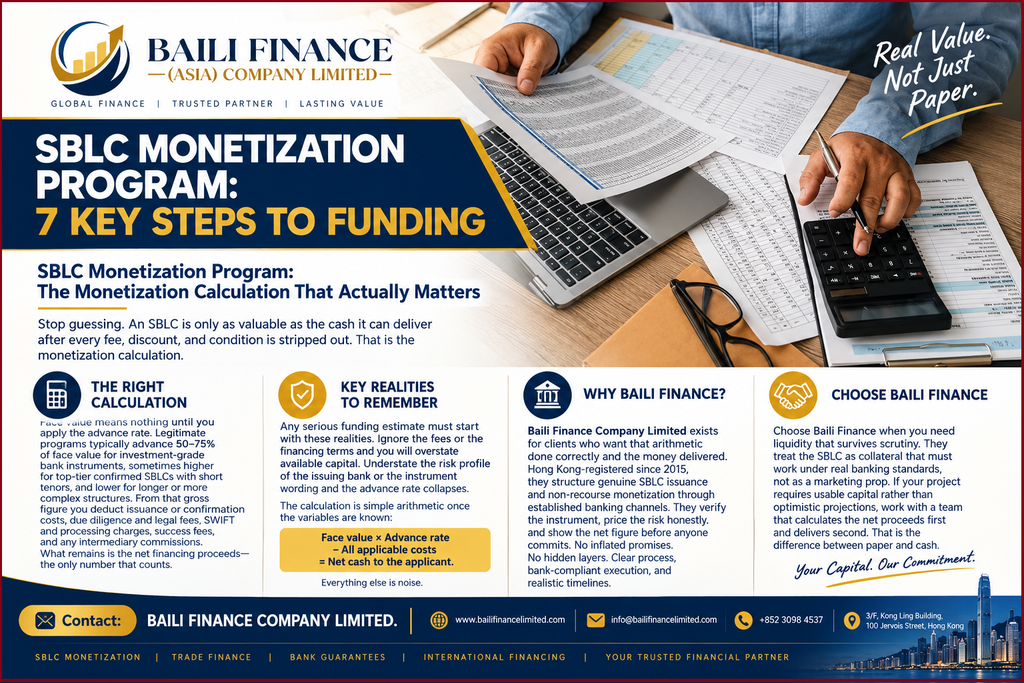
An Illustrative Financing Calculation
Consider a company with an SBLC carrying a face value of USD 10 million.
For planning purposes, assume a financing provider is willing to consider a facility equal to 60% of the face value. This percentage is an illustration, not a market quotation or an estimate of what a lender will offer.
| Item | Illustrative amount |
|---|---|
| SBLC face value | USD 10,000,000 |
| Assumed financing advance | 60% |
| Gross financing amount | USD 6,000,000 |
| Illustrative transaction costs | USD 150,000 |
| Net proceeds before other applicable deductions | USD 5,850,000 |
The calculation assumes that the lender approves the facility and that the stated costs are deducted from the gross amount.
Actual terms may differ materially. Interest, taxes, legal expenses, bank charges, collateral requirements, and other costs may reduce the available funds further.
The borrower must also repay the facility in accordance with its contractual terms. The SBLC’s face value does not eliminate that obligation.
A professional financing proposal should explain the basis of the advance amount, every material fee, the net disbursement, and the complete repayment structure.
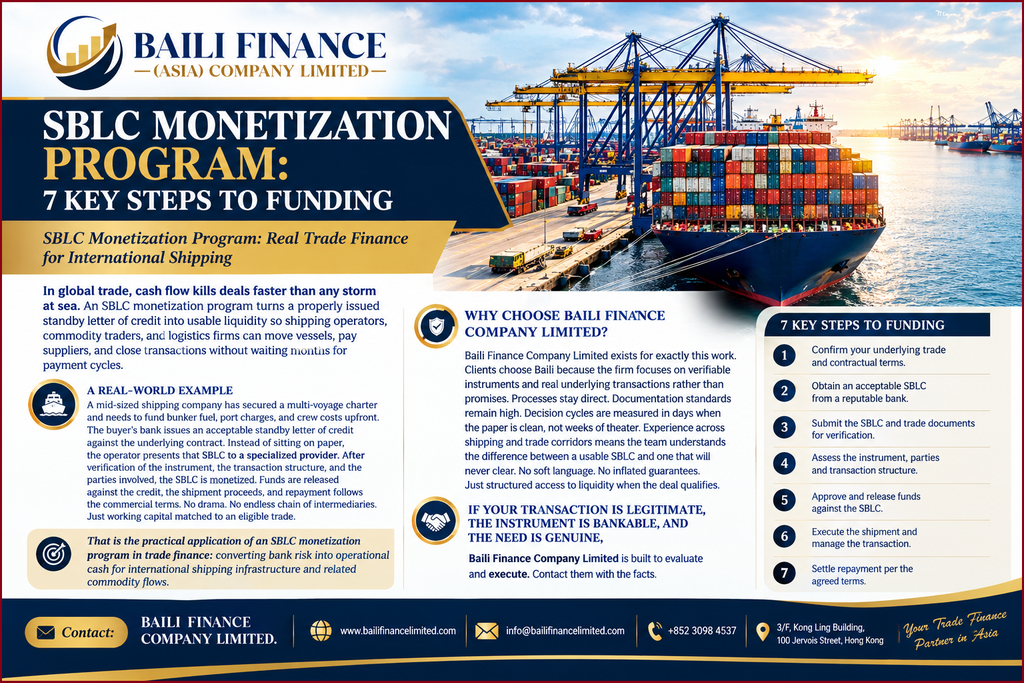
Real-World Commercial Example: Financing an Import Contract
Consider an established industrial equipment distributor that secures a contract to supply machinery to a commercial customer in another country.
The distributor must pay its manufacturer before receiving payment from the customer. Although the distributor has a signed purchase agreement, the timing of its cash inflows does not align with the supplier’s payment requirements.
The company explores several funding options, including a conventional working-capital facility and SBLC-backed financing.
Its bank has issued an SBLC in connection with a separate commercial obligation. The distributor asks a prospective financing provider whether the instrument could support a new facility.
The provider requests the SBLC details, verifies the instrument through appropriate channels, reviews the distributor’s financial statements, and examines the supply contract, expected customer receipts, and repayment plan.
Following its assessment, the provider determines whether the SBLC can legally and commercially support the proposed transaction. It may approve a facility, request additional security, propose different terms, or decline the application.
If the provider approves the financing and the parties satisfy all conditions, the distributor can use the proceeds for the permitted commercial purpose. It then repays the facility from its operating cash flow or customer receipts, according to the financing agreement.
This example illustrates a possible use of SBLC-backed financing. It does not establish that the distributor will qualify, that a particular advance percentage is available, or that every existing SBLC can support a new facility.
The central lesson is that financing depends on the complete transaction, not simply the existence of a bank instrument.
Case Study: Evaluating a Proposed SBLC-Backed Facility
The following case study is hypothetical. It demonstrates how a company and financing provider might evaluate a proposed transaction; it does not describe a verified client engagement or an actual transaction completed by Baili Finance Limited.
The Business Challenge
A manufacturing company receives a large export order requiring it to purchase raw materials, pay production costs, and arrange shipping before collecting payment from its overseas buyer.
The company holds an SBLC with a face value of USD 8 million. It believes that the instrument may help it obtain the working capital required to complete the order.
However, the company cannot assume that the entire face value is available for borrowing. It needs to establish whether a lender will accept the instrument and whether the proposed facility makes commercial sense.
The Assessment
The company assembles its corporate documents, financial statements, export contract, production budget, expected cash flow, and SBLC information.
The prospective financing provider reviews the issuing bank, instrument wording, beneficiary rights, expiry date, governing rules, and proposed security arrangements.
It also assesses the buyer’s payment obligations, the company’s ability to complete the order, and the expected timing of repayment.
During the review, the parties identify a potential issue: the SBLC’s existing terms and related obligations require further examination before the proposed financing structure can proceed.
Rather than assuming that the instrument is immediately monetizable, the parties seek clarification and independent legal advice.
The Financing Decision
After reviewing the available information, the financing provider considers whether it can approve a facility on acceptable terms.
The outcome could involve a revised structure, additional collateral, amended documentation where permitted, or a decision not to proceed.
If the provider approves the transaction, the company compares the net funding amount and total repayment cost against the expected profit from the export order.
It proceeds only if the financing arrangement satisfies its commercial objectives and all required conditions are met.
Lessons From the Case Study
This scenario demonstrates four important principles:
- Verify before committing: Establish the instrument’s authenticity and legal characteristics before paying transaction-related fees.
- Assess the underlying business: A viable financing structure requires a credible repayment source.
- Understand the legal rights: An SBLC’s terms determine how it can support the proposed transaction.
- Evaluate the full economics: The company must consider net proceeds, financing costs, repayment obligations, and commercial risks.
The purpose of due diligence is not simply to complete a transaction. It is to determine whether the transaction is legitimate, enforceable, affordable, and suitable for the applicant.
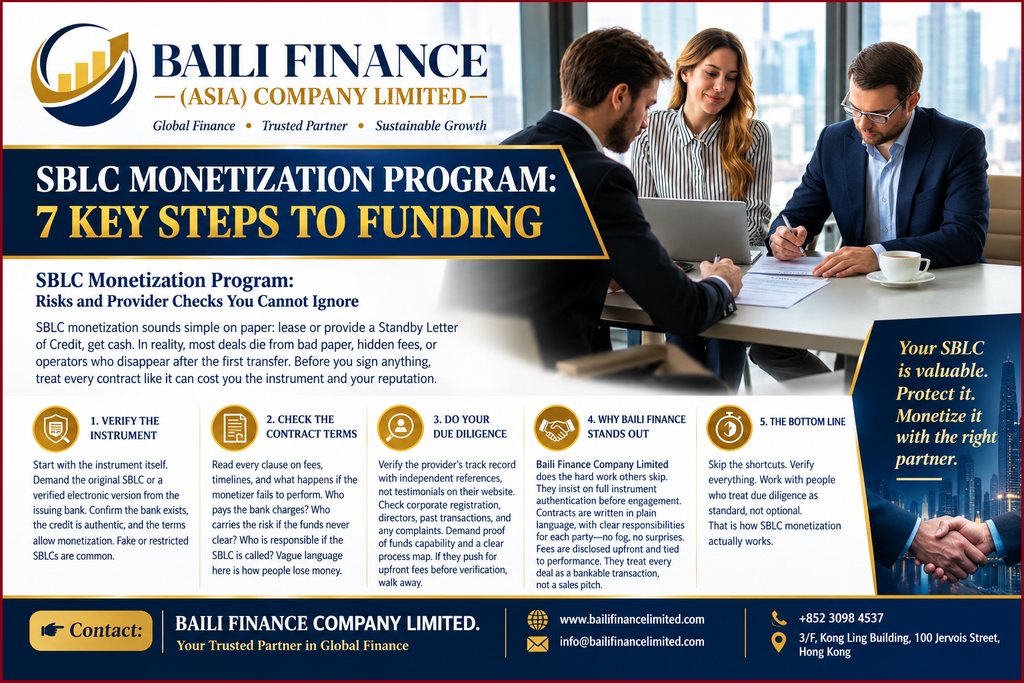
SBLC Monetization Risks and How to Reduce Them
SBLC-related transactions require careful attention because the terminology can obscure the differences between an authentic bank undertaking, a financing proposal, and an unverified intermediary’s claims.
Businesses should address the following risks before proceeding.
1. Fraudulent Instruments and Misrepresented Bank Communications
Fraudsters may circulate altered documents, impersonate banks, or present fabricated confirmations.
Companies should verify instruments through reliable bank channels and independently established contact details. They should not rely solely on documents supplied by a broker or intermediary.
2. Guaranteed-Return or Guaranteed-Funding Claims
An intermediary may claim that every SBLC qualifies for financing or promise a specific payout regardless of the issuing bank and transaction structure.
Such claims require independent verification. No responsible assessment should treat an unreviewed instrument as automatically acceptable collateral.
3. Excessive Upfront Fees
Applicants should understand why each fee is payable, who receives it, what service it covers, and whether it remains payable if the transaction does not proceed.
Before transferring funds, obtain written terms, verify the recipient, and seek independent legal advice. Avoid payments to unexplained third-party accounts or arrangements that lack clear contractual support.
4. Unclear Legal Rights
A financing agreement may use terms such as assignment, transfer, lease, collateralization, or monetization without adequately explaining their legal effect.
The parties should identify exactly what rights are being granted and whether the relevant bank and beneficiary consents are required.
5. Regulatory and Sanctions Exposure
Cross-border financing may involve banking regulations, anti-money-laundering requirements, sanctions restrictions, tax obligations, and licensing considerations.
The parties should establish which legal requirements apply to each participant and jurisdiction before executing the transaction.
6. Repayment and Liquidity Risk
A borrower remains responsible for repayment under the financing agreement even if its underlying commercial project experiences delays.
The company should stress-test its cash flow, consider adverse scenarios, and confirm that the repayment schedule remains manageable.
The Role of ISP98 and International Banking Rules
The legal and operational framework of an SBLC deserves particular attention.
The International Chamber of Commerce’s International Standby Practices (ISP98) provides rules for standby letters of credit when the instrument expressly incorporates them.
ISP98 addresses matters such as the undertaking’s obligations, presentation of documents, examination, cancellation, reimbursement, and other aspects of standby practice.
However, ISP98 does not automatically apply to every SBLC. The instrument’s wording and applicable law determine the relevant framework. Other instruments may use different rules, including applicable provisions of the Uniform Customs and Practice for Documentary Credits (UCP 600) or other relevant legal frameworks.
The distinction matters because the governing rules can affect the parties’ rights, the documents required for a demand, and the procedures that apply to the instrument.
For a proposed monetization transaction, professional advisers should review both the SBLC and the financing agreement. They should identify any conflicts between the documents and confirm that the proposed security arrangements comply with the applicable legal requirements.
A bank’s issuance of an SBLC also does not establish that an unrelated lender will accept it as collateral.
How to Choose an SBLC Monetization Provider
Selecting a financing provider requires more than comparing advertised advance percentages.
Businesses should assess the provider’s legal identity, contractual role, funding capacity, transaction process, and willingness to explain its requirements.
Before proceeding, ask the following questions:
- What is the provider’s exact role: lender, arranger, adviser, or intermediary?
- Which entity will provide the financing?
- What due diligence must the applicant complete?
- How will the SBLC be authenticated?
- What legal rights will the financing provider receive?
- Which fees are payable, to whom, and at what stage?
- What conditions must be satisfied before disbursement?
- What is the complete repayment obligation?
- What happens if the transaction fails to close?
- Which governing law and dispute-resolution provisions apply?
Where relevant, verify the provider’s regulatory status and any required authorization through official sources. Ask for references or independently verifiable evidence of relevant experience, while recognizing that references alone do not guarantee performance.
Avoid relying on unsupported claims of exclusive bank relationships, guaranteed returns, or automatic access to financing.
A credible transaction process should allow the applicant to understand the proposed arrangement before committing to material expenditure.
Why Businesses Should Consider Baili Finance Limited
Businesses exploring an SBLC monetization program need a clear understanding of their financing objectives, the instrument they hold, and the requirements that a prospective financing counterparty may impose.
Baili Finance Limited provides a point of contact for businesses seeking to discuss financing requirements and explore potential transaction options.
Before making any financing decision, applicants should prepare relevant information about their company, the SBLC, the proposed use of funds, and the expected repayment source. This information can help establish whether further discussion is appropriate.
Any proposed arrangement should remain subject to instrument verification, counterparty due diligence, legal review, compliance checks, and the approval of the relevant financing parties.
Businesses should confirm the company’s current service scope, contractual role, eligibility requirements, and any applicable fees directly before entering into an agreement.
Frequently Asked Questions About SBLC Monetization Programs
1. What is an SBLC monetization program?
An SBLC monetization program is a financing arrangement that uses an eligible standby letter of credit as potential credit support for a loan or other approved financing facility.
The lender assesses the instrument, the applicant, the underlying transaction, and the proposed repayment arrangements. Approval is not automatic, and the amount available may be lower than the SBLC’s face value.
2. How does SBLC monetization work?
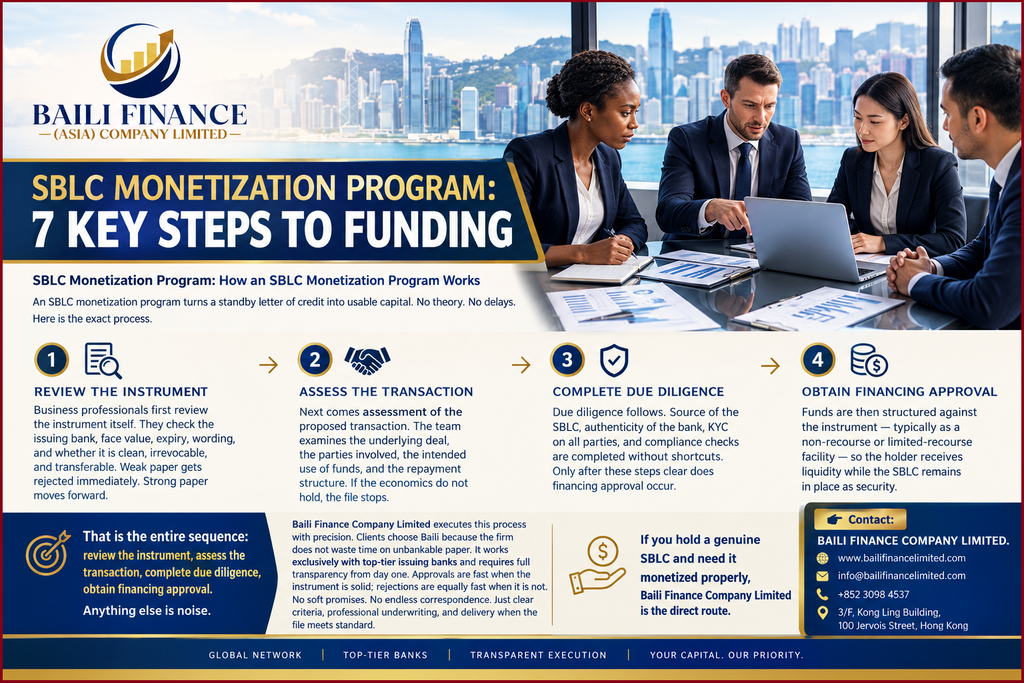
The process generally involves an initial assessment, instrument authentication, due diligence, negotiation of financing terms, execution of agreements, satisfaction of funding conditions, and disbursement.
The specific steps depend on the instrument, the financing provider, the relevant banks, and the applicable law.
3. Can I monetize any standby letter of credit?
No. A financing provider may reject an SBLC because of its issuing bank, wording, expiry date, beneficiary details, governing rules, jurisdiction, or other risk factors.
The provider must determine whether the instrument can legally and commercially support the proposed transaction.
4. What percentage of an SBLC’s face value can I receive?
There is no universal advance percentage. The amount depends on the lender’s assessment of the instrument, the borrower, the collateral structure, and the transaction’s risks.
Applicants should request a written proposal showing the gross facility, fees, net proceeds, interest or other financing charges, and repayment obligations.
5. How long does SBLC monetization take?
There is no standard completion period for every transaction. Timing depends on document readiness, bank verification, due diligence, legal review, regulatory requirements, and the time needed to satisfy the lender’s conditions.
Applicants should obtain a transaction-specific timetable rather than relying on a guaranteed funding date.
6. Is SBLC monetization the same as selling an SBLC?
No. Monetization commonly refers to obtaining financing supported by an SBLC, while a sale would involve a different proposed transfer of rights or interests.
The legal effect depends on the instrument’s terms, the transaction documents, and applicable law. Some SBLCs cannot be transferred as the parties may wish, although a separate assignment of proceeds may be possible under the applicable rules and legal framework.
7. Does an SBLC guarantee that a lender will provide funding?
No. An SBLC represents an undertaking by the issuing bank under specified conditions. It does not oblige every other bank or lender to provide financing against it.
The prospective lender must independently approve the transaction.
8. What documents are required for an SBLC monetization application?
Requirements vary, but a financing provider may request corporate registration documents, beneficial ownership information, financial statements, proof of identity, the SBLC details, relevant bank information, underlying commercial contracts, and a proposed use-of-funds statement.
Additional documents may be necessary for compliance, credit assessment, and legal review.
9. Is SBLC monetization safe?
The level of risk depends on the instrument, the financing structure, the parties, and the safeguards used.
Applicants should authenticate the SBLC, verify counterparties, obtain independent legal advice, understand all fees, and review the complete repayment obligations before committing funds.
No financing arrangement is risk-free.
10. How can I discuss an SBLC monetization opportunity with Baili Finance Limited?
Start by contacting Baili Finance Limited through its official website, www.bailifinancelimited.com, to discuss your financing requirements and establish whether further assessment may be appropriate.
Prepare a summary of the requested funding amount, intended use of funds, SBLC details, issuing bank, expiry date, and expected repayment source. Avoid sending sensitive banking credentials or confidential authentication information through unsecured channels.
Any potential transaction remains subject to review, due diligence, applicable requirements, and the relevant financing parties’ approval.
Conclusion: Make an Informed Decision About SBLC Monetization
An SBLC monetization program may provide a financing option for eligible businesses that need capital to support trade, contractual commitments, working capital, or expansion.
However, the existence of a standby letter of credit does not automatically create available cash or guarantee access to a loan. The transaction depends on the instrument’s authenticity, the issuing bank, the proposed financing structure, the applicant’s financial position, and the lender’s approval.
Businesses should therefore begin with verification, proceed through a documented assessment, and evaluate every material cost and obligation before committing to a transaction.
By understanding the distinction between an SBLC’s face value and its potential role as credit support, applicants can approach financing discussions with more realistic expectations and better-informed questions.
READY TO EXPLORE AN SBLC MONETIZATION PROGRAM?
Your Standby Letter of Credit Could Be an Important Part of Your Business Financing Strategy. Start With the Right Assessment.
If your business holds a Standby Letter of Credit (SBLC) and you’re exploring financing for international trade, working capital, major contracts, or business expansion, now is the time to clarify your options.
At Baili Finance Limited, we invite businesses seeking SBLC-related financing to initiate a discussion about their funding objectives, instrument details, and transaction requirements.
Whether you’re evaluating an existing SBLC or considering a potential financing structure, the first step is to understand the instrument, assess the available options, and establish what the transaction may require.
Take the Next Step Toward Understanding Your Financing Options
Contact Baili Finance Limited to discuss:
- Your funding requirements: Explain the amount of financing you’re seeking and how you intend to use it.
- Your SBLC details: Identify the issuing bank, face value, expiry date, and relevant instrument terms.
- Your potential financing structure: Explore whether your circumstances may warrant further assessment.
- The next steps: Establish what documentation, verification, due diligence, and approvals may be required.
Don’t base your financing decisions on assumptions or unverified promises. Start with a clear understanding of your options and the requirements involved.
Start Your SBLC Financing Inquiry Today
Visit: www.bailifinancelimited.com to contact Baili Finance Limited and discuss your SBLC-related financing requirements.
Prepare a brief summary of your business, funding objectives, and available instrument details so your inquiry can focus on the information that matters.
Your next financing decision starts with the right conversation. Contact Baili Finance Limited today to explore whether an SBLC-related financing arrangement may be suitable for your business.
All potential transactions remain subject to instrument verification, due diligence, applicable laws and regulations, contractual terms, and the approval of the relevant financing parties.
Intermediaries/Consultants/Brokers are welcome to bring their clients 100% protected. Our brokers receive 2% commission for referral. We assist Clients and brokers in their attempt to secure funding by working on their funding requests that may require innovative financing. In complete confidence, we will work together for the benefits of all parties involved.
#SBLCMonetization #StandbyLetterOfCredit #SBLCFinancing #TradeFinance #StructuredFinance #InternationalTrade #BusinessFunding