Headline: SBLC as Collateral: Uses, Risks & Financing Guide
A standby letter of credit (SBLC) as collateral can help businesses secure financing, support commercial obligations, and strengthen their position when negotiating with lenders and trading partners. For companies involved in international trade, project finance, real estate, and corporate lending, understanding how an SBLC works as collateral can improve financial planning and help them evaluate available funding options.
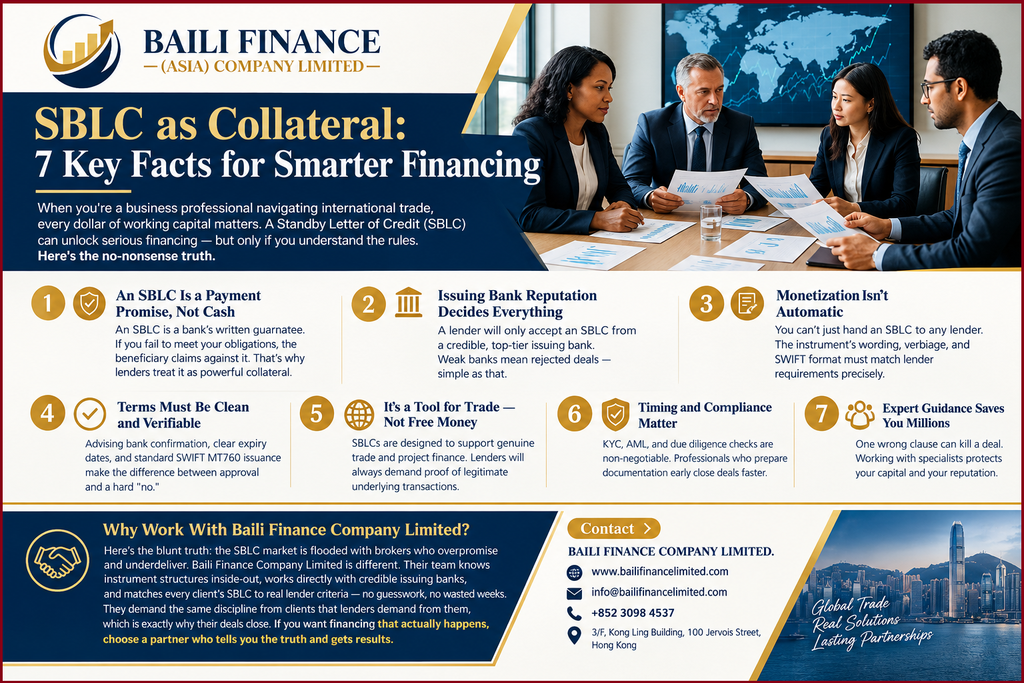
However, an SBLC does not automatically qualify as acceptable collateral. The issuing bank, the wording of the instrument, the applicant’s financial position, and the proposed lender’s credit policies all influence whether a transaction can proceed.
For businesses exploring SBLC-backed financing, standby letter of credit collateral requirements, or using an SBLC to secure a loan, understanding these factors is essential before entering into an agreement.
At Baili Finance Limited, businesses can explore relevant financial solutions and discuss their transaction requirements. Every proposed arrangement, however, requires appropriate due diligence and an assessment of the parties involved.
This guide explains how SBLC collateral works, its commercial applications, the risks to consider, and the practical steps businesses should take before pursuing a financing transaction.
Keywords: SBLC as collateral, standby letter of credit collateral, SBLC financing, SBLC-backed financing, loan against SBLC, SBLC financing solutions, How does SBLC collateral work, SBLC collateral requirements, SBLC collateral value, Can an SBLC be used as collateral for a loan, how much can you borrow against an SBLC, how to use a standby letter of credit as collateral, SBLC-backed loans, SBLC collateral requirements, loan against SBLC, trade finance, credit enhancement.
What Is an SBLC as Collateral?
An SBLC is a bank-issued undertaking that provides a named beneficiary with a payment mechanism if the applicant fails to meet specified obligations and the beneficiary presents the documents required under the instrument.
When used as collateral, an SBLC may support a financing arrangement by providing the lender with an independent payment undertaking from an acceptable issuing institution. Instead of relying solely on the borrower’s promise to repay, the lender evaluates the SBLC as an additional source of credit support.
The lender must agree to accept the instrument. It will normally assess the issuer’s creditworthiness, the SBLC’s legal enforceability, its expiry date, the amount available for a claim, and the conditions governing payment.
The International Chamber of Commerce explains the structure and commercial applications of standby letters of credit in its comprehensive guide to standby letters of credit. The guide is a useful reference for businesses evaluating this instrument in international transactions.
How does an SBLC differ from conventional collateral?
Conventional collateral may include real estate, equipment, inventory, receivables, cash deposits, or marketable securities. A lender can assess these assets and, where the law permits, enforce security rights over them following a default.
An SBLC works differently. The beneficiary relies on the issuing institution’s independent undertaking to pay against a presentation that complies with the SBLC’s terms.
Consequently, the lender evaluates both the instrument and the bank standing behind it.
For example, a lender might consider an SBLC issued by a bank it already approves, subject to legal and credit review. It might reject another instrument with the same face value because the issuer does not meet its requirements or the payment conditions create unacceptable risk.
The central principle is that an SBLC’s face value does not automatically equal its collateral value. The receiving institution determines its acceptability and how much financing, if any, it will support.
How Does SBLC Collateral Financing Work?
Using a standby letter of credit as collateral involves several parties and contractual relationships. The exact process depends on the financing structure, the issuing bank, the lender, and the governing documentation.
The following steps illustrate a typical arrangement.
1. The borrower identifies a financing requirement
A business determines how much funding it needs, why it needs the funds, and how it intends to repay the facility.
The requirement might relate to working capital, an international supply contract, equipment acquisition, or a qualifying project.
At this stage, the borrower should establish whether the proposed lender accepts SBLC collateral. This preliminary confirmation helps avoid arranging an instrument that the lender will not recognize.
2. The lender evaluates the proposed SBLC
The lender reviews the proposed issuer, instrument amount, currency, validity period, beneficiary details, governing rules, and documentary conditions.
It also assesses the borrower’s credit profile, the proposed transaction, and the repayment plan.
Some lenders may require cash margins, additional guarantees, or other security. Others may decline the proposal regardless of the SBLC’s face value.
3. The issuing bank completes its assessment
If the applicant requests a new SBLC, the issuing bank conducts its own credit and compliance checks.
The bank may require cash collateral, an existing credit facility, other security, or sufficient borrowing capacity. Its requirements depend on the applicant’s circumstances and the bank’s policies.
An applicant should not assume that a bank will issue an SBLC solely because a third-party lender intends to accept it.
4. The parties agree on the instrument’s terms
Before issuance, the lender and relevant transaction parties should agree on the wording and operational requirements.
These may cover:
- The beneficiary’s legal name and address.
- The maximum amount available for a drawing.
- The expiry date and place of presentation.
- The documents required to make a claim.
- The governing rules and applicable law.
- Any transfer, assignment, amendment, or confirmation requirements.
Clear drafting helps reduce disputes and prevents avoidable inconsistencies between the financing agreement and the SBLC.
5. The SBLC is issued and authenticated
The issuing bank transmits the instrument through an agreed, authenticated banking channel or another method accepted by the parties.
The beneficiary or lender should independently verify the instrument with the issuing bank using reliable contact details obtained from an independent source.
A PDF, scanned document, message, or certificate supplied by an intermediary does not, by itself, establish that a genuine and enforceable bank undertaking exists.
6. The lender completes its collateral review
The lender verifies the instrument, confirms that its terms satisfy the agreed conditions, and completes its legal, credit, compliance, and operational checks.
Where the transaction involves a pledge, assignment, or other security arrangement, the parties must establish the legal mechanism that gives the lender the intended rights.
Only after the relevant approvals and contractual conditions have been satisfied can the financing proceed.
7. The borrower receives funds under the agreed facility
Once all conditions precedent have been fulfilled, the lender may disburse the loan or activate the agreed facility.
The borrower must then comply with the repayment schedule, financial covenants, reporting obligations, and other financing terms.
If the borrower defaults, the lender’s ability to claim under the SBLC depends on the instrument’s wording, the lender’s rights, and the applicable legal framework. Payment is not automatic merely because a default occurs.
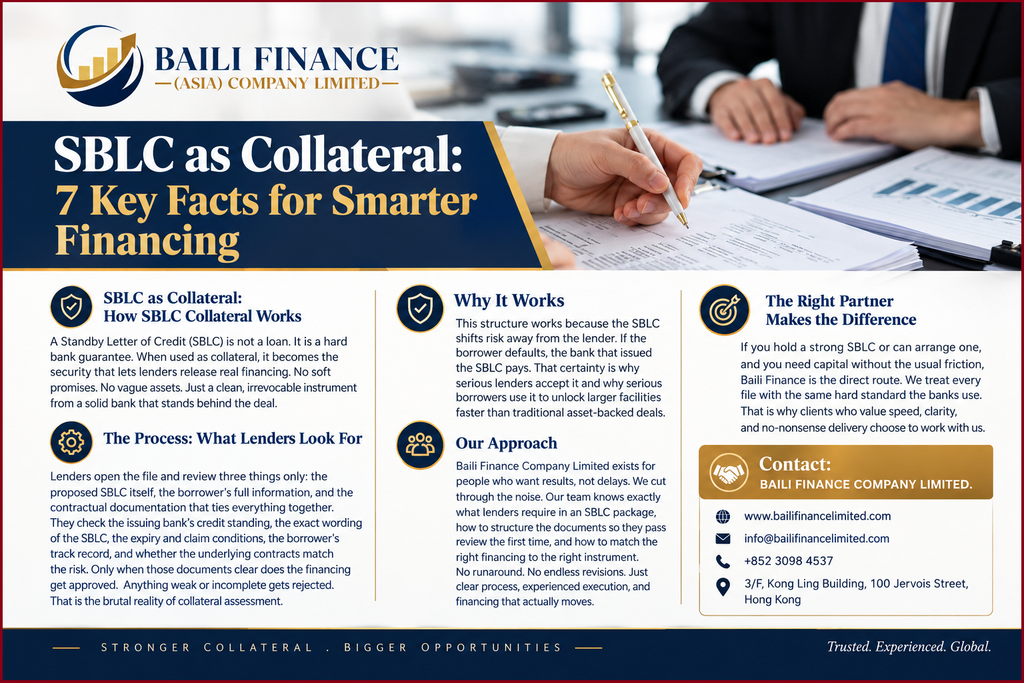
What Types of SBLC Can Support Financing?
Not every standby letter of credit serves the same commercial purpose. The intended obligation determines which structure may suit a transaction.
Financial SBLC
A financial SBLC supports a payment obligation. Depending on its wording, it may cover a loan repayment obligation, an outstanding payment, or another financial commitment.
For example, a lender may request a financial standby to support a borrower’s repayment obligations, provided the issuer, beneficiary, and terms meet its requirements.
Performance SBLC
A performance SBLC supports contractual performance rather than repayment alone.
A construction company, for example, might arrange a performance standby in favour of a project owner to address specified risks associated with failure to perform under a contract.
Whether a lender can accept this instrument as collateral for a separate loan depends on the rights it provides and whether the structure permits the lender to obtain the required protection.
Direct-pay SBLC
A direct-pay standby provides a payment undertaking designed around specified payment obligations. Its suitability depends on the transaction documents and the precise rights of the beneficiary.
The parties should not assume that every direct-pay instrument is interchangeable with a conventional loan security arrangement.
Counter-SBLC arrangements
In some cross-border transactions, one bank issues a counter-standby in favour of another bank, supporting the second bank’s issuance of a separate guarantee or standby.
This structure can help parties work with local banking relationships while obtaining support from another institution. However, it creates additional documentation, bank-credit, and legal considerations.
The appropriate structure depends on the commercial objective, not simply on the label attached to the instrument.
Key Benefits of Using an SBLC as Collateral
When a lender accepts the instrument and the documentation provides adequate protection, an SBLC may offer several advantages.
1. Additional credit support
An SBLC can supplement a borrower’s existing credit profile. The lender may consider the issuing bank’s creditworthiness alongside the borrower’s repayment capacity and other security.
This can be relevant when a company has a viable transaction but needs additional support to satisfy a counterparty’s risk requirements.
2. Support for international transactions
Cross-border businesses often deal with different legal systems, currencies, banking relationships, and commercial practices.
A properly structured SBLC can provide a defined payment undertaking that the parties can evaluate independently of the underlying commercial contract.
3. Potential access to financing
Where a lender accepts the instrument, an SBLC may support a loan or credit facility that would otherwise require a different security package.
However, acceptance does not guarantee approval. Lenders continue to assess the borrower’s ability to repay and the transaction’s overall risk.
4. Defined payment conditions
An SBLC specifies the conditions under which a beneficiary can demand payment.
Clear documentary requirements help the parties understand the process for making a claim. Nevertheless, the beneficiary must comply with the instrument’s terms, and legal issues such as fraud or abusive drawing remain subject to applicable law.
5. Support for contractual obligations
Businesses may use SBLCs to support financial commitments, contractual performance, and certain other obligations.
This flexibility makes the instrument relevant to trade finance, project transactions, and corporate risk management.
Important: An SBLC does not create free capital, eliminate repayment obligations, or guarantee access to funding. The economic value depends on the specific transaction and the rights the instrument actually provides.
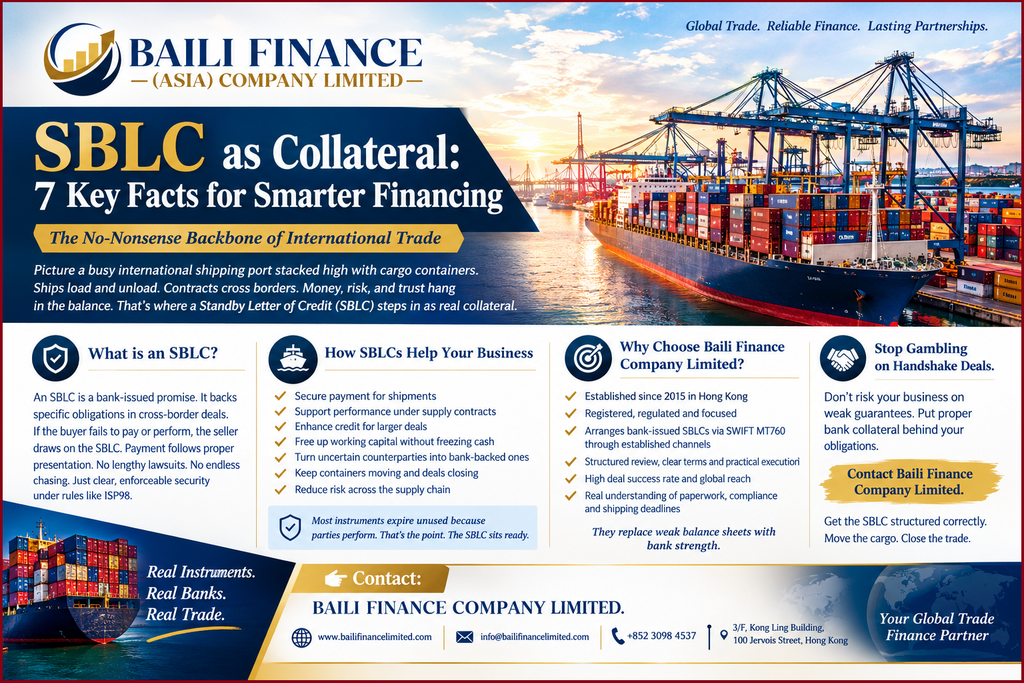
What Determines the Collateral Value of an SBLC?
The lender’s assessment determines whether an SBLC can support financing and, if so, to what extent.
Several factors usually influence this decision.
| Assessment factor | Why it matters |
|---|---|
| Issuing bank | The lender evaluates the issuer’s creditworthiness, jurisdiction, and ability to honour a complying presentation. |
| SBLC amount | The stated amount sets the maximum potential drawing, subject to the instrument’s terms. |
| Expiry date | The lender checks whether the instrument remains valid for an adequate period and whether its expiry aligns with the financing. |
| Documentary conditions | The lender examines whether it can satisfy the drawing requirements if a claim becomes necessary. |
| Legal enforceability | Governing law, jurisdiction, beneficiary rights, and applicable regulations affect the lender’s position. |
| Transfer and assignment rights | The lender checks whether the proposed security arrangement gives it enforceable rights. |
| Currency and country risk | Exchange-rate exposure, transfer restrictions, and jurisdictional risks may affect acceptance. |
| Borrower credit profile | The lender still evaluates repayment capacity, existing liabilities, and the purpose of the financing. |
Does a $10 million SBLC guarantee a $10 million loan?
No.
A lender might accept an SBLC for less than its face value, require additional collateral, or decline the transaction. Its decision depends on its credit policy, risk assessment, documentation, and applicable legal requirements.
The instrument’s face value represents the stated maximum exposure under its terms. It does not establish the amount a lender must advance.
For this reason, businesses should obtain the lender’s acceptance criteria before committing to issuance fees or other transaction expenses.
Real-World Numerical Example: SBLC as Loan Collateral
Consider the following illustrative transaction.
A trading company needs working capital to fulfil an international supply contract. It approaches a lender for a revolving credit facility and proposes an SBLC from a bank that the lender may be willing to accept.
The proposed SBLC has a face value of $5 million.
The lender reviews the issuer, validates the instrument, assesses the company’s repayment capacity, and evaluates the contractual security arrangements. Following its assessment, it agrees in principle to a facility of $3 million, subject to all required approvals and documentation.
The difference between the SBLC amount and the proposed loan reflects the lender’s own credit decision. It does not represent a standard advance rate or an automatic valuation rule.
Illustrative transaction figures
SBLC face value
$5,000,000
Proposed credit facility
$3,000,000
The proposed facility equals 60% of the SBLC’s face value in this hypothetical example. This is an illustration, not a market benchmark or an offer of financing.
Before disbursement, the lender verifies the final instrument, completes its compliance procedures, confirms its rights as beneficiary or secured party, and satisfies its internal approval requirements.
If the company later defaults, the lender may seek payment under the SBLC only in accordance with the instrument’s terms and the relevant legal framework. It cannot assume that the entire stated amount will be paid without a complying presentation.
This example demonstrates why a business should assess the full financing structure rather than focus exclusively on the SBLC’s face value.
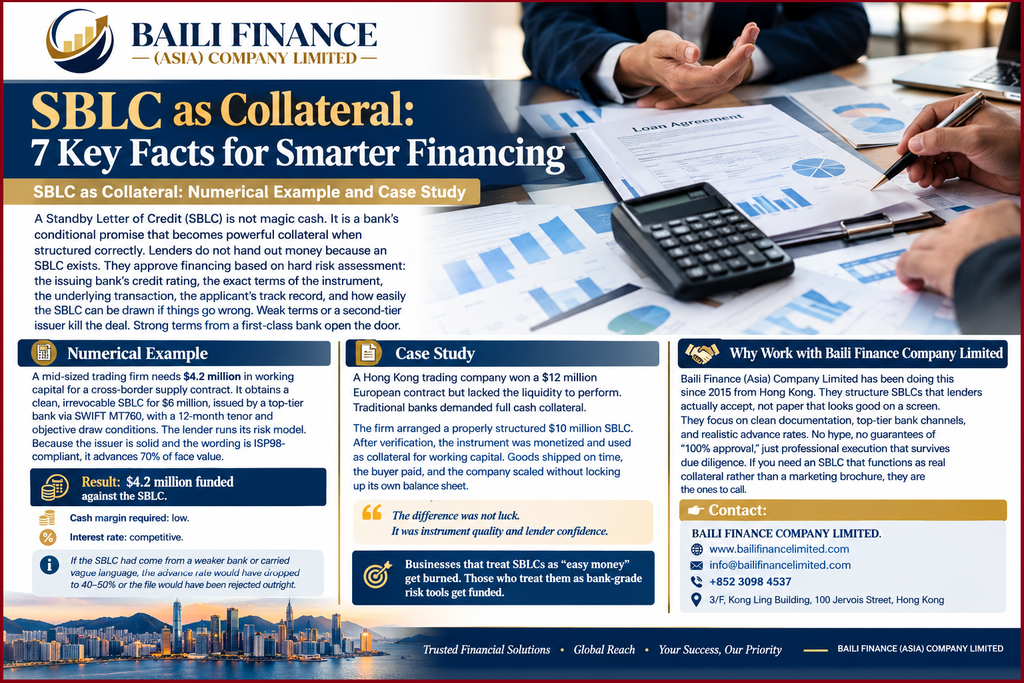
Case Study: A Hypothetical Cross-Border Financing Transaction
The following case study is fictional. It illustrates how a business might evaluate SBLC-backed financing; it does not describe a verified client transaction or establish that any particular lender would approve the arrangement.
The business challenge
An international equipment distributor secures a supply contract worth $8 million. It must pay its supplier before collecting payment from its customers.
The company has an established trading history, but its available working capital cannot cover the supplier’s payment schedule and operating expenses.
Management considers several options, including a conventional secured loan, trade finance, and a credit facility supported by a standby letter of credit.
The proposed solution
The company approaches a financing institution to determine whether an SBLC from an acceptable bank could support a working-capital facility.
Rather than arranging the instrument immediately, the company asks the proposed lender to specify its issuer eligibility standards, beneficiary requirements, acceptable wording, minimum remaining validity, and collateral documentation.
The lender then reviews the proposed structure and requests financial statements, transaction contracts, information about the issuing bank, and evidence supporting the company’s repayment plan.
The due-diligence process
The parties identify several matters that require attention:
- The proposed issuer must meet the lender’s credit and jurisdictional requirements.
- The SBLC must name the correct beneficiary and contain acceptable drawing conditions.
- The expiry date must align with the expected financing period and the lender’s risk requirements.
- The legal documents must establish the lender’s intended rights.
- The company’s projected cash flow must support repayment independently of an assumed successful claim under the SBLC.
Management also compares the instrument’s issuance costs, ongoing fees, legal expenses, and potential cash-margin requirements against alternative financing options.
The outcome
Suppose the lender approves the proposed facility after completing its due diligence and receiving satisfactory documentation.
The company can then draw funds according to the facility agreement, pay its supplier, and manage its operating cycle while collecting receivables from customers.
The transaction’s success depends on the actual approval, the enforceability of the documentation, the company’s ability to repay, and compliance with the financing agreement.
If the lender rejects the issuer or the instrument’s terms, the company must consider another acceptable structure or alternative funding source.
Lessons for businesses
This case study highlights three important principles.
First, confirm lender acceptance before arranging an SBLC. Issuance without an agreed financing purpose can result in unnecessary expense.
Second, coordinate the bank, lender, borrower, and legal advisers early. Inconsistent documentation can delay or prevent completion.
Third, evaluate the total cost and repayment risk. An SBLC may provide additional credit support, but it does not eliminate the borrower’s financial obligations.
Risks and Mistakes to Avoid When Using an SBLC as Collateral
An SBLC transaction requires careful scrutiny. Its value depends on the issuing institution’s undertaking and the beneficiary’s ability to enforce its rights.
Assuming every SBLC is acceptable
Lenders establish their own eligibility criteria. A standby from an institution that one lender accepts may not meet another lender’s requirements.
What to do: Request written confirmation of the lender’s requirements before arranging issuance.
Treating the face value as guaranteed financing
A $20 million SBLC does not automatically produce a $20 million loan.
What to do: Obtain the proposed facility terms, including the approved amount, fees, repayment schedule, covenants, and conditions precedent.
Using an unauthenticated instrument
Fraudulent documents, misleading intermediary representations, and false claims about banking relationships can expose businesses to significant losses.
What to do: Verify the instrument directly through independently established bank channels. Do not rely exclusively on contact details or documents supplied by an intermediary.
Ignoring expiry and drawing conditions
A standby may offer insufficient protection if it expires before the relevant risk period ends or requires documents that the beneficiary cannot produce.
What to do: Have qualified legal and trade-finance professionals review the instrument’s wording before issuance.
Overlooking costs and recourse obligations
Issuance fees, collateral requirements, confirmation charges, legal expenses, and other transaction costs can affect the arrangement’s commercial viability.
Furthermore, if the issuing bank honours a complying demand, the applicant will generally remain responsible for reimbursing the bank under the applicable reimbursement agreement.
What to do: Model the total transaction cost and assess the consequences of a claim before signing.
Accepting unrealistic funding promises
Claims that an SBLC guarantees instant cash, requires no due diligence, or automatically produces financing should receive careful scrutiny.
No intermediary can guarantee that an independent lender will approve a facility unless the relevant institution has actually approved the transaction on the stated terms.
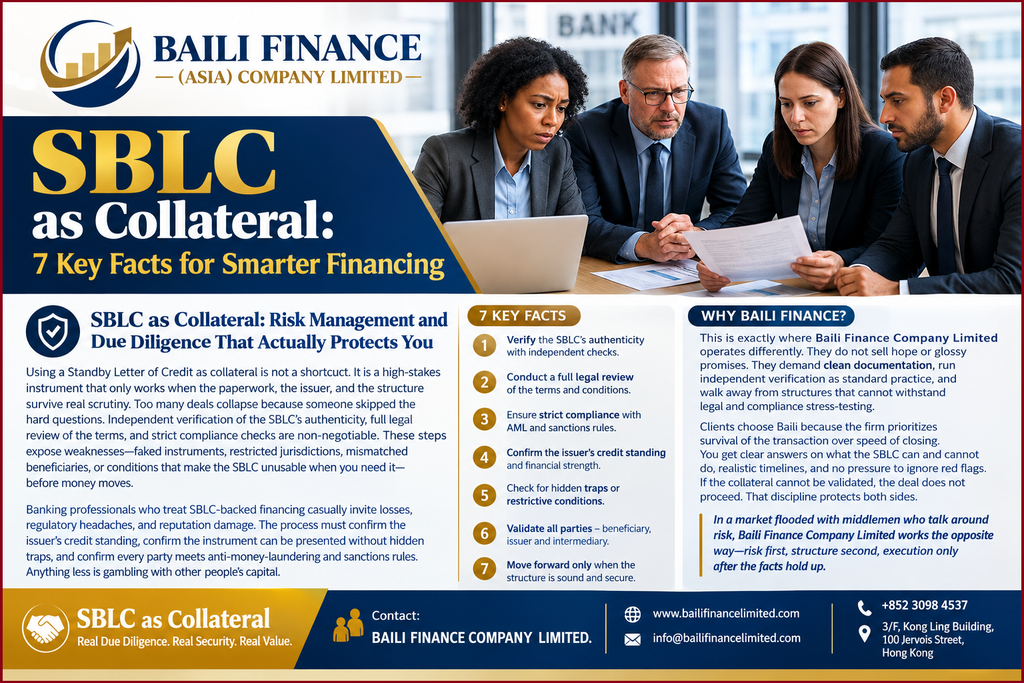
Legal and Regulatory Considerations
SBLC transactions involve more than the instrument itself. The parties must also consider the financing agreement, reimbursement arrangements, applicable law, compliance obligations, and the rights of each participant.
International Standby Practices (ISP98)
The International Chamber of Commerce publishes the International Standby Practices (ISP98), a set of rules designed for standby letters of credit and related independent undertakings.
When the SBLC expressly incorporates ISP98, those rules help govern its operation, subject to their terms and applicable law. They address matters including presentations, the issuer’s undertaking, amendments, and expiry.
Parties should not assume ISP98 applies automatically to every SBLC. They should confirm which rules the instrument incorporates and whether the wording modifies or excludes any provisions.
UCP 600 and demand guarantees
Depending on the transaction, parties may also consider the Uniform Customs and Practice for Documentary Credits (UCP 600) or the ICC’s Uniform Rules for Demand Guarantees (URDG 758).
These instruments serve related but distinct purposes. The appropriate framework depends on the legal form and commercial function of the undertaking.
Professional advice can help determine which rules suit the proposed arrangement.
Anti-money laundering and sanctions compliance
Banks and financial institutions apply relevant customer due-diligence, anti-money laundering, sanctions, and other regulatory requirements.
An SBLC transaction may require verification of beneficial ownership, the source of funds, the parties’ identities, the commercial purpose, and the underlying contracts.
Businesses should provide accurate information and allow adequate time for these checks.
Legal review before execution
Before proceeding, the parties should establish who holds the beneficiary rights, whether those rights can be assigned or transferred, how a claim must be presented, and which jurisdiction governs disputes.
Where the lender requires security over the SBLC or its proceeds, qualified counsel should confirm that the proposed structure creates the intended rights and complies with applicable law.
SBLC as Collateral: The Brutal Truth Businesses Must Face
Standby Letters of Credit (SBLCs) as collateral remain a core tool in trade finance, project guarantees, and liquidity management in 2025–2026. Demand is rising from emerging markets, tighter supply chains, and capital-efficiency pressure. Banks push digital and tokenized structures, but the fundamentals never changed: an SBLC is only as good as the issuing bank’s credit and the real collateral behind it. Default rates stay low (under 0.3% per ICC data), yet fraud is rampant.
Key Takeaways. A real SBLC is a bank’s irrevocable promise to pay if the applicant defaults. It is not an asset you buy, lease, or trade for profit. Legitimate use requires full bank underwriting, KYC/AML, and hard collateral—usually 20–100% cash or securities. Monetization means pledging a high-quality bank-issued SBLC to a licensed lender for a loan. Nothing more.
What a Business Must Know and How to Proceed
Start with a real commercial need: performance security, payment guarantee, or contract requirement. Approach your own relationship bank or a top-tier regulated bank. Expect rigorous due diligence, collateral lock-up, and fees of 1–4% annually. Timeline is weeks, not days. No underlying contract? No deal. Preserve cash by using the SBLC instead of depositing full amounts, but understand the bank can call the collateral if the beneficiary draws.
Fraud Reality Check – Spot It Fast
Most “SBLC as collateral” offers are scams. Red flags that kill the deal instantly:
- “Leased,” “rented,” or “monetized” SBLCs with no collateral required
- Upfront fees for “activation,” “compliance,” or “blocking”
- Promises of high returns, non-recourse cash, or secret trading platforms
- PDF “MT760” documents emailed by brokers instead of bank-to-bank SWIFT
- Long intermediary chains, NDAs before details, or name-dropping top banks without direct verification
- Instant issuance or no KYC
Verify every instrument directly with the issuing bank through official channels. If it sounds easy or profitable beyond risk, it is fraud. FBI, SEC, and regulators have warned for years: these programs do not exist.
Stay with regulated banks. Demand transparency. Anything else destroys capital.
How Baili Finance Limited Can Support Your Financing Enquiry
Businesses evaluating SBLC as collateral should begin with a clear description of their financing needs, the proposed instrument, and the intended transaction.
At Baili Finance Limited, prospective clients can make an enquiry to discuss their requirements and explore whether a suitable financial arrangement may be available.
The appropriate starting point is to prepare the information needed to assess the transaction, including:
- Financing requirement: The amount sought, the intended use of funds, and the preferred tenor.
- Instrument details: The proposed face value, currency, issuing institution, beneficiary, and expiry date, where available.
- Transaction purpose: The commercial contract, working-capital requirement, or financial obligation that the arrangement will support.
- Financial information: Relevant company financial statements, repayment projections, and supporting documentation.
- Timing: The proposed completion date and any contractual deadlines.
The feasibility of a transaction depends on its structure, due diligence, counterparty acceptance, and the applicable approval process. An initial enquiry should not be treated as confirmation of funding, an offer of credit, or a guarantee that a particular SBLC will qualify as collateral.
Frequently Asked Questions About SBLC as Collateral
1. Can an SBLC be used as collateral for a loan?
Yes, an SBLC may support a loan if the lender accepts the instrument and the documentation provides the necessary rights and protection. The lender evaluates the issuing bank, wording, expiry, legal enforceability, and borrower’s repayment capacity. Not every SBLC qualifies, and approval is never automatic.
2. How much can I borrow against an SBLC?
There is no universal advance rate. A lender may offer a facility below the SBLC’s face value, require additional security, or decline the transaction. The amount depends on the issuer’s creditworthiness, the instrument’s terms, the lender’s policies, and the overall financing risk.
3. Do I need cash collateral to obtain an SBLC?
Not necessarily. An issuing bank may require a cash deposit, other assets, an existing credit facility, or sufficient financial capacity. Requirements vary by bank and applicant. Businesses should confirm the issuing bank’s conditions before committing to transaction costs.
4. Can a third-party SBLC be used as collateral?
Potentially, but the lender must accept the proposed structure and verify that the relevant parties have the authority and legal rights needed to support it. The applicant, issuer, beneficiary, and borrower may be different parties. Their roles and obligations must be clearly documented.
5. How long does SBLC-backed financing take?
The timeframe varies according to the issuing bank’s procedures, the lender’s review, the transaction’s complexity, and the completeness of the documentation. Cross-border transactions may require additional authentication, compliance checks, legal opinions, or approvals. No fixed completion time should be assumed before the institutions review the proposal.
6. Can an SBLC guarantee a loan approval?
No. An SBLC can provide additional credit support, but the lender retains its own approval process. It may consider the borrower’s financial position, the issuer’s creditworthiness, the instrument’s enforceability, and the financing purpose. The presence of an SBLC does not oblige a lender to advance funds.
7. What is the difference between an SBLC and a bank guarantee?
Both instruments can support commercial or financial obligations, but their legal form, governing rules, and payment conditions may differ. An SBLC generally operates as an independent documentary undertaking. A demand guarantee may also operate independently, depending on its terms and applicable law. The instrument’s actual wording matters more than its label.
8. Can an SBLC be monetized?
The term SBLC monetization is used in the market to describe arrangements in which a party seeks financing against an SBLC or its associated rights. The term does not establish that the instrument has a readily available cash value or that a lender will accept it. Any proposed transaction requires independent verification, a defined financing structure, and appropriate due diligence.
9. What documents are required for SBLC-backed financing?
Requirements depend on the lender and the transaction. They may include company registration documents, ownership information, financial statements, the proposed SBLC text, underlying commercial contracts, evidence of the issuing bank, repayment projections, and legal documentation establishing the lender’s rights.
10. What happens if the borrower defaults?
The consequences depend on the loan agreement, the SBLC’s drawing conditions, the beneficiary’s rights, and applicable law. If the beneficiary can make a complying presentation, the issuer must assess it under the instrument’s terms and applicable rules. A successful drawing does not necessarily extinguish the borrower’s separate reimbursement or repayment obligations.
Conclusion: Make SBLC Collateral Part of a Defined Financing Strategy
Using an SBLC as collateral can provide an additional source of credit support for businesses seeking financing, managing international trade obligations, or structuring corporate transactions. However, its usefulness depends on the issuing bank, the instrument’s wording, the lender’s acceptance criteria, and the legal rights established by the transaction documents.
Businesses should focus on more than the face value of the standby letter of credit. They should confirm lender eligibility requirements, verify the instrument independently, assess all costs, establish the proposed security rights, and maintain a credible repayment plan.
The same principles apply whether the transaction involves working capital, project finance, cross-border trade, or another commercial requirement. Proper preparation can help businesses identify practical options and avoid arrangements that fail to meet their financing objectives.
For businesses considering SBLC-backed financing, the next step is to obtain a clear assessment of the proposed transaction before committing to issuance costs or contractual obligations.
Ready to explore your SBLC financing options?
Contact Baili Finance Limited to introduce your financing requirement, explain your intended use of the funds, and outline the SBLC structure you are considering. Provide the relevant transaction details so your enquiry can be assessed against the applicable requirements.
Do not rely on assumptions about collateral value or promises of guaranteed funding. Start with a properly documented enquiry and determine whether a suitable financing arrangement may be available for your business.
Make your next financing decision with a clear understanding of the instrument, the risks, and the requirements. Contact Baili Finance Limited to begin your enquiry.
Visit: https://www.
Intermediaries/Consultants/Brokers are welcome to bring their clients 100% protected. Our brokers receive 2% commission for referral. We assist Clients and brokers in their attempt to secure funding by working on their funding requests that may require innovative financing. In complete confidence, we will work together for the benefits of all parties involved.
#SBLC #SBLCAsCollateral #StandbyLetterOfCredit #TradeFinance #StructuredFinance #CorporateFinance #BusinessFinancing #InternationalTrade