Headline: SBLC Transaction Costs: 9 Bank Charges Explained
Understanding the cost of a Standby Letter of Credit (SBLC) is essential before entering an international trade finance transaction. SBLC transaction costs and bank charges can affect the total financing budget, contractual obligations, cash flow, and profitability of a commercial agreement. Whether a business needs an SBLC to support an international supply contract, secure a financial obligation, or strengthen its position in a cross-border transaction, understanding how banks calculate their fees helps prevent unexpected expenses.

A Standby Letter of Credit represents a bank’s independent payment undertaking, subject to its terms and applicable rules. It provides a beneficiary with a payment mechanism if the applicant fails to fulfil a specified obligation and the beneficiary presents a complying demand.
However, obtaining an SBLC involves more than paying a single issuance fee. Banks may charge issuance commissions, commitment fees, amendment fees, advising charges, confirmation commissions, SWIFT transmission costs, and other administrative expenses.
These charges depend on several factors, including the issuing bank, transaction value, validity period, applicant’s creditworthiness, collateral arrangements, country risk, and the nature of the underlying obligation.
For businesses considering this instrument, understanding the complete cost structure is essential. This guide examines the principal SBLC transaction costs, explains how banks calculate their charges, provides practical examples, and identifies the questions applicants should ask before committing to a transaction.
Keywords: SBLC Transaction Costs and Bank Charges, SBLC transaction fees, Standby letter of credit costs, SBLC issuance charges, SBLC bank commission, Standby letter of credit bank fees, SBLC pricing, SWIFT MT760 charges, SBLC confirmation fees, SBLC advising charges, SBLC collateral requirements, Cost of issuing an SBLC, International trade finance charges, How much does it cost to obtain an SBLC?, What are the bank charges for a standby letter of credit?, How do banks calculate SBLC issuance fees?, What is the SWIFT MT760 fee for an SBLC?, How much commission do banks charge for an SBLC?, What factors determine standby letter of credit costs?, Are SBLC bank charges calculated monthly or annually?, Who pays the bank charges for an SBLC transaction?, What documents are required to apply for an SBLC?, How can businesses reduce SBLC transaction costs?.
1. What Are SBLC Transaction Costs and Bank Charges?
SBLC transaction costs refer to the expenses associated with arranging, issuing, advising, maintaining, amending, confirming, and, where applicable, drawing against a Standby Letter of Credit.
Banks charge these fees because issuing an SBLC exposes them to a contingent financial obligation. Although the bank may not immediately transfer funds to the beneficiary, it undertakes to honour a complying demand under the instrument.
Consequently, the issuing bank assesses the applicant’s financial position, the proposed undertaking, the transaction structure, and the risks associated with potential payment.
Unlike an ordinary bank transfer, an SBLC transaction involves several parties and banking processes. Each participating institution may charge for the services it provides.
For example, an applicant requesting an SBLC may encounter:
- Issuance and commitment commissions.
- Credit assessment and processing fees.
- SWIFT MT760 transmission charges.
- Advising bank fees.
- Confirmation commissions.
- Amendment and extension charges.
- Collateral and security-related costs.
- Correspondent banking expenses.
- Legal documentation and compliance costs.
Importantly, not every transaction attracts every fee. The applicable charges depend on the agreed banking structure and the terms offered by the participating institutions.
2. The 9 Major SBLC Fees Every Applicant Should Know
Understanding individual bank charges makes it easier to calculate the actual cost of an SBLC transaction.
2.1. SBLC Issuance Fee
The issuance fee is one of the principal costs associated with obtaining a Standby Letter of Credit.
The issuing bank charges this commission for undertaking the payment obligation specified in the SBLC.
Banks generally calculate the issuance commission using the instrument’s face value, validity period, applicable commission rate, and minimum fee requirements.
For instance, a bank might calculate its issuance commission quarterly or annually. The applicable rate may also differ between financial and non-financial undertakings.
A financial SBLC that supports a repayment obligation may attract a different risk assessment from a performance-related SBLC.
Several factors influence the issuance fee:
- The face value of the SBLC.
- The requested validity period.
- The applicant’s credit history.
- The applicant’s available collateral.
- The issuing bank’s internal risk assessment.
- The beneficiary’s jurisdiction.
- The nature of the underlying transaction.
Applicants should request a written quotation showing the applicable rate, minimum commission, charging period, and payment schedule.
2.2. SBLC Commitment Fee
A commitment fee compensates a bank for making a credit facility or contingent exposure available to an applicant.
Depending on the bank’s product structure, this charge may apply while the SBLC remains outstanding.
The distinction between an issuance commission and a commitment fee matters. Some banks incorporate relevant exposure costs into one commission, while others may identify separate charges.
Therefore, applicants should establish whether the quoted issuance fee includes the commitment charge or whether the bank will debit it separately.
This distinction can materially affect the total cost of a long-term SBLC.
2.3. SWIFT MT760 Transmission Charges
SWIFT provides a secure messaging network through which financial institutions exchange authenticated financial messages.
In an SBLC transaction, banks commonly use the SWIFT MT760 message to issue a demand guarantee or Standby Letter of Credit.
The MT760 message carries information about the undertaking, including its reference, issue date, applicable rules, and relevant terms.
However, applicants should understand that SWIFT transmission and the underlying financial undertaking are different things.
A SWIFT transmission fee covers the bank’s messaging service. It does not represent the value of the SBLC, a payment guarantee, or proof that the applicant has secured an available credit facility.
Banks may charge separately for:
- Initial SWIFT transmission.
- Additional message pages.
- Amendments.
- Message investigations and tracing.
- Correspondent bank communications.
The official SWIFT MT760 Message Reference Guide provides technical information about the issuance of demand guarantees and standby letters of credit.
This is an important reference when assessing the operational component of SBLC transaction costs.
2.4. SBLC Advising Fees
An advising bank receives an undertaking from the issuing bank and advises it to the beneficiary.
The advising bank may examine the apparent authenticity of the received instrument and communicate its terms to the beneficiary.
It does not automatically assume the issuing bank’s payment obligation merely because it advises the SBLC.
The advising bank may charge an advising fee for this service.
The amount depends on its tariff, the transaction’s complexity, the beneficiary’s location, and any additional services requested.
Applicants should clarify whether the advising fee falls to them or the beneficiary under the agreed charges arrangement.
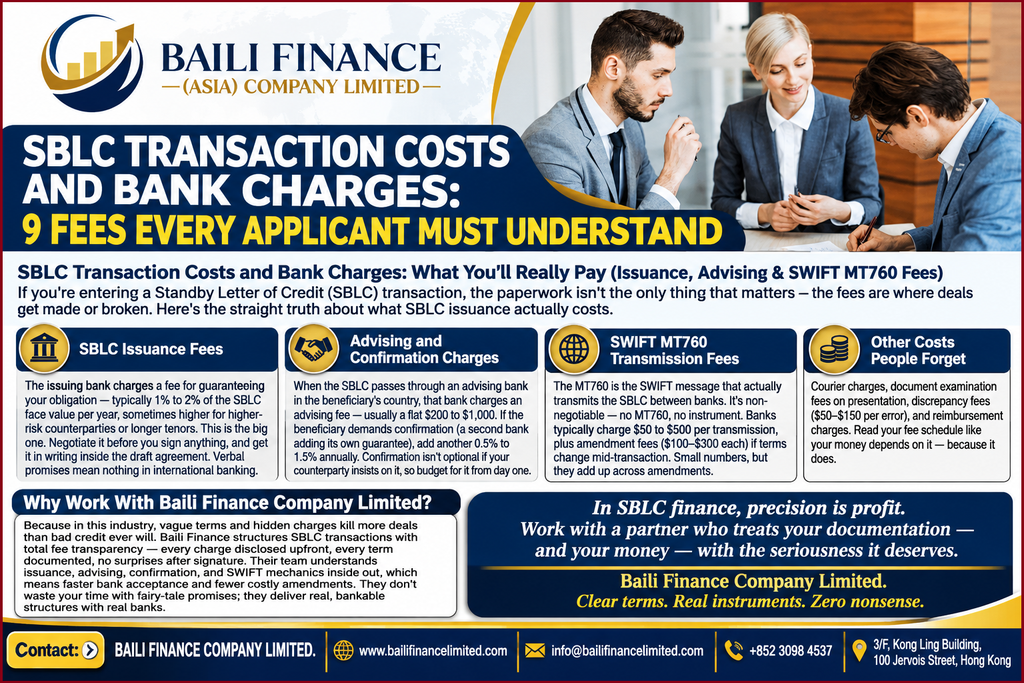
2.5. SBLC Confirmation Charges
Confirmation introduces an additional payment undertaking from a confirming bank.
Where a bank adds its confirmation, it undertakes to honour a complying presentation in accordance with the SBLC’s terms, subject to the applicable rules.
This additional undertaking can be important when the beneficiary has concerns about the issuing bank, country risk, or cross-border payment exposure.
However, confirmation usually introduces additional costs.
The confirming bank considers:
- The issuing bank’s credit standing.
- The issuing country’s political and economic conditions.
- The amount and tenor of the undertaking.
- The applicable governing rules.
- The confirming bank’s internal risk limits.
Confirmation commissions may therefore differ substantially between transactions.
Applicants should never assume that an advising fee includes confirmation. These are separate banking services with different responsibilities.
2.6. SBLC Amendment Fees
An amendment changes one or more terms of an existing SBLC.
For example, an applicant may request:
- An extension of the expiry date.
- An increase or reduction in the undertaking amount.
- A change to the beneficiary’s details.
- An adjustment to the presentation requirements.
- A modification to the underlying contractual reference.
Banks may charge a flat administrative fee for certain amendments. Changes affecting the amount or validity period may also attract additional commission.
An extension can be particularly important because it may increase the period during which the bank remains exposed to the undertaking.
Applicants should therefore review the expiry date and contractual requirements carefully before issuance.
2.7. Collateral and Cash Margin Costs
Collateral requirements can significantly influence the overall cost of an SBLC transaction.
Depending on the applicant’s financial position, the issuing bank may require cash collateral, a credit facility, a counter-guarantee, or another acceptable form of security.
A fully cash-collateralised SBLC may require the applicant to place funds under the bank’s control for the duration of the undertaking.
Although the applicant may recover eligible collateral after the bank releases its exposure, the funds may remain unavailable for other business activities.
This creates an opportunity cost.
For example, a business that places substantial cash collateral with a bank may have fewer funds available for inventory purchases, payroll, operational expenses, or other investments.
Applicants should distinguish between:
- The bank’s actual service charges.
- The collateral amount.
- The financing cost of obtaining collateral.
- The opportunity cost of restricted funds.
Collateral is not necessarily a bank fee. However, it remains a material part of the transaction’s economic cost.
2.8. Legal, Documentation and Compliance Fees
Banks must assess whether an SBLC transaction complies with their internal policies and applicable legal and regulatory requirements.
This process may involve customer due diligence, beneficial ownership verification, sanctions screening, transaction monitoring, credit assessment, and examination of supporting documents.
Some banks include these services within their standard administrative charges. Others may apply additional fees for legal review, non-standard wording, or external professional services.
Complex transactions may also require legal advice concerning governing law, jurisdiction, demand conditions, and enforceability.
Applicants should establish which professional and administrative expenses the quoted banking charges include.
2.9. Cancellation, Reduction and Release Fees
An applicant may request the cancellation or reduction of an SBLC before its original expiry date.
However, the bank cannot necessarily release its undertaking simply because the applicant no longer needs it.
The bank must follow the instrument’s terms and obtain any required beneficiary consent, original-document surrender, or other acceptable evidence of discharge.
Depending on the arrangement, the bank may charge an administrative fee for processing a cancellation, reduction, or release.
Before issuance, applicants should understand the conditions under which the bank can discharge its exposure and release any associated collateral.
3. How Do Banks Calculate SBLC Issuance Charges?
Banks use different pricing methods when calculating standby letter of credit fees. Understanding these methods helps applicants estimate their financial commitments before submitting an application.
The most common approaches include:
Percentage of the SBLC face value: The bank applies an agreed commission rate to the instrument’s amount.
Annual commission: The bank calculates the commission according to the annual exposure period.
Quarterly commission: The bank charges for each quarter or part of a quarter during which the undertaking remains outstanding.
Flat administrative fee: The bank applies a fixed charge for a particular service, such as advising, processing, or transmitting a message.
Risk-based pricing: The bank adjusts its pricing according to the applicant’s creditworthiness, collateral, issuing exposure, and other relevant risks.
Understanding an SBLC cost calculation
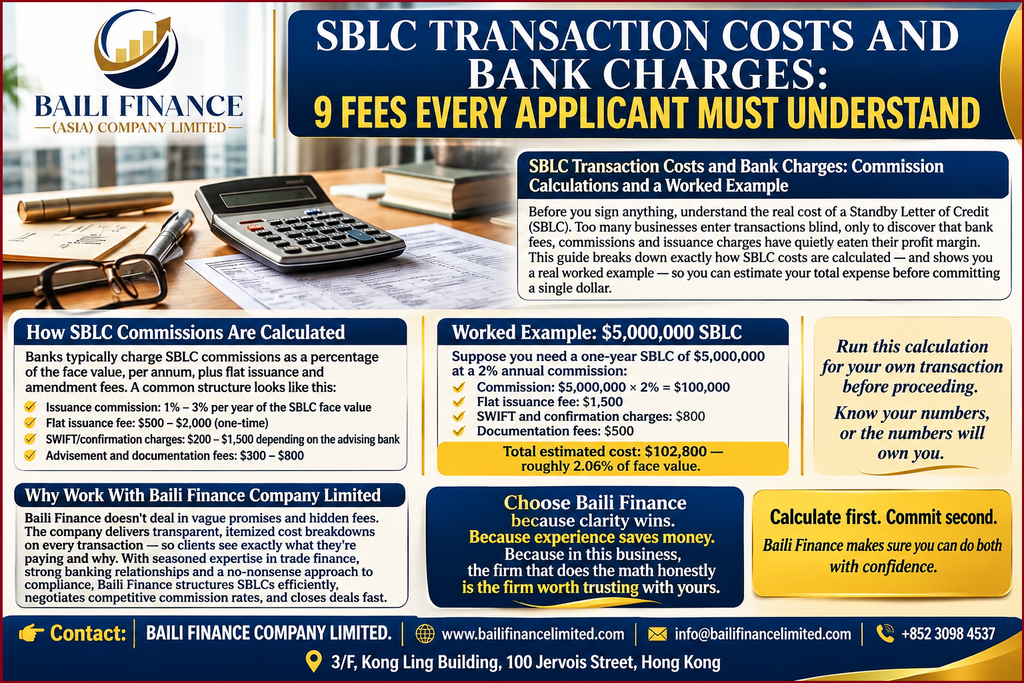
Consider a hypothetical transaction with the following details:
- SBLC face value: $2,000,000.
- Validity period: 12 months.
- Illustrative annual commission: 1.5%.
- Administrative and communication expenses: $400.
The annual issuance commission would be:
\[ \$2,000,000 \times 1.5\% = \$30,000 \]
Adding the assumed administrative and communication expenses:
\[ \$30,000 + \$400 = \$30,400 \]
Illustrative SBLC cost breakdown
SBLC face value
$2,000,000
Annual commission
$30,000
Other assumed charges
$400
Estimated transaction cost
$30,400
Illustrative calculation only. This is not a bank quotation or a published market rate. Actual pricing depends on the issuing bank and transaction structure.
The example demonstrates why applicants should request a complete quotation rather than rely on an advertised percentage alone.
For additional context, UOB’s published trade finance fee schedule illustrates how an established bank distinguishes between financial and non-financial standby issuance, amendments, advising, and communication charges. Its published Singapore-dollar tariffs are specific to that bank and should not be treated as universal market rates.
4. What Factors Influence SBLC Transaction Costs?
Two businesses requesting SBLCs with the same face value may receive different quotations. This happens because banks evaluate the complete transaction rather than simply applying one universal percentage.
The following factors commonly influence pricing.
4.1. Issuing Bank and Credit Rating
The issuing bank’s financial standing and creditworthiness influence the acceptability and pricing of its undertaking.
A beneficiary may prefer an SBLC issued by a bank with an established international correspondent network and a credit profile that meets its requirements.
However, a bank’s reputation alone does not determine the total cost. Its internal pricing policies, risk appetite, and available credit facilities also matter.
4.2. Transaction Amount
The face value represents the maximum amount available under the undertaking, subject to its terms.
Larger undertakings create greater potential exposure for the issuing bank. Consequently, the bank may require additional credit approval, collateral, or risk assessment.
Some institutions offer negotiated pricing for substantial transactions, but applicants shouldn’t assume that a larger amount automatically attracts a lower commission.
4.3. Validity Period
The SBLC’s validity period directly affects how long the issuing bank remains exposed.
A 12-month undertaking generally creates a different cost obligation from a three-year undertaking.
Automatic extension clauses can also affect pricing. Where the instrument contains an evergreen clause, the applicant should understand the notice requirements, renewal arrangements, and potential additional commissions.
4.4. Applicant’s Financial Standing
Banks assess the applicant’s financial capacity to reimburse the issuing bank if the beneficiary makes a complying demand.
The assessment may include:
- Audited financial statements.
- Cash flow projections.
- Existing credit facilities.
- Banking relationships.
- Corporate ownership information.
- Available collateral.
- Existing financial commitments.
A financially strong applicant may qualify for more favourable credit terms, subject to the bank’s approval.
4.5. Country and Jurisdiction Risk
International transactions may involve different legal systems, banking regulations, currency arrangements, and political conditions.
A bank may consider the issuing country, beneficiary’s jurisdiction, applicable sanctions, correspondent relationships, and relevant transfer restrictions.
These factors can affect both transaction approval and the applicable fees.
4.6. Type of Standby Letter of Credit
The underlying obligation also influences the bank’s assessment.
For example:
- A financial SBLC supports a monetary obligation.
- A performance SBLC supports contractual performance.
- An advance payment SBLC supports the proper accounting of an advance.
- A bid bond standby supports tender-related obligations.
- A commercial SBLC supports payment obligations associated with goods or services.
The ICC’s International Standby Practices (ISP98) reference explains these different standby classifications and the rules governing standby undertakings.
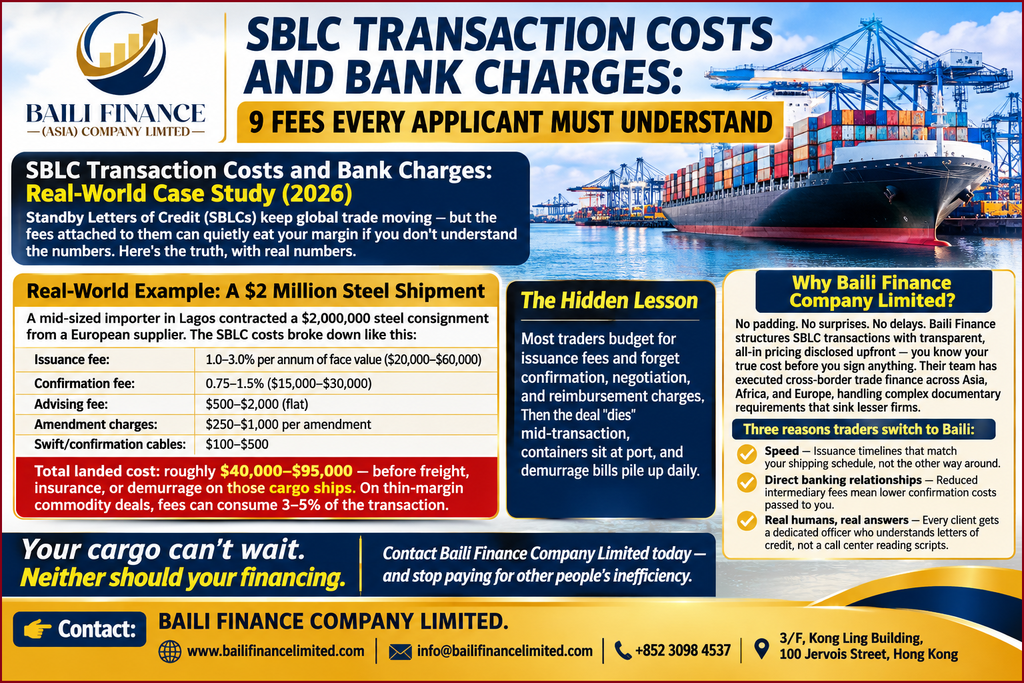
5. Real-World Example: Calculating the Cost of an International SBLC
Consider an international trading company that enters into a supply agreement with a manufacturer.
The manufacturer requires a standby letter of credit worth $5 million to support the buyer’s payment obligations.
The buyer approaches its bank and requests a 12-month financial SBLC.
Following its assessment, the bank offers the following hypothetical commercial terms:
| Cost component | Illustrative charge |
|---|---|
| SBLC amount | $5,000,000 |
| Annual issuance commission | 1.25% |
| Issuance commission | $62,500 |
| Advising fee | $250 |
| SWIFT and administration | $150 |
| Total estimated charges | $62,900 |
The calculation is:
\[ \$5,000,000 \times 1.25\% = \$62,500 \]
\[ \$62,500+\$250+\$150=\$62,900 \]
The buyer should also establish whether the bank requires cash collateral or another form of security.
If the bank requires 100% cash collateral, the buyer may need to restrict $5 million for the applicable period. That amount is not an additional transaction fee, but the restriction creates a financing and liquidity consideration.
Alternatively, if the bank approves a lower collateral requirement, the buyer may retain access to more working capital, subject to the facility’s conditions.
The commercial lesson: A business should evaluate both the direct SBLC bank charges and the economic cost of obtaining the instrument. Comparing only the issuance commission may produce an incomplete assessment.
6. Case Study: How an SBLC Applicant Can Control Transaction Expenses
The following case study is illustrative. It does not represent a verified Baili Finance Limited client transaction.
Background
An international trading company plans to enter a long-term supply agreement with an overseas supplier.
The supplier requires a $10 million financial undertaking to support the buyer’s contractual payment obligations.
The applicant initially focuses on the issuance commission. However, during the preliminary assessment, it identifies several additional cost considerations:
- The bank’s annual commission.
- The proposed validity period.
- The possibility of an extension.
- Cash collateral requirements.
- Advising and communication charges.
- The beneficiary’s requirements concerning the issuing bank.
- Potential amendment expenses.
The challenge
The applicant discovers that its initial cost estimate excludes several services that may become necessary before the transaction reaches completion.
Furthermore, the proposed SBLC wording contains provisions that require clarification.
The parties must also agree on the applicable rules, expiry arrangements, presentation requirements, and the allocation of bank charges.
The approach
Rather than proceeding with an incomplete cost estimate, the company adopts a structured assessment.
First, it identifies the beneficiary’s minimum banking requirements.
Second, it obtains a detailed breakdown of the issuing bank’s fees.
Third, it reviews the collateral requirements and their effect on available working capital.
Fourth, it examines the proposed SBLC wording to reduce the possibility of unnecessary amendments.
Finally, it establishes which party will bear the advising, confirmation, and other applicable banking expenses.
The outcome
This approach provides the applicant with a clearer understanding of the transaction’s financial commitments before proceeding.
It also helps the parties identify potential contractual disagreements and avoid budgeting based on incomplete information.
The central lesson is that effective SBLC cost management begins before issuance. Reviewing the structure, documentation, and banking requirements early can reduce avoidable administrative expenses and improve financial planning.
7. How to Reduce SBLC Transaction Costs Without Compromising Banking Requirements
Businesses should approach SBLC cost management through proper transaction planning rather than simply searching for the lowest advertised commission.
The following measures can help.
1. Compare complete banking quotations.
Request itemised quotations from eligible issuing banks. Compare issuance commissions, minimum fees, advising charges, amendment expenses, and collateral requirements.
2. Confirm the beneficiary’s requirements early.
Establish the acceptable issuing bank, required currency, amount, expiry date, governing rules, and wording before submitting the final application.
3. Negotiate the appropriate validity period.
Avoid requesting a longer validity period than the underlying commercial agreement requires. However, ensure that the proposed expiry date adequately protects the beneficiary.
4. Prepare accurate documentation.
Provide complete corporate, financial, contractual, and compliance documents. Missing information can delay the assessment and create additional processing requirements.
5. Review the SBLC wording before issuance.
Agree on material provisions in advance. This can reduce amendments caused by avoidable differences between the applicant’s and beneficiary’s requirements.
6. Understand collateral arrangements.
Compare the cost of cash collateral with other security arrangements that the issuing bank may accept.
7. Clarify the allocation of charges.
The applicant and beneficiary should agree on who pays issuance, advising, confirmation, and other relevant banking fees.
8. Avoid unnecessary intermediaries.
Every additional institution or service provider should have a clearly defined role. Verify the identity, authority, responsibilities, and compensation of any intermediary involved.
9. Verify the issuing process.
Confirm the bank’s issuance procedures and the authenticity of the relevant communications. A document described as an SBLC arrangement is not equivalent to an operative bank undertaking.
8. Understanding SBLC Rules, SWIFT and Banking Procedures
The cost of an SBLC should never be separated from its legal and operational structure.
An undertaking may incorporate ISP98, UCP 600, or another appropriate set of rules, depending on the transaction and the parties’ agreement.
The rules selected can influence documentary requirements, examination procedures, notices, and the rights and obligations of the parties.
For standby letters of credit, ISP98 provides a specialised framework. The International Chamber of Commerce’s discussion of ISP98 explains how it addresses standby practice and complements other trade finance rules.
Meanwhile, SWIFT MT760 serves as a banking communication format for issuing a demand guarantee or standby letter of credit.
Applicants should understand three important distinctions:
- A SWIFT message is a communication mechanism, not a financing facility.
- An issuance quotation is not proof that a bank has approved the application.
- A proposed SBLC draft is not the same as an issued and authenticated undertaking.
These distinctions are important when assessing transaction costs and avoiding misleading financial representations.
For additional technical information, consult the official SWIFT MT760 technical documentation.
9. Common Mistakes to Avoid When Paying SBLC Bank Charges
Although SBLCs can support international commercial transactions, applicants should exercise care when evaluating fees and proposed issuance arrangements.
Several mistakes can increase costs or expose businesses to unnecessary financial risks.
Mistake 1: Assuming Every Bank Uses the Same Fee Structure
Banks establish their own pricing policies. A commission quoted by one institution does not establish the rate that another institution must charge.
Always obtain a transaction-specific quotation.
Mistake 2: Paying Unverified Upfront Fees
Applicants should verify the identity of the receiving institution, the purpose of each charge, and the authority of the party requesting payment.
A request for an advance payment does not establish that a bank has approved or issued an SBLC.
Where possible, obtain written confirmation of the relevant bank charges directly from the responsible institution.
Mistake 3: Confusing SWIFT Charges With Issuance Fees
An MT760 transmission charge does not represent the cost of the bank’s financial undertaking.
These are separate components, and applicants should ensure that quotations distinguish between them.
Mistake 4: Ignoring Confirmation Costs
Some beneficiaries require confirmation from another acceptable bank.
This service introduces a separate undertaking and may create additional commissions. Applicants should establish this requirement before agreeing on the transaction budget.
Mistake 5: Overlooking Expiry and Extension Provisions
An SBLC that remains outstanding longer than anticipated may attract additional charges.
Review expiry dates, automatic extension provisions, cancellation procedures, and release requirements before issuance.
Mistake 6: Accepting Unclear Fee Agreements
Every party should understand its financial responsibilities.
Where possible, obtain an itemised breakdown identifying the payer, recipient, purpose, calculation method, currency, and payment date for each charge.
10. Why Professional SBLC Transaction Planning Matters
An SBLC is a financial undertaking, not simply a document that a business purchases.
Its successful implementation depends on the relationship between the applicant, issuing bank, beneficiary, advising bank, and any confirming or correspondent institution.
Consequently, proper planning should address the commercial objective, banking requirements, documentation, cost structure, and applicable legal framework.
For businesses operating across international markets, these considerations can determine whether an SBLC arrangement meets the beneficiary’s requirements and fits the applicant’s financial capacity.
At Baili Finance Limited, businesses can make enquiries about SBLC-related transaction requirements and the considerations involved in arranging an appropriate financial instrument.
Before proceeding, applicants should establish the exact services required, the participating institutions, applicable charges, and the conditions governing any proposed undertaking.
The objective should always be a properly structured transaction supported by clear documentation and verifiable banking procedures.
11. Frequently Asked Questions About SBLC Transaction Costs and Bank Charges
1. How much does it cost to obtain a Standby Letter of Credit?
The cost depends on the issuing bank, SBLC amount, validity period, applicant’s creditworthiness, collateral arrangements, and transaction requirements.
Banks may charge an annual or quarterly issuance commission, together with administrative, SWIFT, advising, or other applicable fees. There is no universal SBLC issuance rate.
The applicant should request a detailed quotation before proceeding.
2. What is the standard SBLC commission rate?
There is no single internationally applicable SBLC commission rate.
Individual banks establish their own pricing based on credit exposure, risk assessment, transaction structure, and internal policies.
Some calculate their commissions annually, while others use quarterly charging periods or a combination of percentage-based and flat fees.
A bank’s published tariff should therefore be treated as specific to that institution and its stated conditions.
3. Are SBLC fees calculated monthly, quarterly, or annually?
Banks use different charging arrangements.
Some charge an annual commission, others charge quarterly, and certain institutions apply minimum fees or charge for each quarter or part thereof.
The applicant should confirm the charging frequency, commencement date, renewal conditions, and whether the bank calculates fees on the full face value or outstanding amount.
4. What is the difference between an SBLC issuance fee and a SWIFT MT760 fee?
An SBLC issuance fee compensates the issuing bank for undertaking the financial obligation specified in the instrument.
A SWIFT MT760 fee relates to the banking communication used to issue the undertaking.
The issuance commission and SWIFT transmission charge are separate expenses, although a bank may include certain communication costs within a combined quotation.
5. Does an SBLC require 100% cash collateral?
Not necessarily.
Collateral requirements depend on the issuing bank’s credit assessment, the applicant’s financial position, the available credit facility, and the nature of the transaction.
Some banks may require full cash collateral, while others may accept partial collateral, other security, or an approved credit facility.
The applicant must obtain confirmation of the bank’s actual requirements.
6. Who pays the SBLC bank charges: the applicant or beneficiary?
The applicant commonly bears the issuance commission because it requests the bank to issue the undertaking.
However, the parties can agree on the allocation of advising, confirmation, amendment, and other transaction expenses.
The applicable charges arrangement should be established before issuance to avoid disagreements.
7. Are SBLC confirmation fees different from advising fees?
Yes.
An advising bank communicates an undertaking to the beneficiary and performs the relevant advising functions. A confirming bank adds its own payment undertaking, subject to the instrument’s terms.
Confirmation introduces additional credit exposure, which explains why its commission may be higher than a standard advising fee.
8. Does an SBLC attract additional charges when its validity period is extended?
An extension may attract additional commission because the bank continues to carry the relevant exposure for a longer period.
The bank may also charge an amendment fee.
The exact amount depends on its pricing arrangements, the extended validity period, and the revised terms.
9. Can an SBLC be cancelled before its expiry date?
Cancellation may be possible, but the issuing bank must follow the instrument’s terms and applicable rules.
Depending on the undertaking, the bank may require the beneficiary’s consent, a formal release, or other acceptable evidence that its obligations have ended.
The applicant should also confirm whether cancellation or release fees apply and when the bank will return eligible collateral.
10. What documents are required to apply for an SBLC?
Requirements vary between banks and transactions.
Commonly requested documents include:
- Certificate of incorporation or business registration.
- Corporate ownership and beneficial ownership information.
- Directors’ identification documents.
- Audited financial statements.
- Bank statements or financial references.
- Underlying commercial agreement.
- Beneficiary information.
- Requested SBLC amount and validity period.
- Proposed instrument wording, where available.
- Information about the source of funds and collateral.
Additional documents may be required following the bank’s compliance and credit assessment.
11. Is an SBLC the same as a bank guarantee?
They are related instruments, but they aren’t necessarily identical.
Both can support contractual or financial obligations. However, their legal structure, applicable rules, demand requirements, and treatment under relevant laws may differ.
An SBLC may be issued subject to ISP98 or UCP 600, while an independent demand guarantee may use URDG 758.
The parties should select the appropriate instrument based on the transaction and obtain suitable legal and banking advice.
12. Does paying SBLC transaction fees guarantee issuance?
No.
Paying an application, processing, or other fee does not automatically mean that a bank has approved or issued an SBLC.
Issuance remains subject to the institution’s credit approval, compliance checks, documentation requirements, and other applicable conditions.
Applicants should distinguish clearly between an application, an approval, a proposed instrument, and an authenticated issued undertaking.
12. Final Summary: Understand the Costs Before Arranging an SBLC
SBLC transaction costs and bank charges form an important part of international trade finance planning. Understanding these expenses helps businesses evaluate the financial implications of obtaining a Standby Letter of Credit and avoid incomplete transaction budgets.
The principal charges may include issuance commissions, commitment fees, SWIFT MT760 transmission expenses, advising fees, confirmation commissions, amendment charges, administrative costs, and collateral-related financing expenses.
However, the actual cost depends on the issuing bank, face value, validity period, applicant’s creditworthiness, collateral structure, and the requirements of the beneficiary.
For this reason, businesses should never rely exclusively on a quoted percentage when assessing the total cost of an SBLC.
Instead, request an itemised quotation, review the proposed instrument, verify the participating banks, establish the applicable rules, and understand every financial obligation before proceeding.
Most importantly, distinguish between a genuine bank undertaking and preliminary arrangements that have not received the necessary banking approval.
A well-planned SBLC transaction begins with financial clarity, proper documentation, and verified banking procedures.
Whether your business requires a financial standby letter of credit, performance SBLC, commercial undertaking, or assistance understanding the costs associated with an international trade finance arrangement, careful preparation remains essential.
Arrange Your SBLC Transaction With Greater Financial Clarity
Planning an SBLC Transaction? Start With the Right Information.

Ready to Structure Your SBLC Transaction? Talk to Baili Finance Limited Today.
Your Next SBLC Transaction Starts With the Right Financial Partner.
Don’t let unclear bank charges, unsuitable transaction structures, or incomplete documentation complicate your international trade finance plans.
Whether you’re seeking a Financial SBLC, Performance SBLC, Commercial SBLC, or another standby letter of credit arrangement, understanding the requirements and associated costs is the first step towards making an informed decision.
At Baili Finance Limited, we welcome enquiries from businesses, corporate applicants, and international trade professionals seeking information about SBLC transaction arrangements.
Let’s discuss your requirements.
Contact us to enquire about:
- SBLC transaction requirements and structuring.
- Applicable bank charges and issuance costs.
- Transaction documentation and procedures.
- Financial and performance standby requirements.
- International banking and trade finance arrangements.
Don’t commit to an SBLC transaction without understanding the costs, requirements, and banking procedures involved. Take the next step today.
Contact Baili Finance Limited Now.
Visit:www.
Visit Baili Finance Limited Copy SBLC Enquiry Message. All transactions remain subject to the relevant financial institution’s approval, due diligence, and applicable terms.
Don’t approach an SBLC transaction without understanding its complete financial requirements. Make an informed enquiry with Baili Finance Limited today.
Intermediaries/Consultants/Brokers are welcome to bring their clients 100% protected. Our brokers receive 2% commission for referral. We assist Clients and brokers in their attempt to secure funding by working on their funding requests that may require innovative financing. In complete confidence, we will work together for the benefits of all parties involved.
#SBLC #StandbyLetterOfCredit #TradeFinance #SBLCTransactionCosts #BankCharges #InternationalTrade #SWIFTMT760 #FinancialInstruments #BankGuarantee #CorporateFinance