Headline: SBLC Transaction Process: 9 Steps Explained
Introduction: Understanding the SBLC Transaction Process
International trade and cross-border commercial transactions often involve substantial financial commitments. Buyers, sellers, contractors, investors and financial institutions must manage payment obligations, contractual performance and counterparty risks across different jurisdictions. One financial instrument that supports these obligations is the Standby Letter of Credit (SBLC).
Understanding the SBLC transaction process is essential for businesses seeking to establish financial credibility, secure contractual commitments and manage international trade obligations. Whether a company needs a standby letter of credit to support a commercial agreement, secure a payment obligation or meet a contractual requirement, it must understand how banks assess applications, issue undertakings and handle beneficiary claims.
An SBLC is an independent bank undertaking issued at the request of an applicant in favour of a beneficiary. It provides financial protection if the applicant fails to fulfil specified contractual or payment obligations. Unlike an ordinary commercial letter of credit, which generally serves as a primary payment mechanism, an SBLC typically functions as a secondary payment instrument. The beneficiary may demand payment when the applicant fails to meet the conditions established in the instrument.
However, the transaction involves more than submitting an application and receiving a bank document. It requires appropriate structuring, due diligence, credit assessment, documentation, compliance checks, issuance and authentication.
This guide explains the complete standby letter of credit transaction process, from the initial commercial agreement to issuance, verification, potential presentation and eventual expiry or cancellation. It also examines the responsibilities of the participating parties, common transaction risks, practical examples and frequently asked questions.
Keywords: Standby Letter of Credit Process, SBLC Issuance Process, How Does an SBLC Work?, SWIFT MT760 Process, SBLC Application Requirements, International SBLC Transactions, SBLC Bank Verification Process, SBLC Transaction Procedure, How to Apply for a Standby Letter of Credit, Step-by-Step SBLC Transaction Process, How Banks Issue Standby Letters of Credit, Documents Required for SBLC Issuance, How to Verify an SBLC Through SWIFT MT760, How Long Does an SBLC Transaction Take?, What Happens After an SBLC Is Issued?, SBLC Transaction Costs and Bank Charges, Difference Between SBLC and Bank Guarantee
1. What Is a Standby Letter of Credit (SBLC)?
A Standby Letter of Credit is a financial undertaking issued by a bank or another eligible financial institution to protect a beneficiary against a defined failure by the applicant.
The applicant requests the instrument, while the issuing bank evaluates the application and decides whether it can accept the associated financial exposure.
Once issued, the SBLC establishes an independent obligation. The issuing bank must honour a complying demand presented under the instrument, subject to its terms, applicable rules and governing law.
For example, a buyer may enter into a supply agreement with an international manufacturer. The manufacturer may require an SBLC to secure the buyer’s payment obligations. If the buyer defaults and the manufacturer makes a compliant demand under the SBLC, the issuing bank must examine the presented documents and honour the demand if they satisfy the instrument’s requirements.
The SBLC therefore provides an additional source of payment security.
Main Characteristics of an SBLC
An SBLC generally has the following characteristics:
- Independent undertaking: The issuing bank’s obligation operates independently of the underlying commercial contract, subject to applicable law.
- Documentary requirement: The beneficiary must present the documents specified in the SBLC.
- Defined validity period: The instrument establishes an expiry date or another permitted termination mechanism.
- Specified financial amount: The issuing bank undertakes to pay up to the amount stated in the instrument.
- Identified beneficiary: The undertaking names the party entitled to make a complying demand.
- Applicable rules: The instrument identifies the rules governing its operation, where applicable.
The International Chamber of Commerce (ICC) developed the International Standby Practices 1998 (ISP98) specifically for standby letters of credit.
Businesses can consult the official ICC resource on International Standby Practices ISP98 to understand the rules governing standby instruments.
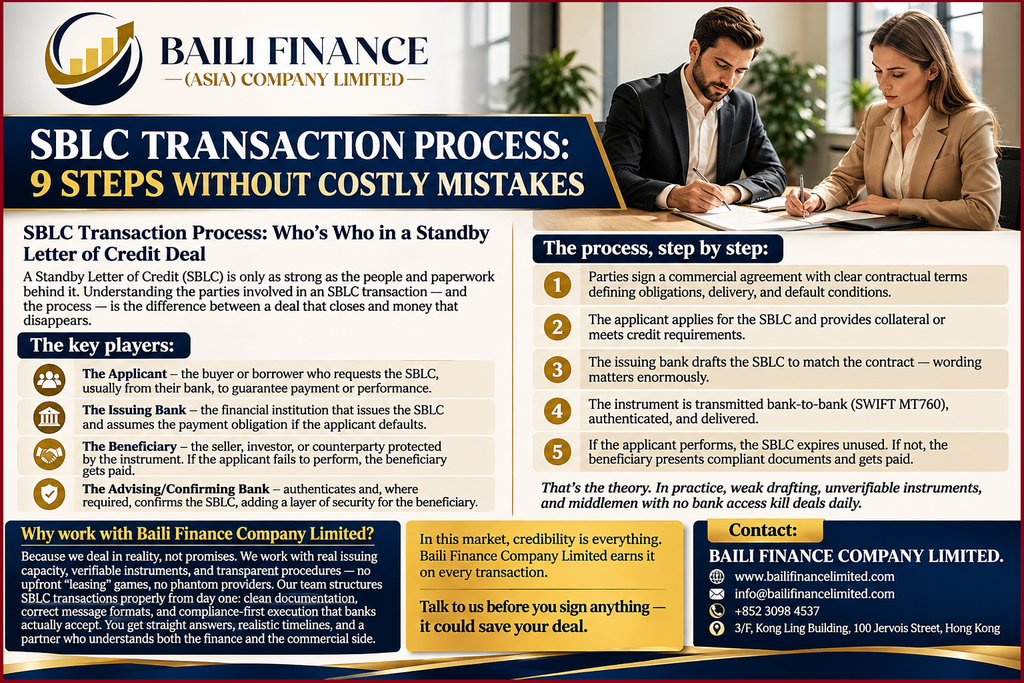
2. Parties Involved in an SBLC Transaction
Before examining the SBLC issuance process, businesses should understand the responsibilities of each participant.
Although transaction structures vary, the following parties commonly participate.
2.1 Applicant
The applicant is the individual or company requesting the SBLC.
Usually, the applicant has an existing contractual obligation to another party. The applicant approaches its banking institution to arrange an SBLC in favour of the beneficiary.
The applicant must provide the required corporate information, financial statements, transaction details and supporting documentation.
It also remains responsible for its reimbursement obligations to the issuing bank.
2.2 Beneficiary
The beneficiary is the party receiving the financial protection provided by the SBLC.
For example, a supplier may require an SBLC from a buyer before agreeing to manufacture and deliver goods.
The beneficiary should review the proposed wording, amount, expiry date, applicable rules and presentation requirements before accepting the instrument.
2.3 Issuing Bank
The issuing bank is the financial institution that creates and assumes the independent undertaking.
It assesses the applicant’s creditworthiness, conducts compliance checks and determines whether the transaction meets its internal requirements.
The issuing bank carries the primary obligation to honour a complying demand under the SBLC.
2.4 Advising Bank
An advising bank communicates the SBLC to the beneficiary on behalf of the issuing bank.
Its responsibility generally includes checking the apparent authenticity of the received instrument and accurately advising its contents.
An advising bank does not automatically assume the issuing bank’s payment obligation.
2.5 Confirming Bank
Where additional protection is required, the beneficiary may request confirmation from another bank.
A confirming bank adds its own independent undertaking to honour a complying presentation, subject to the terms of its confirmation.
Confirmation can be particularly relevant when the beneficiary has concerns about the issuing bank’s country risk, credit standing or payment jurisdiction.
2.6 Financial Consultants and Transaction Facilitators
Financial consultants and transaction facilitators may assist businesses with transaction preparation, documentation coordination, communication and identifying appropriate banking channels.
However, their involvement does not automatically create a banking obligation.
Only the institution actually issuing the SBLC assumes the issuing bank’s undertaking. Businesses should therefore distinguish between advisory services, financial intermediation and regulated banking activities.
3. The Complete SBLC Transaction Process: Nine Essential Steps
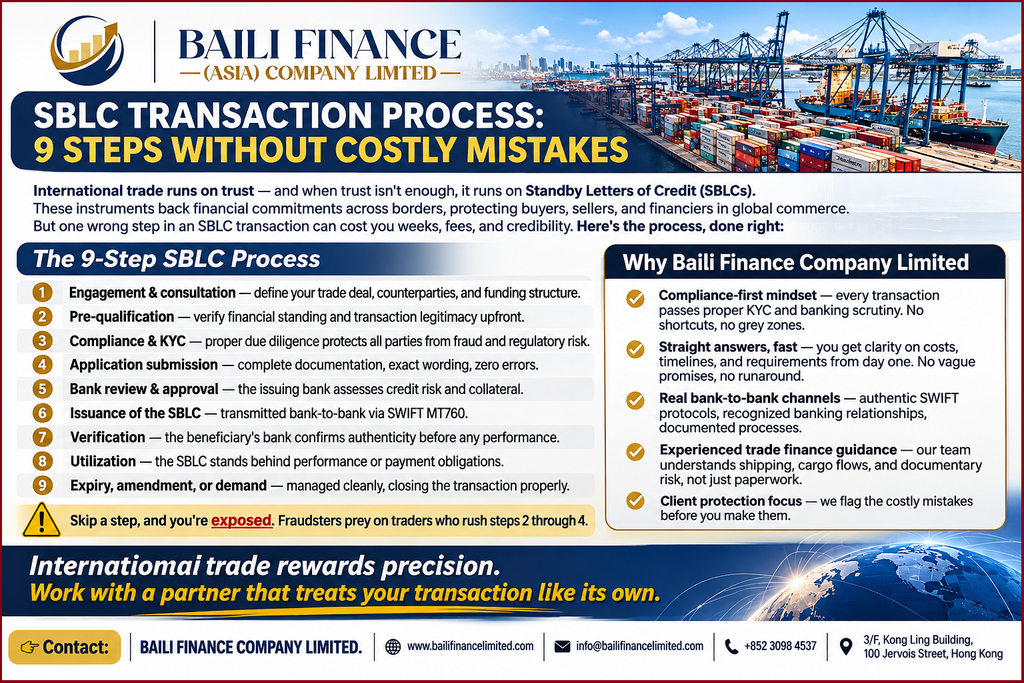
The SBLC transaction process follows several stages. Although individual banks may apply different procedures, the following framework explains the typical transaction from initial assessment to final issuance.
Step 1: Establish the Underlying Commercial Agreement
The process normally begins when two parties enter into a commercial arrangement requiring financial security.
The agreement may involve:
- International supply contracts.
- Import and export transactions.
- Construction and infrastructure projects.
- Payment obligations.
- Advance payment protection.
- Performance commitments.
- Long-term commercial agreements.
At this stage, the parties determine whether an SBLC provides the appropriate protection.
They should establish the required amount, currency, validity period, beneficiary details and circumstances under which the beneficiary may demand payment.
For example, an international supplier may require a buyer to provide a USD 5 million payment standby before commencing production.
The commercial agreement should clearly explain the purpose of the instrument and its relationship to the underlying obligation.
A properly structured agreement reduces the likelihood of disputes during the issuance and presentation stages.
Step 2: Select an Appropriate Issuing Bank
After establishing the commercial requirement, the applicant identifies a bank capable of issuing the requested SBLC.
Bank selection requires careful consideration.
The applicant should examine:
- The institution’s regulatory status.
- Its capacity to issue standby instruments.
- Its international banking relationships.
- Its credit standing.
- Its acceptance by the beneficiary.
- Its operational ability to transmit the instrument through an agreed banking channel.
The beneficiary may specify acceptable issuing banks or establish minimum credit-rating requirements.
Where the transaction involves multiple jurisdictions, the parties should also consider applicable banking regulations, sanctions requirements and legal restrictions.
Importantly, the applicant should verify that the proposed issuing institution can actually undertake the transaction rather than relying solely on statements from an intermediary.
Step 3: Prepare the SBLC Application
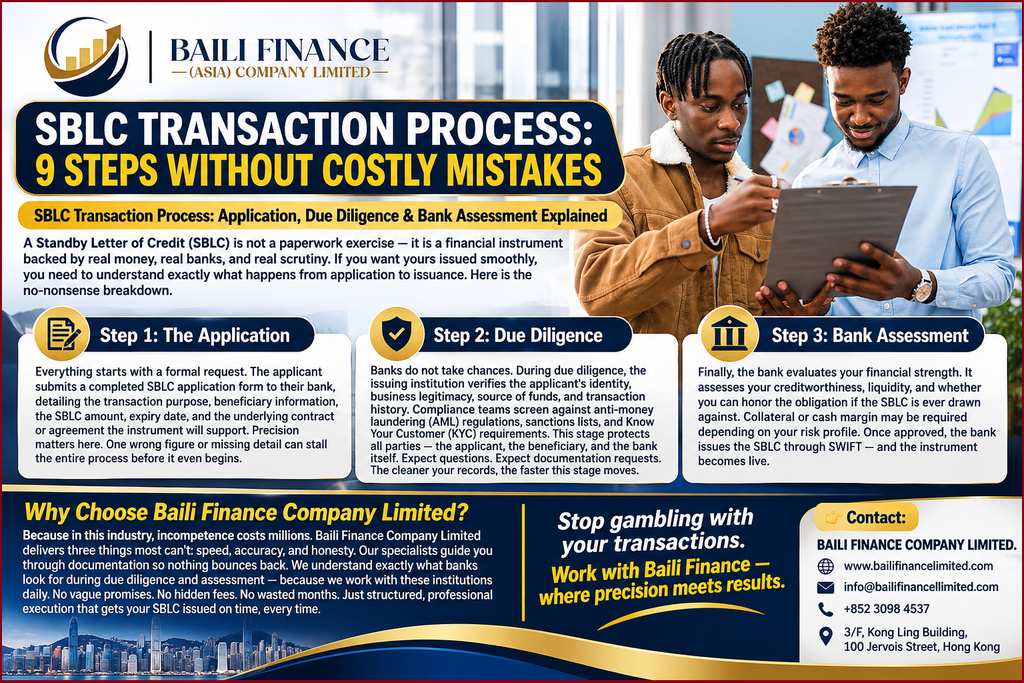
Once the applicant identifies a suitable issuing bank, it submits an application.
The bank generally requests information about the applicant, beneficiary and underlying transaction.
Typical documentation may include:
- Completed SBLC application form.
- Certificate of incorporation or equivalent registration documents.
- Corporate ownership and beneficial ownership information.
- Directors’ identification documents.
- Financial statements.
- Bank account information.
- Underlying commercial agreement.
- Beneficiary details.
- Proposed SBLC wording.
- Source-of-funds and transaction-related information, where required.
The bank may request additional documents depending on the applicant’s jurisdiction, transaction size, business activities and risk profile.
Documentation must be accurate and consistent.
Differences between the applicant’s corporate records, contractual information and banking instructions can delay the assessment.
Step 4: Bank Due Diligence and Credit Assessment
The issuing bank conducts its internal assessment before approving the proposed SBLC.
This is one of the most important stages in the SBLC transaction process.
The bank evaluates whether the applicant can meet the financial and contractual obligations associated with the requested facility.
Its assessment may include:
Creditworthiness: The bank reviews the applicant’s financial position, repayment capacity, liabilities and available credit facilities.
Know Your Customer (KYC): The bank verifies the identity of the applicant, directors, shareholders and beneficial owners.
Anti-Money Laundering (AML): The institution examines the transaction’s economic purpose, source of funds and relevant financial activities.
Sanctions screening: The bank checks the parties, jurisdictions and relevant counterparties against applicable sanctions restrictions.
Transaction assessment: The bank reviews the underlying contract, commercial rationale, beneficiary information and proposed SBLC terms.
Collateral assessment: Depending on the applicant’s credit profile and the bank’s policies, the institution may require cash collateral, security, an approved credit facility or another acceptable form of support.
An application does not guarantee approval.
The issuing bank retains discretion to decline a transaction that fails its credit, compliance or internal risk requirements.
Step 5: Agree on the SBLC Terms and Conditions
Following the initial assessment, the parties and the issuing bank work towards an acceptable SBLC structure.
The wording requires careful review because the bank’s obligation depends on the instrument’s actual terms.
Important provisions include:
- Applicant’s legal name.
- Beneficiary’s legal name.
- SBLC amount and currency.
- Issue date.
- Expiry date.
- Place of presentation.
- Method of presentation.
- Documents required for a demand.
- Applicable rules.
- Governing law and jurisdiction.
- Reduction or extension provisions, where applicable.
- Amendment and cancellation requirements.
The parties should pay particular attention to the demand conditions.
If the beneficiary must submit a signed demand and a statement declaring that the applicant has failed to perform a specified obligation, the instrument should explain those requirements clearly.
Ambiguous wording can create unnecessary disputes and increase the risk of a non-complying presentation.
The parties should obtain appropriate legal and banking advice before accepting the final wording.
Step 6: Issuing Bank Approval and Fee Settlement
Once the bank completes its assessment and accepts the proposed terms, it proceeds with its internal approval and issuance arrangements.
Depending on the facility, the applicant may need to:
- Execute the bank’s facility documentation.
- Provide agreed collateral.
- Sign reimbursement agreements.
- Pay arrangement or issuance fees.
- Satisfy outstanding compliance requirements.
- Complete any required account or credit-facility formalities.
SBLC fees are not universal.
They depend on factors such as the issuing institution, amount, currency, tenor, applicant credit profile, collateral structure and transaction complexity.
Applicants should obtain an official fee schedule or written quotation directly from the relevant institution.
They should also establish whether the bank charges issuance, amendment, advising, confirmation, collateral or other applicable fees.
No applicant should assume that payment of an intermediary’s service fee guarantees bank approval or issuance.
Step 7: SBLC Issuance Through the Appropriate Banking Channel
After satisfying its approval and issuance requirements, the issuing bank prepares and issues the SBLC.
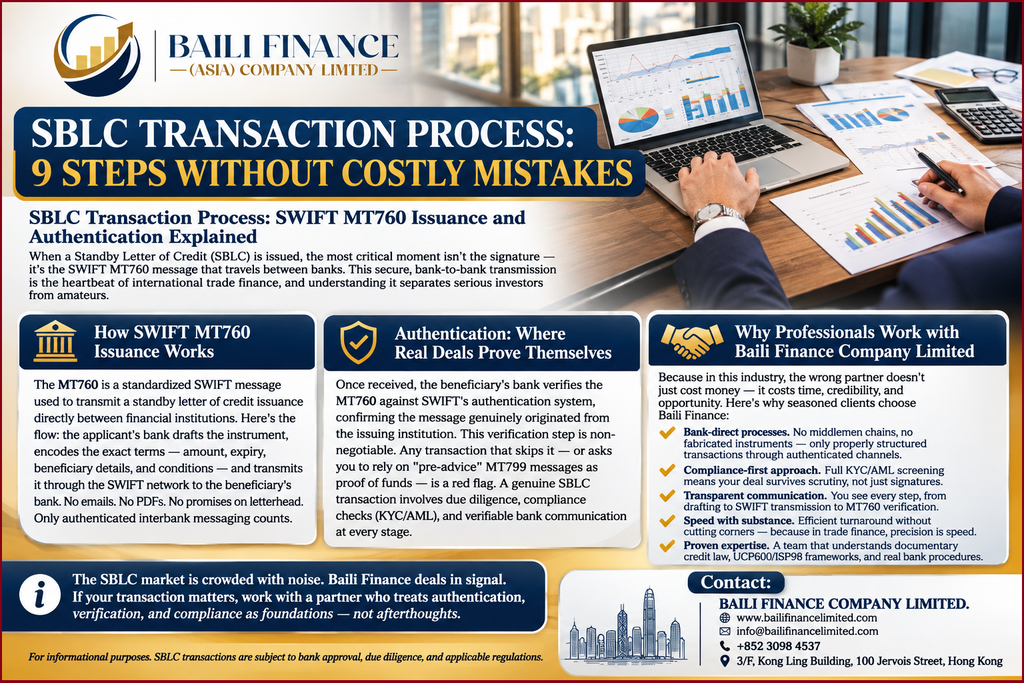
In many international transactions, the bank uses the SWIFT financial messaging network to transmit the undertaking.
One commonly used message type is SWIFT MT760, which supports the issuance of a demand guarantee or standby letter of credit.
Depending on the transaction structure, the issuing bank may transmit the instrument directly to the beneficiary’s bank or through another designated advising institution.
The receiving bank then handles the advising process.
The SWIFT message must contain the relevant undertaking information, including the instrument’s reference, issue date, applicable rules, expiry information and other required terms.
For technical reference, consult the official SWIFT Category 7 Standards documentation, which covers documentary credits, guarantees and standby letters of credit.
An important distinction exists between a SWIFT message and a screenshot, draft or purported pre-advice.
A screenshot of an MT760, a PDF claiming to represent an issued SBLC or a message copied into an email does not independently establish that the issuing bank has transmitted an authentic operative undertaking.
The relevant receiving bank should authenticate and advise the instrument through its established procedures.
Step 8: Advising, Authentication and Beneficiary Verification
Once the advising bank receives the instrument, it follows its procedures to establish the apparent authenticity of the message and advise the beneficiary.
The beneficiary should then review the instrument carefully.
Key verification points include:
- Does the instrument identify the correct issuing bank?
- Does the beneficiary’s legal name match its corporate records?
- Is the amount correct?
- Is the currency correct?
- Does the expiry date meet the commercial agreement?
- Are the demand conditions clear?
- Does the instrument refer to the agreed applicable rules?
- Is the presentation location practical?
- Does the instrument contain the agreed amendments and conditions?
The beneficiary should also ensure that its bank can receive and process the undertaking.
Where discrepancies exist, the parties should address them through the appropriate banking channels.
A genuine SBLC should be verified through the banks involved rather than through telephone numbers, email addresses or contact details supplied solely by an unverified intermediary.
Step 9: Monitoring, Presentation, Expiry and Closure
Issuance does not necessarily mean that the transaction has ended.
The applicant must continue meeting its underlying obligations, while the beneficiary retains the protection established by the instrument.
If the applicant performs its obligations, the beneficiary normally has no reason to make a demand.
However, if a defined default occurs, the beneficiary may present a demand in accordance with the SBLC.
The issuing bank examines the documents against the instrument’s requirements and applicable rules.
If the presentation complies, the bank honours the demand according to the instrument’s terms.
If the presentation does not comply, the bank may reject it, subject to applicable rules and law.
Where the underlying obligations have been completed, the parties should follow the instrument’s terms concerning expiry, release or cancellation.
An SBLC does not automatically become cancellable merely because the applicant requests its termination. The applicable rules, undertaking wording and beneficiary’s rights must be respected.
4. Understanding the Role of SWIFT MT760 in an SBLC Transaction
The SWIFT MT760 message plays an important role in many international standby transactions.
It provides a structured bank-to-bank messaging format for issuing a demand guarantee or standby letter of credit.
It can also support the transmission of counter-undertakings in relevant transaction structures.
However, businesses must understand what MT760 does and does not represent.
What MT760 Actually Does
An MT760 enables the issuing institution to transmit the relevant undertaking information through the SWIFT network.
It provides structured fields for information such as:
- Undertaking reference number.
- Date of issuance.
- Form of undertaking.
- Applicable rules.
- Expiry arrangements.
- Amount and currency.
- Beneficiary information.
- Presentation requirements.
- Additional undertaking conditions.
The actual message structure depends on the applicable SWIFT standards and the transaction.
MT760 Is Not the Same as an SBLC Draft
A draft is a proposed instrument that has not necessarily been issued.
A pre-advice may communicate an intention or preliminary information, depending on its wording.
An MT760, when properly issued as an operative undertaking, communicates the undertaking through the relevant banking channel.
Businesses should therefore avoid treating draft documents, screenshots, email attachments and unverified message copies as equivalent to an authenticated bank-issued instrument.
The receiving bank’s authentication and advising procedures remain essential.
5. Types of SBLC Transactions and Their Commercial Applications
Different businesses use standby letters of credit for different financial purposes.
The appropriate structure depends on the underlying obligation.
5.1 Financial Standby Letter of Credit
A financial SBLC supports payment obligations.
For example, a company may obtain a financial standby to secure repayment obligations under a financing agreement.
If the applicant fails to pay as required, the beneficiary may make a demand under the instrument.
5.2 Performance Standby Letter of Credit
A performance SBLC supports contractual performance.
A project owner may require a contractor to provide an SBLC to secure the contractor’s performance obligations.
The instrument can provide financial recourse if the contractor fails to meet the specified contractual requirements.
5.3 Advance Payment Standby Letter of Credit
An advance payment SBLC protects a party that pays money before receiving the corresponding goods or services.
For example, a manufacturer may request an advance payment to purchase raw materials.
The buyer may require a standby instrument to protect the advance if the supplier fails to fulfil the agreed obligations.
5.4 Bid Bond or Tender Standby
A standby instrument may support a bidder’s obligations during a procurement process.
It can provide protection against specified failures, such as a bidder refusing to honour its tender commitments where the instrument covers that event.
5.5 Direct-Pay Standby
A direct-pay SBLC supports a payment arrangement in which the instrument may serve as a payment mechanism under the stated conditions.
Its operation depends on the actual wording and applicable rules.
These categories describe commercial functions. The legal effect of an SBLC always depends on its specific terms, applicable rules and governing law.
6. Real-World Example: How an SBLC Transaction Works
Consider an international manufacturing transaction between two companies.
A European industrial equipment supplier agrees to deliver production machinery to an overseas buyer.
The contract has a total value of USD 8 million. However, the supplier wants additional payment security before committing resources to manufacture and deliver the equipment.
The parties agree that the buyer will arrange a USD 2 million financial SBLC to support a specified payment obligation.
The transaction proceeds as follows.
First, the commercial agreement is signed.
The buyer and supplier establish the contractual payment schedule and agree on the SBLC requirements.
Second, the buyer approaches its bank.
The buyer submits the commercial agreement, company documents, financial information and proposed SBLC wording.
Third, the bank conducts due diligence.
The issuing institution evaluates the buyer’s financial capacity, ownership structure, source of funds and transaction details.
Fourth, the parties approve the wording.
The beneficiary reviews the proposed amount, validity period, demand conditions and applicable rules.
Fifth, the bank approves and issues the instrument.
After completing its internal requirements, the bank transmits the undertaking through the agreed banking channel.
Sixth, the beneficiary’s bank authenticates and advises the SBLC.
The supplier reviews the advised instrument and confirms that it meets the agreed contractual requirements.
Finally, the commercial transaction continues.
The supplier manufactures and delivers the equipment.
If the buyer fulfils its payment obligations, the beneficiary does not need to draw on the SBLC. If a covered default occurs, the supplier may submit a complying demand within the instrument’s validity period.
This example demonstrates how an SBLC can support an international commercial agreement without replacing the underlying contract.
7. Illustrative Case Study: Managing an SBLC Issuance Transaction
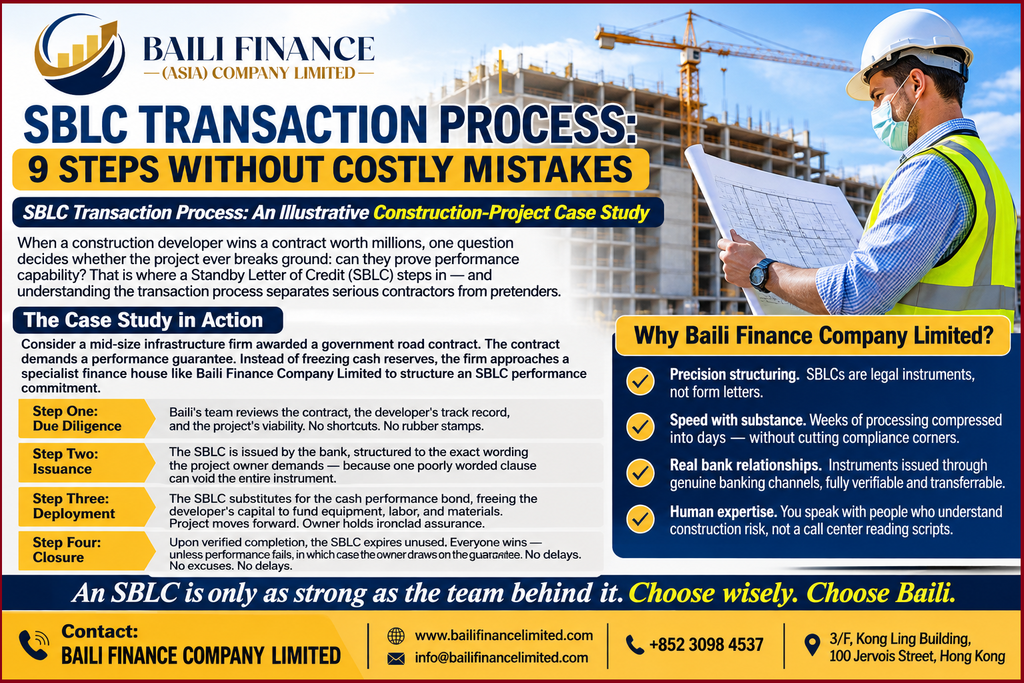
The following case study is hypothetical. It illustrates a typical transaction structure and does not represent a verified client transaction or a confirmed issuance by Baili Finance Limited.
Background
An international construction company enters into an agreement with an infrastructure developer to undertake a project valued at USD 25 million.
The developer requires a performance-related financial undertaking before granting the contractor full operational access to the project.
The contractor considers an SBLC as a suitable instrument to satisfy the contractual requirement.
However, the initial proposed structure contains several issues:
- The proposed issuing bank has not been accepted by the beneficiary.
- The draft SBLC contains unclear demand conditions.
- The expiry date does not provide sufficient time for the contractual performance period.
- The beneficiary’s required presentation location has not been confirmed.
- The contractor has not completed its banking documentation.
Transaction Preparation
The contractor reviews the underlying agreement and obtains clarification from the developer regarding the required instrument.
The parties then establish the amount, beneficiary details, expiry arrangements and applicable rules.
The contractor approaches its banking institution and provides the requested corporate and financial documents.
The bank conducts its credit and compliance assessment.
During the review, the proposed SBLC wording is revised to address the beneficiary’s presentation requirements and the contractual performance conditions.
Issuance and Verification
Following the bank’s approval, the applicant completes the required facility documentation and satisfies the agreed issuance conditions.
The issuing bank then transmits the SBLC through the appropriate banking channel.
The beneficiary’s bank authenticates and advises the instrument.
The developer checks the final terms against the project agreement and confirms that the instrument meets its requirements.
Outcome
The contractor satisfies the financial security requirement and proceeds with the project.
The case illustrates why transaction preparation, bank selection, documentary accuracy and beneficiary review matter.
It also demonstrates that a successful SBLC transaction depends on more than obtaining a document. The instrument must meet the underlying commercial requirement and satisfy the relevant banking and legal conditions.
8. Common Mistakes to Avoid During the SBLC Transaction Process
Businesses can reduce transaction delays and financial exposure by addressing common mistakes before submitting an application.
1. Selecting an Unacceptable Issuing Bank
A beneficiary may reject an SBLC from an institution that does not meet its credit or banking requirements.
Confirm the beneficiary’s acceptable issuing-bank criteria before proceeding.
2. Using Incomplete or Inconsistent Documentation
Incorrect company names, outdated registration records and inconsistent contractual details can delay bank assessment.
Review every document before submission.
3. Ignoring the SBLC Wording
The wording determines the bank’s undertaking and the conditions for making a demand.
Do not approve an instrument without reviewing its provisions carefully.
4. Confusing MT760 With Proof of Authenticity
A copied message or screenshot is not a substitute for bank-to-bank authentication.
Always use the receiving bank’s established verification process.
5. Overlooking Expiry and Presentation Requirements
An otherwise valid demand may encounter problems if the beneficiary misses the expiry deadline or fails to comply with presentation requirements.
Establish these details before issuance.
6. Assuming Every SBLC Can Be Monetised or Transferred
Not every standby instrument supports transfer, assignment or monetisation.
These activities depend on the actual instrument, applicable law, banking policies and the willingness of the relevant financial institution.
Businesses should never rely on unsupported claims of guaranteed monetisation or automatic financing.
7. Paying Unverified Intermediaries
Verify the identity, authority and contractual role of every service provider.
Confirm bank fees directly with the relevant institution and document all professional service arrangements.
9. How Long Does the SBLC Transaction Process Take?
There is no universal issuance timeline.
The duration depends on the issuing bank, applicant’s financial profile, transaction structure, documentation quality and regulatory requirements.
A straightforward application from an established banking customer may progress more efficiently than a complex international transaction involving multiple institutions and jurisdictions.
The following stages commonly influence the timeline:
| Transaction stage | Main timing factor |
|---|---|
| Initial assessment | Availability of transaction information |
| Application | Completeness of documents |
| Due diligence | KYC, AML and compliance reviews |
| Credit approval | Applicant’s financial position |
| Wording review | Agreement between the parties |
| Issuance | Bank approval and operational processing |
| Advising | Receiving bank procedures |
Applicants should request a realistic estimated timeline from the issuing bank.
Any proposed completion date should remain subject to banking approval, compliance checks and the satisfaction of outstanding conditions.
10. Costs and Fees Associated With an SBLC Transaction
The cost of arranging a standby letter of credit varies between institutions and transactions.
There is no universally applicable SBLC issuance fee.
Depending on the structure, the applicant may encounter:
- Application or arrangement fees.
- Issuance fees.
- Facility or credit commitment fees.
- SWIFT or communication charges.
- Advising bank fees.
- Confirmation fees.
- Amendment fees.
- Legal and documentation expenses.
- Collateral-related costs.
The issuing bank may calculate certain fees using the instrument amount, validity period and applicant’s risk profile.
For this reason, applicants should obtain a written quotation that identifies the fee basis, payment schedule and any additional charges.
They should also distinguish between bank charges and independent consultancy or transaction-coordination fees.
11. How to Choose the Right SBLC Transaction Support Provider
Arranging an international SBLC transaction may require coordination between the applicant, beneficiary, banks and professional advisers.
Where external transaction support is appropriate, businesses should assess the provider carefully.
Consider the following factors:
Transparency: The provider should explain its role, services, fees and limitations.
Documentation: It should establish clear documentation requirements and maintain accurate transaction records.
Banking relationships: Any claimed banking relationship should be described accurately and independently verified where relevant.
Compliance awareness: The provider should understand the importance of KYC, AML, sanctions screening and applicable financial regulations.
Communication: It should provide clear information about transaction stages and outstanding requirements.
No unsupported guarantees: A professional provider should not promise bank approval, guaranteed issuance, guaranteed monetisation or a predetermined outcome outside its control.
These considerations help applicants identify credible professional support while retaining direct oversight of their banking arrangements.
12. Why Work With Baili Finance Limited?
Baili Finance Limited provides a point of contact for businesses seeking information and professional assistance with financial transaction requirements.
For companies exploring standby letters of credit, transaction preparation should begin with a clear understanding of the commercial requirement, proposed instrument structure and relevant banking procedures.
Baili Finance Limited encourages businesses to approach SBLC transactions with proper documentation, transparent communication and an understanding of the responsibilities of the applicant, beneficiary and issuing institution.
Before proceeding, prospective clients should establish:
- The commercial purpose of the requested SBLC.
- The required amount and currency.
- The proposed issuing-bank requirements.
- The beneficiary’s acceptance criteria.
- The underlying contractual obligation.
- The expected validity period.
- The applicable documentation and compliance requirements.
Every transaction remains subject to the relevant financial institution’s independent assessment, approval and issuance procedures.
For further information about SBLC transaction requirements, businesses can visit www.bailifinancelimited.com and contact the company to discuss their proposed requirements.
13. Frequently Asked Questions About the SBLC Transaction Process
1. What is the SBLC transaction process?
The SBLC transaction process is the series of steps involved in arranging, assessing, approving, issuing and advising a standby letter of credit. It normally begins with an underlying commercial agreement, followed by bank selection, application submission, due diligence, credit assessment, wording approval, fee settlement, issuance and beneficiary verification.
2. How does an SBLC work in international trade?
An SBLC provides an independent financial undertaking from an issuing bank in favour of a beneficiary. If the applicant fails to fulfil a covered payment or performance obligation, the beneficiary may present the documents required by the SBLC. The issuing bank examines the presentation and honours it if it complies with the instrument’s terms.
3. What documents are required for an SBLC application?
Common requirements include a completed application, certificate of incorporation, ownership information, directors’ identification, financial statements, bank information, underlying commercial agreement, beneficiary details and proposed SBLC wording. Additional documentation may be necessary depending on the issuing bank’s requirements and the transaction’s risk profile.
4. What is the role of SWIFT MT760 in an SBLC transaction?
SWIFT MT760 is a financial messaging format used to issue a demand guarantee or standby letter of credit. It enables the issuing institution to transmit the undertaking through the SWIFT network. The receiving bank follows its authentication and advising procedures before communicating the instrument to the beneficiary.
5. How long does it take to issue an SBLC?
The timeframe varies according to the issuing bank, applicant’s credit profile, transaction complexity, documentation and compliance requirements. There is no guaranteed universal issuance period. Applicants should obtain an estimated timeline directly from the institution responsible for issuing the instrument.
6. Can an SBLC be issued without collateral?
Some banks may consider issuing an SBLC against an approved credit facility or the applicant’s overall financial standing. Other institutions may require cash collateral, pledged assets or additional security. The decision depends on the bank’s credit assessment, internal policies and the applicant’s financial circumstances.
7. What is the difference between an SBLC and a bank guarantee?
Both instruments can provide financial security for contractual obligations. However, their legal structure, applicable rules and market practices may differ. SBLCs commonly operate under ISP98 or, where expressly incorporated and applicable, UCP 600. Demand guarantees commonly operate under ICC URDG 758. The specific instrument wording and governing law determine the actual obligations.
8. What happens when the applicant defaults?
If the applicant fails to fulfil an obligation covered by the SBLC, the beneficiary may submit a demand according to the instrument’s presentation requirements. The issuing bank examines the documents. If the demand complies, the bank honours it according to the undertaking. The applicant may then have a reimbursement obligation to the bank.
9. Can a beneficiary reject an SBLC?
Yes. A beneficiary may reject a proposed SBLC if the issuing bank, amount, currency, wording, expiry date or other conditions fail to satisfy the underlying commercial agreement. This is why parties should agree on the instrument requirements before the issuing bank finalises the undertaking.
10. Is an SBLC transferable or available for monetisation?
Not automatically. Transfer, assignment and any financing or monetisation arrangement depend on the instrument’s terms, applicable law, banking policies and the willingness of the relevant financial institution. A beneficiary should obtain professional legal and banking advice before entering into any such arrangement.
11. Is SWIFT MT760 sufficient to prove that an SBLC is genuine?
A purported MT760 screenshot or copied message is not sufficient independent proof. The beneficiary should arrange authentication through its receiving bank using established bank-to-bank procedures. The relevant institution should confirm the message’s apparent authenticity and advise the undertaking through the appropriate channel.
12. What rules govern an international SBLC transaction?
ISP98 is a recognised set of rules specifically designed for standby letters of credit. UCP 600 may also apply to a standby where the instrument expressly incorporates it and its provisions are applicable. The governing law and the instrument’s wording remain important in determining the parties’ legal rights and obligations.
Conclusion: Understanding the SBLC Transaction Process Before You Proceed
The SBLC transaction process requires coordination, accurate documentation, financial assessment and compliance with established banking procedures.
From establishing the underlying commercial agreement to selecting an issuing bank, submitting the application, completing due diligence, agreeing on the instrument’s wording and receiving the final undertaking, every stage contributes to the transaction’s effectiveness.
Understanding the roles of the applicant, beneficiary, issuing bank and advising bank is equally important. In addition, businesses must understand the significance of ISP98, the potential application of UCP 600 and the role of SWIFT MT760 in communicating bank-issued undertakings.
Most importantly, an SBLC should meet a clearly defined commercial requirement. Businesses should verify the issuing institution, review the instrument’s conditions, understand the associated costs and avoid relying on unsupported promises of guaranteed issuance or monetisation.
READY TO ARRANGE AN SBLC? LET’S DISCUSS YOUR TRANSACTION.
Securing the right Standby Letter of Credit starts with understanding your financial requirements, identifying the appropriate banking structure and preparing your transaction correctly.
Whether you’re seeking an SBLC for an international trade agreement, a major commercial contract, a financial obligation or a performance commitment, getting the transaction structure right from the beginning matters.
Baili Finance Limited is ready to hear about your requirements and discuss the professional support your transaction may need.
Don’t let incomplete documentation, unclear banking requirements or avoidable transaction delays undermine your commercial objectives.
Take the initiative. Give your proposed transaction the attention it deserves.
Contact Baili Finance Limited today to discuss your SBLC requirements.
When making your enquiry, provide the following information:
- SBLC Amount: The financial value you intend to arrange.
- Currency: USD or your required transaction currency.
- Transaction Purpose: Financial security, international trade, performance obligations or another commercial requirement.
- Beneficiary Requirements: The proposed beneficiary’s banking and instrument specifications.
- Issuing Bank Requirements: Any preferred or acceptable issuing institutions.
- Expected Timeframe: Your proposed transaction schedule.
With these details, your enquiry can be assessed more effectively, and the relevant next steps can be discussed.
YOUR NEXT SBLC TRANSACTION DESERVES THE RIGHT APPROACH.
Visit: www.bailifinancelimited.com and contact Baili Finance Limited today.
Start the conversation. Clarify your requirements. Explore the appropriate SBLC transaction structure.
Your next step could begin with one enquiry. Make it count.
Do not proceed on assumptions. Do not rely on unverified banking claims. Understand the transaction before committing your resources.
Contact Baili Finance Limited today and take the next informed step towards structuring your SBLC transaction.
Intermediaries/Consultants/Brokers are welcome to bring their clients 100% protected. Our brokers receive 2% commission for referral. We assist Clients and brokers in their attempt to secure funding by working on their funding requests that may require innovative financing. In complete confidence, we will work together for the benefits of all parties involved.
#SBLC #SBLCTransactionProcess #StandbyLetterOfCredit #SWIFTMT760 #TradeFinance #InternationalTrade #FinancialInstruments #BankGuarantee #TradeFinanceSolutions #InternationalBanking #FinancialSecurity #BailiFinanceLimited