Headline: How Does an SBLC Work? Complete Guide
A Standby Letter of Credit (SBLC) is an important financial instrument that helps businesses manage payment risk, secure contractual obligations and establish confidence in domestic and international transactions. But how does an SBLC work, who issues it, and under what circumstances can a beneficiary claim payment?
Understanding how a Standby Letter of Credit works is essential for companies involved in international trade, infrastructure development, construction, project financing, corporate lending and other commercial activities that require financial security.
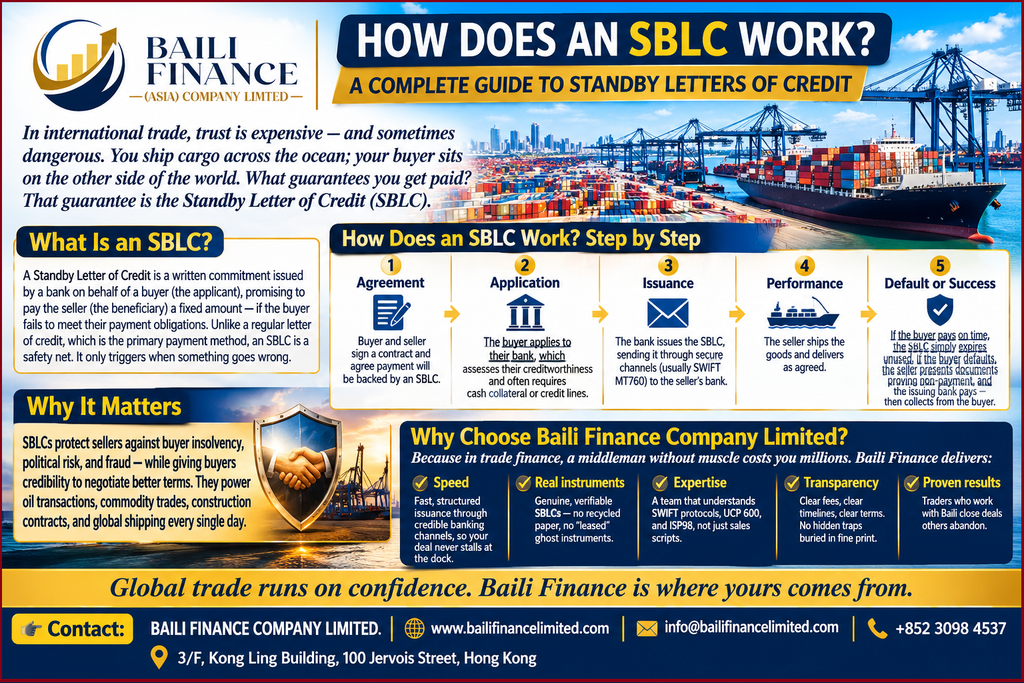
An SBLC provides an independent payment undertaking from an issuing bank or another eligible financial institution. It protects a beneficiary if the applicant fails to meet a specified financial or contractual obligation. Rather than serving as the primary payment method, it generally functions as a secondary payment mechanism that the beneficiary can use after a defined default or drawing event.
However, an SBLC does not automatically release funds, guarantee access to financing or eliminate every commercial risk. Its effectiveness depends on the issuer’s creditworthiness, the instrument’s wording, the applicable rules and the beneficiary’s ability to satisfy the documentary requirements.
This guide explains the SBLC issuance process, how standby letters of credit operate, the parties involved, their commercial applications, associated costs, potential risks and practical considerations. It also includes a real-world commercial scenario and a detailed illustrative case study to help businesses understand the process.
Keywords: How Does an SBLC Work, Standby Letter of Credit, SBLC Process, SBLC Meaning, SBLC Issuance, Financial SBLC, Performance SBLC, International Trade Finance, Bank Guarantee, ISP98, UCP 600, How does a standby letter of credit work in international trade, How to obtain a standby letter of credit, How does an SBLC payment work, How does an SBLC protect a beneficiary, Requirements for issuing an SBLC, Financial SBLC vs Performance SBLC, SBLC issuance process and requirements
What Is a Standby Letter of Credit (SBLC)?
A Standby Letter of Credit, commonly abbreviated as SBLC or standby LC, is an independent documentary undertaking issued by a bank or another eligible financial institution at the request of an applicant in favour of a named beneficiary.
Under its terms, the issuer undertakes to honour a complying demand or documentary presentation up to the stated amount, subject to the conditions contained in the instrument.
In simple terms, an SBLC provides financial protection to a business when another party fails to fulfil an agreed obligation.
For example, a construction company may obtain an SBLC to assure a project owner that it has financial backing if it fails to complete a project according to the contract. Similarly, a borrower may arrange a financial SBLC to secure repayment obligations under a loan agreement.
The issuing institution assumes an independent obligation to the beneficiary. Consequently, its responsibility does not ordinarily depend on whether the applicant and beneficiary agree about the performance of their underlying commercial contract.
The International Chamber of Commerce recognises two important frameworks for documentary credit transactions:
- ISP98 (International Standby Practices): A specialised set of international rules developed for standby letters of credit.
- UCP 600 (Uniform Customs and Practice for Documentary Credits): International rules primarily designed for commercial documentary credits, which may also apply to SBLCs where appropriate.
The instrument must expressly incorporate the relevant rules if the parties intend to make them applicable.
For a deeper understanding of these frameworks, consult the ICC Academy’s comprehensive guide to standby letters of credit.
How Does an SBLC Work? Understanding the Process
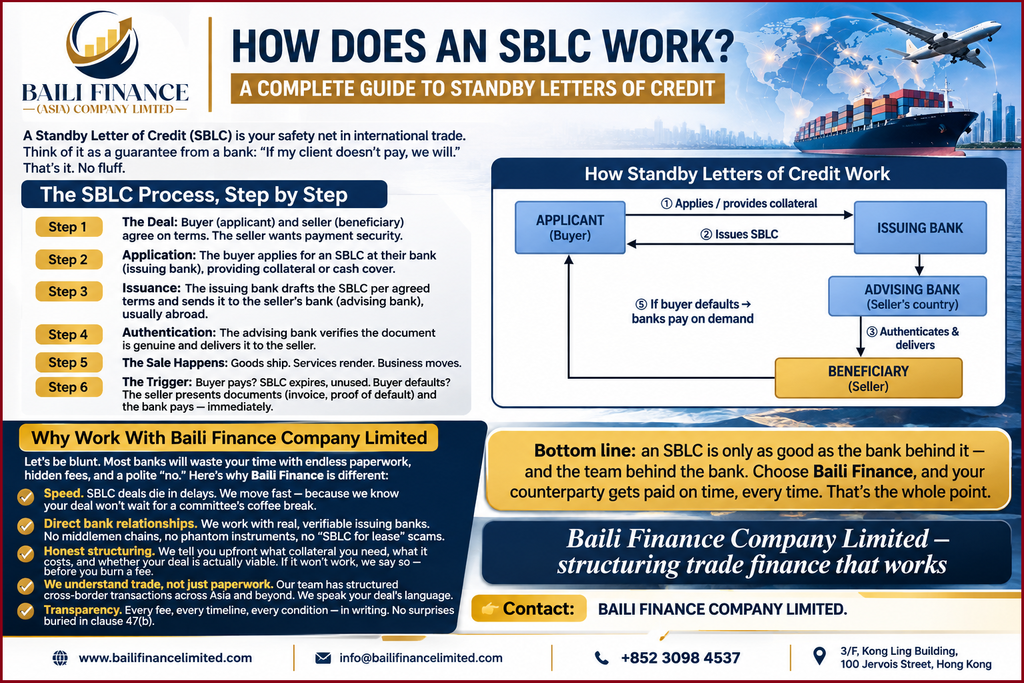
An SBLC works through a contractual arrangement involving an applicant, an issuing institution and a beneficiary. Depending on the transaction, an advising bank, confirming bank or nominated bank may also participate.
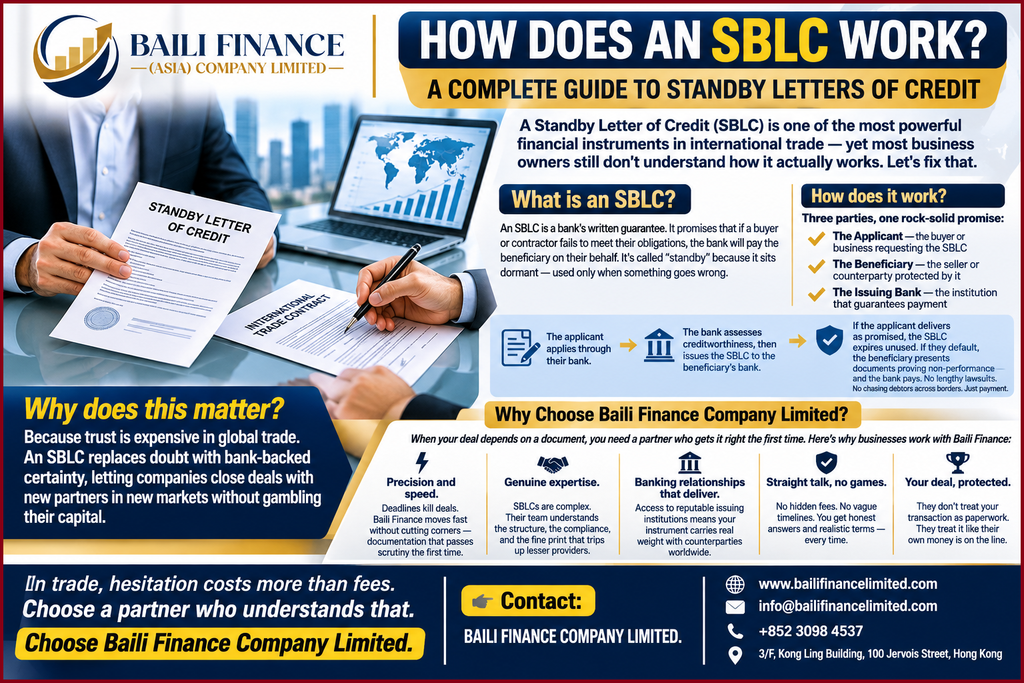
The central principle is straightforward: the applicant arranges the instrument, the issuing bank assumes an independent payment obligation, and the beneficiary receives protection against specified contractual or financial defaults.
However, the actual process involves several important stages.
1. The Applicant Enters Into a Commercial Agreement
The process generally begins when two businesses enter into a commercial agreement that requires financial security.
The agreement may involve a construction project, international supply contract, loan facility, equipment purchase, infrastructure development or another commercial obligation.
The party required to provide financial security becomes the SBLC applicant. The party receiving that protection becomes the beneficiary.
Both parties should agree on the required instrument’s value, purpose, validity period, governing rules, drawing conditions and acceptable issuing institution before the applicant approaches a bank.
2. The Applicant Approaches an Issuing Bank
After agreeing on the requirement, the applicant approaches a bank or eligible financial institution to request an SBLC.
The institution conducts its own assessment before deciding whether to issue the instrument.
This assessment may consider:
- The applicant’s financial statements.
- Existing borrowing arrangements and credit exposure.
- Business operations and transaction history.
- Available collateral or cash margin.
- The applicant’s repayment capacity.
- The underlying commercial transaction.
- Regulatory, sanctions and anti-money laundering requirements.
- The proposed SBLC amount and validity period.
The bank may require cash collateral, other acceptable security or an approved credit facility.
Importantly, an applicant does not automatically qualify for an SBLC simply because it has a commercial agreement or a beneficiary requesting one.
The issuing institution must independently approve the transaction under its credit and compliance policies.
3. The Bank Approves and Issues the SBLC
If the applicant satisfies the institution’s requirements, the bank may approve the application and issue the standby letter of credit.
The instrument specifies the issuer, applicant, beneficiary, maximum liability, currency, expiry date, presentation requirements and circumstances under which the beneficiary may demand payment.
It should also identify the applicable rules, governing law and place and method of presentation.
The bank may transmit the instrument directly to the beneficiary or through an advising bank.
Where an advising bank participates, its role generally involves checking the apparent authenticity of the instrument and communicating its terms to the beneficiary. Advising does not, by itself, create an independent payment obligation for that bank.
4. The Beneficiary Receives and Reviews the Instrument
Once the SBLC reaches the beneficiary, the beneficiary should examine its wording carefully.
Receiving an SBLC does not automatically mean that the beneficiary has obtained the protection it originally requested.
The instrument must match the commercial agreement.
For example, the beneficiary should confirm:
- The correct legal names of all parties.
- The approved SBLC amount and currency.
- The expiry date and presentation location.
- The permitted drawing conditions.
- The required demand statements and supporting documents.
- The issuing bank’s acceptability.
- The applicable international rules.
- Whether partial or multiple drawings are permitted.
Any material discrepancy should be addressed before the beneficiary accepts the instrument as satisfactory security.
5. The Applicant Performs Its Contractual Obligations
Following issuance, the applicant continues performing its obligations under the underlying agreement.
For example, a supplier delivers goods, a contractor completes construction work or a borrower makes scheduled repayments.
When the applicant performs as agreed, the beneficiary generally has no reason to draw on the SBLC.
This explains why standby letters of credit commonly expire without payment.
An SBLC is intended to provide financial protection against a defined risk, not to replace ordinary contractual performance.
6. The Beneficiary Makes a Demand if a Qualifying Default Occurs
If the applicant fails to fulfil an obligation covered by the SBLC, the beneficiary may exercise its drawing rights.
However, the beneficiary must follow the instrument’s exact presentation requirements.
Depending on the wording, the required documents may include:
- A signed demand for payment.
- A statement identifying the applicant’s default.
- A certificate confirming the amount due.
- A draft or other specified payment demand.
- Additional documents expressly required by the instrument.
The beneficiary must submit these documents to the correct institution, at the correct location, through the permitted presentation method and before expiry.
A demand that fails to satisfy the applicable documentary requirements may be rejected.
7. The Issuing Bank Examines the Presentation
After receiving the demand, the issuing institution examines the documents against the SBLC’s terms and the incorporated rules.
This examination focuses on documentary compliance rather than conducting a full investigation into the underlying commercial dispute.
Under ISP98, the issuer undertakes to honour a presentation that appears on its face to comply with the instrument.
If the presentation complies, the issuer must honour it according to the stipulated payment method and timing.
If the presentation contains discrepancies, the issuer may issue a notice of dishonour in accordance with the applicable rules and the instrument’s provisions.

8. The Bank Makes Payment and Seeks Reimbursement
When the beneficiary submits a complying presentation, the issuing bank honours its independent obligation.
Payment is made according to the SBLC’s terms, subject to its available amount and applicable rules.
The applicant remains responsible for reimbursing the issuing institution under their separate banking arrangement.
Therefore, the bank’s payment to the beneficiary does not ordinarily extinguish the applicant’s underlying reimbursement obligation.
9. The SBLC Expires or Is Discharged
If the beneficiary never makes a complying demand, the SBLC generally expires on its specified expiry date.
Some instruments contain automatic extension provisions, commonly called evergreen clauses. These clauses may extend the expiry date periodically unless the issuer gives notice of non-extension within the specified period.
The parties should understand these provisions before issuance because they can affect the duration of the bank’s exposure and the applicant’s costs.
Who Are the Main Parties Involved in an SBLC Transaction?
Understanding the participants helps businesses identify their responsibilities and legal positions.
Applicant
The applicant is the party requesting the standby letter of credit.
It is usually the buyer, borrower, supplier, contractor or other business required to provide financial security.
The applicant pays the applicable bank charges and remains responsible for reimbursement if the issuer honours a complying demand.
Beneficiary
The beneficiary is the party receiving the protection under the SBLC.
It may be a seller, lender, project owner, service provider or commercial counterparty.
The beneficiary holds the right to present a demand in accordance with the instrument’s terms.
Issuing Bank
The issuing bank creates the SBLC and assumes the independent undertaking to honour a complying presentation.
Its creditworthiness is a central consideration because the beneficiary ultimately relies on the issuer’s ability and willingness to meet its obligations.
Advising Bank
An advising bank communicates the instrument to the beneficiary, typically through an established banking relationship.
Its role does not automatically include a payment undertaking.
Confirming Bank
A confirming bank adds its own independent undertaking to honour a complying presentation, subject to the terms of its confirmation.
This arrangement can provide additional protection where the beneficiary has concerns about the issuing bank’s credit standing or country risk.
Nominated Bank
A nominated bank is authorised under the SBLC to perform specified functions, such as receiving a presentation, paying or negotiating.
However, nomination alone does not necessarily oblige that bank to honour the instrument.
What Are the Different Types of SBLC?
Businesses use different categories of standby letters of credit depending on the obligations they want to secure.
1. Financial SBLC
A financial standby letter of credit supports a financial obligation.
Common applications include:
- Loan repayment.
- Credit facility obligations.
- Outstanding financial liabilities.
- Debt servicing arrangements.
- Certain payment obligations under commercial contracts.
For example, a lender may require a borrower to provide a financial SBLC to secure repayment under an approved financing arrangement.
2. Performance SBLC
A performance standby letter of credit secures the applicant’s contractual performance.
It is commonly used in construction, engineering, infrastructure and procurement contracts.
If the applicant fails to meet the specified performance obligations, the beneficiary may submit a complying demand.
3. Advance Payment SBLC
An advance payment SBLC protects a buyer that makes an advance payment to a supplier.
If the supplier fails to deliver the agreed goods or services and the relevant drawing conditions are satisfied, the buyer may claim the protected amount.
4. Bid or Tender SBLC
A bid standby supports a company’s obligations during a tender process.
It may protect the project owner if a successful bidder withdraws its bid or fails to enter into the required contract, subject to the instrument’s terms.
5. Commercial SBLC
A commercial standby supports payment obligations arising from the supply of goods or services.
It provides a secondary payment mechanism when the applicant fails to meet the agreed payment obligation.
6. Direct-Pay SBLC
A direct-pay standby supports a specified payment obligation and may operate as a primary payment mechanism rather than simply as a secondary default instrument.
Its payment structure depends on the wording and underlying transaction.
7. Counter SBLC
A counter standby supports the issuance of another independent undertaking by a second financial institution.
For example, an international bank may issue a counter SBLC in favour of a local bank, which then issues a separate local undertaking to the final beneficiary.
The two instruments create separate documentary obligations.
Real-World Example: How an SBLC Supports an International Supply Contract
Consider a practical commercial situation involving an international equipment supplier and an industrial buyer.
A manufacturing company in Germany enters into a contract with an equipment supplier in South Korea for machinery valued at USD 5 million.
The contract requires the buyer to provide an SBLC covering its payment obligations.
The buyer approaches its banking institution and requests a financial SBLC for USD 5 million in favour of the supplier.
Following credit assessment, collateral review and compliance checks, the issuing bank approves the application and issues the instrument.
The supplier receives the SBLC through an advising bank and reviews the terms. It confirms that the amount, expiry date, issuer and drawing requirements satisfy the contractual conditions.
The supplier then proceeds with production and shipment.
Scenario A: The buyer fulfils its obligations.
The buyer receives the machinery, completes the required acceptance procedures and pays according to the agreed payment terms.
The supplier never needs to draw on the SBLC. The instrument eventually expires, subject to its terms.
Scenario B: The buyer fails to pay.
The buyer receives the machinery but fails to make the contractual payment.
If the circumstances satisfy the SBLC’s drawing conditions, the supplier may submit the prescribed demand and supporting documents to the issuing bank.
The bank examines the presentation. If it complies with the instrument, the bank honours the demand up to the available amount.
The bank subsequently seeks reimbursement from the applicant under their banking agreement.
This example demonstrates how an SBLC can support an international commercial transaction without replacing the buyer’s normal payment obligations.
Case Study: How a Performance SBLC Protects an Infrastructure Project
The following is an illustrative case study, not a report of an independently verified transaction. It demonstrates how a performance standby can operate in a project-finance environment.
Background
An infrastructure development company, Meridian Engineering Ltd., secures a contract to construct a commercial logistics facility.
The project owner requires financial security before allowing the contractor to commence work.
The contract has a value of USD 20 million and requires a performance SBLC equal to 10% of the contract value.
Consequently, the required standby amount is USD 2 million.
The SBLC Arrangement
Meridian Engineering approaches its banking institution and requests a performance SBLC for USD 2 million in favour of the project owner.
The bank reviews the company’s financial position, credit history, existing facilities, collateral arrangements and project-related risks.
After completing its assessment, the bank approves the application and issues the instrument.
The project owner receives the SBLC and confirms that its terms meet the contractual requirements.
The Commercial Problem
During construction, Meridian Engineering experiences operational difficulties and fails to complete a specified project milestone.
The contractor and project owner attempt to resolve the issue through the contractual procedures.
However, the contractor ultimately fails to meet the performance requirements covered by the standby.
The Beneficiary Makes a Demand
The project owner reviews the SBLC and prepares the required documentary presentation.
Assume the instrument requires a signed demand and a statement identifying the relevant contractual default.
The project owner submits the documents before expiry and follows the specified presentation procedure.
The Issuing Bank’s Decision
The bank examines the presentation against the SBLC’s documentary requirements.
It does not simply substitute its own investigation of the construction dispute for the documentary examination required by the instrument.
If the presentation complies, the bank honours the demand, subject to the available amount and the applicable rules.
For illustration, assume the project owner makes a valid partial demand of USD 750,000.
The bank pays the amount due under the standby.
The Outcome
The project owner receives the contractual financial protection available under the SBLC.
Meridian Engineering remains responsible for reimbursing the bank under its separate arrangement.
The case demonstrates why the wording of a performance SBLC matters. The beneficiary’s protection depends on the instrument’s actual terms, not merely on the existence of a construction contract.

What Are the Main Benefits of an SBLC?
A properly structured standby letter of credit can provide several commercial benefits.
1. Improved payment security
An SBLC gives the beneficiary an independent payment undertaking from the issuing institution, subject to documentary compliance.
2. Increased commercial confidence
Businesses may become more willing to enter into international contracts when the counterparty provides acceptable financial security.
3. Support for international trade
An SBLC can support transactions involving different jurisdictions, currencies and commercial counterparties.
4. Contractual risk management
Companies can use performance, financial and advance payment standbys to address specific contractual risks.
5. Credit enhancement
Where the issuing institution has stronger credit standing than the applicant, the instrument may improve the beneficiary’s assessment of the transaction’s payment security.
6. Flexible commercial applications
Businesses can structure standby instruments around different financial and non-financial obligations, subject to the issuer’s policies and the instrument’s wording.
What Are the Risks and Limitations of an SBLC?
Although an SBLC can provide significant commercial protection, businesses should understand its limitations.
Issuer Credit Risk
The beneficiary relies on the issuing institution’s ability to honour its undertaking.
A weak or unacceptable issuer may reduce the commercial value of the instrument.
Beneficiaries should independently assess the issuing institution’s creditworthiness, jurisdiction and regulatory standing.
Documentary Compliance Risk
An SBLC does not guarantee payment merely because the applicant defaults.
The beneficiary must satisfy the required presentation conditions.
Incorrect wording, missing documents, late presentation or delivery to the wrong location can create serious problems.
Fraud and Improper Drawings
The independent nature of an SBLC means that the issuer generally examines the documents rather than deciding the underlying commercial dispute.
Consequently, applicants should consider the beneficiary relationship and the possibility of improper demands when negotiating drawing requirements.
Applicable law may provide exceptions for fraud and other exceptional circumstances.
Issuance and Maintenance Costs
The applicant may incur issuance fees, commitment charges, collateral costs, amendment fees and other banking expenses.
Costs vary according to the issuer, applicant’s credit profile, instrument amount, duration, collateral requirements and transaction structure.
Expiry Risk
A beneficiary that fails to present a complying demand before expiry may lose its drawing rights.
Companies should monitor expiry dates, notice periods and any automatic extension provisions.
Country and Regulatory Risk
Cross-border transactions may involve sanctions, foreign exchange restrictions, legal differences and country-specific banking requirements.
The parties should consider these factors before selecting an issuer and agreeing on the instrument’s governing law.
How Much Does an SBLC Cost?
There is no universal SBLC issuance fee.
The total cost depends on the issuing institution’s pricing structure, the applicant’s financial position, the amount requested and the duration of the undertaking.
Common charges may include:
- Issuance fee: The charge for establishing the standby.
- Commitment fee: A charge for the bank’s continuing exposure.
- Collateral costs: Expenses associated with cash margins or pledged security.
- Amendment fees: Charges for permitted changes to the instrument.
- Advising fees: Charges from an advising bank.
- Confirmation fees: Additional charges where another bank provides confirmation.
- Other transaction expenses: Depending on the transaction and participating institutions.
For example, an SBLC of USD 2 million may have a different cost from an SBLC of USD 10 million, even if both have the same duration.
The applicant should request a written fee schedule and understand whether charges apply upfront, periodically or upon specific events.
Businesses should avoid relying on generic online fee percentages as a substitute for an actual institutional quotation.
What Documents Are Required to Obtain an SBLC?
Documentation requirements vary between institutions and transactions.
However, an applicant may need to provide:
- Certificate of incorporation and company registration documents.
- Identification documents for directors and beneficial owners.
- Recent audited financial statements.
- Bank statements and financial records.
- Corporate ownership information.
- The underlying commercial contract.
- Details of the proposed beneficiary.
- The requested SBLC amount and currency.
- Proposed wording and applicable international rules.
- Information about the purpose, duration and drawing conditions.
The issuing institution may request additional information to satisfy its credit, legal and compliance requirements.
Submitting these documents does not guarantee approval. Each application remains subject to the institution’s independent assessment.
SBLC vs Bank Guarantee: What Is the Difference?
An SBLC and a bank guarantee can serve similar commercial purposes, but they are not automatically interchangeable.
Both instruments may provide independent payment undertakings to a beneficiary when the required documentary conditions are satisfied.
However, their legal treatment, terminology and applicable rules can differ.
An SBLC commonly incorporates ISP98 or UCP 600, depending on its structure.
A demand guarantee may incorporate the ICC’s Uniform Rules for Demand Guarantees (URDG 758).
The distinction matters because the applicable rule set can affect documentary examination, presentation procedures, payment obligations and the responsibilities of the parties.
The correct instrument depends on the beneficiary’s requirements, applicable law, the issuing institution and the underlying transaction.
Businesses should therefore avoid treating every bank guarantee and standby letter of credit as legally identical.
SBLC vs Commercial Letter of Credit
Although both instruments fall within the broader documentary credit framework, they serve different commercial functions.
A commercial letter of credit generally operates as a primary payment mechanism for a transaction involving goods or services.
The seller presents the documents required by the commercial credit to receive payment.
An SBLC, by contrast, generally provides a secondary payment undertaking. The beneficiary normally expects the applicant to fulfil its obligations without drawing on the instrument.
The SBLC becomes relevant when a specified default or drawing event occurs and the beneficiary makes a complying presentation.
This distinction affects the purpose, documentary requirements, cost structure and expected use of each instrument.
Important International Rules Governing SBLC Transactions
International rules help establish consistent procedures for issuing, examining and honouring standby instruments.
ISP98
The International Standby Practices, published as ICC Publication No. 590, provide rules specifically designed for standby letters of credit.
They address matters such as issuance, independence, documentary presentations, payment demands, amendments, expiry and dishonour.
ISP98 is particularly relevant when the parties want a framework focused on standby transactions.
UCP 600
The Uniform Customs and Practice for Documentary Credits is primarily designed for commercial documentary credits.
However, it can apply to standby letters of credit to the extent its provisions are applicable and the instrument incorporates the rules.
URDG 758
The Uniform Rules for Demand Guarantees provide a separate framework for demand guarantees.
Although these instruments share several commercial characteristics with SBLCs, the applicable rules are not identical.
Applicable National Law
International rules do not replace all applicable national laws.
The transaction may also be affected by local banking regulations, contract law, fraud exceptions, insolvency rules and the instrument’s governing-law provisions.
For example, businesses working with US-law-governed letters of credit may need to consider Article 5 of the Uniform Commercial Code.
The parties should obtain appropriate legal and banking advice when structuring material cross-border obligations.
How to Choose the Right SBLC Provider
Selecting an issuing institution requires careful evaluation.
Businesses should not make decisions based solely on advertised fees, proposed transaction values or claims about access to international banking networks.
Consider the following factors:
1. Banking credentials: Verify the institution’s legal identity, regulatory authorisation and ability to issue the required undertaking.
2. Creditworthiness: Assess its financial standing and whether the beneficiary accepts its credit risk.
3. Instrument structure: Confirm that the provider can accommodate the required amount, currency, validity period and drawing conditions.
4. International banking capability: Establish whether the institution can transmit and authenticate the instrument through the required banking channels.
5. Compliance procedures: Understand the institution’s KYC, AML, sanctions and source-of-funds requirements.
6. Transparency: Request clear information about fees, collateral, approval conditions and contractual responsibilities.
7. Legal documentation: Have qualified professionals review the proposed wording before issuance.
A genuine SBLC transaction requires proper institutional assessment and an enforceable documentary undertaking. No intermediary should represent that an instrument is guaranteed to be issued before the issuing institution has completed its approval process.
External Sources:
Frequently Asked Questions About How an SBLC Works
1. How does an SBLC work in international trade?
An SBLC works by providing a beneficiary with an independent payment undertaking from an issuing institution. If the applicant fails to fulfil an obligation covered by the instrument, the beneficiary may submit the required documents and demand payment. The issuing institution examines the presentation and honours it if it complies with the SBLC’s terms and applicable rules.
2. Who can apply for a Standby Letter of Credit?
Eligible businesses and other approved applicants can apply through a bank or financial institution that offers standby issuance services. Approval generally depends on financial capacity, creditworthiness, collateral arrangements, transaction purpose and regulatory compliance. The applicant must also satisfy the institution’s documentation requirements.
3. Does an SBLC guarantee that the beneficiary will receive payment?
An SBLC provides an independent payment undertaking, but payment is not automatic. The beneficiary must make a complying presentation before the instrument expires. The issuer’s creditworthiness, applicable law and the instrument’s specific terms also matter.
4. What happens when an SBLC expires?
An SBLC generally ceases to be available for a new drawing after its expiry, subject to its terms and applicable rules. If it contains an automatic extension clause, its expiry date may extend unless the issuer provides the required notice of non-extension. Beneficiaries should monitor these provisions carefully.
5. Can an SBLC be used as collateral for a loan?
A lender may accept an SBLC as credit support or collateral enhancement, subject to its internal credit policies, the issuer’s acceptability, the instrument’s terms and applicable law. However, acceptance is not automatic, and an SBLC does not itself constitute cash or guarantee loan approval.
6. What is the difference between a financial SBLC and a performance SBLC?
A financial SBLC supports payment obligations, such as loan repayment or other financial liabilities. A performance SBLC supports non-financial contractual obligations, such as completing a construction project or delivering contracted services.
7. Can an SBLC be transferred to another beneficiary?
Transferability depends on the instrument’s wording and applicable rules. A standby may permit the transfer of drawing rights, but an assignment of proceeds is a separate legal concept. Businesses should distinguish between transferring beneficiary rights and assigning the money payable under an instrument.
8. Can a bank refuse to pay under an SBLC?
An issuing bank may refuse a demand that does not comply with the instrument’s requirements or where a valid legal defence applies. The bank must examine the presentation under the incorporated rules and applicable law. A disagreement over the underlying contract does not, by itself, normally determine whether a documentary presentation complies.
9. How long does it take to issue an SBLC?
There is no universal issuance timeframe. Processing depends on the institution, applicant’s documentation, credit approval, compliance checks, collateral arrangements and negotiation of the instrument’s wording. Applicants should obtain a realistic timeline directly from the proposed issuing institution.
10. Does an SBLC require 100% cash collateral?
No. Collateral requirements depend on the issuing institution’s policies and its assessment of the applicant’s credit risk. Some applicants may qualify through approved credit facilities or other acceptable security arrangements, while others may face substantial cash collateral requirements.
11. Is an SBLC the same as a bank guarantee?
No. Both may provide independent financial undertakings, but they can operate under different legal frameworks and documentary rules. An SBLC may incorporate ISP98 or UCP 600, whereas a demand guarantee may incorporate URDG 758. The instrument’s actual wording and applicable law determine its operation.
12. Can a beneficiary draw the full SBLC amount?
A beneficiary may draw up to the amount available under the instrument, provided the presentation complies with its requirements. Some SBLCs allow partial and multiple drawings, while others restrict them. The instrument must be reviewed before a demand is made.
Conclusion: Understanding How an SBLC Works Is Essential for Secure Business Transactions
A Standby Letter of Credit provides an independent documentary payment undertaking that can support financial obligations, contractual performance and international commercial arrangements.
Understanding how an SBLC works enables applicants and beneficiaries to make better decisions about financial security, contractual exposure and cross-border transactions.
The process begins with a commercial agreement and an application to an issuing institution. The bank assesses the applicant, approves the proposed transaction and issues the instrument. The beneficiary reviews the terms and relies on the undertaking if a qualifying default occurs. If the beneficiary submits a complying demand, the issuing institution honours its obligation in accordance with the SBLC and applicable rules.
Nevertheless, the value of an SBLC depends on more than its stated amount. Issuer credibility, documentary precision, expiry provisions, governing rules, collateral arrangements and regulatory compliance all influence its effectiveness.
Businesses should therefore approach SBLC transactions with proper due diligence and a clear understanding of their contractual and financial responsibilities.
Looking for SBLC Assistance for Your Business?
Are you considering a Standby Letter of Credit to support an international trade transaction, secure a financial obligation or meet a contractual requirement?
The structure of your transaction matters. Choosing the appropriate instrument, understanding the issuing requirements and reviewing the documentary conditions before proceeding can help reduce avoidable delays and commercial risks.
Baili Finance Limited welcomes enquiries from businesses seeking information and professional assistance relating to standby letters of credit and international trade-finance arrangements.
Visit: www.bailifinancelimited.com to learn more about our services and discuss your requirements.
Contact our team with the following information:
- The purpose of the proposed SBLC.
- The required amount and currency.
- The applicant’s country of incorporation.
- The beneficiary’s country and industry.
- The proposed validity period.
- The underlying commercial or financial obligation.
Do not leave your next international transaction dependent on unclear financial arrangements. Start with a properly assessed SBLC requirement and obtain the information you need before committing to a transaction.
Contact Baili Finance Limited today to discuss your SBLC requirements and determine the appropriate next steps.
Intermediaries/Consultants/Brokers are welcome to bring their clients 100% protected. Our brokers receive 2% commission for referral. We assist Clients and brokers in their attempt to secure funding by working on their funding requests that may require innovative financing. In complete confidence, we will work together for the benefits of all parties involved.
#StandbyLetterOfCredit #SBLC #TradeFinance #InternationalTrade #FinancialInstruments #BankGuarantee #CorporateFinance #ProjectFinance #FinancialSecurity