Headline: SME Loans: SBLC Providers: How to Choose the Right Partner
Introduction: Why the Right SBLC Provider Matters
In international finance, access to credible financial instruments can determine whether a business secures a major contract, completes an international transaction or obtains the financing required to execute a development project. For companies operating across different jurisdictions, SBLC providers play an important role in facilitating financial security, supporting commercial agreements and improving access to structured funding opportunities.
A Standby Letter of Credit (SBLC), also known as a Standby Letter of Credit Facility or SLOC, is an independent banking undertaking that provides a beneficiary with payment protection when the applicant fails to meet specified contractual or financial obligations. Banks commonly issue these instruments to support international trade, project financing, business transactions, contractual performance and credit enhancement.
However, finding an SBLC provider involves more than identifying a company that advertises standby letters of credit. Businesses must understand the issuing institution, the proposed financial structure, the applicable international banking rules, the transaction requirements and the process for authenticating the instrument.
Furthermore, the distinction between an SBLC issuing bank, a financial intermediary and an SBLC arrangement company deserves careful attention. Each may perform a different role, and understanding those responsibilities helps businesses make informed financial decisions.
For companies seeking an experienced financial partner, BAILI FINANCE (ASIA) COMPANY LIMITED provides information and enquiries concerning SBLC issuance, monetization, bank guarantees and international trade finance.
This guide examines how SBLC providers operate, what businesses should consider before entering an agreement, how standby letters of credit support international transactions and how to evaluate an SBLC financing proposal.
Keywords: SBLC Providers, Best SBLC providers, International SBLC providers, Standby letter of credit providers, SBLC issuance companies, SBLC monetization companies, SBLC financing solutions, How to obtain an SBLC, Bank-issued standby letter of credit, SWIFT MT760 SBLC providers, SBLC providers for project financing, SBLC for international trade, Non-recourse SBLC financing, Financial standby letter of credit, Performance standby letter of credit, How to verify an SBLC, SBLC issuance process, SBLC vs bank guarantee, standby letter of credit, international SBLC, SBLC monetization, SBLC issuance, bank guarantee providers, SWIFT MT760, trade finance, project financing, structured finance
1. What Are SBLC Providers?
SBLC providers are financial institutions or specialist financial service companies that help businesses obtain Standby Letters of Credit for qualifying commercial and financial transactions.
Their involvement may include arranging issuance through a bank, assessing transaction requirements, coordinating documentation, structuring the financial arrangement and facilitating communication between the applicant, issuing institution and beneficiary.
The term SBLC provider does not always describe the same business model. Some providers are licensed banks that issue standby letters of credit directly. Others act as financial arrangers, intermediaries or transaction coordinators working with issuing banks.
This distinction matters because the actual issuing bank assumes the independent payment obligation under the SBLC. An intermediary does not automatically become the issuer simply because it arranges the transaction.
Understanding How an SBLC Works
An SBLC involves three principal parties:
- Applicant: The company or individual requesting the issuance of the standby letter of credit.
- Issuing bank: The financial institution that undertakes to honour a complying presentation under the SBLC.
- Beneficiary: The party receiving the financial protection.
For example, an international buyer may enter into a supply agreement with an overseas manufacturer. The manufacturer wants assurance that the buyer can meet its payment obligations. The buyer therefore arranges an SBLC through an issuing bank.
If the buyer fails to fulfil the relevant obligations, the manufacturer may present the documents specified in the SBLC and request payment.
The issuing bank examines the presentation against the instrument’s terms. If the presentation complies, the bank honours its undertaking, subject to the applicable rules and terms.
Importantly, an SBLC represents an independent undertaking. The issuing bank generally examines the documents presented rather than investigating the underlying commercial dispute.
The International Chamber of Commerce explains this principle in its comprehensive Guide to Standby Letters of Credit.
2. Why Businesses Use International SBLC Providers
Businesses operating internationally encounter financial and contractual challenges that can affect commercial relationships.
A supplier may require payment assurance before releasing valuable goods. A project owner may require a contractor to provide financial security before awarding a construction contract. A lender may also request an independent bank undertaking before extending a credit facility.
Working with an appropriate SBLC provider can help address these requirements.
The following are some of the principal applications.
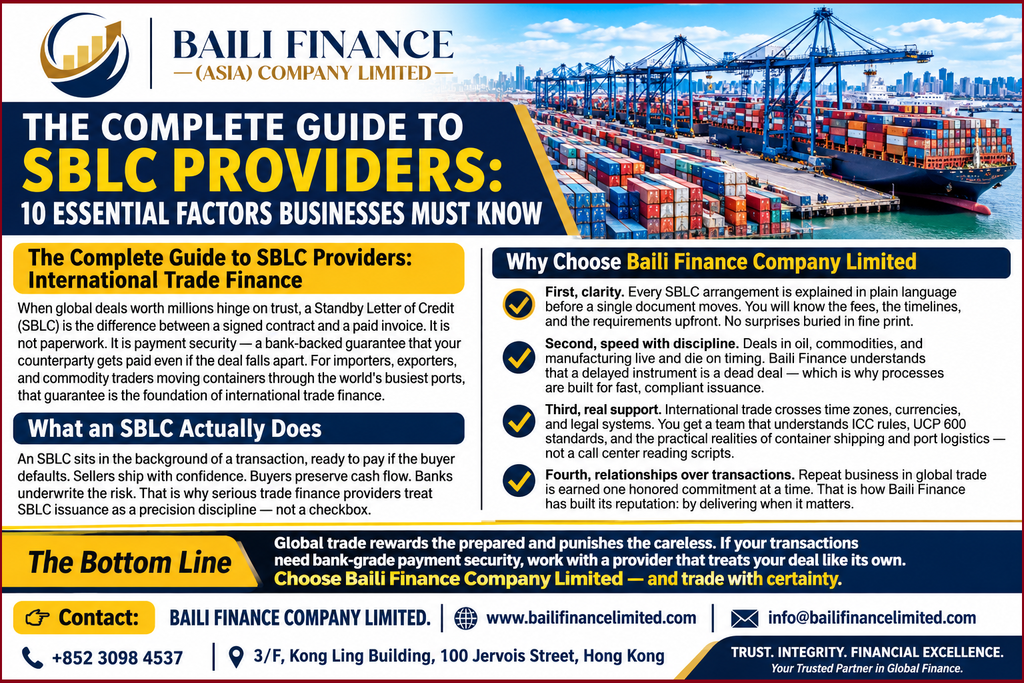
A. International Trade Finance
International trade frequently involves companies operating in different countries, banking systems and legal jurisdictions.
An SBLC can support payment obligations between an importer and an exporter. It provides the beneficiary with an independent undertaking from the issuing bank, subject to the instrument’s terms.
This arrangement can help businesses establish commercial relationships and negotiate transactions involving substantial financial commitments.
B. Project Financing
Infrastructure, energy, construction and industrial development projects often require financial commitments before implementation begins.
Project owners, contractors, lenders and suppliers may require different forms of financial security.
An appropriately structured performance or financial SBLC can support these requirements, depending on the transaction and the beneficiary’s acceptance criteria.
C. Credit Enhancement
Credit enhancement involves improving the financial security supporting an obligation.
For example, a company with an acceptable commercial relationship but a weaker credit profile may arrange an SBLC issued by a financially stronger bank.
The beneficiary may consider the issuing bank’s credit standing when assessing the additional protection.
However, acceptance depends on the beneficiary’s internal requirements, the issuer’s creditworthiness, jurisdictional considerations and the instrument’s wording.
D. Business Expansion
Growing companies sometimes need additional financial capacity to support procurement, contractual commitments and expansion into new markets.
An SBLC may help satisfy a contractual security requirement, allowing a business to proceed with a transaction that would otherwise require alternative collateral.
It does not automatically provide working capital or guarantee access to a loan. Any subsequent financing requires separate approval and appropriate documentation.
E. Advance Payment Security
Suppliers sometimes request advance payments before beginning production or delivering goods.
A buyer may require an advance payment SBLC to protect the amount paid if the supplier fails to fulfil the relevant obligations.
This structure is particularly relevant to large procurement contracts, equipment purchases and international supply agreements.
3. Types of Standby Letters of Credit Offered Through SBLC Providers
Not every business requires the same financial instrument. The appropriate SBLC depends on the underlying obligation, the beneficiary’s requirements and the commercial purpose.
Understanding the different types helps applicants select a suitable structure.
1. Financial SBLC
A financial SBLC supports monetary obligations, including loan repayment, outstanding liabilities and other agreed financial commitments.
If the applicant fails to meet the specified payment obligation, the beneficiary may submit a complying demand under the instrument.
2. Performance SBLC
A performance SBLC supports contractual performance obligations.
For example, a construction company may arrange an SBLC to provide financial protection to a project owner if it fails to meet specified contractual responsibilities.
3. Advance Payment SBLC
An advance payment SBLC protects a party that makes an advance payment to a supplier or contractor.
The instrument establishes a defined basis for claiming payment if the applicant fails to account for the advance as required.
4. Bid or Tender SBLC
A bid SBLC supports a tendering process by providing financial assurance that the bidder will honour specified bidding commitments.
Government procurement, infrastructure projects and large corporate tenders may require this type of financial undertaking.
5. Commercial SBLC
A commercial SBLC supports payment obligations relating to goods or services.
It may serve as a secondary payment mechanism when the applicant fails to settle the relevant commercial obligation through the agreed payment arrangements.
6. Direct Pay SBLC
A direct pay SBLC supports an underlying payment obligation and may function as the primary payment mechanism under its specific terms.
Its structure differs from a conventional standby intended primarily as protection against default.
7. Revolving SBLC
A revolving SBLC provides for the reinstatement or continuation of available coverage under specified conditions.
The instrument must clearly establish how reinstatement operates, including applicable limits, time periods and drawing conditions.
8. Counter SBLC
A counter SBLC supports the issuance of another independent undertaking, commonly by a local bank in favour of a beneficiary.
This structure may help facilitate transactions where the beneficiary requires an undertaking from a particular bank or within a particular jurisdiction.
9. Insurance SBLC
An insurance SBLC supports specified insurance or reinsurance-related financial obligations.
10. Transferable or Assignable SBLC
Transfer and assignment provisions require careful drafting because transferring drawing rights and assigning proceeds are legally different concepts.
The applicable rules and exact instrument wording determine what rights the beneficiary may transfer or assign.
The International Standby Practices provide further classifications and guidance concerning these instruments.
4. How to Choose the Best SBLC Providers: 10 Essential Factors
Selecting an SBLC provider requires a structured evaluation. A company may advertise international banking relationships, fast processing or attractive financing terms, but businesses should examine the actual transaction arrangements before making a commitment.
Consider the following ten factors.
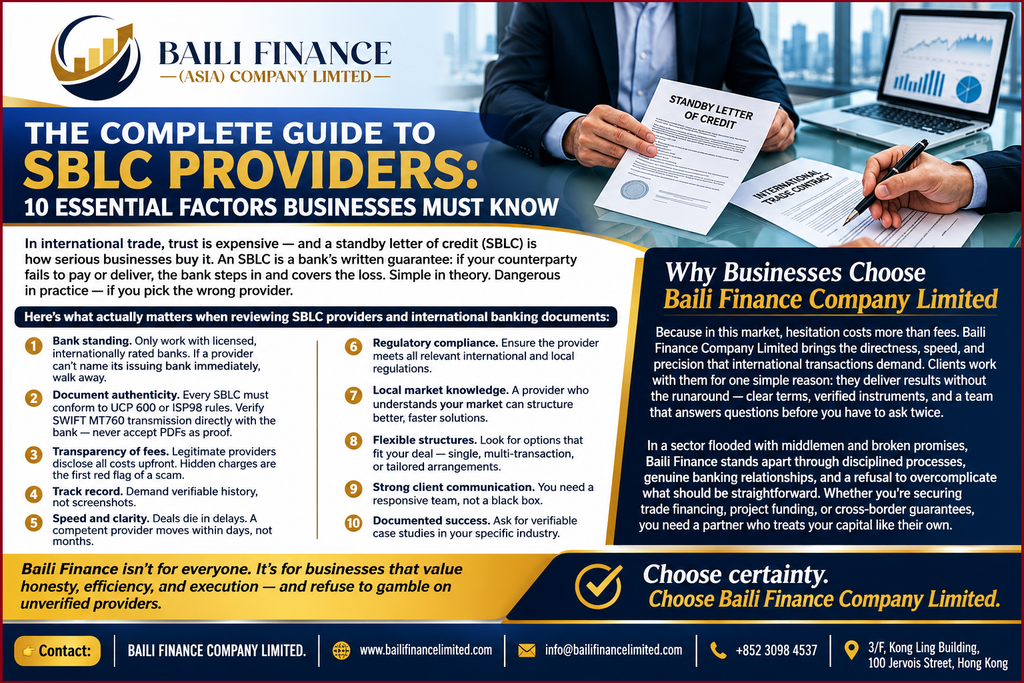
1. Verify the Actual Issuing Bank
This should be one of the first steps.
Ask the provider to explain which bank will issue the proposed SBLC and whether it acts directly or through an intermediary.
Where appropriate, independently establish the issuing bank’s legal identity, banking status and relevant regulatory position.
Do not treat a provider’s website, marketing materials or corporate registration as proof that a particular bank has approved an issuance.
The issuing bank’s financial standing is central to the instrument’s commercial value.
2. Examine the Issuing Bank’s Creditworthiness
An SBLC provides limited commercial value if the beneficiary does not consider the issuing bank acceptable.
Evaluate:
- The issuing bank’s financial strength.
- Its credit ratings, where available.
- Its country and jurisdictional risk.
- Its reputation in international banking.
- The beneficiary’s acceptance requirements.
- Whether confirmation from another acceptable bank is necessary.
A reputable intermediary cannot replace the creditworthiness of the actual issuing institution.
3. Understand the Applicable International Rules
Two important frameworks are:
- ISP98: International Standby Practices 1998.
- UCP 600: Uniform Customs and Practice for Documentary Credits.
ISP98 provides rules specifically designed for standby letters of credit. UCP 600 may also govern an SBLC where the instrument incorporates those rules and their application is appropriate.
The parties should determine which rules govern the undertaking before issuance.
Read the ICC International Standby Practices reference to understand the framework.
4. Confirm SWIFT Transmission Arrangements
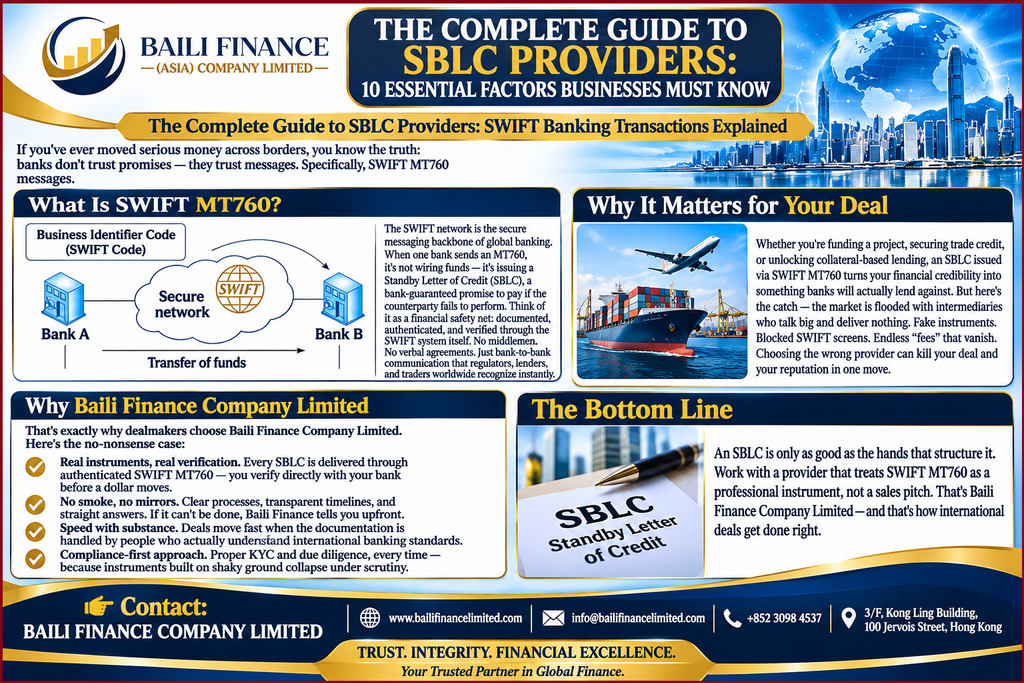
International SBLC transactions may involve SWIFT messaging, including MT760, which banks use to transmit guarantee and standby letter of credit messages.
However, the mention of SWIFT MT760 in a proposal does not establish that an instrument has been issued, authenticated or accepted.
Businesses should independently verify the message through the appropriate banking channels.
Never rely exclusively on screenshots, copied message text or documents supplied by an unverified intermediary.
5. Review the SBLC Wording
The wording determines the rights and responsibilities of the parties.
Before accepting an instrument, review:
- Applicant’s legal name.
- Beneficiary’s legal name.
- Issuing bank’s identity.
- Face value and currency.
- Expiry date and place of presentation.
- Governing rules.
- Drawing conditions.
- Presentation requirements.
- Amendment provisions.
- Applicable law and jurisdiction.
An SBLC with unsuitable drawing conditions may fail to provide the protection that the beneficiary expects.
Legal and trade finance professionals should review the proposed wording before issuance.
6. Examine the Provider’s Transaction Process
A professional SBLC provider should explain its process clearly.
The applicant should understand the documentation requirements, eligibility assessment, bank coordination, transaction costs, approval stages and expected communication procedures.
Avoid providers that refuse to explain their operational role or cannot identify the responsibilities of the parties involved.
7. Demand Transparent Pricing
SBLC issuance involves costs that may depend on the amount, tenor, issuing institution, applicant’s credit profile, collateral arrangements and transaction structure.
Ask for a written breakdown of:
- Arrangement fees.
- Bank issuance charges.
- Collateral requirements.
- Advising or confirmation charges.
- Legal and documentation expenses.
- Amendment charges.
- Other transaction-related costs.
Be particularly cautious of unusually low fees accompanied by guaranteed approval or immediate issuance claims.
8. Evaluate Compliance and Due Diligence
International financial transactions require appropriate identity verification, ownership checks, source-of-funds assessment and transaction-purpose reviews.
Depending on the jurisdiction and institutions involved, additional compliance documentation may apply.
A credible transaction process should not encourage applicants to bypass banking procedures.
9. Understand the Provider’s Role in Monetization
Some businesses seek SBLC monetization rather than issuance alone.
Monetization refers to arrangements intended to obtain financing against an acceptable financial instrument.
However, an SBLC does not automatically become cash or guarantee that a lender will advance funds.
A prospective monetization transaction requires a willing financing institution, acceptable instrument terms, credit assessment, collateral or risk arrangements where applicable, and a separate financing agreement.
Request written confirmation of the proposed lender, financing conditions, fees, repayment obligations and recourse provisions.
10. Review the Contract Before Making Payments
Never proceed based solely on verbal assurances.
Review the agreement, including:
- The provider’s precise contractual role.
- The proposed issuing institution.
- Refund and cancellation conditions.
- Payment milestones.
- Performance obligations.
- Governing law.
- Dispute resolution provisions.
- Confidentiality and compliance requirements.
Independent legal review can help identify contractual risks before the applicant commits funds.
5. How Does the SBLC Issuance Process Work?
Although individual transactions differ, international SBLC issuance generally follows a structured process.
Understanding these stages helps applicants prepare the necessary information.
Step 1: Define the Financial Requirement
The applicant identifies the commercial purpose of the SBLC.
This includes the required amount, currency, beneficiary, transaction type and validity period.
The applicant should also establish whether the beneficiary requires a particular issuing bank, jurisdiction or governing rule.
Step 2: Submit an Application
The applicant provides the provider or arranging institution with relevant corporate and transaction information.
Typical documents may include:
- Certificate of incorporation.
- Company registration information.
- Directors’ identification documents.
- Beneficial ownership details.
- Financial statements.
- Bank reference information, where required.
- Underlying commercial contract.
- Beneficiary details.
- Proposed SBLC wording.
Additional information may be necessary depending on the applicant and transaction.
Step 3: Compliance and Financial Assessment
The relevant financial institutions conduct their required due diligence.
They may evaluate the applicant’s financial position, business activities, source of funds, collateral availability and transaction purpose.
The issuing bank determines whether it is prepared to assume the proposed undertaking.
Step 4: Agree on the Transaction Structure
Once the relevant parties have assessed the application, they establish the proposed structure.
This includes the issuing institution, SBLC amount, tenor, fees, collateral arrangements, governing rules and other conditions.
The beneficiary should review the proposed wording before issuance.
Step 5: Execute the Required Agreements
The applicant completes the required contractual and banking documentation.
All applicable charges, collateral arrangements and compliance conditions should be clearly established.
Step 6: Bank Issuance and SWIFT Transmission
Following the required approvals and completion of the bank’s procedures, the issuing bank may issue the SBLC.
Where the transaction uses SWIFT MT760, the issuing bank transmits the relevant message through the banking network.
The beneficiary or its bank should authenticate the instrument through appropriate channels.
Step 7: Beneficiary Review and Acceptance
The beneficiary examines the SBLC to establish whether it satisfies the underlying contractual requirements.
If the instrument contains errors or unacceptable provisions, the parties may need to arrange amendments.
Once accepted, the SBLC provides the agreed financial protection throughout its validity, subject to its terms.
6. SBLC Monetization Companies: How Does Monetization Work?
One of the most frequently discussed subjects in international structured finance is SBLC monetization.
Businesses sometimes seek monetization because they hold or expect to receive an acceptable SBLC but require additional financing to support commercial activities.
An SBLC monetization company typically arranges or facilitates a financing structure in which a lender evaluates the standby instrument and considers whether to extend credit against it.
The financing arrangement may involve a direct lender, a bank, a private credit institution or another eligible financial counterparty.
What Determines SBLC Monetization Eligibility?
Several factors influence whether an SBLC can support a financing arrangement.
1. Issuing bank: The lender evaluates the identity, financial strength and acceptability of the issuing institution.
2. Instrument authenticity: The SBLC must be independently verifiable through appropriate banking channels.
3. Face value: The amount of the undertaking may influence the potential financing structure.
4. Tenor: The validity period must align with the lender’s requirements.
5. Wording: The instrument must contain provisions acceptable to the prospective lender.
6. Beneficiary and transaction structure: The lender evaluates the parties’ legal rights and the proposed use of the instrument.
7. Financing terms: The lender determines the amount, pricing, repayment conditions and any collateral or recourse arrangements.
Is SBLC Monetization Always Non-Recourse?
No.
The expression non-recourse means that the lender’s contractual recovery rights are limited to specified assets or sources, subject to the agreement and applicable law.
However, the use of an SBLC does not automatically make a financing arrangement non-recourse.
Businesses must distinguish between the SBLC itself and the separate financing contract.
Before proceeding, establish whether the financing carries personal guarantees, corporate repayment obligations, collateral requirements, indemnities or other recourse provisions.
This distinction is essential when comparing SBLC monetization companies and their financing proposals.
7. SBLC Providers vs Bank Guarantee Providers: What Is the Difference?
SBLCs and bank guarantees share important characteristics. Both can provide independent financial undertakings supporting contractual or payment obligations.
However, their terminology, governing rules and market practices may differ.
| Comparison | SBLC | Bank Guarantee |
|---|---|---|
| Main purpose | Supports financial or performance obligations | Supports financial or performance obligations |
| Common rules | ISP98 or UCP 600 | URDG 758 or other agreed rules |
| Typical markets | Widely used internationally | Widely used internationally |
| Payment conditions | Defined documentary presentation | Defined documentary demand |
| Issuing institution | Usually a bank | Usually a bank |
| Commercial application | Trade, credit support and project finance | Construction, tenders and contractual security |
Neither instrument is automatically superior.
The appropriate choice depends on the underlying transaction, the beneficiary’s requirements, the applicable legal framework and the issuing institution’s willingness to provide the undertaking.
For example, a construction project owner may prefer a demand guarantee subject to URDG 758, while an international lender may specifically request an SBLC subject to ISP98.
The parties should agree on the instrument before arranging issuance.
8. Real-World Example: How an SBLC Supports an International Transaction
Consider a publicly available example of how organisations use standby letters of credit to protect financial obligations.
The United Kingdom’s Office of Gas and Electricity Markets (Ofgem) has published a standby letter of credit template for obligations relating to domestic customer credit balances.
The template identifies the issuing bank, applicant and beneficiary, defines the maximum amount, specifies the demand process and establishes expiry provisions.
It also incorporates provisions addressing the applicable international rules and the issuer’s payment undertaking.
This illustrates an important point: an SBLC is not simply a general statement that a company has financial backing. It is a documented undertaking with specific parties, amounts, presentation conditions and legal consequences.
The published Ofgem Standby Letter of Credit Template provides a useful practical reference for understanding how an institutional beneficiary structures its requirements.
Businesses can learn from this example by paying particular attention to the issuer’s identity, the beneficiary’s rights, the maximum amount and the expiry conditions.
9. Case Study: How an SBLC Provider Can Support a Large Infrastructure Project
The following is an illustrative case study based on a realistic international project-finance scenario. It is not a claim about a completed Baili Finance client transaction.
Background
An international engineering company receives an opportunity to participate in a large infrastructure development project.
The project owner requires the successful contractor to provide financial security before commencing work.
The contract requires a performance SBLC with a face value of USD 5 million.
Although the engineering company has the technical capacity to undertake the project, its existing banking facilities do not accommodate the required instrument.
Consequently, the company approaches an international financial services provider to explore an appropriate SBLC arrangement.
The Challenge
The company faces three principal challenges:
- Its existing banking facility cannot accommodate the full required SBLC amount.
- The project owner requires an acceptable issuing bank.
- The instrument must comply with specific contractual wording and presentation requirements.
The company cannot simply obtain any standby letter of credit. It needs an instrument that meets the beneficiary’s requirements.
The Proposed Solution
The company engages an SBLC arrangement provider to assess the transaction.
The provider reviews the project contract, the required instrument amount, the beneficiary’s conditions and the company’s financial documentation.
Following the initial assessment, the parties identify a proposed banking structure.
The issuing institution conducts its own independent credit and compliance assessment before deciding whether to approve the issuance.
The parties then agree on the required wording, expiry period, governing rules and applicable fees.
Implementation
After the relevant approvals and contractual requirements have been satisfied, the issuing bank proceeds with the proposed SBLC issuance.
The bank transmits the instrument through the agreed banking channel.
The beneficiary’s bank verifies the instrument, and the project owner reviews its wording against the contract.
Following acceptance, the engineering company satisfies the project’s financial security requirement.
Business Outcome
The company can now proceed with the next contractual stage, subject to the remaining project conditions.
The SBLC does not itself finance construction or guarantee project profitability. Rather, it addresses the specific financial security requirement that previously prevented contractual progress.
Key Lessons
This example demonstrates five important principles:
- An SBLC must address a defined commercial requirement.
- The issuing bank’s acceptability is central to the transaction.
- The beneficiary should review the wording before issuance.
- Financial institutions retain independent approval authority.
- A standby letter of credit and a separate project financing facility serve different purposes.
The principal lesson is that successful SBLC arrangements begin with transaction suitability, not promises of immediate issuance.
10. Why Businesses Consider BAILI FINANCE (ASIA) COMPANY LIMITED
When evaluating international SBLC providers, businesses should consider the provider’s service scope, transaction approach, communication standards and ability to coordinate relevant financial arrangements.
BAILI FINANCE (ASIA) COMPANY LIMITED is a Hong Kong-registered financial services company whose published services include standby letters of credit, bank guarantees, international trade finance, structured financial solutions and SBLC monetization arrangements.
The company’s website identifies its corporate registration number as 2315541 and its business registration number as 65543223.
Its published service offering addresses businesses, contractors, traders, project developers and companies seeking structured financial solutions.
Here are some areas prospective clients can explore.
A. SBLC Issuance and Arrangement
BAILI FINANCE provides information and enquiries concerning SBLC issuance and arrangements for qualifying business transactions.
The proposed structure depends on the applicant’s requirements, the transaction’s commercial purpose and the relevant banking institution’s approval.
B. SBLC Monetization
Businesses interested in obtaining financing against an acceptable standby letter of credit can enquire about the available monetization arrangements.
Each proposed transaction requires separate financial assessment, lender acceptance and agreement on financing conditions.
C. Bank Guarantee Services
In addition to SBLC-related services, the company publishes information concerning bank guarantees for contractual performance, tender requirements, advance payments and financial obligations.
D. International Trade Finance
Cross-border trade requires coordination between commercial parties, financial institutions and service providers.
BAILI FINANCE offers international trade finance solutions designed to address the financial requirements of businesses operating across different markets.
E. Structured Financial Solutions
Some businesses require more than a single financial instrument.
Depending on the transaction, a structured solution may involve several financing components, contractual arrangements and banking relationships.
The company’s financing services provide a point of enquiry for businesses exploring these requirements.
For further information, visit:
Website: https://www.bailifinancelimited.com
SBLC Services: https://www.bailifinancelimited.com/sblc.html
Email: info@bailifinancelimited.com
Telephone: +852 3098 4537
Prospective clients should discuss their specific requirements with the company and independently verify the proposed issuing bank, instrument and financing terms before entering into an agreement.
11. Common Mistakes to Avoid When Selecting SBLC Providers
Even experienced business owners can encounter difficulties when arranging international banking instruments.
The following mistakes deserve particular attention.
Mistake 1: Confusing an Intermediary With an Issuing Bank
A financial arranger and an issuing bank have different legal responsibilities.
Always establish which institution assumes the payment undertaking.
Mistake 2: Accepting Guaranteed Issuance Claims
No responsible intermediary should represent that an independent bank must approve an application.
The issuing bank retains authority over its credit, compliance and risk assessment.
Mistake 3: Ignoring the Beneficiary’s Requirements
An SBLC that does not satisfy the beneficiary’s requirements may be commercially unsuitable.
Obtain the beneficiary’s specifications before beginning the application.
Mistake 4: Assuming SWIFT MT760 Guarantees Acceptance
MT760 is a banking message type, not an independent guarantee of commercial acceptance.
The underlying undertaking must be authenticated and reviewed.
Mistake 5: Overlooking Expiry and Presentation Conditions
An SBLC may lose its value to the beneficiary if it expires before the relevant obligations conclude.
The parties should establish sufficient validity and clear presentation requirements.
Mistake 6: Treating Monetization as Automatic
Owning or arranging an SBLC does not guarantee that a lender will provide financing.
Monetization requires separate approval and contractual arrangements.
Mistake 7: Making Payments Without Reviewing the Agreement
Always examine the contractual terms, payment obligations, refund conditions and provider responsibilities.
Independent professional advice is particularly important for substantial cross-border transactions.
12. The Future of SBLC Providers in International Finance
The demand for financial instruments that support international business continues to reflect the importance of cross-border trade, infrastructure investment and structured financing.
As businesses expand into new markets, they must address different banking requirements, regulatory frameworks, contractual obligations and counterparty risks.
SBLC providers will continue to play a role in helping eligible businesses navigate these requirements through banking relationships, transaction structuring and financial coordination.
However, the quality of a provider’s service will depend on more than its ability to introduce a financial product.
Businesses will increasingly need transparent transaction processes, independently verifiable banking arrangements, appropriate compliance procedures and financing structures that reflect actual commercial requirements.
Technology will also influence how financial institutions exchange documents, authenticate messages and coordinate international transactions.
Nevertheless, the fundamental principles will remain unchanged: the issuing institution must stand behind its undertaking, the beneficiary must understand its rights, and the instrument must contain enforceable terms that address the underlying transaction.
For businesses considering an SBLC, selecting the right financial partner should therefore involve careful assessment rather than decisions based solely on marketing claims.
13. Frequently Asked Questions About SBLC Providers
The following answers address common questions from business owners, importers, exporters, contractors, project developers and investors researching SBLC providers.
1. What are SBLC providers?
SBLC providers are banks or specialist financial service companies that issue, arrange or facilitate Standby Letters of Credit for eligible businesses.
Some providers issue instruments directly as banks, while others coordinate arrangements through issuing financial institutions.
Before proceeding, applicants should establish the provider’s exact role and identify the bank responsible for the undertaking.
2. Who are the best SBLC providers?
The best SBLC provider depends on the applicant’s financial requirements, the beneficiary’s acceptance criteria, the issuing bank’s creditworthiness and the transaction’s jurisdiction.
Businesses should assess the provider’s banking relationships, transparency, compliance procedures, contractual terms and ability to coordinate the required instrument.
A provider should not be selected solely because it advertises a low issuance fee or fast processing.
3. How much does an SBLC cost?
SBLC costs vary according to several factors, including:
- The instrument’s face value.
- The validity period.
- The issuing bank.
- The applicant’s credit profile.
- Collateral requirements.
- Transaction complexity.
- Advising and confirmation arrangements.
There is no universal SBLC issuance fee applicable to every transaction.
Applicants should request a detailed written quotation before proceeding.
4. What is the minimum amount for an SBLC?
There is no single universal minimum amount for every SBLC.
The acceptable amount depends on the issuing institution, its internal policies, the transaction’s purpose and the beneficiary’s requirements.
Applicants should communicate the required amount and currency during the initial assessment.
5. What is SWIFT MT760 in an SBLC transaction?
SWIFT MT760 is a message type used by banks to transmit guarantee and standby letter of credit information.
It facilitates communication between financial institutions during the issuance process.
However, applicants and beneficiaries should authenticate the instrument through their respective banks rather than relying on copied messages or screenshots.
6. Can an SBLC be monetized?
An SBLC may support a financing arrangement if a lender considers the instrument acceptable.
The lender evaluates the issuing bank, instrument wording, validity, beneficiary rights and overall transaction risk.
Monetization is not automatic, and the financing terms require separate approval and documentation.
7. What is the difference between an SBLC and a bank guarantee?
Both instruments can provide financial security for commercial obligations.
An SBLC generally operates under ISP98 or UCP 600 when those rules are incorporated. Demand guarantees commonly operate under URDG 758.
The appropriate instrument depends on the transaction, legal framework and beneficiary’s requirements.
8. How long does it take to obtain an SBLC?
The processing period depends on the applicant’s documentation, compliance assessment, issuing bank’s approval procedures, transaction structure and beneficiary’s requirements.
Some applications require additional due diligence or revisions to the proposed wording.
Applicants should request a realistic transaction timetable rather than relying on guaranteed delivery claims.
9. Can a company obtain an SBLC without collateral?
Possibly, depending on the issuing bank’s credit assessment and the applicant’s financial position.
Some institutions may consider credit facilities, cash collateral, other security arrangements or acceptable third-party support.
However, applicants should not assume that an SBLC can be obtained without collateral or financial commitments.
10. Are SBLC providers banks?
Not necessarily.
Some SBLC providers are licensed banks that issue instruments directly. Others are financial service companies, arrangers or intermediaries that coordinate issuance through banks.
Businesses should identify the actual issuer before entering into a transaction.
11. Which international rules govern standby letters of credit?
ISP98 and UCP 600 are two important frameworks used for standby letters of credit.
The parties should specify the applicable rules in the instrument itself.
The legal effect of the undertaking also depends on its wording, applicable law and jurisdiction.
12. How can I verify an SBLC?
The beneficiary should contact its bank and request independent authentication through appropriate banking channels.
Verification should establish the issuing institution’s identity, the instrument’s reference, its terms and its authenticity.
Documents supplied only by an intermediary should not replace independent bank-to-bank verification.
Conclusion: Choose an SBLC Provider That Understands Your Financial Objectives
Selecting the right SBLC provider is an important decision for businesses involved in international trade, infrastructure development, project financing and large commercial transactions.
A Standby Letter of Credit can provide an independent financial undertaking that supports contractual obligations, improves transaction security and helps businesses meet the financial requirements of their commercial partners.
However, the value of an SBLC depends on several factors. These include the issuing bank’s financial standing, the instrument’s wording, the applicable international rules, the beneficiary’s acceptance requirements and the authenticity of the banking transmission.
Furthermore, businesses exploring SBLC monetization must understand that an SBLC does not automatically generate liquidity. Any financing arrangement requires separate approval, appropriate documentation and clearly defined contractual obligations.
For this reason, choosing an SBLC provider should never be based exclusively on promotional claims, advertised fees or promises of immediate issuance.
Instead, businesses should prioritize transparency, professional transaction coordination, independent verification and a clear understanding of the financial structure.
BAILI FINANCE (ASIA) COMPANY LIMITED provides an avenue for businesses seeking information and assistance concerning SBLC issuance, SBLC monetization, bank guarantees and international trade finance.
Whether you are an importer, exporter, contractor, project developer, corporate borrower or financial intermediary, understanding your requirements is the first step towards identifying an appropriate financial solution.
Take the Next Step With BAILI FINANCE
Your next international business transaction may require more than conventional banking facilities. It may require a financial instrument structured around your contractual commitments, funding objectives and beneficiary’s requirements.
Do not spend valuable time exploring unsuitable financial arrangements.
Speak with BAILI FINANCE (ASIA) COMPANY LIMITED about your SBLC requirements today.
Visit: www.bailifinancelimited.com to explore the available financial services, discuss your transaction requirements and request an initial assessment.
You can also contact the team directly:
- Website: https://www.bailifinancelimited.com
- Email: info@bailifinancelimited.com
- Telephone: +852 3098 4537
- Location: Hong Kong
Tell us what your business needs, the amount of the proposed SBLC, your preferred validity period and the purpose of the transaction. Our team can discuss the relevant requirements and potential structuring options with you.
Make your next financial decision with a clear understanding of the instrument, the issuing institution and the transaction terms.
BAILI FINANCE — Supporting International Business Through Structured Financial Solutions.
Intermediaries/Consultants/Brokers are welcome to bring their clients 100% protected. Our brokers receive 2% commission for referral. We assist Clients and brokers in their attempt to secure funding by working on their funding requests that may require innovative financing. In complete confidence, we will work together for the benefits of all parties involved.
#SBLCProviders #StandbyLetterOfCredit #SBLCFinancing #SBLCMonetization #InternationalTradeFinance #BankGuarantee #SWIFTMT760 #ProjectFinancing #StructuredFinance #TradeFinance