
Headline: Technology Financing: The Complete Guide to Funding Innovation, Digital Transformation and Business Growth
Technology has become a central component of business operations, corporate competitiveness and long-term economic development. From artificial intelligence and cloud computing to cybersecurity, automation, telecommunications and enterprise software, organisations increasingly depend on technology to improve productivity, manage costs and expand into new markets. However, acquiring, developing and implementing these systems requires capital. This is where technology financing becomes essential.

Technology financing provides businesses, technology companies, entrepreneurs and project developers with access to capital for acquiring equipment, developing software, implementing digital infrastructure, upgrading existing systems and commercialising technological innovations. It also enables organisations to undertake technology investments without necessarily funding every expense from existing cash reserves.
For businesses pursuing digital transformation, access to appropriate financing can determine how quickly they implement new systems, manage operational costs and achieve their investment objectives. Nevertheless, choosing the right financing structure requires careful consideration of project costs, projected revenue, repayment capacity, asset values and commercial risks.
According to the International Finance Corporation (IFC), micro, small and medium-sized enterprises account for more than 90% of businesses worldwide and face substantial financing constraints in emerging markets. This demonstrates why accessible business finance remains important for organisations seeking to invest, expand and innovate.
At BAILI FINANCE (ASIA) COMPANY LIMITED, we recognise the importance of structured financing in supporting business expansion, equipment acquisition, operational investment and commercially viable projects. Through tailored financing discussions and structured financial solutions, businesses can explore funding arrangements that reflect their capital requirements and strategic objectives.
This comprehensive guide explains how technology financing works, the available funding options, eligibility considerations, benefits, risks, application processes and practical considerations for businesses seeking technology investment financing.
Keywords: Technology Investment Financing, Technology Funding, Business Technology Financing, Technology Equipment Financing, Corporate Technology Financing, Technology Project Financing, Digital Transformation Financing, IT Infrastructure Financing, Business Financing Solutions, Structured Financing, How to obtain technology financing for businesses, Best financing options for technology companies, Business loans for technology equipment, Financing solutions for digital transformation, How companies finance technology investments, Funding for technology infrastructure projects, Equipment financing for IT companies, Technology financing for small and medium-sized businesses, Financing options for software development, Corporate financing for technology expansion.
What Is Technology Financing?
Technology financing refers to the provision of financial resources to businesses, organisations, entrepreneurs and technology developers for purchasing, developing, upgrading or implementing technology-related products, systems and infrastructure.
Rather than requiring an organisation to pay the entire cost of a technology investment immediately, financing arrangements can distribute the expenditure over an agreed period or introduce capital from external investors.
Depending on the transaction, technology financing may support:
- Computer hardware, servers and networking infrastructure.
- Software development and enterprise applications.
- Artificial intelligence and machine learning projects.
- Cloud computing and data storage infrastructure.
- Cybersecurity systems and information technology upgrades.
- Telecommunications equipment and digital networks.
- Industrial automation and robotics.
- Research and development of new technologies.
- Medical technology and specialised equipment.
- Digital transformation and business process automation.
Technology financing isn’t restricted to technology companies. Manufacturing businesses, hospitals, logistics operators, financial institutions, educational organisations, telecommunications providers and commercial enterprises also require funding to acquire and implement technology.
For example, a manufacturing company may need financing to introduce automated production equipment. A healthcare organisation may require capital to install diagnostic systems and electronic medical record infrastructure. Similarly, a financial services company may seek funding to implement cybersecurity systems, upgrade its payment infrastructure or develop a digital banking platform.
In each situation, the financing requirement depends on the project’s objectives, financial structure, implementation schedule and expected commercial benefits.
Why Technology Financing Matters for Modern Businesses
Technology investment requires financial planning. Even when a company understands the operational benefits of adopting new systems, the initial capital requirement may exceed its available cash reserves.
Consequently, businesses that cannot finance technology investments internally may delay important upgrades, restrict expansion or continue using inefficient systems.
Technology financing addresses this challenge by providing access to capital that supports investment while helping businesses manage their available liquidity.
1. Supports Digital Transformation
Digital transformation involves integrating technology into business operations, customer services, financial management and organisational processes.
However, successful implementation often requires expenditure on software licences, infrastructure, consultants, employee training, cybersecurity and system integration.
Technology financing allows businesses to explore funding arrangements for these investments without relying exclusively on retained earnings.
2. Preserves Working Capital
Working capital supports everyday business activities, including payroll, inventory purchases, supplier payments and operational expenses.
Using substantial cash reserves to purchase technology can reduce the funds available for these activities.
An appropriate financing structure may allow a business to distribute technology expenditure across an agreed repayment period, subject to affordability and the facility’s terms.
This can help management maintain a more balanced capital allocation strategy.
3. Improves Operational Efficiency
Technology investments can reduce manual processes, improve reporting, increase production capacity and strengthen operational controls.
For example, an automated inventory management system can help a distributor monitor stock levels, identify purchasing requirements and reduce administrative errors.
Similarly, enterprise resource planning software can integrate financial reporting, procurement, inventory and operational information.
Financing these investments can help businesses implement improvements according to their operational priorities.
4. Supports Innovation and Research
Technology development frequently requires significant expenditure before a company generates commercial revenue.
Research and development activities may involve specialised personnel, laboratories, software infrastructure, testing equipment and product development.
Access to suitable funding can support these activities and help businesses progress from research to commercialisation.
Nevertheless, lenders and investors generally evaluate the technical feasibility, intellectual property position, market demand and commercial prospects of the proposed project.
5. Strengthens Business Competitiveness
Businesses that invest in relevant technology can improve service delivery, information management, product quality and customer experience.
For organisations operating across multiple markets, modern digital infrastructure also supports communication, reporting and international operations.
Financing can therefore help companies undertake necessary investments while managing their broader financial commitments.

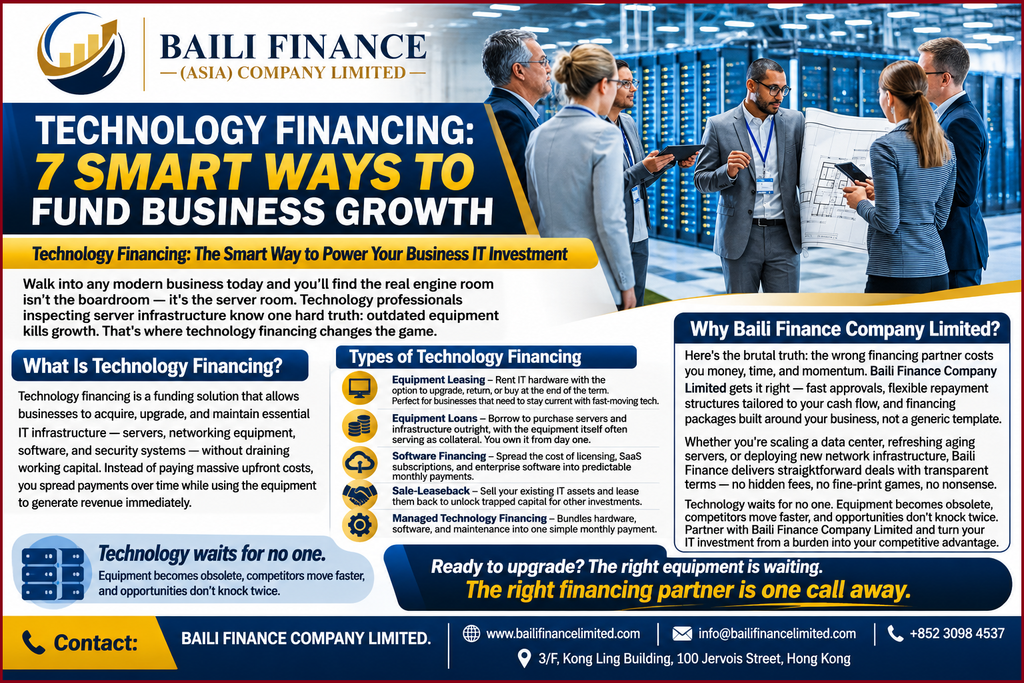
Types of Technology Financing Available to Businesses
There isn’t one financing structure suitable for every technology investment. The appropriate arrangement depends on the amount required, business maturity, asset ownership, repayment capacity and investment objectives.
Understanding the principal technology financing options helps business owners make informed decisions.
1. Technology Equipment Financing
Technology equipment financing provides capital for acquiring physical technology assets.
These may include:
- Servers and data centre equipment.
- Computers and enterprise hardware.
- Telecommunications infrastructure.
- Industrial automation systems.
- Medical diagnostic equipment.
- Networking and security infrastructure.
- Robotics and specialised machinery.
Depending on the arrangement, a financing provider may lend against the equipment, finance the purchase directly or structure an instalment-based acquisition.
Equipment financing can be particularly useful when the asset has an identifiable commercial purpose and a measurable useful life.
Businesses should consider maintenance expenses, depreciation, insurance, replacement costs and repayment obligations before committing to a facility.
2. Software and IT Infrastructure Financing
Software implementation can involve substantial expenditure, particularly for organisations adopting enterprise-level systems.
Technology financing may support investments in:
- Enterprise resource planning systems.
- Customer relationship management platforms.
- Accounting and financial management software.
- Cloud infrastructure.
- Data analytics platforms.
- Cybersecurity applications.
- Digital payment systems.
- Business automation software.
Unlike physical equipment, software investments may involve recurring subscription fees, implementation charges and ongoing technical support.
Consequently, financing assessments should distinguish between one-time capital expenditure and continuing operating expenses.
3. Business Loans for Technology Investment
Business loans can provide capital for companies seeking to acquire technology, upgrade infrastructure or finance broader operational improvements.
Depending on the lender and facility, the funds may support several related business requirements.
For example, an established company may require capital to purchase servers, implement new enterprise software and recruit technical personnel.
A business loan may help fund these activities under an agreed repayment structure.
The lender will typically assess the company’s financial statements, cash flow, existing liabilities, management experience and intended use of funds.
4. Venture Capital Financing
Venture capital involves investors providing equity capital to businesses with growth potential.
This funding model is particularly relevant to technology startups developing innovative products, software platforms or technology-based services.
Unlike conventional debt, equity investment doesn’t normally require scheduled principal and interest repayments. Instead, investors receive an ownership interest and expect financial returns through business growth, dividends or an eventual exit.
However, founders must consider ownership dilution, investor participation rights, governance requirements and exit expectations.
Venture capital is therefore more appropriate for certain growth-stage businesses than for companies simply seeking to purchase operational equipment.
5. Venture Debt Financing
Venture debt provides borrowing facilities to qualifying venture-backed or high-growth companies.
It can complement equity financing by providing additional capital without requiring the company to issue as many new shares.
Companies may use venture debt to support working capital, capital expenditure, expansion or other approved business requirements.
However, venture debt introduces repayment obligations and may include financial covenants, security arrangements, warrants or other conditions.
According to a February 2026 study by FMO Ventures and Dalberg, technology-enabled businesses seek debt for working capital, capital expenditure and on-lending, although access remains constrained by collateral requirements, underwriting criteria and product availability. The report provides valuable insight into the financing requirements of technology-enabled companies.
Read the FMO study on debt financing for technology-enabled startups and scale-ups.
6. Technology Project Financing
Technology project financing supports specific investments with defined objectives, budgets, implementation schedules and expected financial or operational outcomes.
Examples include:
- Data centre construction.
- Telecommunications network development.
- Smart manufacturing installations.
- Enterprise-wide digital transformation.
- Technology infrastructure expansion.
- Large-scale software development.
- Renewable energy technology installations.
Project financing assessments may consider the project’s projected cash flows, contracts, technical feasibility, implementation risks and repayment sources.
This structure is particularly relevant when the proposed technology investment forms part of a larger commercial or infrastructure development.
7. Leasing and Asset-Based Financing
Leasing allows businesses to access technology equipment in exchange for agreed payments over a specified period.
It can reduce the initial capital requirement associated with acquiring certain assets.
Asset-based financing, on the other hand, uses eligible assets as security for borrowing.
Depending on the arrangement, businesses may use equipment, receivables, inventory or other acceptable assets to support a financing application.
Both approaches require careful assessment of ownership rights, contractual obligations, asset valuations and default provisions.
8. Structured and Mezzanine Financing
Some technology investments require more complex financing arrangements, particularly where conventional lending doesn’t fully satisfy the project’s capital requirements.
Structured financing can combine different funding sources or introduce transaction-specific repayment and security arrangements.
Mezzanine financing occupies a position between senior debt and equity within a company’s capital structure.
It may support expansion, acquisitions, technology commercialisation or projects requiring additional capital beyond the amount available through conventional senior lending.
However, mezzanine financing generally carries additional costs and risks because of its subordinated position.
Which Technology Investments Can Be Financed?
Technology financing covers a broad range of industries and investment categories.
The following examples illustrate common financing requirements.
| Technology sector | Potential financing requirements |
|---|---|
| Artificial intelligence | Computing infrastructure, software development and specialised equipment |
| FinTech | Payment systems, digital banking infrastructure and cybersecurity |
| Healthcare technology | Diagnostic equipment, medical systems and digital records |
| Telecommunications | Network equipment, fibre infrastructure and data transmission systems |
| Manufacturing technology | Robotics, industrial automation and production systems |
| Cloud computing | Servers, storage infrastructure and platform development |
| Cybersecurity | Security infrastructure, monitoring systems and data protection |
| Education technology | Learning platforms, digital classrooms and educational software |
| Renewable energy technology | Smart grids, energy storage and monitoring systems |
| Logistics technology | Fleet management, tracking and warehouse automation |
The financing structure should reflect the nature of the investment.
For example, a telecommunications infrastructure project may require long-term capital and detailed technical assessments. In contrast, a small enterprise purchasing computers and software may require a conventional business loan or equipment financing arrangement.
How Does Technology Financing Work?
Technology financing generally follows a structured process involving the identification of funding requirements, financial assessment, due diligence, financing evaluation and contractual execution.
Although individual providers have different procedures, the following stages explain how the process typically works.
Step 1: Identify the Technology Investment
The business must first establish what it intends to finance.
This includes identifying the equipment, software, infrastructure or development project and determining how the investment supports its commercial objectives.
A clear project definition helps prevent unnecessary borrowing and provides a basis for evaluating the proposed expenditure.
Step 2: Calculate the Required Capital
Businesses should prepare a detailed technology investment budget.
The budget may include:
- Purchase and installation costs.
- Software licences.
- Technical consultancy.
- Infrastructure development.
- Employee training.
- Maintenance and support.
- Insurance.
- Contingency expenditure.
- Working capital requirements.
It is important to distinguish between initial investment costs and recurring operational expenses.
Step 3: Evaluate the Financial Position
Financing providers generally assess the applicant’s ability to meet its financial obligations.
This may involve reviewing:
- Audited financial statements.
- Management accounts.
- Existing borrowing facilities.
- Cash flow projections.
- Revenue performance.
- Business assets.
- Outstanding liabilities.
- Credit history.
For technology startups, the assessment may also consider investment backing, intellectual property, customer contracts, product development and the company’s business model.
Step 4: Select an Appropriate Financing Structure
The company should compare the available financing options against its financial position and investment requirements.
For instance, equipment financing may suit a business acquiring identifiable physical assets.
A project financing structure may be more appropriate for a large infrastructure investment, while equity financing may suit a technology startup seeking capital to develop an innovative product.
The objective is to identify a financing structure that aligns with the project’s commercial realities.
Step 5: Complete Due Diligence
Due diligence helps financing providers evaluate the transaction’s financial, legal, technical and commercial risks.
Depending on the project, the review may include:
- Company registration documents.
- Ownership and management information.
- Technology supplier agreements.
- Equipment quotations.
- Technical specifications.
- Intellectual property documentation.
- Customer contracts.
- Project implementation schedules.
- Financial projections.
- Regulatory approvals.
Technology projects may also require cybersecurity, data protection and operational risk assessments.
Step 6: Review Financing Terms
Before accepting an offer, businesses should examine the proposed financing terms.
Important considerations include:
- Total financing amount.
- Interest rate or financing charges.
- Repayment schedule.
- Financing duration.
- Security requirements.
- Arrangement and administrative fees.
- Early repayment conditions.
- Default provisions.
- Financial covenants.
- Applicable legal and regulatory requirements.
The total cost of financing matters more than the advertised interest rate alone.
Step 7: Execute the Financing Agreement
Once the parties complete the necessary assessments and agree on the terms, they can proceed with the relevant contractual documentation.
Funds may be disbursed directly to the borrower, paid to approved suppliers or released according to agreed project milestones.
The exact disbursement method depends on the financing structure.
Step 8: Implement and Monitor the Investment
After receiving financing, the business should monitor expenditure, implementation progress and financial performance.
Management should compare actual project costs against the approved budget.
It should also assess whether the technology investment delivers the expected operational and commercial benefits.
Proper monitoring supports financial accountability and helps businesses manage repayment obligations.
Who Qualifies for Technology Financing?
Eligibility varies according to the financing provider, transaction size, jurisdiction and type of investment.
However, several categories of businesses may seek technology financing.
Established companies: Businesses seeking to upgrade IT infrastructure, automate operations or improve productivity.
Small and medium-sized enterprises: SMEs requiring funding to acquire business technology, improve digital capabilities or expand operations.
Technology startups: Early-stage companies developing software, artificial intelligence products, digital platforms and technology-based services.
Infrastructure developers: Companies undertaking telecommunications, data centre, network and technology infrastructure projects.
Healthcare providers: Hospitals, clinics and medical organisations acquiring specialised equipment and digital healthcare systems.
Manufacturing companies: Industrial businesses implementing robotics, automated machinery and advanced production systems.
Technology distributors: Businesses requiring working capital to purchase, distribute or maintain technology-related products.
Applicants should remember that eligibility doesn’t guarantee approval. Financing providers assess each application according to their own risk policies, financial criteria and transaction requirements.
Documents Required for Technology Financing
Preparing complete documentation can improve the efficiency of a financing assessment.
Although requirements differ between providers, applicants should generally prepare the following:
| Document | Purpose |
|---|---|
| Certificate of incorporation | Confirms legal business registration |
| Company profile | Explains business activities and operations |
| Business plan | Describes objectives and commercial strategy |
| Financial statements | Demonstrates historical financial performance |
| Bank statements | Supports cash flow assessment |
| Project proposal | Explains the proposed technology investment |
| Supplier quotations | Establishes estimated acquisition costs |
| Technical specifications | Identifies the required technology |
| Cash flow projections | Demonstrates expected financial performance |
| Existing loan details | Identifies current financial commitments |
| Ownership information | Supports identity and due diligence checks |
For larger transactions, additional documents may include feasibility studies, shareholder resolutions, security documentation, project contracts and independent asset valuations.
Applicants should provide accurate information and ensure that financial projections reflect reasonable assumptions.
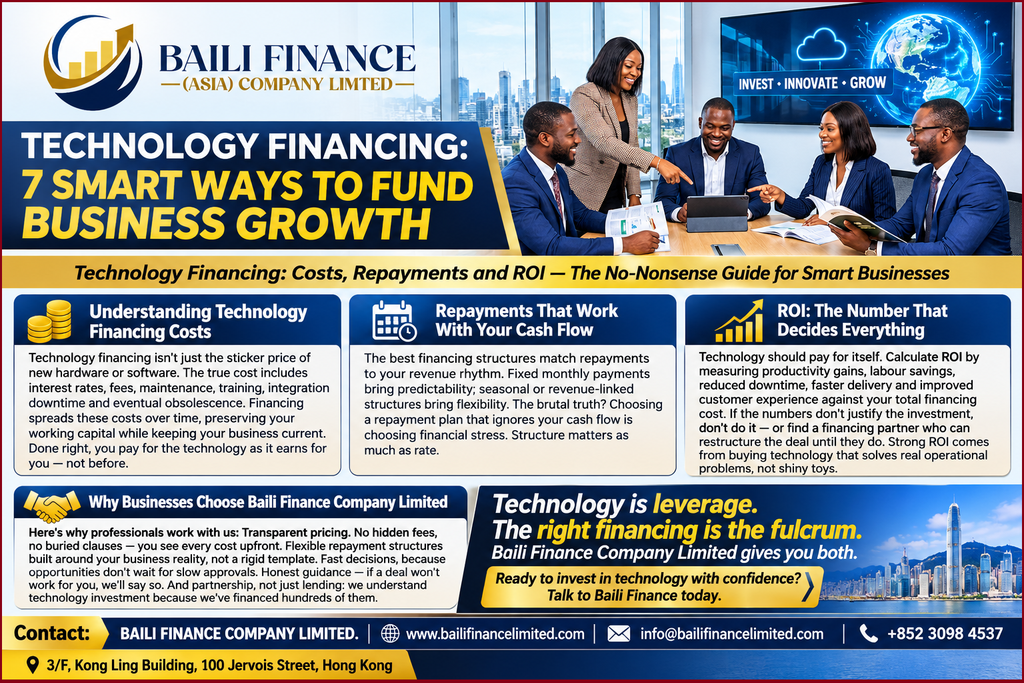
How to Calculate the Cost of Technology Financing
Understanding the total cost of borrowing is essential before committing to a technology investment.
Consider a hypothetical business seeking USD 500,000 to purchase enterprise technology equipment.
Assume the company receives a three-year loan with an illustrative annual interest rate of 10%, using monthly repayments and a standard amortising repayment structure.
Illustrative technology financing calculation
Loan amount
$500,000
Annual interest
10%
Loan duration
36 months
Repayment frequency
Monthly
Estimated monthly repayment
$16,134
Approximate total repayment: USD 580,820. Approximate interest: USD 80,820.
This calculation illustrates how a company can estimate its repayment obligations before proceeding.
Actual financing costs may differ because of fees, compounding conventions, repayment dates, security requirements and other contractual terms.
Businesses should also evaluate whether the technology investment can generate sufficient operating benefits or cash flow to support the financing obligations.
Benefits of Technology Financing
Technology financing can provide several commercial and financial advantages when structured appropriately.
Improved Cash Flow Management
Financing may reduce the need for large upfront payments, allowing businesses to retain funds for other operational requirements.
Access to Modern Technology
Companies can explore funding for equipment, software and infrastructure that may otherwise exceed their immediate capital budgets.
Business Expansion
Technology investment can support additional production capacity, improved service delivery and entry into new markets.
Better Capital Allocation
Businesses can allocate available funds across different operational priorities instead of concentrating expenditure on one technology purchase.
Predictable Financial Planning
Fixed repayment arrangements can help businesses forecast financing obligations, provided the terms and interest structure remain unchanged.
Support for Long-Term Development
Technology investments can contribute to improved operational capacity, product development and organisational efficiency.
However, these benefits depend on selecting suitable technology, managing implementation costs and maintaining the ability to meet financing obligations.
Risks and Challenges Associated With Technology Financing
Despite its advantages, technology financing introduces financial and operational risks that businesses must evaluate.
1. Technology Obsolescence
Technology changes rapidly. Equipment purchased today may require replacement or upgrades before the financing agreement expires.
Businesses should compare the useful life of an asset with the financing duration.
2. Repayment Pressure
Debt creates contractual repayment obligations regardless of whether the technology investment achieves its expected results.
Businesses should therefore assess cash flow carefully before borrowing.
3. Implementation Delays
Software integration, equipment installation and infrastructure development may take longer than expected.
Delays can increase project costs and postpone the financial benefits of the investment.
4. Cybersecurity and Data Protection
Digital systems introduce risks relating to unauthorised access, cyberattacks and information security.
Companies should include appropriate cybersecurity controls in their technology investment budgets.
5. Foreign Exchange Exposure
Businesses purchasing technology internationally may face currency fluctuations.
Where the financing currency differs from the company’s operating revenue currency, exchange rate movements may affect repayment affordability.
6. Supplier and Performance Risk
Technology suppliers may fail to deliver equipment or services according to agreed specifications and timelines.
Businesses should assess suppliers, verify contractual obligations and establish appropriate acceptance and warranty procedures.
7. Excessive Borrowing
Companies should avoid financing technology investments without a clear commercial justification.
A financing facility should support an identifiable business objective rather than increase liabilities without a reasonable prospect of operational or financial benefit.
Real-World Example: Technology Financing in Business Operations
Consider the experience of an established manufacturing company seeking to increase production capacity and improve operational reporting.
The company operates several production facilities and relies heavily on manual inventory management, traditional machinery and disconnected accounting systems.
As customer demand increases, management identifies three operational problems:
- Production delays caused by manual processes.
- Inventory management errors.
- Limited visibility into operating costs.
The company decides to implement an integrated enterprise resource planning system, acquire automated production equipment and upgrade its internal network infrastructure.
However, the total investment exceeds its available cash reserves.
Instead of using all its working capital, management evaluates several financing options.
The proposed investment includes:
| Investment category | Estimated cost |
|---|---|
| Automated production equipment | $300,000 |
| Enterprise software | $100,000 |
| Network and server infrastructure | $60,000 |
| Installation and integration | $25,000 |
| Employee training | $15,000 |
| Total investment | $500,000 |
The company considers an equipment financing facility for the physical machinery and a separate business financing arrangement for software implementation and infrastructure expenditure.
Before proceeding, management reviews its cash flow, existing liabilities, supplier agreements and projected operating savings.
It also establishes implementation milestones and evaluates the repayment requirements.
This example demonstrates how technology financing can support operational modernisation while allowing management to consider working capital preservation.
The actual outcome would depend on the financing terms, successful implementation and the company’s ability to achieve the expected operational improvements.

Case Study: Financing Digital Transformation for a Technology-Driven Enterprise
The following is an illustrative case study based on a realistic commercial financing scenario. It isn’t a representation of an independently verified Baili Finance client or a completed transaction.
Background
A technology services company has developed a cloud-based enterprise management platform for corporate customers.
Following several successful customer acquisitions, the company plans to expand its infrastructure, improve cybersecurity and increase its capacity to support additional users.
Management estimates that the expansion will require USD 2 million.
The proposed investment covers:
- Additional cloud computing infrastructure.
- Cybersecurity and data protection systems.
- Software development and platform upgrades.
- Additional server capacity.
- Technical personnel and implementation costs.
- Working capital for the expansion period.
Although the company generates recurring subscription revenue, its available cash reserves cannot comfortably support the entire investment.
Management therefore explores external financing.
The Financing Challenge
The company faces three principal challenges.
First, conventional lenders require sufficient evidence of repayment capacity and may not consider projected technology growth adequate security.
Second, the company wants to avoid excessive equity dilution.
Third, management needs a financing structure that accommodates the timing of infrastructure investment and projected revenue growth.
These considerations require a detailed assessment of the company’s financial position and proposed expansion.
The Proposed Financing Strategy
After reviewing its funding requirements, the company considers a combination of financing structures.
| Financing component | Illustrative amount |
|---|---|
| Senior business financing | $1,000,000 |
| Structured financing | $600,000 |
| Shareholder equity contribution | $400,000 |
| Total capital | $2,000,000 |
This illustrative structure distributes the investment across debt, structured capital and shareholder funding.
It also avoids relying exclusively on one source of capital.
Expected Commercial Outcomes
The company establishes measurable performance indicators to evaluate the investment.
These include:
- Increased platform capacity.
- Improved system availability.
- Stronger cybersecurity controls.
- Reduced infrastructure bottlenecks.
- Increased customer onboarding capacity.
- Improved operating cost management.
- Sustainable debt servicing capacity.
The company also establishes financial monitoring procedures to compare actual performance against its original projections.
Lessons for Businesses Seeking Technology Financing
This case study demonstrates several important principles.
First, establish the actual funding requirement. Businesses should distinguish between essential technology expenditure and optional upgrades.
Second, consider different financing sources. A combination of debt, structured financing and equity may be more suitable than relying on a single facility.
Third, demonstrate commercial viability. Financing proposals should explain how the investment supports business operations, revenue generation or measurable productivity improvements.
Fourth, maintain repayment discipline. Projected growth should not replace realistic cash flow analysis.
Finally, prepare for implementation risks. Technology projects require effective supplier management, technical oversight and financial monitoring.
A well-prepared financing proposal should therefore address both the capital requirement and the company’s ability to execute the investment successfully.
Technology Financing for Startups Versus Established Companies
The financing requirements of a technology startup differ significantly from those of an established enterprise.
Understanding these differences helps businesses identify more suitable funding arrangements.
| Consideration | Technology startups | Established businesses |
|---|---|---|
| Financial history | Often limited | Usually more extensive |
| Revenue | May be unpredictable | Often more established |
| Collateral | Frequently limited | May have eligible assets |
| Equity financing | Commonly considered | May be less necessary |
| Debt financing | Depends on eligibility and business maturity | Often more accessible |
| Primary investment | Research, development and market entry | Upgrades, automation and expansion |
| Main assessment | Business model, market potential and technical viability | Cash flow, financial performance and repayment capacity |
Technology startups may benefit from equity investment, grants, strategic partnerships and specialist venture debt.
Established businesses may have additional options through corporate loans, equipment financing, asset-based lending and structured finance.
Nevertheless, neither category automatically qualifies for financing. Each application requires an individual assessment.
How to Choose the Right Technology Financing Partner
Selecting a financing partner requires more than comparing advertised interest rates.
Businesses should evaluate the provider’s financing capabilities, transaction requirements, transparency and ability to understand the proposed investment.
Consider the following factors.
Financing Experience
Look for a provider with relevant experience in business lending, equipment financing, corporate funding or structured financial transactions.
A financing partner should understand the commercial purpose of the investment and the financial requirements associated with it.
Transparent Financing Terms
All financing charges, repayment obligations, security requirements and contractual conditions should be clearly documented.
Avoid entering arrangements that contain unclear fees or unrealistic promises.
Flexible Financing Structures
Different technology projects have different capital requirements.
A suitable financing partner should be able to evaluate the transaction and determine whether the proposed funding structure is commercially appropriate.
Due Diligence Standards
Professional financing providers should conduct appropriate assessments before committing capital.
Businesses should also perform their own verification of the financing provider, its legal identity, contractual authority and relevant regulatory status.
International Financing Capabilities
For businesses operating across multiple jurisdictions, cross-border financing experience may be important.
Currency exposure, local regulations, international payment arrangements and documentation requirements can affect transaction execution.
How BAILI FINANCE Supports Business and Technology-Related Financing Requirements
Technology investment often forms part of a wider corporate financing strategy.
A company acquiring advanced equipment may also require working capital. An infrastructure developer may need project financing. A technology distributor may require additional liquidity to support international procurement and inventory operations.
These requirements demonstrate the importance of considering the entire transaction rather than viewing technology expenditure in isolation.
BAILI FINANCE (ASIA) COMPANY LIMITED, a Hong Kong-based financial services firm, provides tailored financing and structured financial solutions for businesses and qualified clients across international markets.
Its financing activities include business loans, corporate financing, project finance, equipment financing, mezzanine financing, international trade finance and other structured funding requirements.
For organisations considering technology-related investments, these financing categories may provide relevant starting points for discussing the broader capital requirements of a project.
Depending on the transaction, financing discussions may involve:
Business and Corporate Financing
Businesses seeking capital for expansion, operational improvements or technology-related expenditure can explore appropriate business and corporate financing arrangements.
The assessment considers the applicant’s financial position, funding objectives and proposed use of capital.
Equipment Financing
Companies acquiring servers, machinery, automated production systems and other eligible operational assets may explore equipment financing structures.
The financing arrangement should reflect the nature and value of the assets, the applicant’s financial capacity and the commercial purpose of the acquisition.
Project Financing
Large-scale technology infrastructure developments may require funding based on defined project objectives, implementation schedules and projected financial performance.
Project financing discussions can consider the overall capital requirement, transaction structure and relevant project risks.
Mezzanine Financing
Where conventional senior financing doesn’t fully satisfy a company’s capital requirements, mezzanine financing may be considered, subject to the transaction’s suitability and the relevant risk assessment.
Structured Financing
Certain technology investments form part of wider commercial transactions involving several funding requirements.
Structured financing can provide a framework for evaluating these requirements and considering suitable combinations of financial instruments and capital sources.
Importantly, the availability of any financing facility depends on individual assessment, due diligence, funding arrangements and contractual approval. Mention of a financing category doesn’t constitute an offer or guarantee of funding.
Businesses can review the company’s financing solutions to understand its wider financing activities.
The Future of Technology Financing
Demand for technology investment continues to develop as businesses adopt artificial intelligence, automation, cloud infrastructure, advanced analytics and digital financial services.
These developments are changing the types of assets and projects that businesses need to finance.
Several areas are likely to remain important.
Artificial Intelligence Infrastructure
AI development and deployment require computing capacity, data storage, specialised hardware and supporting infrastructure.
Businesses implementing AI solutions may require financing for equipment acquisition, software development and infrastructure expansion.
Data Centres and Cloud Computing
Growing demand for digital services increases the importance of reliable computing and storage infrastructure.
Data centre projects may require substantial capital for land, buildings, power systems, cooling equipment, servers and connectivity.
These projects often require detailed feasibility assessments and long-term capital planning.
Cybersecurity Investment
Cybersecurity has become an important component of enterprise risk management.
Organisations need to invest in security software, monitoring infrastructure, identity management and data protection systems.
Financing can help businesses allocate resources towards these essential operational requirements.
Industrial Automation
Manufacturers increasingly consider robotics, automated production systems and intelligent monitoring technologies.
These investments may improve productivity and reduce dependence on certain manual processes.
However, the financial benefits depend on implementation costs, equipment performance, maintenance requirements and production demand.
Financial Technology
Digital payments, electronic transactions, financial management platforms and automated compliance systems continue to influence the financial services sector.
FinTech businesses may require capital for software development, infrastructure, regulatory compliance and business expansion.
Sustainable Technology
Energy-efficient equipment, smart grids, battery storage and renewable energy technologies can require significant investment.
Businesses exploring these areas may need project financing, equipment financing or other structured capital arrangements.
The financing market will therefore need to accommodate different business models, asset types, implementation periods and risk profiles.
Frequently Asked Questions About Technology Financing
1. What is technology financing?
Technology financing is a funding arrangement that enables businesses, organisations and technology companies to acquire, develop, upgrade or implement technology-related assets and systems.
It may cover computer hardware, software, cybersecurity, cloud infrastructure, automation equipment, telecommunications networks and technology development projects.
Depending on the transaction, financing may take the form of business loans, equipment financing, leasing, venture debt, equity investment or structured finance.
2. How can a business obtain financing for technology equipment?
A business can obtain technology equipment financing by identifying the assets it needs, preparing supplier quotations, establishing the required capital and submitting a financing application.
The financing provider may assess the company’s financial statements, cash flow, existing liabilities, equipment value and intended use of the assets.
Approval depends on the provider’s eligibility requirements and assessment of the transaction.
3. Can small businesses qualify for technology financing?
Yes. Small businesses may qualify for technology financing, provided they satisfy the relevant financing provider’s requirements.
Depending on their financial position, they may explore SME loans, equipment financing, leasing, asset-based lending or other appropriate funding arrangements.
Factors such as business history, revenue, cash flow, existing liabilities and repayment capacity can influence eligibility.
4. What types of technology projects can receive financing?
Technology financing may support software development, artificial intelligence infrastructure, cybersecurity systems, telecommunications projects, cloud computing, industrial automation, medical technology, data centres and digital transformation initiatives.
The availability of financing depends on the project’s commercial viability, capital requirements, technical feasibility and the applicant’s financial position.
5. Is technology financing available for startups?
Technology startups may access financing through venture capital, angel investment, grants, specialist venture debt and other funding arrangements.
However, early-stage businesses often face additional challenges because they may have limited financial history, insufficient collateral or unpredictable revenue.
Investors and lenders may therefore examine the business model, management experience, market demand, intellectual property and development milestones.
6. What documents are required to apply for technology financing?
Typical requirements include company registration documents, financial statements, bank statements, a business plan, a technology investment proposal, supplier quotations and cash flow projections.
Larger projects may also require feasibility studies, technical assessments, project contracts, security documents and independent valuations.
The exact documentation depends on the financing provider and transaction.
7. What is the difference between technology financing and equipment financing?
Technology financing is a broad funding category covering technology-related investments, including hardware, software, infrastructure and development projects.
Equipment financing is more specific. It generally supports the acquisition of physical assets such as servers, computers, machinery, robotics and telecommunications equipment.
Equipment financing can therefore form part of a broader technology financing strategy.
8. Can technology financing cover software development?
Yes. Depending on the provider and financing structure, funding may support software development, enterprise applications, digital platforms, cybersecurity systems and technology implementation.
The assessment may consider development budgets, intellectual property ownership, technical feasibility, commercial demand and projected revenue.
9. What are the risks of technology financing?
The main risks include repayment pressure, technology obsolescence, implementation delays, cybersecurity threats, foreign exchange exposure and supplier performance issues.
Businesses should evaluate the total financing cost, expected asset life, implementation schedule and projected cash flow before accepting a financing facility.
10. How do I choose the best technology financing option?
The best option depends on the purpose of the investment, the amount required, the company’s financial position and its preferred capital structure.
Businesses should compare interest rates, financing fees, repayment periods, security requirements, ownership implications and contractual conditions.
Professional financial advice may also help applicants evaluate complex transactions.
11. Can international companies obtain technology financing through a Hong Kong-based financial services firm?
International companies may explore financing arrangements through Hong Kong-based financial services firms, subject to the provider’s geographical coverage, transaction criteria, applicable regulations and due diligence requirements.
Cross-border transactions may also require additional documentation relating to company ownership, source of funds, currency exposure and the jurisdiction in which the investment will take place.
12. Does technology financing guarantee business growth?
No. Financing provides capital, not guaranteed commercial success.
The results depend on selecting appropriate technology, implementing it effectively, controlling costs and achieving the intended operational or commercial objectives.
Businesses should establish measurable investment targets and maintain appropriate financial controls throughout the project.
Conclusion: Make Technology Investment a Strategic Financial Decision
Technology financing plays an important role in helping businesses acquire essential equipment, implement digital systems, develop innovative products and expand their operational capabilities.
As organisations increasingly depend on technology, the ability to access suitable capital becomes an important consideration in long-term business planning.
However, successful technology investment requires more than securing funding. Businesses must identify their actual capital requirements, evaluate the commercial benefits, select an appropriate financing structure and maintain sufficient repayment capacity.
Whether the objective involves acquiring advanced equipment, implementing enterprise software, expanding cloud infrastructure, developing artificial intelligence systems or financing a large-scale technology project, a well-structured financial strategy can support responsible investment.
For business owners, entrepreneurs, technology developers and corporate decision-makers, the priority should be to match the financing structure with the investment’s purpose, financial requirements and expected commercial outcomes.
BAILI FINANCE (ASIA) COMPANY LIMITED understands that every business has different capital requirements. Through its business financing, equipment financing, project financing and structured financial solutions, the company provides a starting point for qualified businesses seeking to discuss their financing objectives.
The next step is to evaluate your project, establish the required capital and identify a financing structure that reflects your commercial circumstances.
Don’t allow an unresolved financing requirement to delay an important business investment. Start the conversation with BAILI FINANCE today.
READY TO FINANCE YOUR NEXT TECHNOLOGY INVESTMENT?
The right technology can transform your business, improve operational efficiency, strengthen competitiveness, and unlock new growth opportunities. But turning that potential into reality requires the right financing strategy.
At Baili Finance (Asia) Company Limited, we understand that technology investments require careful financial planning and access to suitable funding solutions. Whether you are upgrading equipment, implementing advanced software, expanding digital infrastructure, or undertaking a major technology project, securing appropriate financing can help you move forward with greater confidence.
Don’t let funding constraints delay your business transformation.
Contact Baili Finance today to discuss your technology financing requirements and explore potential funding solutions aligned with your business objectives.
BAILI FINANCE (ASIA) COMPANY LIMITED
Website: www.bailifinancelimited.com
Email: info@bailifinancelimited.com
Take the next step towards smarter investment, stronger operations, and sustainable business growth.
Get in touch with Baili Finance today and let’s discuss how to finance your next technology project.
Discuss Your Financing Requirements All financing enquiries remain subject to eligibility, due diligence, transaction assessment and applicable contractual conditions.
Your next business investment deserves a financing strategy built around its actual requirements. Contact our team and take the first step towards evaluating your funding options.
Intermediaries/Consultants/Brokers are welcome to bring their clients 100% protected. Our brokers receive 2% commission for referral. We assist Clients and brokers in their attempt to secure funding by working on their funding requests that may require innovative financing. In complete confidence, we will work together for the benefits of all parties involved.
#TechnologyFinancing #TechnologyInvestment #BusinessFinancing #DigitalTransformation #CorporateFinance #EquipmentFinancing #ProjectFinancing #StructuredFinance #BusinessLoans #TechnologyInfrastructure #ArtificialIntelligence #FinTech #SMEFinancing #BusinessGrowth #BAILIFinance