Headline: HOW SBLC FINANCING WORKS: 10 FACTS YOU NEED TO KNOW
Businesses often need substantial working capital, trade finance, project funding, or bank-backed credit support before they can execute a major commercial opportunity. However, conventional lending can require significant collateral, audited financial records, strong banking relationships, and a lengthy credit assessment.
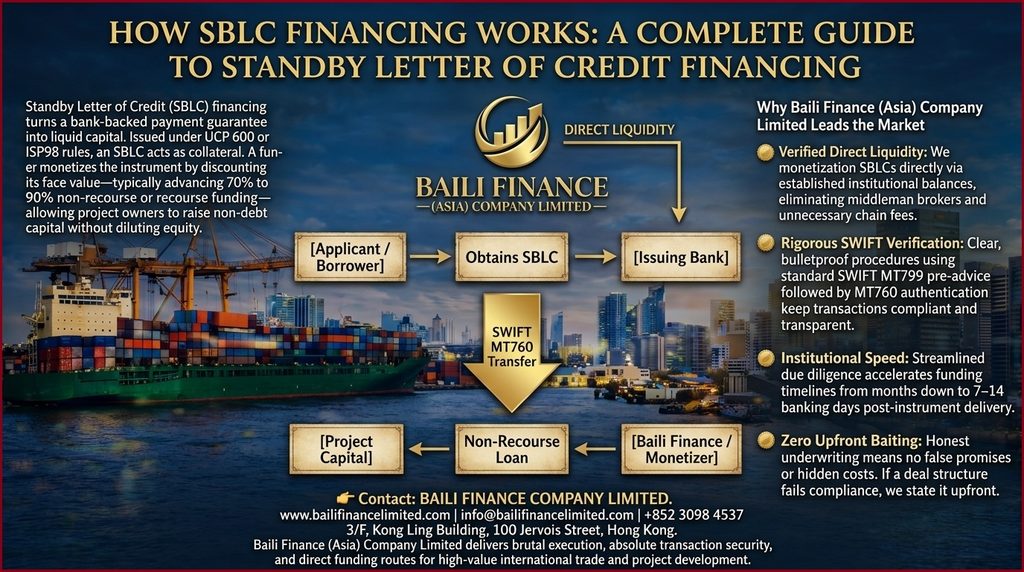
SBLC financing offers another financing structure in which a Standby Letter of Credit (SBLC) can support a financing transaction, subject to the terms of the instrument, the issuing bank’s credit quality, the financier’s requirements, and applicable law.
Understanding how SBLC financing works matters because an SBLC isn’t simply a cash deposit, an investment product, or an automatic source of funding. It’s a bank-issued undertaking that can provide assurance to a beneficiary if the applicant fails to meet a specified obligation. The International Chamber of Commerce (ICC) describes standby credits as instruments generally used to support payment or performance obligations.
For businesses researching SBLC financing, standby letter of credit monetization, SBLC-backed funding, trade finance, bank instruments, project finance, or working capital, the distinction between the instrument and the financing transaction remains essential.
This guide explains how SBLC financing works, who participates, how the transaction typically progresses, what financiers examine, the costs involved, the risks to consider, and how businesses can approach the process professionally.
Keywords: how SBLC financing works, standby letter of credit financing, SBLC monetization, SBLC-backed financing, standby letter of credit monetization, how to finance with an SBLC, SBLC funding, SBLC financing process, standby letter of credit funding, trade finance, bank instrument financing, project finance, working capital financing
What Is an SBLC?
A Standby Letter of Credit, commonly called an SBLC or standby credit, represents an undertaking from a bank to pay a beneficiary when the applicant fails to satisfy specified obligations and the beneficiary presents the documents required by the SBLC.
Unlike a conventional commercial letter of credit, which businesses commonly use as a payment mechanism in trade transactions, a standby letter of credit generally serves as a backup obligation. ICC materials distinguish commercial credits from standby credits on this basis: a standby typically supports payment or performance if the underlying transaction doesn’t proceed as expected.
An SBLC normally involves three principal parties:
- Applicant — the company or individual requesting the SBLC.
- Issuing bank — the bank that issues the SBLC.
- Beneficiary — the party receiving the bank’s undertaking.
A fourth party can enter the structure when financing becomes involved:
- Financier or funding institution — the party that evaluates the SBLC and may provide financing against an acceptable structure.
The financing doesn’t automatically arise merely because an SBLC exists. Instead, the financier assesses the SBLC, the issuing bank, the transaction, the applicant, the legal structure, and the proposed repayment source.
What Does an SBLC Actually Do?
An SBLC provides credit support.
For example, suppose Company A enters into a contract requiring Company A to pay Company B $10 million. Company B may request an SBLC from a bank to reduce its payment risk.
If Company A performs according to the contract, the beneficiary may never draw on the SBLC.
If Company A defaults and the SBLC’s conditions permit a compliant draw, Company B can present the required demand and documents to the relevant bank.
The bank then handles the presentation according to the SBLC’s terms and applicable rules.
That distinction matters when considering SBLC-backed financing. The SBLC provides bank-backed credit support; the financing agreement determines how a financier advances funds and how the borrower repays them.
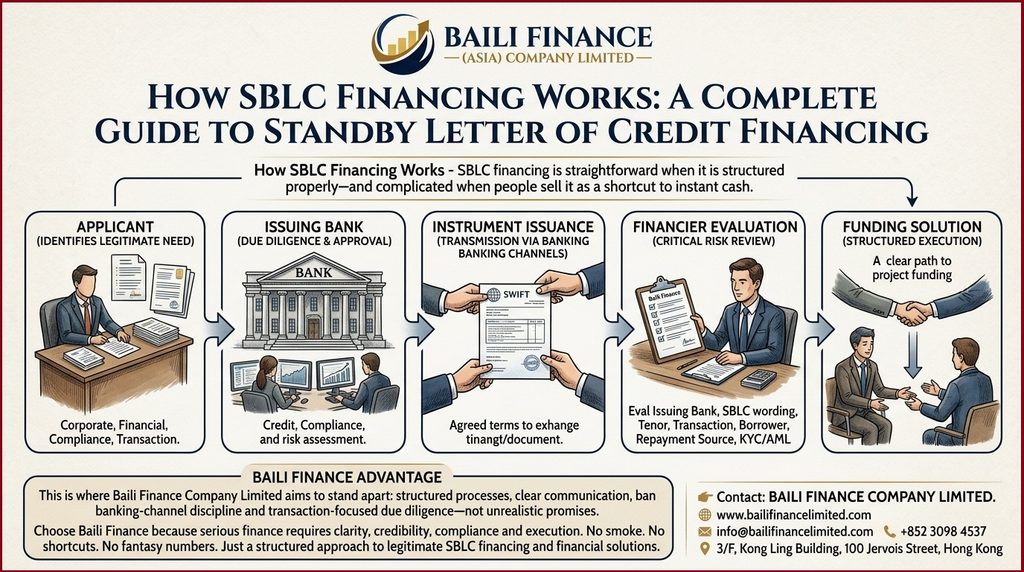
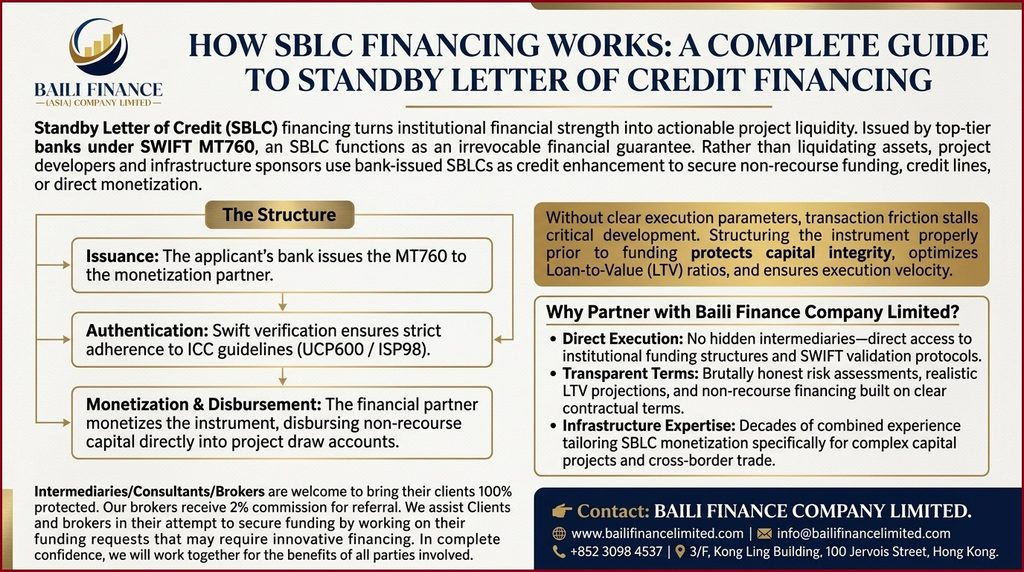
How SBLC Financing Works
The exact structure differs between transactions, but a legitimate SBLC financing arrangement generally follows a defined process.
1. The Applicant Identifies a Genuine Financing Requirement
The business first establishes why it needs financing.
The purpose might include:
- Working capital
- Import and export financing
- Contract financing
- Project development
- Equipment acquisition
- Construction
- Infrastructure
- Commodity transactions
- Expansion capital
- Performance-related obligations
- Short-term liquidity requirements
Starting with the underlying commercial purpose helps a financier determine whether the proposed transaction makes economic and legal sense.
A credible financier won’t rely solely on the face value of an SBLC. It will usually want to understand the complete transaction.
2. The Applicant Arranges the SBLC
The applicant approaches a bank capable of issuing the required instrument.
The issuing bank conducts its own assessment. Depending on the applicant and transaction, the bank can consider financial statements, credit history, collateral, cash flows, account activity, the underlying transaction, management information, and other risk factors.
The applicant also pays the applicable bank charges.
At this stage, businesses should avoid treating an SBLC as a document that an intermediary can simply manufacture. A genuine SBLC comes through a legitimate banking channel and must contain enforceable terms.
3. The SBLC Contains Specific Terms
The instrument normally identifies important information such as:
- Issuing bank
- Applicant
- Beneficiary
- Amount
- Currency
- Issue date
- Expiry date
- Applicable rules
- Conditions for presentation
- Documents required for a demand
- Governing provisions
- Place and method of presentation
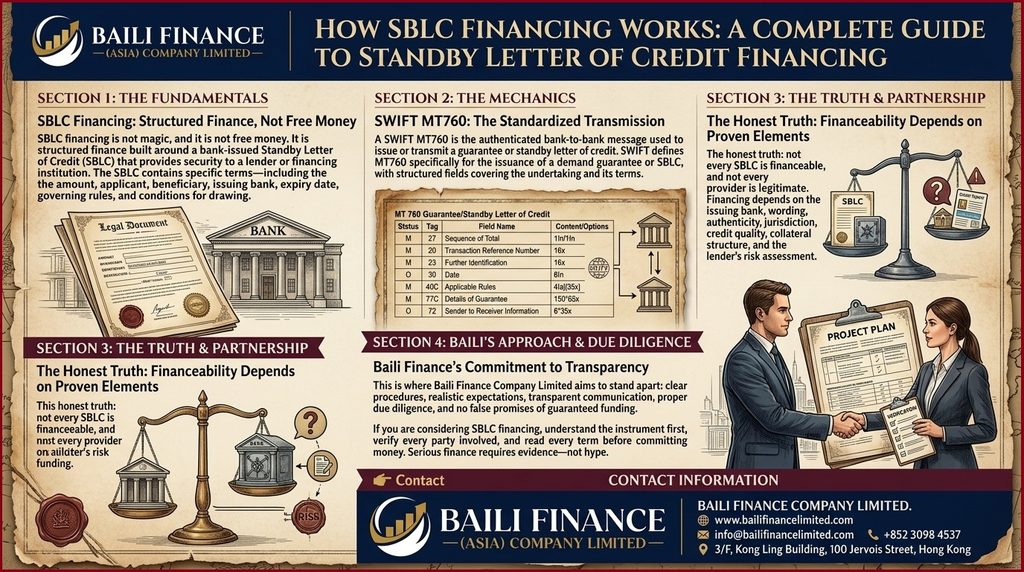
SWIFT’s documentation identifies MT 760 as the message used for issuing a demand guarantee or standby letter of credit. Its specifications include undertaking details such as the undertaking number, issue date, form of undertaking, applicable rules, and expiry information.
4. The Receiving Bank Advises or Verifies the Instrument
The beneficiary or financing party may receive the SBLC through an appropriate banking channel.
A receiving or advising bank can play an important role in authenticating and advising the instrument. SWIFT documentation also describes bank-to-bank and corporate processes involving guarantee and standby messages.
This stage deserves particular attention.
A PDF, scanned document, email attachment, screenshot, or alleged SWIFT copy doesn’t by itself establish that an SBLC represents a genuine bank undertaking.
Professional transaction parties verify the instrument through appropriate banking channels.
5. The Financier Conducts Due Diligence
Once the financier receives the relevant information, it assesses whether the SBLC qualifies for the proposed financing structure.
The financier may review:
- Issuing bank
- Bank jurisdiction
- Credit standing
- SBLC amount
- Currency
- Expiry
- Governing rules
- Beneficiary
- Applicant
- Transferability, where relevant
- Assignment provisions, where relevant
- Demand conditions
- Underlying transaction
- Legal enforceability
- Compliance requirements
- Source of funds
- Repayment strategy
- Financing term
The financier can also require independent legal review.
The most important question isn’t simply, “How much is the SBLC worth?”
The better question is:
“What enforceable rights does this specific SBLC provide, and how does the proposed financing structure legally and commercially use those rights?”
10 FACTS YOU NEED TO KNOW
- An SBLC Is a Bank Undertaking, Not Cash
A Standby Letter of Credit provides a bank-backed payment or performance undertaking. It doesn’t automatically mean the beneficiary or applicant has cash available. - SBLC Financing Requires a Separate Financing Agreement
Having an SBLC doesn’t automatically guarantee funding. A financier must independently assess the instrument, transaction, applicant, issuing bank, and repayment structure. - The Issuing Bank Matters
The financier will typically examine the issuing bank’s credibility, jurisdiction, banking status, and ability to honor the undertaking. - SWIFT MT760 Is Important in SBLC Transactions
MT760 is a SWIFT message type used to issue a demand guarantee or standby letter of credit. However, a reference to MT760 alone doesn’t prove that an instrument is genuine or financeable. - The SBLC’s Terms Determine Its Practical Value
Amount, expiry date, governing rules, presentation requirements, beneficiary, jurisdiction, and other provisions can materially affect whether a financier accepts the instrument. - SBLC Monetization Doesn’t Mean 100% Cash Conversion
An SBLC with a $10 million face value doesn’t automatically produce $10 million in financing. A financier determines the amount it may advance after due diligence and risk assessment. - Due Diligence Is Essential
Financiers can examine corporate documents, financial statements, transaction contracts, source of funds, issuing bank information, compliance requirements, and the underlying commercial purpose. - ISP98 and Other Banking Rules Matter
ISP98 provides internationally recognized rules specifically for standby letters of credit. Depending on the instrument, other rules such as UCP 600 or URDG 758 may also become relevant. - Costs and Financing Terms Vary
Applicants may encounter bank issuance fees, legal costs, due diligence expenses, arrangement fees, financing charges, and other transaction costs. There isn’t one universal SBLC financing rate. - Fraud Prevention Is Critical
Businesses should verify counterparties, banks, instruments, documentation, and financing terms through appropriate channels. Claims of guaranteed funding, instant monetization, or financing without due diligence warrant serious scrutiny.
What Is SBLC Monetization?
The term SBLC monetization commonly refers to a financing arrangement in which a qualifying SBLC supports an advance, credit facility, or other financing structure.
However, “monetization” doesn’t mean that a bank automatically converts the SBLC’s face value into cash.
That misconception creates significant problems in this market.
A $10 million SBLC doesn’t automatically generate $10 million in financing.
A financier might offer a percentage of the amount, subject to its credit assessment, transaction costs, legal structure, risk appetite, term, issuing bank, and other conditions.
For example, a hypothetical financing provider might agree to advance 60% of an acceptable SBLC’s face amount. A $10 million SBLC could therefore support a proposed $6 million facility, subject to all applicable conditions.
The percentage isn’t universal.
Likewise, a financier may reject an SBLC entirely if the issuing bank, terms, jurisdiction, beneficiary structure, documentation, or transaction doesn’t meet its requirements.
What Determines SBLC Financing Amounts?
Several factors influence the amount a financier may consider.
Issuing Bank Quality
The issuing bank represents one of the most important considerations.
A financier typically wants confidence that the issuing bank has the financial standing, regulatory status, operational capability, and reputation required for the transaction.
The stronger the issuing bank and the cleaner the structure, the easier it can be for a financier to assess the instrument.
SBLC Terms
The wording matters.
An SBLC with restrictive presentation conditions can produce a very different risk profile from one with straightforward, clearly defined demand requirements.
Applicable rules also matter. ICC identifies ISP98 as a dedicated set of international rules for standby letters of credit, while UCP 600 can apply to a standby when the credit expressly incorporates those rules.
Expiry Period
The financing period needs to align with the SBLC’s validity and the financier’s risk requirements.
An instrument approaching expiry may provide less useful support than one with sufficient remaining tenor.
Jurisdiction
The laws governing the instrument, the issuing bank, the applicant, the beneficiary, and the financing agreement can materially affect the transaction.
Cross-border structures therefore require careful legal and compliance analysis.
Financing Purpose
A legitimate commercial purpose can strengthen transaction clarity.
Financiers generally need to understand where the money goes, how the business will use it, and how the facility will be repaid.
The Role of ISP98, UCP 600 and URDG 758
Businesses researching how SBLC financing works should understand the rules governing the underlying instrument.
ISP98 specifically addresses standby letters of credit and reflects international practice concerning standby undertakings.
UCP 600 primarily governs documentary credits, although its rules can apply to standby letters of credit when the instrument expressly makes them applicable.
URDG 758 provides rules for demand guarantees and can become relevant when a transaction uses an independent demand guarantee rather than an SBLC.
The parties should therefore establish which rules govern the instrument before relying on it for financing.
A professional transaction doesn’t treat these rule sets as interchangeable.
SBLC Financing vs Traditional Business Loans
SBLC financing and conventional lending solve different problems.
| Factor | SBLC Financing | Traditional Business Loan |
|---|---|---|
| Primary support | Bank undertaking | Borrower’s credit and collateral |
| Main instrument | SBLC | Loan agreement |
| Bank involvement | Issuing bank and potentially advising bank | Lending bank |
| Financing decision | Depends on SBLC and transaction | Depends on borrower and collateral |
| Funding amount | Negotiated and risk-based | Based on lender’s credit assessment |
| Repayment | Defined under financing agreement | Defined under loan agreement |
| Due diligence | Instrument, bank, applicant and transaction | Borrower, cash flow, collateral and credit |
| Cross-border use | Common | Depends on lender and jurisdiction |
The two structures can also complement each other.
A business might use conventional debt for one requirement and bank-backed trade finance for another.
Real-World Example: SWIFT MT760
A useful real-world reference comes from SWIFT’s published standards.
SWIFT identifies MT 760 as the message used to issue a demand guarantee or standby letter of credit. Its published specifications describe the message structure and information required for the undertaking.
This illustrates an important point: an SBLC transaction involves formal banking infrastructure and defined messaging standards.
It isn’t equivalent to sending a letter on company letterhead.
In an actual transaction, the receiving bank and relevant financial institutions must process and verify the undertaking according to their procedures and applicable rules.
Illustrative Case Study: $10 Million SBLC Financing
Consider a hypothetical company called Alpha Infrastructure Ltd.
Alpha has secured a large infrastructure contract but needs $5 million in working capital to purchase equipment and mobilize contractors.
The company has limited conventional collateral but can arrange a $10 million SBLC from a bank acceptable to a potential financier.
Step 1: Structuring
Alpha provides the financier with information about the project, contract, corporate structure, financial position, repayment source, and proposed SBLC.
Step 2: Bank Review
The issuing bank completes its own customer and transaction assessment before issuing the SBLC.
Step 3: Instrument Issuance
The SBLC reaches the relevant banking channel under the agreed terms.
Step 4: Verification
The financier and its bank verify the instrument and assess its legal and commercial acceptability.
Step 5: Financing Offer
After completing due diligence, the financier agrees in principle to provide a $5 million facility, subject to definitive documentation and closing conditions.
Step 6: Documentation
The parties execute the financing agreement, security documents, legal opinions where required, and other transaction documents.
Step 7: Funding
The financier releases the agreed amount according to the financing agreement.
Step 8: Repayment
Alpha repays the facility according to the agreed schedule and financing terms.
The example demonstrates why SBLC financing isn’t simply “cash for an SBLC.”
The financing depends on the complete transaction.
If Alpha’s issuing bank isn’t acceptable, the SBLC contains unsuitable terms, the underlying project fails due diligence, or the repayment structure doesn’t work, the financier can decline the transaction.
How Much Does SBLC Financing Cost?
There isn’t one universal SBLC financing fee.
The total cost can include several components:
- Issuance fees
- Bank charges
- Advising fees
- Legal fees
- Due diligence costs
- Compliance costs
- Arrangement fees
- Financing charges
- Administrative expenses
- SWIFT-related banking charges
- Other transaction expenses
The financing cost should therefore come from a complete written term sheet rather than an informal percentage quoted without supporting details.
Businesses should also distinguish between SBLC issuance costs and SBLC financing costs.
They aren’t necessarily the same expense.
Common SBLC Financing Scams and Warning Signs
Because SBLC transactions can involve large face values, international banking relationships, and sophisticated terminology, businesses should apply strong due diligence.
Watch carefully for claims such as:
- “Guaranteed 100% funding”
- “No due diligence required”
- “Every SBLC qualifies”
- “We can monetize any bank instrument”
- “Send an upfront fee and we’ll release millions”
- “No bank verification is necessary”
- “The SWIFT copy is sufficient”
- “The bank doesn’t need to communicate directly”
- “We guarantee a fixed return”
These claims should trigger additional scrutiny.
A legitimate financing provider should be able to explain its process, eligibility requirements, documentation, fees, compliance procedures, and financing conditions clearly.
Never Confuse an SBLC With Free Cash
An SBLC represents a bank undertaking.
It doesn’t mean that the applicant has deposited the face amount in cash.
It also doesn’t mean that a financier must provide an equivalent amount.
This distinction remains one of the most important principles in standby letter of credit financing.
What Documents May a Financier Request?
Requirements vary, but a serious transaction can require:
- Certificate of incorporation
- Corporate profile
- Identification documents
- Ownership information
- Audited financial statements
- Management accounts
- Bank statements
- Business plan
- Project documentation
- Underlying contracts
- Invoices or purchase orders
- Source-of-funds information
- SBLC draft
- Issuing bank information
- Beneficiary information
- Financing proposal
- Legal documents
- Compliance documentation
Additional documents may apply depending on the jurisdiction, transaction size, industry, and financing structure.
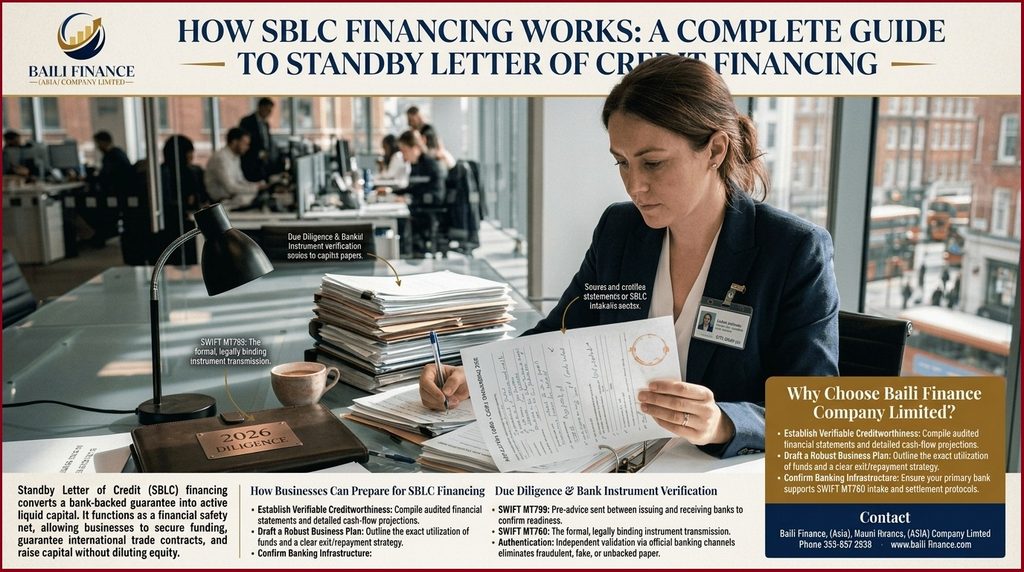
How Businesses Can Prepare for SBLC Financing
Preparation can significantly reduce unnecessary delays.
Start With the Transaction
Clearly define the business purpose.
A financier needs to understand the commercial rationale before assessing the proposed financing structure.
Confirm the Issuing Bank
Identify the bank before relying on an SBLC financing proposal.
Don’t assume that every issuing bank receives equal treatment.
Review the Draft SBLC
Have qualified legal and banking professionals review the wording before issuance.
Small drafting differences can affect how the instrument operates.
Understand the Financing Agreement
Review the facility amount, interest or financing charge, repayment schedule, security, default provisions, conditions precedent, and termination provisions.
Verify Every Counterparty
Check the identity, corporate registration, banking relationships, regulatory status, physical presence, and transaction history of relevant parties.
Avoid Pressure
Large financial transactions shouldn’t depend on rushed decisions.
If an intermediary insists that you transfer money immediately before providing verifiable documentation, stop and conduct additional due diligence.
Why the SBLC Wording Matters
An SBLC operates according to its terms.
The beneficiary can’t simply demand payment in any manner it chooses.
The presentation must satisfy the requirements established by the instrument and applicable rules.
ICC materials provide examples of disputes involving SBLC presentations, documentary requirements, expiry dates, and compliance with the credit’s terms.
That makes professional drafting essential.
A financier also needs to understand what rights the instrument actually creates before assigning value to it in a financing structure.
SBLC Financing for International Trade
International businesses can use standby structures to address several commercial requirements.
Potential applications include:
- Supplier payment support
- Contract obligations
- Performance obligations
- Advance payment security
- Lease obligations
- Construction contracts
- International procurement
- Commodity transactions
- Project finance support
- Working capital structures
The specific application depends on the underlying transaction and the SBLC’s wording.
For cross-border transactions, parties should also consider foreign-exchange exposure, sanctions compliance, anti-money-laundering requirements, local banking regulations, tax implications, and enforceability.
Frequently Asked Questions About SBLC Financing
1. What is SBLC financing?
SBLC financing refers to a financing structure in which an acceptable Standby Letter of Credit supports or facilitates a financing transaction. The financier assesses the SBLC, issuing bank, applicant, transaction, legal structure, and repayment source before deciding whether to provide funding.
2. Can an SBLC be converted directly into cash?
Not automatically.
An SBLC is a bank undertaking rather than a cash deposit. A financier may provide funding against an acceptable structure, but the amount and terms depend on its due diligence and risk assessment.
3. How much financing can I obtain against an SBLC?
There is no universal percentage.
The financing amount depends on factors including the SBLC’s face value, issuing bank, remaining tenor, jurisdiction, wording, transaction purpose, applicant profile, financier’s risk appetite, and repayment structure.
4. Is an SBLC the same as a bank guarantee?
They can perform similar credit-support functions, but they aren’t identical instruments in every legal or operational context. The governing rules, wording, jurisdiction, and applicable banking practice determine the precise characteristics.
5. What is SWIFT MT760?
MT760 is a SWIFT message type used for issuing a demand guarantee or standby letter of credit. SWIFT’s published standards define the structure and information associated with the message.
6. What is ISP98?
ISP98 stands for International Standby Practices 1998. It provides rules specifically designed for standby letters of credit and related independent undertakings.
7. Can every SBLC be monetized?
No.
A financier can reject an SBLC because of the issuing bank, jurisdiction, terms, compliance concerns, documentation, transaction structure, insufficient tenor, or other risk factors.
8. Does an SBLC guarantee financing?
No.
An SBLC can support a financing proposal, but it doesn’t obligate an unrelated financier to provide funding. Financing remains subject to the financier’s due diligence and contractual approval.
9. How long does SBLC financing take?
The timeframe varies significantly.
Bank issuance, compliance checks, legal review, instrument verification, financing approval, documentation, and closing can all affect the timeline. Complex international transactions generally require more review.
10. What should I verify before entering an SBLC financing transaction?
Verify the issuing bank, instrument, beneficiary, financing provider, transaction purpose, applicable rules, governing law, fees, financing terms, documentation, and legal enforceability.
Independent professional advice can also help identify structural and compliance risks before funds or fees change hands.
Final Summary: Understand the Structure Before You Fund
How SBLC financing works becomes much clearer once businesses separate the SBLC itself from the financing transaction.
An SBLC represents a bank-backed undertaking. It can provide payment or performance support and, when a financier accepts its structure, it may support a financing facility.
However, the SBLC’s face value doesn’t automatically equal available cash.
The issuing bank matters. The wording matters. The applicable rules matter. The jurisdiction matters. The underlying transaction matters. The financier’s risk assessment matters.
ICC’s established framework for standby letters of credit, including ISP98 and the treatment of standby credits under UCP 600 where expressly incorporated, demonstrates why the legal and documentary structure deserves careful attention.
For businesses considering SBLC-backed financing, standby letter of credit monetization, trade finance, project funding, or working capital solutions, the strongest approach starts with verification rather than assumptions.
Before proceeding, confirm what the instrument actually provides, who issued it, who will finance against it, what conditions apply, what the total costs are, and how the financing will be repaid.
If you’re considering an SBLC financing transaction, don’t rely on generic promises or headline funding percentages. Get the structure reviewed, understand the requirements, and assess the transaction before committing capital.
Ready to Explore an SBLC Financing Structure?
If your business has a genuine financing requirement and you’re considering an SBLC, standby letter of credit financing, trade finance, project funding, or working-capital structure, contact Baili Finance Limited to discuss your requirements.
Bring the key transaction details, proposed financing amount, intended use of funds, issuing bank information, and available documentation. A structured discussion can help determine whether the proposed transaction warrants further assessment.
Your next financing decision deserves more than a funding promise. It deserves a clear structure, proper due diligence, and commercially sound documentation.
Contact Baili Finance Limited today and start the conversation about your financing requirements.
Intermediaries/Consultants/Brokers are welcome to bring their clients 100% protected. Our brokers receive 2% commission for referral. We assist Clients and brokers in their attempt to secure funding by working on their funding requests that may require innovative financing. In complete confidence, we will work together for the benefits of all parties involved.
#SBLCFinancing #StandbyLetterOfCredit #TradeFinance #ProjectFinance #WorkingCapital #BusinessFinance #SBLC #TradeFinanceSolutions #CorporateFinance #InternationalFinance